Risk Mitigation Frameworks in Agile Process
Abubakar Hamid, Dr. Baber Hayat, Hanan Masood
Abstract— Agile Process in software development has become the most prevailing and significant trend in today’s advance technological era. Since agile software development lacks formal risk management techniques and consequently agile models claim to be risk-driven by nature. These risks can be reduced by numerous practices like continuous software integration and early verification. By acknowledging existing risk mitigation frameworks and their usage in agile software development, the benefits of different risk mitigation frameworks have been discussed. Agile solely implements bounded risk practices where few tendencies of risk mitigation are left behind. This research work focuses on the importance of risk mitigation frameworks and their implementation in agile approaches.
.
Index Terms— Cognitive Process, Commitments Management, Risk Mitigation, Vulnerabilities
—————————— ——————————
1.
Introduction
Agile strategies have the capability particularly in accommodating amendment because of volatile needs. However, the additional concomitant risks, managing the numerous dependent items of labor are distributed across an outsized project. This paper examines the change mitigation models of agile strategies to determine a number of risks and for project managers to require wise actions and
This paper examines the change mitigation models of
agile strategies to determine a number of risks and for project managers to require wise actions and selections. Several risk mitigation models are mentioned in this research work.
2. Importance of Risk Mitigation
Frameworks
Why Risk Mitigation Matters in Agile?
An understanding of a project's risk appetency, together with the kind of risks that a project presents, is central to such higher cognitive process [5]. Failure to spot acceptable risk response ways supported risk exposure will considerably have an effect on the agile method a scarcity of management over risk observance will cause the very fact that it cannot be assessed whether or not a risk exists or isn't adequately managed. A basic construct of agile development is that the effective exchange of high-quality data, know-how, ideas, suggestions, skills and specialist data. people Risk management in associate agile technique is one in all the foremost vital internal methodologies and strengthens the resilience already within the hindrance section and is for process success is crucial but, they additionally involve risks in managing the numerous dependent jobs that area unit touch an outsized project [6].
Lack in risk mitigation affects software package development processes and means the event flow for redaction the associated artifacts needs to be derived back to earlier development phases, that causes extra
A
gile strategy provides the opportunity to recognize and mitigate risk in its initial stage. The mitigation models aim at coordinating the activity for managing orientation of the risks. Agile software Development (ASD) has gained significance in which changes throughout the event life cycle are made. The challenge for managers is to work out whether agile technique is acceptable or not for a given set of project activities and mitigation techniques which are ought to be used. A basic construct in agile development is effective sharing of high-quality data, know-how, ideas, skills, suggestions, and associated experience among the people.The change management in an agile strategy belongs to the foremost vital internal processes and strengthens resilience throughout the hindrance amount and is inevitable for making success
————————————————
Abubakar Hamid is currently pursuing his Master Degree Program in Software Engineering at University of Lahore, Pakistan
6142
resources and prices, however may also cause delays within the schedule [6].
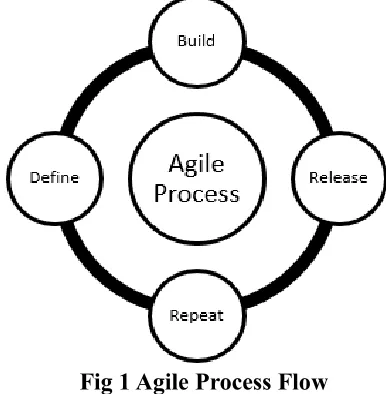
Agile is a repeatable process so it needs care while concerning with risks you have chances to remove risk while iterations as shown in Fig 1.
Fig 1 Agile Process Flow
3. Risk Mitigation Frameworks
1). Commitment Management
This Commitment management is associate approach that uses commitments between client and developers to outline an inventory of agreements as baseline for the project, with the goal of mitigating the chance of losing sight of the first project motivations [7]. The commitment management method has been characterized for Business motivation. The particular objectives of this method framework area unit to:
Manage and management the agreed-upon commitments throughout the entire project.
Improve risk management through risk visibility on the business expectation elements: practicality (scope), quality, budget, and time-to-market.
Offer a negotiation baseline for client and developers.
Outline and agree on the underlying motivations.
Consists of an abstract schema.
Fig 2.Commitments Management Model
2). Agile Security Framework (ASF)
The Agile Security Framework (ASF) is unvarying framework during which each section of the safety lifecycle is addressed, that isn't thought of later and maintains gracefulness by providing flexibility in implementing changes at any level [3]. ASF helps developers by providing bit-by-bit steerage in implementing security technologies which will bring them to attain a secure software package and mitigating the chance. This includes hybrid techniques (combining abusive stories and attack trees), security coaching exercises, security frameworks (classifying the safety needs thought of in several iterations. It takes into consideration all of the mentioned aspects. Phase one emphasizes security needs enclosed within the requirement analysis and coming up with. Identification of crucial assets. Explores user stories describing Ware's options and practical needs [8]. Threat modeling is completed in phase two. This is often a difficult activity and will be through with care and clarity. In section three secure code implementation is performed.
Fig 3 Agile Security Framework
Explained model expressly relates to contingency, primarily unsure contingency problems .It addresses external limitations on the ability of the project team. Work associated with IT conjointly typically considers the criticality of the project as an element in however it ought to be structured and managed [1]. Generally structure contingency terms these are often seen as internal instead of external factors. Factors relate to effects instead of the chance of the unexpected: to the results of self-uncertainty instead of to the results of uncertainty. The model has so combined them with 2 directly connected uncertainty factors to make the UC framework, the UC framework. Most management applications cited deem comparisons of multiple things (multiple enablers, a project on time, or Project versus model), and this needs a continuation scale for the axes. Sensible use case studies also are needed, and this can possible result in any development of the framework. Work is afoot on each of them. The model conjointly highlights a chance for any elaboration of project contingency theory. This model appear to be each higher outlined and a lot of wide practiced, a bonus of try programming is that such extreme individualism is unlikely it's a posh infrastructure: it needs right smart understanding and security sophistication inside the implementation team, and if there's an attempt to implement it ahead of the system, there's a high start-up price.
4).
Project
Risk
Management
Model supported scrummage Framework
and Prince2 Methodology
It’s a combined model with victimization prince2management options and scrummage iteration distribution options. It enhance the scrummage method in project management processes and agile comes with a risk management approach .It consists of the subsequent elements. First, within the project charter, the obligations of people relative to the project are often outlined. The project manager starts the project with an estimate of desires and prices. Product homeowners and project managers collaborate in analysis and transparency necessities. In the method of directional the project, selections area unit created to issue the project and licenses area unit issued comes are often initiated once coming up with project manager details and steps. After that, the project enters
the initiation part.
Progress. Product homeowners and project managers judge sprints and determine project risks victimization budding charts and weekly conferences within the planned model, risks area unit entered and updated within the initiation part, method management and boundary management phases within the final part, the report is given and these processes area unit dead iteratively and incrementally.
Fig 4. Hybrid Framwork Steps
5). User Story Quality
This framework needs a quick client description. In agile package practicality and frameworks like extreme programming or scrummage, user stories area unit usually used as the way to assemble necessities. A user story may be a variety of would like for a computer code that has become an important item and is sort of widespread in agile methodology not like ancient strategies, the stress on user story is traceability reflective CM and version management unvaried & progressive Development Analysis & style Documents Communication Agile package Development [6].
There are three representation in the framework .They are as follows
Card
Oral Communication
Confirmation Unit area
Card, oral communication and Confirmation area unit it's thought of consumer driven: the case study method and participants. The risk mitigation framework creates a form then validates the form through a knowledgeable man of science.
6144
of knowledge collected within the case study.
Fig 6. User Story Quality
6). Coordination Framework
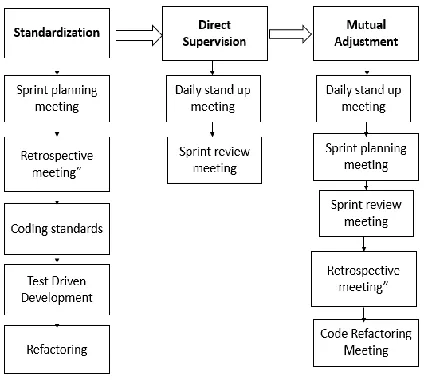
In planned model there are three basic coordination mechanisms that describe the elemental ways that within which organizations coordinate their work [8]. These are:
Mutual adjustment:
Mutual adjustment ensures that a package development project are able to do an appropriate degree of coordination by an easy method of informal communication between project stakeholders.
Direct supervising:
With direct supervision, coordination are often achieved through issue orders and directions by one person to many others whose actions area unit reticulated.
Standardization:
Standardization are often classified as coordination by the program. The model notes that there are four kinds of standardization they are as follows
work processes
output
skills
norms
Work method standards usually specify however members of the event team perform their reticulated tasks. Standardization of output sometimes specifies the expected results for varied development tasks. Standardization of skills ensures that the team encompasses a set of skills that area unit comfortable to hold out development tasks.
Fig 7. Coordination Framework
7). Risk Management Framework
The planned models deals with all aspects of agile development. Then rate known risks supported their severity and make action plans (responses) to affect high-priority risks within the final continuous watching and follow-up action to make sure that your action arrange is minimizing the risks [1]. Agile package development strategies area unit focused around maximizing the advantages of a product owner. Effective risk management involves distinguishing risks. And analysis of every risk to see its severity. It includes a risk board ad risk register for watching risk factors. Model includes an easy risk register with temporary data additionally to the current there's a risk exposure [2].
This risk register is reevaluated at each sprint meeting. Its values are adjusted supported current valuation of current and new risks. This consolidated risk can outline a brand new worth for risk.
Fig 7. Risk Management Model
3. Results
After reviewing the danger mitigation models the result shows that edges of selecting Agile methodology focuses totally on providing price, whereas maintaining safety for organizations to implement solutions firms select Agile as a result of in long comes, it will quickly answer changes in business [3]. Agile is predicated on the realities of the necessities of the organization, not inventive
By deep collaboration with customers, and readiness to alter (within cheap budget), Agile promotes a win-win philosophy.
Like the framework commitment management model has been evaluated through variety of case studies that allowed United States to receive feedback from the client aspect on 2 analysis levels the abstract level, wherever the framework has been assessed by IT professionals thought-about as specialists within the space as a result of their experience in project management; and therefore the project level, wherever the framework has been instantiated Associate in Nursing utilized in real comes throughout the total life cycle of variety of educational comes
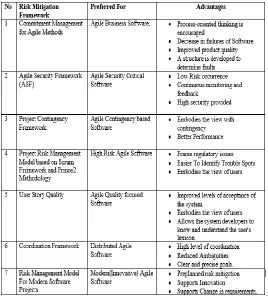
Table 1
Agile Risk Mitigation Framework
6146
helped to take care of project standards, and higher project coordination [3]. The practices ―Test driven development‖, ―Coding standards‖, and ―Refactoring‖ additionally helped to take care of project standards and redoubled project communication as these practices sometimes support communication through the code.
4. Conclusion
Agile software development needs formal risk mitigation frameworks. The risk mitigation plays a considerable role in agile software development. In this research paper various approaches have been discussed to reduce the risks in changing and iterative environment like agile. The reviewed models suggest that a particular risk mitigation framework can only be used for a specific type of agile software development. Shared decision-making of different stakeholders to assess risks is often difficult especially in giant agile software. In Future we aim to develop additional systematic approaches for assessing risks and risk mitigation frameworks in agile software development as mentioned in the study
References
[1].Alenljung, B., A. Person, Portraying the Practice of Decision-making in Requirements Engineering: a Case Study of large Scale Bespoke Development, Requirements Engineering Journal, 2008, 13, pp. 257-279.
[2].Augustine, S., Managing Agile Projects, PrenticeHall, 2005.
[3].Barney S., Aurum A., C. Wohlin, A Product Management Challenge: Creating Software Product Value through Requirements Selection, Journal of Software Architecture, 54 (2008), pp. 576-593. [4].Controlling prototype development through risk
analysis. MIS Quarterly, 20, 481–504. Batra, D. (2009)
[5].Interpersonal conflict and its management in information system development. MIS Quarterly, 25, 195–228. Barki,H., Rivard,S.&Talbot,J.(2001) [6].Visaggio, C.A. (2005) Pair designing as practice
for enforcing and diffusing design knowledge. Journal of Software Maintenance and Evolution: Research and Practice, 17, 401–423
[7].Racheva, Zornitza- Daneva, Maya- Herrmann, Andrea- 2010/01/01- A conceptual model of