INTRODUCTION
Contamination of water with lead heavy metal ions is a large environmental concern associated with the increasing of industrial processes which discharge aqueous effluents containing lead ions. Lead ions are not biodegradable and tend to accumulate in living organisms, causing various health problems. According to the World Health Organisation, the accepted range of Pb+2 in water is 0.01 ppm. There are many conventional processes for the removal of lead and the different heavy metals from industrial
www.orientjchem.org
CODEN: OJCHEG 2011, Vol. 27, No. (4): Pg. 1397-1401 Est. 1984
An International Open Free Access, Peer Reviewed Research Journal
Effect of Temperature and pH in Adsorption
of Pb
+2Ions by Porous Perlite Clay
SABA AMINIFARD¹, HAMIDREZA JAMALZADEH²,
ESMAEIL BIAZAR³* and MAHDI FOULADI¹
¹Young Researchers Club, Tonekabon Branch, Islamic Azad University, Tonekabon (Iran). ²Department of Biology, Tonekabon Branch, Islamic Azad University, Tonekabon (Iran). ³Department of Chemistry, Tonekabon Branch, Islamic Azad University, Tonekabon (Iran).
*Corresponding author: E-mail: [email protected] (Received: August 03, 2011; Accepted: September 17, 2011)
ABSTRACT
The adsorption potential of the Perlin clay for the removal of lead ions from aqueous solutions was tested. The adsorption amount measured at the different temperature (25°C, 45°C and 65°C) and Ph (2, 3 and 5). A high adsorption capacity aws calculated. An increase in the retention capacity with increasing temperature was measured. The influence of pH in the acidic range was investigated. The measured increase in the adsorption rate at higher pH values (5) was explained through the influence of H+ ions on the complex ion formation.
Key words: Adsorption, Perlite Clay, Lead, Temperature, pH.
MATERIAL AND METHODS
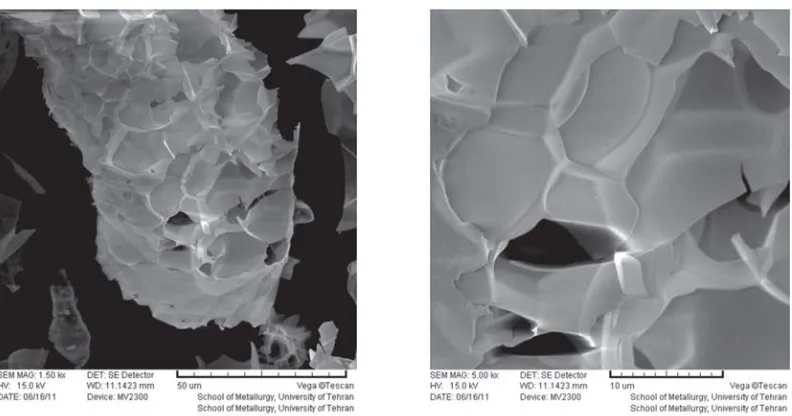
All the experiments were prepared by dissolving analytical grade PbCl2 to distilled water. The stock solution was diluted to a specific concentrations and stored at 25°C in a dark place. The initial pH of the solution was adjusted using a 1.0 M HCl solution. Clay samples obtained from Eshlagh-chai (Tabriz-Iran) were used as adsorbent mater ial. Hence, a high grade Per lite was implemented for the adsorption experiments. The morphological properties of the clay are displayed in figures 1 and 2, respectively.
Before the experiments, the clay samples were washed with deionised water several times with a constant stirring, to remove the soluble inorganic salts and any adhering materials. The samples were then left to settle, separated from liquid by filtration and then dried at 80°C for 24 hours. The samples were afterwards subjected to sieve analysis. The average size of Perlite obtained by Particle size analyzer (PSA). Morphology structure of perlite clay investigated by SEM images (Cambridge Stereo scan, model S-360).
The adsorption amounts were determined by allowing a lead ions solution of known initial concentration to be mixed with accurately weighed amount of perlite in a tightly closed flask at a certain temperature. The amount of perlite in the slurry was 1g/250 mL solution. A constant mixing at a constant temperature was achieved using a water bath shaker. The Perlite solution were then equilibrated for 50 hours. The clay suspensions were then filtered and the supernatant solution was subjected to analysis using Atomic Absorption Spectrophotometer (AAS). The amount of lead ions retained by Perlite were calculated from the difference between the initial concentration and the equilibrium concentration. The same experiment was repeated at different initial concentrations and different temperatures.
RESULTS AND DISCUSSION
The elemental analyze of perlite presented in table 1. The particle size analyzer (PSA) results presented in figure 1 indicate a average size 25 µm (figure 1) also figure 2 shows morphology structure of perlite by SEM analyse. The SEM images show porous structure of perlite so can adsorb different cations.
Effect of temperature on lead adsorption Figure 3 shows adsorption amount of Pb+2 metal ions by Perlite par ticles in the different temperature (25°C, 45°C and 65°C). The results show high retention capacity for the Pb+2 metal ions by Perlite particles in high temperature. The retention capacity of Perlite increases with increasing the temperature over the temperature range studied. Effect of pH on lead adsorption
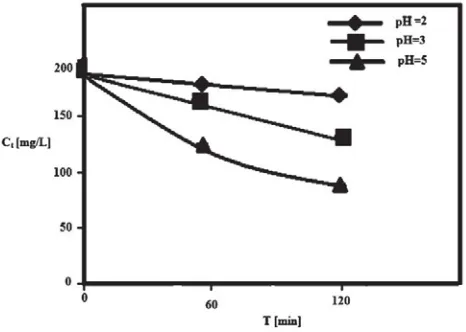
The experimental measurements for the change in lead ions concentration as a function of time at different initial pH values are depicted in figure 4. The adsor ption experiments were conducted at 25°C and initial lead ions concentration of 200 mg/L. The adsorbent amount used is 1g/250 mL solution. As shown in figure 4 increasing the pH value of the solution from 2 to 5 leads to an acceleration in the adsorption rate especially in the earlier stages. This dependenc of adsorption rate on pH was reported in the literature10. The influence of pH on the adsorption process of lead ions on Perlite can be explained through the influence of H+ ions on the complex ion formation process. The formation of complexes during the adsorption process is occurred by the interaction between the lead ions and the Perlite negative charged sites (SiO-) as well as the lattice hydroxyl groups (Si-OH) according to the equations6.
2
2
2
SiO
−+
Pb
+→
(
Si O
−
)
−
Pb
...(1)2 2
2
2
Si OH
−
+
Pb
+⇔
(
Si O
−
)
−
Pb
+2
H
+...(2)Table 1: The elemental analyze of perlite
Sio2 Al2O3 K2O Na2O CaO Fe2O3 MnO MgO P2O5 L.O.I.
Fig. 1: The average size of Perlite used in all experiments
Fig. 2: The SEM images of Perlite used in all experiments with to different magnification (1500 × (a); 5000 ×(b))
Decreasing the pH value resluts in increasing the amount of H+ ions in the solution. H+ ions can complete with Pb+2 ions and bond to the SiO- site of Perlite according the equation 1. As a result the number of free SiO- free sites availabe for Pb+2 ions to form a stable complexes will decrease, therefore the adsorption rate will consequently decrease. Moreover, increasing the amount of H+ ions due to decreasing in the pH value will lead to shifting of the equilibrium described by equation 2 to the lift side leading to a decrease of the adsorption rate of lead ions. Because protons H+ ions can adsorb into and desorb from surface charge sites, the pH value of the solution contacting the surface of the clay affects its net surface charge, and thus its ion exchange capacity. Accordingly, the shown in figure 4 increasing adsorption rate at pH values greather than 3 can be attributed to the possible formation of negative charges on the clay surface, hence increasing of the ion exchange capacity of the clay.
CONCLUSION
Natural beneficiated clay Perlite collected from Eshlagh-chai (Tabriz-Iran) was investigated as a low cost and potential adsorbents for the removal of toxic lead ions from wastewater and industrial solutions.
Results obtained indicates that a very fast and efficient removal of lead ions can be achieved using Perlite as adsorbent.
In this study, experiments were conducted with low Perlite to solution ration (1 g/250 Ml solution) aiming to understand the effect of pH and temperature. However, complete removal can be achieved by increasing the Perlite to solution ratio. A faster removal of lead ions can be achieved by inreasing the temperature up to 65°C and increasing the pH in the acidic medium to 5.
REFERENCES
1. Nilson, R., Removal of Metals by Chemical Treatment of Municipal Wastewater, J. Water. Res., 5: 51-60 (1971).
2. Ishizaki, C. and Marti, I., Surface Oxide Structure on Commercial Activated Carbon
Carbon 19(6): 409 (1983).
Technology, 25(13-15): 1555-1569 (1990). 4. Yavus, O, Altunkaynak, T. and Guzel, F.,
Removal of copper, nickel and manganese from aqueous solution by kaolinite, Water Research 37: 948-952 (2003).
5. Crank, J., The Mathematics of Diffusion, Claredon Press, Oxford, 80 (1993). 6. Poots, V.J.P., McKay, G. and Healy, J.J., The
removal of Acid Dye from Effluent Using Natural Adsorbents - I, Water Research, 10: 1061-1066 (1976).
7. Carberr y, J.B., Twardoisski, C.J., and Eberhardt, D.K., Clay Adsorption Treatment of Non Ionic Surfactants in astewater, J. Water
Pollut. 49: 452-459 (1977).
8. Chang, C. and Ku. Y., Adsorption Kinetics of Cadmium Chelates on Activated Carbon, J. Hazardous Materials, 38: 439-451 (1994). 9. Sheta A.S. and et al., Sorption characteristics
of zinc and iron by natural zeolite and bentonite, Microporous and Mesoporous Materials, 61: 127-136 (2003).