92 IJSTR©2017
www.ijstr.org
Energy- Efficient Routing Protocols For Wireless
Sensor Network : A Review
Pardeep Kaur, Sandeep Kad
Abstract: There has been plenty of interest in building and deploying sensor networks. Wireless sensor network is a collection of a large number of small nodes which acts as routers also. These nodes carry very limited power source which is non-rechargeable and non-replaceable which makes energy consumption an significant issue. Energy conservation is a very important issue for prolonging the lifetime of the network. As the sensor nodes act like routers as well, the determination of routing technique plays a key role in controlling the consumption of energy. This paper describes the framework of wireless sensor network and the analysis and study of various research work related to Energy Efficient Routing in Wireless Sensor Networks.
Index Terms: Energy Efficient Routing, Wireless Sensor Network, PDORP, DSR, PEGASIS, LEACH, TEEN, APTEEN
————————————————————
1
I
NTRODUCTIONWireless sensor network gained popularity in recent years due to the advancement in wireless communication technology and a rapidly developing zone for research. WSN refers to a system of sensor hubs associated through a wireless medium [1][2]. Every hub comprises of Handling capacity ( at least one CPU, DSP chips Microcontroller) may contain different sorts of memory (program, information and flash memories), have a power source (e.g., batteries and sun-powered cells), and contain different sensors and actuators [3]. Energy conservation is a big issue in WSN as sensor hubs carry limited non-rechargeable power source and it is not easy to replace the nodes which makes power saving important to increase the lifetime of nodes. Energy efficient routing protocols are required to minimize the utilization of the power resources and prolonging the network lifetime path while transferring data [4].
1.1 Wireless Sensor Network
WSN is a network of small, self-sufficient gadgets called sensors which gather distinctive sorts of Physical or Environmental Conditions e.g temperature, sound, vibration, weight, movement at various areas and process information and transmit the detected data to clients [5]. These sensors are utilized to gather the data from the environment and transfer it to the base station. A base station gives an association with the physical world where the gathered information is handled, broke down and exhibited to helpful applications [2] [6]. WSNs contain a large number of these sensor hubs, and these sensors can transmit data either among each other or straightforwardly to an outside base station . A large number of sensors can be deployed in various applications to detect various events like pressure, movement of object, fire etc. [7]. The basic design of sensor node is as shown in Figure 1.1.
Handling unit
Fig.1.1. Framework of sensor hub[1]
The sensor hub is a self-ruling little gadget that comprises of chiefly four units that are sensing (detecting), Processing (handling), communication and power supply [1].
Sensing unit: are normally made out of two subparts: Sensors and analog to digital converter(ADC). Sensor sense data in form of analog signals and these signals then converted to digital signals by ADC and then forwarded to handling unit.
Handling unit: It is associated with a small memory and deals with the strategies that make the sensor hub work together with alternate hubs to complete the allocated detecting undertakings.
Communication unit: It associates the hubs to the network.
Power source is the most vital segments of a sensor hub.
It might be upheld by sun-powered cells. There are additionally different subunits, which are application subordinate. The majority of routing procedures and detecting undertakings require the information of area with high exactness. In this way, it is normal that a sensor hub has a location discovering framework.[3]
2
R
OUTING INWSN
Routing strategies are required for transferring data between the sensor nodes and the base station [1] [2]. Routing in WSN is different than traditional IP network routing because it exhibits a number of unique characteristics such as it is unrealistic to build a global addressing scheme for a large number of sensor nodes, secondly as opposed to regular correspondence systems all utilization of sensor systems require the stream of detected information from numerous sources to a specific BS [8]. Different routing techniques are
Power Supply
Detecting unit
Memory
Processor
Communication unit
Location discovering
framework Mobilizer
__________________________________
Pardeep Kaur is currently pursuing Master of
Technology in Computer science engineering , Department of Computer Science & Engineering , Amritsar college of Engineering and Technology, Amritsar, India, PH-9872065034.
E-mail: [email protected]
Sandeep Kad is Associate professor ,Department of
Computer Science & Engineering , Amritsar college of Engineering and Technology, Amritsar , India .
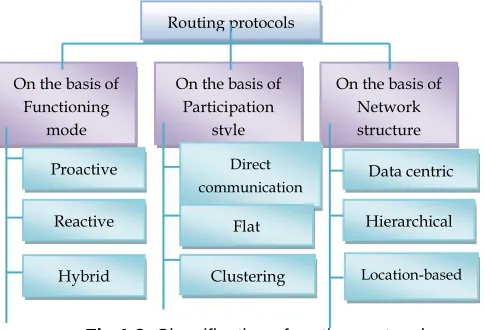
proposed for remote sensor network and these conventions can be classified as per different parameters. The classification of routing methods is shown in figure 1.2[1].
Fig 1.2. Classification of routing protocols
Functioning mode based routing protocols
The function of a wireless sensor network specifies its application. Therefore, routing protocols can be categorized according to the operation used to satisfy a WSN function as follows:
Proactive Protocols: These protocols are also called as table-driven protocols. In Proactive, the data is transmitted to a BS through the predefined route. For example LEACH, PEGASIS.
Reactive Protocol: In Reactive Protocol the route is established on demand. The route is established dynamically i.e.Network -based route is found when needed. TEEN, AODV, DSR are some reactive protocols. Hybrid protocols: All the routes are found initially and then
improved at the time of sending data. These protocols possess the concepts of both reactive and proactive. For example APTEEN.
Participation style based routing protocols
Some WSNs consist of homogeneous nodes, whereas some consist of heterogeneous nodes and these nodes participate differently in every network i.e. according to remaining energy of nodes, cluster head etc. Based on this concept we can classify the protocols as:
Direct Communication protocols: In this type of protocols the information sensed by nodes is sent directly to Base Station(BS). SPIN is this type of protocol.ˆ
Flat protocols: In this, the nodes search for the valid path and then transmit it to BS. For example Rumor Routing protocol.
Clustering Protocols: In this, the area is divided into clusters and Cluster heads are assigned to each cluster. All the nodes in the cluster send data to corresponding cluster heads and then cluster head sends it to Base station. For example TEEN
Network-based routing protocols
Network-based routing protocols depend on the strategy how the network is prearranged. Such protocols fall under three categories:
Data Centric protocols: These are query based and they depend on the naming of the desired data. The BS sends
queries within a certain region to get information and waits for a reply from the nodes. Nodes in a particular region collect the specific data based upon the queries. SPIN is a data-centric protocol.
Hierarchical protocols: In this, the nodes with lower energy are used to capture information and nodes with higher energies are used to process and transfer it that is why it is used to perform energy efficient routing. TEEN, APTEEN are hierarchical protocols.
Location Based: In these, the location of nodes must be known to find an optimal path using flooding. To get the information about location of0 node GPS is used. For example GEAR.
2.1 Energy efficient routing protocols in WSN
Energy efficiency of a network is a significant concern in wireless sensor network (WSN). These days networks are becoming large, so information gathered is becoming even larger, which all consume a great amount of energy resulting in an early death of a node. Therefore, many energy efficient protocols are developed to lessen the power used in data sampling and collection to extend the lifetime of a network. Following are some energy efficient routing protocols:
1. LEACH “Low-Energy Adaptive Clustering Hierarchy” In this type of hierarchical protocol, most of the nodes communicate to cluster heads (C.H) [1] [8]. It consists of two phases:
(i). The Setup Phase: in this phase, the clusters are ordered and then Cluster Head(CH) has been selected. The task of CH is to cumulate, wrapping, and forward the information to the base station (Sink) [2].
(ii). The Study State Phase: in the previous state, the nodes and the CH have been organized, but in the second state of “LEACH”, the data is communicated to the base station (Sink). Duration of this phase is longer than the previous state. To minimize the overhead, the duration of this phase has been increased. Each node in the network, contact with the cluster head, and transfer the data to it and after that CH will develop the schedule to transfer the data of each node to base station [8] [2].
2. PEGASIS “Power-Efficient Gathering in Sensor Information Systems”
It is a “chain-bases protocol” and an upgrading of the “LEACH”. In “PEGASIS” every node transfers only with a close neighbor to direct and obtain information. It receipts turns communicating to the BS, thus decreasing the quantity of energy consumed per round [9]. The nodes are in this way that a chain should be developed, which can be completed by the sensor nodes along with using an algorithm. On the other hand, the BS can compute this chain and transmission of it to all the sensor nodes. [10]To develop the chain, it is expected that all nodes have universal information of the system and that a greedy algorithm is engaged. Thus, the structure of the chain will begin from the remote node to the nearer node. If a node expires, the chain is rebuilt in the similar method to avoid the lifeless node [11].
3. TEEN “Threshold sensitive Energy Efficient sensor Network protocol” The TEEN is a hierarchical protocol designed for the conditions like sudden changes in the sensed attributes such as temperature. For a reactive network, the first developed Routing protocols
On the basis of Functioning
mode
On the basis of Participation
style
On the basis of Network structure
Proactive Direct
communication Data centric
Reactive Flat Hierarchical
protocol was TEEN [12]. The reduction of the number of transmissions is the purpose of a hard threshold, which is done by allowing the nodes to transmit only when the sensed attribute is in the range of interest. The number of transmissions is reduced by soft threshold by avoiding all the transmissions which might occur when the sensed attribute is changed slightly or not changed. TEEN is well applicable for time important problems and is likewise quite efficient in terms of saving energy and response time. It also allows the user to manage the power utilization and accurateness to suit the application [13].
4.APTEEN “Adaptive Threshold sensitive Energy Efficient Sensor Network"
The “APTEEN” is an expansion of “TEEN” and goals at both taking episodic data gatherings and replying to time-critical events. As soon as the BS formulates the clusters, the C.H transmits the features, the values of threshold and schedule of transmission to all nodes.[12] After that, the C.H performs information accumulation, which has as a consequence to preserve power. The main advantage of “APTEEN” in contrast to “TEEN”, is that nodes utilize a smaller amount power. on the other hand, the primary disadvantages of APTEEN are the complication and that it results in lengthier deferment times [14].
5. Directed Diffusion
Directed diffusion is data-centric routing protocol for collecting and publishing the information in WSNs [15]. It has been developed to address the requirement of data flowing from the sink toward the sensors, i.e. when the sink requests particular information from these sensors. Its main objective is extending the network lifetime by realizing essential energy saving. In order to fulfill this objective, it has to keep the interactions among the nodes within a limited environment by message exchange. A localized interaction that provides multipath delivery is a unique feature of this protocol. This unique feature with the ability of the nodes to respond to the queries of the sink results in considerable energy savings [1] [15].
6. Energy-Efficient Sensor Routing (EESR)
EESR is a flat routing algorithm [16] proposed particularly to decrease the power utilization and data latency, and to give scalability in the WSN. Mainly, it consists of Gateway, Base Station, Manager Nodes, and Sensor Nodes [17] [18]. Their duties are: Gateway Delivers messages from Manager Nodes or forms other networks to the Base Station, which has extra specification than normal sensor nodes. It sends and receives messages to/from Gateway. Moreover, it sends queries and collects data to/from sensor nodes. Manager Nodes and Sensor Nodes collect data from the environment and send it to each other in 1-Hop distance till the Base Station [16].
3 L
ITERATURE REVIEWAhmad, A., Latif, K. Javaid N. Khan et. al. (2013) [20] investigated on clustering procedure which is most well recognized directing strategy in WSNs. Because of differing need of WSN application productive vitality use in directing conventions is very still a potential field of research. Authors presented new energy efficient directing technique in this research. This strategy is utilized to defeat the fundamental trouble of energy hole and coverage hole. In their strategy, they have controlled these issues by presenting density
overhead of the LEACH protocol. In PEGASIS, the nodes form a chain, and each node stores in its routing table the addresses of an upstream and a downstream node. The data collection process is initiated at the far end of the chain. Each intermediate node aggregates the received data with its local data before transmitting the result to its upstream neighbor. The last node in the chain is responsible for transmitting to the sink node. Liu Wenjun and Yu Jiguo et. al. (2009) [6] proposed that rather than allowing the nodes to transmit directly to the base station, a novel scheme of clustering was proposed. Clustering provides resource utilization and minimizes energy consumption in WSNs by reducing the number of sensor nodes that involve in the long-distance communication. They used an energy-efficient clustering and routing scheme for wireless sensor networks (EECR) which includes distributed nodes clustering, dynamic cluster head rotation, and inter-cluster routing selection. In clustering stage they used uneven clustering mechanism in which cluster heads (CHs) which are closer to the base station (BS) have smaller cluster size than those farther from BS, thus they can conserve some power for inter-cluster data forwarding. For the
dynamic cluster head rotation mechanism, the sensor hubs perform cluster head function in turn which balances power consumption well among CHs. Gherbi Chirihane & Aliouat Zibouda et al. (2015) [25] proposed a distributed energy efficient adaptive clustering protocol with Data Gathering for WSN reduces the energy consumption and network lifetime is extended. The clustering techniques are used efficiently with distributed cluster heads. The node’s ratio is turned off for fixed time period and sleep control laws are designed to reduce the cost function. The scenario displays random deployment of nodes and the total simulation time is decomposed using resource reservation. The technique distributed energy efficient adaptive clustering protocol with Data Gathering (DEACP) reduced the overall network energy consumption, balance the energy consumption among the sensors and extend the lifetime of the network by making the clustering efficient in complexity of message and time, well-distributing the cluster-heads across the network, the load balancing done well and as a result transmission power of the node is reduce which subsequently reduces the energy consumption .
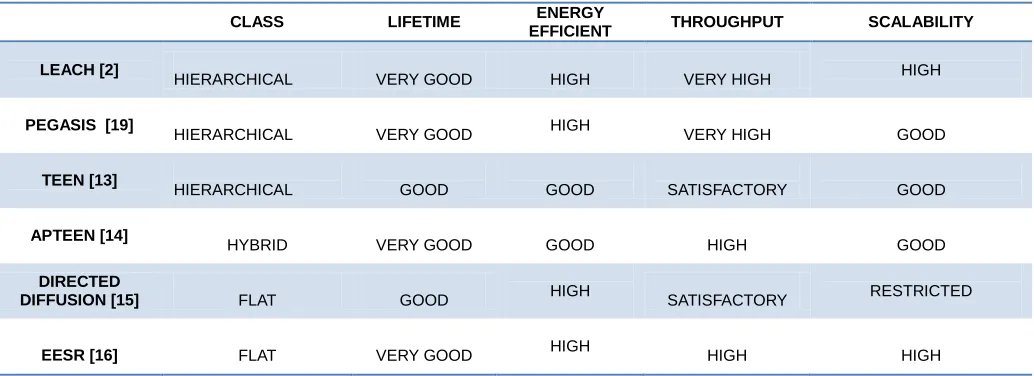
TABLE I. Comparison of various routing protocols
CLASS LIFETIME ENERGY
EFFICIENT THROUGHPUT SCALABILITY
LEACH [2]
HIERARCHICAL VERY GOOD HIGH VERY HIGH HIGH
PEGASIS [19]
HIERARCHICAL VERY GOOD HIGH VERY HIGH GOOD
TEEN [13]
HIERARCHICAL GOOD GOOD SATISFACTORY GOOD
APTEEN [14]
HYBRID VERY GOOD GOOD HIGH GOOD
DIRECTED
DIFFUSION [15] FLAT GOOD HIGH SATISFACTORY RESTRICTED
EESR [16] FLAT VERY GOOD HIGH HIGH HIGH
4
C
ONCLUSION AND FUTURE SCOPEIn addition to many applications of wireless sensor networks, it is necessary to transmit information appropriately with regard to power utilization and network lifespan as well as limited resources of such networks. The most significant difficulty in such networks is routing and transferring data to the destination node in compliance with the energy problem. Therefore, energy-efficient routing protocols have significant and effective roles in wireless sensor networks. They are divided into three major groups based on data, network structure and reliability. In this study, energy-efficient routing protocols were investigated in wireless sensor networks. Then the essential classifications were introduced and related parameters of corresponding protocols were compared to each other. Despite the fact that these protocols are performing well in terms of energy conservation but issues like quality of service (QoS) would be expected to address to ensure utilization of most energy proficient way for data transfer and in addition ensuring guaranteed data transfer rate or delay. Another interesting issue in routing is that the majority of the present routing conventions accept that the
sensor hubs and the sink is stationary. In circumstances, for example, on the battlefield where the sink and maybe the sensors should be versatile. In such cases, new routing techniques are required keeping in mind the end goal to deal with the overhead of portability and topology changes in such power constrained circumstances. Integrating WSN with wired networks(i.e. Internet) is other possible future research for routing protocols .
R
EFERENCES[1] Kazem Sohraby, Daniel Minoli and Taieb Znati, “Wireless Sensor Networks”, ELSEVIER Inc., 2007.
[2] N. A. Pantazis, S. A. Nikolidakis, and D. D. Vergados, “Energy-efficient routing protocols in wireless sensor networks: A survey,” IEEE Commun. Surv. Tut., vol. 15, no. 2, pp. 551-591, 2013.
[4] Pallavi S. Katkar and Prof. (Dr.) Vijay R. Ghorpade, “A Survey on Energy Efficient Routing Protocol forWireless Sensor Networks”, (IJCSIT) International Journal of Computer Science and Information Technologies, Vol. 6, 2015.
[5] Jayashri Deb Sinha and Subhabrata Barman, "Energy Efficient Routing Mechanism in Wireless Sensor Network", IEEE conference on Recent Advances in Information Technology,2012.
[6] Liu W. and Yu J., “Energy Efficient Clustering and Routing Scheme for Wireless Sensor Networks”, IEEE International Conference on Intelligent Computing and Intelligent Systems, pp: 612-616, 2009.
[7] Jamal N. Al-Karaki and Ahmed E. Kamal, "Routing techniques in Wireless sensor networks: a survey", IEEE Wireless Communications, pp:6-28, 2004.
[8] J. N. Al-Karaki, and A. E. Kamal, “Routing techniques in wireless sensor networks: A Survey,” IEEE Wirel. Commun., vol. 11, no. 6, pp. 6-28, 2004.
[9] S. Lindsey and K. M. Sivalingam. “Data Gathering Algorithms in Sensor Networks Using Energy Metrics.” IEEE Transactions on Parallel and Distributed Systems, 13(9): 924-934, 2002.
[10]Holger Karl and Andreas Willig “Protocols and Architectures for Wireless Sensor Networks.”,2005 John Wiley & Sons, Ltd. ISBN: 0-470-09510-5
[11]Jayashri Deb Sinha and Subhabrata Barman, "Energy Efficient Routing Mechanism in Wireless Sensor Network", IEEE conference on Recent Advances in Information Technology,2012.
[12]Roseline, R.A., Sumathi, P, Local clustering and threshold sensitive routing algorithm for Wireless Sensor Networks, Devices, Circuits and Systems (ICDCS), 2012 International Conference, IEEE, 2012.
[13]A. Manjeshwar and D. Agrawal,” TEEN: A routing protocol for Enhanced Efficiency in Wireless Sensor Networks,” In Proceedings of 15th International Parallel and Distributed Processing Symposium (IPDPS’01) Workshops, USA, California, 2001, pp. 2009-2015.
[14]A. Manjeshwar, D. Agrawal,” APTEEN: A Hybrid Protocol for Efficiency Routing and Comprehensive Information Retrieval in Wireless Sensor Networks,” In Proceedings of International Parallel and Distributed Processing Symposium, Florida, 2002, pp.195-202.
[15]K.Sohraby, D.Minoli, T.Znati "WIRELESS SENSOR NETWORKS, Technology, Protocols, and Applications" Published by John Wiley & Sons, Inc., Hoboken, New Jersey. 2007.
[16]H. Oh and K. Chae, “An Energy-Efficient Sensor Routing with low latency, scalability in Wireless Sensor Networks",
IEEE 2007 International Conference on Multimedia and Ubiquitous Engineering, pp 147-152, May 2007.
[17]H. Oh, H. Bahn and K. Chae, "An Energy-Efficient Sensor Routing Scheme for Home Automation Networks," IEEE Transactions on Consumer Electronics, Vol.51, No.3, pp.836-839, Aug.2005.
[18]A. Norouzi, M. Dabbaghian, A. Hatamizadeh and B. Berk Ustundag, "An Improved EL Gossiping Data Distribution Technique with Emphasis on Reliability and Resource Constraints in Wireless Sensor Network," IEEE international ISBN: 978-1-4673-5613-8©2013 IEEE Conference on Electronic Computer Technology, Kuala Lumpur, 7-10 May 2010, pp. 179-183.
[19]Lindsey S. and Raghavendra C. S., "PEGASIS: Power-efficient gathering in sensor information systems", IEEE Aerospace Conference, pp: 1125-1130, 2002.
[20]Ahmad A., Latif, K., Javaid, N., Khan, A. and Qasim U., "Density controlled divide-and-rule scheme for energy efficient routing in Wireless Sensor Networks," Electrical and Computer Engineering (CCECE), 2013 26th Annual IEEE Canadian Conference on, vol., no., pp.1,4, 5-8 May 2013.
[21]Lohan P. and Chauhan R., "Geography-informed sleep scheduled and chaining based energy efficient data routing in WSN," Electrical, Electronics and Computer Science (SCEECS), 2012 IEEE Students' Conference on, vol., no., pp.1,4, 1-2 March 2012.
[22]Seongsoo Jang, Ho-Yeon Kim, Nam-Uk Kim and TaiMyoung Chung, "Energy-Efficient Clustering scheme with Concentric Hierarchy," RF and Microwave Conference (RFM), 2011 IEEE International, vol., no., pp.79,82, 12-14 Dec. 2011.
[23]Saravanakumar R, Susila S.G. and Raja J., "An energy-efficient cluster based node scheduling protocol for wireless sensor networks," Computational Intelligence and Computing Research (ICCIC), 2010 IEEE International Conference on, vol.1-5, pp.28-29 Dec. 2010.
[24]Brar G. S., Rani S., Song H. and Ahmed S. H., "Energy Efficient Direction-Based PDORP Routing Protocol for WSN", IEEE Special Section on Green Communications and Networking for 5g Wireless, Vol. 4, pp: 3182-3194, 2016.