A STUDY OF MANAGEMENT OFNGOS WITH
REFERENCE TO HIV IN KOLHAPUR CITY
Prof. Karan B. Patil, Mrs. Reeti K. Patil
1Assistant Professor,
2Research Student
Dhananjay Mahadik Group of Institutions, Kagal (India)
ABSTRACT
Today a huge amount of resources are being provided by state and central government in the field of HIV. The current study made an attempt to know various patterns of administration implementation in various NGOs related to HIV. In spite of providing huge financial assistance drugs, pregnancy kits, and other materials, etc., still there is a dilemma which has put the NGOs administration in critical situation and hence the system is answerable to government as well as the clientele systems. Therefore, the attempt is made to know various hazards in administration due to which the staff and the clientele system may deprive from the recourses. A flexible and well planned administration can only leads to run NGOs smoothly and transparency can be maintained in order to serve the objective of NGOs.Therefore; the Researcher has selected the topic related to NGOs and HIV and their management in Kolhapur city.
Key Words: NGOs, HIV, Management.
I.
INTRODUCTION TO THE STUDY
In the world, the term Non-Government Organization (NGO) is used in various ways and they can refer to many
various types of organization. Non –Government Organization is very broadest sense of concept it is not depend
upon government and not directly or indirectly part or structure of government so in an entire world there were
millions of NGOs working for various objectives. So there were in the level of international 40,000 NGO are
working. The US is having 2 million NGOs, Russia is having 4, 00,000 NGOs Kenya is bringing out240 NGOs
every year and India is estimated between 1 to 2 million NGOs.
So above all kinds of NGOs are working for achieving their own objectives. Among above all NGOs researcher
had taken NGOs of Level of Operations under city wide organization for his study. Under the city wide NGOs
there are so many kinds of NGOs are working like Educational NGOs, Agricultural NGOs, and HIV/AIDS
NGOs so here number of NGOs are working. Among them researcher has taken those NGOs who are working
on HIV/AIDS area. Researcher had selected very important topic entitled as “A Study of Management of
Selected NGOs With Reference To HIV in Kolhapur City”. The currents study made an attempt to know the
various patterns of administration implementation in various NGOs related to HIV. In spite of providing huge
financial assistance drugs, pregnancy kits, and other materials, etc., but still there is a dilemma which has put the
NGOs administration in critical situation and hence the system is answerable to government as well as the
staff and the clientele system may deprive from the recourses. A flexible and well planned administration can
only leads to run NGOs smoothly and transparency can be maintained in order to serve the objective of NGOs.
So in Kolhapur city there are total 03 NGOs are working on HIV/AIDs so all NGOs are taken as a sample for
study.
1.1 Statement Of The Problem
The study focuses on the management of NGOs working in the field of HIV. NGO management is an important
aspect of the entire welfare of the clientele system and the total NGOs set up.
The study will be helpful in formulating various strategies of administration in order to bring out innovative and
intervention plans. It will be helpful in mobilizing resources. Hence the title of the research statement is entitled
as “A Study of Management of Selected NGOs In Kolhapur City.”
1.2
Objective of the Study
1. To understand the nature of NGOs working in the field of HIV.
2. To study the various Training Methods.
3. To Know the Nature of Infrastructure of NGOs.
II METHODOLOGY
For accomplishing the above mentioned objectives, collection of both primary and secondary data were called
for; the study was based on facts and figures through conducting survey in Kolhapur city.
Respondents were surveyed for the study & separate structured interview was prepared and data was collected
through a face to face discussion and moreover before conducting the survey a pilot surveys was conducted to
test the validity of the questionnaires.
2.1 Selection Of The City
One of the most important steps in process is the selection of city. “KOLHAPUR” which is very famous in
INDIA for various reasons.
Researcher has selected Kolhapur city for present study because Kolhapur at stands second position in HVI
field.
2.2 SourcesOf Data Collection -
For achieving the objectives of the study the data with facts & figures were collected through survey method,
except for the statistics pertaining to Kolhapur city. The methodology adopted for collecting the data is
explained as under
i)
Primary Data
The study required in depth information about the employee of the selected NGOs. The primary data is the most
A structured questionnaire was prepared in order to conduct survey more scientifically and also to save the time
of the NGOs people.
Questionnaire
After selecting the city & methods decided to collect the data for the study a structured questionnaire was
prepared.
The preliminary draft of questionnaire was prepared and pilot survey of few respondents was made. This helped
in framing the final questionnaire with few additions & deletions.
Designing a questionnaire is not as simple job as it looks at first sight. The sequence of the questions & the
layout of the questionnaire have also been made thoughtfully. Primary data was also collected through personal
discussion and observation method to understand the practice of NGOs in managing the HIV/AIDs related
problems
ii) Secondary Data
Any data which has been gathered earlier for some other purpose is secondary datahas been collected from
respective NGOs internet website, books, newspaper etc.
2.3 Sample Design
In Kolhapur city there are 03 NGOs working in the field of HIV. Under these 03 NGOs 05 projects on HIV is in
Progress. The administrative staff differs due to the variations in the recruitment process. Hence 38 Respondents
were taken for proposed study.
Researcher has taken 50% respondents from total employee of NGO. Hence sample size i.e. 38.
No. Of Respondents Selected For Study.
Sr.
No.
Name of NGOs Total
Employee
Number of
Respondents Selected
01
LOTUS MEDICAL FOUNDATION- An Ngo
In Kolhapur, Maharashtra. 35 18
02
NETWORK OF KOLHAPUR BY PEOPLE
LIVING WITH HIV/AIDS-- An NGO In
Kolhapur, Maharashtra. 24 12
03
MUSLIM SAMAJ PRABODHAN VA
SHIKSHAN SANSTHA - An NGO In
Kolhapur, Maharashtra. 16 08
Total 75 38
2.4 Data Analysis and Interpretation
Once data has been collected the researcher has to process, analyze and interpret the same. It is desirable to have
In order to sharpen the inferences drawn on the basis of simple description of facts, statistical techniques like pie
chart, bar chart have been used for showing data.
III SCOPE OF THE STUDY
The scope of the study covers all the personnel’s of the hospitals set up to the scope provides an opportunity to
understand the view towards the administrative patterns of NGOs.
1. Geographical Scope:
Geographical scope of study is limited to Kolhapur city because it is not physically possible to cover
the entire Kolhapur district. Hence researcher has concentrated on those NGOs who are located in
Kolhapur city only.
2. Functional Scope:
Functional scope directly related to predetermine objectives set by the researcher before starting the research
work therefore scope of study is limited to the predetermined objectives only.
3. Topical Scope:
Topical scope is also confined to the “A Study of Management of Selected NGOs in Kolhapur City” which is
small part of NGOs activity in the study. Apart from HIV study no other aspects are consider such as
recruitment, selection, training, welfare of the community etc.
4. Analytical Scope:
Analytical scope is also limited to the analysis of predetermined objectives only. In which the researcher has
analyzed the collected information with the help of statistical tools and other analytical techniques.
IV. LIMITATION OF THE STUDY
Though the study has been conducted through a pre-designed questionnaire there is possibility of difference in
what is recorded and what is true, as the respondents might not deliberately reported their true preference and
even if they want to do so, there is bound to be difference owing to problems of filters in communication
process.
However researcher has tried to minimize these errors by personally conducting interviews to have frank
opinion from the respondents. Thus the conclusions and inferences drawn and suggestions put forward is based
Data Analysis and Interpretation
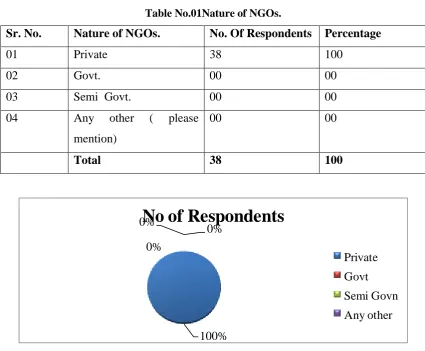
Table No.01Nature of NGOs.
Sr. No.
Nature of NGOs.
No. Of Respondents Percentage
01
Private
38
100
02
Govt.
00
00
03
Semi Govt.
00
00
04
Any
other
(
please
mention)
00
00
Total
38
100
100%
0%
0%
0%
No of Respondents
Private
Govt
Semi Govn
Any other
Interpretation
The above table depicts the data regarding the nature of NGOs functioning in Kolhapur city. Surprisingly it is
observed that almost all the NGOs that are working on HIV/AIDs are belonging the private sector no
government or semi government NGOs are to taking initiative in working on HIV/AIDs related problems in
Kolhapur city.
Table No.02 Basis Of Running NGOs:
Sr. No.
Description
No. Of Respondents
Percentage
01
Full time
38
100
02
Part time
00
00
Interpretation
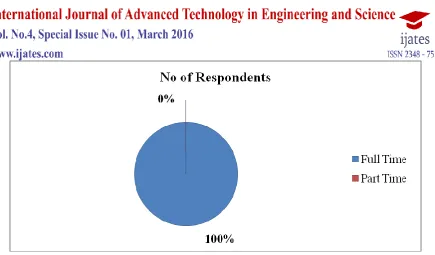
The above table brings out the information how the NGOs are working in Kolhapur city. It is seen from the
above table that all the respondents have opine that they are working on HIV and AIDs in their respective NGOs
on full time basis. Because they might have considered such activities are highly required in the society
members. Unless the services are offer on full time basis it is not possible to bring down the increasing rate of
HIV.AIDs patients
.
Table No.03 Nature of infrastructure
Sr.
No.
Nature of Infrastructure
No.
Of
Respondents
Percentage
01
Own Building
00
00
02
Rented
38
100
03
Donated
00
00
Total
38
100
0%
20%
40%
60%
80%
100%
0%
100%
0%
The above table depicts the information about whether NGOs are working in their own building or rented
building. It is found that all the 100% respondents are working in rented building. This may be due to
non-availability of enough fund to make their investment in the form of own building.
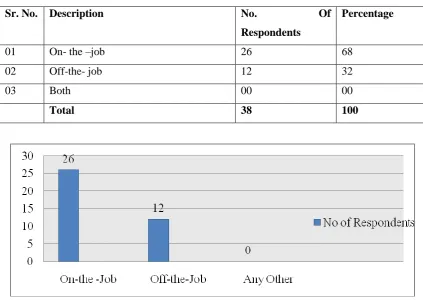
Table No.04 Training methods for clients
Sr. No. Description
No.
Of
Respondents
Percentage
01
On- the –job
26
68
02
Off-the- job
12
32
03
Both
00
00
Total
38
100
Interpretation
The above table focuses on the information related to the training method adopted by NGOs in giving training to
their clients. It is seen that more than half of the respondents (clients) receives training on-the-job and rest of the
respondents that is 32% receives training off-the-job. Which method is to be used by offering training to their
clients depends upon the client’s expectation and requirement.
V. FINDINGS
After having the analyzed the collected data through primary and secondary data of information the same
information is used for developing the inferences which is directly related to predetermine objectives.
There are different types of organizations such as private organization; government organization and semi
government organization are working on different social issues. It is found that there are three private
organizations that they working on HIV/AIDs related problem in Kolhapur city. Hence, it is inferred that
private organizations are taking the initiative in giving services relating to HIV/AIDs related problem in
Kolhapur. Therefore it is observed all NGOs who are working on HIV/AIDs are belonging to private
sector.(Refer Table no. 01)
All the NGOs running their organizational activities on full time basis. Because of which they can extend
It is found from table no.03 that all the NGOs are performing their social business activities in rented
building rather than having their own building. It is more convenient for the NGOs to work in rented
building as it is needs less investment compare to investment in having own building. (Refer Table no.03)
It is understood that NGOs are also organizing training program for their clients. Most of the NGOs are
conducting training programme on the job for their clients in order to keep secrecy.(Refer Table no. 04)
VI. CONCLUSION
Finally the study concluded that, the study aims to explore and evaluate the management of Non- Governmental
Organization (NGO) in Kolhapur City, Maharashtra. So, after overall discussion finally reach to make certain
conclusion. So as per study it had seen various types of NGOs and their nature. All NGOs are working under
private sector and they are working on full time basis. It is really good work because the needed person can get
treatment at any time as per their convenience. As per our study none of NGOs are not having their own
infrastructure that is building so that for organizing any activity NGOs facing problem by building owner also
patients are not ready to come like this kind of building. Then NGOs are providing training to their clients as per
their requirement.
VII. SUGGESTIONS
After having analyzed the information and inferences developed based on analytical information. Following
recommendation are made to minimize the problems related to HIV/AIDs.
It is recommended that government should take the initiative and encourage the private sector by giving
sufficient funds to run the organizational activities related to HIV/AIDs related problems.
It is suggested that government should start their own unit to educating the society members relating to
this HIV/AIDs related problems. As well as they should organized state, national level seminars to
develop the awareness among the people about such issues.
It is suggested that NGOs should organize the training programme for their clients according to the
requirement of their clients that is either on the job training or off-the-job training method.
BIBLIOGRAPHY
[1]. Prevention of HIV/AIDS & Drugs Abuse- G.C. Satpathy, Published in 2003in India, By IshaBooks ,
D-43,Prithiraj Road, Adarsh Nagar Delhi-110033.
[2]. AIDS & the Human Survival- Dr. V. Ramamurthy, first Publication 2000by Authors press.
[3]. AIDS & Civil Society –Indians Learning Curve- Edited By- Radhika Rama subhan Bhanwar
Rishyaringa, Prem Rawat Publication ,Jaipur.
[4]. Sex workers in social Environment,- G. K. Grover, Cyber Tech Publication.
[5]. NGOs and The State- Dr. R. K. Gupta, Mahaveer & sons New Delhi, First Edition 2006.
[6]. Formation And Management Of NGOs –Non Governmental Organization- Anita Abraham, Universal
[7]. NGOs & Protection of Human Rights- Rajni Malhotra dhingra, Deep & Deep Publication PVT, LTD,F-
159, Rajouri garden, New Delhi-110027.
[8]. AIDS & NGOs- Digumarti Bhaskarrao 2000, Discovery Publishing House New Delhi-110002.
[9]. NGOs of Management- saket And Sahu, Print Media Publication jaipur.
[10]. NGOs in India- R. Sooryamoorthy, K. D. Gangrate, PremRawat for Rawat publication.
[11]. Role of NGOs in Social Economic Development- Ravishanker Kumar Singh,AbhijitPublication,New
Delhi-110044.
[12]. NGOs & development- Dr. R. K.Gupta, Mahaveer&sons,New Delhi-1100094.