IJEDR1702179 International Journal of Engineering Development and Research (www.ijedr.org) 1049
Estimation of open channel flow parameters
by using optimization techniques
1Ebissa G. K., 2Dr. K. S. Hari Prasad
Department of Civil Engineering, Indian Institute of Technology Roorkee
ABSTRACT: Open channel flow parameter estimation is an inverse problem, which involves
the prediction of a function within a domain, given an error criterion with respect to a set of
observed data. Various numerical methods have been developed to estimate open channel flow
parameters. For this study, Genetic Algorithm optimization technique is selected. Because of its
inherent characteristics, Genetic Algorithm optimization technique avoids the subjectivity, long
computation time and ill-posedness often associated with conventional optimization techniques.
The present study involves estimation of open channel flow parameters having different bed
materials invoking data of Gradual Varied Flow (GVF). Use of GVF data facilitates estimation
of flow parameters. The necessary data base was generated by conducting laboratory
experiments in Hydraulics Lab of civil Engineering at IIT Roorkee. In the present study, the
efficacy of the Genetic Algorithm (GA) optimization technique is assessed in estimation of open
channel flow parameters from the collected experimental data. Computer codes are developed to
obtain optimal flow parameters Optimization Technique. Applicability, Adequacy & robustness
of the developed code are tested using sets of theoretical data generated by experimental work.
Estimation of Manning’s Roughness coefficient from the collected experimental work data by
using Manning’s equation & GVF equation were made.
The model is designed to arrive at such values of the decision variables that permit minimized
mismatch between the observed & the computed GVF profiles. A simulation model was
developed to compute GVF depths at preselected discrete sections for given downstream head
and discharge rate. This model is linked to an optimizer to estimate optimal value of decision
variables. The proposed model is employed to a set of laboratory data for three bed materials (i.e,
d50=20mm, d50=6mm and lined concrete). Application of proposed model reveals that optimal
value of fitting parameter ranges from 1.42 to 1.48 as the material gets finer. This value differs
IJEDR1702179 International Journal of Engineering Development and Research (www.ijedr.org) 1050
different bed conditions of experimental channel appear to be higher than the corresponding
reported /Strickler’s’ estimates.
Key Words:- Open channel flow parameters, GVF, parameter estimation, optimization
techniques, Manning’s roughness coefficient.
INTRODUCTION
Parameter identification techniques have been widely used in the field of hydrology,
meteorology, and oceanography. The issue of parameter identification based on the optimal
control theories in oceanography can be traced from the early work of Bennett and McIntosh
(1982) and Prevost and Salmon (1986). Panchang and O’Brien (1989) carried out early an
adjoint parameter identification for bottom drag coefficient in a tidal channel. Das and Lardner
(1991) estimated the bottom friction and water depth in a two-dimensional tidal flow. Yeh and
Sun (1990) presented an adjoint sensitivity analysis for a groundwater system and identified the
parameters in a leaky aquifer system. Wasantha Lal (1995) used singular value decomposition to
calibrate the Manning’s roughness in one-dimensional (1D) Saint Venant equations. Khatibi et
al. (1997) identified the friction parameter in 1D open channel considering the selection of
performance function and effect of uncertainty in observed data. Atanov et al. (1999) Used the
adjoint equation method to identify a profile of Manning’s n in an idealized trapezoidal open
channel. Ishii (2000) identified a constant Manning’s n in an open channel flow with a movable
bed. Ramesh et al. (2000) solved the inverse problem of identifying the roughness coefficient in
a channel network using the sequential quadratic programming algorithm. Sulzer et al. (2002)
estimated flood discharges using the Levenberg–Marquardt minimization algorithm. For the
parameter identification issues about adjoint methodology in meteorology and oceanography,
one may refer to Ghil and Malanotte-Rizzoli (1991) and Zou et al. (1992).
The identifications of parameters in some cases are hard to achieve due to ill-posedness in the
inverse problems. Chavent (1974) noted instability and nonuniqueness of identified parameters
in the distributed system. Due to the instability, some minimization procedures will lead to
serious errors in the identified parameters and make the identification process unstable. In the
case of nonuniqueness, the identified parameters will differ according to the initial estimations of
IJEDR1702179 International Journal of Engineering Development and Research (www.ijedr.org) 1051
(1998) have pointed out that the problem of uniqueness in parameter identification is intimately
related to identification, which addresses the question of whether it is at all possible to obtain a
unique solution of the inverse problem for unknown parameters. Although there are a lot of
identification procedures available for estimating parameters in mathematical models, none of
them can automatically guarantee stability and uniqueness in the parameter identifications in
diverse engineering problems. It is therefore vital to confirm the performance of these procedures
to find stable ones that can warrant obtaining the optimal solutions. For the present study,
channel roughness is identified by using optimization technique.
Optimization techniques were successfully used by Becker and Yeh (1972, 1972a), Fread and
Smith (1978) and Wormleaton and Karmegam (1984) to identify parameters for regular
prismatic channels having simple cross-sections. These researchers used the same optimization
algorithm (the so-called "Influence Coefficient" Algorithm) which, mathematically, is closely
related to both quasi linearization and the gradient method. Khatibi et al. (1997) used a nonlinear
least square technique with three types of objective function and identified open channel friction
parameters by a modified Gauss-Newton method. Atanov et al. (1999) used Lagrangian
multipliers and a least square errors criterion to estimate roughness coefficients. More recently,
Ding et al. (2004) used the quasi-Newton method to identify Manning’s roughness coefficients in
shallow water flows. Nevertheless, the above studies considered only the case of in-bank flow.
Therefore, there is a need to extend the method to out-bank flow, where flood plain roughness
will obviously have to be considered.
One of the very few studies which dealt with the identification of compound channel flow
parameters is the one by Nguyen and Fenton (2005). In this study, roughness coefficients in the
main channel and flood plains were identified as two different parameters using an automatic
optimization method. The model was applied to Duong River in Vietnam, where roughness
coefficients of the main channel and the flood plain were presented as different constant values
as well as polynomial functions of stage.
Need for the Present Study: From above brief literature review it can be seen that many
IJEDR1702179 International Journal of Engineering Development and Research (www.ijedr.org) 1052
by using optimization techniques. Still more experimental study is required to estimate open
channel flow parameters. The present study investigated for estimation of channel roughness
coefficients for different three types of bed materials (d50=20mm, d50=6mm and lined concrete)
by using optimization method. Also the present study is done to generate and monitor gradually
varied flow profiles corresponding to different bed materials, discharge rates and ponded depths
in the channel by using Crank-Nicolson method to solve the governing differential equation.
In this study the Simplex method is used in an optimization model to estimate the parameters in
the channel.
Objectives: The present study involves estimation of Manning roughness n of a channel having
different channel bed materials invoking data of gradual varied flow (GVF). Use of GVF data
facilitates estimation of depth dependent Manning’s roughness n. the necessary data base was
generated by conducting laboratory experiments. The overlying objective is fulfilled through the
accomplishment of sub objectives listed below.To identify open channel flow parameters by
using Genetic Algorithm optimization Technique, To generate and monitor gradually varied flow
profiles corresponding to different bed materials, discharge and ponded depths and Invoking the
observed data of the GVF profiles and the linked simulation optimization approach to estimates
Manning’s n corresponding to different channel bed materials in the experimental channel, and
hence to calibrate the following composite roughness equation.
METHODS AND MATERIALS
This study was carried out to identify open channel flow parameters by using Genetic Algorithm
optimization technique. Manning’s roughness coefficient and other parameters are estimated for
different bed materials used ( d50 =6mm and 20mm grain size and Lined concrete bed materials).
Also, GVF flow profile is identified. Crank-Nicolson method is used to solve the governing
differential equation.
Parameter optimization technique is used to find the optimal value of coefficient roughness for
three different bed materials. Estimation of roughness coefficient is based on Manning’s
IJEDR1702179 International Journal of Engineering Development and Research (www.ijedr.org) 1053
parameters. This estimation invokes the data of observed GVF profiles and such accounts for
different bed materials with the flow depth. Experimental works was done to several sets of data
monitored in Hydraulics Laboratory of Civil Engineering Department.
Experimental Works
In this chapter, water surface flow profiles corresponding to specific discharges, bed material and
ponded depth have been obtained through experimentation. This chapter includes a detailed
description of experimental setup, adopted procedures and the observations with range of data
obtained for different flow conditions. The experiments for the investigation were carried out in
Hydraulics Laboratory of Civil Engineering Department. IIT-Roorkee, India
Details of Experimental Setup
Flume
A rectangular tilting flume of length 30m, width 0.205m and height 0.50m was used. The bed of
the flume was made up of lined concrete and the other two sides were made up of glass and GI
sheet. Discharge was released through an inlet pipe of 0.010m diameter into the flume. The
entrance of the channel was provided with flow suppressors in order to make the flow stable. In
order to maintain desired depth of water at the downstream of the channel, a tail gate was fitted
at the end of the channel. Water discharging from the tail gate, passed to the sump which was
circulated again through a 15hp centrifugal pump for further experimentation.
Experimental Procedures
The experiments were conducting by adopting the following steps as mentioned below:-
Slope Measurement
All the sets of experiment were performed on a particular slope of the channel. The slope was
measured by using two steel containers connected with a long rubber tube. Both the containers
were placed on the channel bed separated by the rubber tube along the length of the channel. One
of the containers placed at higher elevation was filled with water and simultaneously care was
IJEDR1702179 International Journal of Engineering Development and Research (www.ijedr.org) 1054
amount of time around 24 hours. Then the water levels were measured. The slope of the channel
was computed by using the following formula.
𝑆
𝑜=
𝐻1−𝐻2𝐿
(1)
Where, H2 and H1 is the depth of water in second and first container respectively after
equilibrium is established and L is the distance between the containers.
Based on this formula and obtained data after 24 hours, the bed slope of the channel will be;-
H1=21.5cm=0.215m, H2=7.792cm=0.0792m and distance between the two containers, L=22.7m
Then
, 𝑆
𝑜=
𝐻1−𝐻2𝐿
, 𝑆
𝑜=
0.215−0.0792
22.7
, 𝑆
𝑜= 0.00598
Therefore, the bed slope of the channel is 0.00598.
Sieve Analysis
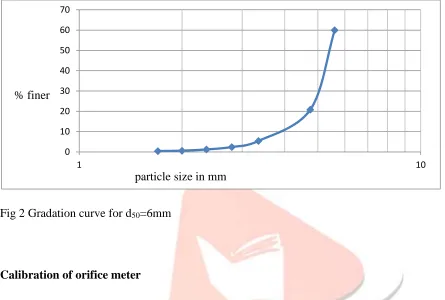
Sieve analysis was performed to determine the particle size of the material used to create
artificial bed roughness. Results of sieve analysis were plotted to investigate the particle size of
the bed material used in the present study. Experiments were conducted on two different bed
materials. First on one rough bed condition having gravel as a bed particle size d50 =20mm,
d50=6mm and then on the smooth condition having lined concrete as bed material. Then, the
gradation curve is plotted as follow:
-20 0 20 40 60 80 100
1 10 100
IJEDR1702179 International Journal of Engineering Development and Research (www.ijedr.org) 1055
Fig 1 Gradation curve for d50=20mm
Fig 2 Gradation curve for d50=6mm
Calibration of orifice meter
Orifice meter was provided in the inlet pipe for the measurement of discharge. Orifice plate was
made up of GI sheet having diameter of 0.06m and the diameter of inlet pipe was 0.10m.
Ultrasonic flow meter was used for the calibration of coefficient of discharge of orifice meter.
Different discharges were noted corresponding to varying head. This result was plotted and the
best fitted line was used (Fig. 3).
0 10 20 30 40 50 60 70
1 10
particle size in mm % finer
0 0.002 0.004 0.006 0.008 0.01 0.012
0 0.05 0.1 0.15 0.2
√H (m)
IJEDR1702179 International Journal of Engineering Development and Research (www.ijedr.org) 1056
Fig. 3 Calibration curve
Cd was calibrated as 0.66. after calibration of Cd of orifice meter, the discharge in the channel
was computed by using the following equation.
𝑄 = 𝐶
𝑑𝑎
𝑜√2𝑔ℎ (2)
Where, ao is area of orifice plate; g= acceleration due to gravity and h= height of water column.
Measurement of water surface profiles
i) Water was released into the rectangular flume by opening the valve of inlet pipe,
ii) The desired depth of flow was maintained at the downstream end by operating sluice gate
provided at the end of the channel. The depth of water was measured using pointer gauge,
iii) After a while when the flow become steady in the channel and the desired depth was
maintained at the downstream end, the water surface profile was being measured,
iV) Starting from the maintained depth at the downstream end (0.00m), the water surface profile
is measured towards upstream at 21 discrete locations that are 0.00m, 0.20m, 0.70m, 1.20m,
1.70m, 2.20m, 2.70m, 3.70m, 4.70m, 5.70m, 6.70m, 7.70m, 8.70m, 9.70m, 10.70m, 12.70m,
14.70m, 16.70m, 18.70m, 20.70m and 22.70m.
v) The above mentioned steps were repeated for thee different downstream depths, Discharges
rates and bed roughness as mentioned in Table 1
Table 1 Data used for experimental measurement of water surface profiles
Discharge rates
(m3/s)
8.601x10⁻³ 9.233x10⁻³ 9.314x10⁻³
Downstream depths
(m)
0.25 0.30 0.35
Bed materials
(d50 in mm)
IJEDR1702179 International Journal of Engineering Development and Research (www.ijedr.org) 1057 Collection of data
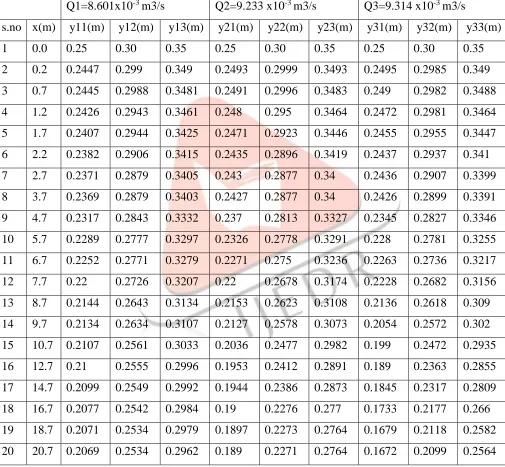
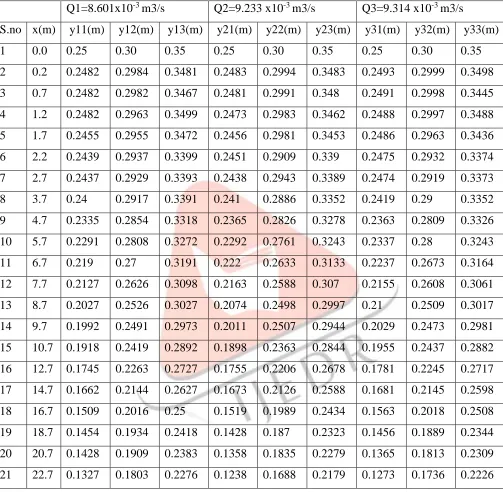
The data obtained for experimental measured water surface profiles corresponding to different
bed materials is presented in Table 2, 3 and 4 for d50=20mm, d50=6mm and lined concrete
respectively.
Table 2 Observed water surface profiles corresponding to d50=20mm
Q1=8.601x10⁻³ m3/s Q2=9.233 x10⁻³ m3/s Q3=9.314 x10⁻³ m3/s
s.no x(m) y11(m) y12(m) y13(m) y21(m) y22(m) y23(m) y31(m) y32(m) y33(m)
1 0.0 0.25 0.30 0.35 0.25 0.30 0.35 0.25 0.30 0.35
2 0.2 0.2447 0.299 0.349 0.2493 0.2999 0.3493 0.2495 0.2985 0.349
3 0.7 0.2445 0.2988 0.3481 0.2491 0.2996 0.3483 0.249 0.2982 0.3488
4 1.2 0.2426 0.2943 0.3461 0.248 0.295 0.3464 0.2472 0.2981 0.3464
5 1.7 0.2407 0.2944 0.3425 0.2471 0.2923 0.3446 0.2455 0.2955 0.3447
6 2.2 0.2382 0.2906 0.3415 0.2435 0.2896 0.3419 0.2437 0.2937 0.341
7 2.7 0.2371 0.2879 0.3405 0.243 0.2877 0.34 0.2436 0.2907 0.3399
8 3.7 0.2369 0.2879 0.3403 0.2427 0.2877 0.34 0.2426 0.2899 0.3391
9 4.7 0.2317 0.2843 0.3332 0.237 0.2813 0.3327 0.2345 0.2827 0.3346
10 5.7 0.2289 0.2777 0.3297 0.2326 0.2778 0.3291 0.228 0.2781 0.3255
11 6.7 0.2252 0.2771 0.3279 0.2271 0.275 0.3236 0.2263 0.2736 0.3217
12 7.7 0.22 0.2726 0.3207 0.22 0.2678 0.3174 0.2228 0.2682 0.3156
13 8.7 0.2144 0.2643 0.3134 0.2153 0.2623 0.3108 0.2136 0.2618 0.309
14 9.7 0.2134 0.2634 0.3107 0.2127 0.2578 0.3073 0.2054 0.2572 0.302
15 10.7 0.2107 0.2561 0.3033 0.2036 0.2477 0.2982 0.199 0.2472 0.2935
16 12.7 0.21 0.2555 0.2996 0.1953 0.2412 0.2891 0.189 0.2363 0.2855
17 14.7 0.2099 0.2549 0.2992 0.1944 0.2386 0.2873 0.1845 0.2317 0.2809
18 16.7 0.2077 0.2542 0.2984 0.19 0.2276 0.277 0.1733 0.2177 0.266
19 18.7 0.2071 0.2534 0.2979 0.1897 0.2273 0.2764 0.1679 0.2118 0.2582
IJEDR1702179 International Journal of Engineering Development and Research (www.ijedr.org) 1058
21 22.7 0.2031 0.2494 0.2934 0.1872 0.2253 0.2712 0.1511 0.1929 0.2389
Table 3 Observed water surface profiles corresponding to d50=6mm
Q1=8.601x10⁻³ m3/s Q2=9.233 x10⁻³ m3/s Q3=9.314 x10⁻³ m3/s
S.no x(m) y11(m) y12(m) y13(m) y21(m) y22(m) y23(m) y31(m) y32(m) y33(m)
1 0.0 0.25 0.30 0.35 0.25 0.30 0.35 0.25 0.30 0.35
2 0.2 0.2482 0.2984 0.3481 0.2483 0.2994 0.3483 0.2493 0.2999 0.3498
3 0.7 0.2482 0.2982 0.3467 0.2481 0.2991 0.348 0.2491 0.2998 0.3445
4 1.2 0.2482 0.2963 0.3499 0.2473 0.2983 0.3462 0.2488 0.2997 0.3488
5 1.7 0.2455 0.2955 0.3472 0.2456 0.2981 0.3453 0.2486 0.2963 0.3436
6 2.2 0.2439 0.2937 0.3399 0.2451 0.2909 0.339 0.2475 0.2932 0.3374
7 2.7 0.2437 0.2929 0.3393 0.2438 0.2943 0.3389 0.2474 0.2919 0.3373
8 3.7 0.24 0.2917 0.3391 0.241 0.2886 0.3352 0.2419 0.29 0.3352
9 4.7 0.2335 0.2854 0.3318 0.2365 0.2826 0.3278 0.2363 0.2809 0.3326
10 5.7 0.2291 0.2808 0.3272 0.2292 0.2761 0.3243 0.2337 0.28 0.3243
11 6.7 0.219 0.27 0.3191 0.222 0.2633 0.3133 0.2237 0.2673 0.3164
12 7.7 0.2127 0.2626 0.3098 0.2163 0.2588 0.307 0.2155 0.2608 0.3061
13 8.7 0.2027 0.2526 0.3027 0.2074 0.2498 0.2997 0.21 0.2509 0.3017
14 9.7 0.1992 0.2491 0.2973 0.2011 0.2507 0.2944 0.2029 0.2473 0.2981
15 10.7 0.1918 0.2419 0.2892 0.1898 0.2363 0.2844 0.1955 0.2437 0.2882
16 12.7 0.1745 0.2263 0.2727 0.1755 0.2206 0.2678 0.1781 0.2245 0.2717
17 14.7 0.1662 0.2144 0.2627 0.1673 0.2126 0.2588 0.1681 0.2145 0.2598
18 16.7 0.1509 0.2016 0.25 0.1519 0.1989 0.2434 0.1563 0.2018 0.2508
19 18.7 0.1454 0.1934 0.2418 0.1428 0.187 0.2323 0.1456 0.1889 0.2344
20 20.7 0.1428 0.1909 0.2383 0.1358 0.1835 0.2279 0.1365 0.1813 0.2309
21 22.7 0.1327 0.1803 0.2276 0.1238 0.1688 0.2179 0.1273 0.1736 0.2226
IJEDR1702179 International Journal of Engineering Development and Research (www.ijedr.org) 1059
Q1=8.601x10⁻³ m3/s Q2=9.233 x10⁻³ m3/s Q3=9.314 x10⁻³ m3/s
s.no x(m) y11(m) y12(m) y13(m) y21(m) y22(m) y23(m) y31(m) y32(m) y33(m)
1 0.0 0.25 0.30 0.35 0.25 0.30 0.35 0.25 0.30 0.35
2 0.2 0.2435 0.2953 0.3472 0.2455 0.298 0.3494 0.2474 0.2992 0.348
3 0.7 0.2419 0.2964 0.3474 0.2474 0.2974 0.3493 0.2465 0.2948 0.3527
4 1.2 0.237 0.2941 0.3461 0.2469 0.2887 0.3489 0.2449 0.2889 0.3469
5 1.7 0.2336 0.2918 0.3429 0.242 0.2874 0.344 0.243 0.2966 0.3463
6 2.2 0.2292 0.2911 0.341 0.2338 0.2874 0.3431 0.2429 0.2919 0.3458
7 2.7 0.2282 0.2872 0.3382 0.2319 0.2855 0.3402 0.2428 0.2918 0.3447
8 3.7 0.2198 0.2819 0.3327 0.2301 0.2809 0.3356 0.2359 0.291 0.3436
9 4.7 0.2173 0.2762 0.3272 0.2236 0.2764 0.3311 0.2345 0.2873 0.3363
10 5.7 0.2117 0.2708 0.3227 0.2154 0.2672 0.3265 0.231 0.2747 0.3326
11 6.7 0.2051 0.2651 0.3152 0.2125 0.2615 0.3181 0.2235 0.2671 0.3251
12 7.7 0.1958 0.2559 0.306 0.1986 0.2505 0.3005 0.2061 0.2532 0.3132
13 8.7 0.189 0.2426 0.291 0.1936 0.2463 0.2947 0.1973 0.2491 0.3026
14 9.7 0.1808 0.2327 0.2864 0.1901 0.2399 0.293 0.1955 0.2428 0.2936
15 10.7 0.1718 0.2253 0.2715 0.1811 0.2329 0.2884 0.1856 0.2401 0.2892
16 12.7 0.1654 0.2191 0.2682 0.1619 0.2108 0.2674 0.1673 0.2265 0.2772
17 14.7 0.1571 0.2089 0.2583 0.1547 0.2036 0.263 0.1629 0.2155 0.2759
18 16.7 0.1463 0.2041 0.2564 0.1391 0.1918 0.2458 0.1501 0.1975 0.2664
19 18.7 0.1443 0.201 0.2551 0.1201 0.1765 0.232 0.1439 0.1893 0.241
20 20.7 0.1419 0.1996 0.2537 0.1146 0.1647 0.2185 0.1203 0.1821 0.2276
21 22.7 0.1418 0.1965 0.2506 0.1028 0.1591 0.2148 0.1137 0.1665 0.2146
RESULTS AND DISCUSSION
Simulation Model
The optimization problem posed in the preceding section is solved by employing the linked
optimization problem. This approach would require development of a model for simulation of
IJEDR1702179 International Journal of Engineering Development and Research (www.ijedr.org) 1060
Subsequently this simulation model is linked to an optimizer for addressing the optimization
problem. Effectively the simulation model would provide the vector of computed depths
𝑦(𝑥𝑖, 𝑄𝑘, 𝐻𝑖) appearing in the objective function. The details of the simulation model in the
following sections.
Discretization of reach
In the simulation model the entire channel reach is discretized into M small space steps such that
depth of water level at Mth step is greater than 1.01 x normal depth.
Governing differential equation
Governing differential equation used for simulation of GVF is given as:
𝑑𝑦 𝑑𝑥 =
𝑆𝑜− 𝑆𝑓
1 −𝑄2𝑇 𝑔𝐴3
(3)
In this equation 𝑑𝑦
𝑑𝑥 is change in depth y with distance x; Sf is energy slope and T is top width. Sf
can be calculated by using Manning’s formula as:
𝑆𝑓 =
𝑛𝑐2𝑄2
𝐴2𝑅4/3 (4)
Where 𝑛𝑐 is composite roughness coefficient and computed as follow:
𝑛𝑐 =
(∑
𝑛
𝑖∝
𝑃
𝑖 𝑁
𝑖=1
)
1/∝
(∑
𝑁𝑖=1𝑃
𝑖)
1/∝(5)
Simulation strategy
Crank-Nicolson method is used to solve the governing differential equation mentioned in above
section. In this method, depth of water level at next space step is calculated as:
IJEDR1702179 International Journal of Engineering Development and Research (www.ijedr.org) 1061
Where, 𝑦𝑖+1 and 𝑦𝑖 is depth of water level at 𝑖 + 1𝑡ℎ and 𝑖𝑡ℎ section respectively, ∆𝑥 is the
distance between them and 𝛽 is the average slope which is given as follow:
𝛽 =( 𝑑𝑦
𝑑𝑥⎸𝑦𝑖 +𝑑𝑦𝑑𝑥⎸𝑦𝑖+1)
2 (7)
Where,
(
𝑑𝑦𝑑𝑥
⎸𝑦
𝑖)
and ( 𝑑𝑦𝑑𝑥
⎸𝑦
𝑖+1)
are the change in the depth of flow with channel distance x at𝑖𝑡ℎ and 𝑖 + 1𝑡ℎ section. Equation (6) can be further elaborated using previously mentioned
equation as:
𝑦𝑖+1= 𝑦𝑖 −(
𝑆𝑜− 𝑛 2
𝑐𝑖𝑄2
𝑇2𝑦 𝑖10/3
1 − 𝑄2 𝑔𝑇2𝑦
𝑖3
𝑆𝑜− 𝑛 2
𝑐𝑖𝑄2
+ 𝑇2𝑦𝑖+110/3 1 − 𝑄2
𝑔𝑇2𝑦 𝑖+13)
∆𝑥
2 (8)
Where, 𝑛𝑐𝑖 and 𝑛𝑐𝑖+1are the composite roughness of 𝑖𝑡ℎ and 𝑖 + 1𝑡ℎ section. An iterative
procedure is adopted for the computation of 𝑦𝑖+1. In this procedure, 𝑦𝑖+1𝑙+1 is calculated where
l is the number of iteration as:
𝑦𝑖+1𝑙+1= 𝑦𝑖 − 𝛽∆𝑥 (9)
And the iteration ends when it met the converging criterion, which is given as:
𝑦𝑖+1 𝑙+1
− 𝑦𝑖+1𝑙 <∈ (10)
Where, ∈ is a constant term. Thus, using the above mentioned approach 𝑦𝑖+1 is computed for
each discrete step up to Mth step and this leads to the simulation of GVF profiles.
IJEDR1702179 International Journal of Engineering Development and Research (www.ijedr.org) 1062
As mentioned in above section, the experimental channel consists of three types of wetted
perimeter; accordingly following equation is used in the simulator for computing the composite
roughness𝑛𝑐:
𝑛𝑐 =(𝑛1
∝∗ 𝐵 + 𝑛
2∝∗ 𝑦 + 𝑛3∝∗ 𝑦)1/∝
(𝐵 + 2𝑦)1/∝ (11)
Fig. 4 Composite roughness of channel
Where, 𝑛𝑐 is the composite Manning’s n,𝑛1, 𝑛2, and 𝑛3 are value of Manning’s n for bed and
sides respectively. B is bed width and y is the depth of flow. Since composite roughness depends
on the depth of the flow, which is not constant in the present scenario. Therefore, 𝑛𝑐 is computed
at each section of the water surface flow profile. The value of ∈ is take n as 0.001 in equation
(5).
Optimization
The following problem was solved three times corresponding to different bed conditions i.e.
d50=20mm, d50=6mm and lined concrete as bed materials.
y
𝑛2 𝑛3
(Glass) B (GI sheet)
IJEDR1702179 International Journal of Engineering Development and Research (www.ijedr.org) 1063 Decision Variables:
(𝑛𝑖, 𝑖 = 1, … … . .3); and ∝
Objective Function:
𝑀𝑖𝑛 𝑍 = ∑ ∑ ∑ 𝑤𝑖
𝑀
𝑖 3
𝑘 3
𝑙
[𝑦(𝑥𝑖, 𝑄𝑘, 𝐻𝑙) − 𝑦⏞𝑖𝑘𝑙]2 (12)
Where, 𝑦(𝑥𝑖, 𝑄𝑘, 𝐻𝑙) and 𝑦⏞𝑖𝑘𝑙 are simulated and experimentally measured depth at 𝑖𝑡ℎ discrete
section, 𝑘𝑡ℎ discharge rate and 𝑙𝑡ℎ downstream head respectively; 𝑀 is a subset of the locations
where the observed depth is larger than 1.01 x normal depth; 𝑤𝑖 is the weight assigned to the
mismatch at 𝑖𝑡ℎ location. In the present study the weights are assigned to index the length
discretized by the discrete sections. Thus (𝑤𝑖) is defined as follows:
𝑤𝑖 =
(𝑥𝑖+1− 𝑥𝑖−1)
2 (13)
Constraint:
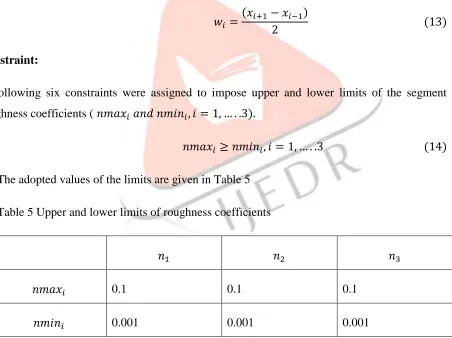
i) Following six constraints were assigned to impose upper and lower limits of the segment
roughness coefficients ( 𝑛𝑚𝑎𝑥𝑖 𝑎𝑛𝑑 𝑛𝑚𝑖𝑛𝑖, 𝑖 = 1, … . .3).
𝑛𝑚𝑎𝑥𝑖 ≥ 𝑛𝑚𝑖𝑛𝑖, 𝑖 = 1, … . .3 (14)
The adopted values of the limits are given in Table 5
Table 5 Upper and lower limits of roughness coefficients
𝑛1 𝑛2 𝑛3
𝑛𝑚𝑎𝑥𝑖 0.1 0.1 0.1
IJEDR1702179 International Journal of Engineering Development and Research (www.ijedr.org) 1064
ii) Following three constraints were assigned to ensure realistic relative roughness of the three
roughness coefficients.
𝑛1 ≥ 𝑛2 ≥ 𝑛3 (15)
iii) Following constraints was assigned to impose upper and limits of fitting parameters (∝).
2 ≥ ∝ ≥ 1 (16)
Since the reported value of ∝ 1.5, a range of 1 to 2 was prescribed.
Linked simulation optimization approach is used to estimate the optimal values of the parameters
for three bed conditions i.e d50=20mm, d50=6mm and lined concrete as bed materials and their
corresponding GVF profiles were simulated.
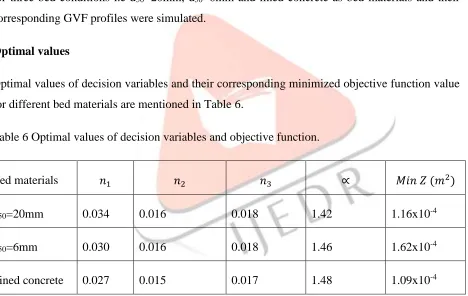
Optimal values
Optimal values of decision variables and their corresponding minimized objective function value
for different bed materials are mentioned in Table 6.
Table 6 Optimal values of decision variables and objective function.
Bed materials 𝑛1 𝑛2 𝑛3 ∝ 𝑀𝑖𝑛 𝑍 (𝑚2)
d50=20mm 0.034 0.016 0.018 1.42 1.16x10⁻⁴
d50=6mm 0.030 0.016 0.018 1.46 1.62x10⁻⁴
Lined concrete 0.027 0.015 0.017 1.48 1.09x10⁻⁴
Optimal reproduction of GVF profiles
Computed GVF profiles corresponding to the optimal parameter values and the variation of
composite roughness are in the following figures. The profile is plotted for three different bed
IJEDR1702179 International Journal of Engineering Development and Research (www.ijedr.org) 1065
Fig. 5 Observed reproduction of GVF profiles ( Q=8.601x10⁻³ m3/s and d50=20mm)
Fig. 6 Optimal reproduction of GVF profiles ( Q=8.601x10⁻³ m3/s and d
50=20mm)
0.00 0.05 0.10 0.15 0.20 0.25 0.30 0.35 0.40
0 5 10 15 20 25
H1=0.25m H2=0.30m H3=0.35m
x (m) D
e p t h
(
m)
0 0.05 0.1 0.15 0.2 0.25 0.3 0.35 0.4
0 5 10 15 20 25
H2=0.25m H2=0.30m H3=0.35m
x (m) D
e p t h
(
IJEDR1702179 International Journal of Engineering Development and Research (www.ijedr.org) 1066
Fig. 7 Observed reproduction of GVF profiles ( Q=9.233x10⁻³ m3/s and d50=6mm )
Fig. 8 Optimal reproduction of GVF profiles ( Q=9.233x10⁻³ m3/s and d
50=6mm)
0.00 0.05 0.10 0.15 0.20 0.25 0.30 0.35 0.40
0 5 10 15 20 25
H1=0.25m H2=0.30m H3=0.35m
x (m) D
e p t h
(
m)
0 0.05 0.1 0.15 0.2 0.25 0.3 0.35 0.4
0 5 10 15 20 25
H2=0.25m H2=0.30m H3=0.35m
x (m) D
e p t h
(
IJEDR1702179 International Journal of Engineering Development and Research (www.ijedr.org) 1067
Fig. 9 Observed reproduction of GVF profiles ( Q=9.314x10⁻³ m3/s and lined concrete)
Fig. 10 Optimal reproduction of GVF profiles ( Q=9.314x10⁻³ m3/s and lined concrete)
Estimated parameters
The bed roughness (𝑛1) varies from 0.027 to 0.034 as bed material /condition changes from lined
concrete to gravel (d50=20mm). The corresponding reported/ Strickler’s estimates are given in
0.00 0.05 0.10 0.15 0.20 0.25 0.30 0.35 0.40
0 5 10 15 20 25
H1=0.25m H2=0.30m H3=0.35m x (m) D e p t h ( m) 0 0.05 0.1 0.15 0.2 0.25 0.3 0.35 0.4
0 5 10 15 20 25
IJEDR1702179 International Journal of Engineering Development and Research (www.ijedr.org) 1068
Table 5.2 by using equation 1.2. It may be seen that optimal roughness estimates are higher than
Strickler’s estimates.
Table 7 Reported/Strickler’s estimated optimal estimates for bed materials
Bed material/condition Reported/Strickler’s Estimation Optimal estimates
d50=20mm 0.0247 0.034
d50=6mm 0.0202 0.030
Lined concrete 0.013-0.015 0.027
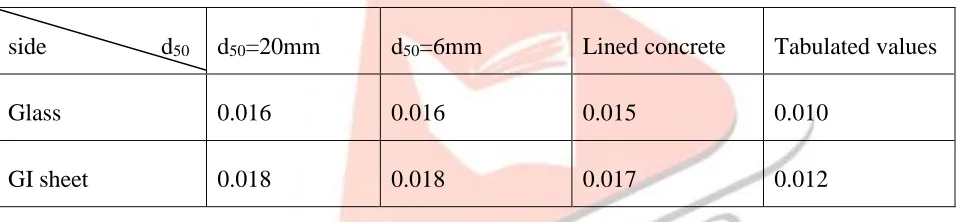
The roughness coefficient of glass and GI sheet sides as optimized for various runs are presented
in Table 8.
Table 8 Reported/Strickler’s estimates and optimal estimates for sides
side d50 d50=20mm d50=6mm Lined concrete Tabulated values
Glass 0.016 0.016 0.015 0.010
GI sheet 0.018 0.018 0.017 0.012
The estimated roughness coefficients satisfy the known inequality (𝑛2 < 𝑛3) and are higher than
the tabulated values. This establishes the credibility of the proposed model.
The optimal value of ∝ (fitting parameter) ranges from 1.42 to 1.48, which differs from the
reported value i.e. 1.5. The optimal value of ∝ increases as the bed materials get finer.
Reproduction of observed profile
Computed GVF profiles corresponding to the optimal parameter values match quite well with
corresponding observed profiles.
IJEDR1702179 International Journal of Engineering Development and Research (www.ijedr.org) 1069
It can be observed that composite roughness reduces with increase in flow depth. Apparently
because of increase in weightage of side resistance, the value of composite roughness increase.
CONCLUSION
This study was carried out to identify open channel flow parameters. Manning’s roughness
coefficient and other parameters are estimated for different bed materials used ( d50 =20mm grain
size , 6mm grain size particles and Lined concrete bed materials). Also, based on the estimated
value of Manning roughness coefficient and flow depths, GVF flow profile is identified.
An optimization method is applied to identify the parameters based on Manning formula for
estimation of manning roughness coefficient and corresponding manning roughness parameters.
This estimation invokes the data of observed GVF profiles and such accounts for different bed
materials with the flow depth.
Experimental works is done to several sets of data monitored in Hydraulics Laboratory of Civil
Engineering Department. The application led to the following conclusions;
i) The GVF profile computed on the basis of estimated parameters match quite closely
with the corresponding observed profiles.
ii) Strickler’s formula under estimate the roughness due to the bed material.
iii) The following commonly used formula is calibrated for Manning coefficient
estimation
𝑛𝑐 =(∑ 𝑛𝑖
∝𝑃 𝑖 𝑁
𝑖=1 )1/∝
(∑𝑁 𝑃𝑖
𝑖=1 )1/∝
iv) The currently documented value of ∝ is 1.5. However, the present work reveals that it
varies from 1.42 to 1.48. The value of ∝ generally decreases as the bed material gets
coarser.
IJEDR1702179 International Journal of Engineering Development and Research (www.ijedr.org) 1070
1. Atanov, G. A., Evseeva, E. G., and Meselhe, E. A. (1999). ‘‘Estimation of roughness
profile in trapezoidal open channel.’’ J. Hydraul. Eng., 125(3), 309–312
2. Ayvaz MT (2013). A linked simulation–optimization model for simultaneously
estimating the Manning’s surface roughness values and their parameter structures in
shallow water flows. Journal of Hydrology. 2013; 500: 183-199
3. Barros A.P and Calello J.D.,(2001), ‘’surface Roughness for shallow over land flow on
crushed stone surfaces’’, J.Hydraulics. Eng. ASCE. Vol. 127, No.1, January. Pp.38-52
4. Becker, L., and Yeh, W. W.-G. (1972). ‘‘Identification of parameters in unsteady open
channel flows.’’ Water Resour. Res., 8(4), 956–965.
5. Bennett, A. F., and McIntosh, P. C. (1982). ‘‘Open ocean modeling as an inverse
problem: Tidal theory.’’ J. Phys. Oceanogr., 12, 1004–1018.
6. Candela A, Noto LV, Aronica G. Influence of surface roughness in hydrological response
of semiarid catchments. Journal of Hydrology. 2005; 313(3-4): 119-131.
7. Chow, V.T., (1959), ‘’open channel Hydraulics’’, McGraw-Hill, New York
8. Christodoulou G.C., (2014), ‘’Equivalent Roughness of submerged obstacles in open
channel flow’’, J.Hydraulics. Eng. ASCE. Vol.140, No.2, February, pp.226-230
9. Das A., (2000), ‘’optimal channel cross section with composite roughness’’, J.Irrig.Drain.
Eng. ASCE. Vol.126, No.1, January, pp 68-72
10.Das, S. K., and Lardner, R. W. (1991). ‘‘On the estimation of parameters of hydraulic
models by assimilation of periodic tidal data.’’ J. Geophys. Res., [Oceans], 96, 15187–
15196
11.Dey S., (2000), ‘’Chebyschev solution as Aid in computing GVF by standard step
method’’, J.Irrig.Drain. Eng. ASCE. Vol.128, No.4, July/August, pp.271-274
12.Ding Y., Jia. Y. and Wang S.S.M., (2004), ‘’Identification of Manning’s Roughness
coefficient in shallow water flows’’, J.Hydraulics. Eng. ASCE. Vol.130, no.6, June,
pp.501-510
13.Esfandiari M. and Maheshwari B.L., (1998), ‘’suitability of selected flow Equations and
variation of Manning’s n in furrow Irrigation’’, J.Irrig.Drain. Eng. ASCE. Vol.124, No.2,
IJEDR1702179 International Journal of Engineering Development and Research (www.ijedr.org) 1071
14.Guo Y., Zhang L., Shen Y., and Zhang J., (2008), ‘’Modeling study of free overfall in a
rectangular channel with strip Roughness’’, J .Hydraulics. Eng. ASCE. Vol.134, No.5,
May, pp. 664-667
15.Hameed L.K, and Ali T., (2013), Estimating of manning’s Roughness coefficient for
Hilla River through calibration using HEC-RAS Model’’, Jordan J. Civil Eng. Vol.7,
No.1, October, pp. 44-53
16.Hessel R., Jetten V., and Guanghi Z., (2003), ‘’Estimating Manning’s n for steep
slopes’’, CATINA, vol.54, No. 1-2, November. Pp. 77-91
17.Ishii, A. (2000). ‘‘Parameter identification of Manning roughness coefficient using
analysis of hydraulic jump with sediment transport.’’ Kawahara Group Research Report,
Chuo University, Japan
18.Jarret R.D., (1984), ‘’Hydraulics of High Gradient Streams’’, J .Hydraulics. Eng. ASCE.
Vol.110, No.11, November, pp.1519-1539
19.Koza JR. Human-competitive results produced by genetic programming. Genetic
Programming and Evolvable Machines. 2010; 11(3-4): 251-284.
20.Li Z. and Zhang J., (2001), ‘’calculation of field Manning’s Roughness Coefficient’’,
Agricultural water management, Vol.153, No.49, January 1, pp.152-161
21.Mailapalli D.R., Raghuwanshi N.S., Singh R., Schmitz G.H., and Lennartz F., (2002),
‘’spatial and temporal variation of Manning’s Roughness Coefficient in furrow Irrigation’’, J. Irrig.Drain. Eng. ASCE. Vol.134, No.2, April, pp.185-192
22.Naidu B.J, Bhallamudi S.M., Narasimhan S., (1997), ‘’GVF Computation in Tree-type
channel networks’’, J .Hydraulics. Eng. ASCE. Vol.123, No.8, August, pp.700-708
23.Navon, I. M. ~1998!. ‘‘Practical and theoretical aspect of adjoint parameter estimation
and identifiability in meteorology and oceanography.’’ Dyn. Atmos. Oceans, 27~1–4!,
55–79
24.Panchang, V. G., and O’Brien, J. J. (1989). ‘‘On the determination of hydraulic model
parameters using the strong constraint formulation.’’ Modeling marine systems, Vol. I, A.
M. Davies, ed., CRC Press, Boca Raton, Fla., 5–18.
25.Prevost, C., and Salmon, R. (1986). ‘‘A variational method for inverting hydrographic
IJEDR1702179 International Journal of Engineering Development and Research (www.ijedr.org) 1072
26.Qin J. and Ng S.L., (2012), ‘’Estimation of effective roughness for water worked gravel
surfaces’’, J .Hydraulics. Eng. ASCE. Vol.138, No.11, November, pp.923-934
27.Ramesh R., Datta B., Bhallamudi S.M. and Narayana S., (2000), ‘’optimal estimation of
roughness in open channel flows’’, J .Hydraulics. Eng. ASCE. Vol.126, No.4, April, pp.
299-303
28.Reddy H.P., and Bhallamudi S.M., (2004), ‘’Gradual Varied Flow computation in cyclic
looped channel network’’, J. Irrig.Drain. Eng. ASCE. Vol.130, No.5, October, pp.
424-431
29.Rodríguez-Caballero E, Cantón Y, Chamizo S, et al. Effects of biological soil crusts on
surface roughness and implications for runoff and erosion. Geomorphology. 2012;
145-146: 81-89.
30.Stone B.M, and Hung T.S., (2002), ‘’Hydraulic Resistance of flow in channels with
cylindrical Roughness’’ J .Hydraulics. Eng. ASCE. Vol.128.,No.5, May, pp.50-506
31.Subramanya, K., (2012), ‘’flow in open channel’’, McGraw-Hill, third edition.
32.Urquhart, W. J. (1975). Hydraulics: Engineering field manual, U.S. Department of
Agriculture, Soil Conservation Service, Washington, D.C.
33.Vatankhah A.R., (2012), ‘’Direct Integration of Manning based GVF Equation in
trapezoidal channels’’, J. Hydrol. Eng. ASCE. Vol.128, No.3, March, pp. 445-462
34.Yeh, W. W.-G. (1986). ‘‘Review of parameter identification procedures in groundwater
hydrology: The inverse problem.’’ Water Resour. Res., 22(2), 95–108.
35.Zou, X., Navon, I. M., and Le Dimet, F. X. (1992). ‘‘An optimal nudging data
assimilation scheme using parameter estimation.’’ Q. J. R. Meteorol. Soc., 118, 1163–