COMPARATIVE ANALYSIS OF ROUTING
PROTOCOLS BASED ON SOME QoS FACTORS IN
WIRELESS ADHOC NETWORKS
Prerna Rani
M.TECH Student at Hindu College of Engineering, Sonepat (India)
ABSTRACT
In the last few years we have be observed a tremoundously increasing popularity of wireless networks because
of its various advantages over wired netwok. And mobile adhoc networks ,one of the wireless networks has
become research interest.A mobile ad hoc network consists of mobile self configuring wireless nodes and there
is no centralized management for communication between these nodes. The dynamic characteristics of MANET
demands better connectivity and guaranteed QoS.There are various factors that affect quality of service of
network. It is an issue for mobile ad hoc networks to provide effective QoS. In this paper we have compared
various routing protocols on some QoS factors.
Keywords:
AODV, DSR, MANET, OLSR, QOS, ZRPI. INTRODUCTION
1.1 Mobile Ad-Hoc Network
A mobile ad-hoc network (MANET) is non-centralized infrastructure less collection of peer nodes, which
discover their route themselves for communication. MANET is a creating, organizing and
self-administrative network.
Ad hoc wireless networks (AWNs) are zero configuration, self-organizing, and highly dynamic networks
formed by a set of mobile hosts connected through wireless links. These networks can be formed on the fly,
without requiring any fixed infrastructure. As these are infrastructure less networks, each node should act also as
a router. [1]
1.2 Infrastructure Network
n Infrastructure wireless network, the nodes search for its nearest base station within their communication range
and they communicate with other nodes via their base station . Nodes in infrastructure network are also mobile
as like the nodes of ad hoc network but there is no direct communication between them.
Fig-2 Infrastructure network
1.3 Quality of Service (QoS)
QoS has defined as a set of service requirements that needs to be meet by the network while transporting a
packet stream from a source to its destination. The network has expected to guarantee a set of measurable
pre-specified service attributes to the users in terms of end-to-end performance, such as time, bandwidth
requirement, throughput, probability of packet loss, the variation in latency (jitter), Route acquisition Delay,
Communication Overhead, Scalability etc. It is the capability to control the traffic mechanism so that network
provides the services to the users.[8] Quality of service for a network is measured in terms of guaranteed amount
of data which a network transfers from one place to another in a given time slot. The size of the ad-hoc network
is directly related to the quality of service (QoS) of the network. If the size of the mobile ad-hoc network is
large, it might make the problem of network control extremely difficult. Quality of service (QoS) is the
performance level of a service offered by the network to the user. The goal of QoS provisioning is to achieve a
more deterministic network behavior, so that information carried by the network can be delivered better and
network resources can be utilized better.
Fig-3 Quality of Service
1.3.1 QoS parameters in MANETs
As different applications have different requirements, the services required by them and the associated QoS
For example, in case of multimedia applications time, bandwidth requirement, power requirement, probability of
packet loss, the variation in latency (jitter), Route acquisition Delay, Communication Overhead, Scalability are
the key QoS parameters, whereas military applications have strict security requirements.
For applications such as emergency search and rescue operations, availability of network is the key QoS
parameter.
In WSNs the QoS requirements are more influenced by the resource constraints of the nodes. Some of the
resource constraints are battery charge, processing power, and buffer space.
Time complexity is defined as the largest time that can elapse between the moment T1 when the last topology
change occurs and the moment T2 at which all the routers have final shortest path and distance to all other
routers.
Delay is the time elapsed from the departure of a data packet from the source node to the arrival at the
destination node, including queuing delay, switching delay, propagation delay, etc.
Jitter is generally referred as variations in delay, despite many other definitions. It is often caused by the
difference in queuing delays experienced by consecutive packets.
Scalability is the ability of a computer application or product (hardware or software) to continue to function well
when it (or its context) is changed in size or volume in order to meet a user need.
Packet loss rate is the percentage of data packets that are lost during the process of transmission.
Routing is an essential component of communication protocols in mobile ad hoc networks. The design of the
protocols are driven by specific goals and requirements based on respective assumptions about the network
properties or application area. Therefore, it is extremely important that these networks should be able to provide
efficient quality of service (QoS) that can meet the vendor requirements. To provide efficient QoS in mobile
ad-hoc networks, there is a strict need to establish new architectures and services for routine network controls. QoS
support is essential for supporting time critical traffic sessions.
II. CHALLENGES IN MOBILE AD HOC NETWORK
There are various issues in ad hoc networks that make them very complicated to integrate with the existing
global internet. Some of the problems discussed below:
2.1 Routing
Routing is one of the most complicated problems to solve as ad hoc networks have a seamless connectivity to
other device in its neighborhood. No default route is available because of multi hop routing. Each node in the
network acts as routers and transmits the data packet to its neighbor in the route to share the information
between mobile nodes.
2.2 Security
The security of MANET is depends on its nodes. The wireless network is more vulnerable than the wired
network. If we want to transmit the data over wireless channel then there is a possibility to lose or modify the
node of that network so that it can get the required information .so it is very important to solve various security
issue to make the ad hoc network into a good solution
2.3 Quality of service
Quality of service (QoS) is the performance level of a service offered by the network to the user. Because of
mobility of nodes in ad hoc wireless network it is very difficult to provide quality of service in the network .in
the dynamic nature of MANET .made it fairly demanding to uphold connectivity and guaranteed QoS.There are
various factors needs to be consider to provide better quality over the network as well as over the nodes.
2.4 Self Configuration
The mobile ad hoc network is an infrastructure less network. For communication within the network, it needs to
organize the network, to discover the neighbor of the nodes and if the most important is to maintain the topology
that is established. The route is discovered and maintained by the nodes itself and because of mobility of nodes
and dynamic nature of the wireless network it is very important to properly organize the network .
III. ROUTING TECHNIQUES IN MANET
3.1 Proactive Routing
In proactive routing, each node has one or more tables that contain the latest information of the routes to any
node in the network.
Each node in the network has routing table for the broadcast of the data packets and want to establish
connection to other nodes in the network. These nodes record for all the presented destinations, number of hops
required to arrive at each destination in the routing table. The routing entry is tagged with a sequence number
that is created by the destination node. To retain the stability, each station broadcasts and modifies its routing
table from time to time. How many hops are required to arrive that particular node and which stations are
accessible is the result of broadcasting of packets between nodes. Each row has the next hop for reaching to a
node/subnet and the cost of this route. as the number of nodes in the MANET increases, the size of the table will
increase; this can become a problem in itself.
Destination Sequence Distance Vector (DSDV) Optimized Link State Routing (OLSR) are examples of
Proactive routing protocols.
3.2 Reactive Routing
It employs flooding (global search) concept. When a source node wants to transmit a message, it floods a query
into the network to discover the route to the destination. Reactive protocol searches for the route in an
on-demand manner and sets the link in order to send and accept the packet from a source node to destination node.
Route discovery process is used in on demand routing by flooding the route request (RREQ)packets throughout
the network. The discovered route is maintained until the destination node becomes inaccessible or until the
route is no longer desired. Although the network topology changes dynamically, the network traffic caused by
the route discovery step is low compared to the total communication bandwidth.
3.3 Hybrid routing
Hybrid protocols attempt to assimilate the advantages of purely proactive and reactive protocols. The key idea is
to use a reactive routing procedure at the global network level while employing a proactive routing procedure in
a node’s local neighborhood. Initially the routing established with some proactively prospected routes and then
serves the demand from additionally activated nodes through reactive flooding. The choice of one or the other
method requires predetermination for typical cases. The main disadvantage of such algorithms is: Reaction to
traffic demand depends on gradient of traffic volume.
E.g. Zone routing protocol (ZRP)
IV. CLASSIFICATION OF ROUTING PROTOCOLS IN MANET
Fig-4 Routing Protocol in MANET
4.1 Destination Sequence Distance Vector (DSDV)
DSDV is a table-driven routing scheme for ad hoc wireless network based on the Bellman–Ford algorithm. C.
Perkins and P.Bhagwat developed it in 1994. The main contribution of the algorithm was to solve the routing
loop problem. Each entry in the routing table contains a sequence number, the sequence numbers are generally
even if a link is present; else, an odd number is used. The number is generated by the destination, and the
emitter needs to send out the next update with this number. Routing information is distributed between nodes by
sending full dumps infrequently and smaller incremental updates more frequently.
If a router receives new information, then it uses the latest sequence number. If the sequence number is the same
as the one already in the table, the route with the better metric is used. Stale entries are those entries that have
not been updated for a while. Such entries as well as the routes using those nodes, as next hops, deleted. DSDV
requires a regular update of its routing tables, which uses up battery power and a small amount of bandwidth
even when the network is idle.
Whenever the topology of the network changes, a new sequence number is necessary before the network
4.2 Optimized Link State Routing (OLSR)
OLSR (Optimized Link State Routing) routing protocol is a table-driven or proactive protocol based on the
traditional link state algorithm. The point to point OLSR routing protocol is a non-uniform proactive protocol. It
is important to understand that OLSR does not route traffic. It is not responsible for the process of routing
traffic. It could be described as a route maintenance protocol and responsible for maintaining the routing table
used for routing packages. OLSR protocol includes four steps for finding the route from source to destination:
neighbor sensing, MPR selection, MPR Information Declaration, routing table calculation. OLSR protocol is the
enhanced version of pure link state routing protocol that chooses the optimal path during a flooding process for
route setup and route maintenance. Under the OLSR routing protocol strategy, nodes in the network exchange
periodical topology information with each other and select a set of neighboring nodes called Multipoint Relays
(MPRS) to retransmit their packets. OLSR uses MPR technique as an optimization for control traffic flooding
and minimizes the size of control messages and the number of rebroadcast node during a route update. All the
nodes are informed about the subset of all the available links and the link between MPR and MPR selectors. In
OLSR, link state information is generated by nodes which are chosen by MPR’s.
4.3 Ad Hoc on-Demand Distance Vector Routing (AODV)
AODV allows mobile nodes to obtain routes quickly for new destinations and does not require nodes to
maintain routes to destinations that are not in active communication. AODV allows mobile nodes to respond to
link breakages and changes in network topology in a timely manner. When links break, AODV causes the
affected set of nodes to be notified so that they are able to invalidate the routes using the lost link. One
distinguishing feature of AODV is its use of a destination sequence number for each route entry. The
destination sequence number is created by the destination to be included along with any route information it
sends to requesting nodes.
4.4 Dynamic Source Routing(DSR)
Dynamic Source Routing (DSR) is a routing protocol for wireless mesh networks. It is similar to AODV in that
it forms a route on-demand when a transmitting computer requests one. However, it uses source routing instead
of relying on the routing table at each intermediate device. Determining source routes requires accumulating the
address of each device between the source and destination during route discovery. This protocol is truly based
on source routing whereby all the routing information is maintained (continually updated) at mobile nodes. It
has only two major phases, which are Route Discovery and Route Maintenance. Route Reply would only be
generated if the message has reached the intended destination node. To return the Route Reply, the destination
node must have a route to the source node. If the route is in the Destination Node's route cache, the route would
be used. Otherwise, the node will reverse the route based on the route record in the Route Request message
header. In the event of fatal transmission, the Route Maintenance Phase is initiated whereby the Route Error
packets are generated at a node. The erroneous hop will be removed from the node's route cache; all routes
containing the hop are truncated at that point. Again, the Route Discovery Phase is initiated to determine the
4.5 Zone Routing Protocol(ZRP)
Zone Routing Protocol is a Hybrid network protocol that uses the advantages of proactive and reactive routing
protocols. A node along with its neighboring nodes forms a Zone. Within the zone, this protocol uses table
driven protocol for the local communication and for the communication outside the zone, it uses on demand
approach. For example if the destination nodes lies within the zone then it uses the routing information stored by
each need in that zone as like proactive routing technique but if the destination node lies outside the zone then it
check for the zone having the destination node an in this way it reduces the overhead for route finding. After a
finding the zone, the message will be send to it and with in that zone, have the destination node, it again uses
proactive protocol.
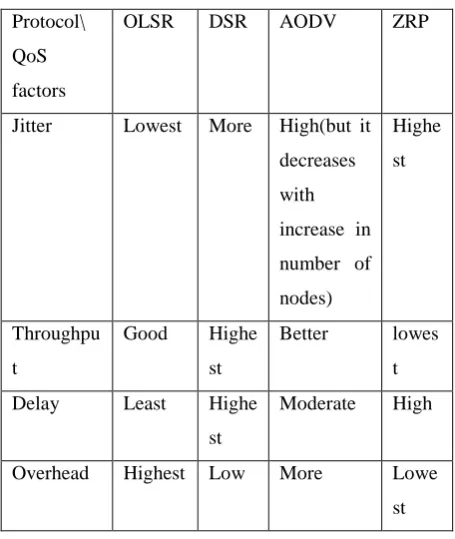
V. PERFORMANCE OF ROUTING PROTOCOLS
5.1 Packet Routing Overhead
In case of OLSR, as it consistently floods the message for table updatation, it increases its network overhead.
Hence, it provides higher routing traffic .In case of DSR as it does not send unnecessary routing traffic hence the
routing overhead is less as compared to OLSR but AODV has less overhead as compared to DSR because it
maintains no sequence of the packet to be deliver. In case of ZRP when the destination node lies within the zone
it uses proactive protocol inside the zone the routing overhead will increase as it needs to maintain the updated
information.
5.2 Delay
In OLSR it always updates its routing hence the network is available for data transmission. Hence the delay
provided by the OLSR is relatively low while DSR performs better than AODV and ZRP.AODV works better if
the number of nodes are less, Increase in nodes of network result in higher delay. Because of the varying nature
of mobile network, ZRP provides maximum delay.
5.3 Throughput
The throughput of a network defined as the capability to transmit maximum number of data packets over the
channel In case of higher number of nodes and mobility of nodes AODV transmits the maximum data from
source to destination. The throughput provided by DSR is very low because of higher overhead. As number of
node increases in the network, their performance degrades. In every case, the throughput provided by the OLSR
is high. The ZRP provides the least throughput in case of varying nodes.
5.4 Jitter
Jitter defined as the variance in the delay timing. AODV provides high jitter but as no. of nodes increases its
performance increases. In case of DSR protocol it is relatively low than AODV.As the route is updated in
OLSR, it provides better performance. ZRP gives highest jitter: as the number of nodes increases, the delay in
Table – Comparison of Protocols
VI. CONCLUSION
This paper provides the comparative analysis of various routing protocols. Performance varies according to the
nature of the network. In case of throughput, DSR provides better performance than OLSR and ZRP but OLSR
give you least end-to-end delay. Moreover, in case of ZRP it gives higher jitter where OLSR provide lowest
jitter. However, if we talk about routing overhead then ZRP gives better performance than other routing
protocols. Overall, we find that DSR is better. There are various aspects for further research based on some
other QoS factors.
REFEENCES
[1] T. Bheemarjuna Reddy, I. Karthigeyan, B.S. Manoj, C. Siva Ram Murthy “Quality of Service Provisioning
In Ad Hoc Wireless Networks: A Survey of Issues and Solutions” Department Of Computer Science and
Engineering, Indian Institute of Technology, Madras 600036, India
[2] P.Venkata Maheswara (Dept. of CSE), K. Bhaskar Naik (Asst. Prof., Dept. of CSE), “Routing Protocol
Performance Issues And Evaluation Considerations In MANET”Sree Vidyanikethan Engg. College,
Tirupati, India
[3] Saurabh Chandraȧ, Ashish Xavier Dasȧ And A.K. Jaiswalȧ “Qos For Energy Efficient Routing Protocols
In IEEE 802.11 Wireless Mobile Ad hoc Network Using Qualnet Simulator 6.1” Ȧdept. Of Ece, Shiats,
Allahabad, India
[4] Mahendra Kumar, Research Scholar, A. K. Jain, Professor And Head “ Effect Of Delay And Jitter On
Wireless Ad-Hoc Networks (IEEE 802.11) With Various Routing Protocols” Department Of Protocol\
QoS
factors
OLSR DSR AODV ZRP
Jitter Lowest More High(but it
decreases
with
increase in
number of
nodes)
Highe
st
Throughpu
t
Good Highe
st
Better lowes
t
Delay Least Highe
st
Moderate High
Overhead Highest Low More Lowe
Instrumentation And Control Engineering, Dr. B R Ambedkar National Institute Of Technology Jalandhar,
Punjab-144011, India
[5] Tanu Jain, P.G Scholar, Rupesh Dubey, Associate Professor “Achieving Throughput In Topology By
Implementing Qos In Wireless Ad Hoc Networks” Department Of Electronics And Communication
Engineering, Ies Ips Academy, Indore (M.P), India.
[6] S. Sridhar, And R. Baskaran “Efficient Routing In Mobile Adhoc Networks Emphasizing Quality of
Service By Trust & Energy Based Aodv”
[7] Jeroen Hoebeke, Ingrid Moerman, Bart Dhoedt And Piet Demeester “An Overview Of Mobile Ad Hoc
Networks: Applications And Challenges” Department Of Information Technology (Intec), Ghent
University – Imec Vzw, Sint Pietersnieuwstraat 41, B-9000 Ghent,Belgium.
[8] Mrs. Amandeep Kaur, An Overview Of Quality Of Service Computer Network Assistant Professor,
Department of Computer Application, Apeejay Institute of Management, Ramamandi, Jalandhar-144001,