University of Pennsylvania University of Pennsylvania
ScholarlyCommons
ScholarlyCommons
Publicly Accessible Penn Dissertations
2019
Measuring And Securing Cryptographic Deployments
Measuring And Securing Cryptographic Deployments
Luke Taylor Valenta
University of Pennsylvania, [email protected]
Follow this and additional works at: https://repository.upenn.edu/edissertations
Part of the Computer Sciences Commons
Recommended Citation Recommended Citation
Valenta, Luke Taylor, "Measuring And Securing Cryptographic Deployments" (2019). Publicly Accessible Penn Dissertations. 3507.
Measuring And Securing Cryptographic Deployments
Measuring And Securing Cryptographic Deployments
Abstract Abstract
This dissertation examines security vulnerabilities that arise due to communication failures and incentive mismatches along the path from cryptographic algorithm design to eventual deployment. I present six case studies demonstrating vulnerabilities in real-world cryptographic deployments. I also provide a framework with which to analyze the root cause of cryptographic vulnerabilities by characterizing them as failures in four key stages of the deployment process: algorithm design and cryptanalysis,
standardization, implementation, and endpoint deployment. Each stage of this process is error-prone and influenced by various external factors, the incentives of which are not always aligned with security. I validate the framework by applying it to the six presented case studies, tracing each vulnerability back to communication failures or incentive mismatches in the deployment process.
To curate these case studies, I develop novel techniques to measure both existing and new cryptographic attacks, and demonstrate the widespread impact of these attacks on real-world systems through
measurement and cryptanalysis. While I do not claim that all cryptographic vulnerabilities can be described with this framework, I present a non-trivial (in fact substantial) number of case studies demonstrating that this framework characterizes the root cause of failures in a diverse set of cryptographic deployments.
Degree Type Degree Type Dissertation
Degree Name Degree Name
Doctor of Philosophy (PhD)
Graduate Group Graduate Group
Computer and Information Science
First Advisor First Advisor Nadia A. Heninger
Keywords Keywords
Cryptography, Diffie-Hellman, Elliptic curves, Internet scanning, TLS
MEASURING AND SECURING CRYPTOGRAPHIC DEPLOYMENTS
Luke Valenta
A DISSERTATION
in
Computer and Information Science
Presented to the Faculties of the University of Pennsylvania
in
Partial Fulfillment of the Requirements for the
Degree of Doctor of Philosophy
2019
Supervisor of Dissertation
Nadia Heninger, Adjunct Associate Professor of Computer and Information Science
Graduate Group Chairperson
Rajeev Alur, Zisman Family Professor and Computer and Information Science Graduate Group Chair
Dissertation Committee
Jonathan M. Smith, Professor of Computer and Information Science
Matthew A. Blaze, Adjunct Professor of Computer and Information Science
Boon Thau Loo, Professor of Computer and Information Science
ACKNOWLEDGEMENT
One page is not enough room to list all of the collaborators, mentors, staff, classmates, and
friends to which I am grateful for making the last five years so enjoyable, enlightening, and
interesting. I am especially grateful to those below:
Nadia Heninger, not only for her valuable guidance and support, but for the adventures—
from acro yoga in the park to parties on pirate ships—that made this journey unforgettable.
Prof. Smith, for always being there to provide wisdom and advice, and working tirelessly
to help others. Prof. Loo, for his encouragement and enthusiastic support throughout my
graduate school career. Prof. Blaze, who is always willing to share his vast knowledge
and experience. Prof. Green, for his insight, thoughtfulness, willingness to collaborate,
and exceptional ability to spark research ideas. Brandi Adams, for convincing me to give
research a try, and David Levin for helping me to discover the joys of research.
Nick Roessler, for all of the thought-provoking conversations, board game nights, and Philly
adventures we’ve shared over these past five years. I couldn’t ask for a better friend,
roommate, and juggling partner. Marcella Hastings, for being an amazing labmate, travel
companion, and all around one of the most fun and personable people I know. Shaanan
Cohney, who is a genuine and truly wonderful friend, always willing to loop me in as a
co-conspirator in mischief. Rafi Ruben, for patiently teaching me everything I know about
sysadmining, and for always being willing to drop everything to help a friend.
My parents, Van and Claudia, for reading my papers despite claiming they “didn’t
under-stand a word,” and for never failing to provide me with advice and love when I need it. My
siblings, Sarah, Stephen, David, Lydia, Peter, and Abigail, who have inspired me with their
own accomplishments and continue to be some of my best friends in the world. Finally,
I am grateful to Nicole for her continuous love and support, and for giving me so many
ABSTRACT
MEASURING AND SECURING CRYPTOGRAPHIC DEPLOYMENTS
Luke Valenta
Nadia Heninger
This dissertation examines security vulnerabilities that arise due to communication failures
and incentive mismatches along the path from cryptographic algorithm design to eventual
deployment. I present six case studies demonstrating vulnerabilities in real-world
crypto-graphic deployments. I also provide a framework with which to analyze the root cause of
cryptographic vulnerabilities by characterizing them as failures in four key stages of the
deployment process: algorithm design and cryptanalysis, standardization, implementation,
and endpoint deployment. Each stage of this process is error-prone and influenced by
vari-ous external factors, the incentives of which are not always aligned with security. I validate
the framework by applying it to the six presented case studies, tracing each vulnerability
back to communication failures or incentive mismatches in the deployment process.
To curate these case studies, I develop novel techniques to measure both existing and new
cryptographic attacks, and demonstrate the widespread impact of these attacks on
real-world systems through measurement and cryptanalysis. While I do not claim that all
cryptographic vulnerabilities can be described with this framework, I present a non-trivial
(in fact substantial) number of case studies demonstrating that this framework characterizes
TABLE OF CONTENTS
ACKNOWLEDGEMENT . . . ii
ABSTRACT . . . iii
LIST OF TABLES . . . vii
LIST OF ILLUSTRATIONS . . . xv
CHAPTER 1 : Introduction . . . 1
1.1 A framework for analyzing failures in cryptographic deployments . . . 1
1.2 Case studies . . . 6
CHAPTER 2 : Measuring finite field Diffie-Hellman . . . 18
2.1 Introduction . . . 18
2.2 Background . . . 21
2.3 TLS . . . 28
2.4 IPsec . . . 38
2.5 SSH . . . 45
2.6 Factoring Group Orders of Non-Safe Primes . . . 48
2.7 Discussion . . . 49
CHAPTER 3 : Measuring elliptic curve Diffie-Hellman . . . 55
3.1 Introduction . . . 55
3.2 Preliminaries . . . 58
3.3 Related Work . . . 67
3.4 Elliptic Curve Measurements . . . 68
3.5 CurveSwap Attack . . . 74
3.7 Source Code Analysis . . . 82
3.8 Discussion . . . 84
3.A Invalid Curve and Twist Points . . . 85
3.B Extended Scans on Multiple Ports . . . 86
CHAPTER 4 : Side-channel attack against Curve25519 . . . 88
4.1 Introduction . . . 88
4.2 Preliminaries . . . 97
4.3 Cryptanalysis . . . 105
4.4 Experimental Results . . . 110
4.5 Software Countermeasures . . . 117
4.6 Conclusion . . . 120
CHAPTER 5 : 512-bit RSA in the wild . . . 121
5.1 Introduction . . . 121
5.2 Background . . . 123
5.3 Implementation . . . 127
5.4 Experiments . . . 129
5.5 512-bit keys still in use . . . 134
5.6 Conclusions . . . 142
CHAPTER 6 : Logjam attack and measurements . . . 143
6.1 Introduction . . . 143
6.2 Diffie-Hellman Cryptanalysis . . . 145
6.3 Attacking TLS . . . 149
6.4 State-Level Threats to DH . . . 160
6.5 Recommendations . . . 173
6.6 Disclosure and Response . . . 174
CHAPTER 7 : DROWN attack and measurements . . . 176
7.1 Introduction . . . 176
7.2 Background . . . 179
7.3 Breaking TLS with SSLv2 . . . 185
7.4 General DROWN . . . 191
7.5 Special DROWN . . . 197
7.6 Measurements . . . 201
7.7 Signature forgery attacks and QUIC . . . 204
7.8 Related work . . . 206
7.9 Discussion . . . 208
7.A Public key reuse . . . 212
7.B Adaptations to Bleichenbacher’s attack . . . 212
7.C Highly optimized GPU implementation . . . 220
7.D Amazon EC2 evaluation . . . 223
7.E A brief history of obsolete cryptography . . . 224
CHAPTER 8 : Conclusion . . . 226
8.1 Takeaways . . . 226
8.2 Summary of Impact . . . 228
LIST OF TABLES
TABLE 1 : Characterizing cryptographic attacks—Attacks against
cryp-tographic deployments can be traced back to a mistake,
misunder-standing, or incentive mismatch in the deployment process. . . 7
TABLE 2 : Common application behavior—Applications make a diverse set
of decisions on how to handle Diffie-Hellman exponents, likely due
to the plethora of conflicting, confusing, and incorrect
recommenda-tions available. . . 28
TABLE 3 : TLS library behavior—We examined popular TLS libraries to
determine which weaknesses from Section 2.2.6 were present. Reuse
of exponents often depends on the use of the library; the burden is
on the application developer to appropriately regenerate exponents.
Botan and libTomCrypt both hardcode their own custom groups,
while GnuTLS allows users to specify their own parameters. . . . 31
TABLE 4 : IPv4 non-safe prime and static exponent usage—Although
non-safe primes see widespread use across most protocols, only a
small number of hosts reuse exponents and use non-safe primes; these
TABLE 5 : TLS key exchange validation—We performed a 1% HTTPS scan
in August 2016 to check if servers validated received client key
ex-change values, offering generators of subgroups of order 1, 2 and
7. Our baseline DHE support number counts hosts willing to
ne-gotiate a DHE key exchange, and in the case of g7, if p−1 is
di-visible by 7. We count hosts as “Accepted” if they reply to the
ClientKeyExchange message with aFinishedmessage. For g7, we
expect this to happen with probability 1/7, suggesting that nearly
all of the hosts in our scan did not validate subgroup order. . . 35
TABLE 6 : IPv4 top non-safe primes—Nine non-safe primes account for the
majority of hosts using non-safe primes. . . 36
TABLE 7 : HTTPS support for RFC5114 Group 22—In a 100% HTTPS
scan performed in October 2016, we found that of the 12,835,911
hosts that accepted Diffie-Hellman key exchange, 901,656 used Group 22.
We were able to download default web pages for 646,157 of these
hosts, which we examined to identify companies and products. . . . 37
TABLE 8 : IKE group support and validation—We measured support for
RFC5114 DSA groups in IKEv1 and IKEv2 and test for key exchange
validation by performing a series of 100% IPv4 scans in October
2016. For Group 23, gs is a generator of a subgroup with order 3,
and for Groups 22 and 24, gsis a generator of a subgroup of order 7. 43
TABLE 9 : SSH validation—In a 1% SSH scan performed in February 2016,
we sent the key exchange valuesyc= 0,1 andp−1. We count hosts as
having initiated a handshake if they send aSSH MSG KEX DH GEX GROUP,
and we count hosts as “Accepted” if they reply to the client key
TABLE 10 : Distribution of orders for groups with non-safe primes—
For groups for which we were able to determine the subgroup order
exactly, 160-bits subgroup orders are common. We classify other
groups to be likely DSA groups if we know that the subgroup order
is at least 8 bits smaller than the prime. . . 48
TABLE 11 : Full key recovery attack complexity—We estimate the amount
of work required to carry out a small subgroup key recovery attack,
and show the prevalence of those groups in the wild. Hosts are
vulnerable if they reuse exponents and fail to check subgroup order. 50
TABLE 12 : Attacking RFC 5114 groups—We show the log of the amount
of work in bits required to perform a small subgroup key recovery
attack against a server that both uses a static Diffie-Hellman
expo-nent of the same size as the subgroup order and fails to check group
order. . . 50
TABLE 13 : Group order factorization for common non-safe primes—
We used the elliptic curve method to factor (p−1)/2 for each of the
non-safe primes we found while scanning, as well as the mistyped
OpenSSL “prime”. . . 51
TABLE 14 : Server supported curves—BASE gives the number of hosts that
we were able to negotiate any key exchange with andECDHE gives
the number that support ECDHE key exchange. Percentage support
for each curve is with respect to ECDHE. . . 65
TABLE 15 : Client supported curves extensions with user agents—We
show the ranked list of the most common supported curves lists
along with the user agents and operating systems of the clients for
a sample of 4,187,201 client hellos collected from Cloudflare. The
mapping of curve IDs in the supported curves list to curve names is
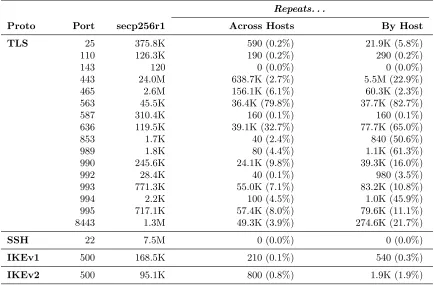
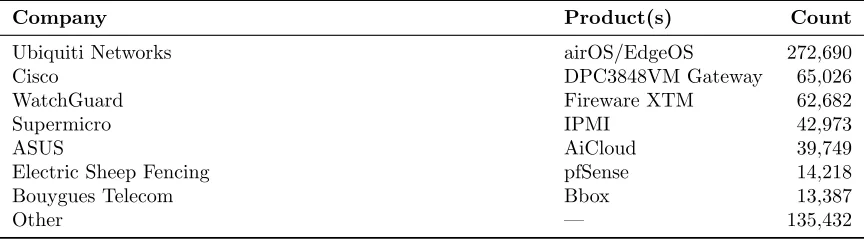
TABLE 16 : Repeated key exchanges—In November 2016, we scanned a
ran-domly selected 10% of IPv4 addresses twice in rapid succession,
of-fering curve secp256r1. Across Hosts gives the number of hosts that
sent the same key exchange value as another host within a single
scan, and By Host shows the number of hosts that sent the same
key exchange value in both scans. . . 72
TABLE 17 : Servers ignoring client supported curves—In our scans, we
found that some servers responded with the same curve regardless
of client’s list of supported curves. RFC 4492 states that a server
must not negotiate the use of an ECC cipher suite if it is not able
to complete an ECC handshake with the parameters offered by the
client [72]. . . 73
TABLE 18 : TLS server support for weak curves—In August 2017, we scanned
a randomly selected 10% of TLS hosts to measure support for weak
curves. We scanned each host twice for each curve to detect servers
using ephemeral-static keys. The baseline scan shows the number of
hosts with which we were able to negotiate any curve. The repeat
percentages are with respect to the support scans for each curve. . 78
TABLE 19 : TLS client support for weak curves—From a sample of 4,187,201
client hellos collected from Cloudflare in October 2016, over 16%
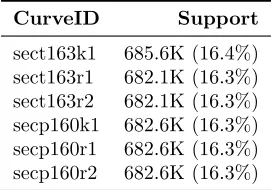
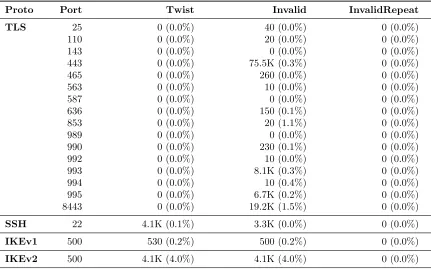
TABLE 20 : Invalid key exchanges—In November 2016, we scanned a
ran-domly selected 10% of IPv4 addresses offering order 5 points on an
invalid curve and on the twist of curve secp256r1. We show the
number of hosts for which handshake negotiation is successful. As
described in Section 3.6.2, we estimate that the number of
vulnera-ble TLS hosts is 5/2 times larger than the numbers reported in the
table. For SSH and IKE, these numbers are an upper bound on the
number of vulnerable hosts. . . 81
TABLE 21 : JWE libraries—We manually inspected the source code of several
libraries implementing JSON Web Encryption, and found that many
were vulnerable to a classic invalid curve attack. . . 83
TABLE 22 : Repeated key exchanges—Extended version of Table 16. . . . 86
TABLE 23 : Invalid key exchanges—Extended version of Table 20. . . 87
TABLE 24 : Server supported curves—Extended version of Table 14. . . . 87
TABLE 25 : Large prime bounds—Decreasing the large prime bound
parame-ter increases the amount of work required for sieving, but decreases
the work required for linear algebra. This is an advantageous choice
when large amounts of resources can be devoted to sieving. . . 130
TABLE 26 : HTTPS RSA common key lengths and export RSA
sup-port—HTTPS scans downloaded from scans.io were performed
using ZMap on port 443 on August 23 and September 1, 2015. . . . 136
TABLE 27 : Mail protocol key lengths—An Internet-wide scan of TLS usage
in three common mail protocols shows higher levels of support for
RSA EXPORT cipher suites than in HTTPS. . . 137
TABLE 28 : DKIM key sizes—DKIM public keys were collected from a Rapid7
DNS dataset, and manual DNS lookups of 11,600 domains containing
TABLE 29 : IPsec VPN certificate keys—We performed Internet-wide scans
on port 500 of IKEv1 in aggressive mode. Of the servers that
re-sponded with certificates, 1.6% had a 512-bit public key. . . 139
TABLE 30 : SSH host key lengths—Host keys were collected in April 2015 in
a ZMap scan of SSH hosts on port 22 mimicking OpenSSH 6.6.1p1. 140
TABLE 31 : Top 512-bit DH primes for TLS—8.4% of Alexa Top 1M HTTPS
domains allowDHE EXPORT, of which 92.3% use one of the two most
popular primes, shown here. . . 149
TABLE 32 : Estimating costs for factoring and discrete log—For sieving,
we give two important parameters: the number of bits of the
smooth-ness boundBand the sieving region parameter I. For linear algebra,
all costs for DH are for safe primes; for DSA primes with q of 160
bits, this should be divided by 6.4 for 1024 bits, 4.8 for 768 bits, and
3.2 for 512 bits. . . 160
TABLE 33 : Estimated impact of Diffie-Hellman attacks—We use
Internet-wide scanning to estimate the number of real-world servers for which
typical connections could be compromised by attackers with various
levels of computational resources. For HTTPS, we provide figures
with and without downgrade attacks on the chosen ciphersuite. All
others are passive attacks. . . 170
TABLE 34 : 2048-bit Bleichenbacher attack complexity—The cost to
de-crypt one ciphertext can be adjusted by choosing the set of fractions
F the attacker applies to each of the passively collected ciphertexts
in the first step of the attack. This choice affects several parameters:
the number of these collected ciphertexts, the number of connections
the attacker makes to the SSLv2 server, and the number of offline
TABLE 35 : Oracle queries required by our attack—In Phase 1, the attacker
queries the oracle until an SSLv2 conformant ciphertext is found.
In Phases 2–5, the attacker decrypts this ciphertext using leaked
plaintext. These numbers minimize total queries. In our attack, an
oracle query represents two server connections. . . 195
TABLE 36 : Hosts vulnerable to general DROWN—We performed
Internet-wide scans to measure the number of hosts supporting SSLv2 on
several different protocols. A host is vulnerable to DROWN if its
public key is exposed anywhere via SSLv2. Overall vulnerability to
DROWN is much larger than support for SSLv2 due to widespread
reuse of keys. . . 199
TABLE 37 : Hosts vulnerable to special DROWN—A server is vulnerable
to special DROWN if its key is exposed by a host with the
CVE-2016-0703 bug. Since the attack is fast enough to enable
man-in-the-middle attacks, a server is also vulnerable (to impersonation) if
any name in its certificate is found in any trusted certificate with an
exposed key. . . 201
TABLE 38 : Impact of key reuse across ports—Number of shared public keys
among two ports, in thousands. Each column states what number
and percentage of keys from the port in the header row are used on
other ports. For example, 18% of keys used on port 25 are also used
on port 443, but only 4% of keys used on port 443 are also used on
TABLE 39 : Time and cost efficiency of our attack on different hardware
platforms—The brute force attacks against symmetric export keys
are the most expensive part of our attack. We compared the
perfor-mance of a na¨ıve implementation of our attack on different platforms,
and decided that a GPU implementation held the most promise. We
then heavily optimized our GPU implementation, obtaining several
LIST OF ILLUSTRATIONS
FIGURE 1 : The CurveSwap attack.—A man-in-the-middle can force TLS
clients to use the weakest curve that both the client and server
support. Then, by computing the discrete log on the weak curve,
the attacker can learn the session key and arbitrarily read or modify
message contents. . . 75
FIGURE 2 : Trace (excluding four first bits) of scalar-by-point
multi-plication of a secret key with an element of order 4—We can
learn the bits of the scalar (shown on the x-axis) from the sequence
of longand short modular reduction operations: a short reduction implies that the current bit is the same as the previous bit, whereas
a long reduction means that the current bit is the complement of the previous bit. . . 109
FIGURE 3 : Memory access times of the Flush+Reload attack–The lengths
of the horizontal bars corresponding to the lengths of modular
re-ductions. The results were obtained by flushing and reloading four
memory locations, two within the constant-time swap code and two
within the multiplication code. In each sample, we perform a flush
followed by a reload for each of these four memory locations,
mea-suring access times. We show the minimum of the access times for
the two memory locations in the constant-time swap code in red,
and the minimum of the access times for the two memory locations
FIGURE 4 : Five processed traces—Dark spots indicate an observedlong re-duction and light spots indicate an observedshortreduction. Three errors in the observation are marked with X marks. Two of them
observe the wrong reduction length and the third is a superfluous
bit. . . 114
FIGURE 5 : Distribution of the number of errors (excluding four first
bits) in traces of the scalar multiplication—Out of 1000
cap-tured traces, there are an average of 3.8 errors per trace. . . 115
FIGURE 6 : A time/cost curve for 512-bit factorization—Each point above
is annotated with the instances used for sieving and linear algebra,
respectively, and represents an experimental estimate. There are
diminishing returns from imperfect parallelization in linear algebra.
The dotted line shows the fastest time we were able to achieve;
larger experiments usually encountered node instability. . . 123
FIGURE 7 : The number field sieve—The number field sieve factoring
algo-rithm consists of several main stages. Sieving and linear algebra
are the most computationally intensive stages. Sieving is
embar-rassingly parallel, while parallelizing linear algebra can encounter
communication bottlenecks. . . 124
FIGURE 8 : Target density and oversieving—Increasing the target density
parameter decreases linear algebra time, but requires more relations
to construct the matrix. Collecting additional relations beyond
the minimum also produces a better matrix and decreases linear
algebra time. This trade-off can be advantageous if more resources
FIGURE 9 : DNSSEC key sizes and duration—The ratios of RSA key lengths
has remained relatively stable over time, although the total number
of DNSSEC keys collected fluctuated across scans. The number of
512-bit keys remained around 10,000, or 0.35% of the total. Many
DNSSEC keys are rotated infrequently, and 512-bit keys are rotated
less frequently than longer keys. . . 134
FIGURE 10 : PGP RSA public key lengths by reported creation date—
RSA public keys were downloaded from keyserver.borgnet.us,
a PGP keyserver bootstrap dataset, on October 4, 2015. . . 141
FIGURE 11 : The number field sieve algorithm for discrete log—The
al-gorithm consists of a precomputation stage that depends only on
the prime p and a descent stage that computes individual logs.
With sufficient precomputation, an attacker can quickly break any
Diffie-Hellman instances that use a particularp. . . 144
FIGURE 12 : The Logjam attack—A man-in-the-middle can force TLS clients
to use export-strength DH with any server that allowsDHE EXPORT.
Then, by finding the 512-bit discrete log, the attacker can learn
the session key and arbitrarily read or modify the contents. Dataf s
refers to False Start [201] application data that some TLS clients
send before receiving the server’sFinished message. . . 152
FIGURE 13 : Individual discrete log time for 512-bit DH—After a
week-long precomputation for each of the two top export-grade primes
(see Table 31), we can quickly break any key exchange that uses
them. Here we show times for computing 3,500 individual logs; the
FIGURE 14 : NSA’s VPN decryption infrastructure—This classified
illus-tration published by Der Spiegel [20] shows captured IKE
hand-shake messages being passed to a high-performance computing
sys-tem, which returns the symmetric keys for ESP session traffic. The
details of this attack are consistent with an efficient break for
1024-bit Diffie-Hellman. . . 169
FIGURE 15 : SSLv2 handshake—The server responds with a ServerVerify
message directly after receiving an RSA-PKCS#1 v1.5 ciphertext
contained inClientMasterKey. This protocol feature enables our
attack. . . 181
FIGURE 16 : Our SSLv2-based Bleichenbacher attack on TLS—An
at-tacker passively collects RSA ciphertexts from a TLSv1.2
hand-shake, and then performs oracle queries against a server that
CHAPTER 1 : Introduction
Billions of users every day rely on cryptographic protocols like Transport Layer Security
(TLS), Secure Shell (SSH), and Internet Protocol Security (IPsec) for communication
se-curity. The security of these protocols relies both on their theoretical cryptographic
under-pinnings and their concrete instantiations. Over the years, cryptographic primitives have
evolved to adhere to stronger notions of security as the field advances. However, despite
decades of innovation and constant improvement to the state of the art, the cryptographic
security of real-world systems is not a solved problem. Cryptographic primitives, standards,
and implementations have failed repeatedly over the years, leaving a trail of vulnerable
sys-tems. New attacks are constantly being developed, and old attacks resurface in unexpected
ways, driving the need for continual reevaluation of the security of deployed systems.
In this dissertation, I present six research studies that uncover both new and existing attacks
in deployed cryptographic systems. To understand the provenance of these vulnerabilities, I
introduce a novel framework for characterizing cryptographic vulnerabilities as
communica-tion failures and misaligned incentives in the multi-stage cryptographic deployment process,
and use this framework to trace each of the presented case studies back to their root causes.
1.1. A framework for analyzing failures in cryptographic deployments
In this section, I break down the cryptographic deployment process into four primary stages,
and describe the factors that influence each stage. Understanding each stage is a crucial for
determining the origination of cryptographic failures in real-world deployments.
1.1.1. Algorithm design and cryptanalysis
The first step in the cryptographic deployment process is algorithm design. Cryptographic
algorithm designers are typically cryptography experts that have deep understandings of
the mathematical underpinnings of their constructions. In this stage, the algorithm designer
constructs a cryptographic primitive and (often) proves its security based on mathematical
assumptions in some adversarial model. Low-level details such as encoding formats, random
the mathematical details. However, algorithm designers may provide guidelines for choosing
concrete parameters based on the asymptotic complexity of the best known attacks against
the primitive.
1.1.2. Standardization
The next stage in the cryptographic deployment framework is standardization. Standards
development is driven by trusted standards bodies such as National Institute of Standards
and Technology (NIST), the IEEE Standards Association (IEEE-SA), and the Internet
Engineering Task Force (IETF). These organizations develop standards for government,
industry, and private use. Standards organization are concerned with improving existing
standards as well as developing new standards to adapt to the evolving needs of technology
users. This involves identifying cryptographic algorithms for standardization and providing
detailed guidelines for their use in applications to ensure interoperability. The
standardiza-tion process also allows for scrutiny of cryptographic primitives by the security community
and makes standardized options available for common cryptographic operations to help
prevent non-experts from “rolling their own crypto.”
While algorithm designers and cryptanalysts may have some say in the cryptographic
stan-dardization process, there are many other players involved, each with their own incentives.
These parties include governments, vendors implementing the standards, security
profes-sionals, and the end users of the technology. Thus, the standardization process must cater
to many external requests and demands, and usually results in a final specification for which
security is only one of many priorities such as interoperability, regulatory compliance, and
implementation flexibility.
1.1.3. Implementation
Following standardization, implementation is the next stage of cryptographic deployment.
The outputs of this stage are software or hardware implementations of cryptographic
pro-tocols and primitives ready to be deployed in applications. Implementers of cryptographic
libraries are often individuals or teams of programmers with some specialized knowledge of
implementations regarding programming language, performance optimizations, algorithm
support, and parameter selection. For example, IETF standards designate where
imple-mentation choices are required with key words like “MUST”, “SHOULD”, and “MAY” in
protocol specifications [76]. Implementations may seek accreditation of compliance with
standards requirements such as NIST’s FIPS 140-2 standard [233], or may skip
standards-compliance altogether.
In general, implementations are only as secure as the protocols they implement, and are
susceptible to additional human errors and programming mistakes. Further, cryptographic
implementations must be concerned with attack vectors such as side-channel attacks that
may be out of scope for standards specifications, while providing the performance demanded
by users of the implementation.
Cryptographic libraries expose APIs that are then used by application developers to build
products used in real-world cryptographic deployments. Library developers should not
as-sume that application developers have the same in-depth understanding of the cryptographic
primitives, and should thus expose simple and robust APIs to prevent misuse.
1.1.4. Endpoint deployment
Endpoint deployment is the final step of the deployment process. Application developers
and system administrators are the main parties involved in this stage.
Application developers choose cryptographic implementations to meet some desired
func-tionality within larger applications. For example, an application that requires a secure
communication channel may use a TLS implementation such as OpenSSL to provide this
functionality. Application developers are responsible for correctly using library APIs to
carry out some task, and providing the configurations necessary for a secure deployment.
System administrators determine the exact hardware, software, and configuration of
end-point cryptographic deployments. They are responsible for updating applications to
efficiently and effectively. While security is often a requirement, it may not be prioritized
as highly as availability, functionality, compliance, and performance. System
administra-tors may also have time constraints and organizational pressures that prevent them from
properly configuring, updating, and maintaining their systems.
While some system administrators and application developers do have in-depth knowledge of
cryptographic algorithm design, this is often not the case and should not be assumed. Thus,
cryptographic implementations should clearly describe the risk accompanying the available
performance, functionality, and security trade-offs that they provide to their users, and
provide secure-by-default configurations.
1.1.5. Background
I now provide background on recurring themes that appear in the presented case studies.
Diffie-Hellman key exchange. Diffie-Hellman key exchange is a public-key algorithm
used as a fundamental building block for many cryptographic protocols. It allows two parties
to derive a shared secret after seeing each other’s public keys, with no prior communication
necessary. In the basic protocol, Alice and Bob each generate private keys a and b and
transmit their public keys ga and gb, respectively. Upon seeing the other party’s public
key, Alice and Bob can each compute the valuegab as a shared secret. If the Diffie-Hellman
parameters and public keys are chosen carefully, the basic protocol is secure against a passive
eavesdropper who can observe the public values.
Small subgroup attacks and public key validation. When this protocol is deployed
in real-world systems, additional care must be taken to ensure security. For instance, the
basic protocol trivially breaks in the presence of an active Monster-in-the-Middle (MitM)
attacker if messages between Alice and Bob are not properly authenticated. Further, if Bob
uses the same secret key b for multiple connections, Mallory may be able to carry out an
attack against connection with other parties.
his secret key using an untrusted input from his peer. A class of attacks known as small
subgroup attacks are possible if Bob uses a maliciously chosen public key from Mallory to
compute the shared secret. The attacks can either force the derived shared secret to be
a predictable value, or leak information about Bob’s secret key through a side channel or
from the key exchange output. Such attacks can be prevented if Bob performskey exchange
validation to detect and reject invalid public keys. The specific checks required for key
exchange validation vary depending on the domain parameters, and may require some level
of computation.
Although the attacks and defenses have been known for decades, there are many reasons
why implementations might omit validation, including for performance, a reduction in code
complexity, or an assumption that the attacks will be prevented by some other protocol
mechanism. However, a break in these assumptions can lead to devastating attacks. The
work presented in this dissertation shows that lack of validation continues to be a source of
attacks against Diffie-Hellman in real-world systems.
Cryptographic agility. Modern protocols are often designed to have cryptographic
agility [170], meaning that it should be possible for the protocol to easily migrate from
older, less secure algorithms to newer, more secure algorithms. Since implementations are
not updated all at once, but gradually over time, up-to-date implementations that support
the latest cryptographic parameters must still support the outdated algorithms if they wish
to communicate with older clients and servers. When standards do not provide sufficient
agility, implementations tend to resort toad hocnegotiation mechanisms, such as repeatedly
falling back to a previous protocol version until both parties indicate support [225].
Obsolete and intentionally weakened cryptography. Perhaps the most well-known
examples of obsolete cryptography lurking in modern systems are the export-grade ciphers
in the SSL/TLS protocols. Throughout the 1990s, U.S. law severely restricted the export
of cryptographic devices and algorithms from the United States. When the SSL protocol
pro-hibited the export of “Information Security Systems and equipment, cryptographic devices,
software, and components”, with an eventual exception made for weak, breakable
encryp-tion. To comply with the regulations, early versions of SSL included cipher suites that
limited the security to 512-bit public keys for RSA and Diffie-Hellman key exchange, and
40-bit keys for symmetric ciphers. The export restrictions were gradually lifted through the
year 2000, and starting with TLSv1.1 export cipher suites were no longer included in TLS
standards. However, implementations often continue to support export-grade cryptography
for backwards compatibility with existing systems.
Downgrade attacks. Maintaining support for obsolete and weakened cryptography in
modern systems can come with adverse side effects. First, backwards compatibility removes
the pressure to update legacy systems that are old and broken, leaving them exposed to
at-tacks. Second, a modern system maintaining support for weakened and vulnerable protocols
or parameters can increase its attack surface, in some cases exposing itself to unexpected
attack vectors. In particular, it invites downgrade attacks, where a MitM attacker can
force two communicating parties to use security parameters weaker than they would have
otherwise negotiated.
1.2. Case studies
This section provides overviews of each of the six cryptographic vulnerability case studies
contributed by this dissertation, and demonstrates how each can be characterized using the
provided cryptographic deployment framework.
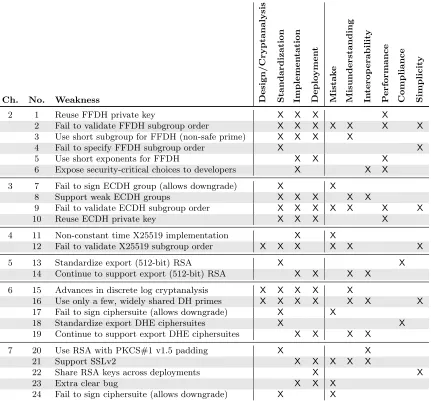
Table 1, which is referenced throughout the case study summaries in this section, shows
how each vulnerability can be characterized. The table indicates which stages of the
cryp-tographic deployment process are primarily responsible, and provides explanations for the
origins of each weakness.
The table columns providing explanations for each weakness are as follows: Mistake means
that the weakness is the result of a human error such a programming mistake or
Ch. No. Weakness Design/Cryptanalysis Standardization Implemen tation Deplo ymen t Mistak e Misunderstanding In terop erabilit y P erformance Compliance Simplicit y
2 1 Reuse FFDH private key X X X X
2 Fail to validate FFDH subgroup order X X X X X X X 3 Use short subgroup for FFDH (non-safe prime) X X X X
4 Fail to specify FFDH subgroup order X X
5 Use short exponents for FFDH X X X
6 Expose security-critical choices to developers X X X
3 7 Fail to sign ECDH group (allows downgrade) X X
8 Support weak ECDH groups X X X X X
9 Fail to validate ECDH subgroup order X X X X X X X
10 Reuse ECDH private key X X X X
4 11 Non-constant time X25519 implementation X X
12 Fail to validate X25519 subgroup order X X X X X X
5 13 Standardize export (512-bit) RSA X X
14 Continue to support export (512-bit) RSA X X X X
6 15 Advances in discrete log cryptanalysis X X X X X
16 Use only a few, widely shared DH primes X X X X X X X 17 Fail to sign ciphersuite (allows downgrade) X X
18 Standardize export DHE ciphersuites X X
19 Continue to support export DHE ciphersuites X X X X
7 20 Use RSA with PKCS#1 v1.5 padding X X
21 Support SSLv2 X X X X X
22 Share RSA keys across deployments X X
23 Extra clear bug X X X
24 Fail to sign ciphersuite (allows downgrade) X X
introduce the weakness without a clear understanding of the security risks. This could be
the result of a failure to communicate security requirements between stages of deployment,
or the result of new advances in cryptanalysis that fundamentally change our
understand-ing of the security of cryptographic primitives. Interoperability means that the decision to
introduce the weakness was made to allow for backwards compatibility with existing
deploy-ments, or to allow deployments flexibility to adapt in the future. Performance means that
a weakness was introduced to improve some aspect of performance. Compliance decisions
are made in order to comply with regulatory requirements; the introduction of export-grade
cryptography into the SSL/TLS standard is a prime example. Simplicityrepresents a
weak-ness that is introduced because it allows for less complex (and hopefully less error-prone)
deployments, or because it makes deployment easier.
Not all of the weaknesses described in Table 1 constitute exploitable vulnerabilities in
isolation, but they do when combined with other weaknesses. The fact that many of these
attacks presented in the case studies require multiple weaknesses to be exploitable in practice
demonstrates a lack of defense in depth in deployed cryptographic systems.
1.2.1. Finite field Diffie-Hellman attacks and measurements
Chapter 2 presents a measurement survey of small subgroup attacks in finite field
Diffie-Hellman (FFDH) deployments. The case study first explores the impact of these attacks
against the TLS, SSH, and IPsec protocols. We examined over 20 cryptographic libraries
to understand their implementation choices, and found that until January 2016,none
per-formed the requisite validation to prevent small subgroup attacks by default. We found
full key recovery attacks against OpenSSL, the Exim mail server, and the Unbound DNS
resolver. We then used ZMap [114] to perform scans of the IPv4 Internet to measure server
behavior regarding Diffie-Hellman parameter choice, key reuse, and key exchange
valida-tion. We found that many server performed insufficient validation for the Diffie-Hellman
parameters that they supported, potentially leaving them open to attack. Finally, we
char-acterized the complexity of small subgroup attacks against Diffie-Hellman groups found in
that fail to perform validation.
Vulnerability characterization. I now discuss how small subgroup attacks, which have
been known about for decades, make their way into modern FFDH cryptographic
deploy-ments. Small subgroup key recovery attacks in the FFDH setting require a deployment
to reuse the same private key for multiple connections, use a non-safe prime, and fail to
perform key exchange validation.
Security proofs for protocols using Diffie-Hellman often require that private keys are ephemeral
to ensure forward secrecy and to prevent key leakage through repeated small subgroup
at-tacks. However, generating fresh ephemeral Diffie-Hellman keys for each new connection
can be computationally expensive, especially for servers that handle high workloads. Thus,
system administrators prefer to cache and reuse ephemeral values to improve performance
(No. 1). This study found that this behavior was enabled by default for some library
implementations (e.g., OpenSSL), and was common for servers on the Internet. Some
stan-dards explicitly forbid this practice, while others place no restrictions on ephemeral key
reuse [218].
Diffie-Hellman requires that public keys are non-identity elements of a sufficiently large
subgroup. To ensure this, standards specify one set of validation checks for safe prime
groups, and another set of validation checks for non-safe primes in “DSA-style” groups that
includes an additional exponentiation to check the subgroup order. The validation checks
required for safe prime groups are simpler and less computationally expensive, so several
standards including IPsec and SSH required implementations to use safe prime groups
only, and specified the simpler validation checks (No. 2). When non-safe primes were
later standardized for IETF protocols including TLS, SSH, and IPsec [206] (No. 3), this
required implementations using these parameters to perform additional validation checks to
avoid small subgroup attacks. However, protocols like SSH and TLS that allow servers to
unilaterally specify the group parameters during the key exchange protocol do not provide
checks (No. 4). Thus, deployments of these protocols that were configured to use these
non-safe primes were unable to perform the necessary validation (No. 2) and became vulnerable
to small subgroup attacks if configured to reuse private keys. Full key recovery attacks are
made possible when implementations additionally use short exponents (e.g., 128 bits for a
1024-bit prime group) to match the size of the group’s expected security (No. 5).
I hypothesize that many practical attacks are made possible because tradeoffs between
security and performance are left to the deployment stage, potentially forcing non-experts
to make security-critical decisions that require domain-specific knowledge (No. 6). Without
a proper understanding of the known risks associated with those tradeoffs at endpoint
deployments, it is no surprise that security vulnerabilities arise.
This chapter is based on work [297] published at NDSS 2017 in collaboration with David
Adrian, Antonio Sanso, Shaanan Cohney, Joshua Fried, Marcella Hastings, J. Alex
Halder-man, and Nadia Heninger.
1.2.2. Elliptic curve Diffie-Hellman attacks and measurements
Chapter 3 presents a survey of the protocol-level and implementation-level attack surface
of elliptic curve Diffie-Hellman (ECDH) in TLS, SSH, IPsec, and JSON Web Encryption
(JWE). The study starts by analyzing the feasibility of a theoretical downgrade attack called
CurveSwap that allows a MitM adversary to downgrade the security of a TLS connection to
the weakest Diffie-Hellman group supported by both client and server, as long as the MitM
can forge the TLS Finished MAC before the connection times out. The study also gauges
the feasibility of similar curve downgrade attacks against SSH and IPsec. Contributions
of this work include extensive active and passive measurements of implementation choices
regarding algorithm support, key reuse, and validation to determine if any client and server
deployments were vulnerable to the downgrade attack. Through our scans, we found a
significant population of servers failing to properly validate key exchange parameters, as well
as a large number of servers repeating key exchange values across connections. However, we
key recovery attacks. We also examined source code and found several implementations of
the JWE standard vulnerable to classic invalid curve attacks, stemming from the fact that
the standard neglects to mention that curve validity checks are necessary.
Vulnerability characterization. The CurveSwap attack itself is possible due to a flaw in
the TLS standard (No. 7). However, we found widespread support for weak (but not quite
practically exploitable) elliptic curve groups in many client and server deployments that
increase the seriousness of the downgrade attack. This can be explained by the pressure
on standards and implementations to provide cryptographic agility to allow deployments
to adapt to their speed and security needs. However, supporting weak parameters can be a
liability, as the CurveSwap attack demonstrates (No. 8).
Similar to the study in Chapter 2 of FFDH deployments, this study finds that a significant
number of ECDH deployments fail to perform proper key exchange validation for the
ne-gotiated group. The TLS, SSH, and IPsec standards all do properly specify the validation
checks required of implementations. However, we found that a small percentage of
deploy-ments failed to implement the checks (No. 9). While the study did find that a ECDH
ephemeral key reuse is very prevalent in TLS, SSH, and IPsec (No. 10), it did not find any
deployments that both reused ephemeral keys and failed to perform proper key exchange
validation. However, in the case of JWE, where Diffie-Hellman public keys are reused, the
standards fail to mention validation entirely, resulting in full invalid curve key recovery
attacks against several implementations.
This chapter is based on work [298] published at EuroS&P 2018 in collaboration with Nick
Sullivan, Antonio Sanso, and Nadia Heninger.
1.2.3. Side-channel attack on Curve25519 using low-order elements
Curve25519 is an elliptic curve designed to be resistant to many known attacks, while also
allowing for simple, side-channel resistant implementations. Users of Curve25519 are
ad-vised that input validation is unnecessary, since the function is designed to process all inputs
the function. Chapter 4 presents a cache side-channel attack against Libgcrypt’s
imple-mentation of Curve25519 that is made possible though a combination of non-constant time
arithmetic and lack of input validation. The attack uses an “order-4” element on Curve25519
to trigger side-channel leakage when passed in to Libgcrypt’s ECDH decryption operation.
Had the implementation performed input validation, these malicious inputs would have
been rejected. We demonstrate full key recovery attacks against three applications that use
the vulnerable library: encrypted git, email, and messaging.
Vulnerability characterization. Despite using the side-channel resistant Montgomery
ladder algorithm with the Curve25519 function that is designed to resist key recovery
at-tacks, this study demonstrates full key recovery attacks against Libgcrypt’s Curve25519
implementation.
The attack works as follows: when a low-order element is passed into the Montgomery
ladder scalar-by-point multiplication routine, it introduces a key-dependent mathematical
structure in the computation; with the ability to measure this structure through a
side-channel attack, one can extract the bits of the private key. Thus, the root cause of the
vulnerability in Libgcrypt’s implementation is the non-constant time arithmetic that
ex-poses a mathematical structure through side-channel leakage (No. 11). The leakage can
then be measured using a cache-based side-channel to complete the attack. However,
prac-tical exploitation of the vulnerability was possible because the implementation failed to
perform input validation to reject low-order elements, following the recommendation of the
Curve25519 designer [56] (No. 12).
This chapter is based on joint work with Daniel Genkin and Yuval Yarom, and was published
at CCS 2017 [145].
1.2.4. 512-bit RSA in the wild
Chapter 5 examines the security impact and prevalence of weak RSA public keys in the wild.
We focus on 512-bit RSA keys, which were exploited in the FREAK attack to MitM TLS
with modern computing capabilities, we optimized and parallelized the Cado-NFS
imple-mentation of the number field sieve (NFS) algorithm and performed fine-grained benchmark
tests using rented cloud computing resources from Amazon EC2. We were able to reliably
factor 512-bit RSA keys in under 4 hours for a cost of $75. We then performed a survey of
RSA key sizes across several protocols, and found that 512-bit RSA keys are surprisingly
persistent in deployed systems, with hundreds of keys found in deployments of DNSSEC,
HTTPS, IMAP, POP3, SMTP, DKIM, SSH, and PGP.
Vulnerability characterization. This study finds that 512-bit RSA keys are surprisingly
persistent in cryptographic deployments. RSA keys of this size were known to be insecure
even before their standardization in SSL for compliance with export regulations (No. 13),
but decades later, a long tail of deployments still have not removed these weak keys from
their configurations (No. 14). I hypothesize that the root cause is that the knowledge of
decades-old advances in cryptanalysis have not been properly propagated all the way to the
system administrators responsible for these deployments.
This chapter is based on work [296] published at Financial Cryptography 2016 in
collabora-tion with Shaanan Cohney, Alex Liao, Joshua Fried, Satya Bodduluri, and Nadia Heninger.
1.2.5. Logjam attack and measurements
Chapter 6 investigates Diffie-Hellman key exchange and finds it to be less secure in practice
than was previously believed. We present the Logjam attack, which allows a MitM attacker
to downgrade a connection to use a weak, export-grade 512-bit Diffie-Hellman group even
when both peers prefer secure parameters. The attack is a protocol flaw in TLS that affects
any server that accepts obsolete export-grade DHE cipher suites and any client willing to
negotiate weak FFDH groups. The paper demonstrates that computing 512-bit discrete
logarithms online for the MitM attack is much easier than was previously thought due to
the fact that a large portion of the computation can be precomputed. We then measure
the impact of the Logjam attack by performing extensive Internet scans. In particular, we
of the vulnerable servers used thesame three 512-bit export DH groups, so performing the
precomputation for only these three groups would allow us to compromise 7% of Alexa top
1M sites.
Vulnerability characterization. Arguably the most interesting discovery of this work
is that Diffie-Hellman is much less secure in practice than previously thought forall FFDH
deployments. Advances in discrete log cryptanalysis using the NFS algorithm showed that
a large precomputation given only the prime is possible, which subsequently allows for
very fast individual discrete logarithm computations for groups using that prime (No. 15).
While the overall asymptotic running time of the algorithm remains the same, the cost of
a single precomputation in the group can be amortized over many individual discrete log
computations. Despite the possibility for this precomputation, a select few Diffie-Hellman
groups were standardized and shared by the majority of hosts on the Internet, suggesting
that standards developers were not aware of these cryptanalytic advances (No. 16).
The Logjam downgrade attack is possible due to a flaw in the TLS protocol (No. 17), along
with support in cryptographic deployments for legacy export-grade DHE ciphersuites.
Sim-ilar to the downgrade attack of Chapter 3, Logjam is a parameter downgrade attack that
takes advantage of the fact that TLS parameter negotiation messages can be tampered with
by a MitM attacker as long as they are able to forge the TLS Finished MAC.
Implemen-tation and deployment support for export-grade DHE ciphersuites makes the attack much
more devastating with the majority of hosts using the same three Diffie-Hellman groups
(No. 16). Thus, a single 512-bit discrete log computation can be performed once for a
given prime, and then used to break TLS connections online via the Logjam downgrade
attack. Government export regulations on cryptography from the 1990s are the root cause
of known-weak cryptography being forced into use in old versions of SSL/TLS (No. 18),
and backwards compatibility is to blame for the prevalence of these known-weak parameters
in modern systems (No. 19).
Za-kir Durumeric, Pierrick Gaudry, Matthew Green, J. Alex Halderman, Nadia Heninger,
Drew Springall, Emmanuel Thom´e, Benjamin VanderSloot, Eric Wustrow, Santiago
Zanella-B´eguelin, and Paul Zimmermann. The paper won the Best Paper Award at ACM CCS 2015,
as well as the Pwnie Award for Most Innovative Research at Black Hat 2015.
1.2.6. DROWN attack and measurements
Chapter 7 discusses the DROWN attack and provides measurements that show its widespread
impact due to cryptographic parameter reuse. The DROWN attack is a complex
cross-protocol attack that is made possible through a combination of weaknesses, and allows an
attacker to break modern TLSv1.2 connections provided that the server shares a public key
or certificate with an SSLv2 deployment. There are two main versions of the attack.
Thegeneral DROWN attack targets previously unnoticed protocol flaws in SSLv2 to develop
a Bleichenbacher padding oracle attack. The SSLv2 oracle is then used to decrypt modern
TLSv1.2 RSA ciphertexts when the SSLv2 and TLSv1.2 servers share a certificate or public
key. The attacker must passively capture 1,000 TLS sessions that use RSA key exchange,
make about 40,000 connections to the SSLv2 server, and perform 250symmetric encryption
operations offline. We were able to perform the computation in under 8 hours at a cost
of $440 using specialized GPU servers on Amazon EC2 [43]. The general DROWN attack
does not rely on any implementation flaws, and takes advantage of commonly supported
export-grade symmetric ciphers in SSLv2 implementations. Measurements from 2016 show
that 33% of all HTTPS servers were vulnerable to the attack.
The special DROWN attack relies on a bug in older versions of OpenSSL that brings the
attack complexity down sufficiently far that it can be completed in under a minute on a
single CPU—fast enough to allow a successful MitM attack against modern browsers. 26%
of HTTPS servers were vulnerable to the special DROWN attack at the time of the attack
discovery. The DROWN attack demonstrates the risk of supporting old broken protocols
for backwards compatibility. It shows that SSLv2 is not only weak, but actively harmful to
Vulnerability characterization. RSA with the PKCS#1 v1.5 padding scheme has been
known to be weak for decades since Bleichenbacher’s original padding oracle attack in
1998 [73], and suitable replacements with provable security such as RSA-OAEP were
pro-posed. However, instead of updating TLS standards to replace PKCS#1 v1.5 padding
with more secure variants, the standards developers instead required library developers to
add implementation-level countermeasures (No. 20). Possible explanations are that
up-dating the standard would break compatibility with existing implementations, and since
Bleichenbacher’s original attack was considered impractical (it required one million chosen
ciphertexts to carry out), the added security did not justify the expense. Regardless of the
reasoning, this demonstrates incentives not aligned with security.
The SSLv2 protocol was shown to be irredeemably flawed soon after its standardization,
and quickly replaced by SSLv3. However, implementations maintained support for this
broken scheme for backwards compatibility with older clients, favoring interoperability over
security (No. 21).
The DROWN attack is able to decrypt modern TLS RSA ciphertexts due to the sharing of
cryptographic parameters with insecure deployments (No. 22). There is no security benefit
for such parameter sharing, but it can be explained by convenience and cost reduction for
system administrators, as acquiring separate certificates for each offered service could be
ex-pensive and inconvenient. The risk of this cryptographic parameter sharing in deployments
was not fully understood until demonstrated by this attack.
The special DROWN variant of the attack uses the “extra clear” bug in OpenSSL’s SSLv2
implementation to drastically reduce the complexity of the attack (No. 23) so that it can
be used in an online attack. Using the same ciphersuite downgrade weakness exploited in
Chapter 6, a MitM attacker can force a connection to use an RSA key exchange when that
is not the preferred key exchange mechanism (No. 24), and even substitute the server’s
certificate with another certificate sharing a common name whose key is exposed via a
This chapter is based on joint work [43] with Nimrod Aviram, Sebastian Schinzel, Juraj
Somorovsky, Nadia Heninger, Maik Dankel, Jens Steube, David Adrian, J. Alex Halderman,
Viktor Dukhovni, Emilia K¨asper, Shaanan Cohney, Susanne Engels, Christof Paar, and
Yuval Shavitt. The paper was a finalist for the Facebook Internet Defense Prize at USENIX
CHAPTER 2 : Measuring finite field Diffie-Hellman
2.1. Introduction
Diffie-Hellman key exchange is one of the most common public-key cryptographic methods
in use in the Internet. It is a fundamental building block for IPsec, SSH, and TLS. In the
textbook presentation of finite field Diffie-Hellman, Alice and Bob agree on a large primep
and an integer g modulo p. Alice chooses a secret integer xa and transmits a public value
gxa modp; Bob chooses a secret integerx
b and transmits his public valuegxb modp. Both
Alice and Bob can reconstruct a shared secret gxaxb modp, but the best known way for a
passive eavesdropper to reconstruct this secret is to compute the discrete log of either Alice
or Bob’s public value. Specifically, giveng,p, and gx modp, an attacker must calculate x.
In order for the discrete log problem to be hard, Diffie-Hellman parameters must be chosen
carefully. A typical recommendation is that p should be a “safe” prime, that is, that
p= 2q+ 1 for some primeq, and thatgshould generate the group of orderqmodulop. For
pthat are not safe, the group orderqcan be much smaller thanp. For security,q must still
be large enough to thwart known attacks, which for primeq run in timeO(√q). A common
parameter choice is to use a 160-bitq with a 1024-bitp or a 224-bitq with a 2048-bitp, to
match the security level under different cryptanalytic attacks. Diffie-Hellman parameters
withpandq of these sizes were suggested for use and standardized in DSA signatures [239].
For brevity, we will refer to these non-safe primes as DSA primes, and to groups using DSA
primes with smaller values ofq as DSA groups.
A downside of using DSA primes instead of safe primes for Diffie-Hellman is that
imple-mentations must perform additional validation checks to ensure the key exchange values
they receive from the other party are contained in the correct subgroup modulo p. The
validation consists of performing an extra exponentiation step. If implementations fail to
validate, a 1997 attack of Lim and Lee [207] can allow an attacker to recover a static
describe several variants of small subgroup confinement attacks that allow an attacker with
access to authentication secrets to mount a much more efficient man-in-the-middle attack
against clients and servers that do not validate group orders. Despite the risks posed by
these well-known attacks on DSA groups, NIST SP 800-56A, “Recommendations for
Pair-Wise Key Establishment Schemes Using Discrete Logarithm Cryptography” [49] specifically
recommends DSA group parameters for Diffie-Hellman, rather than recommending using
safe primes. RFC 5114 [206] includes several DSA groups for use in IETF standards.
We observe that few Diffie-Hellman implementations actually validate subgroup orders,
in spite of the fact that small subgroup attacks and countermeasures are well-known and
specified in every standard suggesting the use of DSA groups for Diffie-Hellman, and DSA
groups are commonly implemented and supported in popular protocols. For some protocols,
including TLS and SSH, that enable the server to unilaterally specify the group used for key
exchange, this validation step is not possible for clients to perform with DSA primes—there
is no way for the server to communicate to the client the intended order of the group. Many
standards involving DSA groups further suggest that the order of the subgroup should be
matched to the length of the private exponent. Using shorter private exponents yields
faster exponentiation times, and is a commonly implemented optimization. However, these
standards provide no security justification for decreasing the size of the subgroup to match
the size of the exponents, rather than using as large a subgroup as possible. We discuss
possible motivations for these recommendations later in the paper.
We conclude that adopting the Diffie-Hellman group recommendations from RFC 5114 and
NIST SP 800-56A may create vulnerabilities for organizations using existing cryptographic
implementations, as many libraries allow user-configurable groups but have unsafe default
behaviors. This highlights the need to consider developer usability and implementation
fragility when designing or updating cryptographic standards.
Our Contributions. We study the implementation landscape of Diffie-Hellman from
imple-mentations to follow best security practices:
• We summarize the concrete impact of small-subgroup confinement attacks and small
subgroup key recovery attacks on TLS, IKE, and SSH handshakes.
• We examined the code of a wide variety of cryptographic libraries to understand their
implementation choices. We find feasible full private exponent recovery vulnerabilities
in OpenSSL and the Unbound DNS resolver, and a partial private exponent recovery
vulnerability for the parameters used by the Amazon Elastic Load Balancer. We
observe thatnoimplementation that we examined validated group order for subgroups
of order larger than two by default prior to January 2016, leaving users potentially
vulnerable to small subgroup confinement attacks.
• We performed Internet-wide scans of HTTPS, POP3S, SMTP with STARTTLS, SSH,
IKEv1, and IKEv2, to provide a snapshot of the deployment of DSA groups and
other non-“safe” primes for Diffie-Hellman, quantify the incidence of repeated public
exponents in the wild, and quantify the lack of validation checks even for safe primes.
• We performed a best-effort attempt to factorp−1 for all non-safe primes that we found
in the wild, using ˜100,000 core-hours of computation. Group 23 from RFC 5114, a
2048-bit prime, is particularly vulnerable to small subgroup key recovery attacks; for
TLS a full key recovery requires 233 online work and 247 offline work to recover a
224-bit exponent.
Disclosure and Mitigations. We reported the small subgroup key recovery vulnerability
to OpenSSL in January 2016 [273]. OpenSSL issued a patch to add additional validation
checks and generate single-use private exponents by default [27]. We reported the Amazon
load balancer vulnerability in November 2015. Amazon responded to our report informing
us that they have removed Diffie-Hellman from their recommmended ELB security policy,
and have reached out to their customers to recommend that they use these latest policies.
to have corrected their exponent generation behavior. We found several libraries that had
vulnerable combinations of behaviours, including Unbound DNS, GnuTLS, LibTomCrypt,
and Exim. We disclosed to the developers of these libraries. Unbound issued a patch,
GnuTLS acknowledged the report but did not patch, and LibTomCrypt did not respond.
Exim responded to our bug report stating that they would use their own generated
Diffie-Hellman groups by default, without specifying subgroup order for validation [253, 295]. We
found products from Cisco, Microsoft, and VMWare lacking validation that key exchange
values were in the range (1, p−1). We informed these companies, and discuss their responses
in Section 2.3.4.
2.2. Background
2.2.1. Groups, orders, and generators
The two types of groups used for Diffie-Hellman key exchange in practice are multiplicative
groups over finite fields (“mod p”) and elliptic curve groups. We focus on the “mod p”
case, so a group is typically specified by a prime p and a generator g, which generates a
multiplicative subgroup modulo p. Optionally, the group order q can be specified; this is
the smallest positive integer q satisfying gq ≡ 1 modp. Equivalently, it is the number of
distinct elements of the subgroup {g, g2, g3, . . .modp}.
By Lagrange’s theorem, the order q of the subgroup generated by g modulo p must be a
divisor ofp−1. Sincepis prime,p−1 will be even, and there will always be a subgroup of
order 2 generated by the element−1. For the other factorsqi ofp−1, there are subgroups
of orderqimodp. One can find a generatorgi of a subgroup of orderqi using a randomized
algorithm: try random integers h until h(p−1)/qi 6= 1 modp; g
i = h(p−1)/qi modp is a
generator of the subgroup. A randomh will satisfy this property with probability 1−1/qi.
In theory, neither pnor q is required to be prime. Diffie-Hellman key exchange is possible
with a composite modulus and with a composite group order. In such cases, the order of the
full multiplicative group modulopisφ(p) whereφis Euler’s totient function, and the order


![Table 15: Client supported curves extensions with user agents—We show the rankedlist of the most common supported curves lists along with the user agents and operatingsystems of the clients for a sample of 4,187,201 client hellos collected from Cloudflare.The mapping of curve IDs in the supported curves list to curve names is maintained byIANA [172].](https://thumb-us.123doks.com/thumbv2/123dok_us/9224028.1457898/88.612.109.541.71.209/supported-extensions-rankedlist-supported-operatingsystems-cloudare-supported-maintained.webp)