Article
Extreme Learning Machine-Based Model for
Solubility Estimation of Hydrocarbon Gases in
Electrolyte Solutions
Narjes Nabipour 1, Amir Mosavi 2,3,4,5, Alireza Baghban 6, Shahaboddin Shamshirband 7,8*, Imre Felde 9
1 Institute of Research and Development, Duy Tan University, Da Nang 550000, Vietnam; [email protected]
2 Kando Kalman Faculty of Electrical Engineering, Obuda University, 1034 Budapest, Hungary; [email protected]
3 School of Built the Environment, Oxford Brookes University, Oxford OX30BP, UK
4 Queensland University of Technology, Faculty of Health, 130 Victoria Park Road, Queensland 4059, Australia; [email protected]
5 Institute of Structural Mechanics, Bauhaus Universität-Weimar, D−99423 Weimar, Germany; [email protected]
6 Chemical Engineering Department, Amirkabir University of Technology, Mahshahr Campus, Mahshahr, Iran
7 Department for Management of Science and Technology Development, Ton Duc Thang University, Ho Chi Minh City, Viet Nam; [email protected]
8 Faculty of Information Technology, Ton Duc Thang University, Ho Chi Minh City, Viet Nam 9 John von Neumann Faculty of Informatics, Obuda University, 1034 Budapest, Hungary; [email protected]
Corresponding: [email protected]
Abstract- Calculating hydrocarbon components solubility of natural gases is known as one of the important issues for operational works in petroleum and chemical engineering. In this work, a novel solubility estimation tool has been proposed for hydrocarbon gases including methane, ethane, propane and butane in aqueous electrolyte solutions based on extreme learning machine (ELM) algorithm. Comparing the ELM outputs with a comprehensive real databank which has 1175 solubility points concluded to R-squared values of 0.985 and 0.987 for training and testing phases respectively. Furthermore, the visual comparison of estimated and actual hydrocarbon solubility leaded to confirm the ability of proposed solubility model. Additionally, sensitivity analysis has been employed on the input variables of model to identify their impacts on hydrocarbon solubility. Such a comprehensive and reliable study can help engineers and scientists to successfully determine the important thermodynamic properties which are key factors in optimizing and designing different industrial units such as refineries and petrochemical plants.
Keywords: hydrocarbon gases; solubility; extreme learning machines; electrolyte solution; predicting model
1. Introduction
Solubility of hydrocarbon and nonhydrocarbon gases, i.e., mixtures of methane, ethane, propane, CO2 and N2 in aqueous phases, is known as one of the important practical and theoretical
challenges in petroleum, geochemical and chemical engineering. This property has effective role in different processes such as achieving optimum conditions for oil and gas transportation, gas hydrate formation, designing thermal separation processes, gas sequestration for protecting environment,
and coal gasification. Petroleum reservoirs normally have some natural gases with aqueous solution at high-pressure and high-temperature conditions so that the solubility of gas becomes attractive for engineers [1-8]. In production and transportation of hydrocarbons, it is possible that water content of gas undergoes an alteration in phase from vapor to ice and gas hydrates. The crystalline solid phases called gas hydrates are created when small sized gas molecules are trapped in lattice of water molecules. Creation of hydrates can cause major flow assurance problems during production and transportation of hydrocarbons steps such as pipeline blockage, corrosion and many other issues resulted from the two-phase flow [1, 9-11].
In the recent years, investigations on CO2 solubility in aqueous electrolyte solutions have grown
significantly as well as they are related to CO2 capture and storage. It is a clear fact that the dominant
cause of global warming is emission of CO2 gas generated from fossil fuels so its sequestration and
disposal in the ocean have been known as a reasonable choice to overcome global warming problems [12-14]. Simulation of enhanced oil recovery, design of supercritical extraction and optimization of CO2 dissolution in the ocean need a comprehensive knowledge about carbon dioxide solubility in
aqueous electrolytes solutions [13-15].
Investigation of natural gas phase behavior in aqueous solutions in different operational conditions is known one of the important issues in the industry, which has wide applications for avoiding problems in designing and optimization of gas processing. In the literature, there are different solubility datasets for various gas-liquid systems. These datasets mostly include hydrocarbons’ dissolution in water/brine systems [1, 4, 5, 9, 16-20] and non-hydrocarbons such as CO2 and N2 dissolution in water/brine systems [7, 12-14, 18, 21-24]. A brief summary of the
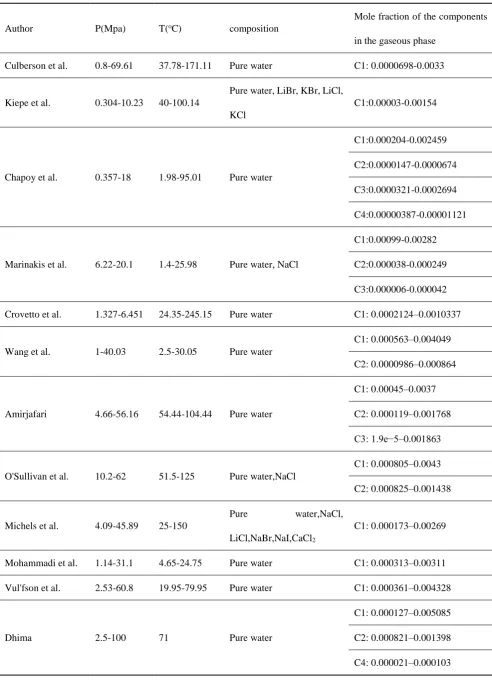
hydrocarbon systems datasets is shown in Table 1 for hydrocarbons. The experimental data of water content of hydrocarbons and non-hydrocarbons are limited because of difficulties in measurement of the low water content gases at high pressure and low temperature. Mohammadi and coworkers expressed that an accurate estimation of water content can be obtained by gas solubility data, therefore, they overcame the complexities of experimental determination of the water content in natural gases [1]. Due to limited number of measurement data, wide attempts have been made to model and describe the gas-liquid equilibrium in aqueous electrolyte solutions. There are several thermodynamic models which uses the Henry’s constant, activity coefficient and cubic equations of state to obtain more information about the equilibrium conditions. The changes of Henry’s constant for the pressure lower than 5 MPa are negligible and it is dominantly effected by temperatures[19]. The high dependency on temperature is obvious at low temperature and also the nonlinear decreasing relationship is observed at high temperatures [25]. Furthermore, there is just a limited number of Henry’s constants for hydrocarbon systems at low temperature. According to this fact, there are several drawbacks in applying the Henry’s law, whereas it has great ability in accurate prediction of solubility. As an example, it is suitable for dilute solutions or near ideal solutions [26]. Additionally, this method is correct for single compounds in no chemical reaction conditions for aqueous phase. Another method is cubic EOS which has several advantages such as small number of parameters, computational efficiency and ease of performance [3, 4, 21]. The EOSs were proposed originally for pure fluids, after that, their applications were expanded for mixtures by combining the constants from different pure components. This extension can be done by different methods such as Dalton’s law of additive partial pressures and Amagat’s rule of additive volumes[5]. For complex compounds, there are some limitations in accuracy of EOS which highlight the importance of empirical adjustments by dealing with the binary interaction parameters. In order to determine these parameters, a reliable source of experimental data for vapor-liquid equilibrium is required which induces some uncertainty into EOSs[7].
Table 1. Details of experimental hydrocarbons solubility in aqueous electrolyte solutions.
Author P(Mpa) T(oC) composition
Mole fraction of the components
in the gaseous phase
Culberson et al. 0.8-69.61 37.78-171.11 Pure water C1: 0.0000698-0.0033
Kiepe et al. 0.304-10.23 40-100.14
Pure water, LiBr, KBr, LiCl,
KCl
C1:0.00003-0.00154
Chapoy et al. 0.357-18 1.98-95.01 Pure water
C1:0.000204-0.002459
C2:0.0000147-0.0000674
C3:0.0000321-0.0002694
C4:0.00000387-0.00001121
Marinakis et al. 6.22-20.1 1.4-25.98 Pure water, NaCl
C1:0.00099-0.00282
C2:0.000038-0.000249
C3:0.000006-0.000042
Crovetto et al. 1.327-6.451 24.35-245.15 Pure water C1: 0.0002124–0.0010337
Wang et al. 1-40.03 2.5-30.05 Pure water
C1: 0.000563–0.004049
C2: 0.0000986–0.000864
Amirjafari 4.66-56.16 54.44-104.44 Pure water
C1: 0.00045–0.0037
C2: 0.000119–0.001768
C3: 1.9e−5–0.001863
O'Sullivan et al. 10.2-62 51.5-125 Pure water,NaCl
C1: 0.000805–0.0043
C2: 0.000825–0.001438
Michels et al. 4.09-45.89 25-150
Pure water,NaCl,
LiCl,NaBr,NaI,CaCl2
C1: 0.000173–0.00269
Mohammadi et al. 1.14-31.1 4.65-24.75 Pure water C1: 0.000313–0.00311
Vul'fson et al. 2.53-60.8 19.95-79.95 Pure water C1: 0.000361–0.004328
Dhima 2.5-100 71 Pure water
C1: 0.000127–0.005085
C2: 0.000821–0.001398
2. Methodology
2.1. Experimental dataset collection
In order to construct a highly accurate and comprehensive model capable of estimating the solubility of mixtures of hydrocarbons in aqueous electrolyte solutions, a comprehensive databank was provided based on existing experimental data in Table 1. This databank contains total number of 1175 solubility points for hydrocarbons (881 and 294 points for training and testing phases respectively.). According to the literature [1, 4, 5, 9, 16-20], the solubility of gases in these systems is highly function of aqueous solutions, pressure, temperature and gaseous phase composition. The aqueous phase composition was change into ionic strength (I) from salt concentrations to reduce dimensions of modeling process. The following equation presents the relationships between ionic strength, valance of charged ions (zi) and molar concentration of each ion (mi):
𝐼 =
12
∑ 𝑚
𝑖|𝑧
𝑖|
2
(1)
In this study, the solubility of hydrocarbons is predicted in terms of concentration of components in gaseous mixture, ionic strength of solution, temperature and pressure:
𝜂
ℎ= 𝑓(𝐶1, 𝐶2, 𝐶3, 𝐶4, 𝐼, 𝑃, 𝑇, 𝑖𝑑𝑥) (2)
In which, 𝜂ℎ represents the hydrocarbon solubility in aqueous phase; C(1-4) are known as the
methane, ethane, propane and butane mole fraction in gas phase(0-99.99); I denotes the ionic strength based on molarity(0-37.35); T denotes the temperature in terms of oC (1.4-245.15); P shows the
pressure in MPa (0.3-100), and idx symbolizes the index of fraction whose solubility is to be determined (1,2,3,4).
2.2. Extreme Learning Machine
Huang proposed a new intelligence method based on single-layer feedforward neural network (SLFFNN) called Extreme Learning Machine to satisfy the drawbacks of gradient-based algorithms such low training speed and low learning rate. In the ELM algorithm, the hidden nodes are selected randomly and the weights of output of the SLFFNN are calculated by applying Moore-Penrose generalized inverse [36, 37].
The scheme of ELM algorithm is demonstrated in Figure 1. By assuming N training sets such as (xi,yi) Rn×Rm for L hidden nodes, the SLFFNN algorithms can be written as following:
∑
𝑖=1𝐿𝛽
𝑖𝑓
𝑖(𝑥
𝑗) = ∑
𝐿𝑖=1𝛽
𝑖𝑓
𝑖(𝑎
𝑖. 𝑏
𝑖. 𝑥)
j=1,….,N (3)
In which, ai=[ai1,...,ain]T points to input weights matrix which is related to hidden nodes, βi=[βi1,…,
βim]T represents the output weights matrix which is related to hidden nodes, and bi symbolizes the
hidden layer bias.
∑
𝐿𝑖=1𝛽
𝑖𝑓
𝑖(𝑥
𝑗) = 𝐻𝛽
(4)
In which, β=[β1,…,βL] and h(x)=[h1(x),…hL(x)] are known as the hidden layer output matrix and
the output weight matrix.
The first step of this model is the random calculation of input weight and the bias of hidden layer for the training phase. Then, determination these values, the hidden layer matrix is obtained by utilization of input variables. Then, the SLFFNN training is changed to a least square problem. The ELM algorithms implement regularization theory to define a target function as following [38-40]:
min 𝐿
𝐸𝐿𝑀=
12
||𝛽||
2+
𝑐2
||𝑇 − 𝐻𝛽||
Figure 1. Structure of ELM algorithm.
3. Results and discussion
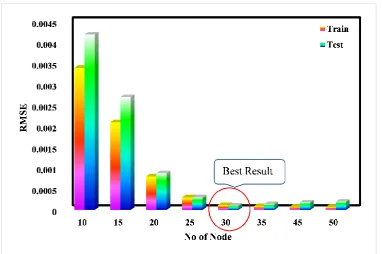
In this study, the solubility of hydrocarbons in the aqueous electrolyte phase is determined based on ELM algorithm. To this end, the sigmoid function is set as activation function and the input weights were initialized randomly in range of (-1,1). Additionally, the number of nodes in the hidden layers was estimated as 30 based on the lowest value of RMSE as determined in Figure 2. As shown, after 30 nodes, by increasing complexity of model, the testing error increased so the optimum structure of the algorithm has 30 nodes to prohibit overfitting.
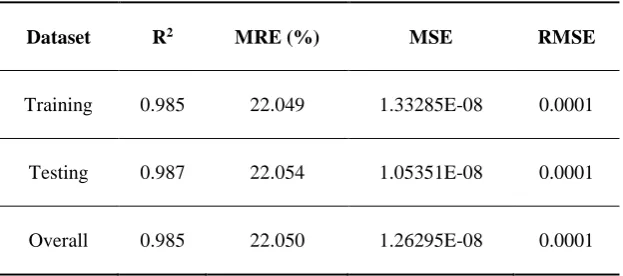
In the following, the statistical results of the estimation of hydrocarbon solubility are inserted in Table 2. The below equations are used to achieve this end:
Mean relative error (MRE) =100
𝑁 ∑ (
𝑋𝑖𝑎𝑐𝑡𝑢𝑎𝑙−𝑋𝑖𝑝𝑟𝑒𝑑𝑖𝑐𝑡𝑒𝑑 𝑋𝑖𝑎𝑐𝑡𝑢𝑎𝑙 𝑁
𝑖=1 ) (6)
Root mean square error (RMSE)= √1
𝑁∑ ((𝑋𝑖
𝑎𝑐𝑡𝑢𝑎𝑙− 𝑋 𝑖 𝑝𝑟𝑒𝑑𝑖𝑐𝑡𝑒𝑑
)2) 𝑁
𝑖=1 (7)
Mean squared error (MSE) = 1
𝑁∑ (𝑋𝑖 𝑎𝑐𝑡𝑢𝑎𝑙− 𝑋 𝑖 𝑝𝑟𝑒𝑑𝑖𝑐𝑡𝑒𝑑 )2 𝑁
𝑖=1 (8)
R-squared (R2) = 1 −∑ (Xi actual−X i predicted )2 N i=1
∑N (Xiactual−Xactual)2 i=1
(9)
As shown in Table 2, the MRE, MSE and RMSE are determined as 22.049, 1.33285E-08 and 0.0001 for training phase respectively. Moreover, for testing phase, MRE=22.054, MSE=1.05351E-08 and RMSE=0.0001 are calculated. The estimated R2 values are 0.985, 0.987 and 0.985 for training, testing
and overall datasets respectively. These results give the knowledge about the high degree of accuracy for proposed ELM algorithm.
Table 2. The statistical analyses of developed model.
Dataset R2 MRE (%) MSE RMSE
Training 0.985 22.049 1.33285E-08 0.0001
Testing 0.987 22.054 1.05351E-08 0.0001
Overall 0.985 22.050 1.26295E-08 0.0001
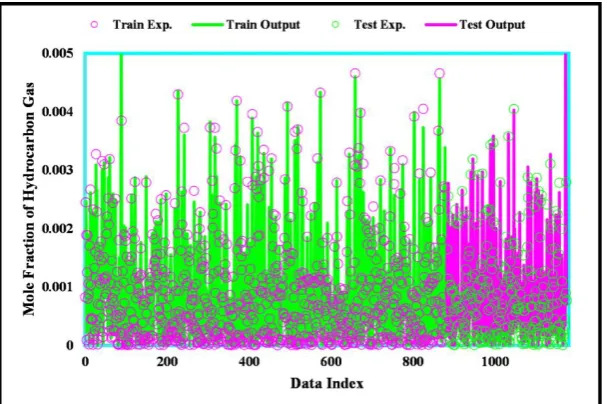
On the one hand, the comparison between the estimated and real hydrocarbons solubility in aqueous electrolyte solutions are shown in Figure 3. This depiction demonstrates an excellent agreement between estimated and real solubility values. Figure 4 also represents the regression plot of actual hydrocarbons solubility versus estimated one. A light cloud of data near the 45o line
Figure 3. Comparison of actual and estimated solubility of hydrocarbons.
Figure 5. Relative deviation between actual and estimated solubility of hydrocarbons.
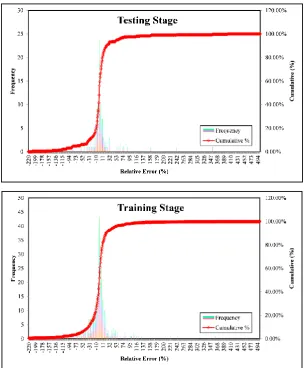
Figure 6. Histogram diagram of relative deviations.
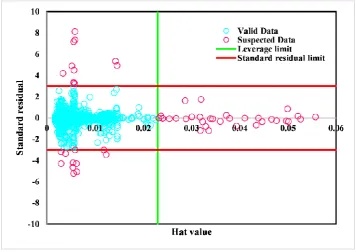
The ELM algorithm implemented in the current work shows an excellent ability in calculation of solubility of hydrocarbons in aqueous phases. One of the important factors which can influence the validation of model is degree of precision of utilized data. In order to clarify the accuracy of solubility databank, the Leverage mathematical method is recruited. This method has some rules to identify the suspected solubility data so that a matrix which is known as Hat matrix, should be constructed based on following formulation[41-45]:
𝐻 = 𝑈(𝑈𝑇𝑈)−1𝑈𝑇 (10)
In which, U symbolizes a matrix of i*j dimensional. i and j are known as the number of algorithm parameter and training points which are used for determination of critical leverage limit as following:
𝐻∗= 3(𝑗 + 1)/𝑖 (11)
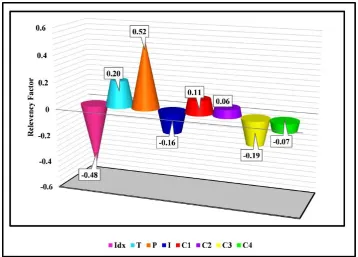
In the most of parametric studies, it is a valuable attempt to identify the effectiveness of all inputs on the target. According to this fact, the sensitivity analysis is employed to investigate effect of concentration of components in gaseous mixture, ionic strength of solution, temperature and pressure on solubility of hydrocarbons in aqueous electrolyte systems. To this end, relevancy factor should be determined as following for each input parameter [46-52]:
𝑟 = ∑ (
𝑛
𝑖=1𝑋𝑘,𝑖−𝑋̅̅̅̅)(𝑌𝑘 𝑖−𝑌̅) √∑𝑛𝑖=1(𝑋𝑘,𝑖−𝑋̅̅̅̅)𝑘2∑𝑛𝑖=1(𝑌𝑖−𝑌)̅̅̅2
(12)
In which 𝑌𝑖and 𝑌̅ denote the ‘i’ th output and output average. 𝑋𝑘,𝑖 and 𝑋̅̅̅𝑘 are known as ‘k’th
of input and average of input. Figure 8 shows the relevancy factor for each effective variable of hydrocarbon solubility. It is necessary to explain that the relevancy factor lies in range of -1 to1 so that the higher absolute value has more impact on hydrocarbon solubility. Furthermore, the positive relevancy factor shows the straight relationship between input and target. The relevancy factors for pressure, temperature, the index of fraction, ionic strength, methane, ethane, propane and butane mole fraction in gas phase are 0.52, 0.20, -0.48, -0.16, 0.11, 0.06, -0.19 ,and -0.07 respectively. According to this explanation and results, as pressure, temperature, and mole fraction of methane and ethane increase, the solubility of investigated hydrocarbon increases. Moreover, pressure and mole fraction of ethane in gaseous phase are the most and least effective parameters on determination of solubility of hydrocarbons.
Figure 8. Sensitivity analysis for solubility of hydrocarbons.
4. Conclusion
The hydrocarbons solubility in aqueous electrolyte phases at high temperature and pressure conditions is known as a major effective parameter in variety of applications for petroleum industries and chemical engineering. Numerous attempts have been made in the current study to suggest a highly accurate and comprehensive predicting tool on the basis of Extreme Learning Machine to calculate hydrocarbons solubility in wide ranges of operational conditions. Comparing the ELM outputs with a comprehensive real databank which has 1175 solubility points concluded to R-squared values of 0.985 and 0.987 for training and testing phases respectively. The excellent agreements of ELM and real hydrocarbon solubility values express that the ELM algorithm is a valuable tool for designing and optimization of various processes that are relating to vapor-liquid equilibrium. Furthermore, this study gives more information about the intensity of each input parameter on solubility of hydrocarbons. Due to the aforementioned results, this work have potential to use in commercial software packages such as CMG and ECLIPSE for simulation of fluid flow in porous media.
Acknowledgements: we acknowledge the financial support of this work by the Hungarian State and the European Union under the EFOP-3.6.1-16-2016-00010 project.
Author Contributions: Conceptualization, A.B., and S.S.; methodology, N.N., A.M., and A.B.; software, N.N., A.M., A.B., S.S. and I.F.; validation, N.N., A.M., A.B., S.S. and I.F.; formal analysis, N.N., A.M., A.B., S.S. and I.F.; investigation, N.N., A.M., A.B., S.S. and I.F.; resources, N.N., A.M., A.B., S.S. and I.F.; data curation, N.N., A.M., A.B., S.S. and I.F.; writing—original draft preparation, N.N., A.M., and A.B.,; writing—review and editing, N.N., A.M., A.B., S.S. and I.F.; visualization, N.N., A.M., A.B., S.S. and I.F.; supervision, I.F.; project administration, A.M.
Conflicts of Interest: The authors declare no conflicts of interest.
References
[2] A. Chapoy, H. Haghighi, B. Tohidi, Development of a Henry’s constant correlation and solubility measurements of n-pentane, i-pentane, cyclopentane, n-hexane, and toluene in water, The Journal of
Chemical Thermodynamics, 40 (2008) 1030-1037.
[3] A. Chapoy, S. Mokraoui, A. Valtz, D. Richon, A.H. Mohammadi, B. Tohidi, Solubility measurement and modeling for the system propane–water from 277.62 to 368.16 K, Fluid Phase
Equilibria, 226 (2004) 213-220.
[4] A. Chapoy, A.H. Mohammadi, D. Richon, B. Tohidi, Gas solubility measurement and modeling
for methane–water and methane–ethane–n-butane–water systems at low temperature conditions, Fluid phase equilibria, 220 (2004) 111-119.
[5] A. Dhima, J.-C. de Hemptinne, G. Moracchini, Solubility of light hydrocarbons and their mixtures in pure water under high pressure, Fluid Phase Equilibria, 145 (1998) 129-150.
[6] J. Kiepe, S. Horstmann, K. Fischer, J. Gmehling, Experimental determination and prediction of gas solubility data for methane+ water solutions containing different monovalent electrolytes, Industrial
& engineering chemistry research, 42 (2003) 5392-5398.
[7] A. Bamberger, G. Sieder, G. Maurer, High-pressure (vapor+ liquid) equilibrium in binary mixtures of (carbon dioxide+ water or acetic acid) at temperatures from 313 to 353 K, The Journal of
Supercritical Fluids, 17 (2000) 97-110.
[8] A.H. Mohammadi, A. Chapoy, B. Tohidi, D. Richon, Water content measurement and modeling
in the nitrogen+ water system, Journal of Chemical & Engineering Data, 50 (2005) 541-545.
[9] D. Marinakis, N. Varotsis, Solubility measurements of (methane+ ethane+ propane) mixtures in
the aqueous phase with gas hydrates under vapour unsaturated conditions, The Journal of Chemical Thermodynamics, 65 (2013) 100-105.
[10] J. Kondori, S. Zendehboudi, M.E. Hossain, A review on simulation of methane production from gas hydrate reservoirs: Molecular dynamics prospective, Journal of Petroleum Science and Engineering, 159 (2017) 754-772.
[11] J. Kondori, S. Zendehboudi, L. James, Evaluation of gas hydrate formation temperature for gas/water/salt/alcohol systems: utilization of extended UNIQUAC model and PC-SAFT equation of
state, Industrial & Engineering Chemistry Research, 57 (2018) 13833-13855.
[12] D. Tong, J.M. Trusler, D. Vega-Maza, Solubility of CO2 in aqueous solutions of CaCl2 or MgCl2
and in a synthetic formation brine at temperatures up to 423 K and pressures up to 40 MPa, Journal of Chemical & Engineering Data, 58 (2013) 2116-2124.
[13] H. Teng, A. Yamasaki, Solubility of liquid CO2 in synthetic sea water at temperatures from 278 K to 293 K and pressures from 6.44 MPa to 29.49 MPa, and densities of the corresponding aqueous solutions, Journal of chemical & engineering data, 43 (1998) 2-5.
[14] F. Lucile, P. Cézac, F.o. Contamine, J.-P. Serin, D. Houssin, P. Arpentinier, Solubility of carbon dioxide in water and aqueous solution containing sodium hydroxide at temperatures from (293.15 to
393.15) K and pressure up to 5 MPa: experimental measurements, Journal of Chemical & Engineering Data, 57 (2012) 784-789.
[15] J.A. Nighswander, N. Kalogerakis, A.K. Mehrotra, Solubilities of carbon dioxide in water and 1 wt.% sodium chloride solution at pressures up to 10 MPa and temperatures from 80 to 200. degree.
C, Journal of Chemical and Engineering Data, 34 (1989) 355-360.
[16] A. Dhima, J.-C. de Hemptinne, J. Jose, Solubility of hydrocarbons and CO2 mixtures in water
[17] A. Michels, J. Gerver, A. Bijl, The influence of pressure on the solubility of gases, Physica, 3 (1936) 797-808.
[18] T.D. O'Sullivan, N.O. Smith, Solubility and partial molar volume of nitrogen and methane in water and in aqueous sodium chloride from 50 to 125. deg. and 100 to 600 atm, The Journal of Physical Chemistry, 74 (1970) 1460-1466.
[19] A. Vul’fson, O. Borodin, A thermodynamic analysis of the solubility of gases in water at high pressures and supercritical temperatures, Russian Journal of Physical Chemistry A, 81 (2007) 510-514.
[20] L.-K. Wang, G.-J. Chen, G.-H. Han, X.-Q. Guo, T.-M. Guo, Experimental study on the solubility of natural gas components in water with or without hydrate inhibitor, Fluid phase equilibria, 207
(2003) 143-154.
[21] A. Chapoy, A.H. Mohammadi, B. Tohidi, D. Richon, Gas solubility measurement and modeling
for the nitrogen+ water system from 274.18 K to 363.02 K, Journal of Chemical & Engineering Data, 49 (2004) 1110-1115.
[22] C. Prutton, R. Savage, The solubility of carbon dioxide in calcium chloride-water solutions at 75, 100, 120 and high pressures1, Journal of the American Chemical Society, 67 (1945) 1550-1554. [23] S. Bando, F. Takemura, M. Nishio, E. Hihara, M. Akai, Solubility of CO2 in aqueous solutions of
NaCl at (30 to 60) C and (10 to 20) MPa, Journal of Chemical & Engineering Data, 48 (2003) 576-579. [24] N.O. Smith, S. Kelemen, B. Nagy, Solubility of natural gases in aqueous salt solutions—II:
Nitrogen in aqueous NaCl, CaCl2, Na2SO4 and MgSO4 at room temperatures and at pressures below 1000 psia, Geochimica et Cosmochimica Acta, 26 (1962) 921-926.
[25] R. Crovetto, R. Fernández‐Prini, M.L. Japas, Solubilities of inert gases and methane in H2O and in D2O in the temperature range of 300 to 600 K, The Journal of Chemical Physics, 76 (1982)
1077-1086.
[26] R. Battino, H.L. Clever, The solubility of gases in liquids, Chemical Reviews, 66 (1966) 395-463. [27] X. Kang, C. Liu, S. Zeng, Z. Zhao, J. Qian, Y. Zhao, Prediction of Henry's law constant of CO2 in
ionic liquids based on SEP and Sσ-profile molecular descriptors, Journal of Molecular Liquids, 262 (2018) 139-147.
[28] X. Kang, J. Qian, J. Deng, U. Latif, Y. Zhao, Novel molecular descriptors for prediction of H2S solubility in ionic liquids, Journal of Molecular Liquids, 265 (2018) 756-764.
[29] X. Kang, Y. Zhao, J. Li, Predicting refractive index of ionic liquids based on the extreme learning machine (ELM) intelligence algorithm, Journal of Molecular Liquids, 250 (2018) 44-49.
[30] W. Qiao, K. Huang, M. Azimi, S. Han, A Novel Hybrid Prediction Model for Hourly Gas Consumption in Supply Side Based on Improved Machine Learning Algorithms, IEEE Access, (2019). [31] W. Qiao, H. Lu, G. Zhou, M. Azimi, Q. Yang, W. Tian, A hybrid algorithm for carbon dioxide
emissions forecasting based on improved lion swarm optimizer, Journal of Cleaner Production, 244 (2020) 118612.
[32] W. Qiao, W. Tian, Y. Tian, Q. Yang, Y. Wang, J. Zhang, The Forecasting of PM2. 5 Using a Hybrid Model Based on Wavelet Transform and an Improved Deep Learning Algorithm, IEEE Access, 7
(2019) 142814-142825.
[33] W. Qiao, Z. Yang, Z. Kang, Z. Pan, Short-term natural gas consumption prediction based on
[34] Y. Zhao, H. Gao, X. Zhang, Y. Huang, D. Bao, S. Zhang, Hydrogen sulfide solubility in ionic liquids (ILs): an extensive database and a new ELM model mainly established by imidazolium-based
ILs, Journal of Chemical & Engineering Data, 61 (2016) 3970-3978.
[35] Y. Zhao, J. Gao, Y. Huang, R.M. Afzal, X. Zhang, S. Zhang, Predicting H 2 S solubility in ionic liquids by the quantitative structure–property relationship method using S σ-profile molecular
descriptors, RSC Advances, 6 (2016) 70405-70413.
[36] G.-B. Huang, Q.-Y. Zhu, C.-K. Siew, Extreme learning machine: a new learning scheme of
feedforward neural networks, Neural networks, 2 (2004) 985-990.
[37] G.-B. Huang, Q.-Y. Zhu, C.-K. Siew, Extreme learning machine: theory and applications,
Neurocomputing, 70 (2006) 489-501.
[38] Y. Bengio, Learning deep architectures for AI, Foundations and trends® in Machine Learning, 2
(2009) 1-127.
[39] Q. Liu, J. Yin, V.C. Leung, J.-H. Zhai, Z. Cai, J. Lin, Applying a new localized generalization error
model to design neural networks trained with extreme learning machine, Neural Computing and Applications, 27 (2016) 59-66.
[40] C.R. Rao, S.K. Mitra, Further contributions to the theory of generalized inverse of matrices and
its applications, Sankhyā: The Indian Journal of Statistics, Series A, (1971) 289-300.
[41] A. Bemani, A. Baghban, A.H. Mohammadi, An insight into the modeling of sulfur solubility of
sour gases in supercritical region, Journal of Petroleum Science and Engineering, (2019) 106459. [42] R. Razavi, A. Bemani, A. Baghban, A.H. Mohammadi, S. Habibzadeh, An insight into the
estimation of fatty acid methyl ester based biodiesel properties using a LSSVM model, Fuel, 243 (2019) 133-141.
[43] M. Mesbah, E. Soroush, V. Azari, M. Lee, A. Bahadori, S. Habibnia, Vapor liquid equilibrium prediction of carbon dioxide and hydrocarbon systems using LSSVM algorithm, The Journal of Supercritical Fluids, 97 (2015) 256-267.
[44] P.J. Rousseeuw, A.M. Leroy, Robust regression and outlier detection, John wiley & sons, 2005. [45] R. Razavi, A. Sabaghmoghadam, A. Bemani, A. Baghban, K.-w. Chau, E. Salwana, Application
of ANFIS and LSSVM strategies for estimating thermal conductivity enhancement of metal and metal oxide based nanofluids, Engineering Applications of Computational Fluid Mechanics, 13 (2019)
560-578.
[46] A. Baghban, M. Kahani, M.A. Nazari, M.H. Ahmadi, W.-M. Yan, Sensitivity analysis and
application of machine learning methods to predict the heat transfer performance of CNT/water nanofluid flows through coils, International Journal of Heat and Mass Transfer, 128 (2019) 825-835. [47] A. Baghban, M.N. Kardani, A.H. Mohammadi, Improved estimation of Cetane number of fatty
acid methyl esters (FAMEs) based biodiesels using TLBO-NN and PSO-NN models, Fuel, 232 (2018) 620-631.
[48] A. Baghban, M. Adelizadeh, On the determination of cetane number of hydrocarbons and oxygenates using Adaptive Neuro Fuzzy Inference System optimized with evolutionary algorithms,
Fuel, 230 (2018) 344-354.
[49] F. Zarei, M.R. Rahimi, R. Razavi, A. Baghban, Insight into the experimental and modeling study
[50] A. Baghban, F. Pourfayaz, M.H. Ahmadi, A. Kasaeian, S.M. Pourkiaei, G. Lorenzini, Connectionist intelligent model estimates of convective heat transfer coefficient of nanofluids in
circular cross-sectional channels, Journal of Thermal Analysis and Calorimetry, 132 (2018) 1213-1239.
[51] A. Bemani, A. Baghban, S. Shamshirband, A. Mosavi, P. Csiba, A. R. Varkonyi-Koczy, Applying ANN, ANFIS, and LSSVM Models for Estimation of Acid Solvent Solubility in Supercritical CO2,
2019, arXiv:1912.05612, DOI: 10.20944/preprints201906.0055.v2