Development and Characterization of Cross-Linked Poly(acrylic
1
acid) Hydrogel Containing Drug by Radiation-Based Techniques
2
3
Jin-Oh Jeong a,b, †, Jae Baik a, †, Sung-Jun An a, Sung-In Jeong a, Jae-Young Lee b,
4
Youn-Mook Lim a, *, Jong-Seok Park a, *
5 6
aAdvanced Radiation Technology Institute, Korea Atomic Energy Research Institute, 1266
Sinjeong-7
dong Jeongeup-si Jeollabuk-do, 580-185, Rep. of Korea 8
bSchool of Materials Science and Engineering, Gwangju Institute of Science and Technology (GIST), 9
Gwangju 61005, Republic of Korea 10
cDepartment of Organic Materials and Fibers Engineering, Chonbuk National University, Jeongju 561-11
756, Rep. of Korea 12
† These authors contributed equally to this work 13
* To whom correspondence should be addressed 14
Abstract: Poly(acrylic acid) (PAAc) hydrogels possess good bioadhesive properties and allow
15
enhanced penetration of drugs. In addition, it is possible to localize the absorption site of the
16
drug in the hydrogel and increase the drug residence time. As opposed to other cross-linking
17
processes radiation-induced polymer cross-linking can be easily and rapidly carried out without
18
the use of cross-linking agents and other chemical additives. In this study, we fabricated
19
metronidazole (MD) containing PAAc hydrogel (MD/PAAc) with different MD contents (0.1,
20
0.25, 0.5 wt%) using varying radiation doses (25, 50, 75 kGy) by gamma-irradiation. The
21
physical and thermal properties were determined by gel content analysis, swelling ratio
22
measurements, compressive strength measurements, differential scanning calorimetery, and
23
thermogravimetric analysis. The properties of the hydrogel degraded due to the crystalline
24
nature of MD. The properties of the hydrogel degraded due to the crystalline nature of MD.
25
Cumulative release observed after 50 min in the case of 0.5MD/PAAc and 0.1MD/PAAc was
26
50% and 10%, respectively. Our findings suggest that MD/PAAc could be a suitable drug
27
delivery carrier for use with radiation-based techniques.
28
29
30
31
Keywords : poly(acrylic acid); metronidazole; hydrogel; crosslinking; radiation
32
33
34
35
36
1. Introduction 1
A hydrogel is defined as a three-dimensional polymeric network that can be contained in
2
water or body fluids [1].Hydrogels have been widely used in biological applications such as
3
wound dressings, adhesion prevention films, and contact lenses because of their marked
4
similarity of human tissue, excellent biocompatibility, and controllable properties [2-4]. In
5
addition, hydrogels retain stable volume in the body owing to the formation of stable structures
6
that show little fluidity under the application of external forces. Hydrogels are fabricated by
7
physical and chemical cross-linking processes [5, 6]. Physical crosslinking is achieved by the
8
formation of ionic bonds, hydrogen bonds, crystallization between the polymer chains, or
9
freezing/thawing method. In the freezing/thawing method, cross-linking is achieved by the
10
formation of crystallites in the polymer-rich domain between water and the polymer chain
11
during repeated freeze/thaw cycles. However, the inherent disadvantage is the long process
12
time of 3 or 4 days [7]. In contrast, chemical cross-linking processes are fast in nature. In this
13
case, cross-links are formed by chemical and radical reactions. Irradiation of polymer solutions
14
results in polymer radicals, which combine through covalent bonds to form insoluble hydrogels.
15
[8].
16
In the case of radiation-induced cross-linking, cross links are formed at the carbon atom of
17
the C-C bond in the polyvinyl polymer, because one or more hydrogen atoms could be attached
18
to the carbon atom. The radiation cross-linking method has many advantages: cross-linking
19
agents are not required [9, 10]; no residual toxic substances are found in the hydrogel;
20
hydrogels having diverse properties can be fabricated by simply controlling radiation dose,
21
polymer concentration, and atmosphere of radiation exposure [11-13].
22
Hydrogels are typically composed of polymers such as natural polymers (e.g., collagen,
23
gelatin, hyaluronic acid, and chitosan) and synthetic polymers (e.g., poly(acrylic acid) (PAAc),
polyethylene oxide (PEO), and poly(vinyl alcohol) (PVA)) [8,9,14,15].The synthetic polymers
1
allow for a higher degree swelling, and impart superior mechanical properties and adhesion
2
strength to the hydrogels as compared to those in the case of natural polymers. For example,
3
PAAc hydrogels show good adhesion strength and are used in bioadhesive drug delivery
4
systems [16, 17].PAAc is a hydrophilic and a highly absorbent polymer that has been widely
5
applied to biomaterials due to its high solubility and biodegradability [5]. PAAc hydrogels have
6
been widely used as drug carriers because of their good bioadhesive properties and enhanced
7
drug penetration. It is possible to localize the absorption site of the drug in the PAAc hydrogel
8
and increase the drug residence time [18].
9
Metronidazole (MD) is a nitroimidazole compound that has been widely used for treating
10
infections caused by anaerobic bacteria and otitis media. The nitro group of MD is activated
11
by nitroreductases such as ferredoxin in the body. High antibacterial property is indicated by
12
disturbed DNA division and nucleic acid synthesis, which can be due to the destruction of the
13
helical structure of the bacterial DNA [19].
14
In this study, PAAc and MD mixtures were exposed to γ-radiations, and MD containing
15
PAAc hydrogels were verified by gel content analysis, swelling ratio measurements, attenuated
16
total reflection Fourier transform infrared spectroscopy (ATR-FTIR), differential scanning
17
calorimetry (DSC), thermogravimetric analysis (TGA), compressive strength tests, and
18
cumulative release of MD analysis. Past studies have reported the fabrication of hydrogels
19
under to γ-irradiation. This study focuses on the MD containing PAAc hydrogel and can reveal
20
a promising approach for the development of radiation cross-linking processes.
21
2. Experimental 1
2.1. Materials
2
Poly(acrylic acid) (PAAc, molecular weight = 100,000) was purchased from Waco Pure
3
Chemical Industries, Ltd (Osaka, Japan). Metronidazole (MD) was obtained from
Sigma-4
Aldrich (St. Louis, MO, USA). All other reagents and solvents were of analytical grade and
5
used as received.
6
2.2. Preparation of metronidazole containing poly(acrylic acid) film using γ-irradiation
7
PAAc was dissolved in distilled water using a magnetic stirrer to a final concentration of 7
8
wt%. MD (0.1, 0.25, 0.5, and 1 wt%) was dissolved in the PAAc solution by using a shaking
9
incubator at 50 oC at 100 rpm until perfect dissolution, under dark conditions. The MD
10
containing PAAc solution was irradiated using a 60Co source (ACEL type C-1882, Korea
11
Atomic Energy Research Institute) with different radiation doses of 25, 50, and 75 kGy (10
12
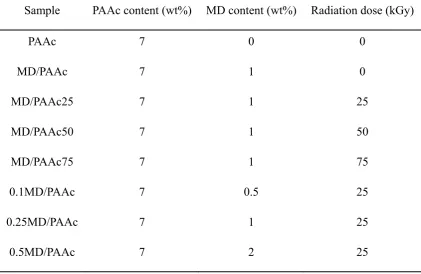
kGy/h) to prepare the MD containing PAAc hydrogel film (MD/PAAc). The general schematic
13
and abbreviated MD/PAAc samples are shown in Figure 1 and Table 1.
14
15
16
Figure 1. Schematic diagrams of MD containing PAAc hydrogel films using γ-irradiation.
17
18
19
1
Table 1. Characteristics of MD containing PAAc hydrogel films at different radiation
2
doses
3
Sample PAAc content (wt%) MD content (wt%) Radiation dose (kGy)
PAAc 7 0 0
MD/PAAc 7 1 0
MD/PAAc25 7 1 25
MD/PAAc50 7 1 50
MD/PAAc75 7 1 75
0.1MD/PAAc 7 0.5 25
0.25MD/PAAc 7 1 25
0.5MD/PAAc 7 2 25
4
2.3. Differential scanning calorimetry
5
The thermal properties of MD/PAAc were investigated by DSC analysis (sQ100, TA
6
instrument, New Castle, PA, USA) under nitrogen flow. The analysis was performed at a
7
heating rate 10 oC/min from 100 to 180 oC.
8
2.4. Thermogravimetric analysis
9
Thermogravimetric analyses were performed using a TA Q600 system (TA Instrument,
10
New Castle, PA, USA). 15.0 mg of the MD/PAAc sample was placed in a platinum pan. The
11
analysis was performed at a heating rate 10 oC/min from 35 to 600 oC under nitrogen flow
12
2.5. Determination of gel content
1
Prior to gel content measurements, the MD/PAAc samples were dried until they were
2
completely free of water. MD/PAAc test specimens were prepared using an 8 mm biopsy punch
3
(Integra, USA). The initial weight of the samples was recorded, and the samples were stirred
4
in distilled water for 24 h at room temperature to remove insoluble components. Then, the
5
MD/PAAc samples were dried and weighed for calculating the gel content. The gel content in
6
the film was determined from the following equation:
7
Gel content (%) = (Wl / Wi) ⅹ 100 8
where Wi and Wl represent the initial and final weights of the dried samples, respectively. 9
2.6. Determination of swelling ratio
10
To measure the swelling ratio, the dried film was prepared by an 8 mm biopsy punch
11
(Integra, USA) and then immersed in distilled water for different time intervals at room
12
temperature, until the equilibrium swelling state was reached. The swelling ratio of the film
13
was determined from the following equation:
14
Swelling ratio (%) = [(Ww - Wd) / Wd] ⅹ 100 15
where Wd and Ww represent the weights of dry and wet film, respectively. 16
2.7. Compressive strength
17
The MD/PAAc sample was prepared by using a 12 mm biopsy punch and then subjected to
18
compressive strength measurements using a texture analyzer (TA-XT2i, Stable Micro Systems
19
Ltd., Godalming, UK) with a load of 50 N and a working distance of 20 mm from the punch.
20
The compressive strength was measured under 50% compression, from the decomposition of
21
the hydrogel film between the plates of the test machine, at a crosshead speed of 5 mm/s.
2.8. Attenuated total reflection Fourier transform infrared spectroscopy
1
The chemical properties of the MD/PAAc samples were measured using an FTIR
2
instrument in ATR mode (ATR-FTIR, Bruker TEMSOR 37, Bruker AXS. INC., Karlsruhe,
3
Germany) over the range 650 to 4000 cm-1at a resolution of 6 cm−1 averaged over 64 scans.
4
2.9. Release test
5
MD/PAAc hydrogels were dried at room temperature. Each dried sample was immersed in
6
phosphate buffered saline(PBS) and incubated in a water bath (BS-21, JEIO TECH, Daejeon,
7
Korea) at 37 oC for 120 min, with gentle shaking at 50 rpm. Samples were acquired at
pre-8
determined time intervals (0, 10, 20, 30, 40, 50, 60, and 120 min), and the released MD was
9
measured using a UV-Vis spectrophotometer (S-3100, Scinco, Seoul, Korea). The absorbance
10
was recorded at 319 nm.
11
2.10. Statistical analysis
12
All data were presented as mean standard deviation (SD) for n = 4. The t-test (Excel,
13
Microsoft) was used to assess the statistical significance of the results (p < 0.05).
14
15
3. Results and Discussion 16
Under γ-irradiation, PAAc formed free radicals on the polymer chain [17].The water molecule
17
formed a hydroxyl radical (OH·) and a hydrogen radical (H·). The C-H bond of PAAc was
18
broken by the hydroxyl radical (OH·) to form a free radical on the PAAc chain. The released
19
hydrogen radical (H·) combined with H· from water, leading to hydrogen gas evolution. In
20
addition, the free radical of PAAc can cross-link with other PAAc molecules, resulting in the
21
formation of a PAAc hydrogel [22].The overall reaction mechanism of MD/PAAc is shown in
Figure 2.
1
2
3
4
Figure 2. Chemical mechanism of MD containing PAAc hydrogel films using γ-irradiation
5
6
MD has 4 main physical characteristics: (1) it is difficultly soluble in common solvents; (2) it
7
has a crystalline structure and the crystals are off-white in color; (3) it is temperature-sensitive;
8
and (4) its color is easily changed upon exposure to light [20, 21].The color of the MD/PAAc
9
hydrogel films changed to dark yellow with an increase in the radiation dose from 25 to 75
10
kGy, due to prolonged exposure to high-energy γ-radiation. The optical images and thicknesses
11
of the MD/PAAc films are shown in Figure 3 and Table 2.
1
Figure 3. Optical images of MD containing PAAc hydrogel films using γ-irradiation
2
3
Table 2. Thickness of MD containing PAAc hydrogel films at different radiation doses
4
Sample Thickness (mm)
MD/PAAc25 0.207±0.030
MD/PAAc50 0.243±0.047
MD/PAAc75 0.317±0.029
0.1MD/PAAc 0.280±0.052
0.25MD/PAAc 0.243±0.047
0.5MD/PAAc 0.277±0.035
5
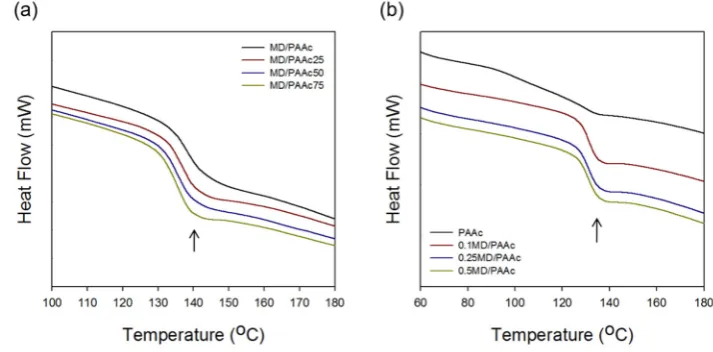
The thermal properties of MD/PAAc were confirmed using DSC and TGA data, as shown
6
in Figure 4 and Figure 5. The melting temperature (Tm) of MD/PAAc increased with an increase
7
in MD content. Tm of 0.1MD/PAAc, 0.25MD/PAAc, and 0.5MD/PAAc was 132.68, 135.33,
8
and 135.74 oC respectively, and the difference between these values increased by approximately
9
3 oC after exposure to γ-radiation. In addition, the latent heat increased with an increase in MD
10
content, suggesting that the high crystallinity of MD, as shown in Table 3. The initial
degradation temperature of MD/PAAc was approximately 60 oC, and further degradation peaks
1
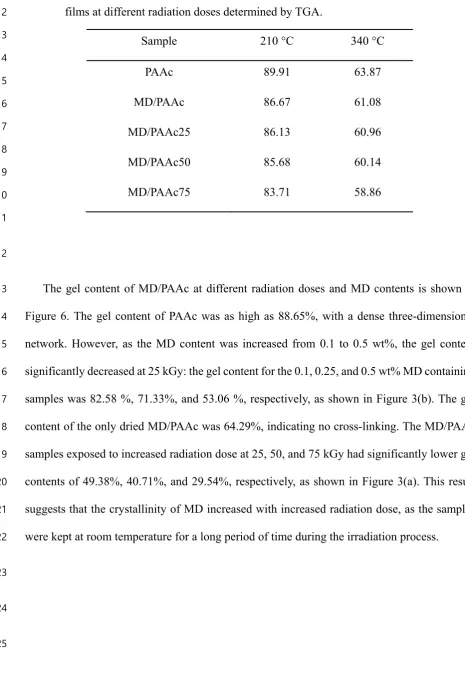
were observed at 210and 340 oC owing to the decomposition of MD [22].The residual amounts
2
of PAAc were 89.91% and 63.87% at 210 and 340 oC, respectively. The MD/PAAc content was
3
86.67% and 61.08% at the same temperatures, and the weight decreased with an increase in the
4
MD content. Furthermore, the remaining amounts of MD/PAAc75 were 83.71% and 58.86%,
5
which were lower than that of MD/PAAc, as shown in Table 4. The thermal stability decreased
6
slightly as the radiation dose was increased because MD slightly affects the thermal stability.
7
8 9
Figure 4. Thermal properties of MD containing PAAc hydrogel films by DSC analysis: (a)
10
MD containing PAAc hydrogel films with different contents of MD (0, 0.1, 0.25, and 0.5 wt%)
11
and radiation doses at 25 kGy, (b) 1wt% MD containing PAAc hydrogel films with different
12
radiation doses (0, 25, 50, and 75 kGy).
1
Figure 5. Thermal properties of 1wt% MD containing PAAc films using TGA, at
2
different radiation doses of 0, 25, 50, and 75 kGy.
3
4
Table 3. Melting point and latent heat of MD containing PAAc hydrogel films with
5
different radiation doses, as determined by DSC
6
Tm (°C) Latent heat (J/g)
0.1MD/PAAc 132.68 2.68
0.25MD/PAAc 135.33 3.36
0.5MD/PAAc 135.74 3.86
MD/PAAc25 142.94 4.11
MD/PAAc50 141.47 3.57
MD/PAAc75 140.19 2.75
7
8
9
Table 4. Residual amounts (210 °C and 340 °C) of MD containing PAAc hydrogel
1
films at different radiation doses determined by TGA.
2
3
4
5
6
7
8
9
10
11
12
The gel content of MD/PAAc at different radiation doses and MD contents is shown in
13
Figure 6. The gel content of PAAc was as high as 88.65%, with a dense three-dimensional
14
network. However, as the MD content was increased from 0.1 to 0.5 wt%, the gel content
15
significantly decreased at 25 kGy: the gel content for the 0.1, 0.25, and 0.5 wt% MD containing
16
samples was 82.58 %, 71.33%, and 53.06 %, respectively, as shown in Figure 3(b). The gel
17
content of the only dried MD/PAAc was 64.29%, indicating no cross-linking. The MD/PAAc
18
samples exposed to increased radiation dose at 25, 50, and 75 kGy had significantly lower gel
19
contents of 49.38%, 40.71%, and 29.54%, respectively, as shown in Figure 3(a). This result
20
suggests that the crystallinity of MD increased with increased radiation dose, as the samples
21
were kept at room temperature for a long period of time during the irradiation process.
22
23
24
25
Sample 210 °C 340 °C
PAAc 89.91 63.87
MD/PAAc 86.67 61.08
MD/PAAc25 86.13 60.96
MD/PAAc50 85.68 60.14
1
Figure 6. Gel content of MD containing PAAc hydrogel films: (a) 1wt% MD containing PAAc
2
hydrogel films with different radiation doses (25, 50, and 75 kGy), (b) MD containing PAAc
3
hydrogel films with different contents of MD (0, 0.1, 0.25, and 0.5 wt%) and radiation dose of
4
25 kGy.
5
6
7
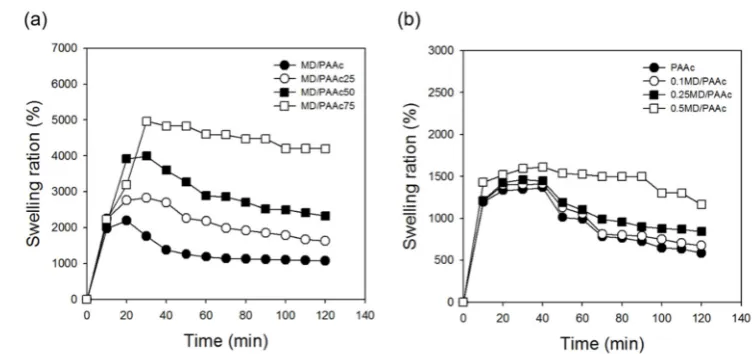
Figure 7. Swelling ratio of MD containing PAAc hydrogel films: (a) MD containing PAAc
8
hydrogel films with different contents of MD (0, 0.1, 0.25, and 0.5 wt%) and radiation dose of
9
25 kGy, (b) 1wt% MD containing PAAc hydrogel films with different radiation doses (25, 50,
10
and 75 kGy).
11
12
13
Figure 7(a) shows that the swelling degree of MD/PAAc increased with an increase in MD
14
content, as the porous three-dimensional networks were affected by MD incorporation. While
15
the swelling degree of MD/PAAc 25 was 2,829%, the MD/PAAc75 sample showed a swelling
of 4,963%. This suggests that MD/PAAc exhibits increased gel content with increasing
1
radiation dose. However, after 40 min, the swelling degree decreased due to the destruction of
2
the hydrogel structure by the crystalline nature of MD.
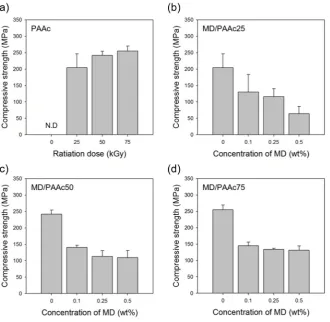
3
4
Figure 8. Compressive strength of MD containing PAAc hydrogel films: (a) 7 wt% PAAc
5
hydrogel films with different radiation doses at 0, 25, 50, and 75 kGy, (b) MD containing PAAc
6
hydrogel films with different contents of MD (0, 0.1, 0.25, and 0.5 wt%) and radiation dose at
7
25 kGy. (c) MD containing PAAc hydrogel films with different contents of MD (0, 0.1, 0.25,
8
and 0.5 wt%) and radiation dose at 50 kGy. (d) MD containing PAAc hydrogel films with
9
different contents of MD (0, 0.1, 0.25, and 0.5 wt%) and radiation dose at 75 kGy. (N.D = not
10
detected)
11
12
Figure 8 shows the compressive strength of PAAc and MD/PAAc for different radiation
13
doses and MD contents. In this study, a 50% compression was chosen for the compressive
14
strength of the β-glucan hydrogel. The compressive strength of PAAc was found to increase
15
with the radiation dose at 25 kGy (204.08 ± 42.78 MPa), 50 kGy (242.17 ± 12.01 MPa), and
16
75 kGy (254.89 ± 15.02 MPa), because of the larger degree of cross-linking in the hydrogels.
At 25 kGy, the compressive strength of 0.1MD/PAAc 25 was 130.24 MPa (± 53.16 MPa), while
1
that of 0.5MD/PAAc25 was 63.72 MPa (± 22.86 MPa), indicating a decrease of approximately
2
60 MPa. The same trend in compressive strength was observed at the other radiation doses.
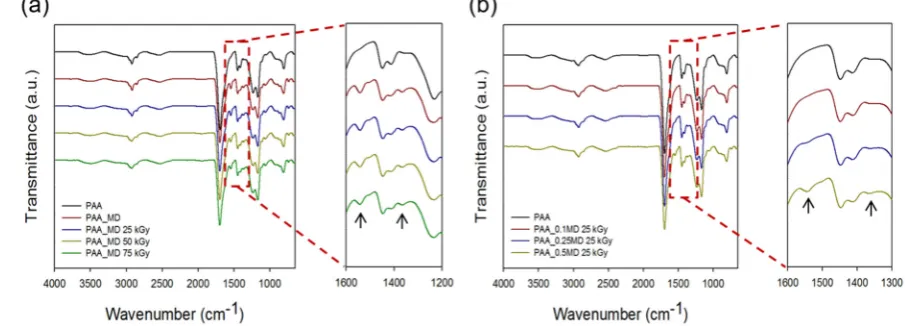
3
4
Figure 9. Chemical properties of MD containing PAAc hydrogel films using
ATR-5
FTIR: (a) MD containing PAAc hydrogel films with different contents of MD (0, 0.1,
6
0.25, and 0.5 wt%) and radiation dose at 25 kGy, (b) 1wt% MD containing PAAc
7
hydrogel films with different radiation doses (0, 25, 50, and 75 kGy).
8
9
Chemical characterization of the MD/PAAc samples was carried out using ATR-FTIR, and
10
the results are shown in Figure 9. The presence of PAAc was confirmed by –COOH (carboxylic
11
acid group) and –OH (hydroxyl group) stretching vibrations at 1700 cm-1 and 3400 cm-1,
12
respectively [14, 23]. New peaks from the nitrite group of MD/PAAc were observed at 1363
13
cm-1 and 1541 cm-1 due to the presence of MD [24]. The peak intensity of the nitrite group
14
increased with the MD concentration. In contrast, for MD/PAAc, there was no change in the
15
intensity of the nitrite peak with an increase in the radiation dose from 25 to 75 kGy.
16
17
18
1
Figure 10. Drug release profile of MD containing PAAc hydrogel films.
2
3
The MD/PAAc hydrogels were dried at room temperature. The drug release was determined
4
by placing it in PBS (pH 7.4). The release of MD was determined at various times by UV
5
spectroscopy. The absorbance was recorded at 319 nm. The MD drug release profiles from the
6
PAAc hydrogels were investigated and are shown in Figure 10. As shown in Figure10, the drug
7
release confirmed that MD was slowly released without any initial burst. The drug was
8
consistently released from the PAA hydrogel (0.5MD/PAAc25), reaching 60% at
9
approximately 60 min in PBS. However, 0.1MD/PAAc exhibited a release of approximately
10
10 % at approximately 60 min in PBS.
11
12
4. Conclusion 13
In this study, MD containing PAA hydrogel films were synthesized by mixing various
14
quantities of MD and PAA, followed by γ-irradiation at different doses. The physical, chemical,
15
and thermal properties of the MD/PAA samples were observed and characterized. When the
fabricated 0.5MD/PAA25 was exposed to γ-irradiation, the gel content was significantly
1
decreased as compared to that for MD/PAA. The presence of MD in MD/PAA was confirmed
2
by the observation of nitrite group peaks at 1363 cm-1 and 1541 cm-1, with an increase in peak
3
intensity with the MD content. In addition, the thermal properties of MD/PAA degraded with
4
an increase in the radiation dose and MD content. After 50 min, the cumulative release of
5
0.5MD/PAA was more than 50%, whereas that of 0.1MD/PAA was 10%. Therefore, MD/PAA
6
could be a viable candidate for a drug delivery carrier, with radiation-based techniques.
7
8
Acknowledgments: 9
This work was supported by INNOPOLIS foundation grant funded by the Ministry of
10
Science and ICT (Information & Communication Technology) and Future Planning, Ko
11
rea government.
12
13
References 14
1. Francis, S.; Kumar, M.; Varshney, L. Radiation synthesis of superabsorbent
15
poly(acrylic acid)-carrageenan hydrogels. Radiat. Phys. Chem.2004, 69, 481-486.
16
2. Jabbari, E.; Nozari, S. Swelling behavior of acrylic acid hydrogels prepared by
c-17
radiation crosslinking of polyacrylic acid in aqueous solution. Eur. Polym. J.2000, 36 ,
18
2685-2692.
19
3. Broom, N.D.; Oloyede, A. The importance of physicochemical swelling in cartilage
20
illustrated with a model hydrogel system. Biomaterials 1998, 19, 1179-1188.
21
4. Scotchford, C.A.; Cascone, M.G.; Downes, S.; Giusti, P. Osteoblast responses to
22
collagen-PVA bioartificial polymers in vitro: the effects of cross-linking method and
23
collagen content. Biomaterials 1998, 19, 1-11.
24
5. Yasin, Y.; Hassan, S. Synthesis of radiation crosslinked poly(acrylic acid) in the
25
presence of phenyltriethoxysilane. Radiat. Phys. Chem. 2014, 97, 292-297.
26
6. Ulanski, P.; Rosiak, J.M. Synthesis of hydrogels by irradiation of polymers in aqueous
27
solution. Radiat. Phys. Chem.1999, 55, 139-151.
7. Qi, X.; Hu, X.; Wei, W.; Yu, H.; Li, J.; Zhang, J.; Dong, W. Investigation of
1
salecan/poly(vinyl alcohol) hydrogels prepared by freeze/thaw method. Carbohyd.
2
polym. 2015, 118, 60-69.
3
8. Huang,X.; Zhang, Y.; Zhang, X.; Xu, L.; Chen, X.; Wei, S. Influence of radiation
4
crosslinked carboxymethyl-chitosan/gelatin hydrogel on cutaneous wound healing.
5
Mat. Sci. Eng. C. 2013, 33, 4816-4824.
6
9. Demetera, M.; Virgolicib, M.; Vanceaa, C.; Scarisoreanua, A.; Kayad, M.G.A.;
7
Meltzerc, V. Network structure studies on γ–irradiated collagen–PVP superabsorbent
8
hydrogels. Radiat. Phys. Chem.2017, 131, 51-59.
9
10. Fekete, T.; Borsa, J.; Takacs, E.; Wojnarovits, L. Synthesis of cellulose derivative
10
based superabsorbent hydrogels by radiation induced crosslinking. Cellulose2014, 21,
11
4157-4165.
12
11. Al-qudah, Y.H.F;Mahmoud, G.A.; Khalek, M.A.A. Radiation crosslinked poly (vinyl
13
alcohol)/acrylic acid copolymer for removal of heavy metal ions from aqueous solution.
14
J. Radiat. Res. Appl. Sci.2014, 7, 135-145.
15
12. Nikolic, V.M.; Krkljes, A.; Popovic, Z.K.; Lausevic, Z.V.; Miljanic, S.S. On the use of
16
gamma irradiation crosslinked PVA membranes in hydrogel fuel cells. Electrochem.
17
Commun.2007, 9, 2661-2665.
18
13. Yanga, J.M.; Sua, W.Y.; Leub, T.L.; Yang, M.C. Evaluation of chitosan/PVA blended
19
hydrogel membranes. J. Membrane. Sci.2004, 236, 39-51.
20
14. Singh, B.; Chauhan, N.; Kumar, S. Radiation crosslinked psyllium and polyacrylic acid
21
based hydrogels for use in colon specific drug delivery. Carbohyd. Polym. 2008, 73
22
446-455.
23
15. Nho, Y.C.; Park, J.S.; Shin, J.W.; Lim, Y.M.; Jeong, S.I.; Shin, Y.M.; Gwon, H.J.
24
Poly(acrylic acid)/polyethylene glycol hygrogel prepared by using gamma-ray
25
irradiation for mucosa adhesion. J. Korean. Phys. Soc.2015, 66, 17-21.
26
16. El-Rehim, H.A.A.; Swilem, A.E.; Klingner, A.; Hegazy, E.A.; Hamed, A.A.
27
Developing the potential ophthalmic applications of pilocarpine entrapped into
28
polyvinylpyrrolidone−poly(acrylic acid) nanogel dispersions prepared by γ radiation.
29
Biomacromolecules 2013, 14, 668-698.
30
17. Nho, Y.C.; Park, J.S.; Lim, Y.M. Preparation of poly(acrylic acid) hydrogel by
31
radiation crosslinking and its application for mucoadhesives. Polymers 2014, 6,
890-32
898.
33
18. Vasi, A.M.; Popa, M.I.; Tanase, E.C.; Butnaru, M.; Verestiuc, L. Poly(acrylic
acid)-34
poly(ethylene glycol) nanoparticles designed for ophthalmic drug delivery. J. Pham.
35
Sci-US.2014, 103, 676-686.
36
19. Lee, M.A. Antimicrobial Resistance Helicobacter pylori. Korean J Clin Microbiol.
37
2001, 4, 73-77.
38
20. Salahuddin, A.; Agarwal, S.M.; Avecilla, F.; Azam, A. Metronidazole thiosalicylate
conjugates: synthesis, crystal structure, docking studies and antiamoebic activity.
1
Bioorg. Med. Chem. Lett. 2012, 22, 5694-5699.
2
21. Martino, P.D.; Censi, R.; Malaj, L.; Capsoni, D.; Massarotti, V.; Martelli, S. Influence
3
of solvent and crystallization method on the crystal habit of metronidazole. Cryst. Res.
4
Technol.2007, 42, 800-806.
5
22. de Souza, N.A.B.; Medeiros, A.C.D.; Santos, A.F.O.; Macedo, R.O. Thermal stability
6
of metronidazole drug and tablets. J. Therm. Anal. Calorim.2003, 72, 535-538.
7
23. Singh, R.; Maity, S.; Sa, B. Effect of ionic crosslink on the release of metronidazole
8
from partially carboxymethylated guar gum tablet. Carbohyd. Polym. 2014, 106,
414-9
421.
10
24. Ramukutty, S.; Ramachandran, E. Crystal growth by solvent evaporation and
11
characterization of metronidazole. J. Cryst. Growth.2012, 351, 47-50.