Hip-Hop Pedagogyas Production Practice: Reverse-Engineering the Sample-Based Aesthetic
Mike Exarchos (a.k.a. Stereo Mike) | London College of Music (University of West London)
Introduction
Hip-hop1 production practice contains a rich matrix of creative methods within its
paradigm, which have the potential to inform and inspire music production pedagogy in higher
education. The techno-artistic trajectory of rap production consists of numerous phases that may
involve live performance, recording, sampling, synthesis, programming, mixing and mastering.
Furthermore, it is not rare for self-contained processes—such as interpolation2 and the creation of
content for sampling—to be actualized as developmental phases within the larger production
trajectory. The well-documented issues affecting phonographic sampling have given rise to
alternative practices, inviting live instrumental musicianship within hip-hop music-making, but
also a dependence on synthesized sonics (often as signifiers of geographical and stylistic
divergence). As a consequence, contemporary hip-hop production—arguably more than any other
commercial music-making form—can provide a dynamic, applied context for the exploration,
implementation, interplay and interaction of most phonographic stages conceived of and
practiced within popular music production. This is not to say that other musics do not deploy
multiple methods within their production processes, or that Hip-Hop exemplifies a sole case of
multi-layered—or bricolage—production. After all, many popular musics have borrowed from
hip-hop practices, and the rap production paradigm can be traced outside of strict stylistic barriers
1 The terms ‘Hip-Hop’ and ‘Rap’ will be used interchangeably throughout the paper, referring to the
musical genre, outputs and practices associated with hip-hop culture and art. To orientate the reader, the paper will use capitalization when referring to Hip-Hop and Rap as a musical genre (noun), and hip-hop and rap in lower case when the terms are used as adjectives describing activities related to and deriving from these.
2Interpolation refers to the studio re-creation of the performances and sonics of an existing recording,
(a fact that widens its appeal and potential as a driver for pedagogical design). But Hip-Hop
offers a hybrid production vehicle par excellence, both acoustic and electronic, performed and
programmed, modern and vintage.
This paper explores the space between these apparent polarities designating a field of
creative opportunities, in order to fuel pedagogical design, explore creative problems (for
academics and students alike) and locate potential synergies in complimentary fields of popular
music curricula that may benefit from further integration. The theorizing and design
extrapolations are inspired by my parallel careers as academic and rap practitioner. On the one
hand, these reflect my contribution to numerous programme and module designs in the areas of
music production, technology, composition, performance and synthesis; and on the other hand,
they reflect my experiences as a self-producing hip-hop artist spanning a ten-year career, initially
independently, for the most part signed to a major label, and currently deploying creative practice
as professional context for doctoral research. The investigation aims at enriching curricula with
aspects of scholarship acquired through these experiences, infusing music production teaching
methods with knowledge gained from real-world hip-hop making practices, whilst exploring the
creative and pedagogical potential in rap production curricula.
The questions, therefore, guiding the rest of this paper are as follows. What aspects of
contemporary music production could be addressed which are now under-represented in higher
education? What are some of the unique synergies that can be discovered converging live
performance, the sample-based process, and various notions of ‘composition’ as encompassed
Sampling: facing the music
At the heart of hip-hop music production lies sampling, both as aesthetic ideal and
problematic practice. Much has been written about sampling as composition (Demers 2003;
Harkins 2008, 2010; Moorefield 2005; Morey and McIntyre 2014; Rodgers 2003; Swiboda
2014), the ethics and legality of sampling (Collins 2008; Goodwin 1988; McLeod 2004), and
sampling as a driver of stylistic authenticity in Hip-Hop (Marshall 2006; Rose 1994; Schloss
2014; Williams 2010). In his extensive ethnographic study, Making Beats: The Art of
Sampled-Based Hip-Hop, Schloss (2014: 72) states that “the idea of sampling as an aesthetic ideal may
appear jarring to individuals trained in other musical traditions, but it absolutely exemplifies the
approach of most hip-hop producers”, and he later adds that “this preference is not for the act of
sampling, but for the sound of sampling: It is a matter of aesthetics” (Schloss 2014: 78). Schloss
here is referring to Hip-Hop’s Golden Era (circa 1988-1998), which was largely exemplified by a
sample-based aesthetic associated with New York (the East Coast) and a production style known
as Boom-Bap3. Mike D’Errico defines “boombap” as a sound characteristic of Hip-Hop’s
“golden age” and provides a representative list of producers and creative approaches:
As sampling technologies developed and became more affordable in the late 1980s and early 1990s, hip-hop entered what became known as it’s “golden age”, defined by a solid “boombap” sound that was shaped by the interactions between emerging sampling technologies and traditional turntable practice. Producers such as DJ Premier from Gang Starr, Prince Paul from De La Soul, and producer-auger DJ Shadow used turntables alongside popular samplers such as the Akai MPC and E-Mu SP-1200 to create instrumental mixtapes with gritty, lo-fi audio qualities (12-bit sample resolution, as
3 Boom-Bap is a hip-hop production style referring onomatopoetically to the sound and rhythm of a
opposed to 16-bit CD quality audio) and innovative performance practices that continue to define the sound of “underground,” “old-school” hip-hop. (D’Errico 2015: 281)
The author here highlights a useful link between emerging sample-based production practices and
the aural, performative tradition of Hip-Hop exemplified by DJing. He also points out that the
sonics and utterances of this modus operandi continue resonating in current production outputs
when an underground or retrospective aesthetic is being called for. At this point, it is important to
make a distinction between sample-based Hip-Hop and other production styles, eras and practices
in hip-hop music, in order to explain why this investigation focuses on the sample-based aesthetic
as the basis for inspiring rap production pedagogies.
The sample-based aesthetic: a review
Hip-hop music production did not commence with a sampler, although—if we refer to
Kvifte’s (2007: 107) definition of sampling as “the process whereby a musician/ composer
includes part of an earlier recording in his/her own music, as a more or less recognisable
citation”—it could be said that Hip-Hop started with sampling as a process. Initially, however,
the ‘citation’ would have taken place via turntable performance in the hands of pioneering Bronx
DJs, who extended the drum breaks from Funk and Soul records to provide the instrumental
foundation for MCs to rap over (Chang 2007; Toop 2000). Hip-Hop’s original instrument was
therefore the turntable (Katz 2012: 43-69) and the significance of the practice is that the music
was built on the ‘citation’ of other recordings even if, phonographically, this potential remained
idle until the availability of affordable sampling technology almost a decade into the art-form.
Conversely, early hip-hop records featured live disco, funk and soul musicians to provide an
instrumental backing, and the following—electro—phase was characterized predominantly by
electronic productions courtesy of drum machines, synthesizers and sequencing technology
Arthur Baker’s futuristic production for Planet Rock (1982) by Afrika Bambaataa. Between them
lies a prime example of turntablism committed phonographically in the form of The Adventures
of Grandmaster Flash on the Wheels of Steel (1981), while the New School era was kicked off
with minimal drum-machine Electro, courtesy of Run-D.M.C.’s Sucker M.C.’s (1983). By 1984,
pioneering producer Marley Marl had started experimenting with affordable samplers,
manipulating drum breaks (Kajikawa 2015: 164-5) and kicking off a sample-based approach that
would be adopted by The Bomb Squad (the production collective behind Public Enemy) and
producers such as DJ Premier, Pete Rock, Q-tip (of A Tribe Called Quest), RZA (of the Wu-Tang
Clan), Prince Paul, DJ Shadow, J Dilla and Madlib; producers who would become associated
with the boom-bap style and would go on to define the sample-based aesthetic of Hip-Hop’s
Golden Era.
Sample-based rap production evolved into rich and complex multilayering, and the
art-form arguably reached its zenith with albums such as It Takes a Nation of Millions to Hold Us
Back (Public Enemy 1988), Paul’s Boutique (Beastie Boys 1989) and Fear of a Black Planet
(Public Enemy 1990), containing hundreds of juxtaposed phonographic samples akin to a rap
music concrète (LeRoy 2006; Sewell 2013; Weingarten 2010). This maximal sample-based
approach received a major blow in 1991 in the form of a lawsuit involving Biz Markie’s Alone
Again, which resulted in the banning of the record and resonated loudly with the hip-hop
community. The ruling inadvertently affected producers’ future practices and styles in response
(Collins 2008; McLeod 1999; Sewell 2013), triggering a number of alternative production
approaches. Such reactions included a reliance on more synthesized—rather than sample-based—
instrumentation, the interpolation (reverse-engineering, mimicry) of phonographic samples, and
the formation of live, performance-based hip-hop collectives. Dr. Dre’s 1992 album, The
Chronic, represents a commercially successful case-in-point for the new-found reliance on
him access to the original musicians and instruments of the P-funk era that he was referencing.
The resulting G-funk sound represented a major stylistic divergence for the genre, becoming
synonymous with the US West Coast. The Roots’ 1993 album Organix, on the other hand,
represented a distinctly live take on the genre, just as the album’s title implies.
The next notable stylistic divergence came from the US South, referencing earlier
dance-floor orientated local subgenres—such as Miami Bass and New Orleans Bounce—and fusing live
performances with increasingly synthesized instrumentation (Grem 2006). From OutKast’s 1994
album Southernplayalisticadillacmuzik to Lil’ Jon & The East Side Boyz’ Get Crunk, Who U
Wit: Da Album (1997), the instrumentation became increasingly electronic, soon featuring little
more than Roland TR-808 drum-machine programming, synthesizer layers and keyboard
workstation presets (Twells 2016). Lil’ Jon’s production style signified the new subgenre of
Crunk (Oldboyentertainment 2005), which gradually morphed into Trap by 2003 with T.I.’s
album/single release Trap Muzik. Crunk and Trap remained largely sample-averse in their
production methods and, to this day, Trap continues to be the prevalent style of hip-hop music in
the mainstream.
Nevertheless, the sample-based aesthetic continued evolving in parallel to these
divergences, as an East Coast production reference, a reaction to mainstream stylizations and a
signifier of hip-hop authenticity (Kulkarni 2015; Marshall 2006; Serrano 2015). A number of
mainstream artists tapped into the production style in order to support lyrical content that was
more personal or conscious, or as a way to stand out from the over-populated Trap crowd. Artists
working under the mainstream radar continued practising the form consistently, and the last few
years have seen a resurgence of boom-bap outputs crossing over into the mainstream—a
phenomenon described by Pitchfork as “a nostalgic sonic wave currently being surfed by NYC
… rappers doing their best to embody the spirit of New York hip-hop without getting stuck in its
demonstrating the contemporary vibrancy and relevance of the sample-based aesthetic; artists
releasing these recordings include Action Bronson (Mr. Wonderful, 2015), Apollo Brown &
Planet Asia (Anchovies, 2017), De La Soul (And the Anonymous Nobody, 2016), Fokis
(Underground with Commercial Appeal, 2017), Joey Bada$$ (B4.DA.$$, 2015), Kool Keith feat.
MF Doom (Super Hero, 2016), MC Eiht (Which Way Iz West, 2017), Sam Brown (Ode To Gang
Starr, 2017), Statik Selektah feat. The LOX & Mtume (But You Don’t Hear Me Tho, 2017), The
Alchemist & Budgie (The Good Book, 2017), Vic Spencer & Big Ghost Ltd (The Ghost of Living,
2016), Joell Ortiz (That’s Hip Hop, 2016) and Your Old Droog (Packs, 2017). On the futuristic
end of the retro-inspired spectrum, producers such as Prefuse 73 and Flying Lotus have been
pushing the envelope of the sample-based approach pioneered by Madlib, DJ Shadow and
J-Dilla, into new, predominantly experimental subgenres (D’Errico 2015; Hodgson 2011).
Sample-based Hip-Hop today: an unexamined opportunity
Practitioners have reacted to the legal landscape surrounding sampling through a number
of alternative approaches, and it is important to consider current practices in this domain. From
Dr. Dre’s interpolation practices, via Southern (T)Rap’s synthetic dependence, to The Roots’
predominantly-live Hip-Hop and—most recently—to De La Soul’s sampling of “more than 200
hours of the Rhythm Roots Allstars, a 10-piece funk and soul band” (Cohen 2016) for And the
Anonymous Nobody album, rap practitioners have assumed a number of positions towards
sampling: from denial and avoidance, to phonographic mimicry and reverse-engineering their
own samples (explored below). Currently, hip-hop production collective J.U.S.T.I.C.E. League
meticulously reverse-engineer samples to fuel a plethora of contemporary rap hits (Law 2016),
while producer Frank Dukes records and mixes original music segments infused with vintage
phonographic sonics to create source content that frees him from both mechanical and publishing
It is at this crossroads between Hip-Hop’s archetypal dependence on phonographic
citation, and practitioners’ innovative approaches to creating new source content fueling
sample-based processes, where a need for study exists. The parameters that grant effective interaction
between new source content and a sample-based aesthetic have not yet been investigated, and this
is both an under-researched area in the evolution of hip-hop production and an opportunity for
pedagogical design to address authentic contemporary practices. A further, important problem
concerns the democratization of the sample-based art-form and the kind of source material that is
available to future makers. Marshall sums up the issue accurately in his article ‘Giving up
Hip-Hop’s Firstborn: A Quest for the Real after the Death of Sampling’:
[D]espite a rise in synthesizer-based production concomitant with the decline in sampling, many hip-hop producers have continued to make beats using samples. Some, such as Kanye West, Just Blaze, P. Diddy, and other producers working for large record labels, enjoy production budgets that permit them to license any sample they like, including the biggest pop hits of previous decades, hence affirming the legal status quo. Some
producers and acts, especially independent and largely local artists, operate well enough under the radar to evade scrutiny or harassment and continue to sample with impunity. And some—in particular, acts with a sizeable national, if not international, following but who lack the resources of a “major label”—find themselves in a tight spot: to sample or not, to be real or not, to be sued or not? (Marshall 2006: 869)
Marshall here maps rap authenticity claims (“to be real or not”) to the sample-based
process and his paragraph reads like a call to action for investigating alternatives against
“affirming the legal status quo”. Indeed, the conundrum between stylistic authenticity (aesthetics)
versus legal implications (pragmatics) raises important questions, and puts academics in an
awkward place when advising students. In the following sections, a number of these questions
will be addressed, such as: What processes and methodologies should be required or accepted for
content be acceptable as source material for sampling or not? What are the implications of either
strategy? Are academics training student practitioners leading them head-on into legal battles, or
are students being denied an industry paradigm? Can academia even begin to discuss hip-hop
aesthetics if the raw materials of the art-form are not fully considered? And finally, how effective
can students’ portfolios be if they cannot become public-facing (due to copyright infringement
embedded in the work)?
Sample-based aesthetics and pedagogy
It is an academic responsibility to explore alternatives and—going further—to set in
motion pedagogy that will continue to explore alternatives through future actualization and
critical analysis. But these alternatives should reach beyond the existing polarities of
live-versus-sampled, or sampled-versus-synthesized. Is there a way to merge the sample-based aesthetic with
the production of copyright-free content? Can this content be sourced from within the student
output (i.e. through collaboration between production and performance cohorts)? What are the
synergies between different fields of popular music curricula that can feed into this interaction?
And in that case, what differentiates a phonographic sample from the inclusion of—newly
conceived and recorded—live musicianship? This set of important questions requires asking and
subsequently theorizing about before any pedagogical design can be set in motion, as they have
implications for the exercises set and the overall alignment of the curriculum.
The pedagogical design proposition in this paper is both a reaction to the
under-researched contemporary practice of reverse-engineering original sample content to serve a
sample-based aesthetic, and a response to Kruse’s (2016b) proposed framework of potential
applications for hip-hop pedagogies. Kruse (2016b: 248) builds on Hill’s (2009) previously
proposed categorizations of hip-hop pedagogy by methodically grouping existing literature under
Kruse’s literature review of “hip-hop as practice” (2016b: 251-252), the majority of approaches
noted utilize beat production and sampling practices as points of access into teaching literacy,
writing, research skills, critical thinking and scholarly analysis (Irizarry 2009; Mahiri 2006;
Petchauer 2011; Rice 2003; Rodríguez 2009; Wilson 2013). Snell and Söderman (2014:
167-170), furthermore, celebrate on the potential of Hip-Hop in a range of academic contexts by
highlighting its effective illustration of critical pedagogy and democratic theory, its relationship
to a multitude of other musical genres, and its fluidity demonstrated in the construction of
identities, but little detail is spared on the inter-stylistic dynamics (and dangers) of how new
cultural (music) production can be actualized. Kruse proposes that:
A seemingly obvious suggestion (though still worth stating) is that students in a music classroom could actually compose and/or perform hip-hop music. This might include composing and/or performing vocally or instrumentally over prerecorded backing (accompaniment) tracks, composing original backing tracks, or both. As the technologies involved in hip-hop beat production and live audio recording continue to become more affordable and easier to use, the possibility of music classrooms functioning as legitimate hip-hop recording studios becomes more realistic. With no more than a single computer, the processes of composing an original backing track, sampling new or previously recorded material, and adding multiple layers of live instruments and/or vocal parts are entirely feasible in a classroom setting. (Kruse 2016b: 256)
The author’s suggestion above is indeed welcome and Kruse goes some way to envision the
specifics and mechanics of hip-hop production in a pedagogical setting. Kruse (2016a, p.15)
expands on the technical detail by suggesting “using genre-appropriate hardware and/or software
(e.g., FL Studio, Akai MPC, Native Instruments Maschine)” in classrooms specifically designed
for teaching hip-hop music-making.
Overall, it would not be an exaggeration to suggest that the lion’s share of education
impacting further learning experiences or simply as an area with welcome potential for future
pedagogies. Kruse comes the closest to considering the applied context for hip-hop production as
practice in a pedagogical environment, and this article responds by synthesizing the need for
exploring this pedagogical gap, with that of examining the alternative contemporary practice of
providing interim content for the sample-based method. By studying the specifics of the practice
and investigating the techno-artistic phases that complete this alternative production approach, it
will be possible to extrapolate a model of the phenomenon, which can then be mapped to
opportunities available in an educational setting. For the purposes of this mapping the article will
consider universities in UK Higher Education (HE) as a context.
Reverse-engineering: the practice
To analyze the practice of reverse-engineering samples, this paper considers the
approaches of three contemporary acts—De La Soul, J.U.S.T.I.C.E. League and Frank Dukes. In
the work of De La Soul and Frank Dukes the objective is not to interpolate (that is, not to mimic
the musical motifs and sonics of previously released music), but to create original segments of
music that could function effectively as source content in a sample-based context. The first point
for consideration, then, is what the parameters of an effective interaction between source content
and—not only sampling practices but also—the sample-based aesthetic are. Testimonies by De
La Soul, J.U.S.T.I.C.E. League and Frank Dukes point our attention to two areas: the musical
(motivic, rhythmic) and the sonic (textural, production) variables. On the one hand, De La Soul
(2017) inform us that their “first album in 11 years was born of 300 hours of live material,
converging bossa nova, soul and hip-hop to funk, disco and reggae”. This short promotional
statement from their And the Anonymous Nobody (2016) album campaign is important as it
demonstrates that the artists have attempted to create a sizeable pool of musical content to serve
they have additionally included “both the studio and instrumental tracks” (De La Soul 2017), and
although the bonus content represents a very small ‘sample’ of the 300-hour pre-production
process, it is worth noting that it evidences the construction of full musical ideas, not just short
segments aimed at sampling. This differentiates the artists’ approach from that of sample library
companies in a number of fundamental aspects. The focus appears to be not on providing neat,
user-friendly sample content for the end user (themselves) to consume, but rich, dynamic and
varied musical material, requiring critical listening, selection and manipulation to fit into new
appropriate contexts; a process akin to “digging in the crates” as mentioned by Schloss (2014:
82-91) in relation to Golden Era practices. The sheer volume of content created for this purpose
implies that De La Soul want to allow for a certain distance from the source content, and perhaps
be surprised or inspired by its variety and potential for interaction with sampling processes (once
brought into a hip-hop context). Furthermore, the multitude of musical styles and rich
instrumentation created for their interim phase are congruent with the sonic
(tracking/mixing/engineering) signatures evident on the record and the bonus/instrumental
material, revealing a carefully matched textural approach to the musical stylizations.
J.U.S.T.I.C.E. League—who are responsible for a plethora of contemporary rap hits for
artists such as Rick Ross, Gucci Mane, Drake and Lil Wayne—provide further insight into the
sonic aspects of the reverse-engineering approach; their process lies somewhere between
interpolation and a convincing re-interpretation of referenced samples (Law 2016). In an
interview with hotnewhiphop.com they shed light on their process:
J.U.S.T.I.C.E. League’s process reveals the importance of the sonic variables that lend a sample
its particular ‘aura’. A phonographic sample contains textural ‘marks’ of the layered processes
and record-production phases that eventually gave birth to the sampled record, differentiating it
from a new recording. Their meticulous re-engineering attempts to infuse convincing (vintage)
sonics on their referential, yet newly recorded, source content.
When this level of reverse-engineering is applied to completely original creations, the
potential exists for musical innovation that, nevertheless, adheres to the sonic requirements of the
sample-based aesthetic, but frees up the art-form from both mimicry and legal complications (or
high clearance costs). Interviewed in Fader magazine, Adam Feeney a.k.a. Frank Dukes (cited in
Whalen 2016) explains in his own words: “I’m still using that traditional approach, but trying to
create music that’s completely forward-thinking and pushing some sort of boundary”. Describing
his production for Kanye West’s “Real Friends” Whalen explains:
Feeney and fellow Toronto producer Boi-1da contributed the song’s “sample,” a delicate piano loop that sounds like it’s lifted from a dusty jazz record, but that Dukes found without having to dig for anything, because he made it himself (…) Manipulating his own compositions like they were somebody else’s is a technique that has brought Feeney—an avowed crate-digger turned self-taught multi-instrumentalist—from relative obscurity to a go-to producer for the industry’s elite (…) By reverse-engineering the art of flipping samples, Feeney is looking at the past, present, and future simultaneously. (Whalen, 2016) The process of creating and reverse-engineering new source content to enable a
sample-based approach is therefore a complex but worthwhile practice, requiring research, multiple
phases of actualization and an abundance of music production skills (acquired by an individual
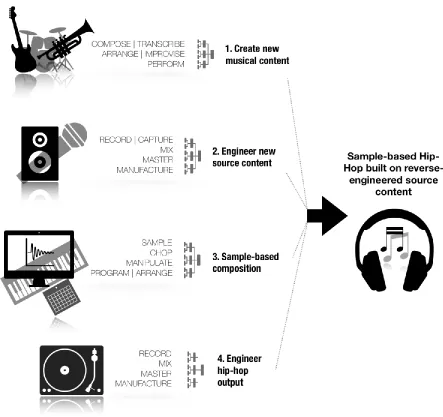
producer, or brought together by a collaborative team). The different phases of the practice are
Figure 1: The different phases of a sample-based hip-hop process built on reverse-engineered sample content are presented schematically. Note that each of the four developmental phases requires a number of sub-processes in order to function. Manufacturing—which appears in phases 2 and 4—implies consideration of mechanical and media sonic artefacts at the end of respective engineering cycles.
The model in Figure 1 highlights the processes necessary for the practice to function.
Sample-based Hip-Hop was traditionally built on the convergence of sampling affordances
interacting with previously made phonographic content (records). Crucially, the aesthetic is
defined by the digital, mechanistic re-organization and manipulation of previously recorded live
performances functioning as source content. When the vintage sonic signifiers infused on records
re-invent a convincing phonographic aura for their source content. It seems that a crucial ingredient
for the sample-based hip-hop aesthetic to function is this interaction between sampling processes
and phonographic context. The practitioners in question achieve this by working tirelessly to
ensure that suitable (vintage) sonics are embedded onto their new source content, and the
musicality of the ideas is either referential to past styles or—stylistically, texturally,
dynamically—varied enough to allow for new opportunities in sample selection, manipulation
and re-contextualization.
Producers such as Frank Dukes and J.U.S.T.I.C.E. League have gradually acquired all the
essential skills to be able to carry out the phases necessary for this large developmental
production trajectory to be brought to completion. De La Soul, on the other hand, are employing
a large collaborative network for the making of their latest magnum opus. For the practice to
function, there are essentially three distinct areas of expertise that need to interact effectively: (a)
live musicianship (creation, performance); (b) sound engineering; and (c) sample-based
composition. By flipping the model into a pedagogical paradigm, a rich spectrum of educational
opportunities comes to fruition, in line with Kruse’s call for a pedagogy of Hip-Hop as practice.
But as he warns, it is important to investigate whether the possibility is realistic, by ensuring the
technical resources and academic affordances are all in place. I turn my attention next to the UK
HE landscape, and specifically universities, in order to explore the feasibility of such a
Synergies: between live performance and the phonographic sample
A number of UK universities provide some flavour of a popular music programme with
elements of both production and performance4. Composition or song-writing are either
implemented in both of these areas, or treated as separate entities. Whichever the case, an
obvious creative opportunity seems to be staring academia in the face with regard to the above
hip-hop paradigm: a music/rap production curriculum informed by sample-based Hip-Hop can
potentially interact with the creation, performance and recording of new music, which may—in
turn—function as source material for further sampling. The integrated production of original
content for the purposes of sampling in such a synchronous, or near-synchronous, context creates
scope for further synergies. Given an interdisciplinary or collaborative coursework activity—
where production and performance students work together towards a hip-hop output—the
sample-based process presents the potential to shape the production of the source material with
‘meta’ considerations in mind, avoiding some of the limitations imposed by working with
material from the past. The students may opt for tracking new content to a metronome, expanding
the sampling pool with extended instrumental sections, and implementing exaggerated structural
and dynamic variations for future exploitation (similar to the 300 hours of source content De La
Soul have employed). Important considerations can be pursued as part of the pedagogical design
and opened up for experimentation by the student body, such as the degree of
‘self-consciousness’ practiced when creating new source material.
Sample-based Hip-Hop is a form of ‘meta’ record production process, as it involves the
application of phonographic processes upon material that has itself been the result of a
4 At the time of writing, there are seven UK Universities offering first degrees with Popular Music and
Production in their title, six offering first degrees with Music Production and Performance in their title, and three offering first degrees with Music Technology and Performance in their title (source: Unistats 2017). However—in relation to first degrees—, there are references to Music Production by 150
Universities, to Music Technology by 146, to Music Performance by 140, to Commercial Music by 122, to
Music Composition by 113, and to Popular Music by 113, which indicates that while a smaller number of
phonographic process (from a different era). Part of its mechanics is this very manipulation of
content that was created without the meta-genre in mind: a funk or soul record made for its own
sake, with its inherent syncopation used or abused, exaggerated and over-exposed through
repetition and re-programming, chopping and truncating within the new context. This raises
important questions about the amount of distance that should be practiced when creating source
content for incorporation into a sample-based hip-hop approach. And this should be left open for
the practical exploration to investigate, and for the critical reflection to evaluate, enabling
pedagogical design that is open-ended and incubates further knowledge, both for academics and
the student body.
From synergy to design
If it is in the space where sampling practices interact with phonographic sonic signatures
that a sample-based hip-hop aesthetic is born, then—from an educational standpoint—it becomes
essential to consider the exploration of such an aesthetic as central to the pedagogical design. A
constructive alignment (Biggs and Tang 2007) of coursework can then take into account such
aims for the pedagogical design as learning outcomes. These may include, for instance, the
infusion of phonographic characteristics upon newly created work; the production of samples as
phonographic segments; the exploration of vintage production techniques pertinent to a chosen
era; investigating phonographic context; or the ‘production’ of live performances with stylized
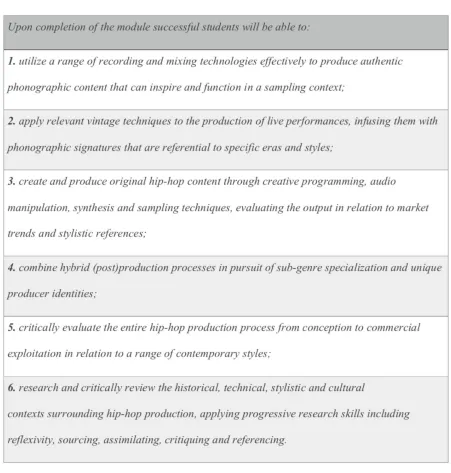
Table 1: Learning outcomes.
The focus of these objectives is understandably practice-based given the phenomena
inspiring the design, but also in response to Kruse’s Hip-Hop-as-practice proposition. Yet the
place of theory has to be carefully considered in such a predominantly practice-based design. The
theoretical issue is two-fold, as it affects both the hypothesis and questions that drive the design,
but also the place of theory within the design itself. There is undoubtedly a theoretical foundation
vision, it would be a mistake to let the designer’s theoretical (or practical) findings rigidly
predetermine the shape of students’ creative outputs. The role of the instructor in this context is
envisioned as that of a mentor-practitioner who oversees balanced, informal learning—this may
be the designer herself or a practitioner contributing to the teaching/delivery—in line with
Söderman’s (2011) recommendations for learning through Hip-Hop (master-apprentice and
peer-to-peer/disciple learning models, learning through workshops/activities and acknowledging
pedagogical lessons already embedded in hip-hop practices). Although it is important to guide the
design with research and industry experience, it is also essential to allow students the opportunity
to reach their own findings, which will in turn contribute to the communal knowledge and future
development of the pedagogical design. This is where the second consideration of a theoretical
underpinning becomes relevant: that of the place of theory within the design. This can take the
form of historical, technical or musicological research set as coursework for the students, but also
as theorizing borne out of reflexive analysis upon the practical experimentation carried out by
students (these aspects are reflected in Learning Outcomes 5-6 in Table 1, above).
In either case, the time-mapping of the curriculum has to portray an effective interplay
between theory and practice, respectful of the potential for emerging knowledge and the
contribution of students towards it. The alignment of coursework tasks in the design thus
becomes essential not only in balancing practice-based work with theory, but also in providing
creative freedom that is nevertheless structured with guided activities. Specifically for music
supervision, Madsen (2003: 79) underlines the benefit of breaking down larger phases into
manageable components, asserting that, “if actual learning is to culminate in a substantive
product the entire process needs to be completed by successive approximations from beginning to
end”. Furthermore, Hamilton, Carson and Ellison (2013: 9) point out the “importance of a
who prefer to work independently to be able to do so”. Lebler and Weston advocate for an
assessment of creative work where:
Students are required to submit recordings of their original work as a substantial
component of their major study (…) along with a clear statement as to their intentions for the recording, details about the contributions of others who were possibly involved, and their observations on the outcome. (Lebler and Weston 2015: 126-127)
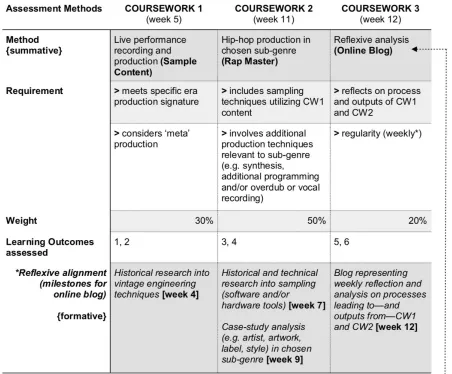
Table 2, below, proposes how this interplay between practice-based work on the one hand, and
research and analysis on the other, could be effectively aligned. Further aims portrayed in the
coursework alignment are to provide structure in the form of milestones (whilst allowing a high
degree of independence in the creative practice), and to enable and inspire collaboration (whilst
safe-guarding individual contribution and ensuring progression). The suggested timeline
highlights blended activities mapped against the practice-based alignment, in support of the
Table 2: Assessment methods.
Outroduction
Hill and Petchauer point out limitations in existing Hip-Hop pedagogy scholarship and
suggest that:
This investigation is inspired by the contemporary hip-hop practice of reverse-engineering source
content in service of an evolving sample-based aesthetic. The paper examines the practice and
explores the pedagogical potential of its application in an educational setting. This examination
locates the creative challenges faced by practitioners in attempting to replace phonographic
samples (traditionally functioning as source content for hip-hop composition) with newly
constructed material. The process reveals a matrix of complex developmental phases and unique
interactions between composition, live performance, sample-based creation and engineering. The
importance of the practice is that it enables an evolutionary mechanism for the survival and
morphing of a historical aesthetic (sample-based/Boom-Bap), which also represents an innovative
and creative re-negotiation of the legal landscape surrounding sampling. The revival of the
style—and the perseverance of practitioners to pioneer alternative, if time-consuming, solutions
for its function—indicate a reaction to the mainstream reign of synthesized Hip-Hop, which may
predict further inter-stylistic experiments and hybrid future production, merging live performance
with electronic music-making. Admittedly, this way of working represents, for the time being, a
small percentage of hip-hop outputs, but the stature of the practitioners attempting it and the
impact of their results indicates promising potential.
From a pedagogical perspective, this may be an overly specialized response to the call by
Kruse, Hill and Petchauer toward hip-hop pedagogies as practice—especially as there is a gap in
educational scholarship dealing with more introductory aspects of rap production and sampling—
but the potential lies in mapping the multi-faceted aspects of the practice to institutional contexts
that already tackle the component parts (in curricula and technical resources). The mapping of
practitioners’ aesthetic pursuits to learning objectives, and the mirroring of the developmental
phases of the practice to coursework alignment are only initial steps toward potential pedagogies
of Hip-Hop as production practice and, of course, the notion could be applied to other rap
stands as a challenge for the otherwise critical and democratic vision of the exercise. Considering
learning outcomes in order to shape the design is therefore acknowledged simply as a starting
point—stemming from the analytical and aesthetic pursuits of the practice—but one which
should be subsequently shaped by student feedback, practitioner/mentor participation, and
“staying in sync” (Lebler and Weston 2015) with the evolution of hip-hop practice. A practice
that adopts a multitude of contemporary approaches to ensure its future cultural production and
one that can offer meaningful pedagogical paradigms for academia; amongst them, the process of
References
Biggs, J. and Tang, C. (2007) Teaching for Quality Learning at University (Society for Research into Higher Education). 3rd edn. Maidenhead: Open University Press.
Chang, J. (2007) Can’t Stop Won’t Stop: A History of the Hip-Hop Generation. London: Ebury Press.
Cohen, F. (2016) De La Soul’s Legacy Is Trapped in Digital Limbo. Available at: https://nyti.ms/2jINoyG (Accessed: 6 February 2017).
Collins, S. (2008) ‘Waveform Pirates: Sampling, Piracy and Musical Creativity’, Journal on the Art of Record Production 3.
D’Errico, M. (2015) ‘Off the Grid: Instrumental Hip-Hop and Experimentation after the Golden Age’, in Williams, J.A. (ed.) The Cambridge Companion to Hip-Hop. Cambridge: Cambridge University Press, pp. 280-291.
De La Soul (2017) [Facebook] 24 February. Available at:
https://www.facebook.com/wearedelasoul/ (Accessed: 25 February 2017).
Demers, J. (2003) ‘Sampling the 1970s in Hip-Hop’, Popular Music 22(1), pp. 41-56.
Goodwin, A. (1988) ‘Sample and Hold: Pop Music in the Digital Age of Reproduction’, Critical Quarterly (30)3, pp. 34-49.
Grem, D.E. (2006) ‘“The South Got Something to Say”: Atlanta’s Dirty South and the Southernization of Hip-Hop America,’ Southern Cultures (12)4, pp. 55-73.
Hamilton, J. G., Carson, S. J., and Ellison, E. R. (2013). 12 Principles for the Effective Supervision of Creative Practice Higher Research Degrees, Dispatches from the Field. Australian Government, Office of Learning and Teaching, Sydney, Australia.
Harkins, P. (2008) ‘Transmission Loss and Found: The Sampler as Compositional Tool’, Journal on the Art of Record Production 4.
— — —(2010) ‘Appropriation, Additive Approaches and Accidents: The Sampler as Compositional Tool and Recording Dislocation’, Journal of the International Association for the Study of Popular Music 1(2), pp. 1-19.
Hill, M. L. (2009) Beats, Rhymes, and Classroom Life: Hip-hop Pedagogy and the Politics of Identity. New York: Teachers College Press.
Hill, M.L. and Petchauer, E. (eds.) (2013) Schooling Hip-Hop: Expanding Hip-Hop Based Education Across the Curriculum. New York: Teachers College Press.
Howard, D.N. (2004) Sonic Alchemy: Visionary Music Producers and their Maverick Recordings. Milwaukee, W.I.: Hal Leonard Corporation.
Irizarry, J. G. (2009) ‘Representin’: Drawing from Hip-Hop and Urban Youth Culture to Inform Teacher Education’, Education and Urban Society 41(4), pp. 489–515.
Kajikawa, L. (2015) Sounding Race in Rap Songs. California: University of California Press.
Katz, M. (2012) Groove Music: The Art and Culture of the Hip-Hop DJ. New York: Oxford University Press.
Krims, A. (2000) Rap Music and the Poetics of Identity. Cambridge: Cambridge University Press.
Kruse, A.J. (2016a) ‘Featherless Dinosaurs and the Hip-Hop Simulacrum: Reconsidering Hip-Hop’s Appropriateness for the Music Classroom’, Music Educators Journal 102(4), pp. 13-21.
— — —(2016b) ‘Toward Hip-Hop Pedagogies for Music Education’, International Journal of Music Education 34(2), pp. 247-260.
Kulkarni, N. (2015) The Periodic Table of Hip Hop. London: Ebury Press.
Kvifte, T. (2007) ‘Digital Sampling and Analogue Aesthetics’, in Melberg, A. (ed.) Aesthetics At Work. Oslo: Unipub, pp. 105-129.
Law, C. (2016) Behind The Beat: J.U.S.T.I.C.E. League. Available at:
https://www.hotnewhiphop.com/behind-the-beat-justice-league-news.23006.html (Accessed: 6 September 2017)
Lebler, D. and Weston, D. (2015) ‘Staying in Sync: Keeping Popular Music Pedagogy Relevant to an Evolving Music Industry’, Journal of the International Association for the Study of Popular Music 5(1), pp. 124-138.
LeRoy, D. (2006) Paul’s Boutique. New York: Bloomsbury Academic.
Madsen, C. K. (2003) ‘Instruction and Supervision of Graduate Students in Music Education’, Research Studies in Music Education 21(1), pp. 72-79.
Mahiri, J. (2006) ‘Digital DJ-ing: Rhythms of Learning in an Urban School’, Language Arts 84(1), pp. 55–62.
Marshall, W. (2006) ‘Giving up Hip-Hop’s Firstborn: A Quest for the Real after the Death of Sampling’, Callaloo 29(3), pp. 868-892.
— — —(2004) How Copyright Law Changed Hip Hop: An Interview with Public Enemy’s Chuck D and Hank Shocklee. Available at:
http://www.alternet.org/story/18830/how_copyright_law_changed_hip_hop (Accessed: 15 April 2015).
Moorefield, V. (2005) The Producer as Composer: Shaping the Sounds of Popular Music. London: The MIT Press.
Morey, J. and McIntyre, P. (2014) ‘The Creative Studio Practice of Contemporary Dance Music Sampling Composers’, Dancecult: Journal of Electronic Music Culture 6(1), pp. 41-60.
Oldboyentertainment (2005) ‘Kings of Crunk’, Hip-Hop Connection 190, p. 74.
Petchauer, E. (2011) ‘I Feel What He Was Doin’: Responding to Justice-oriented Teaching Through Hip-hop Aesthetics’, Urban Education 46(6), pp. 1411–1432.
Rice, J. (2003) ‘The 1963 Hip-hop Machine: Hip-hop Pedagogy as Composition’ College Composition and Communication 54(3), pp. 453–471.
Rodgers, T. (2003) ‘On the Process and Aesthetics of Sampling in Electronic Music Production’, Organised Sound 8(3), pp. 313-320.
Rodríguez, L. F. (2009) ‘Dialoguing, Cultural Capital, and Student Engagement: Toward a Hip Hop Pedagogy in the High School and University Classroom’, Equity & Excellence in Education 42(1), pp. 20–35.
Rose, T. (1994) Black Noise: Rap Music and Black Culture in Contemporary America. Middletown: Wesleyan University Press.
Ruiz, M.I. (2017) Featuring Heems, Danny Brown, and Wiki, the young New York MC 's first official album feels like a graduation, with bars and beats that feel both fresh and lived-in. Available at: https://pitchfork.com/reviews/albums/22988-packs/ (Accessed: 19 September 2017).
Schloss, J.G. (2014) Making Beats: The Art of Sampled-Based Hip-Hop. 2nd edn. Middletown: Wesleyan University Press.
Serrano, S. (2015) The Rap Year Book: The Most Important Rap Song From Every Year Since 1979, Discussed, Debated, and Deconstructed. New York: Abrams Image.
Sewell, A. (2013) A Typology of Sampling in Hip-Hop. Unpublished PhD Thesis, Indiana University.
Snell, K. and Söderman, J. (2014) Hip-Hop Within and Without the Academy. London: Lexington Books.
Swiboda, M. (2014) ‘When Beats Meet Critique: Documenting Hip-Hop Sampling as Critical Practice’, Critical Studies in Improvisation 10(1), pp. 1-11.
Toop, D. (2000) Rap Attack 3: African Rap to Global Hip Hop. 3rd edn. London: Serpent’s Tail.
Twells, J. (2016) The 14 most important synths in electronic music history – and the musicians who use them. Available at: http://www.factmag.com/2016/09/15/14-most-important-synths/ (Accessed: 17 October 2016).
Weingarten C.R. (2010) It Takes A Nation of Millions to Hold Us Back. New York: Bloomsbury Academic.
Whalen, E. (2016) Frank Dukes Is Low-Key Producing Everyone Right Now. Available at: http://www.thefader.com/2016/02/04/frank-dukes-producer-interview (Accessed: 6 September 2017).
Williams, J.A. (2010) Musical Borrowing in Hip-Hop Music: Theoretical Frameworks and Case Studies. Unpublished PhD thesis, University of Nottingham.
Wilson, J. A. (2013) ‘The MC in Y-O-U: Leadership Pedagogy and Southern Hip-Hop in the HBCU Classroom’, in Hill M.L. and Petchauer E. (eds.) Schooling Hop: Expanding Hip-Hop Based Education Across the Curriculum. New York: Teachers College Press, pp. 66–91.
Discography
Action Bronson (2015) Mr. Wonderful [CD] US: Atlantic / Vice Records 549151-2.
Afrika Bambaataa & the Soul Sonic Force (1982) Planet Rock [Vinyl] US: Tommy Boy TB 823.
Apollo Brown & Planet Asia (2017) Anchovies [Stream, Album] US: Mello Music Group.
Beastie Boys (1989) Paul’s Boutique [CD] US: Capitol Records, Beastie Boys Records CDP 7 91743 2.
Biz Markie (1991) I Need A Haircut [Vinyl] Europe: Warner Bros. Records 7599-26648-1.
De La Soul (1989) 3 Feet High and Rising [CD] US: Tommy Boy TBCD 1019.
De La Soul (2016) And the Anonymous Nobody [CD] US: AOI Records AOI001CDK.
Dr. Dre (1992) The Chronic [CD] Europe: Interscope Records 7567-92233-2.
Fokis (2017) Underground with Commercial Appeal [18 x File, FLAC, MP3, 320Kbps] US: Loyalty Digital Corp.
Grandmaster Flash (1981) The Adventures of Grandmaster Flash On The Wheels Of Steel [Vinyl] US: Sugar Hill Records SH 557.
Joey Bada$$ (2015) B4.DA.$$ [17 x File, AAC, Album, 256] US: Pro Era, Cinematic Music Group.
Joell Ortiz (2016) That’s Hip Hop [CD] US: Deranged Music Inc. THHJ01.
Kanye West (2016) The Life Of Pablo [18xFile, FLAC, Album] US: G.O.O.D. MUSIC, Def Jam Recordings.
Kool Keith feat. MF Doom (2016) Super Hero [File, AIFF, Single] US: Mello Music Group.
Lil’ Jon & The East Side Boyz (1997) Get Crunk, Who U Wit: Da Album [CD] US: Mirror Image Entertainment MRR 4556-2.
MC Eiht (2017) Which Way Iz West [Stream, Album] US: Year Round / Blue Stamp Music.
OutKast (1994) Southernplayalisticadillacmuzik [CD] Europe: LaFace Records 73008 26019 2.
Public Enemy (1988) It Takes a Nation of Millions to Hold Us Back [CD] UK & Europe: Def Jam Recordings 527 358-2.
Public Enemy (1990) Fear of a Black Planet [CD] Europe: Def Jam Recordings, CBS 466281 2.
Run-D.M.C. (1983) It’s Like That / Sucker M.C.’s (Krush Groove 1) [Vinyl] US: Profile Records PRO-7019.
Sam Brown (2017) Ode To Gang Starr [File, AAC, Single] US: Below System Records.
Statik Selektah feat. The LOX & Mtume (2017) But You Don’t Hear Me Tho [File, AIFF, Single] US: Showoff Records / Duck Down Music Inc.
Sugarhill Gang (1979) Rapper’s Delight [Vinyl] US: Sugar Hill Records SH 542.
The Alchemist & Budgie (2017) The Good Book, Vol. 2 [Stream, Album] US: ALC.
The Roots (1993) Organix [CD] US: Remedy Recordings, Cargo Records CRGD 81100.
T.I. (2003) Trap Muzik [CD] US: Atlantic, Grand Hustle 7567-83695-2.
Vic Spencer & Big Ghost Ltd (2016) The Ghost of Living [11 × File, FLAC, MP3, Album] US: Perpetual Rebel.