3-14.
Downloaded from: http://insight.cumbria.ac.uk/id/eprint/3914/
Usage of any items from the University of Cumbria’s institutional repository ‘Insight’ must conform to the following fair usage guidelines.
Any item and its associated metadata held in the University of Cumbria’s institutional repository Insight (unless stated otherwise on the metadata record) may becopied, displayed or performed, and stored in line with the JISC fair dealing guidelines (available here) for educational and not-for-profit activities
provided that
• the authors, title and full bibliographic details of the item are cited clearly when any part of the work is referred to verbally or in the written form
• a hyperlink/URL to the original Insight record of that item is included in any citations of the work • the content is not changed in any way
• all files required for usage of the item are kept together with the main item file. You may not
• sell any part of an item
• refer to any part of an item without citation
• amend any item or contextualise it in a way that will impugn the creator’s reputation • remove or alter the copyright statement on an item.
The full policy can be found here.
Citation
Brennan, V., Mallaburn, A., and Seton, L. Tea he s pe eptio of he ist out ea h o k, espe iall i the o te t of hild e s so ial de og aph , TEAN Journal, 10(2), pp. 3-14.
Teachers’ perception of chemistry outreach work, especially in the context of children’s social demography
Teacher Education Advancement Network Journal Copyright © 2018 University of Cumbria Vol 10(2) pages 3-14 Victoria Brennan, Andrea Mallaburn and Linda Seton
Liverpool John Moores University
Abstract
The aim of this current resear h is to i estigate tea he s perceptions of the purpose and impact of chemistry/science outreach work. Considering views of educators, both in training and practice, is an important area to explore as teachers are the gatekeepers to these experiences and consciously or subconsciously have their own views about the value of these programmes. In addition, the teacher can influence a hild s ie of thei s ie tifi a ilit which can potentially inform an i di idual s decisions and perceptions regarding science as a career. It is necessary for a teacher to be aware of
thei pi otal ole ithi the lass oo a d ho thei o ha itus a ha e a i pa t o those
whom they teach.
This pilot study was an illustrative exercise to analyse a small sample of data and provide a focus for a subsequent main data collection where the level of response will be much higher. The study sought to answer the following question; what do teachers in the North-West of England think about chemistry based outreach programmes, especially in the o te t of hild e s so ial de og aph ? Ho e e , o o lusio s o ge e alisatio s a e derived from this small sample itself, only emerging themes are discussed. These themes highlight how teachers may perceive chemistry/science outreach to be of greater importance the higher the educational level and how these programmes may provide experiences and opportunities for students from a lower socio-economic background.
Key Words
Science; chemistry; outreach; impact; perceptions; socioeconomic status; teachers; home-life; school.
Context
Uptake of science students in the UK
In 2015, during the final months of the coalition government in the UK, the then Prime Minister, David Cameron, and his Chancellor, George Osborne, dictated a 6-point long-term economic plan for the north-west (NW) of England (HM Treasury on-line press release 8th January, 2015). Their fourth point was as follows:
…to ake the orth- est a glo al e tre of outsta di g s ie tifi i o atio … ith ajor investments i the ex elle t u i ersities …
learners to study science post-16. Thus, securing future scientists and chemists to occupy these roles and drive the scientific industry forward in the UK.
Socio-economic considerations
Amongst the concerns about the general uptake of science, is the fact that those who apply for sciences (not just hard science) are more likely to do so if their profile shows a higher occupational class (Gorard and See, 2008:217). It is therefore to be considered that some social groupings appear to be underrepresented within the science profession (Anderhag et al., 2013). Tobin (2004:191) agrees
that home is also a factor that can either foster or i hi it the lea i g of s ie e. Socio-economic
status SES o ho e efe s to a ou g pe so s fa il background in terms of occupations, educational qualifications and income. Further considerations are also made in terms of sex, ethnicity, language, disabilities and location. These principles oi ide ith Bou dieu s (1977) theory of cultural capital which proposed that some learners are more comfortable within the school environment and therefore are more likely to succeed. This idea of being comfortable is linked to children who find a
s hool e i o e t o e atu al due to pa e ts a d fa ilies ho have a more privileged insight and promote these values of education (Mufti, 2009). The socio-economic gap of those choosing to study science does not derive from educational key stage 5 (KS5-post 16 education) but much earlier; most pupils would not apply for related courses at a Higher Educational (HE) Institute if they were not studied at a foundation level, this therefore, has an impact on post-16 choices (Gorard and See, 2008).
These fi di gs ge e ated Go a d a d See s paper entitled a hite iddle lass phe o e o .
It is evident that the SES of a learner has an impact on their decisions in choosing to study science, but they also link in the idea that earlier experiences and attainment in science can directly impact on these decisions. This is also highlighted in a more recent report by CASE (2014) that recognised 30% of young adults accessing University placements came from socio-economically deprived areas; however, the representation in Chemistry was lower, estimated at 27%, only just slightly higher than those entering the maths and physics routes.
Science outreach programmes
When researching the impact of such outreach programmes, it is often student feedback or enrolment numbers that are generated and analysed (Alexander et al, 2011; Shanahan et al., 2011; Shaw et al.,
. Although this is i fo ati e a d alua le fo futu e a ti ities, the lo ge it of the p og a e s i pa t a e ette i fo ed the tea he s pe eptio s o e ti e; the e ide e of which is far more limited in the literature. This is despite the strong suggestions that teachers and their
assess e t of a i di idual a ha e a i di e t i pa t o a stude t s o self-concept (Cridge and Cridge, 2015; Schoon et al., 2007; Alexander et al., 2011). One study which confirmed some of these ideas reviewed a vast amount of research which looked into stude t s attitudes and interest in school science. Osborne et al. (2003) concluded that a key factor in this interest was the role of the teacher, suggesting that they have a major part to pla to a ds a stude t s attitude a d pe siste e ithi the
subject. Whilst these results do confirm the importance of the tea he he it o es to a hild s ideas
about science, Osborne et al. (2003) were conscious at the time how very little research had been conducted to see how students viewed their own teachers and how it could affect them. However, later research by both Schoon et al. (2007) and Cridge and Cridge (2015) suggests that not only can the mannerisms and chosen instruction of the individual teacher help to enthuse and maintain interests within the subject, but they can also foster self-belief and facilitate subject-specific achievement in an individual. Thus, as tea he s a pla su h a pi otal ole i a i di idual s
occupational careers, and that this in fa t has a highe i flue e tha the i di idual s fa il
background.
Shaw et al (2010) have looked into some of these themes when evaluating the success of a five-year outreach programme organised by Bristol ChemLabS, and although the sample group of teachers in this study was small, 60% of the teachers identified the long-term beneficial effects of this type of Chemistry i te e tio . These i luded, e thusias fo Che ist , aided understanding of career opportunities i Che ist a d Che ist uptake [at U i e sit ] (Shaw et al., 2010:18). A further longitudinal study by Shallcross et al. (2013) supported their previous findings indicating that
i te e tio s a oss fi e ea s a ot o l i pa t o lea e s oti atio a d e thusias ut a
increase the student uptake in Chemistry at University. This is promising news and with very few examples of monitoring the impact of such outreach programmes over time, the current study is designed to provide some further insight into this topic. Additionally, as the imperative need to recruit future STEM professionals is widely recognised (Smith et al., 2015), the results of the current study will serve to inform initiatives which aim to address increasing the post-16 participation in physical science.
Thus, the focus of this study is to collate primary data from a questionnaire with teachers about their perceptions of science/chemistry outreach programmes. There is a particular focus upon outreach work being used as an intervention tool to reduce the gap in attainment between pupils of different socio economic status (Gorard and See, 2009). Therefore the aim of this research is to investigate what teachers in the North-West of England think about chemistry/science based outreach programmes,
espe iall i the o te t of hild e s so ial demography.
Methodology and Methods
This stage of the study uses a deductive approach whereby the theory drives the methods and data forward and is a form of reasoning whereby a conclusion may be drawn from different propositions or premises (Cohen et al., 2011). The entire study has three stages, however, in this paper the focus is on the pilot of stage one (questionnaire) which has generated i fo atio a out tea he s perceptions of science outreach work in schools. Gillham (2008) suggests that questionnaires are useful for collecting relatively straightforward information as well as being a useful tool to be able to draw conclusions from a population (Davies, 2007). Therefore, this was the chosen method used to collect data, especially as participants were already familiar with questionnaires and they were more likely to participate because they knew what was expected of them.
Cohen et al. (2011) stipulate that it is important to plan the questions with the data analysis in mind. As the aim was to collect mostly quantitative data from the questionnaire this meant that the use of the multiple choice questions and the Likert scale (Likert, 1932) to measure responses would hopefully generate data which would allow standard statistical tests to be used to analyse the results. The use
of the Like t s ale allo s the espo de t to a s e a uestio usi g a ati g s ale a d it allo s the
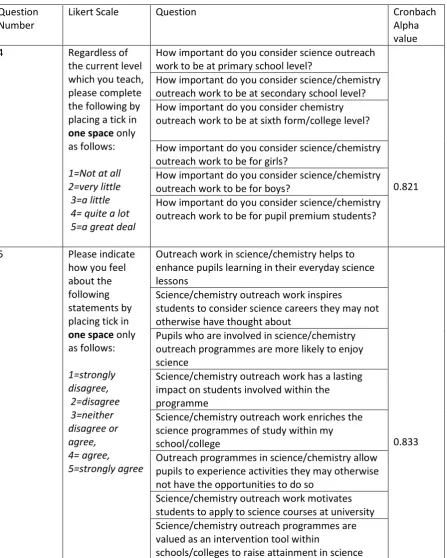
collation of discrete data that tries to accommodate the degree to which someone may agree or disagree (Cohen et al., 2011). In the questionnaire, there were two questions with multiple parts that allowed participants to respond using this measure. These two questions have been outlined in Table
. These t o uestio s p o ided useful i sight i to the pa ti ipa t s ie s of outreach work in a particular context. However, it was decided to include t o ope uestio s hi h would warrant the teacher providing a freely written answer. This aimed to eliminate criticism of solely using the Likert Scale, which does not allow the respondent to add any other comments about the topic being investigated. It was also agreed to only add two of these style questions to reduce potential
espo de t fatigue B a , .
enquiry. Tepper-Jacob (2011) does describe the cost benefits of web based questionnaires, but it was considered that the cost savings were not enough to offset the loss of sample due to clerical web based errors or lower response rates. However, the questionnaire itself also contains a web link and QR code to an online version of the questionnaire for those who prefer this mode of completion. Thus, it is hoped that this sacrifice of cost will be beneficial in terms of gathering knowledge and that by offering a choice of completion method it will not deter people due to their personal preferences when it comes to completing questionnaires (Bryman, 2012).
Table 1. Question 4 and Question 5.
Question Number
Likert Scale Question Cronbach
Alpha value
4 Regardless of
the current level which you teach, please complete the following by placing a tick in one space only as follows:
1=Not at all 2=very little 3=a little 4= quite a lot 5=a great deal
How important do you consider science outreach work to be at primary school level?
0.821 How important do you consider science/chemistry
outreach work to be at secondary school level? How important do you consider chemistry outreach work to be at sixth form/college level?
How important do you consider science/chemistry outreach work to be for girls?
How important do you consider science/chemistry outreach work to be for boys?
How important do you consider science/chemistry outreach work to be for pupil premium students?
5 Please indicate
how you feel about the following statements by placing tick in one space only as follows:
1=strongly disagree, 2=disagree 3=neither disagree or agree, 4= agree, 5=strongly agree
Outreach work in science/chemistry helps to enhance pupils learning in their everyday science lessons
0.833 Science/chemistry outreach work inspires
students to consider science careers they may not otherwise have thought about
Pupils who are involved in science/chemistry outreach programmes are more likely to enjoy science
Science/chemistry outreach work has a lasting impact on students involved within the programme
Science/chemistry outreach work enriches the science programmes of study within my school/college
Outreach programmes in science/chemistry allow pupils to experience activities they may otherwise not have the opportunities to do so
Science/chemistry outreach work motivates students to apply to science courses at university Science/chemistry outreach programmes are valued as an intervention tool within
Testing for internal reliability of the questionnaire.
The design of this questionnaire sought originality and has not been pre-used and thus validated for any previous studies. Hyman et al (2006) discuss how pre-existing questions/surveys are a useful data source as they have been extensively tested during their first use. Bryman (2012) confirms that with pre-existing surveys the data generated in the study is available as a reliable source. Whilst the consideration of using a pre-existing questionnaire was considered, there were no pre-used surveys that matched the research aims. Therefore, an original questionnaire was designed as a method to measure internal reliability, the Cronbach alpha test (Cronbach, 1951) has been applied to question 4 and 5 (see table 1) which uses the multiple indicator measures (Likert Scale, 1932). Internal reliability considers the coherence of questions which are grouped together and whereby their responses may be aggregated (Bryman, 2012). This is important, as, if some questions are incoherent, then this could indicate that the items in this question are unrelated and upon analysing the data, any differences perceived (a p value, which can determine statistical significance) may in fact not be related at all, known as a type 2 error. Following the Cronbach alpha test, the scores for these questions were 0.821 and 0.833 respectively, which indicates an acceptable level of internal reliability, as Bryman (2012) indicates that usually any value above 0.70 is considered to be satisfactory. Two questions provided the opportunity for participants to answer freely and the remaining questions were multiple choice. These questions were stand-alone and as they were not g ouped , the did ot e ui e this statisti al
test for reliability of data produced.
Pre-test
Before the pilot questionnaire was presented to the sample of teachers, it was pre-tested. Bryman (2012) discusses how pre-testing and piloting is always desirable to conduct before administering a self-completion questionnaire. In this instance, the pre-testing was carried out by PhD researchers within the School of Education at Liverpool John Moores University (n=5). Aside from some minor grammatical errors, the uestio ai e as also odified to allo uestio to ha e a othe optio
for the participant. It was also suggested that there were no questions that captured the demographics of the teachers who would complete the questionnaire. Other comments included the wording of some questions and the language that had been used. The feedback was implemented and the questionnaire was modified at this stage to ensure that this questionnaire was accessible prior to the pilot study.
Data analysis
Thematic analysis is a widely used method for analysing qualitative data (Braun & Clarke, 2006; Clarke
& B au , . B au a d Cla ke s app oa h to the ati a al sis is the ost widely cited approach available and was adopted in this study to identify, analyse and interpret patterns of meaning within the data set (Clarke & Braun, 2017). Two questions in the survey, were subjected to a deductive thematic analysis (Bryman, 2012). Themes were identified based on existing literature:
e gage e t , utilisi g a ti ities/ esou es, a ide k o ledge of s ie e a ee s a aila le a d appli atio s i a eal life o te t C idge a d C idge, a d p ofessio al de elop e t of tea he s, and in addition the deli e of these p og a es, su h as the i ol e e t of e te al pa t e s (Gumaelius et al., 2016). Following initial coding and refinement of deductive themes, emerging themes were identified from the data set.
Analysis of Pilot test data
researcher. All present teachers within the science department were given a paper copy of the questionnaire and completed during the visit; any absent member completed the questionnaire online within a two week timescale.
Since the pilot activity was distributed, three of these participants have since taken up a science teaching post at different schools. For analysing this pilot data, it was decided that all 15 responses would be used, as the focus of the pilot study was to ensure quality assurance of the data produced.
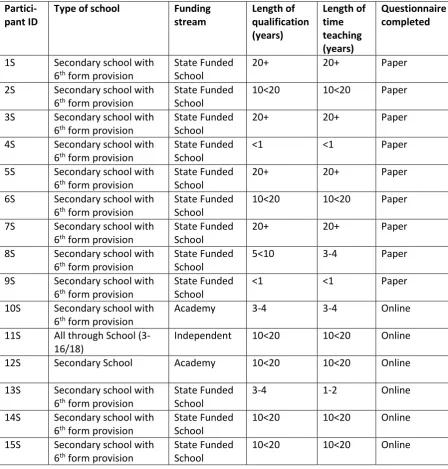
Table 2. Information about participants.
Partici-pant ID
Type of school Funding stream Length of qualification (years) Length of time teaching (years) Questionnaire completed
1S Secondary school with 6th form provision
State Funded School
20+ 20+ Paper
2S Secondary school with 6th form provision
State Funded School
10<20 10<20 Paper
3S Secondary school with 6th form provision
State Funded School
20+ 20+ Paper
4S Secondary school with 6th form provision
State Funded School
<1 <1 Paper
5S Secondary school with 6th form provision
State Funded School
20+ 20+ Paper
6S Secondary school with 6th form provision
State Funded School
10<20 10<20 Paper
7S Secondary school with 6th form provision
State Funded School
20+ 20+ Paper
8S Secondary school with 6th form provision
State Funded School
5<10 3-4 Paper
9S Secondary school with 6th form provision
State Funded School
<1 <1 Paper
10S Secondary school with 6th form provision
Academy 3-4 3-4 Online
11S All through School (3-16/18)
Independent 10<20 10<20 Online
12S Secondary School Academy 10<20 10<20 Online
13S Secondary school with 6th form provision
State Funded School
3-4 1-2 Online
14S Secondary school with 6th form provision
State Funded School
10<20 10<20 Online
15S Secondary school with 6th form provision
State Funded School
10<20 10<20 Online
Findings
What is outreach?
Looking at Figure 1. which outlines the responses to question 2 in the survey, it can be observed that 67% of participants agree that science outreach usually involves an external party. This could be someone who is not part of that particular school, either coming in to deliver programmes or the learners leaving the school to experience these programmes. For example, Participant 1S describes their unde sta di g of out ea h o k as when schools engage with external partners e.g. Primary schools, u i e sities o s ie tists (1S). This response clearly outlines their view of their partnership with other stakeholders. However, some participants indicated the idea of an expert, outside support or the professional development of certain individuals: providing expert science support to schools without expertise or who need targeted info/suppo t (2S).
Figure 1.The ati a al sis of pa ti ipa ts espo ses to uestio : Des i e ou u de sta di g of
s ie e out ea h o k.
However, 27% of participants also described their understanding of outreach to provide a wider knowledge of science careers available and outline application of science in a real-life context. Both themes were described by 7S who suggested their understanding of science outreach work to be: making school science more relevant to the world of work, new developments, types of jobs, motivation to further stud a d e ha i g the u i ulu .
When further exploring teachers ideas of what outreach was in question six (open response), which allows participants to draw on any themes from the questions they have answered (about their views of outreach work), there was a shift in the answer of the participants. Two new themes emerged which
li ked to assisti g lea i g a d the u i ulu a d issues su ou di g the deli e of these p og a es . Tea he s considered the potential of chemistry/outreach as a tool to engage and inspire learners as 60% of the responses highlighted this aspect whilst 46% of participants linked these
0 10 20 30 40 50 60 70 80
Engagement and Inspiration
Utlising new activities/resources
A wider knowledge of science careers
available
Applications in a real-life context
Professional development of
teachers
Involvement of external partners
%
F
re
q
u
e
n
cy
w
h
o
a
g
re
e
p og a es a d lea i g to the u i ulu . These ideas a e ei fo ed i P s response, whose thoughts about chemistry/science outreach included:
Engaging, good quality outreach experiences are very valuable for motivating students and good quality learning. The danger is that, as teachers are so overworked, the activities become fo gotte .
The response is also important when considering the main focal point of view (teachers) of this research who are crucial in sharing and conveying theories with enthusiasm as the attitude of the teacher is pivotal in mediating learning (Burton et al., 2005).
Outreach work and Pupil premium
Pupil Premium is funding which is awarded to a child (paid to the school) who has been in provided free school meals (FSM) within the last 6 years (Ever 6); receipt of this is used as an indicator of SES (Sutherland, 2016). Questions 4 and 5 (see Table 1.) investigated the pa ti ipa ts ideas of i po ta e
and options of outreach work. From these two questions it was found that 87% of participants thought that outreach activities were of the highest importance for pupil premium students. 77% of these
pa ti ipa ts also ag eed st o gl that out ea h p og a es allo pupils to e pe ie e a ti ities that
they may not have had the opportunity to do otherwise. This is encouraging as it suggests that teachers feel that outreach activities in science are a valuable intervention tool for this demographic of learner. It is also of value to note that the length a participant had been qualified as a teacher did not affect their view of how important science/chemistry outreach activities were for pupil premium students. This is encouraging as it shows that teachers at all stages of their career may consider outreach initiatives as a suitable intervention tool to engage these groups of learners
When is outreach work important?
From the responses to question 4 (see Table 1.) it is evident that there is less certainty about the importance of outreach programmes at primary level, due to the more skewed response. 100% of participants felt science/chemistry had uite a lot o a g eat deal of i po ta e at se o da le el
or above. However, only 80% of the participants felt that science/chemistry outreach work was of the same level of importance at primary school level.
When considering this theme further, it is also presented that of the 40% of teachers who rated the importance outreach work has as uite a lot at p i a s hool le el, % of this populatio felt that
these programmes had a g eat deal of importance at secondary level. This small sample indicates that teachers perceive science/chemistry outreach work to be more important at secondary level compared to primary. However, no teacher within this sample taught at primary school level.
Discussion of pilot analysis
The pilot data present certain themes, which will be explored as part of this ongoing research study. The findings here link to themes within literature about demographics of individuals choosing to persist within the field of science post-16 and how this could link to science/chemistry outreach programmes. For reference in this study, primary education in the UK is for students aged 4-11 (Reception to Year 6), secondary education is aged 11-16 (Year 7-11) and age 16+ (Post-16).
Osborne et al (2009) describe how these attitudes develop from the age of 10-14 it is this period of time that will have an impact on future career choices. Therefore, Wilson and Chizeck (2002) suggest that the curiosity of the child should be nurtured at the earliest age possible, which was specifically explored in a three-year review conducted by Ofsted (2013). These findings are concerning as Wilkins (2010) found that primary school teachers have rated science amongst the least enjoyable subjects to teach. Therefore, it could be rationalised that outreach programmes are required more at this educational level, especially as Maltese and Tai (2010) find that in retrospect those who often become scientists make this decision before they start high school.
All participants in the pilot sample indicated that they felt science/chemistry outreach programmes are important for pupil premium students. In addition to this, the sample all agreed or strongly agreed that these initiatives also provide a platform for pupils to experience activities they may otherwise not have had the opportunity to do so. Therefore, it could be that some outreach opportunities provide activities for pupils from a lower SES to help them picture themselves belonging to a scientific community. Research indicates that home may be an inhibiting factor in choosing science due to several reaso s, su h as the la k of a ole- odel o li ited a ee ad i e o suppo t f o pa e ts i
that particular field (Fleer and Rillero, 2008; Gorard and See, 2009).
Another discussion point links to how science/chemistry outreach work may be perceived to be more important for girls. Whilst this is not a primary theme of the study (to compare gender) there is significant literature which highlights that young women may not choose to study science as it may challenge their feminine identity, especially when it comes to the physical sciences (Mendick, 2006).
It is to e o side ed that out ea h p og a es a assist ith di i ishi g this diffe e e
(narrowing the gap) as Mujtaba and Reiss (2013) comment that girls feel like they receive less encouragement, compared to their male peers in their physics studies. Marchand and Taasoobshirazi (2013) find that concerns regarding the lack of girls choosing to study physics could be due to the individual teacher and the teaching of the subject itself. Therefore, outreach programmes may have the potential to provide a more relatable role model and informal teaching model. In turn, these could inspire and engage this underrepresented demographic within the field of physical sciences. Although these studies outline concerns specific to physics and the number of male and females participating in chemistry at both GCSE and A-level are approximately equal in 2017, this has not always been the case (Joint Council for Qualifications, 2017). It will be interesting to see what tea he s attitudes are towards this question in the larger set of data as it encompasses all the sciences.
Question six initially only had the six original themes derived from the literature, however from the participants responses to this question, two new themes emerged surrounding how these programmes could assist with learning in the classroom and assisting learning in the curriculum. Many participants also commented on the delivery of the programme itself, such as time and cost of being involved in outreach activities. These two emergent themes also presented themselves in the literature reviewed as Shanahan et al. (2011) discusses cost of the programmes and Glover et al. (2016) describe one of the reasons teachers chose to engage with Bristol ChemLabS (as a chemistry outreach
p og a e as to assist ith pupils lea i g. The espo ses ega di g the pa ti ipa ts thoughts o
what was science/chemistry outreach work suggested that they felt that it involved external partners such as someone delivering an event at the school or a trip to an organisation. However, towards the end of the questionnaire in the next open response there was a shift in thought. Thus, it will be interesting to see how the distribution of these responses may change, or how new themes may emerge with a larger data set.
Conclusion
socio-economic background as they may provide experiences not available outside of school. When linking these ideas to the literature, it supports the notion that science outreach programmes may be able to enthuse learners and offer contextual insight into future possible careers within science (Cridge and
C idge, . Lite atu e ofte de ates the ight ti e fo the deli e of out ea h i itiati es a d this
study presents an idea that although teachers may think it is more important at a higher educational level, developing positive attitudes towards science should happen at a younger age (Denessen et al., 2015). These ideas are used to outline the next stages of this study and some further ideas that should be explored in more depth.
Next Steps
Based on the discussion and findings from this small-scale pilot study the following hypotheses will be explored with a larger data collection in an additional study. The following hypotheses will allow focus to concentrate on themes, which have started to emerge from this small sample and therefore statistical tests will be able to calculate if there are significant differences, thus accepting or rejecting the hypotheses below:
1. Teachers perceive science/outreach work to be of greater importance the higher the educational level.
2. Teachers find that science/outreach programmes are important for pupil premium students as they offer experience that they may otherwise not had the opportunity to encounter. 3. Science/chemistry outreach programmes are more important for girls than boys.
4. Tea he s feel that s ie e/ he ist out ea h o k a oti ate, i spi e a d e ha e science but are less certain when it comes to impact and implementation of these programmes.
These hypotheses also highlight some issues that should be considered when developing and designing science based outreach programmes as educators are the gatekeeper to these outreach experiences.
Following this pilot stage of the study, there will be two further stages, which aim to collect more
details a out tea he s ie s of science/chemistry outreach. Each stage will be used to recruit the next participants, but as this research aims to work with teachers who engage with science/chemistry outreach, the sampling will become more purposeful and provide more detail as it progresses.
References
Alexander, H., Waldron, A. M, and Abell, S. K. (2011) 'Science and Me: A Student-Driven Science Outreach Program for Lay Adult Audiences', Journal of College Science Teaching, 40(6), pp. 38-44.
Anderhag, P., Emanuelsson, P., Wickman, P. and Ha za, K. M Stude ts' Choi e of Post -Compulsory Science: In search of schools that compensate for the socio-economic background of their students, International Journal of Science Education, 35 18), pp. 3141-3160.
Bourdieu, P. (1977) Outline of a Theory of Practice, Cambridge: Cambridge University Press. Braun, V. and Cla ke, V. Usi g the ati a al sis i ps holog , Qualitative Research in
Psychology, 3, pp. 77-101.
Bryman, A. (2012) Social Research Methods .4th Edition. Oxford: Oxford University Press.
Burton, L. D.; Kijai, J. and Sa gea t, M. A. The ‘elatio ship Bet ee Stude ts Pe eptio s of the Teaching and Learning Process and Academic Performance in Science of Seventh and Eighth Graders Enrolled in Seventh-day Adventist Schools, Journal of Research on Christian Education, 14(2), pp. 177-212.
Campaign for Science and Engineering (CASE) (2014). Improving Diversity in STEM. Available at;
http://www.sciencecampaign.org.uk/resource/ImprovingDiversityinSTEM2014.html
(Accessed: 30 September 2016).
Cohen, L., Manion, L. and Morrison, K. (2011) Research Methods in Education. 7th Edition. Oxon: Routledge.
C o a h L. Coeffi ie t alpha a d the i te al st u tu e of tests, Psychomerika, 16(3) pp.297-334.
Cridge, B.J. and Cridge, A. G. (2015) 'Evaluating How Universities Engage School Students with Science: A Model Based on the Analysis of the Literature', Australian Universities' Review, 57(1), pp. 34-44.
Davies, M. B. (2007) Doing a successful research project. Basingstoke: Palgrave Macmillan.
Denessen, E., Vos, N., Hasselman, F. and Lou s, M. The ‘elatio ship et ee P i a S hool
Teacher and Student Attitudes towards Science and Technology, Education Research International, Article ID 534690, pp.1-7.
Fleer, M. and Rillero, P. (1999) Family involvement in science education: where are the outcomes for parents and stude ts?, Studies in Science Education, 34, pp. 93-114.
Gillham, B. (2008) Small-Scale Social Survey Methods. London: Continuum Books.
Glover, S.R., Harrison, T. G. and Shallcross, D. E. Wh do Se o da S hool Che ist
Teachers Engage in long-te Out ea h pa t e ship ith a u i e sit ?, Acta Didactica Napocensia, 9(2), pp. 79-97.
Gorard, S. and See, B. H. Is S ie e a Middle Class Phe o e o ? The SES dete i a ts of
pa ti ipatio , Research in Post-Compulsory Education, 13(2), pp. 217-222. Gorard, S. and See, B. H. The Impact of socio-economic status on participation and
attai e t i s ie e ,Studies in Science Education, 45(1), pp. 93-129.
Gumaelius, L., Almqvist, M., Árnadóttir, S., Axelsson, A., Conejero, J. A., García-Sabater, J. P., Klitgaard, L., Kozma, C., Maheut, J.; Marin-Garcia, J., Mickos, H.; Nilsson, P., Norén, A., Pinho-Lopes, M., Prenzel, M., Ray, J., Roxå, T. and Voss, M. (2016 Outreach initiatives operated by universities for increasing interest in science and technology, Eu opea Journal of Engineering Education, 41(6), pp. 289-622.
Harlen, W. (2008) Science as a key compound of the primary curriculum; a rationale with policy
i pli atio s, Perspectives in Education: primary science, 1, pp. 4-18.
HM T easu No th West lo g te e o o i pla as set out the P i e Mi iste a d Cha ello . A aila le at:
https://www.gov.uk/government/news/long-term-economic-plan-for-the-north-west-set-out-by-prime-minister-and-chancellor (Accessed: 28 October 2016).
Hyman, L., Lamb, J. and Bulmer, M. ( The Use of P e-Existing Survey Questions: Implications
fo Data Qualit Eu opea Co fe e e o Qualit i Su e Statisti s. A aila le at:
http://ec.europa.eu/eurostat/documents/64157/4374310/22-Use-of-pre-existing-survey-questions-implications-for-data-quality-2006.pdf/e953a39e-50be-40b3-910f-6c0d83f55ed4 (Accessed: 24 May 2017).
Joi t Cou il fo Qualifi atio s E a i atio ‘esults . A aila le at:
https://www.jcq.org.uk/examination-results (Accessed: 27 September 2017)
Knight, P. T. (2002) Small-Scale Research. London: Sage Publications Ltd.
Likert, R. (1932) A Technique for the Measurement of Attitudes. New York: Columbia University Press.
Marchand, G. C. and Taasoobshirazi, G. (2013) Stereotype Threat and Women's Performance in Physics , International Journal of Science Education, 35(18), pp. 3050-3061.
Maltese, A. V. and Robert, H. Tai (2010) Eyeballs in the Fridge: Sources of early interest in science , International Journal of Science Education, 35(2), pp. 669-685.
Mendick, H. (2006) Masculinities in Mathematics. Maidenhead: Open University Press.
Mufti, E. White o ki g- lass kids: Wh a e the faili g? i Kasse , D. a d Ga att, D. eds.) Exploring Key issues in Education, London: Continuum International Publishing Group. Mujtaba, T. and ‘eiss, M. I e ualit i E pe ie es of Ph si s Edu atio : Se o da S hool
Girls' and Boys' Perceptions of their Physics Education and Intentions to Continue with Physics
N esea h pa t e ship N Fo a d St ateg . Available at:
http://www.n8research.org.uk/view/7134/Strategy-2017.pdf (Accessed: 25 September 2017).
Ofsted (2 Mai tai i g Cu iosit : A su e i to s ie e edu atio i s hools , A aila le at: https://www.gov.uk/government/uploads/system/uploads/attachment_data/file/379164/Ma intaining_20curiosity_20a_20survey_20into_20science_20education_20in_20schools.pdf (Accessed: 25 September 2017).
Osborne, J., Simon, S. and Collins, S. (2003 Attitudes to a ds s ie e: A e ie of lite atu e a d its
i pli atio s, International Journal of Science Education, 25(9), pp. 1049-1079.
Osborne, J., Simon, S. and T le , ‘. Attitudes to a ds s ie e: a update Proceedings of the Annual Meeting of the American Educational Research Association, San Diego, California USA, 13-17 April, San Diego, American Educational Research Association. pp. 1-20.
Schoon, I., Ross, A. and Ma ti , P. Science related careers: aspirations and outcomes in two
B itish oho t studies, Equal Opportunities International, 26(2), pp.129 – 143.
Shallcross, D. E., Harrison, T. G., Obey, T. M., Croker, S. J. and No a , N. C. Out ea h ithi the Bristol ChemLabS CETL Ce t e fo E elle e i Tea hi g a d Lea i g, Higher Education Studies, 3(1), pp. 39-49.
Shanahan, M., Pedretti, E., DeCoito, I. and Bake , J. E plo i g the ‘espo ses of
underrepresented Students in Science to an Elementary Classroom Outrea h p og a , School Science and Mathematics, 111(4), pp. 131-142.
Shaw, A. J., Harrison, T. G. and Shall oss, D. E. What alue has Che ist out ea h a University department to secondary schools? Teacher perceptions of Bristol ChemLabs outrea h e e ts Acta Didactica Napocensia, 3(3), pp.15-23.
Smith, J. L., Brown, E. R., Thoman, D. B. and Dee e , E. D. Losi g its e pe ted o u al alue: ho ste eot pe th eat u de i es o e s ide tit as esea h s ie tists, Sociology and Psychology Education 18(1), pp 443-466.
Suthe la d, A. Fa to s asso iated ith a ade i a hie e e t UK Data Service. Available at:
https://www.ukdataservice.ac.uk/use-data/data-in-use/case-study/?id=209 (Accessed: 30
November 2017).
Tobin, K. (2004) Cultural Perspectives on the teaching and learning of science, in Scanlon, E., Murphy, P., Thomas, J. ands Whtelegg, E. (eds) Reconsidering Science learning, London: Routledge Falmer. pp. 176-194.
Tepper-Ja o , ‘. A E pe i e t to Test the Feasi ilit a d Qualit of We -based
Questio ai es of Tea he s Edu atio ‘e ie , 35(1), pp. 40-70.
Wilkins, J. L. M. Ele e ta S hool tea he s attitudes to a ds diffe e t su je ts , The Teacher Educator, 45(1), pp. 23-36.
Wilson, D. M. and Chize k, H. Alig i g out ea h ith Cog iti e De elop e t: K-12 Initiatives
i Ele t i al E gi ee i g at the U i e sit of Washi gto , Frontiers in Education Conference Proceedings, 30th Annual Frontiers in Education Conference, Kansas City, Missouri, USA 18-21 October, Kansas City, Frontiers in Education, pp. T1E/12-T1E/17.
Wolfe, E. W.; Converse, P. D. and Os ald, F. L. Ite -Lever Nonresponse Rates in an Attitudi al Su e of Tea he s Deli e ed ia Mail a d We , Journal of Computer-Mediated Communication, 14, pp.35-66.
Woodward, C. and Wood a d, N. Girls and science: does a core curriculum in primary school