INTRODUCTION
The commercial expansion of the broiler industry since the middle of the 20th century has been asso-ciated with the development of concentrated large-scale hatcheries and large industrial incubators. This progress modified the distance between the hatcheries and the growout farms and transportation distances, and durations were increased to up to 5,000 km and 6 d (Olsen and Winton, 1941). Current EU legislation (Council of the European Union, 2005) specifies that broiler chicks can be transported for a maximum of 24 h and deprived of feed or water for, at most, 72 h
post-hatch. This recommendation is based on the fact that the chick’s metabolic reserves stored in the yolk sac last up to 3 d [EFSA Panel on Animal Health and Welfare (AHAW), 2011].
Despite efforts to improve the design of 1-d-old chick transportation means (truck, plane, or train; Baker et al., 1996; Quinn and Baker, 1997), chicks still may be transported for extended periods under suboptimal en-vironmental conditions (Mitchell and Kettlewell, 1998). This may cause stress and adversely affect chick devel-opment (Valros et al., 2008). For instance, dehydration has been reported to be a problem in newly hatched chicks transported for long periods (Olsen and Winton, 1941; Fairchild et al., 2006). Chick mortality occurs mostly during the first week of growout period (Heier et al., 2002) due to the combined stress of posthatch handling in hatcheries, transportation, and poor ad-aptation to growout conditions (Bayliss and Hinton, 1990). When chick transportation was increased from
Effect of transportation duration of 1-day-old chicks on postplacement
production performances and pododermatitis of broilers up to slaughter age
H. Bergoug ,* M. Guinebretière ,*
1Q. Tong ,† N. Roulston ,‡ C. E. B. Romanini ,§ V. Exadaktylos ,§
D. Berckmans ,§ P. Garain ,‡ T. G. M. Demmers ,† I. M. McGonnell ,† C. Bahr ,§ C. Burel ,*
N. Eterradossi ,# and V. Michel *
* UEB-ANSES, Ploufragan-Plouzané Laboratory, Avian and Rabbit Epidemiology and Welfare Unit, BP 53, 22440 Ploufragan, France; † Royal Veterinary College, Hawkshead Lane, North Mymms,
Hatfield AL9 7TA Hertfordshire, United Kingdom; ‡ Petersime NV Entrumstraat 125 9870 Zulte (Olsene), Belgium; § Division M3-BIORES, Katholieke Universiteit Leuven, Kasteelpark Arenberg 30,
Box 2456 3001 Heverlee, Belgium; and # UEB-ANSES, Ploufragan-Plouzané Laboratory, Avian and Rabbit Virology-Immunology-Parasitology Unit, BP 53, 22440 Ploufragan, France
ABSTRACT This experiment studied the effect of transportation duration of 1-d-old chicks on dehydra-tion, mortality, production performance, and pododer-matitis during the growout period. Eggs from the same breeder flock (Ross PM3) were collected at 35, 45, and 56 wk of age, for 3 successive identical experiments. In each experiment, newly hatched chicks received 1 of 3 transportation duration treatments from the hatch-ery before placement in the on-site rearing facility: no transportation corresponding to direct placement in less than 5 min (T00), or 4 (T04) or 10 h (T10) of transportation. The chicks were housed in 35-m2 pens (650 birds each) and reared until 35 d old. Hematocrit and chick BW were measured on sample chicks before
and after transportation. During the growout period, bird weight, feed uptake, and feed conversion ratio were measured weekly until slaughter. Transportation dura-tion affected BW; T00 groups had a significantly higher BW than T04 and T10 transported birds but this effect lasted only until d 21. No clear effect on hematocrit, feed uptake, feed conversion ratio, or mortality was ob-served for birds transported up to 10 h. The decrease in weight in T10 birds was associated with less severe pododermatitis. Increasing age of the breeder flock was correlated with reduced egg fertility and hatchability, and also with higher quality and BW of hatched chicks. Chicks from older breeders also exhibited reduced mor-tality during the growout period.
Key words: broiler , day-old chick , transportation , performance , pododermatitis
2013 Poultry Science 92 :3300–3309 http://dx.doi.org/ 10.3382/ps.2013-03118
PRODUCTION, MODELING, AND EDUCATION
Received February 21, 2013. Accepted August 15, 2013.
1 Corresponding author: [email protected]
© 2013 Poultry Science Association Inc.
3300
50 to 300 km, mortality also increased from 1.2 to 1.4% (Chou et al., 2004). However, when water and feed were provided during a 72-h holding and transportation pe-riod, chick mortality was reduced and 3-d-old BW gain improved (Xin and Rieger, 1995). This practice is not widely used though, because 1-d-old chicks are trans-ported in total darkness and it is assumed that chicks are less active in darkness, as has been demonstrated in broilers (Archer et al., 2009). Nevertheless, farmers are strongly encouraged to reduce mortality. Indeed, the current 2007/43/EC European Directive allows a broiler density of up to 33 kg/m2, and higher densities
(39 and 42 kg/m2) are permitted only if strict welfare
standards are met, especially if mortality is below a threshold that varies according to the age of birds [1 + (0.06 × age of birds at slaughter); Council of the Euro-pean Union, 2007].
It has been reported that breeder age affects the quality of incubated eggs and consequently the quality and performances of progeny (chick quality, yolk sac weight, and BW; Ulmer-Franco et al., 2010). Since the 1950s, genetic selection has contributed considerably to improving the productivity and efficiency of broilers (Tixier-Boichard et al., 2012). As a consequence, new broiler lines need more specific attention and studies have to take into account their specific requirements at different breeder ages. The present study was performed under European conditions, using the most common transport and rearing practices, with 1-d-old fast-grow-ing broiler chicks produced by the same breeder flock at 3 different ages. The aim of the present study was to examine the effect of 1-d-old chick transportation dura-tion on hematocrit, BW, mortality, feed uptake, feed conversion ratio (FCR), and pododermatitis of broilers during the growout period up to slaughter age at d 35.
MATERIALS AND METHODS
Ethics and Bird Welfare
The experiment was approved and licensed by eth-ics committee of the French Agency for Food, Envi-ronmental and Occupational Health and Safety (AN-SES): ComEth/Afssa/ENVA/UPEC (license number 10/07/06–05).
Birds
Three experiments were carried out using eggs from a single flock of Ross PM3 breeders in 3 batches col-lected when the breeders were 35, 45, and 56 wk old for experiments 1, 2, and 3, respectively (Table 1). Eggs were collected over 4 consecutive days to ensure enough eggs would be available for each experiment. The eggs were transported to ANSES experimental facilities. They were sorted for eggshell cleanliness and integrity and were disinfected using Septrivet tablets (Meden-tech, Wexford, Ireland). The eggs were transferred to trays holding 150 eggs each and stored for 3 d under standard conditions (16°C, 75% RH). Eggs were then preheated for 8 h at 26°C and 75% RH, after which they were incubated (standard program) in 2 identical AirStreamer S2H2 incubators (Petersime N.V., Zulte, Belgium) with a capacity of 9,600 eggs each. At d 18 of incubation, the eggs were candled and those with evidence of living embryos were transferred to hatching baskets. After hatch, chicks were visually sorted ac-cording to commercial hatchery standards: weak chicks or those with physical abnormalities, unhealed navels, or red hocks considered unsalable were culled. Salable chicks were put in transportation baskets with a capac-ity of 100 chicks (21 cm2/chick) and divided equally
between the 3 transportation treatments.
Treatments and Road Transportation
The duration of the different transportation treat-ments were selected according to the results of a survey previously carried out in hatcheries in France about the common practices in chick transportation (data not shown). Hatcheries representing 40% of the total production of 1-d-old broiler chicks in France respond-ed to the survey. Chick transportation of 4 and 10 h corresponded to the average and maximum durations, respectively. For this reason, the control group (T00) considered as nontransported chicks was taken directly from the hatchery to the barn, a distance of about 200 m, within less than 5 min. The second (T04) and third (T10) groups were transported in a truck for 4 or 10 h, respectively. Transportation conducted under com-mercial conditions, using a semi-trailer truck with air conditioning set at 28 to 29°C and 34 to 36% RH (first
Table 1. Number of chicks and pens per treatment in the 3 experiments1
Experiment breeders (wk)Age of Date
Number of pens Number of chicks
T00 T04 T10 T00 T04 T10 1 35 October–December 2010 4 4 4 2,600 2,600 2,600
2 45 January–March 2011 7 7 7 4,550 4,550 4,550
3 56 April–June 2011 7 7 7 4,550 4,550 4,550
Total 18 18 18 11,700 11,700 11,700
1T00 = control group; T04 and T10 = transported in a truck for 4 or 10 h, respectively.
and third experiment). In the second experiment and due to practical reasons, chicks were transported in a smaller truck, with 23 to 25°C and 38 to 45% RH. In all 3 experiments, the experimental chicks were trans-ported by road with commercial chicks to reproduce normal transportation conditions, whereby commercial chicks intended for several farms are transported and delivered by a single truck.
Bird Housing
After transportation, chicks were housed in a single barn with dynamic ventilation and ridge extraction, on a chopped-straw litter, in 35-m2 pens, each containing
650 chicks. The numbers of chicks and pens (repeti-tions) per treatment are presented in Table 1. Birds had adlibitum access to feed and water. Feed was pro-vided by a commercial company, following Ross recom-mendations. Feed was weighed and distributed using an automatic feeding system (DosiPhase Tuffigo, Saint-Évarzec, France). Ambient temperature was set at 32°C on d 1 and gradually reduced to 22°C at slaughter age, in line with common practice at ANSES experimental station. Light was provided by neon lamps. In agree-ment with the information in the European Council Directive 2007/43/CE (Council of the European Union, 2007) available at the time of the experiment, chicks received 24 h of light (24L:0D) during the first 3 d after placement, then 1 h of darkness was added each day from d 4 to 9, to reach 6 h of darkness (18L:6D), and maintained until d 29. The dark period was then re-duced progressively (23L:1D) until the end of growout period. Birds were caught manually by a catching team and slaughtered in a commercial processing plant on d 35.
Measurements
Hematocrits were evaluated on 44 chicks per treat-ment (T00, T04, and T10) in the first experitreat-ment. This number was adjusted to 64 per treatment in experiment 2 and 84 per treatment in experiment 3, to increase the statistical power of the analysis. Blood samples were collected in heparinized microcapillary tubes (50 mm × 1.4 mm). Microcapillary tubes were sealed with clay, centrifuged in a micro hematocrit centrifuge (Centri Jouan A13) at 15,000 × g for 5 min (~22°C). The re-sults were read using a Janetzki microcapillary linear reader.
In each experiment, 100 randomly sampled chicks were individually weighed after hatch for T00, after 4 h of transportation for T04 and after 10 h of transporta-tion for T10. After placement, 30 birds were randomly selected in each pen and weighed at d 7, 14, 21, 28, and 35. On these same days, feed uptake and FCR were measured and calculated each week per pen up to slaughter age. Feed uptake was calculated by subtract-ing the weight of remainsubtract-ing feed in feeders from the weight of feed initially provided. Due to practical
con-straints, it was not possible to quantify the amount of spilled feed. Feed uptake was expressed by cumulative feed (g) per chick. The FCR was expressed as the ratio of cumulative feed uptake (g) to BW (g).
Mortality was checked twice a day in each pen. Podo-dermatitis was assessed on 15 birds per pen, at d 14, 21, 28, and 35. The severity of pododermatitis lesions was scored on the right leg of each bird using scores from 1 to 5 according to Michel et al. (2012), where 1 represents no lesions and 5 a severe lesion covering more than 50% of the footpad surface with ulceration.
To assess the effect of breeder age on hatch param-eters and chick quality, the numbers of infertile eggs, unhatched eggs, culls (unsalable chicks), and salable chicks were counted per tray. The fertility was expressed as the percentage of fertilized eggs (presence of embryo at candling) out of all incubated eggs. The hatchability was expressed as the percentage of salable chicks ob-tained from all the fertilized eggs. In each experiment, chick quality was scored on 250 randomly sampled sal-able chicks on a scale with a maximal final score of 100 according to Tona et al. (2003). Chicks with a score of 100 were considered first-class chicks.
Statistical Analysis
Data were analyzed using GLM (RVAideMemoire package) of the R (version 2.15.1) for Windows plat-form (R Development Core Team, 2012). The first model assessed the effect of transportation duration on hematocrit, BW, feed uptake, and FCR during the growout period up to slaughter age, for each experi-ment separately. The second model assessed the effect of breeder age on incubation results such as fertility, hatchability, chick quality score, culls, hematocrit, and BW at 1 d old before transportation.
Model 1: Yi= μ + TRDi+ εi;
model 2: Yj= μ + BRDj+ εj,
where Yi and Yj: the studied effect; μ: mean; TRDj:
ef-fect of transportation duration; BRDi: effect of breeder
age; and εi and εj: residual errors.
The experimental unit differed according to the mea-sured parameter; it was each bird for chick quality score, BW, and hematocrit; each pen for feed uptake, FCR, and mortality; and each tray of 150 eggs for in-cubation parameters (fertility, hatchability, and per-centage of culls). The Shapiro-Wilk normality test was used to test normality of data. When data followed a normal distribution, the homogeneity of variances was tested with Bartlett’s test; otherwise the permutational Bartlett’s test was used. When the data displayed nor-mality and homogeneous variance, an ANOVA test was performed; otherwise, a Kruskal-Wallis test was used. A Kruskal-Wallis test was also used to analyze podo-dermatitis data. Viability data were analyzed using a Cox proportional hazards regression model of survivors.
When the effect of one of the factors was significant (P
< 0.05), means were compared using Holm adjusted P-values for multiple comparisons.
RESULTS
Hematocrit
In the first experiment, transportation duration had no significant effect on hematocrit, possibly due to the small sample number (n = 44; Table 2). In the second experiment, the number of samples was increased (n = 64). Data show a significant effect of transportation duration; chicks of T04 had the lowest hematocrit com-pared with T00 and T10. In the third experiment (n = 84), T10 hematocrit was significantly lower than T00 and T04, whereas there was no significant difference in hematocrit between T00 and T04.
BW
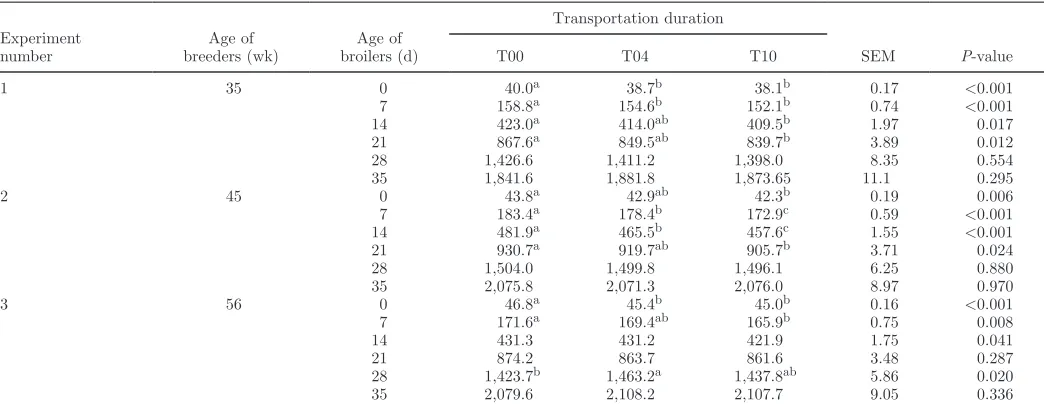
Table 3 shows the effect of transportation duration on BW of birds per experiment up to slaughter age. Transportation duration resulted in lighter chicks early
in the growout period: up to d 21 in experiment 1 and 2. However, at d 35, there were no longer any differ-ences in BW between transportation treatments.
Feed Uptake and FCR
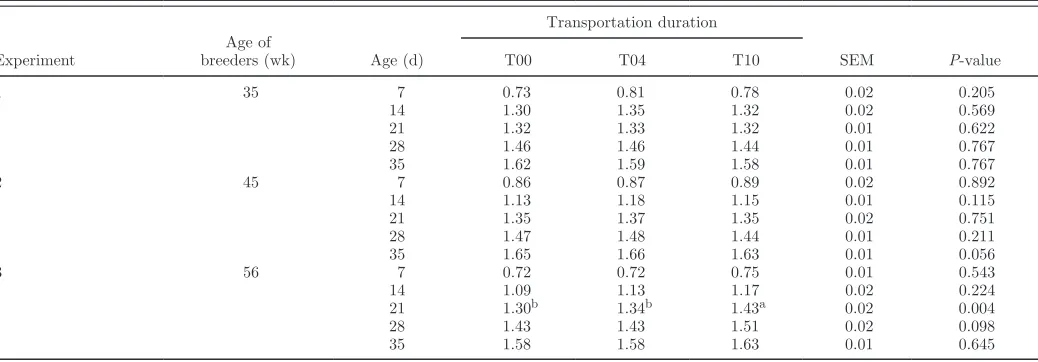
Results of feed uptake and FCR are presented in Tables 4 and 5, respectively. Transportation had no significant effect on cumulative weekly feed uptake in the 2 first experiments. In the third experiment, at d 21 and d 28, feed uptake in T10 was significantly higher than in the other treatments. At d 35, feed uptake in T10 was also significantly higher than in T00, but no significant differences were observed between T04 and the other treatments.
The FCR demonstrated a similar tendency, with no significant effect observed in the first 2 experiments, whereas in the third experiment at d 21, FCR for T10 was significantly higher than for T00 and T04.
Viability
Viability results are presented in Figure 1. The re-sults of the Cox model showed no significant effect of
Table 2. Effect of 1-d-old chick transportation duration on hematocrit of broilers up to slaughter age at different breeder flock ages1
Experiment
number breeders (wk)Age of
Transportation duration
SEM P-value
T00 T04 T10
1 35 30.7 28.5 29.6 0.38 0.349
2 45 30.4a 27.4b 29.4a 0.33 0.003
3 56 29.6a 29.0a 27.8b 0.22 0.005
a,bWithin a row, means of the same factor that do not share a common superscript differ significantly (P ≤ 0.05).
1Hematocrit was assessed on 44, 64, and 84 chicks for the first, second, and third experiments consecutively for each transportation duration. T00
= control group; T04 and T10 = transported in a truck for 4 or 10 h, respectively.
Table 3. Effect of 1-d-old chick transportation duration on BW (g) of broilers up to slaughter age at different breeder flock ages1
Experiment
number breeders (wk)Age of broilers (d)Age of
Transportation duration
SEM P-value
T00 T04 T10
1 35 0 40.0a 38.7b 38.1b 0.17 <0.001
7 158.8a 154.6b 152.1b 0.74 <0.001
14 423.0a 414.0ab 409.5b 1.97 0.017
21 867.6a 849.5ab 839.7b 3.89 0.012
28 1,426.6 1,411.2 1,398.0 8.35 0.554 35 1,841.6 1,881.8 1,873.65 11.1 0.295
2 45 0 43.8a 42.9ab 42.3b 0.19 0.006
7 183.4a 178.4b 172.9c 0.59 <0.001
14 481.9a 465.5b 457.6c 1.55 <0.001
21 930.7a 919.7ab 905.7b 3.71 0.024
28 1,504.0 1,499.8 1,496.1 6.25 0.880 35 2,075.8 2,071.3 2,076.0 8.97 0.970
3 56 0 46.8a 45.4b 45.0b 0.16 <0.001
7 171.6a 169.4ab 165.9b 0.75 0.008
14 431.3 431.2 421.9 1.75 0.041 21 874.2 863.7 861.6 3.48 0.287 28 1,423.7b 1,463.2a 1,437.8ab 5.86 0.020
35 2,079.6 2,108.2 2,107.7 9.05 0.336
a–cWithin a row, means for breeder age and transport duration, respectively, of the same factor that do not share a common superscript differ
sig-nificantly (P ≤ 0.05).
1Data are shown as the mean of 30 individual measurements per pen. T00 = control group; T04 and T10 = transported in a truck for 4 or 10 h,
respectively.
transportation duration on the viability of broilers up to slaughter age in either the first (P = 0.811) or third (P = 0.686) experiment. In the second experiment, vi-ability was significantly (P = 0.049) lower in T00 than in T04 and T10, whereas no significant differences were observed between T04 and T10.
Pododermatitis
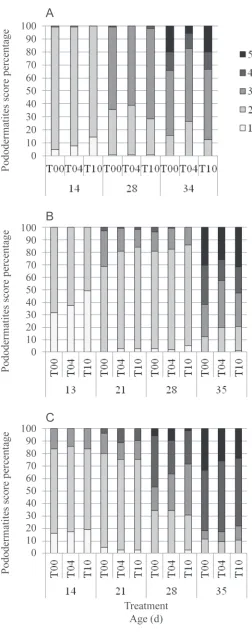
Pododermatitis data are presented in Figure 2. No significant effect of transportation duration on podo-dermatitis was observed in either the first or third ex-periment. In the second experiment, T10 birds had a significantly lower pododermatitis average score than T00 birds at d 13 (1.51 vs. 1.69, P = 0.021) and d 21 (2.15 vs. 2.34, P = 0.013). However, no significant
dif-ference was observed between T04 and the other treat-ments. At d 28 and 35, no significant differences were observed between any treatments.
Breeder Age Effect
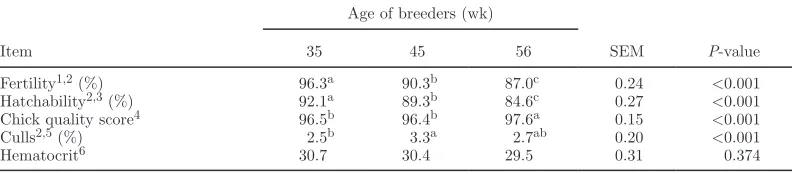
The results of incubation (fertility, hatchability, and chick quality) are presented in Table 6. They show a significant decrease (P < 0.001) in fertility and hatch-ability with increasing breeder age. The chick quality score from 56-wk-old breeders was significantly higher (P < 0.001) than the score from 35- and 45-wk-old breeders. The percentage of culls was significantly high-er (P < 0.001) in 45-wk-old breeders than for the other breeder ages. However, breeder age had no significant (P = 0.311) effect on hematocrit.
Table 4. Effect of 1-d-old chick transportation duration on cumulative feed uptake (g/bird) of broilers up to slaughter age at differ-ent breeder flock ages1
Experiment
number breeders (wk)Age of broilers (d)Age of
Transportation duration
SEM P-value
T00 T04 T10
1 35 7 116.2 125.2 119.1 3.44 0.304
14 550.9 559.3 538.5 6.02 0.403 21 1,144.5 1,130.5 1,108.3 8.37 0.216 28 2,078.0 2,063.3 2,013.3 13.75 0.127 35 2,979.0 2,990.7 2,950.6 15.20 0.587
2 45 7 157.7 155.0 153.0 2.51 0.780
14 543.5 549.8 527.5 4.53 0.102 21 1,253.8 1,261.1 1,220.6 8.11 0.081 28 2,205.6 2,220.4 2,157.3 14.59 0.174 35 3,414.4 3,442.7 3,372.9 22.12 0.223
3 56 7 122.6 122.9 123.6 1.58 0.968
14 469.0 487.0 494.7 6.09 0.218 21 1,135.5b 1,152.9b 1,230.4a 13.68 0.004
28 2,030.1b 2,092.2b 2,173.5a 20.31 0.008
35 3,278.9b 3,330.7ab 3,442.5a 25.91 0.022 a,bWithin a row, breeder age and transport duration means of the same factor that do not share a common superscript differ significantly (P ≤ 0.05). 1Pen was the experimental unit for feed uptake and feed conversion ratio. T00 = control group; T04 and T10 = transported in a truck for 4 or 10
h, respectively.
Table 5. Effect of 1-d-old chick transportation duration on feed conversion ratio of broilers up to slaughter age at different breeder flock ages1
Experiment breeders (wk)Age of Age (d)
Transportation duration
SEM P-value
T00 T04 T10
1 35 7 0.73 0.81 0.78 0.02 0.205
14 1.30 1.35 1.32 0.02 0.569 21 1.32 1.33 1.32 0.01 0.622 28 1.46 1.46 1.44 0.01 0.767 35 1.62 1.59 1.58 0.01 0.767
2 45 7 0.86 0.87 0.89 0.02 0.892
14 1.13 1.18 1.15 0.01 0.115 21 1.35 1.37 1.35 0.02 0.751 28 1.47 1.48 1.44 0.01 0.211 35 1.65 1.66 1.63 0.01 0.056
3 56 7 0.72 0.72 0.75 0.01 0.543
14 1.09 1.13 1.17 0.02 0.224 21 1.30b 1.34b 1.43a 0.02 0.004
28 1.43 1.43 1.51 0.02 0.098 35 1.58 1.58 1.63 0.01 0.645
a,bWithin a row, means of the same factor that do not share a common superscript differ significantly (P ≤ 0.05).
1Pen was the experimental unit for feed uptake and feed conversion ratio. T00 = control group; T04 and T10 = transported in a truck for 4 or 10
h, respectively.
The BW of chicks at hatch significantly increased with age of breeders. Chicks from 45-wk-old breed-ers had the highest BW between d 7 and 28, but at slaughter age, birds from 56-wk-old breeders were the heaviest (P < 0.001). Birds from 35-wk-old breeders were significantly lighter throughout growout period (P < 0.001). Birds from the 35-wk-old breeders had significantly lower feed uptake than birds from the 45-wk-old breeders, except at d 14. Feed uptake was significantly lower for birds from the 56-wk-old breeder than for those from 45-wk-old breeders, except at d 35 where no significant differences were observed. The lowest FCR was observed with birds from older breed-ers (56 wk) during the first 2 wk of growout period. Then, no significant differences were observed up to d 28. At slaughter age, FCR was higher in 45-wk-old breeders than in 35- and 56-wk-old breeders. Viability was significantly affected by the age of breeders (P < 0.001). Multicomparisons of survival analysis showed that mortality in flocks from 35- and 45-wk-old ers was significantly higher than from 56-wk-old breed-ers (P < 0.001). However, no significant differences in mortality were observed between chicks from 35- and 45-wk-old breeders (P = 0.268).
DISCUSSION
This experiment investigated whether broiler chicks expressed lower performance and had higher mortality rates after being transported for long periods.
Hematocrit is defined as the volume of packed blood cells, expressed as a percentage of total blood volume. It increases with the dehydration status and hypoxia (Maxwell et al., 1990; Zhou et al., 1999). It was as-sumed that newly hatched chicks spending a longer time without access to water would present a higher hematocrit. To the best of our knowledge, no previous study investigated the effect of transportation duration of 1-d-old chicks on dehydration using hematocrit. In previous studies, weight loss was used as an indicator of dehydration (Reis et al., 1997; Peebles et al., 2004), but Hager and Beane (1983) reported that weight loss could be attributed primarily to excretion. Our results show a significant decrease in hematocrit in the last experiment for longer transportation duration (a longer period before the first feed and water intake). These results are not in line with those of Peebles et al. (2004) who found no significant decrease in hematocrit (33.1 to 27.0%) when 1-d-old chicks were subjected to a 72-h delay before their first feed and water intake. No differ-ence was observed either in hematocrit of 1-d-old chicks despite the difference in hatch time and the time spent in the hatcher (Wolanski et al., 2006). Hematocrit is also likely to increase in environments containing a high CO2 concentration: Maxwell et al. (1987, 1990) showed
an increase in chick hematocrit from 29.0% (normal environment) to 36.1% (CO2 concentration up to 1%).
The decrease of hematocrit observed in our study could
Figure 1. Broiler viability up to slaughter age according to trans-portation duration for 35- (A), 45- (B), and 56-wk-old (C) breeders. T00 = control group; T04 and T10 = transported in a truck for 4 or 10 h, respectively. Color version available in the online PDF.
therefore be explained by the decrease in CO2 from 1%
in the hatcher to 0.03% in the transportation crates. When 1-d-old chicks were transported for 4 or 10 h, BW of birds was reduced up to d 21, but after this peri-od, no differences were observed between treatments up to slaughter age. This confirms the results of Baião et al. (1998) who suggested that a longer period of hatch-ing associated with a longer interval between hatchhatch-ing and housing impaired the weight gain of the broilers in the first week of growout period, but did not change the final weight or feed efficiency at the end of the gro-wout period. Batal and Parsons (2002) suggested that early feeding after hatch stimulates early gut develop-ment, resulting in efficient energy utilization and higher weight gain. Fairchild et al. (2006) found that despite having an early access to water, delayed feed access ini-tially impaired broiler growth, but no differences were observed after 2 wk of growout.
No significant differences in feed uptake and FCR were observed between chicks transported for differ-ent durations. However, Almeida et al. (2006) reported that removing chicks from incubators directly after hatch compared with those removed 12 h later resulted in higher feed intake up to d 28, but not in higher weight gain at the end of the growout period. Vargas et al. (2009) suggested that in broilers FCR was not affected when chicks were removed from the hatcher 12 h after hatch. This result could be explained by the fact that the feed uptake measurement was not precise, because spilt feed could not be quantified. It could also be linked to sex dimorphism (the difference in BW be-tween males and females), which is around 300 g at d 35 (Aviagen, 2007); thus, sex ratios, which may vary between pens, would result in high feed uptake variabil-ity. These differences could increase the variability be-tween experimental units and consequently reduce the statistical power. Sex dimorphism and sex ratio should therefore be taken into account in future experiments.
Chou et al. (2004) suggested that transportation of chicks for distances higher than 50 km (a fasting pe-riod of more than 1 h and stress of transportation) results in higher mortality rates (1.2 vs. 1.4%) dur-ing the first week of the growout period. The rate of mortality during the first week was lower in our study (0.9 to 1.1%). This could be explained by the fact that all transported chicks were driven across flat areas in our study, whereas Chou et al. (2004) reported that transporting 1-d-old chicks through mountain roads in-creased the risk of mortality by 9.48% during the first week. The results of Chou et al. (2004) were also based on field data with no controlled factors, whereas our experiments were held in an experimental station with a controlled environment during the transportation and growout period. Almeida et al. (2006) suggested that a long fasting period (12 h) after hatching had no effect on mortality during the growout period.
Prevalence of severe pododermatitis was reduced in T10 at d 13 and 21 in the second experiment. Trans-porting chicks for 10 h decreased growth during the
Figure 2. Effect of transportation duration on pododermatitis for 35- (A), 45- (B), and 56-wk-old (C) breeders. T00 = control group; T04 and T10 = transported in a truck for 4 or 10 h, respectively.
3 first weeks and as a consequence resulted in lighter birds. Therefore, lighter birds had less pododermatitis as it has been reported that pododermatitis positively correlates with weight (Kestin et al., 2001). Pododer-matitis is also probably linked to poor litter quality (Berg, 2004), but no significant differences in litter quality were observed between treatments in the pres-ent study (unpublished data).
The same breeder flock was used throughout the 3 experiments, the breeder age consequently increased from experiment 1 to 3; thus, this age effect could not be separated from the experiment effect. However, our results are in accordance with the literature: increasing breeder age from 35 to 56 wk significantly decreased egg fertility from 96.3 to 87.0%. Increasing age also decreased hatchability from 92.1 to 84.6%, which is in line with the results of Tona et al. (2001a,b) who identified optimal hatchability from 31- to 40-wk-old broiler breeders. Hatchability is related to egg fertility and embryo mortality throughout the incubation pro-cesses (Yassin et al., 2008). Embryo mortality has been reported to increase with increasing breeder flock age (Elibol et al., 2002; Zakaria et al., 2009). Chick qual-ity scores and the proportion of first class chicks were higher in 56-wk-old breeders than in 35- and 45-wk-old breeders. These results are not consistent with those of Willemsen et al. (2008) who showed high chick qual-ity scores of 96 and 90 in 39- and 53-wk-old breeders, respectively. The percentage of culls was significantly higher in mid-age breeders, whereas Ulmer-Franco et al. (2010) found fewer culled chicks from young breed-ers (29 wk old) than from older breedbreed-ers (57 wk old). Chick quality has been reported to be a difficult mat-ter to define as it is a subjective evaluation depending on the judgment of each individual (Willemsen et al., 2008).
Weight of 1-d-old chicks was 6.9 g higher for 56-wk-old breeders than for 35-wk-56-wk-old breeders, in line with the results of Hulet et al. (2007) who found the weight of 1-d-old chicks from 57-wk-old breeders higher (+7.7
g) than chicks from 29-wk-old breeders. Other research suggests a positive correlation between the age of breed-ers and the weight of 1-d-old chicks (Tona et al., 2001a; Almeida et al., 2008; Willemsen et al., 2008). Final BW was higher in 56-wk-old breeders than in 35- and 45-wk-old breeders. Our results are in accordance with the results of Ulmer-Franco et al. (2010, 2012) who highlighted a tendency for higher growth performance with increasing breeder age. The increase in BW was also associated with an increase in feed uptake as was reported by Vargas et al. (2009) who found that feed intake was significantly higher in birds from 60-wk-old breeders than from those from 30-wk-60-wk-old breed-ers. Mortality decreased with increasing breeder age, which is in line with the results of McNaughton et al. (1978) and Hearn (1986) who found higher mortality in birds from 26- to 30-wk-old breeders than in those from 58-wk-old breeders. Higher mortality is also associated with smaller eggs, which are relatively more frequent in young breeders (Tona et al., 2001a, 2004). However, Peebles et al. (1999) observed higher mortality in birds from old breeders, and the difference became significant in the last week of growout period. On the other hand, Hulet et al. (2007) found no significant effect of breeder age on mortality during the overall growout period. No clear conclusion can be highlighted for the effect of breeder age on mortality, as contradictory results have been reported in previous studies. Furthermore, in our experiments, the effect of breeder age could not be separated from that of treatment or season.
In conclusion, under our experimental conditions, transportation of 1-d-old chicks for 4 or 10 h compared with those moved directly to the farm (less than 5 min) had no effect on mortality except in the second experi-ment, but reduced BW until d 21 and as a consequence reduced the prevalence of severe pododermatitis. How-ever, it had no effect on final BW. No clear effect of transportation duration could be highlighted for hema-tocrit, feed uptake, or FCR due to a lack of precision in measurements; further studies are needed to confirm
Table 6. Effect of the age of breeders on fertility, hatchability, 1-d-old chick quality score, and per-centage of culls in broilers
Item
Age of breeders (wk)
SEM P-value
35 45 56
Fertility1,2 (%) 96.3a 90.3b 87.0c 0.24 <0.001
Hatchability2,3 (%) 92.1a 89.3b 84.6c 0.27 <0.001
Chick quality score4 96.5b 96.4b 97.6a 0.15 <0.001
Culls2,5 (%) 2.5b 3.3a 2.7ab 0.20 <0.001
Hematocrit6 30.7 30.4 29.5 0.31 0.374 a–cWithin a row, means that do not share a common superscript differ significantly (P ≤ 0.05).
1Fertility (%) = (number of fertile eggs/number of set eggs) × 100.
2A total of 128 incubation trays or hatching baskets were the experimental unit for measurements of fertility,
hatchability, and cull percentage.
3Hatchability (%) = (number of salable chicks hatched/number of fertile eggs) × 100.
4Chick quality was assessed on 250 individual chicks randomly selected for each experiment. The maximal score
is 100.
5Culls = (unsalable chicks/fertile eggs) × 100.
6Hematocrit was assessed on 44, 64, and 84 chicks for age of breeders (35, 45, and 56 wk old consecutively).
whether they have any real effect. Increasing age of breeders decreased fertility and hatchability, but it in-creased 1-d-old chick quality and BW. Older breeders also resulted in reduced mortality and increased mar-ket BW, but the age effect of breeders could not be differentiated from the experimental or seasonal effect. Chicks from older breeders appear to be heavier and could therefore support long transportation durations.
ACKNOWLEDGMENTS
The authors thank S. Bougeard (ANSES: Ploufra-gan, France) and M. Hervé (UMR1349 INRA–Agro-campus Ouest: Rennes, France) for their help in the statistical analyses, Syndicat National des Accouveurs (Rennes, France) and France AgriMer (Montreuil-sous-Bois, France) for their funding, and the staff from AN-SES experimental station (Ploufragan, France) for their help in the experiments.
REFERENCES
Almeida, J. G., S. L. Vieira, B. B. Gallo, O. R. A. Conde, and A. R. Olmos. 2006. Period of incubation and posthatching holding time influence on broiler performance. Braz. J. Poult. Sci. 8:153–158. http://dx.doi.org/10.1590/S1516-635X2006000300003.
Almeida, J. G., S. L. Vieira, R. N. Reis, J. Berres, R. Barros, A. K. Ferreira, and F. V. F. Furtado. 2008. Hatching distribution and embryo mortality of eggs laid by broiler breeders of different ages. Braz. J. Poult. Sci. 10:89–96. http://dx.doi.org/10.1590/ S1516-635X2008000200003.
Archer, G. S., H. L. Shivaprasad, and J. A. Mench. 2009. Effect of providing light during incubation on the health, productivity, and behavior of broiler chickens. Poult. Sci. 88:29–37. http:// dx.doi.org/10.3382/ps.2008-00221.
Aviagen. 2007. ROSS PM3: Broiler performance objectives. Avia-gen, Midlothian, UK.
Baião, N. C., S. V. Cançado, and C. G. Lucio. 1998. Effect of hatch-ing period and the interval between hatchhatch-ing and houshatch-ing on broiler performance. Arq. Bras. Med. Vet. Zoo. 50:329–335. Baker, C. J., S. Dalley, X. Yang, P. Kettlewell, and R. Hoxey.
1996. An investigation of the aerodynamic and ventilation characteristics of poultry transport vehicles: Part 2, wind tun-nel experiments. J. Agric. Eng. Res. 65:97–113. http://dx.doi. org/10.1006/jaer.1996.0083.
Batal, A., and C. Parsons. 2002. Effect of fasting versus feeding oasis after hatching on nutrient utilization in chicks. Poult. Sci. 81:853–859.
Bayliss, P. A., and M. H. Hinton. 1990. Transportation of broilers with special reference to mortality rates. Appl. Anim. Behav. Sci. 28:93–118. http://dx.doi.org/10.1016/0168-1591(90)90048-I.
Berg, C. 2004. Pododermatitis and hock burn in broiler chickens. Pages 37–49 in Measuring and Auditing Broiler Welfare. C. A. Weeks and A. Butterworth, ed. CABI Publishing, Wallingford, UK.
Chou, C. C., D. D. Jiang, and Y. P. Hung. 2004. Risk factors for cumulative mortality in broiler chicken flocks in the first week of life in Taiwan. Br. Poult. Sci. 45:573–577. http://dx.doi. org/10.1080/000716604000006248.
Council of the European Union. 2005. Council Regulation (EC) No 1/2005 of 22 December, 2004, on the protection of animals dur-ing transport and related operations and amenddur-ing Directives 64/432/EEC and 93/119/EC and Regulation (EC) No 1255/97. Off. J. Eur. Union L 3:1–44.
Council of the European Union. 2007. Council Directive 2007/43/ EC of 28 June, 2007, laying down minimum rules for the
protec-tion of chickens kept for meat producprotec-tion. Off. J. Eur. Union L 182:19–28.
EFSA Panel on Animal Health and Welfare (AHAW). 2011. Scien-tific opinion concerning the welfare of animals during transport. EFSA J. 9:125 10.2903/j.efsa.2011.1966.
Elibol, O., S. Peak, and J. Brake. 2002. Effect of flock age, length of egg storage, and frequency of turning during storage on hatch-ability of broiler hatching eggs. Poult. Sci. 81:945–950.
Fairchild, B. D., J. K. Northcutt, J. M. Mauldin, R. J. Buhr, L. J. Richardson, and N. A. Cox. 2006. Influence of water provision to chicks before placement and effects on performance and incidence of unabsorbed yolk sacs. J. Appl. Poult. Res. 15:538–543. Hager, J. E., and W. L. Beane. 1983. Posthatch incubation-time and
early growth of broiler-chickens. Poult. Sci. 62:247–254. http:// dx.doi.org/10.3382/ps.0620247.
Hearn, P. J. 1986. Making use of small hatching eggs in an integrat-ed broiler company [Abstract of Spring Meeting of the WPSA (UK Branch)]. Br. Poult. Sci. 27:498.
Heier, B. T., H. R. Høgåsen, and J. Jarp. 2002. Factors associat-ed with mortality in Norwegian broiler flocks. Prev. Vet. Massociat-ed. 53:147–158. http://dx.doi.org/10.1016/S0167-5877(01)00266-5. Hulet, R., G. Gladys, D. Hill, R. Meijerhof, and T. El-Shiekh. 2007.
Influence of egg shell embryonic incubation temperature and broiler breeder flock age on posthatch growth performance and carcass characteristics. Poult. Sci. 86:408–412.
Kestin, S. C., S. Gordon, G. Su, and P. Sorensen. 2001. Relation-ships in broiler chickens between lameness, liveweight, growth rate and age. Vet. Rec. 148:195–197.
Maxwell, M. H., S. Spence, G. W. Robertson, and M. A. Mitch-ell. 1990. Haematological and morphological responses of broil-er chicks to hypoxia. Avian Pathol. 19:23–40. http://dx.doi. org/10.1080/03079459008418653.
Maxwell, M. H., S. G. Tullett, and F. G. Burton. 1987. Haematology and morphological changes in young broiler chicks with experi-mentally induced hypoxia. Res. Vet. Sci. 43:331–338.
McNaughton, J. L., J. W. Deaton, F. N. Reece, and R. L. Haynes. 1978. Effect of age of parents and hatching egg weight on broiler chick mortality. Poult. Sci. 57:38–44. http://dx.doi.org/10.3382/ ps.0570038.
Michel, V., E. Prampart, L. Mirabito, V. Allain, C. Arnould, D. Huonnic, S. Le Bouquin, and O. Albaric. 2012. Histologically-validated footpad dermatitis scoring system for use in chicken processing plants. Br. Poult. Sci. 53:275–281. http://dx.doi.org /10.1080/00071668.2012.695336.
Mitchell, M., and P. Kettlewell. 1998. Physiological stress and wel-fare of broiler chickens in transit: Solutions not problems! Poult. Sci. 77:1803–1814.
Olsen, M. W., and B. Winton. 1941. Viability and weight of chicks as affected by shipping and time without feed. Poult. Sci. 20:243–250. http://dx.doi.org/10.3382/ps.0200243.
Peebles, E., S. Doyle, T. Pansky, P. Gerard, M. Latour, C. Boyle, and T. Smith. 1999. Effects of breeder age and dietary fat on subsequent broiler performance. 1. Growth, mortality, and feed conversion. Poult. Sci. 78:505–511.
Peebles, E. D., R. W. Keirs, L. W. Bennett, T. S. Cummings, S. K. Whitmarsh, and P. D. Gerard. 2004. Relationships among post-hatch physiological parameters in broiler chicks post-hatched from young breeder hens and subjected to delayed brooding place-ment. Int. J. Poult. Sci. 3:578–585.
Quinn, A. D., and C. J. Baker. 1997. An investigation of the ven-tilation of a day-old chick transport vehicle. J. Wind Eng. Ind. Aerod. 67–68:305–311. http://dx.doi.org/10.1016/S0167-6105(97)00081-0.
R Development Core Team. 2012. R: A Language and Environment for Statistical Computing. R Foundation for Statistical Comput-ing, Vienna, Austria.
Reis, L. H., L. T. Gama, and M. C. Soares. 1997. Effects of short storage conditions and broiler breeder age on hatchability, hatch-ing time, and chick weights. Poult. Sci. 76:1459–1466.
Tixier-Boichard, M., F. Leenstra, D. K. Flock, P. M. Hocking, and S. Weigend. 2012. A century of poultry genetics. World’s Poult. Sci. J. 68:307–321. http://dx.doi.org/10.1017/S0043933912000360. Tona, K., F. Bamelis, W. Coucke, V. Bruggeman, and E. Decuypere.
2001a. Relationship between broiler breeder’s age and egg weight
loss and embryonic mortality during incubation in large-scale conditions. J. Appl. Poult. Res. 10:221–227.
Tona, K., F. Bamelis, B. De Ketelaere, V. Bruggeman, V. Moraes, J. Buyse, O. Onagbesan, and E. Decuypere. 2003. Effects of egg storage time on spread of hatch, chick quality, and chick juvenile growth. Poult. Sci. 82:736–741.
Tona, K., E. Decuypere, and W. Coucke. 2001b. Effects of strain, hen age and transferring eggs from turning to stationary trays after 15 to 18 days of incubation. Br. Poult. Sci. 42:663–667. http://dx.doi.org/10.1080/00071660120088614.
Tona, K., O. Onagbesan, B. De Ketelaere, E. Decuypere, and V. Bruggeman. 2004. Effects of age of broiler breeders and egg stor-age on egg quality, hatchability, chick quality, chick weight, and chick posthatch growth to forty-two days. J. Appl. Poult. Res. 13:10–18.
Ulmer-Franco, A. M., G. Cherian, N. Quezada, G. M. Fasenko, and L. M. McMullen. 2012. Hatching egg and newly hatched chick yolk sac total IgY content at 3 broiler breeder flock ages. Poult. Sci. 91:758–764. http://dx.doi.org/10.3382/ps.2011-01757. Ulmer-Franco, A. M., G. M. Fasenko, and E. E. O’Dea Christopher.
2010. Hatching egg characteristics, chick quality, and broiler per-formance at 2 breeder flock ages and from 3 egg weights. Poult. Sci. 89:2735–2742. http://dx.doi.org/10.3382/ps.2009-00403. Valros, A., R. Vuorenmaa, and A. M. Janczak. 2008. Effect of
simu-lated long transport on behavioural characteristics in two strains of laying hen chicks. Appl. Anim. Behav. Sci. 109:58–67. http:// dx.doi.org/10.1016/j.applanim.2007.02.007.
Vargas, F. S. C., T. R. Baratto, F. R. Magalhães, A. Maiorka, and E. Santin. 2009. Influences of breeder age and fasting after
hatch-ing on the performance of broilers. J. Appl. Poult. Res. 18:8–14. http://dx.doi.org/10.3382/japr.2008-00029.
Willemsen, H., N. Everaert, A. Witters, L. De Smit, M. Debonne, F. Verschuere, P. Garain, D. Berckmans, E. Decuypere, and V. Bruggeman. 2008. Critical assessment of chick quality measure-ments as an indicator of posthatch performance. Poult. Sci. 87:2358–2366. http://dx.doi.org/10.3382/ps.2008-00095.
Wolanski, N. J., R. A. Renema, F. E. Robinson, V. L. Carney, and B. I. Fancher. 2006. Relationship between chick conformation and quality measures with early growth traits in males of eight selected pure or commercial broiler breeder strains. Poult. Sci. 85:1490–1497.
Xin, H., and S. R. Rieger. 1995. Physical conditions and mortali-ties associated with international air transport of young chicks. Trans. ASAE 38:1863–1867.
Yassin, H., A. G. J. Velthuis, M. Boerjan, J. van Riel, and R. B. M. Huirne. 2008. Field study on broiler eggs hatchability. Poult. Sci. 87:2408–2417. http://dx.doi.org/10.3382/ps.2007-00515.
Zakaria, A. H., P. W. Plumstead, H. Romero-Sanchez, N. Leksri-sompong, and J. Brake. 2009. The effects of oviposition time on egg weight loss during storage and incubation, fertility, and hatchability of broiler hatching eggs. Poult. Sci. 88:2712–2717. http://dx.doi.org/10.3382/ps.2009-00069.
Zhou, W. T., M. Fujita, and S. Yamamoto. 1999. Thermoregulatory responses and blood viscosity in dehydrated heat-exposed broil-ers (Gallus domesticus). J. Therm. Biol. 24:185–192. http:// dx.doi.org/10.1016/S0306-4565(99)00010-8.