1
The Role of Big Data Analytics in Developing System Dynamic
Models
Hamed Kianmehr, Ph.D. Candidate, Systems Science and Industrial Engineering, Binghamton University, NY, USAhttp://orcid.org/0000-0002-7024-7864
Nasim Sabounchi, Assistant Professor, Systems Science and Industrial Engineering, Binghamton University, NY, USAhttp://orcid.org/0000-0002-8027-8779, email: [email protected] Lina Begdache, Assistant Professor, Health and Wellness Studies, Binghamton University, NY, USA http://orcid.org/0000-0001-5213-6979
Abstract
Dietary factors are one of the risk factors that can impact the brain chemistry, which leads to mental distress. Based on our data mining approach, we found that mental distress in men is associated with eating unhealthy food. Our aim in this paper is to apply results from our big data analytics approach to inform system dynamics (SD) modeling to investigate the causal relationships between brain structures, nutrients from food and dietary supplements, and mental health. We perform descriptive analysis based on a large data set to estimate the SD modeling parameters. Finally, we calibrate the model towards a time series data collected for individuals on their dietary and distress patterns. The results reveal that bridging these different methodologies leads to further insights from the SD model and decreases the error of calibrated parameter values. Future research is needed to validate our initial results for investigating the relationship between mental distress and dietary intake.
Keywords: System Dynamics Modeling, Big data, Mental Distress, Diet
Introduction
groups has a larger HC volume in comparison of woman [8]. Additionally, the amygdala activation is not equal in man and women [9]. So, based on this discrepancy between brain structure of men and women and different effects of dietary patterns, it is very complex to study its relationship with mental distress. There are different methods to investigate the dietary patterns such as principal component analysis (PCA) and clustering, but limited research exists for deriving the dynamic relationship between DP and mental distress. Also here are several machine learning methods used in health care domain to investigate the latent factors [10].
The purpose of this study is to investigate the causal relationship between dietary variables and mental distress based on gender by adopting results from the big data analytics approach. To our knowledge, this is the first study, which explores how big data analytics can inform causal links in SD models. We build upon prior studies that investigate the association between mental distress based on dietary intake and differences among adult men and women.
Method
We apply machine learning techniques including PCA to derive the relationship between dietary pattern and mental distress. Then we use evidence from the literature to validate our findings. Based on our validated findings, we developed a system dynamics model to replicate time series data for one adult man between 30 to 39 years old that has recorded his dietary habits and mental distress levels over 40 days period. In order to estimate the unknown parameters, we applied traditional calibration methods in SD, that tries to decrease the difference between historical times series data and simulated results. Also, due to lack of data, we used an Indirect Inference approach by applying stepwise regression to estimate the other unknown parameters of the SD model [11].
SD model
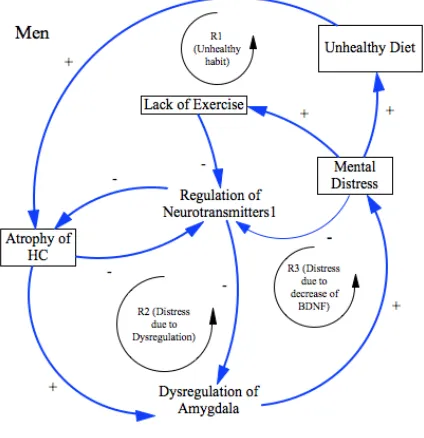
Loop R3 explains the effect of exercise on mental distress [14].
Figure 1 Casual Loop Diagram for men
Results
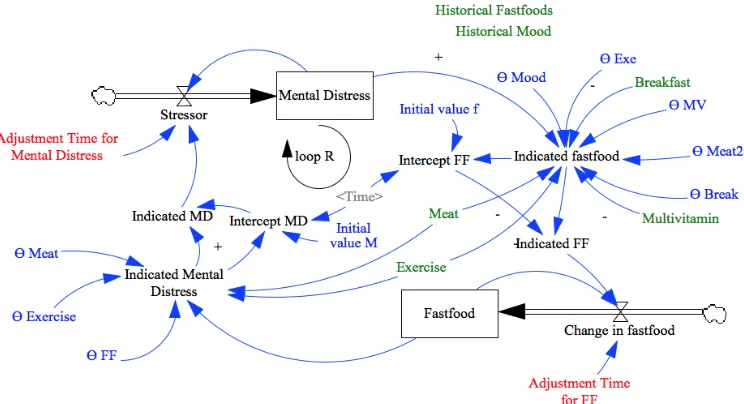
We represent a simple SD model of the main factors between diet and mental distress. As shown in figure 2, for men, there is a reinforcing loop which is defined by effect of fast food on mental distress and vice versa based on our article which is now under review. We applied the PCA method to derive the different dietary patterns based on 563 individuals for men versus women. Our key finding is that mental distress among men is dependent on fast food consumption and so we use traditional calibration tool to estimate 𝜃! and 𝜃! to find the relationship between fast food consumption and mental distress. Some other variables besides mental distress can impact individuals to eat more fast food which we consider them as exogenous variables and include breakfast, meat, exercise, and multivitamin. For estimating the unknown parameters that include 𝜃!, 𝜃!, 𝜃!, 𝜃! and 𝜃!, we run the stepwise regression to define the
Figure 2 - SD model for unhealthy dietary intake and mental distress for Men 30 to 39 years
Table 1 Unknown Parameters in the SD Model
Unknown parameters (θ) Regression values Calibrations values Adjustment Time for Mental
Distress
1.859
Adjustment Time for FF 0.3
Ɵ Fast Food -3.516
Ɵ Mood -0.01608
Ɵ Exercise -2.282
Ɵ Multivitamin 0.1228
Ɵ Meat 2.674
Ɵ Meat2 0.2131
Ɵ Breakfast -0.1395
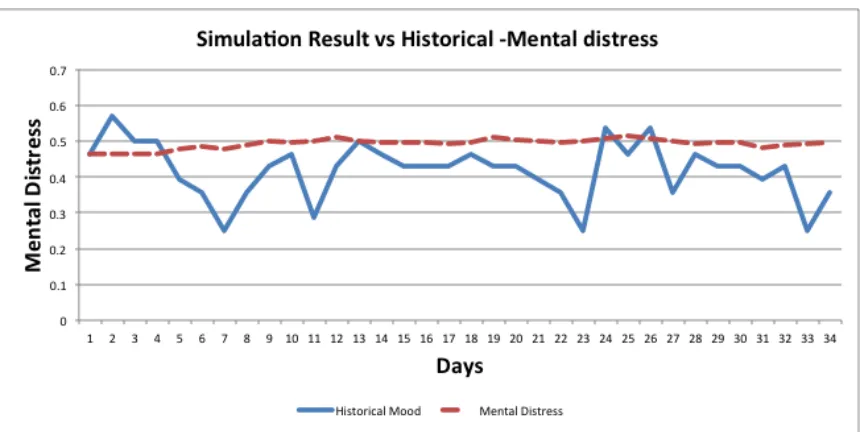
Figure 3 Simulation Result vs. Historical-Mental distress
This the first attempt that we try to map the feedback loop by applying some data mining techniques which are supported by the literature and a previous study [15, 16] . This SD model can provide the environment for policymakers to investigate the impact of different dietary pattern in mental distress and predict the future trend.
Future research
This study is an ongoing work that we want to find the answer to some questions through applying some machine learning techniques and system dynamics;
1- How can we derive causal relations by using big data analytics and apply it in developing SD models?
2- How can we find nonlinear relationships using longitudinal data for validating SD models?
References
1. Seney, M.L. and E. Sibille, Sex differences in mood disorders:
perspectives from humans and rodent models. Biology of sex differences, 2014. 5(1): p. 17.
2. Rao, T.S., et al., Understanding nutrition, depression and mental illnesses.
Indian Journal of Psychiatry, 2008. 50(2): p. 77.
3. McLean, A., et al., The effects of tyrosine depletion in normal healthy volunteers: implications for unipolar depression. Psychopharmacology, 2004. 171(3): p. 286-297.
4. Rutter, M., A. Caspi, and T.E. Moffitt, Using sex differences in psychopathology to study causal mechanisms: unifying issues and research strategies. Journal of Child Psychology and Psychiatry, 2003.
44(8): p. 1092-1115.
5. Wai, J. and M. Makel, Sex differences in ability tilt in the right tail of cognitive abilities: A 35-year examination. 2017.
6. Ingalhalikar, M., et al., Sex differences in the structural connectome of the human brain. Proceedings of the National Academy of Sciences, 2014.
111(2): p. 823-828.
7. Ruigrok, A.N., et al., A meta-analysis of sex differences in human brain structure. Neuroscience & Biobehavioral Reviews, 2014. 39: p. 34-50. 8. Tan, A., et al., The human hippocampus is not sexually-dimorphic:
meta-analysis of structural MRI volumes. Neuroimage, 2016. 124: p. 350-366. 9. Van Wingen, G.A., et al., Testosterone increases amygdala reactivity in
middle-aged women to a young adulthood level.
Neuropsychopharmacology, 2009. 34(3): p. 539.
10. Begdache, L., H. Kianmehr, and C.V. Heaney, College Education on Dietary Supplements May Promote Responsible Use In Young Adults.
Journal of dietary supplements, 2018: p. 1-14.
11. Hosseinichimeh, N., et al. Estimating system dynamics models using indirect inference. in Proceedings of the International System Dynamics Conference. 2015.
12. Jacka, F.N., et al., Western diet is associated with a smaller hippocampus: a longitudinal investigation. BMC medicine, 2015. 13(1): p. 215.