the use of mechanical adjusting devices:
a report of three cases
Jim Nykoliation,
BSc, DC, FCCS(C)*
Dale Mierau,
BSPE, DC, MSc, FCCS(C)**
* Private practice of Chiropractic, Saskatoon, Saskatchewan, Canada.
** Saskatoon Musculoskeletal Rehabilitation Center, Saskatoon, Saskatchewan, Canada. Contact: Dr. Jim Nykoliation, 6 – 123 Lenore Drive, Saskatoon, Saskatchewan, S7K 7H9. © JCCA 1999.
Les dispositifs de réglage mécanique (DAM) trouvent de plus en plus de preneurs parmi les chiropraticiens et les chiropraticiennes, mais leur utilisation n’est pas dénuée d’effets indésirables. Voici l’histoire de trois patients soumis à ce type de traitement et les circonstances dans lesquelles se sont produits les problèmes. Les DAM peuvent être source de complications directes et indirectes pour les patients en chiropratique. La notion selon laquelle les DAM sont plus sûrs que les
manipulations articulaires usuelles pourrait être inexacte. L’application d’une force inappropriée par le praticien ou la praticienne, ou l’absence de mécanisme de sûreté intégrée sur les dispositifs pourraient jouer un rôle dans l’apparition d’effets indésirables ou de lésions imputables à l’intervention. Toutefois, il ne faudrait pas considérer les résultats décrits ci-dessous comme concluants parce qu’ils ne reposent que sur un petit nombre de cas.
(JACC 1999; 43(3):161–167)
M O T S C L É S : accident vasculaire cérébral, incident
vasculaire cérébral, chiropratique, dispositif de réglage mécanique (DAM), manipulation.
As the popularity of mechanical adjusting devices
(MADs) increases within the chiropractic profession, it is evident that adverse effects associated with the provision of this intervention can occur. This paper describes three such cases, along with a discussion about their
circumstances. The use of MADs may cause both direct and indirect complications for chiropractic patients. The notion that MADs might be safer than conventional articular manipulation procedures might not be
accurate. The use of improper force by the practitioner, and/or the lack of a “fail-safe” mechanism on the MAD might contribute to adverse effects and/or injuries from MADs. These findings should not be interpreted as conclusive because they are based on a small number of case reports.
(JCCA 1999; 43(3):161–167)
K E YW O R D S: cerebrovascular accident, cerebrovascular
incident, chiropractic, mechanical adjusting device (MAD), manipulation.
Introduction
An adverse effect may be defined as any detrimental result of an action or treatment.1 All treatments have the potential
to result in adverse effects or harm to the patient. As spinal manipulative therapy (SMT) becomes more of a main-stream therapeutic approach, chiropractors should explore
com-munication skills, and 3) up to date knowledge of the es-sentials of quality care.
A treatment intervention that is somewhat unclear in its growth and utilization within the chiropractic profession is the use of mechanical adjusting devices (MADs). A recent job analysis of chiropractic practices in Canada indicated that one type of MAD was used by about 44% of the respondents.2 However, another survey of the profession
looked more closely at the utilization of techniques on patients, and found that, although various forms of MADs were indeed quite common, they tended to be used as a treatment less than 10% of the time.3 From this data, we
presume that, while MADs have not replaced traditional manual techniques in the day-to-day clinical practices of chiropractors in Canada, there is a significant level of in-terest in these various devices within the Canadian chiro-practic community. Proponents of MADs contend that treatment with a MAD is equivalent to (or a substitute for) manual joint manipulation.4
This paper describes and discusses three cases in which adverse effects were associated with the use of MADs. Two of the cases were obtained from trial records of civil litigation cases that have been concluded; the third is from the clinical records of a private chiropractic clinic. Each case illustrates a specific type of adverse effect involving the use of a MAD.
Case reports
Case one
This is a summary of a malpractice action that arose when a patient received a MAD treatment, which was alleged to have caused injury to the thoracic region.
LH is a 32-year-old woman with chronic headaches, who initially consulted Dr. S because she learned that he pro-vided an innovative treatment. She had a history of spine pain from a whiplash-associated disorder, and had been assessed for scoliosis as a child, (although she was never actually treated for scoliosis). At the time of consultation, she was approximately 24 weeks pregnant with her second child, and was on maternity leave.
Physical examination, including palpation of her cervi-cal and thoracic areas, was performed. He then adminis-tered a MAD treatment, “with an accompanying twisting
motion.” The patient was shocked, not having expected
this treatment. The chiropractor then applied heating pads to her spine. She went home, whereupon her right shoulder and thoracic region began to hurt, worsening to very se-vere pain within two hours.
LH returned to see Dr. S several days later, who, upon learning of the complications, indicated that “it would take
a long time, but he would be able to reverse what he had done and would now treat in the opposite direction”. The
chiropractor’s assistant performed ultrasound on the pa-tient’s shoulder, and Dr. S performed the same type of MAD maneuver, only “in the left direction”. This did not provide the patient with any pain relief. She went to the office sev-eral days later, and received the same form of treatment, again without benefit.
LH consulted her family physician the next week be-cause of progressive severe right scapular and shoulder pain. After her child was born, she was prescribed nonster-oidal anti-inflammatories (NSAIDS), which did not lessen her pain. She was called back from her maternity leave to her work as a machine shop mechanical contractor, but was unable to return to work because of her pain.
Her family physician eventually referred her to a sur-geon because of persistent pain and crepitus in the right scapular region. The patient underwent surgery to her ribs and the scapula. The patient’s pain and crepitus improved for three weeks, but returned thereafter. She was referred to another surgeon, who performed a further surgical pro-cedure on a portion of the ribs and scapula. After the sec-ond surgery, almost two years after the initial incident, her painful condition was only 40% improved via self-report. This patient continues to suffer from the pain at the scapular region. She takes medication for pain daily, and rarely has a painless day. She is not able to work full-time, although has started her own business that allows her to control her hours and activity. She does not engage in many of her previous activities of daily living, including social and athletic endeavors.
At the trial, the patient and the chiropractor agreed that the only treatment received was with the MAD. However, the patient contended that the treatment was applied with a twisting motion, while the practitioner denied the use of the twisting motion. According to his chart, the chiropractor used the MAD on right C2, and right T5.
the facts from the examination for discovery to the evi-dence at trial. In contrast, LH’s recollection was delivered in a concise, consistent manner, which never varied in its presentation.
Expert witnesses agreed that Dr. S kept poor records, and his history and physical examination habits were sub-standard. At best it could be said he was uncertain as to what exactly he had done to the patient on the date in question.
Further expert testimony established the patient’s prior back problems were irrelevant to the scapular problem that was the subject of the trial.
Dr. S was found negligent in treating LH because he;
•
failed to treat the patient’s presenting complaint;•
failed to make a proper diagnosis;•
provided treatment to her shoulders and spine without obtaining an adequate history;•
failed to communicate to the patient the difference between diagnostic testing and treatment;•
failed to obtain informed consent from the patient prior to providing the treatment;•
improperly treated her shoulders and spine with manipulation;•
injured the muscles and ligaments in her right shoulder.Damages were awarded by the court, and were of a considerable amount.
It is interesting to note that in the final deliberations of the court, no distinction was made between the use of MADs versus conventional SMT, and any claims of increased safety of MADs were either forgotten or ignored in this case. Carey and Townsend mention this case in an article about bias and ignorance in medical reporting, describing the uncertainty and misinterpretations of the medical spe-cialists involved. In the end, however, the conclusion was that the MAD was the source of the patient’s problems, despite the failed surgeries.5
Case two
This is a case taken from the records of the private practice of one of the authors.
DK is a 48-year-old woman with an 18 month history of progressive neck pain, headaches, and right arm paraes-thesia. Previously, she had undergone evaluation by a neu-rologist, and had been given NSAIDS, with no relief of symptoms. She eventually consulted a chiropractor who treated her with a MAD. She underwent treatment from this practitioner for over a year. Treatments consisted solely of the application of a MAD, and were based on a frequency of three times a week for the duration of her care. In all, she estimated she had gone for over one hun-dred visits, with no relief of symptoms. Despite her lack of progress, she continued to attend for treatment, because the practitioner had informed her that this was the “safest” technique, and that other forms of SMT were more force-ful and dangerous.
Her family physician suggested she explore another ap-proach to manual therapy, and suggested she seek the ad-vice of another chiropractor. When the patient first attended the second chiropractor, she stated she was very frustrated with her ongoing symptoms and her lack of progress. She was also very apprehensive of any further chiropractic intervention.
On examination, she had full cervical movement. She exhibited tenderness of the suboccipial muscles bilater-ally, and palpation of these points of tenderness repro-duced her headache. She had points of tenderness and restriction to motion testing of the lower cervical facet joints, at C6–C7, and C7–T1. Neurological examination of her extremities was unremarkable with the exception of subjective sensory deficit to light touch along the C8 der-matome on the right. She had no evidence of muscle wast-ing, and all extremity muscle groups were graded at 5/5 to manual testing. Deep tendon reflexes were bilaterally symmetrical in all four extremities. Plantar responses were down-going, and provocation tests for vertebrobasilar in-sufficiency were negative.
Radiographic examination of her cervical spine re-vealed mild degenerative changes, but otherwise was nor-mal.
root. A trial of SMT was recommended. However, she was reluctant to consent to SMT due to apprehension derived from her conversations with her previous chiropractor. She finally agreed to treatment, after considerable discussion.
Her treatment was uneventful. She tolerated SMT well, and over a three week period, she had a total of nine visits for SMT, after which all her symptoms had completely abated. On three months follow-up by telephone, she re-mained without symptoms.
Case three
This case is another malpractice summary of an incident where a patient suffered a cerebrovascular accident (CVA) following treatment from a MAD.
AB is a 36-year-old woman involved in a motor-vehicle accident, and as a consequence of that incident, developed headaches and neck pain. She consulted Dr. Z some three months later. She had received no treatment for her acci-dent-related condition. Despite her headaches, she had not lost any time from her work as a secretary. She had no other complaints.
She had seen Dr. Z several years before, for a lower back condition and headaches, and had been successfully treated with conventional SMT.
On examination, cervical spine rotation and lateral flexion to the right was full, with pain in the suboccipital area at the end range of both movements. Left rotation and left lateral flexion was approximately 75% of normal, with pain in the suboccipital area. Flexion was full and painless. Extension was full, with marked pain in the suboccipital area. Upper and lower extremity deep tendon reflexes were normal. There was slight decrease to light touch sen-sation in the upper extremity in a nondermatomal fashion. Cervical compression testing elicited no pain. Paraspinal muscle spasm extended to the trapezeii bilaterally. Leg-length isolation testing was done to ascertain subluxation levels.
Xrays revealed “a subluxation of the upper cervical
spine at C1–C2”, but no other abnormality.
She received treatment with a MAD at the right C1–C2 level, with no other SMT applied. Heat packs were applied to the patient’s neck following the procedure. The patient reported that she did not like the MAD treatment, because
she found it unpleasant and painful. Her symptoms did not improve, and were, in fact, worse. She called to cancel her subsequent appointment, because she did not wish to have the treatment applied again. She did not return to the clinic for almost two months. She finally did so only after the chiropractor contacted her and persuaded her to return by promising not to use the MAD again. Her second treatment consisted of cervical traction, diathermy, and conventional SMT with no use of the MAD. Her symptoms improved after this treatment.
She saw Dr. Z one week later, and indicated she felt considerably better. He again applied cervical traction and thoracic SMT. Then, without her permission, he applied a MAD treatment to her cervical spine. She did not receive conventional SMT to her cervical spine. Immediately after receiving the MAD, she complained of neck pain, blurred vision, dizziness, lightheadedness, and numbness and weakness in her right arm and leg. She subsequently vom-ited. She was allowed to rest for awhile, and felt no better. She was sent home, driving herself. Her condition steadily worsened, and she drove off the road on the way home. After arriving at home, she called a friend for help and was taken to hospital by ambulance.
She was diagnosed with a CVA with complete right-sided hemiparesis, and difficulty speaking. She remained in hospital for almost one month. When she was released, she had to walk with the use of a brace on her right leg.
She underwent intensive rehabilitation for the next year and improved considerably, regaining most of her speech, and much of her limb function. She was able to discard her leg brace. However, this patient was left with permanent weakness in her right arm and leg, and difficulty with memory, speech, and balance. She was unable to work for almost six months, and then only returned to a part-time secretarial position. She has never returned to full time work as a secretary due to her impairment. She never re-turned to various social and sporting activities that she had previously enjoyed.
Discussion
The intent of this article is not to identify MADs as danger-ous, or more likely to cause adverse effects than other chiropractic procedures, but rather to illustrate that no ef-fective treatment for patients with spinal disorders is com-pletely without risk. These cases are reported to show that a variety of adverse effects occurring with conventional chiropractic treatment can also occur with the use of MADs. Chiropractors should be aware that a potential risk for adverse effect exists with the utilization of these devices.
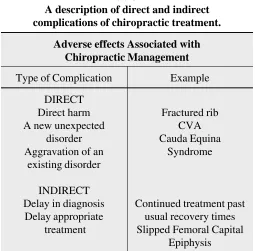
Adverse effects may be classified into two categories: direct and indirect complications (Table 1). Direct compli-cations result from the unexpected aggravation of an exist-ing disorder or the unexpected onset of a new disorder as a direct result of treatment. Indirect complications result in delay of diagnosis and appropriate treatment as a conse-quence of using a procedure or treatment that, in retro-spect, has proven to be ineffective.1 Case One and Case
Three are examples of direct complications associated with the use of MADs, and Case Two is an example of an indirect complication associated with the use of MADs.
In many instances, it is often hard to discern whether an adverse effect is due solely to a direct complication of the
treatment intervention itself, or if poor practitioner per-formance also contributed. Hence, in Case One and Case Three, although it is fairly clear the MAD was the only treatment provided and allegedly caused the incident, other factors (poor record keeping, poor communication with the patient, lack of proper consent) probably contrib-uted to the finding of guilt at trial. Lawsuits against chiropractors often occur because of failure of communi-cation, rather than due to the intervention applied, or the reaction to the intervention.6
Accurate collection and interpretation of adverse effects of treatment within the chiropractic patient population is fraught with pitfalls that must be considered when attempt-ing to study this topic. Hence, there is extensive ignorance of the frequency and severity of complications for many treatment methods. For instance, the authors of a recent review were only able to arrive at a speculative assessment that rated the risk of CVA from cervical manipulation at .5-2 incidents per million cervical manipulations per-formed, even after a careful review of all the existing pub-lished literature on CVA.7
The adverse effects associated with chiropractic treat-ment may be misreported or over reported in the published literature.5,8 Other times, incidents are not reported, or are
settled out of court, and an accurate record of what tran-spired is not always available. Even those cases reported here, although based on complete and concluded records, may have unknown inaccuracies which are not discernible from the clinical and/or trial records.
Another reason information on adverse effects of chiro-practic treatment is hard to obtain is that the treatment is considered very safe.9 Senstad et al. describe common side
effects and symptom provocation from routine spinal ma-nipulation in chiropractic practice. The morbidity from the treatment was very low. For example, the most common reactions reported were local discomfort (53%), headache (12%), tiredness (11%), or radiating discomfort (10%). Reactions were mild or moderate in 85% of patients.10,11
Case Two is a good example of an indirect complication associated with MAD treatment. Proponents of MADs claim these devices are safe and gentle. Osterbauer states, because MADS produce a measured and repeatable force of fairly low magnitude, they could offer increased safety compared to traditional SMT.4 He further claims there are
not any yet–demonstrated direct adverse effects.12 Thus,
some chiropractors are of the impression that MADs may
Table 1
A description of direct and indirect complications of chiropractic treatment.
Adverse effects Associated with Chiropractic Management
Type of Complication Example DIRECT
Direct harm Fractured rib A new unexpected CVA
disorder Cauda Equina Aggravation of an Syndrome
existing disorder INDIRECT
Delay in diagnosis Continued treatment past Delay appropriate usual recovery times
be a less forceful, and hence, safer therapeutic choice than SMT in certain cases.13–16 This impression is probably
more the result of under-reporting of problems associated with data collection, rather than an actual absence of ad-verse effects. Such statements about the greater safety of MADs cannot be sustained because accurate supporting data are not available.
Another issue raised by examination of these cases is that of the use of excessive or improper force by the prac-titioner. In both Case One and Case Three there existed testimony that implied the practitioner might have applied the MAD forcefully to the patient prior to and during the actual adjustment procedure. It is generally accepted within the chiropractic profession that SMT should not be forced, but rather the lightest amount of thrust should be used.17 In SMT, the practitioner actually touches the
pa-tient. We think this gives the advantage of experiencing the patient’s tightening or resistance if the position or con-tact prior to SMT is harsh or painful. This type of patient contact is not part of a MAD treatment.
Another issue raised in the documents associated with Case Three is the fact that most MADs do not have a so-called “fail-safe” mechanism, whereby if excessive pre-manipulative pre-load force is applied, additional force could not be transmitted to the patient. We believe that this is a biomechanical question that should be addressed in further research endeavors.
The risks of SMT are relatively small, and do not usu-ally represent a contraindication to its careful use, taking into consideration patient risk factors and technical con-siderations such as force and positioning. Risk must be weighed against benefit. It would be unfair to characterize MAD treatments as more likely to cause an adverse effect than conventional SMT. Likewise, it would be unfair to categorize conventional SMT as excessively dangerous. However, MAD treatment is probably just as likely (or unlikely) to cause an adverse effect as conventional SMT. Thus, the same standards of care, including precautions and weighing the risk-benefit ratio that would apply to conventional SMT, should apply equally to MAD treat-ment.
The cases here should be taken seriously, and should not be dismissed as isolated events. For example, as part of a retrospective survey of Danish chiropractors, Klougart et al. describe a patient that experienced a cerebrovascular incident (CVI) consisting of vertigo, vomiting, and ataxia
after having C1 treated with a MAD.18 Sullivan describes a
case whereby a female patient suffered a brain stem stroke, with permanent neurologic deficit, following a treatment with a MAD.19
It is wise to be cautious with a novel and untested thera-peutic approach if a practitioner is to avoid claims of mal-practice. One purported rationale for use of MADs is that a lot of chiropractors do it. This reasoning will not go far in a defense against a malpractice claim. No therapeutic in-tervention, including treatment with MADs, should be uti-lized unless it is based upon credible instruction. Records should be available in the event it becomes necessary to prove the quality of training.
Conclusion
Case reports do not provide conclusive evidence about the benefit or safety of any health care intervention. However, in the instance of MADs, the following is worthy of con-sideration:
•
MADs may have adverse effects causing both direct and indirect complications to chiropractic patients.•
Statements indicating that MADs might be safer than conventional SMT have yet to be confirmed. Chiro-practors cannot deny the existence of the risk of injury or the risk of adverse effects from any chiropractic inter-vention, including the use of MADs. However, gener-ally speaking, we believe that chiropractic procedures are for the most part, safe.•
MADs may not necessarily be a more gentle approach in clinical situations that call for a more conservative approach.•
Adverse effects from chiropractic procedures, including the application of MADs, may be under-reported or may escape unnoticed. Well-documented, unbiased, epi-demiological reports are necessary to more accurately determine the risk versus benefit.•
Improper use of preload force by the practitioner, and/or the lack of a “fail-safe” mechanism on the MAD, might contribute to adverse effects and/or injuries.References
1 Henderson D, Chapman-Smith D, Mior S, Vernon H. Clinical guidelines for chiropractic practice in Canada. Supplement to J Can Chiropr Assoc 1994; 38:1–202. 2 National Board of Chiropractic Examiners. Job analysis of
chiropractic in Canada. Greely, Colorado, 1993:84. 3 Kopansky-Giles D, Papadopoulos C. Canadian
Chiropractic Resource Databank (CCRD): a profile of Canadian chiropractors. J Can Chiropr Assoc 1997; 41(3)155–191
4 Osterbauer PJ, Fuhr AW. The current status of activator methods chiropractic technique, theory, and training. Chiropractic Technique 1990; 2(4):168–175.
5 Carey PF, Townsend GM. Bias and ignorance in medical reporting. J Can Chiropr Assoc 1997; 41(2)105–116. 6 Carey PF. Why are chiropractors being sued? J Can
Chiropr Assoc 1991; 35(4):237–240.
7 Dabbs V, Lauretti WJ. A risk assessment of cervical manipulation vs. NSAIDs for the treatment of neck pain. J Manipulative Physiol Ther 1995; 18:530–536.
8 Terret A. Misuse of the literature by medical authors in discussing spinal manipulative therapy injury.
J Manipulative Physiol Ther 1995; 18:203–210. 9 Carey PF. CCPA clinical update-cerebral-vascular
accidents: a report on the occurrences and the incidence in a 5 year period in Canada. J Can Chiropr Assoc 1995; 39(2):94–95.
10 Senstad O, Leboeuf-Yde C, Borchgrevink C. Frequency and characteristics of side effects of spinal manipulative therapy. Spine 1997; 22(4):435–440.
11 Haldeman S. Point of view. Spine 1997; 22(4):440–441. 12 Osterbauer PJ, Fuhr AW, Hildebrandt RW. Mechanical
force, manually assisted short lever chiropractic adjustment. J Manipulative Physiol Ther 1992; 15:309–317.
13 Polkinghorn BS. Conservative treatment of torn medial meniscus via mechanical force, manually assisted short lever chiropractic adjusting procedures. J Manipulative Physiol Ther 1994; 17:474–484.
14 Polkinghorn BS. Chiropractic treatment of frozen shoulder syndrome (adhesive capsulitis) utilizing mechanical force, manually assisted short lever adjusting procedures. J Manipulative Physiol Ther 1995; 18:105–115. 15 Byfield D. Cervical spine: manipulative skill and
performance considerations. Eur J Chiropractic 1991; 39:45–52.
16 Polkinghorn BS. Instrumental chiropractic treatment of frozen shoulder associated with mixed metastatic carcinoma. Chiropractic Technique 1995; 7:98–102. 17 Carey P. A suggested protocol for the examination and
treatment of the cervical spine: managing the risk. J Can Chiropr Assoc 1995; 39(1):35–40.
18 Klougart N, Leboeuf-Y de C, Rasmussen LR. Safety in chiropractic practice. Part II: treatment to the upper neck and the rate of cerebrovascular incidents. J Manipulative Physiol Ther 1996; 19:563–569.