Article
Component-Based Modelling for Scalable Smart City
Systems Interoperability: A Case Study on
Integrating Energy Demand Response Systems
Esther Palomar1,*, Xiaohong Chen2, Zhiming Liu3, Sabita Maharjan4and Jonathan Bowen5 1 School of Computing and Digital Technology, Birmingham City University, Birmingham B4 7XG, UK
2 Department of Computer Science, University of Illinois at Urbana-Champaign, Champaign, IL 61801, USA;
3 Centre for Research and Innovation in Software Engineering, Southwest University, Chongqing 400700,
China; [email protected]
4 Networks Department, Simula Research Laboratory, Fornebu 1364, Norway; [email protected]
5 School of Engineering, London South Bank University, London SE1 0AA, UK; [email protected]
* Correspondence: [email protected]; Tel.: +34-121-202-2442
Academic Editors: Andrea Zanella and Toktam Mahmoodi
Received: 12 August 2016; Accepted: 24 October 2016; Published: 28 October 2016
Abstract: Smart city systems embrace major challenges associated with climate change, energy efficiency, mobility and future services by embedding the virtual space into a complex cyber-physical system. Those systems are constantly evolving and scaling up, involving a wide range of integration among users, devices, utilities, public services and also policies. Modelling such complex dynamic systems’ architectures has always been essential for the development and application of techniques/tools to support design and deployment of integration of new components, as well as for the analysis, verification, simulation and testing to ensure trustworthiness. This article reports on the definition and implementation of a scalable component-based architecture that supports a cooperative energy demand response (DR) system coordinating energy usage between neighbouring households. The proposed architecture, called refinement of Cyber-Physical Component Systems (rCPCS), which extends the refinement calculus for component and object system (rCOS) modelling method, is implemented using Eclipse Extensible Coordination Tools (ECT), i.e., Reo coordination language. With rCPCS implementation in Reo, we specify the communication, synchronisation and co-operation amongst the heterogeneous components of the system assuring, by design scalability and the interoperability, correctness of component cooperation.
Keywords:smart city system modelling; component-based architecture design; component system interoperability and coordination; scalable modelling; cooperative demand response
1. Introduction
Interoperability challenges of smart city systems can be overcome with an open architecture approach that facilitates the integration of devices and applications and enables seamless sharing of data between systems and reuse of code. In 2014, Palomar et al. [1] introduced an extension of the refinement calculus of component and object systems (rCOS) modelling method [2,3] that supports the development of a smart community demand response (DR) system [4,5]. A cooperative DR system is coordinating the energy usage among neighbouring households [6] making the overall consumption more sustainable and efficient. In a centralised scenario, an aggregator coordinates and optimises neighbourhood-level aggregated power demand, given the total hourly power consumption across neighbouring households, with the available supply from renewables at the utility sub-station. Both the cooperation of the consumers targeting the available renewable energy supply and the heterogeneity
of the systems and devices involved motivate the need of a component based modelling method for the development of a novel smart community DR solution that tends to promote transformation of the whole energy value chain.
This article presents the implementation of the refinement of Cyber-Physical Component Systems (rCPCS) architecture using Reo Coordination Language [7] and Eclipse Extensible Coordination Tools (ECT) [8]. rCPCS captures the evolving nature of the system architecture and helps in dealing with the dynamically growing functional complexity of the proposed DR framework, which comprises a number of distributed, dynamic components deployed over large networks of heterogeneous platforms. Animation of the Reo model in Eclipse will demonstrate that the formal architecture matches its informal description and adequately describes the modelled system. In particular, our main aim is to show (1) how we design a system that is able to scale up easily with no remarkable change in its architecture, and (2) how we achieve “separation of concerns”; that is, we can focus on what a component does in terms of its interface behaviour ignoring the “how” at an early stage of system design process. Indeed, early validation of the interoperability and scalability of the complex and networked social-technical smart city system designs are key concerns among the technology solutions. Novel software architectures and developments that encounter these challenges are then desired to build correct and reliable smart city applications.
There is a need for a systematic and scalable method (i.e., modelling language with a semantic theory) for modelling, analysis and validation (sound techniques and tools for analysis, verification and simulation) that addresses the dynamically evolving nature of the applications within smart cities. In this regard, formal models and languages such as Reo capture the foundations of the system, building a common understanding between the system components and participants, and making it easy to design and analyse the dynamics of scalable systems and to automatically validate conformance and ensure interoperability. The Reo model is supporting the following essential information flows: (1) information flows between the utility and the aggregator; (2) information flows between each consumer and the aggregator and (3) information and control flows between a consumer and his appliances. We model the co-ordination between components leaving most of their functionalities, especially in the case of appliances, to be implemented in the future. However, we will show that our model is implementation-independent, so any possible implementation for the aggregator will work for instance. Both rCOS and Reo have been used in the design and verification of service-oriented and component-based software systems, but this paper gives a first attempt for them to be used in modelling Smart City systems as a Cyber-Physical Component System.
The rest of the paper is organised as follows. We outline related work in Section2. Section3
describes our cooperative DR framework, including roles and main phases. We present the cyber-physical component-based modelling rCPCS in Section4and the implementation details using Reo in Section5. We end with a discussion in Section6and conclude in Section7.
2. Related Work
The technological complexity, as well as the complexity of the various sectorial services involved within a smart city, has been addressed by a formal approach to open architectures and platforms seeking the creation of global ecosystems, ensuring the interoperability and the creation of standard data models [9]. Moreover, formal modelling has all the characteristics required to replace programming and offer higher productivity, refinement and important features by design.
technology—) bundles in [10] to deal with objects interoperability and heterogeneous information handling. An architecture, initially developed with the objective of providing a consistent model and interfacing standardisation for building Internet of Things (IoT) applications is adapted to the context of smart cities, providing the API for queries, and basic abstractions, such as events, states, and content management services. Also with a middleware shape, Filipponi et al. [11] developed an interoperable event-driven architecture through an Interoperability Open Platform (IOP) for the implementation of information services for monitoring public areas and infrastructures. The architecture formalises the interacting objects ecosystem (sensors, devices, appliances and embedded systems), and the services and custom processes. None of these proposals deals with system composition and/or coordination. There is a great deal of work on formal models of component systems [2,7,8,14–18]. In particular, the modelling with relational calculus of object and component systems, rCOS [2], assists in the formal modelling of software architectures for complex and integrated information and networking systems, monitoring environments and collaborative workflows involving many different kinds of stakeholders and end users across different domains [19,20]. rCOS supports interoperable compositions of components that exhibit interacting behaviour with the environment and, for that, the local data functionality is implemented in different programming paradigms, including modular, procedural and object-oriented programming. Hence, in rCOS, we can deal not only with the interaction among components and processes, but also the state-based functional behaviour of components [3,21].
In Reo coordination language, [7] a channel-based model is used for describing coordination. Components are loosely coupled and can only communicate with each other via a channel, which also coordinates the behaviour of the components. Reo was originally designed to support the compositional construction of web services. In particular, work in [22,23] introduces a Reo coordination middleware to coordinate the interactions among application components by narrowing gaps between real-world applications and low-level hardware and software. Following this idea, Zlatev et al. [24] specify and implement in Reo the negotiation protocols for e-commerce that support compositional construction and dynamical reconfiguration. Moreover, an architecture for normative systems, which contains subsystems for conditional obligations and permissions, is proposed in [25], bridging the gap between logical agent specification languages and agent architectures and programming languages.
Reo coordination language has also been applied to formal modelling long-running business transactions enabling the specification of complex compensation handling scenarios using a small number of modelling primitives [8,26,27]. Changizi et al. [28] introduced a unified toolset to formalise business process models including the Business Process Modelling Notation (BPMN), Unified Modelling Language (UML) Sequence Diagrams, and Business Process Execution Language (BPEL) in terms of Reo circuits. Recently, a framework for generating partially-distributed partially-centralised implementation of Reo connectors is proposed to support build-time compilation and run-time parallelism [29]. Other studies such as [30] merge both Reo networks and the Reo coordination tool to coordinate 2APL (A Practical Agent Programming Language) systems, thus focusing on the integration of Reo networks into the 2APL platform. Simulation has led to interesting animation tools such as the ECT plug-in for the Eclipse development environment [8,31,32]. This model checker tool supports code generation and graphical editing of the Reo connectors and constraint automata allowing animation, which demonstrates correctness of the formal model and assists designers in encountering scalability and usability limitations.
3. System Description
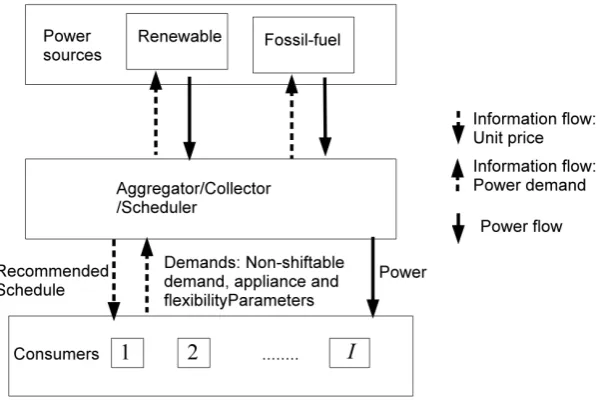
With the installation of home area networks (HANs), smart meters and in-home display, consumers can not only monitor and manage the power consumption within the networked area that links thermostats, washing machines, clothes dryers and many more with a TV, PC and cell phone, but also interact with utilities and other consumers [36,37]. The proposed cooperative DR system as depicted in Figure1defines three possiblerolesthat represent the concerned stakeholders namely:
• Utilityis a set of energy suppliers shared by customers in a community. In this paper, we consider the utility as a combination of two energy suppliers: one is renewable energy supplier and the other is a fossil energy supplier.
• Aggregatoris a centralised scheduler that compromises the plans from consumers and the available energy supply from the utility and finds out the “best” energy consumption strategy for the whole community, based on information about the available energy supply from the utility and the energy consumption plans from consumers.
• Consumeris a household equipped with asmart meterthat is connected to the power line as well as the community network. A consumer may have somehousehold applianceswhich function according to the supply that the Aggregator allocates to them.
Figure 1.System model: roles and information flows.
These above roles will be interpreted as components with their own functionality in our architectural model. In addition, we see appliances of consumers also as components. The functionality of an appliance is not our concern however, because it is usually determined and defined by the producer.
3.1. Utility
The Utility makes essential information available to the consumers about both the reliable renewable and fossils, and energy supply planned for the upcoming 24 h.
3.2. Consumers
An ordered setNof consumers is willing to cooperate in the pursuit of global community targets (i.e., become greener), sending their data to the Aggregator. We consider a discreteH-hour time period, e.g.,H=24 h, during which consumers schedule their electrical jobs [38].
Assumption 1(Consumer’s habits). Consumer habits, behaviours and use of appliances commonly demand a fixed energy load (formulae and benchmarks can be used to estimate appliance and home electronic energy use in kilowatt hours (kWh), as well as household local records—for example, refrigerator, alarm-controller, meters, standby televisions, water heater, etc.) as well as a variable load resulting from the utilisation of such appliances and other equipment or facilities.
Assumption 2(Home energy scheduler). An energy consumption scheduler (or home energy manager) connects via HAN, power-line communication (PLC) or any lower power wireless, such as ZigBee wireless standard [39], to all the appliances in the household.
The scheduler provides the consumer with an interface to allocate ”shiftable" demand at household-level, taking into account his/her time preferences.
Each consumer then pre-allocates a certain amount of fixed demand as well as variable consumption planned for the upcoming 24 h. Thus, consumer i ∈ N = 1, 2, . . . ,N has a non shiftable demand ofxhi,ns in timeslot h, h ∈ H representing the aggregated load of non-shiftable local consumption of their appliances and regarding frequent behaviours. Moreover, consumeri consists of shiftable appliancesAi={ai,m,m∈1, 2, . . . ,M}, whereMis the total number of appliances of consumeriallowing shiftable consumption. Thus,xih,shdenotes the variable energy consumption of consumeriin timesloth.
3.3. Aggregator
Assumption 3(Data Aggregation). The Aggregator acts as a central node to carry out aggregation tasks, and communicates with the Utility as well as other Consumers.
The aggregator can obtain the available power supply information from renewable energy sources/providers and non-renewable sources. The available power supply from the renewable source is known for the upcomingHtime-slots by the aggregator: {PR,01 ,PR,02 , . . . ,PR,0H }. The future smart grid highly emphasises the integration of distributed and renewable energy resources into the grid, together with the prioritised penetration of renewable energy for meeting the consumer demand. Thereby, in our model, the aggregator re-allocates a schedule to the consumers such that their demands are covered by the available renewable energy as far as possible, and the fossil fuel based energy is used only when necessary for the deficit power.
The above formulates our case study within the smart city system. Our cooperative DR system integrates a residential demand response strategy into utility planning taking into account the consumer comfort. The architecture along with its validation in Eclipse is presented in the following and accepts other smart city system compositions.
4. Cyber-Physical Components Modelling—rCPCS
4.1. State Variables, Interfaces and Interactions
In general,cyber-physical component, or simply “component” when there is no confusion, has discrete state variablesthat are directly changed by control programs, andcontinuous state variableswhose changes follow differential equations, depending on states of the discrete variables. The state variables of a componentC, denoted byαC, called the alphabet ofC, is divided into two subsets,αC=hβC,γCi
of private discrete state variables and continuous state variables. For example, an applianceAof a household is a component with its state variablesαA=h{s:{on,off}},{rate:Real}i, whererateis the
rate in which energy is consumed by the appliance when it is in operation.
The interfaces provide the means for the component to interact with its environment (i.e., other possible cyber-physical components including human actors). A componentCcan have aprovided interface(orinput interface),C.pIF, and or arequired interface(oroutput interface),C.rIF; but a component must have an interface. Each of the interfaces contains two sets,C.pIF=hpO,pWiofprovided operations andprovided signalsorwires, orC.rIF=hrO,rWiofrequired operationsandrequired signals. It is required that the set of provided signals is a subset of the continuous variables of the component (i.e.,pW⊆γC).
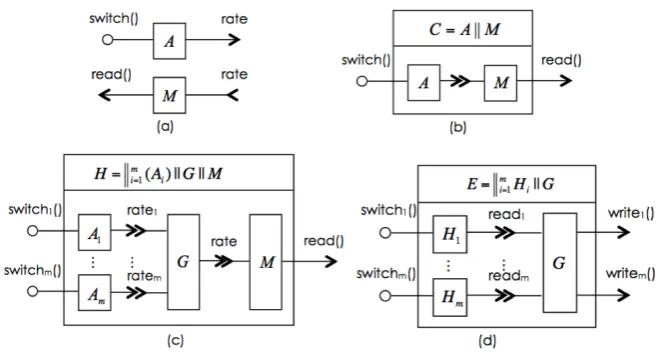
The variablesγC−pWare theprivate continuous variablesofC. Figure2a shows an applianceAwith a
provided interfaceA.IF=h{switch()},{rate}i(i.e., one provided operationswitch()).
Interactions can be performed with other digital or physical components. For example, a digital controller can be designed to interact withAto switch the appliance “on” and “off”, and a meter to record the energy consumption by using therate. On the other hand, interactions of Acan be with human actors, for example the householder can “observe” or use therate to “calculate” the energy consumption and “switch” the appliance “on” and “off”. One can imagine the evolution from interactions of the appliance with human operators to interactions of digital controllers and meters. This would be one step of increase in automation, but the model of the functionality, behaviour, including interactions behaviour, of the appliance remains unchanged.
4.2. Local Functionality and Behaviour
The discrete variables change through execution of programme instructions that are enabled via invocations to interface operations. The execution of these operations is calledlocal functionality. Note that the behaviour of the continuous variables is controlled through the change of the discrete variables. Therefore, the local functionality defines the behaviour or abstract semantics of the control programme. Besides discrete functionality, cyber-physical components can also show continuous evolution for its continuous variables defined in time-dependent functions, often differential equations. For example, the continuous evolution for the applianceAcan be defined byrateas the rate in which energy is consumed by the appliance when it is on, and the rate is assumed to0when the appliance is off. We believe the definition ofrateis usually provided by the manufacture of the appliance. Thus, the behaviourofAis that therateevolves along with the switches on and off of the componentA. Consider, for instance, an electronic meterMthat records the accumulated consumption of energy of appliance
A. Its provided interfaceM.pIFcomes up with a signalreadand its required interfaceM.rIFconsists of a single signalrate. The behaviour ofM(i.e., the evolution ofread) is a timed function of the required signalrate. For example, it can be defined asread(t) =Rt
0rate. Therefore, in general, the behaviour of the continuous variables is defined by timed functions of the discrete variables and the required signals. In general, the continuous behaviour (or the trajectories) of the continuous variables of a componentCis specified by timed functions of the following form, where feedbacks loops are possible
Figure 2.(a)A, representing an appliance, has a provide operationswitch()and a provided signal rate.M, representing a meter, has a provide operationread(), and a required signalrate; and (b)A||M connects the provided signal of Aand the required signal ofM, thus forming a component that provides operationsswitch()andread(). Different ways of composing components represent different design approaches: (c) evolution of a household with a meter; and (d) evolution of an Aggregator.
4.3. Component Composition
Components are composed through their interfaces. rCPCS interfaces include signals for the composition of physical components. Interfaces also bridge different technologies, whereas different ways of composing components represent different design approaches. For example, Figure2b depicts a composite componentC=AkMcomposing applianceAand meterM. Thus, to design a household component as in Figure2c, we consider an arbitrary numbermof appliances in a household, each modelled byAifori=1, . . . ,mand meterM. A main switch connector, denoted byGcentralisesratei
interfaces such that it has a continuous variablerateas its provided interface and{ratei|i=1, . . . ,m}
as provided interfaces. The behaviour ofGisrate=∑mi=1ratei. Thus, the household can be modelled
byH= ((km
i=1 Ai)kG)kM. Similarly, a switch connectorGcan also be used to summate the fixed and
variable demands of individual households. ComponentEin Figure2d represents a scheduler that readsreadifromMito decide when appliances can be switched on to operation according to the energy
combustion budgetfxiandvxi.
The model of the Utility by a component U is simple. It only provides an operation
request(x:Real,y:Real;z:Real)for the supply of energy. Its execution provides the amount of committed
supply for the day through the return parameter. TheEcomponent has an interface (i.e., an active process), through which it periodically calls the interface operations R fi()andRvi()and makes a
request to utilityU viarequest(). Once it receives notification fromUabout the committed supply, it “negotiates” with the households and reallocates budgets, namelyW fi()andWvi(). Each household Hiis then managed by its own. We represent this system scenario asEkU.
4.4. Discussion
With rCPCS, we demonstrate the importance and effectiveness of building models of the system architecture with respect to the following aspects:
1. As the system grows larger, abstraction and decomposition in building the system architecture becomes essential for dealing with complexity.
3. The modelling method supports different implementations of coordination and control of components on different hardware platforms.
4. It supports tool development for simulation and verification.
rCPCS allows system evolution in different ways. For example, the compositionkk
i=1Hiof the
households behaves exactly the same as one household in a “black box” if a connector is added to summate the fixed and variable demands of the individual households. This shows how abstract modelling deals with complexity. Similarly, we can imagine that a network of utilities works in collaboration to provide power supply. Once they reach agreement on how to share the supply upon the Aggregator’s request, they interface with the Aggregator as a single utility. Furthermore, the centralised Aggregator can be transformed into a distributed implementation such that the reallocation can be performed among households themselves. We can also envision a component home manager
HMthat allows the householder to set budgetsfxiandvxiup for each applianceAi; it then controls the
operations of the appliance to meet budgets and calculates consumptionreadiofAifrom itsratei. It is
also possible to arrange a distributed scheduling solution in which the control onAi, along withfxi
andvxi, is embedded in meterMi.
The architectural model is also important for identifying and analysing vulnerabilities and weaknesses within the different components due to interaction mechanisms, communication protocols, hardware quality or software bugs. Based on this hazard and risk analysis, architectural decisions can be made for different concerns, such as distribution, use of redundancy, specially designed secure protocols, etc., to improve safety, security, integrity, and availability.
Moving towards interoperable smart city systems, rCPCS is introduced as a formal framework for modelling and analysis of smart city systems and their compositions, making it easy for designers and planners to integrate platforms, devices and applications. Through the implementation of rCPCS in Reo Coordination Language and the Extensible Coordination Tools for the Eclipse platform, we especially focus on testing its adaptivity modelling aspects such as switching/extending the different components according to the varying requirements.
5. rCPCS Implementation in Reo
Tool support, such as simulation and verification, is important for rCPCS practical adoption. In this section, we model its component communication patterns by means of Reo connectors and the Eclipse ECT plug-in.
5.1. Basic Concepts
Reo [7,35,40,41] is a channel-based exogenous coordination model wherein complex coordinators, called connectors, are compositionally constructed from simpler ones. Components in Reo are computational entities that are able to store, manipulate produce and receive data and messages from other components. Components may be located at different places physically. A complex component may contain other components as part of it as well and are connected throughconnectors. Channelsin Reo have two types of channels ends:sourceandsink. A source channel end accepts data into its channel, and a sink channel end dispenses data out of its channel. It is possible for the ends of a channel to be both sinks or both sources. Reo places no restriction on the behaviour of a channel and thus allows an open-ended set of different channel types to be used simultaneously. Each channel end can be connected to at most one component instance at any given time. Figure3shows the graphic representation of some basic channels:
• FIFO1 channelrepresents an asynchronous channel with one buffer cell which is empty if no data item is shown in the box. If a datumdis contained in the buffer of a FIFO1 channel, thendis shown inside the box in its graphical representation.
• Lossy synchronous channelis similar to a synchronous channel except that it is able to accept data through its source end at all times. The datum is transferred if it is possible to dispense it through the sink end; otherwise, the datum is lost.
• Filter with a pattern P specifies the type of data that are permitted to transfer through it. Any datum that conforms to the pattern is accepted through the source end when at the same time the sink end is ready to dispense it. Any datum that does not conform to the pattern is still accepted through the source end but will be immediately discarded.
• Synchronous drainis similar to a synchronous channel except that it has two source ends and no sink ends. It consumes a pair of data from its two source ends simultaneously and discards them away.
Complex connectors are constructed by composing simpler ones mainly via thejoinandhiding operations. Channels are joined together in a node that consists of a set of channel ends. Nodes are categorised intosource,sinkandmixed nodes, depending on whether all channel ends that coincide on a node are source ends, sink ends or a combination of the two. The hiding operation is used to hide the internal topology of a component connector. The hidden nodes can no longer be accessed or observed from outside. A complex connector has a graphical representation, called aReo circuit, a finite graph where thenodesare labeled with pair-wise disjoint, non-empty sets of channel ends, and theedgesrepresent the connecting channels. The behaviour of a Reo circuit is formalised by means of the data flows at its sink and source nodes. Intuitively, the source nodes of a circuit are analogous to the input ports, and the sink nodes to the output ports of a component, while mixed nodes are its hidden internal details. Components cannot connect to, read from, or write to mixed nodes. Instead, data-flow through mixed nodes is totally specified by the circuits they belong to.
A component can write data items to a source node that it is connected to. The write operation succeeds only if all (source) channel ends coincident on the node accept the data item, in which case the data item is simultaneously written to every source end coincident on the node. A source node, thus, acts as a replicator. A component can obtain data items, by an input operation, from a sink node that it is connected to. A take operation succeeds only if at least one of the (sink) channel ends coincident on the node offers a suitable data item; if more than one coincident channel end offers suitable data items, one is selected nondeterministically. A sink node, thus, acts as a nondeterministic merger. A mixed node nondeterministically selects and takes a suitable data item offered by one of its coincident sink channel ends and replicates it into all of its coincident source channel ends. A component can not connect to, take from, or write to mixed nodes.
(a)
(b)
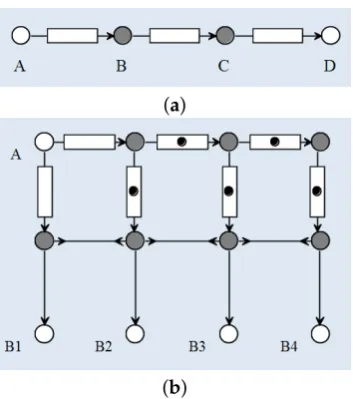
Figure 4.Examples of some Reo circuits. (a) a FIFO3 channel, constructed from some FIFO1 channels, gets data from its input node, temporarily stores it in an internal buffer of size 3, and propagates it to its output node); and (b) a Gatherer4 channel constructed from FIFO1 channels, synchronous channels and synchronous drains.
5.2. Reo Circuits
Example 1(FIFO connectors). A FIFOn connector is similar to a FIFO1 channel except that it has a buffer with a capacity of n instead of1. It consists of a chain of n FIFO1 channels. Figure4a shows an example of a FIFO3 channel that is constructed from three FIFO channels: AB, BC and CD. The grey nodes (B and C) are mixed nodes while the white ones are either source node (as node A) or sink node (as node D).
Initially, the three buffers (shown as blank boxes) are empty. Once a datum arrives at node A, it is accepted and stays in the left buffer. When the datum is staying in the left buffer, the FIFO1 channel AB is full and cannot accept any new data through node A. In the meantime, this datum is going to be transferred automatically from the left buffer to the middle buffer through the mixed node B because the middle buffer is empty. After that, the FIFO3 channel is able to accept another datum from A and store it in the left buffer.
Example 2(Gatherer connectors). A Gatherern connector consists of one source node and n sink nodes. A Gatherern connector is similar to a FIFOn channel such that they are able to store the data previously accepted through the source node as long as the memory does not run out. The difference lies in the fact that FIFOn channel distributes one piece of data at a time while a Gatherern connector dispenses (but does not discard) all the data in its memory. Every time a Gatherern connector dispenses, it only discards the oldest datum in its memory and reserves the vacant space for a new datum.
Figure4b depicts a Gatherer4 connector on its initialisation with some FIFO1 channels full (shown as a dot in the box). It has a source node A for inputs and four sink nodes B1. . . B4for outputs. Node B1always delivers the latest datum in the memory, whereas B2dispenses the second latest datum, and so on. The four sink nodes deliver the data at the same time, which is guaranteed by the synchronous drains between the set of four mixed nodes in the middle.
5.3. Utility–Aggregator Communication
The utility sends the amount of available renewable resources PR1,0, . . . ,PRH,0 and fossil fuel resources P1
F, . . . ,PFH to the aggregator, so the utility–aggregator communication is a one-way communication. In a more complex context that considers billing, we may ask the utility to send the price information to the aggregator who returns billing information about each consumer back to the utility. In that case, the utility–aggregator communication becomes a two-way communication. Furthermore, the utility and the aggregator may be physically located at different places far from each other, so the communication between them cannot be done in a flash. In that case, we may add some timing properties on the communication. At any case, Reo connectors are sufficient to model the communication behaviours [41].
(a)
(b)
Figure 5.Utility–aggregator communication. (a) a GathererHconnector that is used to construct a communication pattern between the utility and the aggregator; and (b) the utility–aggregator connector.
In practice, the aggregator schedules the energy consumption round by round. At every round, the utility is responsible to offer thelatestfossil fuel resourcesiPF(and renewable resources resp.), and the aggregator should be able to collect the fossil fuel resources limits for the past Hhours PFH, . . . ,PF1. Therefore, we have to provide a mechanism to store the utility supply generated in the pastHhours and provide the aggregator with this information at a time through the nodesPH
F,PH
−1
supply available from renewable resources. The entire communication pattern between the utility and aggregator is shown in Figure5b.
A note on the Aggregator’s local functionality. The Aggregator holds the following algorithmic statements according to the available supply from renewable resources, as follows:
Case 1:
∑
i∈Nxhi,ns≥PR,0h . (1)
If Equation (1) is the case∀h∈ Hor for mosth, the renewable energy supply is not able to cover even the non-shiftable appliances, which means that the rest of the power partly for the non-shiftable appliances and wholly for the shiftable appliances should be supplied by the fossil fuel based source. The problem thus reduces to conventional shiftable-appliance-scheduling problem, where scheduling should be done for∑i∈Nxhi,ns−PR,0h
+∑i∈Nxhi,sh:
Case 2:
∑
i∈Nxhi,ns<PR,0h . (2)
In this case, in addition to satisfying the power requirements for non-shiftable appliances of all consumers, the renewable energy serves to supply shiftable appliances.
5.4. Consumer–Aggregator Communication
A consumer sends his power demand for the next few hours to the aggregator. Once the aggregator works out the power scheduling solution, it will send the result back to the consumer. Therefore, the consumer–aggregator communication is a two-way communication (Figure6).
A note on the Consumer’s local functionality.Let us write the demand of Consumeriin timeslothas xhi =xhi,ns+xhi,shforh∈ H, where{xhi,sh}should be optimised. The shiftable appliances of consumer ispecify the following parameters: ai,m : {si,m,ei,m,di,m,ci,m}, which represent the earliest possible starting timeslot, the last acceptable starting timeslot, the duration of operation in timeslots and the power consumption, respectively, of appliance ai,m. Let γi ∈ [0 1]denote the flexibility factor of consumeri, whereγi=0 indicates that the consumer prefers to operate its shiftable appliances in the earliest possible timeslots, andγi =1 implies that the consumer is totally flexible and does not mind operating its shiftable appliances in the last possible slots.
Let us definePRh :=PR,0h −∑i∈Nxhi,ns>0, ∀h∈ Haccording to Equation (2). Note that even if ∑i∈N∑ai,m∈Ai[ci,m]
si,m+di,m
h=si,m ≤∑h∈HP h
Ris true,∑i∈Nxhi,sh ≤PRh∀h ∈ Hmay not hold. The goal of the
aggregator can be achieved in two stages: Stage 1:
min
{xhi,sh,∀i∈N }P
h
R−
∑
i∈N
xih,sh, (3)
s.t.
∑
i∈Nxhi,sh ≤PRh; si,m≤s∗i,m≤ei,m. (4) The solution to Equations (3) and (4) isxi∗,shh corresponding to the optimal starting timeslotss∗i,m for the appliances of consumersi∈ N1, whereI1⊆ N.
Stage 2:
LetN2denote the set of consumers with appliances that could not be scheduled by solving
Equations (3) and (4) such thatN1∪ N2=N. The deficit power requirement is obtained from the
fossil fuel source. For the fossil fuel source, the objective is to minimise the peak-to-average ratio (PAR) of supply from the source. Suppose the set of the appliances not scheduled in stage 1 beA0ifor consumeri,i∈ N2. Letx
0h
i,shbe the shiftable load of consumeri,i∈ N2in timesloth. Thus, the power
requirement from the fossil fuel source will bex0i,shh ∀h∈ H,i∈ N2andai,m∈ A
0
min {x0h
i,sh,∀i∈N2}
max∑i∈N2x
0h
i,sh− {PRh−∑i∈N1x
∗h i,sh}
1
H
∑H∈H∑i∈N2x
0h
i,sh− {PRh−∑i∈N1x
∗h i,sh}
, (5)
s.t.
∑
i∈N2x0i,shh ≤PFh; si,m≤sti,m≤ei,m, (6)
wherePh
F represents the power generation limit of the fossil fuel source in timesloth.
The solution to the optimal power allocation problem is {si∗,m} obtained by solving Equations (3)–(6).
Since the overall problem is non-deterministic polynomial-time hard (NP-hard), existing work proposes approximations using well- known metaheuristic policies such as simulated annealing or some others based on linear programming [42] that provide accurate solutions in a fraction of the time required by the system. Though we will not investigate how these techniques would perform, the optimal consumption for consumerithat the aggregator has to obtain∀i∈ N is
xi∗,sh=
∑
ai,m∈Ai[ci,m] s∗i,m+di,m
h=s∗i,m , (7)
wheres∗i,m∈[si,m ei,m].
Figure 6.Consumer–aggregator communication architecture in Reo.
Figure 7.Consumer–appliance communication architecture in Reo.
5.5. Consumer–Appliance Communication
Algorithms in the Appliance Component.Current smart home energy displays show instantaneous usage, expenditure and historic feedback as a minimum [43]. These displays can allow the consumer to coordinate the interaction among the devices participating in the scheduling. Its implementation should help user engagement and support the novel functionality. To schedule shiftable appliances, the home scheduler (class Consumer) provides consumeriwith the interface to specify the following parameters∀ai,m: the earliest possible starting timeslotsi,m, the last acceptable starting timeslotei,m, and the duration of operation in timeslotsdi,m. Moreover, consumerican indicate a flexibility factor γi∈[0· · ·1]expressing his/her tolerance for operating the shiftable appliances at the earliest/last possible timeslots, respectively. Functionality procedure in class Consumer parametrised these elements through the user interaction. On the other hand, non-shiftable appliances consumption scheduling is automatically allocated by the home scheduler given the hourly usage patterns recorded by the smart meter. Once receiving the aggregator re-allocation, the Consumer scheduler shows the user how much shiftable load was removed or re-allocated. Appliances will automatically operate accordingly.
5.6. Experimental Results
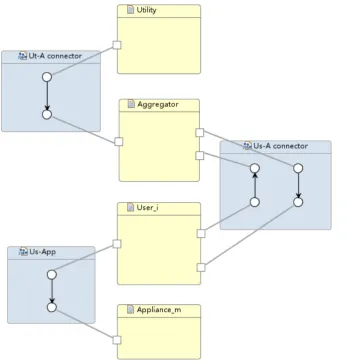
Our model consists of three Reo connectors (shown as blue boxes in Figure8) that form the main body of the architecture. Connector animations of the Reo circuit on the ECT Eclipse confirm the correct communication of the system components. In particular, the following information flows are supported within the current implementation:
1. Utility–Aggregator: Connector GathererH consists of one source node and 24 sink nodes, i.e., the number of hours/slots which utility supply information is provided in. As described is Section 5.3, boxes are one space buffer and save up to one data item; as new data comes into the connector, boxes are filled up so the connector can save up to 24 data items. TwoGathererH connectors serve the Aggregator to gather up both renewable and fossil available supply in kilowatt hour from the Utility; hence, every hour the input will be the updated iPR and iPF, respectively. Refined models might add a GathererH connector from Aggregator to Utility informing the latter about the reallocated supply vector for billing purposes and/or energy management.
2. Aggregator–Consumer: TheA-C connectorlinks the aggregator and a consumer with two simple synchronous channels. A synchronous channel with a source end “in” and a sink end “out” works as the assignment statement of out :=in, transferring data (namely, consumers’ demand structure and allocated supply vector) between the aggregator and a consumer in a flash. However, in practice it is not always feasible because the aggregator and the consumer might be located in different places geographically. The transfer might take several microseconds or longer to proceed, and we need a mechanism to report to the sender whenever the connector fails to successfully transfer the data in time. Synchronous channels can be replaced by more delicate compound circuits made of lossy channels and timed channels. For instance, a timed channel is able to capture the behaviour of a monitor detecting whether the data is transferred successfully within a time threshold. Similarly, a lossy channel can capture data loss during network transmission [7,35].
3. Consumer–Appliances:C-App connectoradopts similar semantics to theA-C connectorbut in a one-way communication shape. For more domotics features on appliances, we might need a two-way communication, thus including more functionality from Appliance towards Consumer. More complex connectors such as Feedback Loop, Sequencer and Inhibitor can be applied for appliances self-scheduling the available supply.
one can develop Reo connectors based on those standards and will be assured that the connectors fit in any implemented protocol.
Figure 8. Cooperative demand response system architecture that allows scalability and system composition and coordination through separate connectors.
6. Discussion
The formal model of the proposed architecture aims at making the design rigorously verifiable, enabling systematic change of architecture design through refinement or equivalence (that is, the algebraic equations proved in refinement calculus), and also making the design process repeatable. The correctness is guaranteed by the soundness of the semantic theory. An actual architecture of a given system implementation is proved by using the toolkit for model checking. Functional correctness is also guaranteed through model transformations implemented in the tool that are proven in the refinement calculus to preserve functional correctness. These models are at different levels of abstraction from the model of requirements through those of architecture design to code generation.
6.1. Model Checking
and coordinator components. Regarding this, we have shown how Reo connectors can specify the communication between the system components. A whole picture of the entire system architecture can be easily drawn from Figures5a,6and7.
Our architecture model has many advantages as follows:
• Scalable.Our model is scalable in that it supports an arbitrary number of consumers and appliances in the energy management system. If the communication patterns between components do not change, the architecture of the entire system will remain the same.
• Component-Based. Our model is a component-based approach. Different components can be developed independently because the interfaces and communication patterns are specified and determined in advanced by Reo connectors. Components can be implemented in any way as long as they respect the interfaces specified by the architecture model. As we will see, the aggregator can use any (centralised) scheduling algorithm in the architecture model and the entire system’s functionality will not change at all.
• Practical.Our model is not only a theoretical model, but also one that can automatically generate codes. Reo comes with a set of development tools including a Java code generator, which generates code for circuits based on their constraint automaton semantics. Therefore, all connectors (shown as blue boxes) are actually passages of Java codes that work as “glue codes” that connect all the components in the system.
Both the rCPCS formal model and its implementation in Reo with Eclipse guarantee that the system is correct-by-construction. Services’ (or systems’) composition are then possible as independent distributed entities that utilise Reo channels and connectors to communicate. Consider, for instance, our cooperative DR system efficiently accommodating plug-in hybrid electric vehicle (PHEV) fleets and making the EV penetration invisible to the system. The Aggregator represents a key component in this composition, which accepts reading real-time demand information from the passing-by vehicles via the control from a new connector. The connector will add PHEV demand to the Aggregator just like from a consumer, so nothing will change within its functionality. The Aggregator will keep notifying and updating consumers/PHEVs of the up-to-date scheduling vectors.
Finally, development and maintenance of computer programs certainly benefit from tool support, providing separation of concerns in the system design stages [45]. This represents the main motivation for using component-based architectures in the smart cities system design and integration, and validating/testing the architectures by Reo implementations. In this regard, Reo language is one of the Turing-complete models such as nondeterministic state machines and regular grammars, with expressive power to represent systems’ properties. Furthermore, the framework provided by Eclipse ECT certainly helps to empirically prove the property representations.
6.2. A Note on the Distributed Approach
Modern grid initiatives are moving toward distributed approaches that add much more autonomy, flexibility and scalability [46]. The use of multi-agent systems has become an increasingly powerful tool for energy management problems [47]. Typical objectives range from reducing peak power demand, utility energy costs and consumer bills [48], balancing energy supply and demand as well as improving grid efficiency [49], and increasing the share of renewable energy sources [50]. These can be achieved using a number of optimisation techniques such as integer, quadratic, stochastic and dynamic programming and also evolutionary algorithms [49].
The simplest way is to make the Aggregator role take turns amongst the Consumers participating. The logic of the resource allocation algorithm would be exactly the same as when it runs on the Aggregator side.
A more complex and decentralised approach, based on the multi-agent architecture, consists of dividing the power management scheduling problem into subproblems involving different agents, each of which solves its own problem independently to find a solution to the whole problem. In general, this scheme seems to be scalable; however, it cannot guarantee obtaining the optimal solution or avoiding the complex interaction between the agents. Nevertheless, we found in [43], one of the most convenient techniques for the autonomous and distributed scheduling (which is a knapsack problem), namely, the backtracking algorithm. Backtracking incrementally builds a search tree that finds all feasible solutions, each of which is an energy consumption schedule represented by anM×Ntime table, whereNis the number of tasks andMis the number of time-slots. Thus, each consumer knowing the others’ demands vectors and running the allocation procedure can satisfy a global peak reduction (or, in other words, achieve respective local peak reduction). Experiments in [43] show that when the number of tasks is over eight, a global coordination among scheduling units is desirable.
7. Conclusions
In this paper, we have proposed a scalable system architecture for a co-operative DR system, which is component-based, and proved component interoperability through formal modelling and languages. In the process of our component-based system design, we can be assured by the architectural description that the system under specification is correct by design with respect to the interoperability correctness of component cooperation. The proposed architecture, namely “Refinement of Cyber-Physical Component Systems” (rCPCS), extends the rCOS modelling method, and provides a powerful means of abstraction so that large and complex composite subsystems, such as the composition of all households, can be treated as as simple component. In addition, rCPCS architecture proposed for a DR system also supports different designs and different processes of system evolution as being integrated to a smart city system, in which new components with various interaction mechanisms can plugged into the existing system. By implementing rCPCS in Eclipse Extensible Coordination Tools and Reo language, we have proved scalability and correct interoperability amongst the heterogeneous system components. Reo has a very flexible infrastructure and can be applied to various application domains as a basis for test set design and decision-making. In our work, we successfully embedded smart grid and smart city systems in Reo’s framework, following the idea of Reo coordination middleware.
Our immediate future work includes the development of the formal semantics and algorithms presented in a Living Lab. We will also use the models to identify safety weaknesses and vulnerable components, as well as points about security threats in order to make architectural decisions to strengthen the system [51]. Furthermore, the introduction of intelligent components with learning capabilities is of interest for utilities and storage purposes.
Acknowledgments:Z.L.’ s work is supported by the project grant SWU116007 from Southwest University and project grant 61672435 from the Chinese National Science Foundation.
Author Contributions:E.P. and S.M. set the problem statement and system model; E.P., Z.L. and J.B. conceived and designed the modelling architecture; E.P., X.C. and Z.L. conceived and designed the implementation; X.C. performed the experiments; all authors carried out data analysis and contributed reagents/materials/analysis tools; and E.P. wrote the paper.
Abbreviations
The following abbreviations are used in this manuscript:
API Application Programming Interface
DR Demand Response
ECT Eclipse Extensible Coordination Tools
HAN Home Area network
IOP Interoperability Open Platform IoT Internet of Things
MDPI Multidisciplinary Digital Publishing Institute PHEV Plug-in Hybrid Electric Vehicle
PLC Power-Line Communication
rCOS Refinement Calculus for component and Object Systems rCPCS Cyber-Physical Component Systems
References
1. Palomar, E.; Liu, Z.; Bowen, J.P.; Zhang, Y.; Maharjan, S. Component-based modelling for sustainable and scalable smart meter networks. In Proceedings of the IEEE International Symposium on a World of Wireless, Mobile and Multimedia Networks (WoWMoM 2014), 3rd IoT-SoS Internet of Things Smart Objects and Service Workshop, Sydney, Australia, 10–12 June 2014; pp. 1–6.
2. Jifeng, H.; Li, X.; Liu, Z. rCOS: A refinement calculus of object systems. Theor. Comput. Sci.2006,365, 109–142. 3. Dong, R.; Faber, J.; Ke, W.; Liu, Z. rCOS: Defining Meanings of Component-based Software Architectures. In Proceedings of the ICTAC Training School on Software Engineering, Shanghai, China, 26–30 August 2013; pp. 1–66.
4. Klein, C.; Kaefer, G. From smart homes to smart cities: Opportunities and challenges from an industrial perspective. InInternational Conference on Next Generation Wired/Wireless Networking; Springer: Berlin/Heidelberg, Germany, 2008.
5. Tang, S.; Huang, Q.; Li, X.Y.; Wu, D. Smoothing the energy consumption: Peak demand reduction in smart grid. In Proceedings of the IEEE INFOCOM 2013, Turin, Italy, 14–19 April 2013; pp. 1133–1141.
6. Mohsenian-Rad, A.H.; Wong, V.W.S.; Jatskevich, J.; Schober, R. Optimal and autonomous incentive-based energy consumption scheduling algorithm for smart grid. In Proceedings of the Innovative Smart Grid Technologies (ISGT), Gothenburg, Sweden, 11–13 October 2010; pp. 1–6.
7. Arbab, F. Reo: A channel-based coordination model for component composition. Math. Struct. Comput. Sci.
2004,14, 329–366.
8. Kokash, N.; Arbab, F. Formal design and verification of long-running transactions with extensible coordination tools. IEEE Trans. Serv. Comput.2013,6, 186–200.
9. Schaffers, H.; Komninos, N.; Pallot, M.; Trousse, B.; Nilsson, M.; Oliveira, A. Smart Cities and the Future Internet: Towards Cooperation Frameworks for Open Innovation. InThe Future Internet; Springer: Berlin, Germany, 2011; pp. 431–446.
10. Blackstock, M.; Kaviani, N.; Lea, R.; Friday, A. MAGIC Broker 2: An open and extensible platform for the Internet of Things. In Proceedings of the Internet of Things (IOT), Tokio, Japan, 29 November–1 December 2010; pp. 1–8.
11. Filipponi, L.; Vitaletti, A.; Landi, G.; Memeo, V.; Laura, G.; Pucci, P. Smart city: An event driven architecture for monitoring public spaces with heterogeneous sensors. In Proceedings of the 2010 Fourth International Conference on Sensor Technologies and Applications (SENSORCOMM), Venice/Mestre, Italy, 18–25 July 2010; pp. 281–286.
12. da Silva, W.M.; Alvaro, A.; Tomas, G.H.; Afonso, R.A.; Dias, K.L.; Garcia, V.C. Smart cities software architectures: A survey. In Proceedings of the 28th Annual ACM Symposium on Applied Computing, Coimbra, Portugal, 18–22 March 2013; pp. 1722–1727.
13. Steuer, S.; Benabbas, A.; Kasrin, N.; Nicklas, D. Challenges and Design Goals for an Architecture of a Privacy-preserving Smart City Lab. Datenbank-Spektrum2016,16, 147–156.
15. Garlan, D.; Monroe, R.T.; Wile, D. Acme: Architectural description of component-based systems. Found Compon.-Based Syst.2000,68, 47–68.
16. Edwards, S.; Lavagno, L.; Lee, E.; Sangiovanni-Vincentelli, A. Design of embedded systems: Formal models, validation and synthesis. InReadings in Hardware/Software Co-Design; Morgan Kaufmann Publishers Inc.: San Francisco, CA, USA, 2001.
17. Schutte, S.; Scherfke, S.; Troschel, M. Mosaik: A framework for modular simulation of active components in smart grids. In Proceedings of the 1st Internet workshop on Smart Grid modelling and simulation (SGMS), Brussels, Belgium, 17 October 2011; pp. 55–60.
18. Pourvatan, B.; Sirjani, M.; Arbab, F.; Bonsangue, M. Decomposition of constraint automata. In Proceedings of the 7th international conference on Formal Aspects of Component Software (FACS), Guimaraes, Portugal, 14–16 October 2012; pp. 237–258.
19. Chen, X.; He, J.; Liu, Z.; Zhan, N. A model of component-based programming. In Proceedings of the International Symposium on Fundamentals of Software Engineering (FSEN), Tehran, Iran, 17–19 April 2007. 20. Chen, Z.; Hannousse, A.H.; Van Hung, D.; Knoll, I.; Li, X.; Liu, Z.; Liu, Y.; Nan, Q.; Okika, J.C.; Ravn, A.P.; et al. Modelling with relational calculus of object and component systems—rCOS. InThe Common Component
Modeling Example; Springer: Berlin/Heidelberg, Germany, 2008; pp. 116–145.
21. Chen, Z.; Liu, Z.; Ravn, A.P.; Stolz, V.; Zhan, N. Refinement and verification in component-based model-driven design. Sci. Comput. Program.2009,74, 168–196.
22. Diakov, N.K.; Arbab, F.; Diakov, N.; Arbab, F. Compositional construction of web services using Reo. In Proceedings of the International Workshop on Web Services: Modeling, Architecture and Infrastructure, Porto, Portugal, 14–17 April 2004.
23. Heydarnoori, A.; Mavaddat, F.; Arbab, F. Towards an automated deployment planner for composition of web services as software components.Electron. Notes Theor. Comput. Sci.2006,160, 239–253.
24. Zlatev, Z.; Diakov, N.; Pokraev, S. Construction of negotiation protocols for E-Commerce applications.
ACM SIGecom Exch.2004,5, 12–22.
25. Boella, G.; van der Torre, L. An architecture of a normative system: Counts-as conditionals, obligations and permissions. In Proceedings of the Fifth International Joint Conference on Autonomous Agents and Multiagent Systems, Hakodate, Japan, 8–12 May 2006; pp. 229–231.
26. Lazovik, A.; Arbab, F.Using Reo for Service Coordination; Springer: Berlin/Heidelberg, Germany, 2007; pp. 398–403.
27. Kokash, N.; Arbab, F. Applying Reo to service coordination in long-running business transactions. In Proceedings of the 2009 ACM Symposium on Applied Computing, Honolulu, HI, USA, 8–12 March 2009; pp. 1381–1382.
28. Changizi, B.; Kokash, N.; Arbab, F. A unified toolset for business process model formalization. In Proceedings of the Formal Engineering Approaches to Software Components and Architectures, Paphos, Cyprus, 27 March 2010.
29. Jongmans, S.S.T.; Santini, F.; Arbab, F. Partially-distributed coordination with Reo. In Proceedings of the 2014 22nd Euromicro International Conference on Parallel, Distributed and Network-Based Processing (PDP), Garching, Germany, 15–17 February 2014; pp. 697–706.
30. Arbab, F.; A¸stef˘anoaei, L.; de Boer, F.S.; Dastani, M.; Meyer, J.J.; Tinnermeier, N. Reo connectors as coordination artifacts in 2APL systems. In Intelligent Agents and Multi-Agent Systems; Springer: Berlin/Heidelberg, Germany, 2008; pp. 42–53.
31. Baier, C.; Klein, J.; Kluppelholz, S. Modeling and verification of components and connectors. InFormal
Methods for Eternal Networked Software Systems (SFM); Springer: Berlin/Heidelberg, Germany, 2011;
pp. 114–147.
32. Clarke, D.; Costa, D.; Arbab, F. Connector colouring I: Synchronisation and context dependency. Sci. Comput. Program.2007,6, 205–225.
34. Xu, T.; Liu, Z.; Tang, T.; Zheng, W.; Zhao, L. Component based design of fault tolerant devices in cyber physical system. In Proceedings of the 2012 15th IEEE International Symposium on Object/Component/Service-Oriented Real-Time Distributed Computing Workshops (ISORCW), Shenzhen, China, 11 April 2012; pp. 37–42.
35. Chen, X.; Sun, J.; Sun, M. A Hybrid Model for Connectors in Cyber-Physical Systems. In Proceedings of the 16th International Conference of Formal Engineering Methods, Luxembourg, Luxembourg, 3–7 November 2014.
36. Gellings, C.W. The Smart Grid: Enabling Energy Efficiency and Demand Response; The Fairmont Press, Inc.: Lilburn, GA, USA, 2009.
37. Darby, S. Smart metering: What potential for householder engagement? Build. Res. Inf.2010,38, 442–457. 38. Myerson, R.B. Conference structures and fair allocation rules.Int. J. Game Theor.1980,9, 169–182.
39. Gungor, V.C.; Sahin, D.; Kocak, T.; Ergut, S.; Buccella, C.; Cecati, C.; Hancke, G.P. Smart grid technologies: Communication technologies and standards. IEEE Trans. Ind. Inf.2011,7, 529–539.
40. Baier, C.; Sirjani, M.; Arbab, F.; Rutten, J. Modeling component connectors in Reo by constraint automata. Sci. Comput. Program.2006,61, 75–113.
41. Arbab, F.; Baier, C.; de Boer, F.; Rutten, J. Models and temporal logical specifications for timed component connectors. Softw. Syst. Model.2007,6, 59–82.
42. Li, G.; Liu, H. Resource allocation for OFDMA relay networks with fairness constraints. IEEE J. Sel.
Areas Commun.2006,24, 2061–2069.
43. Lee, J.; Kim, H.J.; Park, G.L.; Kang, M. Energy consumption scheduler for demand response systems in the smart grid.J. Inf. Sci. Eng.2011,27, 197–211.
44. Centrum Wiskunde & Informatica Institute, S.R.C. A Repository of Reo Connectors. Available online: http://reo.project.cwi.nl/webreo/ (accessed on 18 October 2016).
45. Fitzgerald, J.; Larsen, P.G.Modelling Systems: Practical Tools and Techniques in Software Development; Cambridge University Press: Cambridge, UK, 2009.
46. Pipattanasomporn, M.; Feroze, H.; Rahman, S. Multi-agent systems in a distributed smart grid: Design and implementation. In Proceedings of the 2009 IEEE/PES Power Systems Conference and Exposition, Seattle, WA, USA, 15 –18 March 2009; pp. 1–8.
47. Bakr, S.; Cranefield, S. Optimizing Shiftable Appliance Schedules across Residential Neighbourhoods for Lower Energy Costs and Fair Billing. In Proceedings of the Joint Workshop Proceedings-AIH 2013/CARE 2013, Dunedin, New Zealand, 3 December 2013; pp. 45–52.
48. Mohsenian-Rad, A.H.; Wong, V.W.S.; Jatskevich, J.; Schober, R.; Leon-Garcia, A. Autonomous Demand-Side Management Based on Game-Theoretic Energy Consumption Scheduling for the Future Smart Grid. IEEE Trans. Smart Grid2010,1, 320–331.
49. Clement, K.; Haesen, E.; Driesen, J. Coordinated charging of multiple plug-in hybrid electric vehicles in residential distribution grids. In Proceedings of the 2009 IEEE/PES Power Systems Conference and Exposition, Seattle, WA, USA, 15–18 March 2009; pp. 1–7.
50. Banos, R.; Manzano-Agugliaro, F.; Montoya, F.; Gil, C.; Alcayde, A.; Gómez, J. Optimization methods applied to renewable and sustainable energy: A review. Renew. Sustain. Energy Rev.2011,15, 1753–1766. 51. Bowen, J.P. The Ethics of Safety-Critical Systems.Commun. ACM2000,43, 91–97.
c