Title: Workable cadaveric preservation for developing skills training models- a review
Sontakke BR1, Deshmukh VD2, Kirubhanand C3, Gugapriya TS4, Muthiyan GM5,
Tarnekar AM6
1, 2, 3: Assistant Professor, 4: Additional Professor, 5: Associate Professor, 6: Professor, Department of Anatomy
All India Institute of Medical Sciences, Nagpur, Maharashtra
Abstract: -
Art of embalming as practiced by Egyptian about 3000 years ago transformed into embalming science of modern ages with the use of formaldehyde as a preservative solution. Subsequently, the search for ideal embalming preservative solution continues till date because of the health hazards related to formaldehyde preservation of cadavers. Alternative preservative methods and solutions suitable for making different skill training models with specific requirement of pliability were also experimented. The literature had documented various solutions like Thiel’s solution and technique, phenoxyethanol preservation, saturated sodium chloride solution, cryopreservation, N-Vinyl-2-pyrrolidone, Ethanol–glycerin and Fix 4life solution as alternatives to formaldehyde preservation. This review is an attempt to have an overview comparison of all the recent alternate embalming methods applicable for developing skill training cadaveric models with an aim of reducing formaldehyde usage in preservation.
Keywords: - Embalming, Cadaver, Preservation, Thiel embalming, Phenoxyethanol, Salt solution
Introduction: -
Physical immortality is a never-ending quest for human beings. Over the history of mankind, different methods of preserving the body before and after death were being practiced. All those preservations of dead body were in the realm of religion and belief of afterlife, as practised since 3000 years for Egyptian mummies[1]. The process of near-normal preservation of human cadaver with chemical resulting in minimal decomposition and microbial growth is called embalming[2]. This embalming is of two types namely funeral and medical embalming. In either of these types, the body tissues were fixed by chemical preservative fluid. The long duration of preservation is the aim of medical embalming whereas in funeral it’s for a shorter temporary duration. The ideal preservation fluid has been considered to exhibit antibacterial, fungicidal, non-toxic and non-discolouring properties, still retaining the flexibility of joints and tissues. Metamorphosis of “art of embalming” to “science of preservation” had resulted in experimentation of different compositions, mixtures and preservative solutions for preservation over the recent years.
Changing trends in medical education after Flexner’s report had necessitated formal skill training of procedures a reality. The congruent shift in patient safety measures, ethical and legal reviews in patient care and advancement of surgical procedures paved way for development of skill training models for medical graduates[3–6]. Apart from the specific requirements in each of these skill training models, achieving “near life” flexibility and pliability in cadavers happened to the common requirement[3]. This review was an attempt to provide a comprehensive
enumeration of preservative solutions ideal for skill training models, from the multitude of available embalming fluids.
Formaldehyde:- (1868)
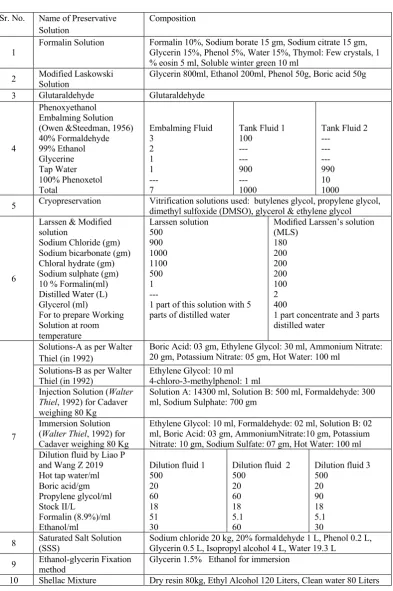
Apart from different natural preservatives used in ancient times, formaldehyde has been in vogue as the primary preservative in embalming in the modern era [7](table:1). Altered DNA methylation, histone modification & changes in microRNA expression are the epigenetic effects and reduced counts of NK cells, regulatory T cells & CD8 effector memory T cells were also noted due to inhalation of formaldehyde[8]. Repeated reports of cytotoxic, carcinogenic and mutagenic effects in embalming personnel and also darkening of preserved cadavers with increased stiffness were considered as limitations of formaldehyde usage [9– 11].Despite these disadvantages, formaldehyde stood as the ideal cadaveric preservative fluid in common use in the embalming arena and anatomy dissection laboratory. Continued research on formaldehyde and its tolerable concentration resulted in a specific guideline of setting the concentration of formaldehyde in the environment between 0.03-0.3 ppm to minimize the deleterious effects. But, the concentration warranted for effective cadaveric preservation caused 5-7 ppm in the environment which was far too high than permitted levels [12]. Thus, the search for alternative preservative fluid which is as effective as formaldehyde, yet having fewer limitations, ideal for making of particular skill training model had resulted in different formulations of embalming fluid in cadaveric preservation.
Modified Laskowski Solution: - (1886)
Original modified Laskowski Solution(table:1) had phenol and glycerin as components which were the probable cause for the strong and unpleasant sugary odor emitted from cadavers. Losses of tissue texture and skin desquamation of cadaver were noted. This had made this preservative fluid less suitable for oral and skin surgery skill training models. Even though this solution retained flexibility as desired, the intense red staining and incomplete preservation of cadaveric tissues prevented widespread use of this solution for cadaveric embalming for specific skill training model development purposes.[13].
Glutaraldehyde:- (1955)
Harries and Tank synthesized glutaraldehyde in 1908. It was first used as a fixative for embalming in 1955. It has disinfective and sterilizing properties effective against the majority of the microorganisms including viruses and spores. Also, the preserved cadavers exhibited required pliability. But the slow perfusion of Glutaraldehyde into the cadaveric tissue necessitating prolonged time for fixation and preservation limited its usage. Moreover, Glutaraldehyde vapors used for long-term were observed to cause respiratory irritation and localized edema for the exposed personnel. These disadvantages led on to decision of European Commission, Brussels to enforce discontinuation of glutaraldehyde preservation for cadavers since 2010 [13].
It was observed that phenoxyethanol lacks the efficiency to be an early fixative of tissues because of its limitation in preventing autolysis of cells. This warranted usage of additional early fixative like formalin along with phenoxyethanol. In this method of preservation (table:1)formalin fixation and phenoxyethanol preservation in two staged process was done. During dissection also the cadaver and other dissected parts were subjected to treatment and covering with sheets soaked in the same compound. Direct non-exposure of skin of personnel working in preservation was the only specific precaution advised during handling of cadavers embalmed by this method [15].Subsequent studies suggested the need for substitution of formalin in cadaver fixation and increasing usage of phenoxyethanol for cadavers, museum specimen and even histological fixation of tissues [15]. Non-pungent odour and almost negligible local as well as systemic toxicity by phenoxyethanol were considered to be its advantages [16]. The 600 litres of chemical usage for every single cadaver, almost 10 months of fixation process, need for continuous immersion of specimens to prevent mould formation and sporadic reporting of instances of immunosuppression of exposed health personnel were claimed as limitations of using this preservation for skill training models[17].
Fresh Frozen (Cryopreservation) Embalming: - (1980)
Low temperature blocks the biochemical mechanisms that trigger cell death cascade in cells. This basic scientific principle was put into use in the fresh frozen method of embalming cadavers with a sub-zero temperature of 77-kelvin degrees. This method also used vitrification solutions that could crystallize the water in the cadavers (table:1)[18]. This method was found to be exemplary in human Oocyte preservation with a triple sucrose solution as an adjuvant [19].
(Modified) Larssen solution: - (1989)
The original formula of Larssen solution (table:1)was reported by Sampaio in 1989 and is modified by Guimaraes da Silva’s in 2004 known as ‘Modified Larssen solution’ (MLS)(table:1). In MLS, along with other salts, glycerol was added and formalin was reduced in comparison to original solution.(table:1)When compared to formalin-fixed cadavers it was found that the flexibility and working comfort of MLS fixed cadavers were satisfactory enough to utilize for surgical training courses. The need to thaw the cadaver at room temperature for at least 3 days before actual utilization of the long term preserved cadavers was considered as a negligible limitation for MLS [20].
Thiel Embalming: - (1992)
By 1992, a method of soft embalming using two types of solution one for intravenous and another for immersion was put forward by Professor Walter Thiel. In this technique, the organ was Perfused through specific tubes and cavities were intravenously injected [21]. Extensive successful usage of this method over the years had perfected this technique [22–26]. Certain documentation of modification to the Thiel’s solution concerning the concentration of chemicals and mixture composition also exist [27–31].(table:1)
a denaturing agent to myofibrils resulting in fragmentation and degradation of muscle fibres. Yet, tendon was noted to be non-disrupted by this method [33].
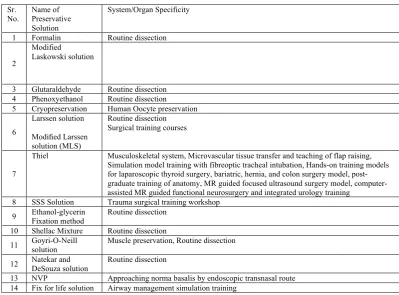
The property of Thiel’s method in restoring hydration of cadaver was the distinctive factor that made “soft embalming” to be considered for developing different skill training models[24].It was also found to be appropriate for human cadaver used in making a flap and microvascular suture training specimens [22]. Simulation model training with fibreoptic tracheal intubation found cadavers preserved using Thiel’s solution proved to be superior to even manikins [34].
Various studies had observed that cadavers embalmed with Thiel’s method were reasonably accommodative for diverse sophisticated surgical training models when compared to routine formalin-fixed cadavers [35–39]. Hands-on training models for various laparoscopic surgery, image guided training models developed using Thiel’s cadaver with documented effectiveness[40].(table:2)
In midst of all these astounding effectiveness in skill training model development, Thiel’s fixation was claimed to have high electrical conductivity as a considerable limitation. Presence of potassium nitrate, ammonium nitrate and sodium sulphite in Thiel’s composition was ascribed as the reason for this phenomenon. An attempt was done in altering the chemical composition and concentration without compromising the advantages provided by Thiel’s solution. In this alternate method, specimens were subjected to the two-staged process where in they were submerged in original Thiel’s solution for 28days only and followed by the 2 weeks usage of the modified solution [41]. Even though, this modification eliminated the electrical conducting phenomenon of Thiel’s fixation, the difficulty in internal visceral dissection stayed to be challenging in specimens preserved by this method. Thus this method of cadaver preservation was found to have limitation for use among students for routine dissection in anatomy laboratory[29].
Saturated Salt Solution (SSS) Embalming Method: - (1998)
In the pursuit for yet another effective alternative to formaldehyde fixation of cadavers, SSS with its different salts was experimented[30].(table:1)
This solution was used in cadavers used for orthopedic surgical training, anatomy dissection and advanced trauma surgical training workshop model[42, 43]. An advanced “cadaver based educational seminar for trauma surgery” found SSS method of fixation to be advantageous with reduced level of formaldehyde exposure[44]. Evaluation of comparative fixation efficacy in cadavers among the three common solutions, SSS, Thiel solution and formalin solution for skills training concluded that SSS exhibited a greater level of maintenance of tissue integrity. It also found that SSS cadavers were of low infectious risk and reduced formalin-induced consequences to the persons handling cadavers. And so, cadavers embalmed by SSS were declared to be proper for developing trauma surgical skills training models[45].
Ethanol-glycerin Fixation method: - (2011)
internal organs architecture were also observed to be preserved in this ethanol – glycerin method of fixation. Usage of this fixation method for finer preservation of cadaver without added health determents was reported by few studies [47]. Superiority of ethanol-glycerin fixation method for routine student dissection in contrast to Thiel’s embalming technique was also documented. Nevertheless, the same study reported the limitation of the ethanol-glycerin fixation for the preservation of cadaveric workshop specimens [48].
Shellac Mixture: - (2011)
Shellac is an animal origin natural polymer, derived from secretions of Lac insects named Laccifer Lacca. The resin was secreted forms the covering of the insect larvae. The lac is collected from the host trees by cutting branches containing resinous insects and grinding with processing. Shellac is soluble in alcohol and alkaline solutions but insoluble in water. It has very low water and acid permeability. Commonly this polymer was used in food industry, ceiling, glossing and also in pharmaceutical industries. The use of shellac mixture for embalming of cadavers was observed to be safe and environment friendly. But slight brown discoloration of skin and not tested for skill training model development were its limitations[49].
Goyri-O-Neill embalming solution: - (2013)
The contents of this solution (table:1) were toxic by nature. As they did not produce any toxic vapors at room temperature and were not harmful on touch unless directly it was deemed to be fit for usage. No change in color of skin with minimal change in the elasticity and minimal increase in the swelling of tissues were reported in cadavers embalmed using this solution. Retention of flexibility of joints as similar to live state with maintenance of structural neurovascular integrity and high morphological correlation with the living tissues even on scanning electron microscopic examination were significant advantages of using this solution for preparing skill training models[50].
Natekar and DeSouza Solution: - (2014)
Long duration of preservation of undissected cadavers, free of fungus and maggots upto 5years was considered to be the prime factor for using this preservation method. It was also observed that skin exhibited a natural look. The fascia, arteries and muscles appeared red dish in color which made differentiating them easy in skill training specimen. [51]. The cost effectiveness and environmentally friendly nature of the solutions composition added to its advantage. (Table:1)
N-vinyl-2-pyrrolidone (NVP) Embalming: - (2018)
Fix 4 life solution: -
The quest for ideal cadaver preservation for airway management simulation training concluded that fix for life (F4L) solution made up of a non-hazardous mixture of aldehydes and manikin cadavers were the most suitable method[54]. This review of merits and demerits of different cadaver preservation methods in usage for skill training model development impressed upon the impracticability of finding out the ultimate single cadaver fixation and preservative solution workable in all possible scenarios. A comprehensive compilation of different preservation solutions ideal for specific surgical skill training model specimen preparation could be used as guide while planning for cadaveric training workshops. (table:2)
Conclusion: -
Each of these different methods reviewed in this study exhibited its inherent pros and cons. The responsibility of weighing the benefits of one particular embalming technique over another and addressing its possible health hazards to the handling personnel lies with the expert anatomist. The choice of fixative finally depends upon the consequent purpose for which the preservation was done for that cadaver specifically.
References: -
1. Abdel-Maksoud G, El-Amin AR (2011) A review on the materials used during the mummification processes in ancient Egypt. Mediterranean Archaeology and Archaeometry 11:129–150
2. Ajmani M.L. Embalming: Principles and Legal aspects, 1st Ed. Jaypee Brothers Medical Publishers 2008
3. Reznick RK, MacRae H (2006) Teaching surgical skills--changes in the wind. N Engl J Med 355:2664–2669. https://doi.org/10.1056/NEJMra054785
4. Oxentenko AS, Ebbert JO, Ward LE, et al (2003) A multidimensional workshop using human cadavers to teach bedside procedures. Teach Learn Med 15:127–130. https://doi.org/10.1207/S15328015TLM1502_10
5. Groscurth P, Eggli P, Kapfhammer J, et al (2001) Gross anatomy in the surgical curriculum in Switzerland: improved cadaver preservation, anatomical models, and course development. Anat Rec 265:254–256. https://doi.org/10.1002/ar.10030
6. Macdonald GJ, MacGregor DB (1997) Procedures for embalming cadavers for the dissecting laboratory. Proc Soc Exp Biol Med 215:363–365.
https://doi.org/10.3181/00379727-215-44144
7. Swenberg JA, Moeller BC, Lu K, et al (2013) Formaldehyde carcinogenicity research: 30 years and counting for mode of action, epidemiology, and cancer risk
assessment. Toxicol Pathol 41:181–189. https://doi.org/10.1177/0192623312466459
8. Hosgood HD, Zhang L, Tang X, et al (2013) Occupational exposure to formaldehyde and alterations in lymphocyte subsets. Am J Ind Med 56:252–257.
https://doi.org/10.1002/ajim.22088
10. Goldstein BD (2011) Hematological and toxicological evaluation of formaldehyde as a potential cause of human leukemia. Hum Exp Toxicol 30:725–735.
https://doi.org/10.1177/0960327110381682
11. Costa S, Costa C, Madureira J, et al (2019) Occupational exposure to formaldehyde and early biomarkers of cancer risk, immunotoxicity and susceptibility. Environ Res 179:108740. https://doi.org/10.1016/j.envres.2019.108740
12. Humans IWG on the E of CR to (2006) Formaldehyde, 2-Butoxyethanol and 1-tert-Butoxypropan-2-ol. International Agency for Research on Cancer
13. Brenner E (2014) Human body preservation – old and new techniques. J Anat 224:316–344. https://doi.org/10.1111/joa.12160
14. Dréno B, Zuberbier T, Gelmetti C, et al (2019) Safety review of phenoxyethanol when used as a preservative in cosmetics. J Eur Acad Dermatol Venereol 33 Suppl 7:15– 24. https://doi.org/10.1111/jdv.15944
15. Frølich KW, Andersen LM, Knutsen A, Flood PR (1984) Phenoxyethanol as a nontoxic substitute for formaldehyde in long-term preservation of human anatomical specimens for dissection and demonstration purposes. Anat Rec 208:271–278. https://doi.org/10.1002/ar.1092080214
16. (2020) Phenoxetol as a formaldehyde-removing agent for long-term preservation: our experience. European Journal of Anatomy 18:267–272
17. Kumar R, Verma RK, Dixit RK, et al (2013) Embalming Solutions and their Adverse Effects: An Update. Asian Journal of Pharmaceutical and Health Sciences 3:
18. Ali J, Shelton JN (1993) Design of vitrification solutions for the cryopreservation of embryos. J Reprod Fertil 99:471–477. https://doi.org/10.1530/jrf.0.0990471
19. Fabbri R, Porcu E, Marsella T, et al (2001) Human oocyte cryopreservation: new perspectives regarding oocyte survival. Hum Reprod 16:411–416.
https://doi.org/10.1093/humrep/16.3.411
20. Bilge O, Celik S (2017) Cadaver embalming fluid for surgical training courses: modified Larssen solution. Surg Radiol Anat 39:1263–1272.
https://doi.org/10.1007/s00276-017-1865-4
21. Ottone NE, Vargas CA, Fuentes R, del Sol M (2016) Walter Thiel’s Embalming Method: Review of Solutions and Applications in Different Fields of Biomedical Research. International Journal of Morphology 34:1442–1454.
https://doi.org/10.4067/S0717-95022016000400044
22. Wolff K-D, Kesting M, Mücke T, et al (2008) Thiel embalming technique: a valuable method for microvascular exercise and teaching of flap raising. Microsurgery 28:273–278. https://doi.org/10.1002/micr.20484
24. Hunter A, Eisma R, Lamb C (2014) Thiel embalming fluid--a new way to revive formalin-fixed cadaveric specimens. Clin Anat 27:853–855.
https://doi.org/10.1002/ca.22392
25. Cabello R, González C, Quicios C, et al (2015) An experimental model for training in renal transplantation surgery with human cadavers preserved using W. Thiel’s embalming technique. J Surg Educ 72:192–197.
https://doi.org/10.1016/j.jsurg.2014.10.002
26. Willaert W, Tozzi F, Van Hoof T, et al (2016) Lifelike Vascular Reperfusion of a Thiel-Embalmed Pig Model and Evaluation as a Surgical Training Tool. Eur Surg Res 56:97–108. https://doi.org/10.1159/000442791
27. Kerckaert I, Van Hoof T, Pattyn P, D’Herde K (2008) Endogent: Centre for Anatomy and Invasive Techniques. Anatomy 2:28–33. http://dx.doi.org/10.2399/ana.08.028
28. Walther Thiel Method for the Preservation of Corpses with Maintenance of the main physical properties of Vivo.
http://journaldatabase.info/articles/walther_thiel_method_for_preservation.html. Accessed 26 May 2020
29. Eisma R, Lamb C, Soames RW (2013) From formalin to Thiel embalming: What changes? One anatomy department’s experiences. Clin Anat 26:564–571. https://doi.org/10.1002/ca.22222
30. Hayashi S, Homma H, Naito M, et al (2014) Saturated salt solution method: a useful cadaver embalming for surgical skills training. Medicine (Baltimore) 93:e196. https://doi.org/10.1097/MD.0000000000000196
31. Hammer N, Schröder C, Schleifenbaum S (2016) On the suitability of Thiel-fixed samples for biomechanical purposes: Critical considerations on the articles of Liao et al. “Elastic Properties of Thiel-Embalmed Human Ankle Tendon and Ligament” and Verstraete et al. “Impact of Drying and Thiel Embalming on Mechanical Properties of Achilles Tendons.” Clin Anat 29:424–425.
https://doi.org/10.1002/ca.22679
32. Eisma R, Lamb C, Soames RW (2013) From formalin to Thiel embalming: What changes? One anatomy department’s experiences. Clin Anat 26:564–571. https://doi.org/10.1002/ca.22222
33. McDougall S, Soames R, Felts P (2019) Thiel embalming: Quantifying histological changes in skeletal muscle and tendon and investigating the role of boric acid. Clin Anat. https://doi.org/10.1002/ca.23491
34. László CJ, Szűcs Z, Nemeskéri Á, et al (2018) Human cadavers preserved using Thiel’s method for the teaching of fibreoptically-guided intubation of the trachea: a laboratory investigation. Anaesthesia 73:65–70.
https://doi.org/10.1111/anae.14104
35. Eisma R, Mahendran S, Majumdar S, et al (2011) A comparison of Thiel and formalin embalmed cadavers for thyroid surgery training. Surgeon 9:142–146.
36. Giger U, Frésard I, Häfliger A, et al (2008) Laparoscopic training on Thiel human cadavers: a model to teach advanced laparoscopic procedures. Surg Endosc 22:901–906. https://doi.org/10.1007/s00464-007-9502-7
37. Eisma R, Wilkinson T (2014) From “silent teachers” to models. PLoS Biol 12:e1001971. https://doi.org/10.1371/journal.pbio.1001971
38. Eljamel S, Volovick A, Saliev T, et al (2014) Evaluation of Thiel cadaveric model for MRI-guided stereotactic procedures in neurosurgery. Surg Neurol Int 5:S404-409. https://doi.org/10.4103/2152-7806.140199
39. Mains E, Tang B, Golabek T, et al (2017) Ureterorenoscopy training on cadavers embalmed by Thiel’s method: simulation or a further step towards reality? Initial report. Cent European J Urol 70:81–87. https://doi.org/10.5173/ceju.2017.913
40. Eljamel S, Volovick A, Saliev T, et al (2014) Evaluation of Thiel cadaveric model for MRI-guided stereotactic procedures in neurosurgery. Surg Neurol Int 5:S404-409. https://doi.org/10.4103/2152-7806.140199
41. Liao P-Y, Wang Z-G (2019) Thiel-embalming technique: investigation of possible modification in embalming tissue as evaluation model for radiofrequency ablation. J Biomed Res. https://doi.org/10.7555/JBR.32.20160148
42. Burns DM, Bell I, Katchky R, et al (2018) Saturated Salt Solution Cadaver-Embalming Method Improves Orthopaedic Surgical Skills Training. J Bone Joint Surg Am 100:e104. https://doi.org/10.2106/JBJS.17.01256
43. Coleman R, Kogan I (1998) An improved low-formaldehyde embalming fluid to preserve cadavers for anatomy teaching. J Anat 192 ( Pt 3):443–446.
https://doi.org/10.1046/j.1469-7580.1998.19230443.x
44. Homma H, Oda J, Sano H, et al (2019) Advanced cadaver-based educational seminar for trauma surgery using saturated salt solution-embalmed cadavers. Acute Med Surg 6:123–130. https://doi.org/10.1002/ams2.390
45. Gosomji IJ, Omirinde JO, Hena SA, et al (2018) Saturated Salt Solution an Alternative Reagent in Reducing Formaldehyde Concentration in Embalming. MOJ Anat & Physiol 5:205–207. https://doi.org/10.15406/mojap.2018.05.00192
46. Hammer N, Löffler S, Feja C, et al (2011) Substitution of formaldehyde in cross anatomy is possible. J Natl Cancer Inst 103:610–611.
https://doi.org/10.1093/jnci/djr035
47. Hammer N, Löffler S, Feja C, et al (2012) Ethanol-glycerin fixation with thymol conservation: a potential alternative to formaldehyde and phenol embalming. Anat Sci Educ 5:225–233. https://doi.org/10.1002/ase.1270
48. Hammer N, Löffler S, Bechmann I, et al (2015) Comparison of modified Thiel embalming and ethanol-glycerin fixation in an anatomy environment: Potentials and limitations of two complementary techniques. Anat Sci Educ 8:74–85. https://doi.org/10.1002/ase.1450
50. Goyri-O’Neill J, Pais D, Freire de Andrade F, et al (2013) Improvement of the
embalming perfusion method: the innovation and the results by light and scanning electron microscopy. Acta Med Port 26:188–194
51. Natekar PE, Desouza FM (2012) A New Embalming Fluid for Preserving Cadavers. 1:5
52. Maruyama K, Yokoi H, Nagase M, et al (2019) Usefulness of N-vinyl-2-pyrrolidone Embalming for Endoscopic Transnasal Skull Base Approach in Cadaver Dissection. Neurol Med Chir (Tokyo) 59:379–383. https://doi.org/10.2176/nmc.oa.2019-0069
53. Haizuka Y, Nagase M, Takashino S, et al (2018) A new substitute for formalin: Application to embalming cadavers. Clin Anat 31:90–98.
https://doi.org/10.1002/ca.23011
Table 1: Composition of Embalming Solutions
Sr. No. Name of Preservative Solution
Composition
1
Formalin Solution Formalin 10%, Sodium borate 15 gm, Sodium citrate 15 gm, Glycerin 15%, Phenol 5%, Water 15%, Thymol: Few crystals, 1 % eosin 5 ml, Soluble winter green 10 ml
2 Modified Laskowski Solution Glycerin 800ml, Ethanol 200ml, Phenol 50g, Boric acid 50g
3 Glutaraldehyde Glutaraldehyde
4
Phenoxyethanol Embalming Solution (Owen &Steedman, 1956) 40% Formaldehyde 99% Ethanol Glycerine Tap Water 100% Phenoxetol Total Embalming Fluid 3 2 1 1 --- 7
Tank Fluid 1 100 --- --- 900 --- 1000
Tank Fluid 2 --- --- --- 990 10 1000
5 Cryopreservation Vitrification solutions used: butylenes glycol, propylene glycol, dimethyl sulfoxide (DMSO), glycerol & ethylene glycol
6
Larssen & Modified solution
Sodium Chloride (gm) Sodium bicarbonate (gm) Chloral hydrate (gm) Sodium sulphate (gm) 10 % Formalin(ml) Distilled Water (L) Glycerol (ml)
For to prepare Working Solution at room temperature Larssen solution 500 900 1000 1100 500 1 ---
1 part of this solution with 5 parts of distilled water
Modified Larssen’s solution (MLS) 180 200 200 200 100 2 400
1 part concentrate and 3 parts distilled water
7
Solutions-A as per Walter Thiel (in 1992)
Boric Acid: 03 gm, Ethylene Glycol: 30 ml, Ammonium Nitrate: 20 gm, Potassium Nitrate: 05 gm, Hot Water: 100 ml
Solutions-B as per Walter
Thiel (in 1992) Ethylene Glycol: 10 ml 4-chloro-3-methylphenol: 1 ml Injection Solution (Walter
Thiel, 1992) for Cadaver weighing 80 Kg
Solution A: 14300 ml, Solution B: 500 ml, Formaldehyde: 300 ml, Sodium Sulphate: 700 gm
Immersion Solution (Walter Thiel, 1992) for Cadaver weighing 80 Kg
Ethylene Glycol: 10 ml, Formaldehyde: 02 ml, Solution B: 02 ml, Boric Acid: 03 gm, AmmoniumNitrate:10 gm, Potassium Nitrate: 10 gm, Sodium Sulfate: 07 gm, Hot Water: 100 ml Dilution fluid by Liao P
and Wang Z 2019 Hot tap water/ml Boric acid/gm Propylene glycol/ml Stock II/L
Formalin (8.9%)/ml Ethanol/ml
Dilution fluid 1 500 20 60 18 51 30
Dilution fluid 2 500 20 60 18 5.1 60
Dilution fluid 3 500 20 90 18 5.1 30
8 Saturated Salt Solution (SSS) Sodium chloride 20 kg, 20% formaldehyde 1 L, Phenol 0.2 L, Glycerin 0.5 L, Isopropyl alcohol 4 L, Water 19.3 L
9 Ethanol-glycerin Fixation method Glycerin 1.5% Ethanol for immersion
11 Goyri-O-Neill solution Diethylene Glycol, Mono-ethylene Glycol
12 Natekar and DeSouza Solution Formalin 4 L, Water 4L, Methyl Alcohol 1L, Glycerin 500ml, Cetrimide 500 ml, Eosin 25 ml, Eucalyptus Oil 25 ml
13 NVP Preserve Solution 10% concentration of NVP & <0.1% N, N’-dibutyl-phenylenediamine
Table 2: Composite list of workable preservation solutions for specific skill training model
Sr. No.
Name of Preservative Solution
System/Organ Specificity
1 Formalin Routine dissection
2
Modified Laskowski solution
3 Glutaraldehyde Routine dissection 4 Phenoxyethanol Routine dissection 5 Cryopreservation Human Oocyte preservation
6
Larssen solution Modified Larssen solution (MLS)
Routine dissection Surgical training courses
7
Thiel Musculoskeletal system, Microvascular tissue transfer and teaching of flap raising, Simulation model training with fibreoptic tracheal intubation, Hands-on training models for laparoscopic thyroid surgery, bariatric, hernia, and colon surgery model, post-graduate training of anatomy, MR guided focused ultrasound surgery model, computer-assisted MR guided functional neurosurgery and integrated urology training
8 SSS Solution Trauma surgical training workshop 9 Ethanol-glycerin Fixation method Routine dissection
10 Shellac Mixture Routine dissection
11 Goyri-O-Neill solution Muscle preservation, Routine dissection 12 Natekar and DeSouza solution Routine dissection