Article
Computational simulation of PT6A gas turbine engine
operating with different blends of biodiesel: A
transient-response analysis
Camilo Bayona-Roa1,2, J.S. Solís-Chaves1∗ Javier Bonilla1and Diego Castellanos1
1 Laboratorio de Simulación Computacional - Universidad ECCI; [email protected]
2 Centro de Ingeniería Avanzada, Investigación y Desarrollo – CIAID, Bogotá (Colombia); [email protected]
* Correspondence: [email protected]
‡ These authors contributed equally to this work.
1
2
3
4
5
6
7
8
Abstract:A computational simulation of a PT6A gas turbine engine operating at off-design conditions is described
in the present article. The model consists of a 0-dimensional thermo-fluidic description of the engine by applying
the mass, linear momentum, angular momentum, and energy balances in each engine’s component. The transient
behavior of the engine is simulated for different blends of the original JET-A1 fuel with bio-diesel. Simulated
thermodynamic variables of the air at each engine’s component, as well as some performance parameters correspond
to the reported experimental measurements. The numerical results also demonstrate the ability of the computational
simulation to predict acceptable fuel blends, such that the efficiency of the engine is maximized and its structural integrity is maintained.
Keywords:Gas turbine engine; Thermo-fluidic model; System dynamics; Bio-diesel; Thermal efficiency. 9
1. Introduction 10
The necessary thrust that is required for an aircraft to provide lift is commonly supplied by a heat engine. In 11
particular, a gas turbine engine has the ability to convert heat energy into mechanical energy by involving the flow 12
of air passing through several thermo-fluidic processes within its components. The most important feature of gas 13
turbine engines is that, contrary to reciprocating engines, separate sections of the engine are devoted to the intake, 14
compression, combustion, power conversion, and exhaust processes. This also means that all processes are performed 15
simultaneously and are strongly coupled between them. 16
Various levels of modeling of operational gas turbine engines, ranging from the systematic engine simulation 17
in [1–6], to the detailed component manufacturing of engine parts in [7–9] rely on the thermo-fluidic modeling of
18
each engine’s component. In this sense, as the engine’s model increase in detail it may lack maturity and robustness: 19
detailed models are based onComputational Fluid Dynamics(CFD), which describes numerically the air flow through
20
the components of the engine, including the combustion phenomena inside the burner. But fully three-dimensional 21
CFD models resolve separately the thermo-fluidic phenomena occurring at each engine’s component [10,11]. Those
22
models are mostly devoted to the design of the turbo-machinery components of the engine (e.g. compressor’s and 23
turbine’s blades), rather than providing the full operational response. Indeed, the aerodynamic matching of stages 24
within the turbo-machinery, and even worst, it’s coupling with other physical descriptions such as the combustion or 25
the blade dynamics, greatly impedes the utility of these models. 26
This article aims to computationally simulate a gas turbine engine when operational parameters like the fuel 27
type are modified. We develop a computational simulation -in the sense of the System Dynamics(SD)
analysis-28
which is capable of giving the transient response of the gas turbine engine’s performance when a change in the 29
operation parameters occurs. Specifically, when the Jet-A1 fuel that is typically used is replaced by a blend with 30
bio-diesel. We rely on the wide range of thermo-fluidic models that have been proposed in the literature: from 31
systematic models in [12–14], to detailed mathematical descriptions in [15–17]. But the conceptual description of the 32
gas turbine engine’s response is complex; it involves the approximation from very different engineering disciplines: 33
Aerodynamics, Thermodynamics, Heat Transfer, Structural Analysis, Materials Science and Mechanical Design, among 34
others. As the main objective of this work is to provide predictive information about the engine operation at off-design 35
conditions, including the computational simulation of test bench analyses and the complete monitoring of the engine, 36
we implement a model that gives a systematic response of the gas turbine engine. This model is aimed to give the 37
indication of the various sensors -Avionics- in the engine. For example, the pressure and temperature of the air stream 38
and the rotating power of the shafts occurring at the different stages of the engine’s components. 39
We restrict our survey to computational codes that give the avionics response of the engine: applications can 40
be found in the literature ranging from preliminary analysis of the new system’s designs, like the ones described 41
in [18–20], to detailed responses of each component’s settings in [21–23]. These fast computational-based engine
42
simulations are the milestone to preventin-flightoperational failureson-live, when engine’s parameters are modified.
43
Our model focus on describing the primary flow-path components such that on-live calculations can be achieved, 44
and avoids the description of the structural behavior of the solid parts of the engine, which are not essential in the 45
engine’s operation. Since some other non-flow-path components affect the ability to maintain the operation conditions, 46
accounting for them can be significant to obtain accurate simulations. This is the case of the combustion control 47
system or the external loads related to the propeller. In any case, the excluded relationships from the model are 48
the engine-inlet or engine-outlet integration (to reproduce the inlet and outlet flows), the engine-aircraft integration 49
(to reproduce structural analysis), the engine-environment integration (for adverse weather and pollution), and the 50
control systems. 51
The remaining parts of this article are organized in the following order. In Section2the real operational gas
52
turbine engine is described: we reproduce a generic version of the Pratt-Whitney PT6A engine. Simultaneously, 53
we present the theoretical description of the thermodynamic processes occurring inside each engine’s components 54
and the SD approach. The simulation of different operation scenarios are given in Section3. The scenarios include
55
a benchmark problem of the engine’s steady operation using Jet-A1 fuel, the subsequent operation with blends of 56
bio-diesel, and the transient engine response at the start-up procedure. Finally, in Section4some conclusions close the
57
article. 58
2. The PT6A engine model 59
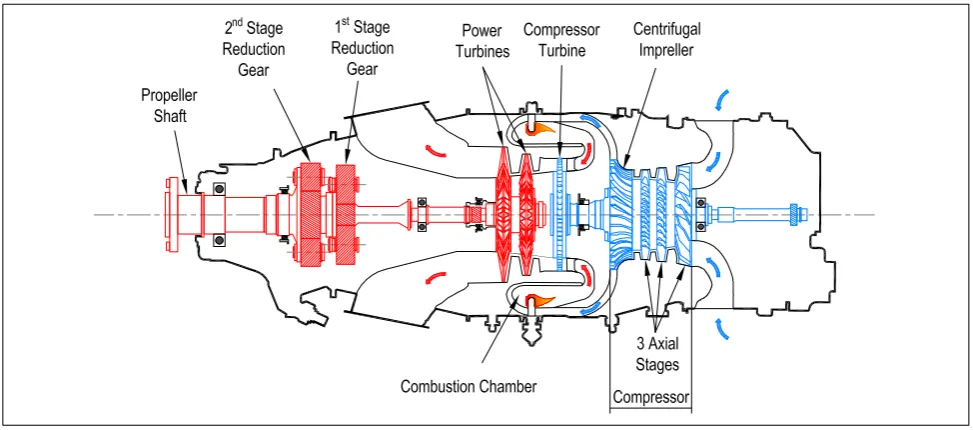
A generic version of the Pratt-Whitney PT6A "Medium" engine, including the labeling of its parts, is displayed in 60
Fig.1. In general, gas turbine engines consist of: an air inlet, a compression section (including the compressor and
61
diffuser), a combustion section (combustion chamber), a turbine section, an exhaust section, and an accessory section 62
(for necessary systems). The theoretical description of the thermodynamic processes occurring in these components is 63
Brayton’s cycle. But the dynamic simulation of the engine’s behavior must account for non-equilibrium conditions, 64
which is the case of the start-up procedure of the engine. The Brayton’s model must, therefore, be complemented with 65
the actual design of the turbo-machinery of the engine’s stages. 66
We develop a gas-dynamical model for describing the thermo-fluidic phenomena present in each gas turbine 67
engine’s component. For doing so, we apply the fluid’s continuity balance for each component with transient mass 68
storage, namely the combustion chamber where compressible effects of the air are relevant, and for the coupling of 69
mass fluxes between consecutive components. We also apply the fluid’s momentum balance at the core flows in the 70
compressor and turbine stages. Fluid’s energy balance accounts for the combustion chamber heat addition and for the 71
compression and expansion processes. The mechanical energy equation is also applied to the rotor stages, including 72
the inertial term of the rotor shaft, in order to model the mechanical coupling between the moving components. The 73
application of these balances to the engine’s components results in a0-dimensional modelrepresenting the operation at
74
transient state. The model is usually confined to the normal operating range of the engine, but in the present work is 75
aimed to give a response to a change in the operational conditions of the engine. 76
A practical approach to solve the 0-dimensional model is to implement it in SIMULINK®software [24], which
77
possess a graphical user interface for building algebraicblock diagramsthat define the governing differential equations.
78
Hence, we present the block diagram of the governing equations in Fig.2, where the engine model is represented at a
79
following paragraphs. Moreover, each component’s block diagram will be presented through the detailed explanation 81
of each sub-system. We list inputs, parameters, variables, and outputs for each block diagram. 82
Figure 1.Cross section of the Pratt-Whitney PT6A engine.
2.1. Air inlet 83
One of the main characteristics of this gas turbine engine is that in most aircraft installations it is mounted 84
backward in the nacelle. This feature makes that the airflow inside the components of the engine is directed in the 85
same direction as the aircraft’s displacement. Another consequence is that the intake is located at the rear part of 86
the engine, and therefore, the air passes through the exterior of the aircraft (and the engine itself) before entering to 87
the intake. The PT6A design cares for guiding the intake air to the engine using ducts that avoid facing the exhaust 88
gases: since the typical requirement is to provide laminar air into the compressor -so that, it can operate at maximum 89
efficiency-, the inlet duct changes smoothly from opposing the direction of the airflow to the axially forward direction 90
of the aircraft’s speed. 91
We define the inlet component as to be the intake air conditioner: even though our model is restricted to an 92
on-ground operation, with no rarefying processes of the atmospheric air entering into the engine, we extend the 93
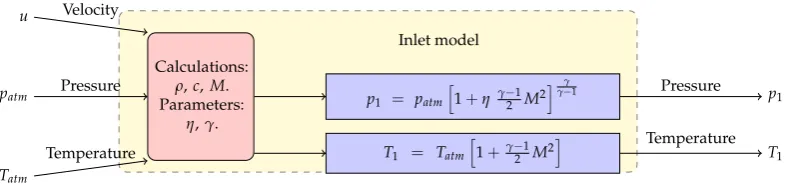
possibility of the operation of the model duringin-flight operationconditions. This effect is modeled using the relations
94
for the pressure and temperature of the air which are presented in the block diagram of Figure3. In the model,patm,
95
andTatmare the atmospheric pressure and temperature,M=u/cis the flight Mach number that relates the aircraft
96
speeduwith the speed of soundc = p
γpatm/ρ, γis the quotient between specific heats of the air, andηis the
97
isentropic efficiency. We use the subscript 1 to label the thermodynamic variables of air at the inlet. Note that when the 98
engine is supposed to operate in thetest bench, the model equates the inlet conditions to the atmospheric conditions
99
p1=patm, andT1=Tatm.
100
2.2. Compression section 101
In the PT6A gas turbine engine (used for aviation), the compression section consists of threeaxial stagesand
102
a singlecentrifugal stage, each considered to be a rise in the air’s pressure: the air flows from the inlet duct to the
103
low-pressure compressor, and then to the next two axial flow stages before passing to the centrifugal stage. The axial 104
stages are composed by rotating blades calledrotors, and static blades calledstators. Those rotating stages move at
105
around 40000 Revolutions Per Minute (RPM) increasing the air’s pressure more than eight times the inlet’s pressure. 106
The last stage of the compressor section is composed of a single centrifugal-flow compressor that accelerates the air 107
Input
data
Inlet.
Axial
compr
ession
stages.
Centrifugal compr
essor
.
Burner
.
Compr
ession
turbine.
Power turbine stages.
Compr
ession
section
rotating
shaft.
Power rotating shaft.
pat
m
,
Tat
m
,
u
,
˙
mf
,
M
l
,
ω
c
(
t
=
0
)
,
ω
p
(
t
=
0
)
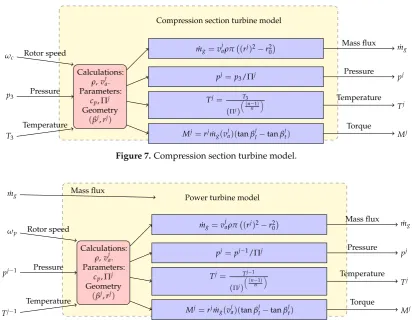
p1
,
T1
p
i,T i,
˙
ma
,∑
3 i=
1
M
i
p2
,
T2
,
M
p3
,
T3
p
j,T j,M j,
˙
mg
,
j
=
1
p
j,T j,M j,
˙
mg
,
j
=
2,
3
ω
c
ω
p
Figure
2.
Flow
chart
of
the
PT6A
engine’s
Calculations:
ρ,c,M.
Parameters:
η,γ.
p1 = patm h
1+η γ−21M2
i γ
γ−1
T1 = Tatm h
1+γ−1 2 M2
i
Inlet model u Velocity
patm Pressure
Tatm
Temperature
Pressure p1
Temperature T1
Figure 3.Inlet model.
stages, it is restricted to a single stage before discharging the airflow. The air stream then leaves the centrifugal 109
compressor section via the diffuser, which is a section of the engine just before the combustion chamber that has the 110
function of preparing the air for the burning area so that it can burn uniformly and continuously. We neglect the 111
diffuser in our representation of the compression section of the engine. 112
A work previous to the modeling of the compressor has to do with the estimation of its geometry. In this sense, 113
we determine the compressor’s geometry by extracting most of the information from technical reports, as well as 114
from the engine’s manual Whitney [25]. Since the axial compression section geometry has been reported in [26] for a
115
four-axial stages PT6A engine, we transcript the geometrical parameters for the first and last stages, but calculate the 116
mean values of the second and third stages of that compressor, and set those values as the second axial stage of our 117
PT6A axial compressor model. The geometric parameters that we have processed for each axial stage geometry are 118
presented in Table1. In the case of the inner and external radius of the rotor blades, we determine those parameters
119
from cross-checking the engine’s manual schemes and the measured values from a disassembled engine. The geometry 120
of the centrifugal compressor is described the rotor’s blade geometry and the inlet’s and outlet’s cross-sectional 121
dimensions, where the innerr1and outerr2radii of the rotor are determined from the engine’s technical report, being
122
92 mm and 117 mm, respectively. 123
Blade Symbol 1st-stage rotor 2nd-stage rotor 3th-stage rotor
Inlet air angle, deg. αl 61.5 59.8 58.0
Exit air angle, deg. αt 54.4 48.9 42.0
Inlet metal angle, deg βl 56.8 57.85 57.1
Exit metal angle, deg. βt 50.5 43.5 36.2
Inner radius, mm. r0 72 76 80
Outter radius, mm. r 100 96 92
Table 1.Processed values of aerodynamic and geometric parameters for the axial compressor stages.
The overall compression stage is defined from the compressor intake(p1,T1)to state 2, at the diffuser outlet
124
(p2,T2). Therefore, it covers the three axial stages, the centrifugal stage, and the diffuser of the PT6A engine.
125
Knowledge of the inlet (upwind) conditions of the air, such as temperature and pressure, as well as the rotational 126
speed of the engine’s rotating shaft, is required. Also, the knowledge of the geometry of the compressor at each stage 127
is mandatory to apply the continuity, momentum and energy balances on which the enthalpy raise and the mass flow 128
depend. Since each compression section is composed of successive stages of rotating blades (rotors) and stationary 129
guide vanes (stators), we analyze at each rotor-stator stage the transmission of the shaft’s mechanical energy into the 130
air’s fluid energy and compose the complete compressor performance by adding the multiple successive compression 131
stages. 132
For simplicity, we assume that the compressor’s blades are thin, rather than having the complete airfoil cross-shape 133
geometry. This supposition is acceptable since in the PT6A engine those are constructed of sheet metal. In the case of 134
the axial compressor, we analyze a singlei−th stage, where a rotor precedes a stator, and consider the same hub radius
135
for the rotor as for the stator. We also make this supposition for the shaft radius at each axial stage. Nevertheless, 136
we consider different cross areas between consecutive compression stages, such that the axial component of velocity 137
can be calculated to conserve mass: in the case of the multistage axial-flow compressor, the blades of each successive 138
stage of the compressor get smaller as the air gets further compressed. In each rotor-stator stage, we consider the 139
thereafter. This is the well-known cascade two-dimensional approximation of turbomachinery analysis, and which 141
configures our control volume. 142
We aim to calculate the variation in the air’s velocity originated by the rotor’s torque. To do this, we apply a 143
simplified analysis of the fluid’s dynamics of the air occurring through the blade: thevelocity triangle. The axial speed
144
of the airflowviacan be measured at the inlet section, such that the volume flow rate can be calculated in terms of the
145
cross-sectional area. Another possibility is to know the inlet air angle (presented in table1), such that the axial velocity
146
is calculated from the velocity triangle. To evaluate the torque on the rotating shaft, we use the angular momentum 147
balance that states that the total momentum in the shaftMis equal to the change between the angular momentum of
148
the flow that crosses the surfaces of the control volume. This change is only related to the tangential velocities of the 149
air given by the velocity triangle analysis. 150
In our model, we consider reversible losses in the compression stages, and therefore, full mechanical efficiency. 151
This implies that the shaft power is the same as the power delivered to the air. We suppose a quasi-static process in 152
which the difference between the amount of energy in the air is given by the increment in power and calculate the 153
temperature rise inside the axial compression stage by applying the energy balance in the control volume. We suppose 154
then, that the net pressure head induced by the compressor is modeled as a polytropic process, where the pressure 155
ratioΠis related with the temperature variation of the air and the polytropic constant of the gasn. The previous
156
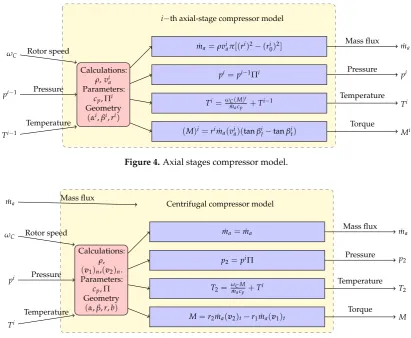
exposition is concisely presented in the block diagrams of Figures4and5.
157
In the case of the centrifugal compressor, we consider that the circumferential cross-sectional area can be defined 158
by the radius and the width of the bladeb. For completeness, we suppose that the flow is defined completely in
159
the normal direction(v1)n, and therefore, the normal velocity at the outlet of the blade can be calculated with the
160
conservation of mass. 161
Calculations:
ρ,via Parameters:
cp,Πi Geometry
(αi,βi,ri)
˙
ma=ρviaπ[(ri)2−(ri0)2]
pi=pi−1Πi
Ti=ωC(M)i ˙ macp +T
i−1
(M)i=rim˙
a(via)(tanβil−tanβit)
i−th axial-stage compressor model
ωC Rotor speed
pi−1 Pressure
Ti−1
Temperature
Mass flux ˙ ma
Pressure pi
Temperature Ti
Torque
Mi
Figure 4.Axial stages compressor model.
Calculations:
ρ,
(v1)n,(v2)n. Parameters:
cp,Π Geometry
(α,β,r,b)
˙ ma=m˙a
p2=piΠ
T2=ωCM ˙ macp+T
i
M=r2m˙a(v2)t−r1m˙a(v1)t Centrifugal compressor model ˙
ma Mass flux
ωC Rotor speed
pi Pressure
Ti
Temperature
Mass flux ˙ ma
Pressure p 2
Temperature T2
Torque
M
2.3. Burner 162
The PT6A burner is mainly characterized by the split in the amount of compressed air that is used for maintaining 163
the combustion: only a fraction of the air entering in the burner reacts with the fuel, while most of the compressed 164
air is used for cooling purposes. The geometrical shape of the burner chamber is an annulus. In this sense, the 165
overall volume is hard to be determined and we have approximated its value from measurements of the disassembled 166
engine’s burner to be around 0.028 m3.
167
Inside the burner, the fuel and the air are separated apart before the flame: combustion with the liquid fuel 168
is performed by the injection of the fuel inside the air stream. Scattering of the fluid into fine droplets leads to the 169
convection and final evaporation of the liquid inside the compressed air-stream. This mixture is a steady non-premixed 170
stream of air-fuel before the full combustion reaction takes place inside the burner. Buoyant mechanisms, but mostly 171
forced convection and turbulence mechanisms of inlet air (due to its high pressure and temperature at the exit of 172
the compression section) maintain the combustion process in the flame. The reaction rate and the products of the 173
combustion (exhaust gases) depend on the quality of the air-fuel mixture occurring before the flame. 174
The combustion quality is automatically controlled by thecombustion control systemthat fixes the amount of
175
injection of fuel; this control is set by default for the Jet-A1 fuel. We neglect the combustion control in our present 176
approach since we aim to investigate the response of the engine to different blends with biodiesel. The change in the 177
physical properties of the fuel affects its spraying as it passes through the fuel injectors in the combustion chamber. 178
This has effects on the maximum temperature inside the fuel chamber at the start-up of the engine. In this sense, the 179
starting procedure has to be designed to be rigorous and must be established for each new operating fuel. For all the 180
above, computational simulation of the particular gas turbine engine’s performance is proposed as a predictive tool 181
for the engine operation, which allows determining the operation variables when the change in the composition of the 182
fuel occurs. This, with a low cost, and without risking the operation of test engines. 183
Our approach to model the burner’s combustion phenomena is simple. The net power of the gas turbine engine 184
is related to the amount of fuel that is burned inside the burner: the heat added to the air-stream is calculated from 185
the energy balance inside the burning chamber, whereLHVis the Low Heating Value of the fuel that represents the
186
amount of energy that is delivered in the combustion process (accounting for the steam boiling in the liquid fuel). This 187
is depicted in the block diagram of Figure6.
188
Note that the amount of chemical energy that is transferred to the air (which is later transformed to mechanical 189
energy in the turbine) depends on the type of fuel used, and this is completely characterized by the fuel flow rate 190
and its lower heating value. The burner also works as an accumulator of mass, where the temporal change of the 191
thermodynamic conditions of the air inside the burner is related to the amount of fuel ˙mf, the incoming air flow rate
192 ˙
ma, the exhausting rate flow of gasses ˙mg, and the volume of the chamberVB. Nevertheless, we describe the temporal
193
variation of the pressure inside the burner to be solely represented by a loss of pressure (with coefficientCb ≤1).
194
Calculations:
ρ.
Parameters: Cb,cp,LHV. Geometry
VB.
p3 = Cbp2
ρVbcpdTdt3 =m˙acp(T2−T3) +m˙f(LHV−cpT3) Burner model
˙
ma, ˙mf, ˙mg Mass fluxes
p2 Pressure
T2
Temperature
Pressure p3
Temperature T3
Figure 6.Burner model.
2.4. Turbine section 195
The air stream leaves the burner with the addition of heat from the combustion and flows through several turbine 196
stages. The first turbine stage is a single-stage axial turbine that powers the compression section synchronously 197
rotating at 40000 RPM via theengine spool, or common shaft. We determine from measurements of the disassembled
198
engine spool an overall mass moment of inertia of the engine spool of about 0.12 Kg m2.
In the PT6A, the hot air flows then into thepower turbines, which are composed by two axial stages that turn at 200
about 30000 RPM, and that are connected to the main shaft that drives the propeller (or load). We also determine that 201
the mass moment of inertia of the main shaft is 0.06 Kg m2. The air is discharged next to the exhaust, and then to the
202
atmosphere, where the air recovers its original free-stream conditions. 203
The turbine process is defined from the state 3 at the combustion chamber outlet(p3,T3)to state 4, at the engine
204
outlet(p4,T4). This means that the expansion ratio of the gas is known for the turbine section. Indeed, knowing the
205
expansion ratio of thej−th stageΠj, one can model each turbine stage as a polytropic expansion process where the
206
pressure and temperature of the air at the discharge can be calculated straightforward. 207
The temperature drop is used then to calculate the retrieved mechanical power inside the turbine. Again, we 208
suppose a complete transformation efficiency between the fluidic and the mechanical power, such that the extracted 209
torque at each axial stage of the turbine is equal to the change in the angular momentum of the air inside the turbine. 210
Similarly to the axial flow compressor analysis, an accurate model of the turbine performance can be derived from a 211
detailed computation of the aerodynamics of the flow over the individual blade elements. The distinctive feature of 212
the turbine is that the mass flow rate of gases through the turbine section depends on the expansion work: we use the 213
angular momentum balance in order to obtain the mass flow of gases through the turbine stage, and therefore, the 214
axial term of the air velocity. The turbine relations are presented in the block diagrams of Figures7and8.
215
Calculations:
ρ,vaj. Parameters:
cp,Πj Geometry
(βj,rj)
˙
mg=vjaρπ (rj)2−r20
pj=p3/Πj
Tj= T3 (Πj)
(n−1)
n
Mj=rjm˙
g(vja)(tanβjl−tanβjt)
Compression section turbine model
ωc Rotor speed
p3 Pressure
T3
Temperature
Mass flux m˙ g
Pressure pj
Temperature Tj
Torque
Mj
Figure 7.Compression section turbine model.
Calculations:
ρ,vaj. Parameters:
cp,Πj Geometry
(βj,rj)
˙
mg=vjaρπ (rj)2−r20
pj=pj−1/Πj
Tj= Tj−1 (Πj)
(n−1)
n
Mj=rjm˙
g(vja)(tanβjl−tanβjt)
Power turbine model ˙
mg Mass flux
ωp Rotor speed
pj−1 Pressure
Tj−1
Temperature
Mass flux m˙ g
Pressure pj
Temperature Tj
Torque
Mj
Figure 8.Power turbine model.
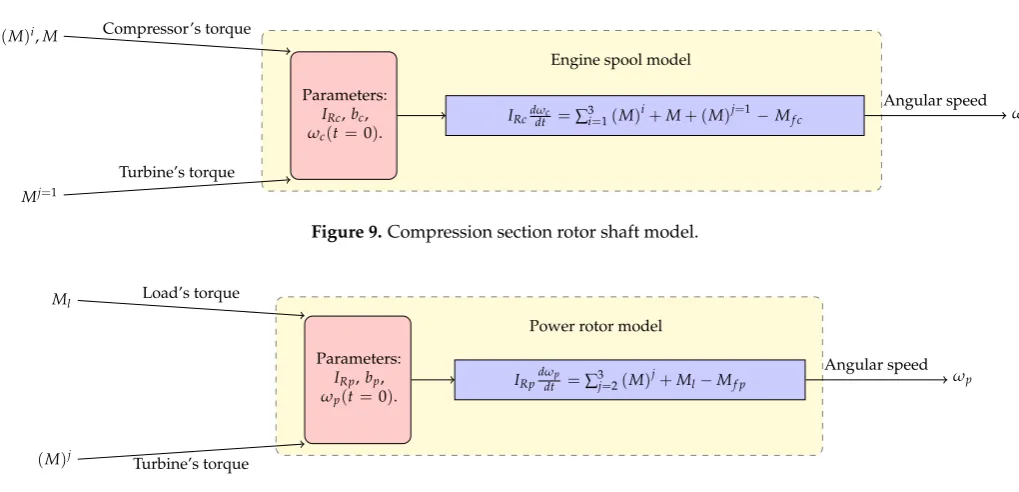
2.5. Rotating Shafts 216
The rotating shafts are modeled by applying the balance of angular momentum. We use the rigid body assumption, 217
and apply the momentum balance in the rotational motion, such that the acceleration power of the shaft must equal 218
the balance between turbine power, compression (or load) power, and parasitic powers. The angular momentum 219
balance applied to the engine spool, as well as the power rotating shaft is presented in the block diagrams of Figures9
220
and10. We defineIRto be the mass moment of inertia of the rotating shaft about its rotating axis,Mis each one of the
221
torques applied to the shaft, andωis the angular velocity of the shaft which can be calculated in terms ofω=Nπ/60,
beingNthe revolutions per minute. We assume a parasitic power from the friction of the rotating shaft. The parasitic 223
torqueMf can be modeled as a bearing friction coefficientbthat multiplies the rotational speed, with its effect acting
224
in the contrary-rotation sense. 225
Parameters: IRc,bc,
ωc(t=0).
IRcddtωc =∑3i=1(M)i+M+ (M)j
=1−M f c Engine spool model
(M)i,M Compressor’s torque
Mj=1
Turbine’s torque
Angular speed
ωc
Figure 9.Compression section rotor shaft model.
Parameters: IRp,bp,
ωp(t=0).
IRpdωdtp =∑3j=2(M)j+Ml−Mf p Power rotor model
Ml Load’s torque
(M)j
Turbine’s torque
Angular speed
ωp
Figure 10.Power turbines rotor model.
2.6. Compatibility conditions 226
Besides the physical description of each engine’s component, one must close the engine’s model coupling the 227
different components to what is referred to thecompatibility conditions.
228
The mass compatibility conditions are related to the conservation of the air mass flow rate. The inlet’s air mass 229
flow rate ˙mais calculated by knowing the inlet air angle at the first axial stage, such that the axial velocity can be
230
calculated knowing the rotational speed and the geometric parameters of the rotor blades. It has been explained 231
that ˙mais conserved among the stages of the compression section. Nevertheless, the mass compatibility condition
232
differs substantially when the air enters the burner: the exhaust gasses mass flow rate ˙mgis not only related to the
233
compressed air flow ˙mareacting with the mass flow of fuel ˙mf, but the exhaust gasses depend on the flow through the
234
turbine section and the engine’s exhaust. Here the compatibility condition is related to the mass flow rate resulting 235
from each turbine stage. Some further explanation about this compatibility condition will be taken in the next section. 236
On the other hand, the angular momentum compatibility condition is the balance of the torques applied for each 237
rotating shaft. Its readily understood that the rotation speed of the axial and centrifugal compressor stages matches 238
with the compressor’s turbine via the engine spool. In the same line, the velocity of the power turbines rotating shaft 239
matches the propeller’s shaft velocity through the reduction gear. 240
Finally, the energetic compatibility conditions are associated with the thermodynamic variables of the air at each 241
one of the stages of the engine. It has been readily mentioned that the air enters each consecutive stage with the 242
pressure and temperature conditions that it obtains at the stage immediately before. This is clear from the overall 243
system’s block diagram depicted in Figure2.
244
3. Numerical Results 245
In this section, we present the numerical results for several different simulation scenarios. The first scenario is the 246
steady response of the engine which is intended to validate the computational model. Then, we solve the steady-state 247
operation by using the blends with biodiesel. Finally, we address the transient operation of the engine using the fuel 248
blends, specifically at the start-up of the engine, when the maximum temperatures can be reached. We suppose an 249
Table 2.On-ground steady operation conditions using Jet-A1 fuel. Extracted from [25].
Standard conditions Value Atmospheric temperature 288 K
Atmospheric pressure 101352.9 pa LHV of Jet-A1 fuel 42.8 MJ/Kg Jet-A1 fuel mass flow 0.062 Kg/s Propeller’s load (at propeller’s shaft) 2684.51 N.m
3.1. Validation of the computational model 251
We first validate the computational model by considering a standard operation of the PT6A engine reported in the 252
operation manual [25]. The geometrical parameters of the PT6A motor are implemented in the computational model
253
correspondingly to Section2. The operation parameters are presented in Table2, where the International Standard
254
Atmosphere (ISA) conditions are set as the environmental conditions. We also assume a constant flow of Jet-A1 fuel, 255
with a calorific power of 42.8 MJ/Kg, and a constant propeller’s load of 2684.51 N.m. We evaluate the stationary 256
response of some tracked variables (invariant in time): for the sake of validation, we track the stationary pressure, 257
temperature and air flow at the stations of the engine. We also set the polytropic constant of the air ton=1.4, and
258
fit some remaining geometric parameters of the model so that we obtain the closest numerical results to the ones 259
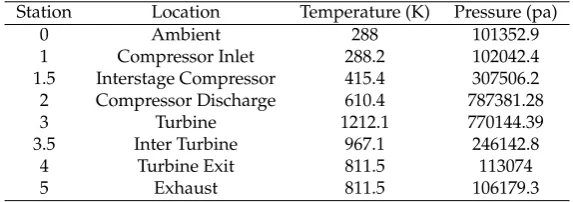
reported in the operation manual. In Table3we list the experimental results that have been previously reported in the
260
operation manual for several stations of the engine, and that we use for the sake of comparisons. 261
We first determine the compression and expansion ratios based on the experimental measurements. The overall 262
compression ratio at the axial stages can be calculated from the data in Table3to be 3.14 : 1 atm, while for the
263
centrifugal compressor the compression ratio is around 2.56 : 1 atm. In this sense, we fit the centrifugal compressor’s 264
anglesβ1andβ2to 40 and 38 degrees, respectively, such that the centrifugal compressor gives rise to the pressure
265
change. On the other hand, the expansion ratio for the compression and power turbines are calculated to be 1 : 3.03 266
atm and 1 : 2.18 atm, respectively. We suppose an expansion ratio of 1 : 1.47 atm for each stage of the power turbines 267
section, and fit the blade’s angles in order to fulfill the mass flow rate compatibility (conservation) condition between 268
the different turbine stages. Table4presents the fitted aerodynamic and geometric parameters for all the turbine
269
stages of the PT6A engine that have been processed. These parameters have been determined following the previously 270
exposed ideas, from cross-checking the engine’s manual schemes and the measured values from a disassembled 271
engine, but mostly from the fulfillment of the mass conservation requirement. The rotor blade airfoils, which are metal 272
profiles followed and preceded by stator vanes, are completely defined by these geometric parameters. Finally, the 273
parasitic power that is lost due to friction can be modeled by setting the bearing coefficientsbcandbpto 0.04 Kg.m2/s
274
and 0.05 Kg.m2/s, respectively, for the engine spool and power rotor shaft. We also model the pressure loss coefficient
275
in the burner to beCb =0.95.
276
The simulated steady engine response is presented in Table 5. In that table, we list the temperature and
277
pressure along the stations of the PT6A engine, together with the calculated relative error against the experimental 278
measurements. We confirm a consistent physical behavior of those thermodynamic variables. Distinctively, the 279
observed pressure at the discharge of the axial compressor stages is higher than the reported one. This inaccuracy is 280
countered by the centrifugal compression section, where the blade’s geometrical parameters are fitted to give accurate 281
results of the overall compression ratio. In this regard, fitting the compressor’s parameters affects negatively the 282
accuracy of the temperature at the discharge of the compression stage, but the energy balance inside the combustion 283
chamber counteracts this effect, and matches the stipulated temperature in the manual, with an error of only 1.57%. 284
Temperature and pressure variables at the expansion stages correspond well to the experimental counterparts, mainly 285
due to the possibility of fixing the expansion relation and the geometrical parameters of the turbines. Given the 286
previous exposition, we believe that the error is restricted to a low range such that it validates the usage of the 287
proposed model for predicting the engine response when new operating conditions are evaluated. 288
3.2. Stationary operation of the PT6A using fuel blends 289
Once the computational model has been validated, the following simulation scenarios are considered: we evaluate 290
Table 3.Temperatures and pressures for PT6A-42 engine at 850 shp and ISA standard conditions. Extracted from [25].
Station Location Temperature (K) Pressure (pa)
0 Ambient 288 101352.9
1 Compressor Inlet 288.2 102042.4
1.5 Interstage Compressor 415.4 307506.2 2 Compressor Discharge 610.4 787381.28
3 Turbine 1212.1 770144.39
3.5 Inter Turbine 967.1 246142.8
4 Turbine Exit 811.5 113074
5 Exhaust 811.5 106179.3
Table 4.Fitted aerodynamic and geometric parameters of the turbine stages.
Blade 1st-stage rotor 2nd-stage rotor 3th-stage rotor
Inlet metal angle, deg -20 -20 -20
Exit metal angle, deg. 80 43 43
Inner radius, mm. 92 90 88
Outter radius, mm. 117 125 142
two different engine operation throttles. Since we aim to predict the engine’s response to the usage of new hypothetical 292
fuels, we vary the parameters that represent the fuel and perform the simulation. In this sense, the standard Jet-A1 293
fuel is mainly composed ofn−heptane and isooctane, which are hydrocarbons that possess between 8 and 16 carbon
294
atoms per molecule, giving aLHVof around 42.8 MJ/Kg (measured in experimental tests [27]). On the other hand,
295
the chemical composition of a biodiesel sample results in an approximatedLHVvalue of 36.29 MJ/Kg [28]. Hence,
296
the pure biodiesel retains a smaller amount of energy than conventional Jet-A1 fuel. We simulate the operation with 297
biodiesel fuel, as well as other hypothetical blends of Jet-A1 with biodiesel. In this sense, we establish a discrete range 298
of mass concentrations of biodiesel in Jet-A1 which are 3 in total: 10% of biodiesel (B10), 20% of biodiesel (B20), and 299
30% of biodiesel (B30). These concentrations give aLHVof 40.84 MJ/Kg, 41.49 MJ/Kg, and 42.14 MJ/Kg, respectively.
300
In the successive, we plot the simulation results for the different types of fuel, so that they are easy to compare visually. 301
We adopt the following notation in the plots for each type of fuel: we use ato denote the pure biodiesel fuel, a
302
?to denote the B10 fuel, a4to denote the B20 fuel, a∗to denote the B30 fuel, and ato denote the Jet-A1 fuel.
303
Figure11shows the air pressure through the engine stages for the two different throttle ranges. We clearly observe
304
a pressure rise at the compression section, as well as an expansion process at the turbine stages. It is evident for both 305
operations ranges that the maximum pressure is located at the centrifugal compressor’s discharge (stage 2) and that 306
there is a slight loss in this pressure at the burner (stage 3). In the full throttle case (right side of the figure), it can be 307
observed that the pressure gap inside the burner between the Jet-A1 fuel and the pure biodiesel fuel is considerable, 308
with an observable maximum pressure of 750 kPa and a lower pressure of 610 kPa. In the case of the 60% throttle, 309
there is a difference of 60 kPa between those fuels, with a maximum pressure of 460 kPa and a minimum pressure of 310
approximately 400 kPa. The fuel blends give results that lay below some 5% of the Jet-A1 pressure range. In any case, 311
the maximum values of pressure are related to the use of the Jet-A1 fuel. This can be explained since it delivers the 312
highest amount of power, which in turn is extracted by the turbine stage and transferred to the compression section 313
via the engine spool. 314
Figure12displays the air temperature through the engine stages for the two different throttles. The temperature
315
results agree well with those reported in the manual: the maximum air temperature is observed at the burner discharge 316
Table 5.Simulation results. Stationary temperatures and pressures at different stations of the PT6A-42 engine. The relative error is calculated against the reported results in Table3.
Station T(K) Error (%) p(pa) Error (%) 1.5 433.63 4.39 423635.89 37.76
2 510.44 16.38 749710.57 4.78
3 1231.15 1.57 727219.25 5.57
1 1.5 2 2.5 3 3.5 4 0.5
1 1.5 2 2.5 3 3.5 4 4.5
5 10
5
1 1.5 2 2.5 3 3.5 4
0 1 2 3 4 5 6 7 8 10
5
Figure 11. Pressure distribution along the engine stages. Results for the stationary engine operation with the 60% (left)and 100%(right)throttles.
(stage 3). In any scenario, the fuel that provides the highest temperature to the engine is the Jet-A1 fuel. For the full 317
throttle operation there is a 100 K temperature difference in the burner between the Jet-A1 fuel and the pure biodiesel 318
fuel: the maximum temperature is given for the Jet-A1 fuel, reaching 1230 K, while the minimum temperature of 1140 319
K is given by the biodiesel operation. The highest drop in temperature occurs at the compression turbine, while the 320
power turbines contribute lesser to the temperature reduction. It is also observed that the temperature difference 321
arising between the fuels at the burner is kept constant at the turbines discharge (stage 4). No important temperature 322
variation is observed for the biodiesel blends. Regardless of the fuel type, the temperature never exceeds a value of 323
1000 K for the 60% throttle operation. 324
We also analyze the response of the engine to different loads. We set the full throttle operation and evaluate the 325
rotational speed of the power shaftNpfor several different loads. The results of the conventional operation of the
326
engine using the 5 different types of fuels are presented in Fig.13, where we observe a diminution in the rotational
327
speedNpwhen the loadMlis increased. Nevertheless, this inverse relation is not linear, and therefore we observe a
328
better engine response (shaft power) at the highest loads. It is recognized that the most calorific fuel -the Jet-A1 fuel-329
gives increased rotational speeds and therefore greater shaft power. On the contrary, the biodiesel operation gives 330
almost 12% less rotational speed than Jet-A1. 331
Lastly, we present the calculation of the thermal efficiencies of the engine steady operation with the different fuels. This is, we calculate the Brayton’s cycle efficiency and the brake efficiency of the engine, being, respectively,
ηb=
1−T4−Tatm
T3−T2
and ηr =
ωpMl ˙
mfLHV
. (1)
We fix a constant load and evaluate the efficiency for several throttles. The efficiency results of the steady operation are 332
presented in Figure14. We observe that the efficiency curves do not correspond to the ones reported in experimental
333
setups, where the efficiency grows linearly with the fuel mass flow, reaching a plateau where the maximum efficiency 334
is located and finally decreasing. In the present results, both efficiency curves decrease being strongly coupled with the 335
amount of fuel mass flow: the amount of delivered power increases with the fuel flow, but the extracted mechanical 336
power at the turbine stages remains almost constant. Still, the thermal efficiencies at full throttle correspond well to 337
the reported stationary efficiencies of the PT6A-42 engine, with the best efficiency record given by the biodiesel fuel. 338
The efficiency decreases with the concentration of biodiesel in the Jet-A1 fuel, having the conventional operation with 339
the Jet-A1 fuel the lowest efficiency. Even though we recognize a spurious behavior in the efficiency curve that can be 340
1 1.5 2 2.5 3 3.5 4 300
400 500 600 700 800 900 1000
1 1.5 2 2.5 3 3.5 4
300 400 500 600 700 800 900 1000 1100 1200 1300
Figure 12. Temperature distribution along the engine stages. Results for the stationary engine operation with the 60% (left)and 100%(right)throttles.
1000 1500 2000 2500 3000
2.6 2.8 3 3.2 3.4 3.6 3.8 4 4.2
4.4 10
4
20 40 60 80 100 0.4
0.45 0.5 0.55 0.6 0.65 0.7 0.75
20 40 60 80 100
0.2 0.25 0.3 0.35 0.4 0.45 0.5 0.55 0.6
Figure 14. Efficiency results. Thermal efficiency(left)and brake efficiency(right)for the engine operation with different throttles.
are promissory. Also, the combustion control -which has been neglected in the present model- may help to explain the 342
difference between the present results and the experimental ones, since it reduces the amount of fuel entering the 343
engine when the air flowing through the engine stages is not sufficient to perform stoichiometric combustion. 344
3.3. Transient operation of the PT6A motor using fuel blends 345
Finally, we evaluate the start-up procedure of the engine with the fuel types that have been tested in previous 346
scenarios. The main goal is to identify problematic conditions during the engine start-up, which is the transient 347
procedure that can actually affect the engine’s integrity. For reproducing the start-up scenario, we initialize the engine 348
spool to an angular velocity ofNc(t=0) =12000 RPM, that is the rotational speed that is provided by the starter.
349
From this point, there is a positive increment of the air pressure (given by the rotation of the compression system) 350
until the desired mass flow of air into the burner is granted. During the initial compression operation, no fuel mass 351
flow is injected into the burner. We consider that at a later instant(t=10)s, when the compressed air into the burner
352
stabilizes, the fuel is injected into the burner and ignited. The mass fuel flow is then gradually increased until the 353
desired throttle is reached at(t=tf). All the start-up procedure is considered to undergo with a constant load.
354
We aim to evaluate the start-up procedure of the PT6A-42 engine with both 100% and 60% of throttle. The results 355
for the operation with fuel blends are displayed similarly as for the stationary operation. We present comparisons of 356
some important variables, such as the air pressure at the compressor discharge and the air temperature inside the 357
burner. It is noticeable that the start-up procedure converges to the steady-state operation. 358
Figure15shows the transient pressure results at the compression stage for the two different throttles. It can be
359
observed that the pressure in the compressor’s discharge undergoes an initial equilibrium when the engine spool is 360
started, reaching a compression ratio below of 1.5 : 1 atm. At(t=10)s, when the fuel is ignited, a sudden increment
361
of the compression ratio of around 2 : 1 atm is noticed for all fuels and throttles. In the case of the 60% throttle, the 362
pressure stabilizes from this instantaneous peak, but the pressure keeps increasing for the full throttle case reaching 363
the reported 8 : 1 atm compression ratio. There is not a significant pressure fluctuation related to the fuel blends: it can 364
only be appreciated a moderate increment for the full throttle and the biodiesel fuel than for the blends and Jet-A1 fuel. 365
The transient temperature inside the burner is presented in Figure16for the two different throttles. We observe a
366
slight increment in the temperature at the initial compression operation. Then, the fuel intake generates a temperature 367
peak in the combustion chamber, which in all scenarios is the maximum temperature that is reached throughout the 368
0 10 20 30 40 50 1
1.5 2 2.5 3 3.5 4 4.5 10
5
0 10 20 30 40 50
1 2 3 4 5 6 7
8 10
5
Figure 15. Transient pressure at the compressor’s discharge. Results for the start-up operation with the 60%(left)and 100%(right)throttles.
the engine does not vary. Instead, it only depends on the fuel blend, where the maximum temperature of 1220 K inside 370
the burner is obtained with the Jet-A1 fuel, and the minimum of 1100 K, approximately, is obtained with the pure 371
biodiesel. After this critical instant, the temperature stabilizes at around 1000 K for the 60% case, with a fluctuation 372
of less than 100 K between the blends and the biodiesel fuel. On the other hand, the temperature in the full throttle 373
scenario increases gradually until the steady state of 1200K is reached at about 40 s. 374
4. Conclusions 375
In this article, we have simulated the PT6A engine operating at off-design conditions. For this, we have simplified 376
the PT6A engine in a process that extracted the essential components of the engine and eliminated the auxiliary ones. 377
The mass, linear momentum, angular momentum, and energy balances have been applied into these components, by 378
which together with the compatibility conditions compose a 0-dimensional thermo-fluidic model of the engine. We 379
have implemented the numerical solution of the model in the SIMULINK software and different simulation scenarios 380
have granted the predictive capacity of our computational model in relation to the systemic response of the engine. 381
Firstly, we have performed a comparison of some thermodynamic variables against the ones reported in the PT6A-42 382
manual. The distribution of temperatures and pressures through each of the engine stages shows similar behavior to 383
that predicted in the thermodynamic theory, as well as in the previously reported experimental measurements of the 384
engine. The relative error between the present results and those reported in the manual is below 10% for most of the 385
stages. 386
The evaluation of the engine response against the change in the composition of the fuel has been achieved next: 387
on one side, to test the hypothetical operation of the engine with blends of biodiesel, but also to predict the start-up 388
response of the engine, which is a complex and transient phenomenon that depends greatly on the type of fuel. In 389
the transient engine starting procedure, the air inside the chamber reaches a temperature peak at the moment of fuel 390
ignition, and the ratio of this temperature to the fuel type is crucial. The simulation results allow us to conclude that 391
the use of blends of biodiesel that are less energetic than the conventional Jet-A1 fuel would not generate a burner 392
overheating since the standard temperature of 1220 K inside the chamber is never exceeded. It is also clear that fuel 393
blends would not generate a pressure excess in the compressor’s discharge, and consequently, these can not generate 394
internal damage to the motor structure. We have also observed that the thermodynamic efficiencies are closely related 395
0 10 20 30 40 50 300
400 500 600 700 800 900 1000 1100 1200 1300
0 10 20 30 40 50
300 400 500 600 700 800 900 1000 1100 1200 1300
Figure 16. Transient temperature at the burner. Results for the start-up operation with the 60%(left)and 100%(right) throttles.
efficiencies are found for the engine operation with fuel blends, giving promissory results of the hypothetical PT6A-42 397
operation with these type of fuels. 398
As a future work, kinetic combustion models can be coupled to the present model in order to determine the 399
added heat and the production of gases. It is also possible to implement engine control: torque control, pressure 400
control, but especially, combustion control. 401
Acknowledgments 402
This work is partially funded through the "Uso de Bioqueroseno como Combustible en Aeronaves de la FAC" 403
project, of the Colombian Government - Colciencias. The authors thankfully acknowledge the resources, technical 404
expertise, and assistance provided by the Colombian Air Force (FAC). This work was supported by Universidad ECCI. 405
References 406
1. Kong, C.; Ki, J.; Koh, K. Steady-State and Transient Performance Simulation of a Turboshaft Engine with Free 407
Power Turbine. ASME 1999 International Gas Turbine and Aeroengine Congress and Exhibition. Citeseer, 1999, pp. 408
V002T04A016–V002T04A016. 409
2. Kong, C.; Roh, H. Steady-state Performance Simulation of PT6A-62 Turboprop Engine Using SIMULINK®. International 410
Journal of Turbo and Jet Engines,20, 183–194. 411
3. Alexiou, A.; Mathioudakis, K. Development of gas turbine performance models using a generic simulation tool. ASME 412
Turbo Expo 2005: Power for Land, Sea, and Air. American Society of Mechanical Engineers, 2005, pp. 185–194. 413
4. Cuenot, B. Chapter Four - Gas Turbines and Engine Simulations. InThermochemical Process Engineering; Academic Press, 414
2016; Vol. 49,Advances in Chemical Engineering, pp. 273 – 385. doi:https://doi.org/10.1016/bs.ache.2016.09.004. 415
5. Menon, S. Simulation of Combustion Dynamics in Gas Turbine Engines. InParallel Computational Fluid Dynamics 2002; 416
North-Holland: Amsterdam, 2003; pp. 33 – 42. doi:https://doi.org/10.1016/B978-044450680-1/50005-X. 417
6. Singh, R.; Maity, A.; Nataraj, P. Modeling, Simulation and Validation of Mini SR-30 Gas Turbine Engine. IFAC-PapersOnLine
418
2018,51, 554 – 559. 5th IFAC Conference on Advances in Control and Optimization of Dynamical Systems ACODS 2018, 419
doi:https://doi.org/10.1016/j.ifacol.2018.05.093. 420
7. Liu, J.; Hussain, S.; Wang, L.; Xie, G.; Sundén, B. Effects of a pocket cavity on heat transfer and flow characteristics 421
of the endwall with a bluff body in a gas turbine engine. Applied Thermal Engineering 2018, 143, 935 – 946. 422
8. Sousa, J.; Paniagua, G.; Collado-Morata, E. Thermodynamic analysis of a gas turbine engine with a rotating detonation 424
combustor.Applied Energy2017,195, 247 – 256. doi:https://doi.org/10.1016/j.apenergy.2017.03.045. 425
9. Wang, M.; Chen, Y.; Liu, Q. Experimental study on the gas engine speed control and heating performance of a gas 426
Engine-driven heat pump.Energy and Buildings2018,178, 84 – 93. doi:https://doi.org/10.1016/j.enbuild.2018.08.041. 427
10. Xia, Z.; Tang, X.; Luan, M.; Zhang, S.; Ma, Z.; Wang, J. Numerical investigation of two-wave collision and wave 428
structure evolution of rotating detonation engine with hollow combustor. International Journal of Hydrogen Energy2018. 429
doi:https://doi.org/10.1016/j.ijhydene.2018.09.165. 430
11. Smirnov, N.; Nikitin, V.; Stamov, L.; Mikhalchenko, E.; Tyurenkova, V. Rotating detonation in a 431
ramjet engine three-dimensional modeling. Aerospace Science and Technology 2018, 81, 213 – 224. 432
doi:https://doi.org/10.1016/j.ast.2018.08.003. 433
12. Dagaut, P.; Cathonnet, M. The ignition, oxidation, and combustion of kerosene: A review of experimental and kinetic 434
modeling. Progress in Energy and Combustion Science2006,32, 48 – 92. doi:https://doi.org/10.1016/j.pecs.2005.10.003. 435
13. Nascimento, M.; Lora, E.; Corrêa, P.; Andrade, R.; Rendon, M.; Venturini, O.; Ramirez, G. Biodiesel fuel 436
in diesel micro-turbine engines: Modelling and experimental evaluation. Energy 2008, 33, 233 – 240. 19th 437
International Conference on Efficiency, Cost, Optimization, Simulation and Environmental Impactof Energy Systems, 438
doi:https://doi.org/10.1016/j.energy.2007.07.014. 439
14. Azami, M.; Savill, M. Comparative study of alternative biofuels on aircraft engine performance. Proceedings
440
of the Institution of Mechanical Engineers, Part G: Journal of Aerospace Engineering 2017, 231, 1509–1521, 441
[https://doi.org/10.1177/0954410016654506]. doi:10.1177/0954410016654506. 442
15. Gatto, E.; Li, Y.; Pilidis, P. Gas turbine off-design performance adaptation using a genetic algorithm. ASME Turbo Expo 443
2006: Power for Land, Sea, and Air. American Society of Mechanical Engineers, 2006, pp. 551–560. 444
16. Li, Y.; Ghafir, M.; Wang, L.; Singh, R.; Huang, K.; Feng, X.; Zhang, W. Improved multiple point nonlinear genetic algorithm 445
based performance adaptation using least square method.Journal of Engineering for Gas Turbines and Power2012,134, 031701. 446
17. Li, Y.; Ghafir, M.; Wang, L.; Singh, R.; Huang, K.; Feng, X. Nonlinear multiple points gas turbine off-design performance 447
adaptation using a genetic algorithm.Journal of Engineering for Gas Turbines and Power2011,133, 071701. 448
18. Pan, M.; Cao, L.; Zhou, W.; Huang, J.and Chen, Y. Robust decentralized control design for aircraft engines: A fractional type. 449
Chinese Journal of Aeronautics2018. doi:https://doi.org/10.1016/j.cja.2018.08.004. 450
19. Zhang, T.; Wu, H.; Fang, Q.; Huang, T.; Gong, Z.; Peng, Y. UHP-SFRC panels subjected to aircraft engine 451
impact: Experiment and numerical simulation. International Journal of Impact Engineering 2017, 109, 276 – 292. 452
doi:https://doi.org/10.1016/j.ijimpeng.2017.07.012. 453
20. Balli, O. Advanced exergy analyses of an aircraft turboprop engine (TPE). Energy 2017, 124, 599 – 612. 454
doi:https://doi.org/10.1016/j.energy.2017.02.121. 455
21. Sirignano, W.; Liu, F. Performance increases for gas-turbine engines through combustion inside the turbine. Journal of
456
propulsion and power1999,15, 111–118. 457
22. Liu, F.; Sirignano, W. Turbojet and turbofan engine performance increases through turbine burners.Journal of propulsion and
458
power2001,17, 695–705. 459
23. Ghoreyshi, S.; Schobeiri, M. Numerical simulation of the multistage ultra-high efficiency gas turbine engine, UHEGT. ASME 460
Turbo Expo 2017: Turbomachinery Technical Conference and Exposition. American Society of Mechanical Engineers, 2017, 461
pp. V003T06A034–V003T06A034. 462
24. MATLAB Simulink Toolbox, Release 2016a. 463
25. Whitney, P..PT6 TRAINING MANUAL; Canada, 2001. 464
26. Yoshinaka, T.; Thue, K. A Cost-Effective Performance Development of the PT6A-65 Turboprop Compressor. ASME 1985 465
Beijing International Gas Turbine Symposium and Exposition. Citeseer, 1985, pp. V001T02A015–V001T02A015. 466
27. Cheng, T.; Simone, H. Measurements of laminar flame speeds of liquid fuels: Jet-A1, diesel, palm methyl esters 467
and blends using particle imaging velocimetry (PIV). Proceedings of the Combustion Institute 2011, 33, 979 – 986. 468
doi:https://doi.org/10.1016/j.proci.2010.05.106. 469
28. Llamas-Lois, A. Biodiesel and biokerosenes: Production, characterization, soot & pah emissions. PhD thesis, ETSI_Energia, 470

![Table 2. On-ground steady operation conditions using Jet-A1 fuel. Extracted from [25].](https://thumb-us.123doks.com/thumbv2/123dok_us/1081844.1608923/10.595.187.407.106.175/table-ground-steady-operation-conditions-using-jet-extracted.webp)