ABSTRACT
Module creation and reuse are
essen-tial for Genetic Programming (GP) to be
effective with larger and more complex
problems. This paper presents a
particu-lar kind of program structure to serve
these purposes: modules are represented
as
λ abstractions and their reuse is
achieved through an implicit recursion.
A type system is used to preserve this
structure. The structure of
λ abstraction
and implicit recursion also provides
structure abstraction
in the program.
Since the GP paradigm evolves program
structure
and
contents
simultaneously,
structure abstraction can reduce the
search effort for good program
struc-ture. Most evolutionary effort is then
focused on the search for correct
pro-gram contents rather than the structure.
Experiments on the Even-N-Parity
problem show that, with the structure of
λ abstractions and implicit recursion,
GP is able to find a general solution
which works for any value of N very
effi-ciently.
1. Introduction
Genetic Programming (GP) [Koza, 1992] is increasing in popularity as the basis for a wide range of learning algo-rithms. The success of GP is generally attributed to its use of an evolutionary-based search strategy combined with a dynamic, tree-structure representation of the programs. Recently, there have been many attempts to enhance GP per-formance [Koza et al., 1996; Koza et al., 1997]. Among them, supporting modules in program representation has been shown to be beneficial [Koza, 1994; Rosca and Bal-lard,1996]. Module creation and reuse can enhance GP in its ability to scale to larger and more complex problems.
In this research, a structure which supports module cre-ation and reuse is incorporated into the program representa-tion. In this structure, modules are represented as λ
abstractions (see Section 2.2) and module reuse is achieved through an implicit recursion (see Section 3.1). A type sys-tem (see Section 3.3) is used to preserve the structure during program evolution.
This style of module creation and reuse provides the fol-lowing advantages:
• Module creation is neither a random process nor a prefixed condition. A randomly generated module may or may not be beneficial to the problem to be solved. On the other hand, a hard-wired module template precludes the genera-tion of more advantageous program structures. Our approach is to generate modules dynamically, based on the recursion structures specified in advance by the users. This allows the exploration of beneficial program structures under the constraints of the users’ specified conditions (see Section 3.2).
• Implicit recursion provides reuse without the possible side effect of infinite loops because there are no semantics of recursion present in the program. This is an inherent fea-ture of implicit recursion. Such a condition not only relieves GP from handling infinite loops in a program but also removes the need for GP to measure the semantic ele-ments of recursive programs which would be used in directing genetic operation.
• The structure of λabstraction and implicit recursion pro-videsstructure abstraction (see Section 6) in the program. Since the GP paradigm evolves programstructure and con-tents simultaneously, structure abstraction can reduce the search effort for good program structure. Most evolution-ary effort is then focused on the search for correct program contents rather than the structure.
We have evolved solutions to the Even-N-Parity problem [Koza,1992] using GP with the implicit recursion structure included in the program representation. The results indicate that with the structure ofλ abstractions and implicit recur-sion, GP is able to find a general solution which works for any value of N very efficiently.
The paper is structured as follows: Section 2 provides background and related work; Section 3 presents our new
Recursion, Lambda Abstractions and Genetic Programming
Tina Yu and Chris Clack
Department of Computer Science
University College London
Gower Street, London WC1E 6BT, U. K.
[email protected] [email protected]
strategy; Section 4 describes the experiments; Section 5 summarizes the results; Section 6 analyzes the results and Section 7 concludes and outlines future work.
2. Background and Related Work
2.1 Recursion and Genetic Programming
Recursion is a general mechanism for program code reuse. When the name of a program appears in its program body, it is like making a new copy of the program code within the program. Recursion leads to more compact programs and can facilitate generalization.Although a powerful reuse mechanism, recursion must be used carefully to be effective. There are two important crite-ria which must be satisfied for a recursive program to be effective:
• a terminating condition (base case);
• the recursive calls must be successively applied to argu-ments that converge towards the terminating condition. A recursive program which fails to meet the two require-ments may or may not produce a result, depending on the program evaluation style. With lazy evaluation, where argu-ments of a function are evaluated only if their values are needed, it is possible for programs containing infinite loops to halt. On the other hand, strict evaluation requires a func-tion’s arguments to be evaluated before the function body and can make such a program loop forever [Hudak,1989]. How program evaluation style affects GP performance has to be further studied.
To evolve recursive programs, GP faces two challenges:
1. Handling infinite loops in a recursive program: An evolved program may produce infinite loops as the two criteria are not always met. [Brave, 1996] adopted a finite limit on recursive calls in his tree search program. Usually such a limit affects the evolution process since a good pro-gram may never be discovered if its evaluation requires more than the permitted recursive calls. This shortcoming, however, does not apply to a tree search program since the maximum number of iterations required to search a tree is its tree-depth. Thus stopping any recursion after tree-depth number of iterations does not affect the behavior of the program. Consequently, Brave’s approach is not a general solution for handling infinite loops. [Wong and Leung, 1996] employed a logic grammar to enforce the base-case structure in their “even-n-parity” programs. However, the convergence of recursive calls was not guaranteed. When infinite loops occur, they used an execution time limit to halt the program. [Clack and Yu, 1997] also imposed a recursion limit to evolve the “map” program. A “map” program applies the first argument (a function) to each ele-ment of the second arguele-ment (a list). Using the length of the input list as the recursion limit seemed to be a sensible decision.
Designing an appropriate fitness for infinite loops is a crucial task in GP, which uses fitness based selection for reproduction. A program which does not halt after the per-mitted number of recursion calls may still contain good partial solutions. Ideally, we would like to use them to generate new and hopefully better programs. [Wong and Leung, 1996] regarded a program which does not produce a result after the allowed execution time as a program ducing a wrong result. No extra penalty is given to the pro-gram. [Clack and Yu, 1997], on the other hand, penalized recursion error proportionate to the length of the input list. When the recursion limit is reached, the program was ter-minated and returned with an empty list (no partial result was returned). The program was penalized not only for producing nothing but also for exceeding the recursion limit. This is a severe punishment. How these fitness mea-surements affect GP performance has to be further studied.
2. Measuring the semantic elements of a recursive pro-gram to direct genetic operation: The GP paradigm uses a syntactic approach to build programs; no semantic anal-ysis is supported. A recursive program which contains a perfect base-case statement may not be selected for repro-duction since semantics are not considered in the GP fit-ness function. [Whigham and McKay, 1995] has identified this problem and suggested the application of genetic operators in an environment where semantic analysis is supported.
2.2
λ Abstractions and Genetic Programming
In our work, we allow λ abstractions in our programs. λabstractions are local function definitions, similar to function definitions in a conventional language such as C. The fol-lowing is an exampleλ abstraction together with an equiva-lent C function.
(λ x (+ x 1)) (λ abstraction)
Inc (int x) (C function)
{return (x+1);}
However, λ abstractions are anonymous and cannot be invoked by name. The reuse ofλ abstractions is performed by passing them as arguments to other functions. The fol-lowing gives an example of the reuse ofλ abstractions:
twice f x = f (f x) twice (λ x (+ x 1)) 2
= (λ x (+ x 1)) ((λ x (+ x 1)) 2) = + ((λ x (+ x 1)) 2) 1
= + (+ 2 1) 1 = + 3 1
= 4
different from ADF. Koza adopted two approaches to defin-ing the structure of a program with ADFs. The first one is to
statically define it before the GP run. Once the structure is specified, every program in the population has the same structure. Genetic operations are customized to preserve the program structure. The second approach is to create various kinds of program structurerandomly during the first genera-tion. Program structure is then open to evolutionary determi-nation [Koza, 1994 Ch. 21]. With predefined program structure, GP does not have the opportunity to explore more advantageous structures. When an unsuitable program struc-ture is given, GP is doomed. On the other hand, leaving GP to determine the program structure among a wide range of possibilities (Koza limited to 3,906 [Koza, 1994 pp. 529]) can be computationally expensive. This research provides a middle ground: modules are determineddynamically by GP but the possible selections are reduced to those allowed by the higher-order functions present in the function sets.
Higher-order functions are functions which take other functions as arguments. Each time one of these functions is used to create a program, the argument with a function type is created as aλ abstraction (more details are given in section 3). A priori knowledge about module creation and reuse is incorporated in functions and terminals to facilitate GP in determining the most effective program structure.
ADFs andλ abstractions are modules which are simulta-neously evolved with the main program. Koza stated that ADFs provide two main functions in GP: First, they perform a top-down process of problem decomposition or a bottom-up process of representational change to exploit identified regularities in the problem. Second, they discover and exploit inherent patterns and modularities within a problem [Koza, 1994]. These are also valid assessments about λ
abstractions.
Two other approaches which also support module cre-ation and reuse are Module Acquisition (MA) [Angeline 1994] and Adaptive Representation through Learning (ARL) [Rosca and Ballard, 1996]. In both approaches, program structures are created andmodified dynamically during the GP run. One important concept about MA and ARL is that modules are building blocks and should be protected from destruction. Modules in MA and ARL are therefore frozen for a period of time without any changes. The only way to modify a module is to Delete (in ARL) or to Expand (in MA) the module and to create a new one. Because of the less fre-quent modification, the quality of the modules becomes very important. [Kinnear, Jr.,1994] reported that the MA approach, where modules are created using randomly extracted program fragments, does not provide any perfor-mance advantages. ARL adopts heuristics to detect good program segments for module creation. This approach pro-duces better programs than GP alone [Rosca and Ballard, 1996].
2.3 Even-N-Parity Problem
The Even-N-Parity has been used by Koza as a difficult problem for GP to solve [Koza, 1992]. This program takes a list of N boolean inputs, returning True if an even number of inputs are True and False otherwise. This problem uses the following function and terminal sets:
• Function Set: {AND, OR, NAND, NOR},
These are standard logic functions and are logically com-plete.
• Terminal Set: {b0, b1,...,bN-1}, N boolean variables.
The test cases consists of all the 2N possible combinations of N inputs. As N is increased, the problem becomes exponen-tial harder. Koza was able to use GP to solve the problem up to N=5. When N=6, none of his 19 runs found a 100%-cor-rect solution [Koza, 1992].
Koza introduced ADFs as a mechanism for GP to con-struct modules for reuse. With ADFs, GP is able to solve this parity problem up to N=11 [Koza, 1994 Ch. 6].
[Wong and Leung, 1996] proposed a general solution which can handle any value of N using recursion. Their approach is to construct a logic grammar to enforce the base-case program structure. Type knowledge can also be incor-porated in the logic grammar. When both sets of information are present in the grammar to guide the evolution, GP is able to find the solution more efficiently than using ADFs. Within 60 runs which use 8 fitness cases (Even-3-Parity), 16 runs found a solution that can work on any value of N. The gener-ated programs, however, do not contain any subroutines, although an “xor” function can be extracted from the grams. The construction of subroutines within recursive pro-grams is not yet implemented in their work. (They also demonstrated that their system required more computation effort when noisy fitness cases were employed [Wong and Leung, 1998]).
3. A New Strategy
This paper presents a structure ofλ abstractions and implicit recursion to evolve program solutions for the Even-N-Parity problem. Implicit recursion facilitates GP to generate gen-eral solutions which work for any value of N.λ abstractions provide the module mechanism for GP to exploit the struc-ture inherent in the Even-N-Parity problem. By combining implicit recursion with module mechanism, performance advantages are anticipated over previous work with the Even-N-Parity problem.
3.1 FOLDR: Implicit Recursion
• MAP: applies the first argument, a monadic operator (a function which takes one argument), to each element of the second argument (a list) to produce a list of the results. For example:
map (+1) [1,2,3]
= [(+1 1),(+1 2),(+1 3)] = [2,3,4]
• FOLD: places the first argument, a dyadic operator (a func-tion which takes two arguments), between each of the items in the list. With FOLDR, the empty list is substituted with the given terminating value and the resulting expres-sion is associated to the right. With FOLDL, the given ter-minating value is prefixed to the expression and the resulting expression is associated to the left. For example:
foldr (+) 10 [1,2,3] = 1 + (2 + (3 + 10)) = 1 + (2 + 13)
= 1 + 15 = 16
foldl (+) 10 [1,2,3] = ((10 + 1)+ 2) + 3 = (11 + 2) + 3 = 13 + 3
= 16
Given the same arguments, FOLDR and FOLDL may or may not produce the same result. More information about the differences between FOLDR and FOLDL functions can be found in [Clack, Myers and Poon, 1995 Ch.4].
• FILTER: applies the first argument, a predicate operator (a function which returns True or False), to each element in the second argument (a list) to produce a list containing items which satisfy the predicate operator. For example:
filter (>1) [1,2,3] = [2,3]
An important characteristic of using implicit recursion is that the programs do not produce infinite loops. The terminating condition is an empty list, which is incorporated into the higher-order functions. Moreover, there are no recursion semantics in the programs as the recursion is performed in the higher-order functions. Implicit recursion is therefore an ideal mechanism to support recursion in GP.
For the Even-N-Parity problem, we include FOLDR in our language to provide implicit recursion because FOLDR produces a single output value and so does the Even-N-Par-ity program. For different problem domains, other higher-order functions might be more suitable. Moreover, combin-ing different higher-order functions is possible.
It might be possible to evolve the Even-N-Parity program using implicit recursion alone withoutλ abstractions. In this case, the function argument to FOLDR would be selected from the function set provided by the users. However, in this paper, we would like to exploit the structure inherent in the
problem. The function argument is allowed to be discovered. Research is underway to compare GP performance using implicit recursion to solve the Even-N-Parity problem with and withoutλ abstractions as described in the following sec-tion.
3.2
λ Abstractions: Module Mechanism
In this work, the modules discovered by GP are represented asλ abstractions. Functions are allowed to take other func-tions as arguments. When an argument with function type is present, a λ abstraction is generated and is used as the actual value for that argument. By specifying primitive functions that require functional arguments, users can direct GP to build modules. For example, suppose the user includes FOLDR in the function set. Since the first argument of FOLDR is a function type, each time FOLDR function is selected to construct the program, a λ abstraction will be generated as the function argument. FOLDR reuses the cre-atedλ abstraction through implicit recursion.
λ abstractions are constructed using the same function set as that used to create the main program. The terminal set, however, consists only of the arguments of the λ abstraction to be created; no global variables are allowed. Argument naming in λ abstractions follows a simple rule: each argu-ment is named with a hash symbol followed by an unique integer, for example #1, #2. This is an easy way to create unique arguments within a λ abstraction. This consistent naming style also allows crossover to be easily performed betweenλ abstractions with the same number of arguments. The following is an example of the FOLDR function withλ
abstraction (in bold) created as its first argument:
FOLDR (λ#1 λ#2 (+ #1 #2)) 10 [1,2,3]
3.3 Type System: Structure Preserving Engine
A type system is used to preserve the program structure ofλabstractions and implicit recursion in the programs. Initially, each primitive function and terminal is specified with type information. Meanwhile, the input and output types of the program to be evolved are specified. This information is used by the type system to select type-matched functions and terminals to construct type-correct programs.
The type information is specified using a type language. The abstract type syntax is given by:
σ :: τ built-in type
|υ type variable
|σ1 −> σ2 function type
| [σ1] list of elements all of typeσ1
|(σ1 −> σ2) bracketed function type
τ::int | string | bool | generici υ::dummyi | temporaryi
• Constants such as 0 and identifiers such asx have a type pre-defined by the user.
• Functions also have pre-defined types (for example, the functionHEAD has the type[a]->a wherea is a dummy type variable).
• Applications have a type given as follows: ifexp1 has type (σ1 ->σ2)
andexp2 has type σ1
then(exp1 exp2) has typeσ2 else there is a type error.
•λ abstractions have the following type: ifx has typeσ1
andexp has typeσ2
then(λx exp) has typeσ1 -> σ2.
A function argument is denoted by the bracketed function type. For example, FOLDR is specified with the following type information:
FOLDR :: (a->b->b) -> b -> [a] -> b
The type information indicates that FOLDR can take three arguments: the first one is a function, the second one is a value and the third one is a list. It returns a single value. Additionally, the first argument is a function which can take two arguments and returns one value. This function argu-ment will be created as a λ abstraction of two arguments. Notice that FOLDR is a polymorphic function whose type signature containstype variables. The type system instanti-ates these type variables when the function is selected to construct the program. It is very important to assure that type variables are instantiated consistently so that the constructed program is type-correct.
By allowing type variables in our type language, the gen-erality of functions in the function set are enhanced. For example, FOLDR can provide implicit recursion for many different types of arguments. More details about polymor-phism and generality in GP can be found in [Yu and Clack, 1998].
The type system also performs type checking during the genetic operation of crossover and mutation. Thus, the struc-ture ofλ abstractions and implicit recursion can be preserved throughout the evolutionary process. The “point-typing” structure-preserving crossover [Koza, 1994 pp. 532] is per-formed in the programs: a point is first selected from the first parent program; depending on the source of the node (the main program or aλ abstraction body), a node with the same source is selected from the second parent program. If the crossover point in the first parent program is inside aλ
abstraction, the crossover point in the second parent program has to be inside aλabstraction which has the same number and type of arguments as the λ abstraction where the first point was selected. This restriction assures that the offspring will not contain any unbound global variables.
The crossover operation is also allowed to be performed onλ abstraction nodes; this is termed “λ modular crossover” as it results the swapping of aλ abstraction module in one program with a λ abstraction module in another program. This operation is similar to the modular crossover in [Kin-near, Jr., 1994]. However, with the type system, the problem of argument mismatching as mentioned in Kinnear’s work does not occur in our implementation.
Eachλ abstraction node is annotated with a type which indicates the number and type of its arguments. The type system limits the λ modular crossover to be performed between twoλ abstractions which have the same number and type of arguments. There follows an example of theλ modu-lar crossover operation. The two parent programs are:
FOLDR (λ#1Int(λ#2Int(/ #1 #2))Int->Int) Int->Int->Int 10 [1,2,3]
FOLDR (λ#1Int(λ#2Int(+ #1 #2))Int->Int) Int->Int->Int 20 [1,2,3]
Note the two swapping λ abstractions have the same type,
Int->Int->Int.The operation produces the following new program:
FOLDR (λ#1Int(λ#2Int(+ #1 #2))Int->Int) Int->Int->Int 10 [1,2,3]
4. Experiments
4.1 Parameters and Primitives
As in [Wong and Leung, 1996], a population size of 500, a maximum generation of 50 and 60 runs are used in the experiment. In addition, a maximum tree depth of 4 for the main program is imposed. Aλ abstraction is considered as one single node in a program parse tree as it performs one task just like the primitive functions in the function set. The maximum tree depth allowed for aλ abstraction is also 4. The crossover rate is 100%. The following are the primitives and their types used in the experiments:
Output Type:bool.
Argument Type:[bool].
Terminal Set:
T = {L:: [bool]}
Function Set:
F = {HEAD:: [a] -> a, TAIL:: [a] -> [a],
A FOLDR expression inside another FOLDR expression cre-ates nested recursion. For example, the following is a pro-gram with nested recursion of depth 2:
FOLDR (+)(FOLDR (+) 0 [1,2,3]) [1,2,3] = FOLDR (+) 6 [1,2,3]
= 12
Nested recursive programs require a considerable amount of time and space to evaluate. The depth of the nested recursion is therefore limited to 100, which we think is powerful enough to handle the Even-N-Parity problem.
4.2 Selection of Fitness Cases
The fitness cases of the Even-2-Parity and the Even-3-Parity are selected to evaluate the programs. There are 22 + 23= 12 fitness cases. A general Even-N-Parity program can handle any value of N, which may be either even or odd. The Even-2-Parity fitness cases help GP to learn to handle an input list with an even number of items while the Even-3-Parity fitness cases train GP to work on an input list with an odd number of items. With this set of fitness test cases, it is hoped that the generated programs can be general solutions which work for any value of N.
4.3 Handling of Run-Time Errors
A program which applies HEAD or TAIL to an empty list gives a run-time error. When such an error occurs, the system receives a default value for the expected type and continues evaluating the program so that a partial solutions can be returned for fitness evaluation. Meanwhile, a run-time error is flagged and solutions marked with this flag are penalized during the fitness evaluation.
4.4 Design of Fitness Function
The fitness function used is the same as that used by Koza [Koza 199, pp.160] except for the punishment of the run-time errors. Each program is evaluated against all of the fitness cases. When a correct result is produced for a fitness case, the program receives a 1; otherwise, it receives a 0. If run-time error has been flagged, fitness is reduced by 0.5. The fitness of a program is the sum of the fitness values for all of the
fit-ness cases. The maximum fitfit-ness value of a program in this experiment is 12.
4.5 Selection of Crossover Locations
A crossover location selection scheme which biases toward root crossover is used [Yu and Clack, 1998]. This selection scheme is designed to accommodate the premature conver-gence of the root nodes which was observed during the experiments and has been reported in [Gathercole and Ross, 1996]. The premature convergence of the root node can severely impair GP performance if the desired behavior of a program depends highly on the root node. The modified crossover location selection scheme provides program root nodes with more opportunities to be replaced with new nodes.
4.6 Crossover Operators
Crossover can be performed on λ abstraction nodes, fully applied or partially applied function nodes. A crossover location is first selected from the first parent program using the scheme described in Section 4.5. Its type and the depth of the node are used to select a crossover point in the second parent. The same selection scheme is used to find a node whose type “unifies” with the given type and whose depth is such that the new tree will satisfy the maximum tree depth. More details about the operation of type unification can be found in [Yu and Clack, 1998].
5. Results
60 runs were made and 57 of them found a solution. More-over, all 57 are general solutions which work for any N num-ber of inputs. To facilitate direct comparison, Koza’s method [Koza, 1992 Ch. 8] is followed to measure the performance of this new strategy. Figure 1 shows the performance curves of the experiments.
The curve P(M,i) shows the cumulative probability of success to solve the problem by generationi using a popula-tion size of 500. The curveI(M, i, z) indicates the number of programs that have to be processed to produce a solution by generationi with probabilityz. In this work, the probabilityz
is set to 99%. The curve ofI(M,i,z) reaches a minimum value
Table 1: Summary of Performance
Results
Implicit Recursion +
Abstractions
λ
Generic Genetic
Programming
GP with ADFs
Programs Even-N-Parity Even-N-Parity Even-7-Parity
Runs/Success 60/57 60/17 29/10
Minimum I (M,i,z) 14,000 220,000 1,440,000
Number of Fitness Cases 12 8 128
of 14,000 at generation 3 (marked on the figure). This means that if this problem is run through to generation 3, processing a total ofI(M,i,z) = I (500, 3, 0.99) = 14,000 individuals (i.e. 500 x 4 generations x 7 runs) is sufficient to yield a solution of this problem with 99% confidence. Since 12 fitness cases are used to test the programs, the number of fitness cases to be processed is 14,000*12 = 168,000. Compared with other related works by Koza using ADFs [Koza, 1994, pp. 196] and by Wong and Leung using a Generic Genetic Program-ming (GGP) system [Wong and Leung, 1996], our perfor-mance excels. Table 1 summarizes the perforperfor-mance of these 3 different approaches in evolving Even-N-Parity program.
Figure 1: Performance curves for the Even-N-Parity program with population size of 500.
6. Analysis and Discussion
The results of the experiments indicate that by using the structure ofλ abstractions and implicit recursion, GP is able to evolve very efficiently Even-N-Parity programs which work for any value of N. Koza’s ADFs provide a mechanism for module creation and reuse which has helped GP learn the Even-N-Parity program up to N=11 but its performance details are not reported (Table 1 uses the performance infor-mation for Even-7-Parity on [Koza, 1994 pp.195]). The GGP system by Wong and Leung uses recursion to support pro-gram code reuse (however, no module creation mechanism is provided). The GGP system can learn the Even-N-Parity programs which work for any value of N more efficiently than the ADF approach.
The GP system presented in this paper supports both recursion and modules. With the structure ofλ abstractions and implicit recursion, this system can learn the Even-N-Par-ity programs which work for any value of N and it can do this by processing a much smaller number of programs than the number required either by the ADF approach or by the GGP system (see Table 1). More than 50% of the 60 runs obtained a solution before generation 5 and two of them found a solution during generation 0 through random search under the constraints of the specified program structure. This
is an exceptional performance compared with any other pre-vious work with the same problem.
Besides the benefits of recursion and modules, the authors believe there is one more factor which contributes to such an exceptional performance:
Higher-order functions provide structure abstraction in the program parse trees. The type system protects this ture abstraction and helps GP to find good program struc-tures during program evolution.
The ability of traditional GP to build good solutions from partial solutions hierarchically has been challenged [O’Reilly and Oppacher, 1995]. The module mechanisms of ADFs, MA and ARL can facilitate GP in hierarchical pro-cessing by abstracting program contents. Our module mech-anism ofλ abstractions promotes the use of hierarchy further by supporting program structure abstraction. As an argu-ment to a higher-order function, a λ abstraction is con-strained to sit underneath the higher-order function in the program tree hierarchy. During program evolution, this two-layer-hierarchy program structure grouping is protected from disruption by the type system; crossover can only change its contents but not its structure. In other words, GP uses the two-layer-hierarchy structure as one unit to exploit the most advantageous program structure. Figure 2 shows three pro-gram structure groupings that have identical structure. Note that they may have different contents since the three λ
abstractions may be different.
Figure 2: Program structure grouping for FOLDR.
The data collected from 10 test runs has been analyzed to see whether structure abstraction is beneficial to GP. During gen-eration 0, various program structures are created. All those programs with more than two FOLDRs had fitness value 0, which means they cannot solve any of the 12 test cases. A few programs with no FOLDR had above average fitness. But all the programs which contain either 1 or 2 occurrences of FOLDR receive better than average fitness. All 57 correct Even-N-Parity programs generated from our experiments also contain either 1 or 2 occurrences of FOLDR (see Table 2). This suggests that the structure of the Even-N-Parity pro-gram is generally determined at generation 0. Most evolu-tionary processes search for the correct program contents to
FOLDR
λ abstraction
FOLDR
λ abstraction FOLDR
fill in the program structure. Table 2 displays all 57 gener-ated correct Even-N-Parity programs.
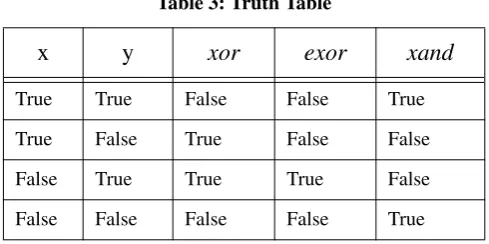
Those functions in italics are generated functions repre-sented as λ abstractions in the programs. They are anony-mous functions in the programs but we provide them with names here for easy reference. The Truth Table for these generatedλ functions is presented in Table 3. Note that those
λ abstractions which computexor might contain very differ-ent code. The values True and False in Table 2 indicate expressions which produce True or False under all condi-tions.
Much research work has asserted that type constraints can reduce the number of ways to construct programs and improve GP performance [Montana, 1995; Haynes, Wain-wright, Sen and Schoenefeld, 1995; Haynes, Schoenefeld and Wainwright, 1996; Clack and Yu, 1997]. [Harris, 1997] used abstraction on user-defined types to enforce a hierarchy in the program parse tree, but in a specialized domain and with the hierarchy defined by the user’s knowledge of that domain: this explicit program structuring method improves
Table 2: Generated Correct Programs
Quantity
Even-N-Parity
22 nor (foldrxor (head L)(tail L)) False
9 foldrxor (nor (head L)(head L)) (tail L)
6 nor (foldrxor (head L)(tail L)) (foldrexor (head L)(tail L))
6 foldrxor (nand (head L)(head L))(tail L)
6 nand (foldr or (head L)(tail L)) (foldrxor (head L)(tail L))
5 nand (foldrxor(head L)(tail L)) True
2 foldrxor (foldrxand (head L)(tail L)) (tail (tail L))
1 nor (foldrxor (head L)(tail L)) (foldrxor (head L) (tail L))
Table 3: Truth Table
x
y
xor
exor
xand
True True False False True
True False True False False
False True True True False
False False False False True
GP performance in his image template matching experi-ments. In this work, type constraints and higher-order func-tions are used in a general context to support structure abstraction and enhance GP performance. It is anticipated that type constraints can assist GP learning in other ways yet to be discovered.
7. Conclusion and Future Work
The structure of λ abstractions and implicit recursion pro-vides GP with an effective mechanism to perform module creation and reuse. This work has demonstrated its power by evolving Even-N-Parity programs. We are continuing the investigation of its applicability to other problems. By incor-porating this mechanism, GP is able to evolve a correct pro-gram by processing far fewer propro-grams than the number required in any previous work. All evolved correct programs are general solutions which work well for any number of inputs. As was outlined in the introduction, three main fac-tors have contributed to this result:
• Module creation is neither a random process nor a prefixed condition. Instead, modules are generated dynamically based on the recursion structures specified in advance by the users. This allows the exploration of beneficial pro-gram structures under the constraints of the users’ specified conditions.
• Implicit recursion provides reuse without the possible side effect of infinite loops since there are no recursion seman-tics present in the program. This not only relieves GP from handling infinite loops in a program but also from measur-ing the semantic elements of recursive programs which would be used in directing genetic operation.
• The structure ofλ abstractions and implicit recursion pro-vides structure abstraction in the program. As the GP para-digm evolves program structure and contents simultaneously, abstraction of structure can reduce the search effort for good program structure. Most evolution-ary effort is then focused on the search for correct program contents rather than the structure.
Further research is being directed in the following areas:
• Evaluation of the performance of a partial application crossover operator according to the type distribution in the program parse trees. Type information plays an important role in the crossover operation since they are used to assure only type-correct programs are generated. The distribution of type in the program parse tree nodes will be analyzed to see how it affects the partial application crossover opera-tor.
Acknowledgments
We like to thank Bill Langdon and Tom Westerdale for their valuable suggestions. We also thank Peter Bentley and Hava Lester for proof-reading this paper.
Bibliography
Angeline, P. J. 1994. Genetic programming and emergent intelligence.Advances in Genetic Programming, Kinnear, Jr., K.E.(ed.), MIT Press, Cambridge, MA, pp. 75-97. Brave, S. 1996. Evolving recursive programs for tree search.
Advances in Genetic Programming II, Angeline, P.J. and Kinnear, Jr., K.E. (eds.), MIT Press, Cambridge, MA, pp.203-219.
Clack, C., Myers, C., and Poon, E. 1995.Programming with Miranda. Prentice Hall International.
Clack, C., and Yu, T. 1997. Performance enhanced genetic programming, Proceedings of the Sixth International Conference on Evolutionary Programming, Angeline, P.J., Reynolds, R., McDonnell, J., and Eberhart, R. (eds.), Springer-Verlag, Berlin, pp.87-100.
Gathercole, C., and Ross, P. 1996. An adverse interaction between crossover and restricted tree depth in genetic pro-gramming. Genetic Programming 1996: Proceedings of the First Annual Conference Genetic Programming. Koza, J.R., Goldberg, D.E., Fogel, D.B., and Riolo, R.L. (eds.), MIT Press, Cambridge, MA. pp. 291-296.
Harris, C. 1997. Strongly typed genetic programming to pro-mote hierarchy through explicit syntactic constraints.Late Breaking Papers at the Genetic Programming 1997 Con-ference. Koza, J. R. (ed.). Stanford University Bookstore, Stanford, CA, pp. 72-80.
Haynes, T.D., Schoenefeld, D.A., and Wainwright, R.L. 1996. Type inheritance in strongly typed genetic program-ming. Advances in Genetic Programming II, Angeline, P.J., and Kinnear, Jr., K.E. (eds), MIT Press, Cambridge, MA, pp. 359-376.
Haynes, T.D., Wainwright, R., Sen, S., and Schoenefeld, D. 1995. Strongly typed genetic programming in evolving cooperation strategies.Proceedings of the Sixth Interna-tional Conference on Genetic Algorithms, Eshelman, L. (ed.), Morgan Kaufmann Publishers, Inc. pp. 271-278. Hudak, P. 1989. Conception, evolution, and application of
functional programming languages.ACM Computing Sur-veys, Vol. 21, No. 3, September, pp. 359-411.
Kinnear, Jr., K. E., 1994. Alternatives in automatic function definition: A comparison of performance.Advances in Genetic Programming, Kinnear, Jr., K.E. (ed.), MIT Press, Cambridge, MA, pp. 119-141.
Koza, J. R. 1992. Genetic Programming: On the Program-ming of Computers by Means of Natural Selection. MIT Press, Cambridge, MA.
Koza, J. R. 1994.Genetic Programming II: Automatic Dis-covery of Reusable Programs. MIT Press, Cambridge, MA.
Koza, J. R., Goldberg, D. E., Fogel, D.B., and Riolo, R.L. editors, 1996. Genetic Programming 1996: Proceedings of the First Annual Conference. MIT Press, Cambridge, MA.
Koza, J. R., Goldberg, D. E., Fogel, D.B., and Riolo, R.L. editors, 1997. Genetic Programming 1997: Proceedings of the Second Annual Conference. MIT Press, Cambridge, MA.
Montana, D. J. 1995. Strongly typed genetic programming.
Evolutionary Computation, Vol. 3:3, pp. 199-230. O’Reilly, U., and Oppacher, F. 1995. The troubling aspects
of a building block hypothesis for genetic programming.
Foundations of Genetic Algorithms, Whitley, L.D., and Vose, M.D. (eds.), Morgan Kaufmann, San Francisco, CA, pp. 73-88.
Rosca, J. P., and Ballard, D. H. 1996. Discovery of subrou-tines in Genetic Programming.Advances in Genetic Pro-gramming II, Angeline, P.J. and Kinnear, Jr., K.E. (eds.), MIT Press, Cambridge, MA, pp.177-201.
Whigham, P. A., and McKay, R.I. 1995. Genetic approaches to learning recursive relations. Progress in Evolutionary Computation, Yao, X. (ed.), Lecture Notes in Artificial Intelligence, Vol. 956, Springer-Verlag, Heidelberg, Ger-many, pp. 17-27.
Wong, M.L., and Leung, K.S. 1996. Evolving recursive functions for the even-parity problem using genetic pro-gramming. Advances in Genetic Programming II, Ange-line, P.J. and Kinnear, Jr., K.E.(eds.), MIT Press, Cambridge, MA, pp.222-240.
Wong, M.L., and Leung, K.S. 1997. Evolutionary program induction directed by logic grammars.Evolutionary Com-putation, Vol. 5:2, pp. 143-180.