Themed Section: Science and Technology
Comparison of Optimization Path Using Transportation
Problem and Game Theory
A. Fathima Mubeen*1, Dr. A. Senthil Rajan21MPhil Scholar, Department of Computer Science, Alagappa University, Karaikudi, Tamil Nadu, India
2Director of Computer Centre, Alagappa University, Karaikudi, Tamil Nadu, India
ABSTRACT
The current technique for tackling transportation issue is northwest corner strategy, slightest cost strategy, Vogel’s estimate strategy. The improvement forms in arithmetic, software engineering and financial aspects are explaining adequately by picking the best component from set of accessible choice components. The most critical and fruitful applications of the optimization technique refers to transportation issue (TP) and extraordinary class of the direct programming (LP) in the task explore (OR). The primary target of transportation issue arrangement techniques is to limit the cost or the season of transportation. In game theory, diversion hypothesis has seen fabulous triumphs in transformative science and financial aspects, and is starting to upset different orders from brain research to political science. The problems are having either saddle point or without saddle point. A new method is proposed to compare transportation problem and game theory.
Keywords: Transportation Problem, Game Theory, Saddle Point, Optimal Solution.
I.
INTRODUCTIONTransportation problem is a linear programming problem and has three methods. To find the initial basic feasible solution of balanced transportation problems are northwest corner method, least cost method, Vogel’s approximation method. The above methods are efficient to give an optimal solution. This type of problem can be solved for a general network. Transportation model is used in the following ways:
To decide the transportation of new material
from various centers of different manufacturing plan.
To decide the transportation of finished goods
from different manufacturing plan for the different distribution centers.
These two are the uses of transportation model. The objective is minimizing transportation cost. Game theory is the study of models of conflicts and
cooperating between intelligent rational decision makers. Game theory has 3 types of decision making situations such as deterministic situation, probabilistic situation, uncertainty situation. The minimum value of each row and maximum value of each column in the particular approach can be chosen that maximizes the minimum gains. This is called the maximin value of the game. The same approach is used to minimize the maximum losses. If the maximin value equals the minimax value then the game is said to have a saddle point. The corresponding strategies are called optimum strategy. The amount of a payoff from an equilibrium point is known as the value of the game.
II.
RELATED WORKissue, which can be illuminated by the simplex technique. As a result of its extremely extraordinary scientific structure, it was perceived early that the simplex strategy connected to the transportation issue can be made very proficient as far as how to assess the vital simplex-technique data. Charnes et al(1954) built up the stepping stone method which gives an elective method for deciding the simplex-technique data.
Dantzig(1963) utilized the simplex technique in the
transportation issue as the primal simplex
transportation strategy. an underlying fundamental practical answer for the transportation issue can be gotten by utilizing the north west corner run, row minima, column minima, matrix minima, or the vogel's estimate strategy.
Ashram et al (1989) presented another calculation for taking care of the transportation issue. The proposed technique utilized just a single task, the gauss Jordan rotating strategy, which was utilized as a part of simplex technique. The last table can be utilized for the post optimality investigation of transportation issue. This calculation is quicker than simplex, broader than venturing stone and fewer complexes than both in taking care of general transportation issue.
III.
PROPOSED METHODThe proposed work is to find the optimal value for both transportation problem and game theory in balanced problem. In transportation problem, three methods are used such as northwest corner method, least cost method, Vogel’s approximation method. Terminology used in the transportation model is
Feasible solution: itsatisfies the constraints of
supply and demand is called feasible solution.
Basic feasible solution:Numbers of positive
allocations are (m+n-1).
Optimal solution:it minimizes the total
transportation cost.
Balanced transportation problem:
atransportation problem in which the total supply from all sources is equal to the total demand in all the destinations.
Unbalanced transportation problem: problems
which are not balanced
Matrix terminology: in the matrix, the squares
are called cells and form columns vertically and rows horizontally.
Degenerate basic feasible solution: if the number
of allocation in basic feasible solutions is less than (m+n-1).
Northwest corner method: It is to compute a basic feasible solution, where the basic variables are selected from northwest corner. The major advantage is very simple and easy to use.
Procedure:
Allocate as much as possible to the cell in the
upper left hand corner, supply and demand conditions.
Allocate as much as possible to the next adjacent
feasible cell.
Repeat step two until all rim requirements are
met.
Table 1
19 30 50 10
70 30 40 60
40 8 70 20
Total supply = total demand = 34
Table 2
19 30 50 10
70 30 40 60
40 8 70 20
5
2
6
3
Total cost = 19*5 + 30*2 + 30*6 + 40*3 + 70*4 + 20*14 = 95 + 60 + 180 + 120 + 280 + 280
Total cost = 1015
Least cost method: Network least technique is processing an essential doable arrangement of a transportation issue where the fundamental factors are picked by the unit cost of transportation. The minimum cost method finds a better starting solution by concentrating on the cheapest routes.
Procedure:
Identify the box having minimum unit
transportation cost( Cij ) .
If there are two or more minimum cost, select
the row and column corresponding to the lower numbered row.
If they appear in this same row, select the
lower numbered column.
Select the value coincide with Xij extremely
area to the supply and demand constraints.
If demand is satisfied , delete the column .
If supply is exhausted , delete the row.
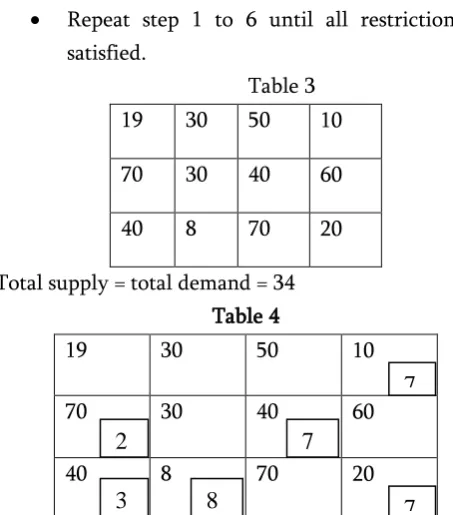
Repeat step 1 to 6 until all restriction are
satisfied.
Table 3
19 30 50 10
70 30 40 60
40 8 70 20
Total supply = total demand = 34 Table 4
19 30 50 10
70 30 40 60
40 8 70 20
Total cost = 10*7 + 70*2 + 40*7 + 40*3 + 8*8 + 20*7 = 70 + 140 + 280 + 120 + 64 + 140
Total cost = 814
Vogel’s approximation method: This technique is an enhanced adaptation of the minimum cost strategy that by and large however not generally creates better beginning solutions.it depends on the idea of limiting open door costs for a given supply line or request section is characterized as the contrast between the most reduced cost and the following least cost elective.
Procedure:
The given transportation issue in unthinkable
shape.
Compute the contrast between the base cost
and the following least cost comparing to each line and every section is known as punishment cost.
Choose the greatest difference. Suppose it
compares to the ithrow. Choose the cell with
least cost in the ithrow. Again if the most
extreme relates to a column, choose the cell with the base cost in this section.
Suppose it is(I,j)th cell. Allocate min (ai,bj) to
this cell. If the min(ai,bj) to this cell. If the
min(ai,bj)=ai, then the availability of the ith
origin is exhausted and demand at the jth
destination remains as bj – ai and the ith row is
deleted from the table. If min(ai,bj)=bj, then the demand and the jth destination is fulfilled
and the availability at the ith origin remains to
be ai-bj and jth column is deleted from the table.
Rehash stages 2, 3, and 4 with the staying
table until the point that all inceptions are depleted and all requests are satisfied.
Table 5
19 30 50 10
70 30 40 60
40 8 70 20
Total supply = total demand =34
7
2
7
Table 6
19 30 50 10
70 30 40 60
40 8 70 20
Total cost = 5*19 + 10*2 + 40*7 + 60*2 + 8*8 + 20*10 = 95+20+280+120+64+200
Total cost = 779
In game theory, to finding the initial basic feasible solution of balanced problem. The solution having saddle point or not. Terminology is used in game theory:
Game: Any arrangement of conditions that
has an outcome reliant on the activities of two of more chiefs (players).
Players: A strategic decision-maker within
the context of the game.
Strategy: An entire arrangement of move a
player will make given the arrangement of conditions that may emerge inside the diversion.
Payoff: The payout a player receives from
arriving at a particular outcome.
Information set: The data accessible at a
given point in the amusement. The term data set is most generally connected when the amusement has a successive part.
Equilibrium: The point in a game where both
players have made their decisions.
Procedure:
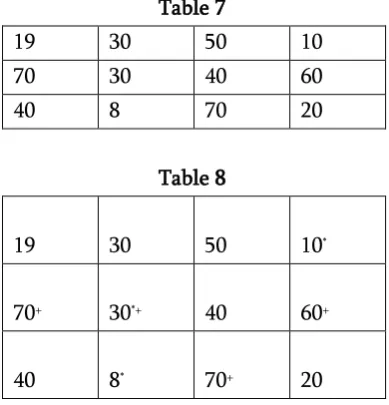
Select the minimum element of each row(*).
Select the maximum element of each
column(+).
Marked (*) and (+) both the position of the
element is a saddle point.
Table 7
19 30 50 10
70 30 40 60
40 8 70 20
Table 8
19 30 50 10*
70+ 30*+ 40 60+
40 8* 70+ 20
Row minima = column maxima = 30 The given problem is a saddle point. Value of the saddle point = 30.
IV.
CONCLUSION
This paper introduces a new concept of Linear programming problems to find the solution of transportation problem can be solved with three different methodologies are northwest corner strategy, minimum cost strategy, Vogel’s approximation strategy. These three methods are given different types of solutions in balanced problem. Compared with the transportation problem and game theory, the problem can be given the best optimal solution by using game theory.Game theory provides the value of the saddle point.
V.
REFERENCES
[1]. Andersion.R.D,Sweeney.J.D,
Williams.A.T&Martin.K.R (2010). : An
introduction to Management Science:
Quantitative Approach to Decision.
[2]. Amponsah S.K (2008), Optimization Technique.
[3]. Eykhoff, (1974): System Identification:
Parameter and State Estimation
5
2
8
7
2
[4]. Kumar.T, and Schilling S.M (2010). : Comparison of optimization Technique in large scale Transportation Problem
[5]. Sweeney J. D, Anderson R, Williams T.A, Camm
D.J (2010), Quantitative Methods for Business.
[6]. Erlander S.B (2010) Cost-Minimizing Choice
Behavior in Transportation Planning: A Theoretical.
[7]. Aguaviva.E(1997).: Quantitative Techniques in
Decision Making 97 Ed.
[8]. Abdur Rashid, An effective approach for solving
transportation problems, Jahangirnagar J.
Mathematics and Mathematical Sciences.
[9]. R.K.Aminur,Analysis and resolution of the
transportation problem: an algorithmic
approach, M.Phill. Thesis,Dept. of Mathematics, Jahangirnagar University, 2012.
[10]. R.K.Aminur, A resolution of the transportation