In Wayne D. Gray and Christian D. Schunn, editors, Proceedings of the 24th Annual Confernce of the Cognitive Science Society, pages 190-195, Erlbaum, 2002
Second Order Isomorphism: A Reinterpretation and Its Implications in
Brain and Cognitive Sciences
Yoonsuck Choe ([email protected])
Department of Computer ScienceTexas A&M University 3112 TAMU
College Station, TX 77843-3112
Abstract
Shepard and Chipman’s second order isomorphism de-scribes how the brain may represent the relations in the world. However, a common interpretation of the theory can cause difficulties. The problem originates from the static nature of representations. In an alternative interpre-tation, I propose that we assign an active role to the inter-nal representations and relations. It turns out that a col-lection of such active units can perform analogical tasks. The new interpretation is supported by the existence of neural circuits that may be implementing such a function. Within this framework, perception, cognition, and motor function can be understood under a unifying principle of analogy.
Introduction
One of the central tenets in neuroscience is that neu-rons receive incoming spikes, process that spatial or temporal information, and then pass on the transformed information for further analysis. Also, neurons that fire together develop strong connections (Bliss and Collingridge 1993). Thus, the neurons represent features in the input, and connections encode relational context among features. This viewpoint is analogous to the sec-ond order isomorphism by Shepard and Chipman (1970; below, just S&C). However, a problem can arise depend-ing on how we interpret S&C’s theory.
The difficulty comes from the static role assigned to representations. In this paper, the representations and the relations are given an active role. When working as a collection, these active units can perform an ana-logical function. In fact, a similar active approach has been employed in previous work, resulting in the emer-gence of analogical (Hofstadter 1985; Mitchell 2001) or metaphorical (Narayanan 1999) functionality.1 An im-portant observation advanced in this paper is that the function of active representations and relations are very similar to that of neurons, and specific circuits in the cortex and the thalamus can actually implement analogi-cal functions. Analogy is commonly attributed to higher cognitive faculties only, but it does not always have to be the case (Chalmers et al. 1992); it may be part of a larger set of human brain function including perception and motor function. I will discuss in the end how such an
1
Analogy and metaphor are closely related in that they refer to similarities in relations and attributes although the relative degree in each may differ (Gentner 1989).
World
Brain
representation
representation
relation relation
W1
B1
B3 B2
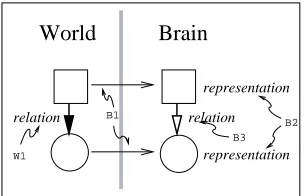
Figure 1: S&C’s Second Order Isomorphism. There are two objects, one square and one round in the world (on the left). The internal representations in the brain of these two ob-jects are shown on the right. The vertical arrows represent the relations between the objects. The two horizontal arrows repre-sent mapping from the world to the brain which is initiated by sensory transduction. Note: The square and circle on the right (in the brain) are just there for the ease of reference. They can be removed without causing any change in content (this applies to the rest of the figures).
analogical framework can allow us to better understand the nature of cognition and brain function.
Common Interpretations
Under second order isomorphism the brain needs to find the relation between the (1) relations between external objects and (2) relations between internal representations (figure 1). S&C’s theory seems to be more appropri-ate in modeling how our brain represents the world than Locke’s Isomorphism (Edelman 1998, 1999). In physical terms, we can interpret the figure as follows: (1) relation in the world (W1; coincidences in sensory events) (2) ar-rows from world to brain (B1; sensory transduction), (3) representations in the brain (B2; afferent connections), and (4) relation in the brain (B3; lateral connections). Of these, let us focus on what is available in our brain (B1– B3). If we take for granted the information our sensory transducers tell us, we can drop B1 from our discussion and focus on just B2 and B3.
World Brain
relation
representation
representation relation compare
World
Brain
representation
representation
relation representation
(of relation)
( ) Interpretation (I). (
) Interpretation (II).
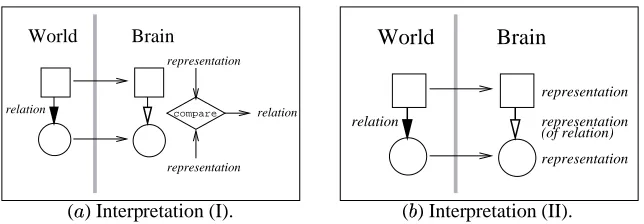
Figure 2: Common Interpretations of Second Order Isomorphism. ( ) An explicit comparison mechanism is necessary to
judge the relations between the two representations. () The comparison box is replaced by a representation of relation. However,
this figure still requires a third-party to evaluate the representation of relation.
judging the output relation in the lower areas). However, as Hilgetag et al. (1996) noted, it is hard to determine a strict hierarchy among cortical maps (in this case, be-tween visual areas). Also, as Zeki (2001) suggests, in-tegration of these information may be a nonhierarchical process. Thus, representing something and delaying the interpretation until later may not work very well.
One can argue that the lateral connections represent the similarity relation, not requiring a separate interpreter (figure 2
). However, we still need something to evalu-ate (or interpret) the resulting representation. Thus, this reformulation just replaces the need for one kind of in-terpreter with another.
Assigning an Active Role to Relation
What can a relation be if it should not be a representa-tion? The problem seem to come from representations and relations playing a static role. What if we assign an active role to the representations as shown in figure 3 ? In the figure, I assigned an active role to the relation ar-row itself, allowing one representation to invoke another. Thus the activation of the internal representation of the square invokes (or turns on) that of the circle, and vice versa.
Now consider how can we use this new active relation (note that it is directional) to describe the relations in the world. First, we have to know what kinds of relations exist in the world. There are two basic relations: spatial and temporal relations. Spatial relations are between ob-jects, and they are causally bidirectional.2 On the other hand, temporal relations are between events, and they are causally directional. When one event precedes the other, the reverse cannot happen simultaneously.
In the brain, action potentials only propagate in one direction along the axon, and the adaptation of synapses tend to learn causality (Song et al. 2000). Such connec-tions are ideal for implementing temporal relaconnec-tions, but what about spatial relations? If we pair a unidirectional arrow from A to B with a reciprocal one from B to A, then we can indeed represent spatial relations with only directional arrows. If representations for object A and B simultaneously activate through mutual excitation, then
2Note that causal simply means that one event precedes the
other in time.
they can represent the spatial relation between the two. So, let us update our figure again to include backward re-lational arrows (figure 3
). We can now think in terms of
temporal relations only, because spatial relations seems
to be a special case of temporal relations (at least in the brain).
The Role of Active Relations and its Neural
Basis
In the previous section, I replaced the representation for relation by an active relation. What about the represen-tations for the objects (or events)? Representation is an inherently static term (like a symbol), thus, we should take a more active viewpoint and ask what action occurs when a neuron detects a pattern in its incoming input, rather than focusing only on what a neuron represents. Knowing what representations do may be as important as knowing what they stand for.
To discover the relationship between things in the world, we need the motor capabilities as much as we need sensors. Thus, between the world and the brain there must be a backward arrow from the brain to the world. The resulting diagram is shown in figure 3 . This addition is crucial in learning the relations in the world (O’Regan and Noe 2001). The final diagram looks very similar to the basic circuitry in our brain. How can this final figure help us understand the mechanisms of the brain? The key is to understand what is the action taken by a neuron, no less than to know what it represents.
Active Relations: A Primitive for Analogical
Processing
Now we have a single active functional unit: a neuron that fires a spike along the active relational arrow as soon as it detects a certain input feature. This unit alone cannot achieve much, neither can a serial chain of such units. The true power of this simple unit is revealed when it is used in a massively parallel way. This may be an obvious line of thought because that is what our brains seem to do. However, it turns out that the collective effort of these simple units can embody a simple yet powerful function of analogy.
World Brain
relation
representation
representation INVOKE
INVOKE
World Brain
relation
representation
representation INVOKE
Neocortex
Sensor Sensor
Motor Neuron
relation INVOKE
Brain World
INVOKE
( ) Active Relations (I) (
) Active Relations (II) () Neural Counterparts
Figure 3:A New Interpretation of Second Order Isomorphism. ( ) In this new interpretation of S&C’s theory, an active role
is assigned to the relation arrow. Notice that the INVOKE arrow is a single arrow, not one arrow going into and another leaving out of the box. Thus, the rounded box signifies that the arrow actually performs an action. ( ) Backward relational arrows are added
in the brain to account for the mutual, but directional nature of relations. With two relational arrows, both spatial and temporal relations can be implemented. () The neural counterparts of ( ) are shown. The limiting term representation is removed, and the
motor reaction (backward arrow from the brain to the world) is added. Sensory transducers are also explicitly shown.
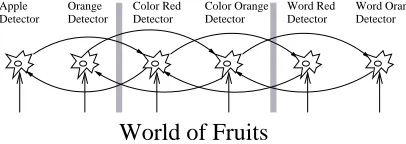
of fruits (figure 4). After the fruit brain experiences the world of fruits, it will learn the co-occurrences between features and establish relational arrows as shown in the figure (arcs with arrows). Also suppose that the brain is partitioned into several specialized map areas (or par-titions), as in cortical maps. Now suppose apple ,
orange , and word-red were presented to the crea-ture simultaneously. If we track the activation, we can see that these detectors will turn on: apple detector, orange detector, color-red detector, color-orange detec-tor, and finally, word-red detector. These activations are
input-driven. Because the neurons are active, as soon as
they detect what they are familiar with, they send out sig-nals through the relational arrows horizontally across the cortex. As a result of this second order activation, the word-orange detector turns on, even without input. Now, here is the crucial moment. We can ask this question:
which neuron’s firing was purely cortically-driven? (note
that we can view this as a filtering process). The re-sult of the filtering is then word-orange . The sig-nificance of this observation is that this process is very similar to solving analogical problems. The input pre-sented to the creature is basically an analogical query:
apple : orange = word-red : ? . The filtered cortical response word-orange can then be the
an-swer to this query.3 Thus, active neurons can perform a rudimentary analogical function when the responses are filtered properly.
However, things can get complicated when combi-nations of objects are used as a query. Let us ex-tend the creature’s feature detectors to include con-cepts of small and big (not shown in the figure). Then we can allow the creature to learn the re-lations again. We can then present an analogi-cal query like this: big apple : small apple = big orange : ? . In this case, if we follow the same steps as above we come across a problem. Be-cause the answer we expect (i.e. small orange ) already appeared in the query, if we look for purely
3
There is an issue of how the presence of word-red can
affect the outcome at all. This problem will be discussed later in the discussion section.
Apple Detector
Orange Detector
Color Red Detector
Color Orange Detector
Word Red Detector
Word Orange Detector
World of Fruits
Figure 4: World of Fruits. A brain with object, color, and word detector neurons is shown. The six neurons each respond to these input features as labeled above. At the bottom is the fruit world, and the thick vertical arrows represent afferent in-put. The horizontal arcs are the relational arrows that point to their most frequently co-occurring counterparts that have been learned through experience. The gray vertical bars represent the partitioning of the brain into separate map areas (from the left to right, object map, color map, and word map). Note that for simplicity, the word-orange detector connects only to the color-orange detector, but not the orange detector, i.e. it is a word-color-orange detector, not a word-object-orange detector.
cortically-driven activations, the answer will be word-red word-orange . However, we can overcome this problem if we ask: what are the most cortically-driven
activities in each partition of the brain? Because big and apple appeared in the input twice but small and orange appeared only once, the latter two can be selected, as well as the purely cortically driven ac-tivities listed above. Thus, even for derived acac-tivities that are input-driven, those that are less input-driven can survive and the correct analogical response can still be found among such activities that are more cortically-driven within each partition (or area). Note that color-orange also survives the filtering, but what is more im-portant here is that a simple filtering process as described above can generate a small subset of potential answers to analogical queries. Although the simple analogical query presented above has a straight forward answer, in more complex analogical problems, there can be multi-ple answers depending on the interpretation (Hofstadter and Mitchell 1994; Mitchell 2001).
In this section, I have shown that active neurons that detect input features and establish relational contexts can collectively perform a rudimentary analogical function.4
4Analogical tasks can become much more complex than the
Activation Subsequent
INPUT=0 INPUT=1
nucleus reticularis thalami
1
C1 C2
C4 C3
CORTEX
R1
R2
T1 T2
WHITE MATTER
1
0
I1 I2
input
present no inputpresent
Thalamus 1
1
1 −2
1
1 −1
1 1
0
NEW QUERY
nRt
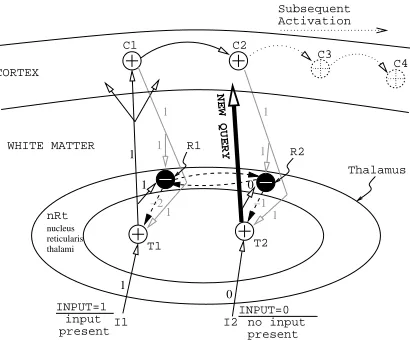
Figure 5: Analogical Filtering in the Thalamus. The dia-gram shows a simplified thalamo-cortical loop that can perform analogical completion and selection and then propagate the se-lection back to the cortex. All connections shown are based on known anatomy of the thalamus and the cortex (Mumford 1995). I1 and I2 are input fibers, T1 and T2 are thalamic re-lay cells, and R1 and R2 are inhibitory nRt cells. C1, C2, C3, and C4 are cortical neurons (each is a set of neurons ranging multiple layers in a single cortical column). The neurons are either excitatory (+) or inhibitory (–), and the arrows are axons (pointing in the direction of action potential propagation). The numbered labels on each arc show the activity being carried. Black solid arrows are ascending fibers to the cortex and the cortico-cortical connections (relational arrows), and gray solid arrows are cortico-thalamic feedback. Black dashed arrows are inhibitory connections. The diagram shows a scenario when an input was presented to C1, which excites C2, and in turn gener-ates the feedback from C2 to T2, which is then retransmitted to the cortex as a new query (ascending thick black arrow). The selection decision for further propagation to the cortex depends on the relative excitation and inhibition T1(T2) receive from C1(C2) and R1(R2). On the right of C2 (dotted) in the cor-tex is the subsequent cascade of analogical completions. Note that to avoid clutter, reciprocal connections in the cortex are not shown.
But does the brain function in such a way? In fact, an exact circuit that may be implementing such a function exists in the brain.
Neural Basis of Analogical Completion and
Filtering
Two basic mechanisms are needed to account for the pro-posed analogical function: completion and filtering. Be-low, I will discuss how the cortico-cortical connections and the thalamo-cortical loop can implement these two mechanisms.
Completions may be accomplished by the long-range cortico-cortical connections (Mumford 1992). As men-tioned earlier, synapses are strengthened when the presy-naptic activity precede postsypresy-naptic activity (Song et al. 2000), thus the connections can implement causal rela-tions. Also, specific patterns of connections observed in animals (e.g. visual cortex of monkeys; Blasdel 1992) show how such patterns can implement specific com-pletion functions. Computational models also showed
to clearly illustrate the basic mechanism.
how such patterns can encode feature co-occurrence and how they can dictate the performance of the model (Choe 2001; Geisler et al. 2001).
For filtering, a separate mechanism is necessary. In the thalamo-cortical loop, there exists a massive feed-back from the cortex to the thalamus and an inhibition mechanism within the nucleus reticularis thalami (nRt) on the surface of the thalamus (Mumford 1995). This particular architecture has been thought to be involved in the analysis and synthesis of new memories (MacKay 1956), active blackboard (Harth et al. 1987; Mumford 1995), global workspace (Newman et al. 1997), and fi-nally, generating attention and consciousness (Crick and Koch 1990). It turns out that these feedforward and feed-back connections from nRt to the cortex together with the nRt inhibitions can filter the feedback from the cor-tex to promote the most cortically-driven feedback, i.e. the analogical answers. Let us first see how the purely cortically-driven activities are selected (figure 5). In the thalamus, ascending fibers (T1 to C1) branch out and excite the inhibitory nRt neuron R1 (T1 to R1). When the feedback from C1 to T1 comes back, it branches and stimulates R1. As a result, if the descending feedback had a matching ascending signal, the inhibition T1 re-ceives is twice as high as other neurons in the thalamus that are activated by purely cortically-driven feedback (i.e. that of T2). If the synaptic weights are appropriate
(i.e. and )
5, at T1 the feedback will
cancel out, but at T2 the feedback will survive the inhi-bition and be retransmitted to the cortex (the new query arrow). Such a surviving cortical feedback, together with the input stimulus at the next moment form a new ana-logical query to the cortex, and the same process is re-peated. That is, C2 elicits activities in C3, and in turn C4 through the thalamo-cortical loop (note that they can be quite far away). For the selection of the most cortically
driven feedback, the mutual inhibitions in the nRt layer
(e.g. between R1 and R2) may disinhibit (inhibiting an inhibitory neuron results in less net inhibition at the tar-get; figure 5) each other and allow the more cortically driven feedback to go back to the cortex, even when all current cortical activities are input driven.
Discussion
The neural mechanisms described in this paper can only account for simple kinds of analogies, and in some case it can even seem as simple pattern completion. For ex-ample, orange = ? will result in the same answer
word-orange as in the Active Relations:... section. How can the term word-red in the original query af-fect the outcome at all? For this, I believe that among many possible completions, the general map area (i.e. the partitions in figure 4) that are activated by input gets higher preference. In this example, the fruit-map, word-map and color-word-map will turn on, thus purely cortical ac-tivations in other general maps (say odor-map, etc.) will not be as salient as that of word-orange . Thus, in this
5Here,
is the synaptic connection strength from neuron
way, the presence of word-red can indeed affect the outcome of the analogical query. A more precise neu-ral mechanism for this kind of selection among areas (or maps) needs to be investigated further.
Researchers regard the analogical capability as the crux of high-level cognition (see Gentner et al. 2001 for a collection of current work on analogy). However, anal-ogy does not need to be limited to high-level cognition. Recent results suggest that analogy may be needed in perception as well (Morrison 1998), and such an abil-ity emerging in perceptual systems may even be a crucial
requirement for cognitive development (Chalmers et al.
1992). Then it is not unthinkable that motor function also employ analogy in a similar manner (cf. sensory motor contingency theory by O’Regan and Noe 2001), thus we can then start to understand perception, cognition, and motor function under the unifying framework of analogy. How can such a diverse functionality be integrated un-der a single framework of analogical processing? Mas-sive connections exist within and across different func-tional areas in the brain, and the sensory/motor maps are topologically organized, i.e. nearby neurons are re-sponsive to nearby features in the sensory space (Koho-nen 1982; von der Malsburg 1973). Within each map, the feature detectors and the cortico-cortical connections learn to encode the relations (Choe 2001). It is possi-ble that cognitive maps also have a topological organiza-tion where nearby areas learn to encode similar concepts, such as semantic maps or episodic memory maps (Miik-kulainen 1993). When the sensory, cognitive, and motor maps are connected in an orderly way preserving their local topology, analogies can be drawn within and (more importantly) across different functional domains.
Within this huge number of maps specializing in dif-ferent tasks, a cascade of multiple analogical comple-tions can be going on in parallel, synchronized at each moment by the 40Hz rhythm to hold an instantaneously coherent state (Gray 1999; Mumford 1995). Such a state can then pose as another analogical query, and the pro-cess can repeat. When the cascade reaches a motor area, behavior will be generated. Memory content may also enter the analogical cascade, and this quasi-static con-tribution can prevent the continuously changing input stream from causing random cascades, thereby main-taining a more goal-directed and stable behavior. Spe-cific mechanisms of how the memory content enters the thalamo-cortical loop, and how analogies are archived in long-term memory should be studied further.
Neuroscience research has revealed a lot about percep-tion and motor abilities in the brain, but understanding the cognitive faculty still remains elusive. Investigation into cognitive functions can proceed under the analogi-cal framework, where we can infer the functionality of the higher areas by backtracking the connections to the perceptual and motor areas and study their topology and analogical links. Specific predictions regarding the lay-out of the higher centers may be made based on the topol-ogy of the lower centers and the connection structure be-tween the two, and experiments can then focus on
verify-ing these predictions. For example, there are orientation maps with smoothly changing orientation preference in V1 (primary visual cortex; Blasdel 1992), and there are object maps in TE (temporal area E; Tanaka 1996) that also change smoothly (for example, rotation of a head). The analogical framework predicts that there will be an orderly mapping from V1 to TE that preserve such local topology across different representation spaces.6 Simi-lar mappings may exist between sensory and cognitive areas, and if such a mapping is found, we can start to un-derstand the abstract cognitive functions based on con-crete perceptual architecture.
The strong connection made in this paper between analogical function and specific neural circuitry can help us better understand both. The functionality of the target area of a neuron can be studied to understand what
ac-tion occurs when a neuron detects a certain feature in the
input. Such a study can reveal the kinds of relations im-plemented in the brain, thus providing us with insights into what kinds of analogies are possible. The mecha-nisms of neural circuits can also be further revealed by carefully designed analogical tests in perception, cogni-tion, and motor funccogni-tion, and also in a combination of these different domains. Different types of unimodal and cross-modal analogical tasks can reveal how the different cortical areas are related and how they invoke each other. In studying such mappings across tasks and modalities, understanding the co-occurrence statistics of natural sig-nals becomes increasingly important as they may give us a hint on how the connections are organized in the brain (Choe 2001; Simoncelli and Olshausen 2001).
Conclusion
In this paper, I analysed the difficulties that the common interpretations of S&C’s second order isomorphism can cause in understanding the brain. I proposed an active role for representations and relations, and it turned out that collectively they can perform an analogical
tion. An important connection between analogical
func-tion and a specific brain circuit was then established, pro-viding support for the new interpretation. This new view-point allows us to understand perception, cognition, and motor function under a unifying framework of analogy, and it can help us take a more focused approach in brain and cognitive sciences.
Acknowledgments
I am greatly indebted to Sang Kyu Shin, James Bed-nar, Risto Miikkulainen, Un Yong Nahm, Marshall May-berry, Bruce McCormick, and Jyh-Charn Liu for their feedback and encouragement. I would also like to thank the anonymous reviewers for their helpful comments and pointers. This research was supported in part by Texas A&M University, and the Texas Higher Education
Coor-6
dinating Board ARP/ATP program under grant #000512-0217-2001.
References
Blasdel, G. G. (1992). Orientation selectivity, prefer-ence, and continuity in monkey striate cortex. Journal
of Neuroscience, 12:3139–3161.
Bliss, T. V. P., and Collingridge, G. L. (1993). A synap-tic model of memory: Long-term potentiation in the hippocampus. Nature, 361:31–39.
Chalmers, D. J., French, R. M., and Hofstadter, D. R. (1992). High-level perception, representation, and analogy. Journal of Experimental and Theoretical
Ar-tificial Intelligence, 4:185–211.
Choe, Y. (2001). Perceptual Grouping in a Self-Organizing Map of Spiking Neurons. PhD thesis,
De-partment of Computer Sciences, The University of Texas at Austin, Austin, TX. Technical Report AI01-292.
Crick, F., and Koch, C. (1990). Towards a neurobiolog-ical theory of consciousness. Seminars in The
Neuro-sciences, 2:263–275.
Edelman, S. (1995). Representation, similarity, and the chorus of prototypes. Minds and Machines, 5:45–68. Edelman, S. (1998). Representation is representation of
similarities. Behavioral and Brain Sciences, 21:449– 498.
Edelman, S. (1999). Representation and Recognition in
Vision. Cambridge, MA: The MIT Press.
Geisler, W. S., Perry, J. S., Super, B. J., and Gallogly, D. P. (2001). Edge Co-occurrence in natural images predicts contour grouping performance. Vision Re-search. 711–724.
Gentner, D. (1989). The mechanisms of analogical learn-ing. In Vosniadou, S., and Ortony, A., editors,
Simi-larity and Analogical Reasoning, 199–241. New York,
NY: Academic Press.
Gentner, D., Holyoak, K. J., and Kokinov, B. N., editors (2001). The Analogial Mind: Perspectives from
Cog-nitive Science. Cambridge, MA: The MIT Press.
Gray, C. M. (1999). The temporal correlation hypothe-sis of visual feature integration: Still alive and well.
Neuron, 24:31–47.
Harth, E., Unnikrishnan, K. P., and Pandaya, A. S. (1987). The inversion of sensory processing by feed-back pathways: A model of visual cognitive functions.
Science, 237:184–187.
Hilgetag, C.-C., O’Neill, M. A., and Young, M. P. (1996). Indeterminate organization of the visual sys-tem. Science, 271:776.
Hofstadter, D. (1985). Waking up from the boolean dream, or, subcognition as computation. In
Metamag-ical Themas, chapter 26. New York, NY: Basic Books.
Hofstadter, D. R., and Mitchell, M. (1994). The copy-cat project: A model of mental fluidity and analogy-making. In Holyoak, K. J., and Barnden, J. A., editors,
Advances in Connectionist and Neural Computation Theory. Norwood, NJ: Ablex Publishing Corporation.
Kohonen, T. (1982). Self-organized formation of topo-logically correct feature maps. Biological
Cybernet-ics, 43:59–69.
MacKay, D. (1956). The epistemological problem for au-tomata. In Shannon, C. E., and McCarthy, J., editors,
Automata Studies, 235–251. Princeton, NJ: Princeton
University Press.
Miikkulainen, R. (1993). Subsymbolic Natural Lan-guage Processing: An Integrated Model of Scripts, Lexicon, and Memory. Cambridge, MA: MIT Press.
Mitchell, M. (2001). Analogy-making as a complex adaptive system. In Segal, L., and Cohen, A., editors,
Design Principles for the Immune System and Other Distributed Autonomous Systems, to appear.
Morrison, C. T. (1998). Situated Representation: Solving
the Handcoding Problem with Emergent Structured Representation. PhD thesis, Bringhamton University;
State University of New York.
Mumford, D. (1992). On the computational architecture of the neocortex, pt. II, the role of the cortico-cortical loop. Biological Cybernetics, 65:241–251.
Mumford, D. (1995). Thalamus. In Arbib, M. A., editor,
The Handbook of Brain Theory and Neural Networks,
153–157. Cambridge, MA: MIT Press.
Narayanan, S. (1999). Moving right along: A compu-tational model of metaphoric reasoning about events. In Proceedings of the National Conference on
Artifi-cial Intelligence (AAAI ’99, Orlando, FL), 121–128.
AAAI Press.
Newman, J., Baars, B. J., and Cho, S.-B. (1997). A neu-ral global workspace model for conscious attention.
Neural Networks, 10:1195–1206.
O’Regan, J. K., and Noe, A. (2001). A sensorimotor ac-count of vision and visual consciousness. Behavioral
and Brain Sciences, 24(5):883–917.
Shepard, R. N., and Chipman, S. (1970). Second-order isomorphism of internal representations: Shapes of states. Cognitive Psychology, 1:1–17.
Simoncelli, E. P., and Olshausen, B. A. (2001). Natu-ral image statistics and neuNatu-ral representation. Annual
Review of Neuroscience, 24:1193–1216.
Song, S., Miller, K. D., and Abbott, L. F. (2000). Competitive hebbian learning through spike-timing-dependent synaptic plasticity. Nature Neuroscience, 3:919–926.
Tanaka, K. (1996). Inferotemporal cortex and object vi-sion. Annual Review of Neuroscience, 19:109–139. von der Malsburg, C. (1973). Self-organization of
orientation-sensitive cells in the striate cortex.
Kyber-netik, 15:85–100.