Licensed under Creative Common Page 440 http://ijecm.co.uk/
EFFECT OF INFORMATION ASYMMETRY ON BORROWING
COST AMONG MICRO-FINANCE CLIENTS IN KENYA
E. N. Muli
Certified Public Accountant, Kenya [email protected]
W. M. Muli
University Lecturer, Kenya [email protected]
Abstract
Money and credit are the lifeblood of an economy. The ability of borrowers to access credit at
reasonable terms is critical to facilitate investment and commerce, and thereby sustain
economic growth. The poor still find it difficult to access finances from MFIs because of the fairly
high cost of loans. Most microfinance clients are information opaque and this partly explains the
high risk premium attached to lending hence higher interest rates. Accordingly, the purpose of
this study was to find out the effect of information asymmetry on the cost of borrowing among
microfinance clients. Specifically, the study sought to find out: effect of credit history on the cost
of borrowing; effect of soft information on the cost of borrowing; and, effect of borrower proximity
on the cost of borrowing. The study employed a descriptive survey design. This research relied
purely on primary data which was collected using a structured questionnaire. Both descriptive
and inferential statistics were used for data analysis. A multiple regression model was used to
estimate the relationship between information asymmetry and cost of borrowing. The study
findings show that borrower credit history and soft information are significant influencers of
borrowing cost among microfinance borrowers in Kenya. Favourable borrower credit history and
soft information have a favourable effect of reducing the borrower cost of borrowing among
microfinance borrowers in Kenya. However, the study also concludes that in the Kenyan context
borrower proximity has no effect on the cost of borrowing among microfinance borrowers in
Licensed under Creative Common Page 441
distance of the borrower from the MFI when evaluating a loan application. The study
recommends that microfinance institutions in Kenya should leverage borrower credit history and
soft information to mitigate information asymmetry challenges. This practice will also be
beneficial to the borrowers who possess good credit history standing and positive soft
information. By extension this will make the bottom of the society (microfinance clients) to
access credit at favourable terms. In turn, this will have a positive impact on the economy by
mainstreaming the poor into economic participation through affordable credit which can be used
to finance business operations sustainably.
Keywords: Information asymmetry, Borrowing cost, Microfinance clients, Kenya
INTRODUCTION
The role of information asymmetry in debt contracting has long been of interest to researchers
in accounting and finance. Information acquisition by financial intermediaries is an essential function. It can improve the allocation of credit in the economy, and it is one of the main sources of bank profits. Better knowledge of their loan applicants allows banks to weed out low-quality
projects.
The concept of asymmetric information was first introduced by Akerlof (1970) in a paper entitled The Market for “lemons”. In the paper, Akerlof (1970) developed asymmetric information
with the example case of automobile market. His basic argument was that in many markets the buyer uses some market statistic to measure the value of a class of goods. Thus the buyer sees
the average of the whole market while the seller has more intimate knowledge of a specific item. Akerlof (1970) argued that this information asymmetry gives the seller an incentive to sell goods of less than the average market quality.
In credit markets, asymmetric information problems arise when borrowers have private information about their creditworthiness that is not observable by lenders. In general, the price of a loan is based on the lender‟s cost plus a risk premium. The cost of funds is often linked to a
short-term market rate, which represents a common benchmark for all borrowers regardless of
their credit history. Lenders will often charge an additional risk premium over the market rate as compensation for bearing the risk of slow, partial, or fully delinquent loan repayments. Some
losses are expected in any risk group of loans and are in effect, paid for by the risk premium. The size of this premium depends on the lender‟s ability to properly assess the creditworthiness
Licensed under Creative Common Page 442 When lenders lack the necessary information to distinguish between good and bad borrowers, it is said that there exist “adverse selection” and “moral hazard” problems in the market for credit. Adverse selection occurs when a borrower‟s private information about their own credit risk
adversely affects uninformed lenders. For instance, with limited credit information, there are likely to be more bad borrowers taking loans at any given interest rate. Moral hazard entails
hidden information following the extension of a loan to a borrower. For instance, if a borrower knows that a lender cannot monitor repayment behaviour, this can induce the borrower to make a material change in income or spending that affects their ability to repay the loan (Jappelli and
Pagano, 2002).
Several studies have been conducted across the world on the subject of information
asymmetry and borrowing. For instance in Portugal, Bonfim, Dai and Franco (2009) provided evidence on the effect of bank competition on the cost of lending, in an environment of reduced
information asymmetries between firms and banks. The authors constructed a simple model linking the number of bank relationships, the cost of lending and bank competition. Banks are
exposed to more competition if the firm has many ongoing bank relationships that improve her threat point when negotiating borrowing costs. Moreover, increased competition in the banking sector might mitigate (substitute) or amplify (complement) this effect. Using a unique data set
from Portugal, they find that when a firm borrows from one additional bank, the interest rate on
bank loans for this firm becomes 9 to 20 basis points lower on average. In addition, it is found that when local bank competition is more intense firms can benefit more from simultaneously
engaging in several banking relationships, hence providing evidence of complementarity between competition and the number of bank relationships. However, these effects are not
observed for the smallest and youngest firms.
Using panel data Taiwan and Huang (2014) examined the impact of information asymmetry and client credit on lending performance. The empirical results showed that: First,
MLBs with good information transparency tend to establish relationships with banks that are characterized by huge losses from bad debts and from credit card lending. Second, Small
foreign firms, as well as MLBs with high profitability, cash and R and D expenditure ratios prefer having relationships with banks with good lending performance and low credit risk. Third, MLBs
and MSBs with poor credit records prefer having relationships with banks that have good lending performance and low credit risk.
Bolton, Freixas, Gambacorta and Mistrulli (2013), studied how relationship lending and transaction lending vary over the business cycle. They were able to study how relationship and transaction-banks responded to the crisis and tested existing theories of relationship banking.
Licensed under Creative Common Page 443 crisis, offered more favourable continuation-lending terms in response to the crisis, and suffered
fewer defaults, thus confirming the informational advantage of relationship banking.
In Kenya, Gaitho (2013) explored the effect of credit reference bureaus (CRBs) on credit
access. The study found out that CRB reduces borrowing cost and loan delinquencies to a moderate extent. It further established that CRB has enhanced effective risk
identification/monitoring and microcredit extension in Kenya. It was therefore recommended that lenders and CRB should work closely to ensure that there is no information asymmetry and therefore ensure that credit flows to deserving borrowers.
In another Kenyan study, Kwambai and Wandera (2013) sought to find out the effects of credit information sharing on nonperforming loans in KCB Kenya and specifically to establish
the trend of bad loans before and after the introduction of CRB, to identify the factors that account for bad loans and to determine the economic sector that records higher bad loans and
the efforts taken to reduce the risk in this sector. The study concluded that credit information sharing and level of nonperforming loans are indeed related. Credit Information Sharing,
increases transparency among financial institutions, helps the banks lend prudently, lowers the risk level to the banks, acts as a borrowers discipline against defaulting and it also reduces the borrowing cost, that is, interest charged on loans.
Concept of Information Asymmetry
According to Akerlof (1970) information asymmetry is a situation whereby the buyer in a market
sees the average of the whole market as the basis of evaluating quality of a product while on the other hand the seller has more intimate knowledge of a specific item. Therefore, the seller is
at an advantageous position because he/she has superior information concerning quality of the product as compared to the buyer. This skewed possession of information is referred to as information asymmetry. According to Leitner (2006) asymmetric information is a situation
whereby borrowers have private information about their creditworthiness that is not observable by lenders. Jappelli and Pagano (2002) wrote that when lenders lack the necessary information to distinguish between good and bad borrowers, it is said that there exist “adverse selection” and “moral hazard” problems in the market for credit. For the purpose of this study the Leitner
(2006) definition shall be adopted.
Information asymmetry can be measured using different parameters; Credit history, soft
information and borrower proximity. Borrower credit history is typically compiled by credit reference bureaus. The purpose of the bureau is to collect, collate, analyze, and disseminate credit information among credit providers. Credit information sharing provides credit history
Licensed under Creative Common Page 444 secure credit facilities from banks. On the other hand, the bank benefits from the mechanism,
since it will address the problem of information asymmetry that is typically used to raise a risk premium on loans. The problems of moral hazard and adverse selection are also minimized.
Credit histories not only provide necessary input for credit underwriting, but also allow borrowers to take their credit history from one financial institution to another, thereby making lending
markets more competitive and, in the end, more affordable (Muli, 2013).
An evaluation of soft information could also reduce information asymmetry. Typically, soft information is not directly verifiable by a third party and includes hypothetical and/or intangible information such as economic projections, assessments of a firm‟s management
quality, and employee morale. Soft information is typically thought to be accessible exclusively
to a primary incumbent. Therefore, this information is only accessible in the context of relationship banking (Campbell and Loumioto, 2013). Soft information can be interpreted as a
private signal about the quality of a firm that is observable to a relationship bank, but not to a transaction bank. Previous research in relationship banking generally suggests that soft information can improve contracting efficiency and affect a firm‟s costs and/or its access to
credit. Relationship lending primarily as a practice can be able to alleviate information asymmetry. It lowers information asymmetries and monitoring costs, in a competitive loan
market, banks transfer monitoring cost savings to their clients in terms of lower interest rates. In
particular, it is expected that reduced information asymmetries through inside information collected during face-to-face meetings are passed on to the borrower by means of a lower
interest rate (Salvatore, Capasso and Gabriele, 2015).
Borrower proximity plays a role in determining the level of information asymmetry. According to Agarwal, Chomsisengphet and Souleles (2009) distance erodes lender‟s ability to
collect proprietary intelligence and to carve out local captive markets suggesting that the requisite soft information is primarily local. Borrower proximity facilitates the collection of soft
information, thereby enhancing its quality, which is consistent with the notion that banks enjoy a local informational advantage that distance erodes. Proximity facilitates the collection of soft
information, leading to a trade-off in the availability and pricing of credit, which is more readily accessible to nearby firms albeit at higher interest rates ceteris paribus.
From the foregoing, for the purposes of this study, information asymmetry shall be measured using three indicators of credit history (Muli, 2013; Jonathan and Jonathan, 2001;
Licensed under Creative Common Page 445 Microfinance refers to small-scale financial services, primarily credit, savings and insurance.
Microfinance offers poor people and micro enterprises access to basic financial services such as loans and savings. The information asymmetry is most pronounced in this borrower segment
because of lack of guarantees, lack of information (short credit history) and difficulty in monitoring. In addition, these micro enterprises frequently do not possess legal documentation,
properties, or regularized wages, which are demanded by traditional banking institutions (Hercules, 2006). Therefore, it would be correct to say that the bulk of microfinance clients are information opaque.
The microfinance institutions have taken different measures to mitigate the information asymmetry problem which is uniquely more pronounced among their clients. One of the key
innovations towards this end is group based lending. Group-based lending, as the term already indicates, requires individuals to organize themselves into groups in order to gain access to
financial services from a MFI. Normally, group-based lending works as follows. Loans are made to individuals, but all members of the group are held responsible for the loan repayment (joint
liability principle). In some programs loans are given strictly for a certain period of time (usually a year), while in other programs the members are allowed to decide the loan terms themselves. Repayments are made on a weekly or monthly basis; this is done at group meetings or directly
to the branches of the microfinance institution. Thus, in group-lending programs the functions of
screening, monitoring and enforcing repayments is to a large extent transferred from the bank agent to group members. Peer pressure is a mechanism group members can use in the process
of mitigating moral hazard and enforcing punctual repayment. In order to secure future access, members are obliged to monitor each other. Once output is realized and a member proves
unwilling to repay, other members can use peer pressure and social sanctions to make him repay (Mehrteab, 2005)
Leveraging customer credit history information has also been used by MFIs to mitigate
losses occasioned by information asymmetry challenges. Various theories have explored how sharing credit information can alleviate moral hazard, adverse selection and over-borrowing.
Sharing this information helps lenders avoid low-quality borrowers and in turn incentivizes borrowers to stay off the blacklist. When lenders share positive information borrowers can
gradually build up a valuable reputation as trustworthy borrowers (Jaap, Ralph & Matteo, 2015). If a potential client has had a bad credit record in the past, it is right for a bank to deal with such
Licensed under Creative Common Page 446 Additionally, Emilio, Galariotis, Villa & Yusupov (2011) opine that the problem of information
asymmetry among the low income borrowers and micro enterprises could be solved through collateral requirement. A major part of the informational problem could be avoided in theory,
through the requirement of tangible collateral prior to lending such as furniture, livestock, and personal effects.
Borrowing Cost
In the strict sense of finance, cost of borrowing is that amount which is paid to the providers of
capital. It either appears as a charge against the business to arrive at the profits for instance interest on debentures or it appears as form distribution of the profits e.g. dividends on
preference shares and ordinary shares. The interest and the dividends both represent the cost of obtaining and using capital (Pandey, 2005).
In this study, the cost of borrowing would be defined more broadly using the parameters discussed below; higher interest (Bonfim, Dai and Franco, 2009), collateral requirement
(Leinter, 2006; Stiglitz and Weiss 1981), shorter debt maturity (Moerman, 2010) and credit rationing (Amir, 2007). Interest charged on borrowed funds is the most visible element in the cost of borrowing. Bonfim, Dai and Franco (2009) wrote that the impact of information
asymmetry on the cost of debt capital is that it influences the interest rate charged on the
borrower. A higher bid-ask spread will apply to the borrowers the lender does not know much about. While on the other hand, borrowers with good credit history would enjoy lower interest
rates. Information asymmetry is priced in terms of interest rate.
Collateral is an important element in the cost of borrowing. Most lenders normally
demand for collateral in order to mitigate against information asymmetry challenges. Generally, the term collateral refers to assets pledged by a borrower to secure a loan. The lender can seize these assets if the borrower does not make the agreed-upon payments on the loan, so the
lender has some protection if the borrower defaults. Therefore, the use of collateral can make it easier for borrowers to obtain loans to finance their investments (Leinter, 2006). Collateral is a
mechanism that mitigates adverse selection, credit rationing, and other inefficiencies that arise when borrowers have ex ante private information. Stiglitz and Weiss (1981) explains collateral as arising from ex ante information gaps between borrowers and lenders. Specifically, when
borrowers have private information regarding their project quality, the equilibrium may be
characterized by adverse selection and credit rationing. The pledging of collateral may allow lenders to sort observationally equivalent loan applicants and mitigate these inefficiencies.
Debt maturity is also determined by information asymmetry. Moerman (2010) found out
Licensed under Creative Common Page 447 higher bid-ask spread on the borrower‟s traded loans translates into a shorter maturity of the borrower‟s subsequently issued loans. Therefore, borrowers with good credit history will be
allowed longer repayment period as compared to information opaque borrowers.
Credit rationing is another measure used by lenders to mitigate information asymmetry challenges. Broadly speaking, „credit rationing‟ refers to any situation in which lenders are
unwilling to advance additional funds to a borrower even at a higher interest rate. It is a situation in which the demand for commercial loans exceeds the supply of these loans at the commercial loan rate quoted by the banks. The lender would deny credit to potential information opaque
borrowers in favour of familiar borrowers (Amir, 2007).
There are various ways to mitigate information asymmetry problems in the market for
credit. These measures either directly or indirectly constitute a cost to the borrower. For example, collateral can be required for a loan; the lender can add risk premium on the lending
rates; the lender can ration credit when there is insufficient information about the borrower; and the lender can demand shorter repayment period. In this study these four will be used as the
measures of the cost of borrowing.
Microfinance Institutions in Kenya
The microfinance sector in Kenya is fairly well developed by the Sub-Saharan Africa standards.
It constitutes of a variety of organisations whose objective is to reach the bottom of the society with varied financial products. The Microfinance Act was formulated in the year 2006 to
specifically regulate this sector. Previously there was no piece of regulation relevant to this sector. This led to a proliferation of a multiplicity of institutions and products aimed at this
hitherto unbanked market segment. The microfinance sector in Kenya has largely developed under this scenario (Darko, 2013)
K-rep was the pioneer microfinance institution in Kenya. It was established in the year 1984
as a non-governmental organization (NGO) before evolving into a microfinance institution (MFI). The conversion from NGO into MFI was motivated by the need to enhance capacity to mobilise
savings from the public for onward lending. The records kept by the Association of Microfinance Institutions (AMFI) indicate that today we have 49 registered MFIs in Kenya.
Statement of Research Problem
According to Sabana (2003) microfinance is very critical in any economy because it helps in mainstreaming the poor into economic participation through provision of credit and other financial services. However, the poor still find it difficult to access finances from MFIs because
Licensed under Creative Common Page 448 explains the high risk premium attached to lending hence higher interest rates (Thomas and
Worrall, 2000).
The provision of microcredits to poor people has been shown to help people work their
own way out of poverty. In fact, Microcredits have become a prime component of development strategy worldwide, and the UN nominated year 2005 to be the year of microcredit. However,
there are many factors to be considered in order to develop a sustainable microcredit program reaching poor. Despite being hailed as the refuge for the poor, MFIs have been accused of levying higher interest rates as compared to the mainstream commercial banks besides
demanding collateral and shorter maturity periods. The high interest rates could be motivated by the fact that there are high cost associated with screening the information opaque loan
applicants and enforcing repayment (Bellucci, Borisov & Zazzaro, 2013).
Therefore, it is critical that a study be carried out to identify and measure the entire
borrowing cost imposed by the MFIs on the poor borrowers and micro enterprises. In order to operate their businesses sustainably, the borrowing cost must be reasonably affordable. The
study will offer insights and recommendations on how MFIs could lower the borrowing cost in the face of information asymmetry. No previous studies have attempted to measure the entirety of this cost and offer suggestions for a reduction.
Studies across the world have been undertaken to evaluate the effect of information
asymmetry on the cost of borrowing. Moerman (2010) evaluated the impact of information asymmetry on debt pricing (interest rate) and maturity. This study relied on only a single
measure of information asymmetry namely credit history; Bonfim, Dai and Franco (2009) investigated the impact of information asymmetry on the cost of debt capital (interest rate). In
this study the author relied on only one measure of borrowing cost namely interest rates; Leinter (2006) evaluated the influence of information asymmetry on collateral requirements. The researcher measured the cost of borrowing using collateral requirement only; Amir (2007)
analyzed the effect of information asymmetry on credit rationing. In this study the cost of borrowing was measured using only one indicator – credit ration; In Kenyan Kwambai and
Wandera (2013) sought to find out the effects of credit information sharing on nonperforming loans in KCB Kenya. The study evaluated the cost of information asymmetry to the lender as
opposed to the borrowers; in another study Gaitho (2013) explored the effect of credit reference bureaus (CRBs) on credit access in Kenya. In this study information asymmetry was purely
measured using credit history.
All the different measures aimed at protecting the lender against information asymmetry namely higher interest, collateral requirement, shorter debt maturity and credit rationing
Licensed under Creative Common Page 449 cost of information asymmetry to the borrowers of funds. Most studies done previously have
only focused on the cost the borrower suffers as a result of a risk premium being added on the interest rate charged (hence the borrower being charged a higher interest rate). This study
intended to broadly capture all indicators of cost to the borrower including: requirement for collateral, shorter debt maturity, credit rationing, and higher interest rate. The study sought to
answer the question: what is the effect of information asymmetry on the cost of borrowing among microfinance clients?
RELATED LITERATURE
In this section, previous related studies are evaluated. The discussion focuses on the study objectives, context, methodologies employed, and the findings. But most important the
knowledge gaps in those studies are brought out.
Credit History and the Borrowing Cost
Employing information asymmetry indicators based on the World Bank‟s Doing Business survey, Barbosa and Marcal (2011) investigated the role that information asymmetry plays in bank spreads. The dependent variable was a country‟s average bank spread, selected to
measure the cost of bank loans in the credit market, independent variables included information rate, degree of coverage of the population of public credit bureaus and degree of coverage of the population of private credit bureaus. Control variables used included the country‟s tax
burden, equity capital requirements, inflation, default level and quality of the legal system. The
number of countries with prime rate data information recorded in the IMF and World Bank databases for the years under study defined the sample size. Based on a universe of 196 countries with a total of 980 notes, a sample was selected containing 14 countries with valid
data, with recorded loan rates intended for a lower-risk public (prime rates) with 70 notes from 2002 to 2006. The results showed that the existence of a lesser degree of information
asymmetry in credit markets reduces bank spreads. This conclusion was obtained based on a study of prime loan rates. The effect would be between a 2% to 4% permanent reduction in
spreads. The relation was obtained based on econometric panel data models with static effects. This study only used one measure of borrowing cost – bank spreads (interest rates).
The current study will measure cost of borrowing more broadly.
In Kenya, Ngugi (2001) sought to explain the factors determining interest rate spread for Kenya‟s banking sector. In the data it was assumed that interest rate depends on demand for
Licensed under Creative Common Page 450 consisted of monthly observations of Treasury bill rates, commercial bank loans and deposits,
lending rates, inter-bank rates, provision for bad loans, and liquidity and cash ratios. These data were obtained from the Central Bank of Kenya. The sample ran from July 1991 to December
1999 for all data set except the inter-bank rate, which was only available from April 1993. A regression model was run to establish the relationships. The results indicated that banks
factored information asymmetry risk in pricing the loans. To cover credit risk, banks charge a premium whose size depends on the bank credit policy. Customers with good credit history normally enjoy lower interest rates and vice versa. This study evaluated interest rate as the only
indicator of borrowing cost.
In China, Huang et al. (2014) conducted a narrative literature review using financing
theories of SMEs information asymmetry and credit rationing theories to analyze the financing difficulties for SMEs. The researchers concluded that information asymmetry leads to adverse
selection and moral hazard and hence higher interest rates. This makes a large number of SMEs to have no access to loans since banks are reluctant to lend. There is increased
transaction cost associated with information search in a situation of information asymmetry. Where credit history information is not available, the bank has to take efforts in terms of money and time to search for information which can reflect the real situation of the enterprise to ensure
the safety and efficiency of loans and prevent borrower default. These information varying from
financial statements, the credit rating level to quality of management, cash flow, business prospects, and so forth. However, information related to this is not easy to obtain in the credit
market, because most of it is highly internalized and not accessible, which will drive up the cost of information searching. This cost is factored in determination of the interest rates.
Howorth and Moro (2012) examined whether lending manager‟s assessments of the
trustworthiness of SME owner managers are associated with interest rate charged. Data were obtained from a survey of lending managers from small banks in North East Italy. The
dependent variable was interest rates paid by each SME on their overdraft as reported by the bank lending manager. The independent variable was trust which was measured using the manager‟s ability to manage business, benevolence and integrity. Market power of the bank
was used as a control variable. The data was collected on a random sample of customers,
resulting in 365 small firms representing a 74% response rate. Multivariate regression analysis found evidence of a negative association between trustworthiness and interest rates. This study
purely used interest rate as the cost of borrowing.
Jonathan and Jonathan (2001) examined the proposition that informal forms of finance might play a significant role in overcoming both information asymmetry and the finance gap. The
Licensed under Creative Common Page 451 interviews were conducted with providers and recipients of finance, as well as advisors and
intermediaries in the small business finance market. Secondly, 1 000 small UK firms were surveyed to investigate the patterns in financing as well as difficulties encountered in the
financing process. The exploratory nature of this initial research phase favored a methodological approach that was inductive in nature. Consequently, a qualitative, interview-based approach
was adopted. The study concluded that the loan provider can reduce credit risk by carefully screening firms at the outset and monitoring projects during the life of the loan. However, screening and monitoring are high cost activities associated with the lending proposition. If the
lender is to recoup these costs then borrower interest rates may be increased, additional risk may be covered by demanding collateral or may be avoided altogether by rejecting the loan
application. To summarize, the general problem of information asymmetry can manifest itself in one of three ways: acceptance of the loan application but at a higher than risk-adjusted interest
rate; acceptance but with strict collateral requirements; or outright rejection of the loan application. The study identified the measures taken by lenders to resolve information
asymmetry problems but did not measure the total cost occasioned by these measures to the borrower.
Soft Information and Cost of Borrowing
Campbell and Loumioto (2013) studied the portability of soft information in a decentralized financial institution. Using unique data on lending decisions made by employees in a highly
decentralized financial services organization, the authors showed that a monitoring system which captures soft information for vertical communication (to superiors) purposes also
facilitates the horizontal communication of soft information (across employees) for decision making purposes. The research site for the study was a federal credit-union with approximately $1.6 billion in assets and 140 000 customers, and 23 branches operating in a single state in the
US. The primary data for the study came from the organizations internal lending, personnel, and customer records during the period 2008 – 2010. Throughout this period, this organization when
compared to a peer group of same-state credit unions or to a national peer group of similar size, has consistently ranked in the top 15% in productivity, loan default rates (2nd lowest), and overall performance (return –on- assets). The study employed an OLS model in the analysis. The results provide evidence that the “stock” of soft information accumulated in this system has
Licensed under Creative Common Page 452 Wanzare (2010) used US loan-level data set between 2000 - 2015 identified soft information
and its impact on borrower default. Soft information was described as information that is hard to express numerically and is only known by the lender exposed to it. The study analyzed the
impact of soft information on the mortgage rate and its effect on borrower default. A regression model was used in the analysis. The study finds out that soft information is a positive and
significant predictor of borrower default and that soft information gathered by lenders is an input into the pricing of the loan.
Aurizion, et al. (2012) studied how access to bank lending during financial crisis differed
between family and non-family firms. The theoretical underpinning of the study was that the presence of a family block-holder in the company attenuates the agency conflict in the
borrower-lender relation, because of higher non-monetary costs of default entailed in this type of corporate ownership structure. Because this information is to a large extent soft, the
researchers further investigated the interaction between the family firm status and the screening technology adopted by the banks. The dependent variable was the difference in net interest rate
charged and the time difference in the collateral-ratio before and after the crisis. Dummy variable distinguishing family and non-family firms was used as the independent variable. The study finds that family firms experienced a contraction in credit granted than non-family firms.
The results are robust to ex-ante differences between the two types of firms and to
bank-specific firms. Banks that increased the role of soft information in their lending practiced reallocated credited towards family firms.
In Uganda, Sseggujja (2010) investigated the relationship between relationship lending, transaction costs and lending interest rates. Relationship lending was measured using: multiple
banking relationships, duration of the relationships, pre-existing relationship and trust. Primary data was collected from 14 commercial banks in Uganda and their borrowers. A sample of 225 was drawn from the population of 566 medium and large sized borrowing enterprises and bank
employees of credit departments. Regression model was the tool of analysis. The study findings reveal that relationship lending has a significant negative effect on lending interest rates and
transaction costs. Therefore, the study concludes that relationship lending and transaction costs have a role in commercial bank pricing and loan application acceptance decision making.
Relationship lending is theoretically expected to reduce asymmetric information, which potentially creates benefits for borrowers. However, empirical evidence is mixed. This motivated
Kysucky and Norden (2013) to conduct a meta-analysis to summarize and explain the heterogeneity in the results in the literature using hand-collected information from 101 studies in the U.S., Europe, Asia and Latin America from 1970-2010. The study finds that strong
Licensed under Creative Common Page 453 relationships‟ dimensions. Long-lasting, exclusive and synergy-creating bank relationships are
associated with higher credit volume and lower loan rates. These benefits are more likely in the United States of America and in countries where bank competition is high. The higher the
deposits to GDP ratio, the higher the importance of SMEs in an economy; suggesting that a higher prevalence if relationship lending does not necessarily come along with higher benefits
for borrowers.
Borrower Proximity and Cost of Borrowing
Bellucci et al. (2013) explored the effects of bank-borrower physical proximity on price and non-price aspects of small business lending in local credit markets in Italy. The study used non-price and
availability as the dependent variables. The independent variable was the distance between the bank and each borrower. The study also used a broad set of control variable reflecting borrower
characteristics and the nature of bank-borrower interaction. Relationships were estimated using ordinary least squares method. The data used was collected over the period 2004 – 2006.
Along the price dimension, the analysis revealed that interest rates increase with bank-borrower distance and decrease with the distance between bank and other competing banks. Along the quantity dimension, it was observed that more distant borrowers are more likely to experience
binding credit limits. Results also showed that quantity effects of bank-borrower distance are
concentrated among less transparent firms.
Commercial banks acquire inside information about the firms they led to. Dass and Mass
(2009) studied the impact of this informational privilege position on the borrowing firm using a broad panel of U.S. firms over the 1993 – 2004 period. The strength of bank-firm relationship was measured by bank-firm proximity, size of the loan, and the lender‟s insider potential.
Proximity was defined as the geographical proximity between the borrower and the lender, the significance of the loan to the borrowing firm‟s finances was measured using the loan-to-asset ratio, and the bank‟s insider potential was measured by the equity ownership of the bank in the
borrowing firm. A cross-sectional econometric model was employed in the study. It was found out that simultaneously; proximity and loan significance should benefit the borrower‟s
governance. Proximity directly affects the bank‟s information-gathering and monitoring ability
and hence the interest rates. The results showed that a stronger relationship, by inducing better monitoring, improves borrower‟s corporate governance. Simultaneously, it makes the bank a
potentially more informed agent in the equity market. This information asymmetry increases adverse selection for the other market participants and lowers the firm‟s stock liquidity. This
Licensed under Creative Common Page 454 Ostromogolsky (2017) conducted a study on the relationship between the borrowing choices
made by small businesses and their loan origination costs in the United States. The researcher made a comparison between firms that borrow from a previously unused financial institution with
firms that borrow from a financial institution with which they have a pre-existing financial relationship. The study assessed the causal effect of borrowing from a new lender on small businesses‟ up-front closing costs. Loan origination cost was defined as the total dollar amount
of fees paid by a borrower to apply for and obtain a loan at the time of origination. Simple cross sectional regression showed that small businesses that turn to new financial institution paid $5
650 to 6 740 more in closing costs than firms that return to a previously used institution. The study also studied a natural quasi-experiment wherein the treatment of borrowing from a new
financial institution was close to was randomly assigned. A unique group of small firms businesses that selected a lender based on the lender‟s distance to the firm was considered.
Data of firms that select a lender based on proximity revealed that borrowing from a new financial institution significantly raises a firm‟s loan origination costs.
Knowledge Gap
An evaluation of the previous studies shows that they made a good attempt at explaining the
relationship between information asymmetry and borrowing cost. However, there exists a
contextual gap in the sense that there seems no study evaluated the effect of information asymmetry on borrowing cost among MFI clients in Kenya. Most of MFI clients are generally
information opaque because they do not have prior borrowing record besides not keeping business records. In addition, it should not be assumed that the results obtained in other
contexts can be generalized into the Kenyan context. This is as evidenced by Kysucky and Norden (2013) who noted that the benefits of information availability in influencing lending cost are more prominent in developed countries where bank competition is high as opposed to
developing countries.
A critical look at the previous studies also shows that they did not comprehensively
operationalize the study variables. For instance, most studies only used credit history as the only indicator of information asymmetry. Majority of studies also relied on a single measure of
borrowing cost namely interest rates. This study measured the two variables in a broader sense. Information asymmetry was measured using: credit history, soft information and borrower-lender
Licensed under Creative Common Page 455
CONCEPTUAL FRAMEWORK AND VARIABLE OPERATIONALIZATION
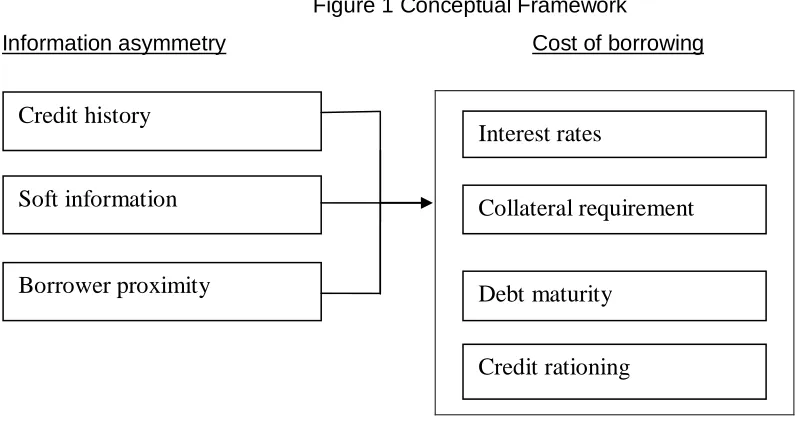
The conceptual framework in Figure 1 illustrates the relationship among study variables:
In this study, the dependent variable is cost of borrowing. This variable was measured using:
interest rates, collateral requirement, debt maturity, and credit rationing. The independent variable in this study was information asymmetry. This variable was measured using: credit
history, soft information, and borrower proximity.
Figure 1 Conceptual Framework
Information asymmetry Cost of borrowing
Operationalization of Variables
The following table shows how the study variables will be measured, measurement scale to be
used and the corresponding questions in the questionnaire.
Table 1 Operationalization of the study variables
Variable Variable type Indicators Measurement scale No. of Questions in questionnaire Information
asymmetry
Independent Credit history Interval/Ordinal Question 7 Independent Soft information Ordinal/Interval Question 8 Independent Borrower proximity Ordinal/Interval Question 9 Borrowing Cost Dependent Interest rate
Collateral requirement
Credit rationing
Debt maturity
Ordinal/Interval Question 10
Credit history
Soft information
Borrower proximity
Interest rates
Collateral requirement
Debt maturity
Licensed under Creative Common Page 456
METHODOLOGY
Research Design
This study adopted a descriptive survey research design. A descriptive study is done so as to be able to give a rundown of the attributes of the study‟s variables and answer the research
questions. According to Best and Khan (2009) a descriptive survey involves presentation of an
issue highlighting its state, customs, opinions, operations, associations or directions. It involves collecting information about existing circumstances or situations with the objective of explanation and exposition. Aggarwal (2008) adds that this research method is not simply about
assembling and arranging facts but involves proper examination, explanation, collation, determination of directions and associations.
Consistent with the foregoing explanation about the meaning of a descriptive survey design, the purpose of this study will be to analyse and identify relationships between
information asymmetry and borrowing costs among microfinance clients in different MFIs. This justifies the choice of this design. A descriptive survey method was used to collect data from
MFIs operators registered with the Association of Microfinance Institutions (AMFI) and subsequently analysed the same to make sense of relationships.
Target Population
This study sought to find out the effect of information asymmetry on the borrowing cost among MFIs borrowers. Therefore, the target population of this study was all the microfinance
institutions operating in Kenya as captured in the Association of Microfinance Institutions (AMFI) data base. Currently (the year 2017) we have 49 MFIs that are registered with AMFI. See
appendix 1 for the sample frame. These will form the total population of this study. The unit of analysis was the individual microfinance institutions. One key informant respondent per MFI was targeted. The respondent was the MFI‟s credit manager. This was chosen as the respondent
because s/he is in charge of appraising loan applicants and determining whether the application should be accepted or declined. The officer also determines the loan terms in relation to interest
rate, collateral requirement and loan maturity.
Sample Size and Sampling Procedure
The sample size was determined using a mathematical model propounded by the Air University
of USA (2002). The model is specified as follows: n = {NZ2 ×0.25}/ {[d2 × (N-1)] + [Z2 ×0.25]}
Where; n = sample size, N = sample frame, d = precision level, Z=number of standard deviation
Licensed under Creative Common Page 457 According to the authors, this model is appropriate for determining sample size if you plan to
report results in a variety of ways. Some formulas are relevant where the researcher wants to report results descriptively while other formulas are applicable where the reporting will be done
using both descriptive and inferential statistics. In this study the results will be reported by use of both descriptive and inferential statistics, hence choice of the above model. The total population
(N) is 49 and the researcher will wish for 95% confidence level and ± 5 percent precision level (d = 0.05, Z= 1.96). Accordingly, the sample size shall be:
N = {49 × 1.962 × 0.25}/ {[0.052× (49-1)] + [1.962×0.25]} = 43.56 ͌ 44
This model has previously been applied in various studies to compute sample size, for instance; Muli (2011) and Gupta et al. (2005). The researcher adopted simple random sampling
procedure to select the 44 sample from the population list focusing on only those MFIs that have branches within Nairobi County for the researcher‟s convenience in terms of time and financial
constraints. Simple random sampling is appropriate if the elements constituting the population are similar. In this study there was no need to stratify the population constituent elements
because the elements are considered uniform and hence the researcher intended to randomly select 44 MFIs from the total population.
Research Instrument
A five point structured likert scale questionnaire was used for the purposes of data collection. The point of scale indicates the degree of agreement level of the respondent to the statement
indicating the effects of information asymmetry on the cost of borrowing. The questionnaire comprises questions related to credit history, soft information and borrower proximity, and how
these affects borrowing cost.
In addition, the questionnaire also has further questions that measures the following demographic aspects: age of the MFI, size of the MFI as measured using number of branches, type of the MFI – whether deposit taking or not, lending modality – whether individual or group
lending, whether the MFI uses credit reference bureau services or not, and whether the MFI has
a dedicated relationship banking section.
Validity and Reliability of the Instrument
Validity shows the extent to which a tool measures the construct being investigated (Gall. et al.,
2003). The researcher used intelligible language in constructing the data collection tools such that the questions were understandable and simple for the respondents to comprehend and offer appropriate responses. The researcher ensured that the questions asked spoke to the
Licensed under Creative Common Page 458 The questionnaire was pilot-tested to guarantee that the instruments ensured coherence and
pertinence. This involved administering the questionnaire in the filed on a sample of MFIs before the actual study. Any problems in the sample questionnaire were identified and rectified before
the actual study. The views of the respondents were considered in improving the tool.
Reliability indicates the extent of internal consistency or dependability of a tool over time.
It shows the exactness and meticulousness of the measurement technique (Kothari, 2004). In this study, the reliability of the questionnaire was tested using the Cronbach alpha coefficient. According to Gliem and Gliem (2003) Cronbach alpha is the best measure of internal
consistency of a measurement instrument. The cut-off point for making a conclusion about the reliability of a tool is the alpha coefficient should be ≥ 0.70.
Data Collection Procedure
This study collected quantitative data using a self-administered questionnaire. The researcher informed the respondents that the instruments being administered was for research purpose
only and the responses from the respondents would be kept secret and confidential.
The researcher obtained an introductory letter from the University to collect data from the MFIs and with the help of research assistants deliver the questionnaires to the respondents and have
them filled and then collect them later: the drop and pick later method.
Data Analysis
Descriptive and inferential statistics were used to analyze the sample data to explain and make abstractions of the population phenomenon. The collected data was checked for completeness,
edited, coded and then entered into the computer. Descriptive statistics were used to summarize the data and establish characteristics of the study population. The tools of analysis used were frequency distributions and percentages. Mean was computed to show the average
opinion consensus on every likert scale question asked, while standard deviation was calculated to show the extent of divergence in the opinion among the respondents.
To establish the effect of information asymmetry on the cost of borrowing, a multiple regression model was used. The variables are a mixture scale of ordinal and interval
measurements. The model is specified as follows: CR= β0 +β1CH+ β2SI + β3BP+ε
Where:
CR= Dependent variable (Cost of borrowing) β0= constant term
Licensed under Creative Common Page 459 ε = Stochastic term.
CH = credit history SI = soft information
BP = borrower proximity
The regression coefficients tested the unique effect of each independent variable. Significance of the regression coefficients was tested using the P values. The corresponding probability value (P value) for each coefficient was used to test the significance of regression coefficients at
5% significance level. P value measures the probability of committing type II error. It is the lowest significance level at which the null hypothesis can be rejected.
The ANOVA F statistic test was used to test whether the model as a whole is significant. In other words, do the independent variables, taken together, predict the dependent variable
better than just predicting the mean of everything? R squared shall be used to test explanatory power of the model.
Regression diagnostics play a vital role in finding and validating a good predictive relationship between the dependent and independent variables. Since this is a cross sectional study only two diagnostic tests were performed namely normality test and multicollinearity test.
Histograms and measures of skewness and kurtosis were used to measure normality of the
data. Multicollinearity occurs when two or more predictors in the model are correlated and provide redundant information about the response. Pearson correlation was used to test the
strength of correlation between the predictor variables. The rule of the thumb is that a correlation of more than 0.7 is an indication of severe multicollinearity (Shen and Gao, 2008).
The solution for this problem is to drop the affected variable.
RESULTS AND DISCUSSIONS
Response Rate
The study targeted a sample size of 44 respondents from different microfinance institutions
(MFIs). The questionnaire was supposed to be filled by the credit manager/officer from each MFI. In this study 32 dully filled questionnaires were received from the respondents. This
represents 73% of the targeted sample size. The response rate conforms to Mugenda and Mugenda (2003) stipulation that a response rate of 70% and over is acceptable.
Reliability of the Data
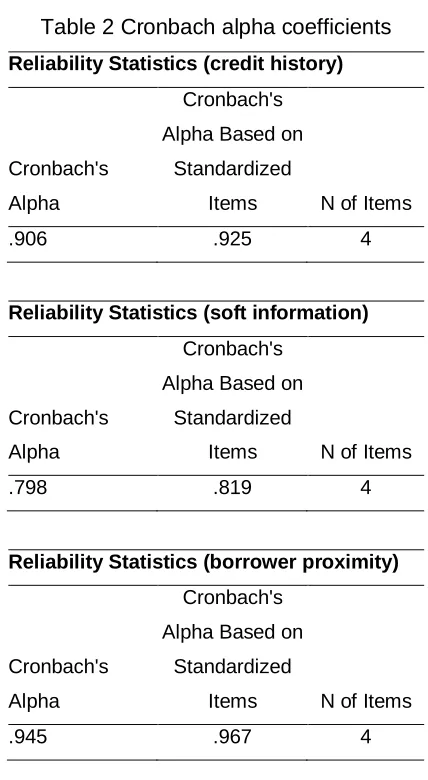
Licensed under Creative Common Page 460 ascertain internal consistency of the Likert scale questionnaire used in data collection. The
general rule of thumb is that a coefficient of not less than 0.7 lends credence to the internal consistency of items used to measure the construct (Gliem & Gliem, 2003). Alpha values were estimated scale-wise (That‟s separately for credit history, soft information and borrower
proximity). The analysis resulted in alpha coefficients higher than 0.70 in all the three cases.
The results are as captured in table 2 below.
Construct validity was demonstrated by high correlations between the items that comprised the constructs. This is a strong indication that the data collection tool used was
reliable. Cronbach alpha is a reliability coefficient based on the average covariance among items in a scale. The average correlation of an item with all other items in the scale articulates
the extent of the common entity.
Table 2 Cronbach alpha coefficients
Reliability Statistics (credit history)
Cronbach's Alpha
Cronbach's Alpha Based on
Standardized
Items N of Items
.906 .925 4
Reliability Statistics (soft information)
Cronbach's Alpha
Cronbach's Alpha Based on
Standardized
Items N of Items
.798 .819 4
Reliability Statistics (borrower proximity)
Cronbach's Alpha
Cronbach's Alpha Based on
Standardized
Items N of Items
Licensed under Creative Common Page 461
Demographic Information
The demographic information of interest in this study was organization type, age of the MFI, number of branches, lending modalities, and the use of credit reference bureaus in credit policy.
These demographics are discussed below:
Organization Type
The results of the study showed that 53 percent of the randomly sampled MFIs were non-deposit taking while 47 percent are microfinance banks (meaning that they are allowed to
mobilize deposits from the public). Traditionally, MFIs in Kenya have not been allowed to mobilize savings from the public until the year 2006 when the microfinance Act was enacted.
These results show a trend of MFIs increasingly embracing deposit taking in light of the enabling legislation. However, a big portion of MFIs are yet to embrace deposit taking. Public
savings in MFIs is usually the main source of funds for lending purposes. The results are summarized in table below
Table 3 Organization type
Organization type
Frequency Percent Valid Percent Cumulative Percent Valid Non-deposit taking MFI 17 53.1 53.1 53.1
Microfinance Banks 15 46.9 46.9 100.0
Total 32 100.0 100.0
Age of the MFI
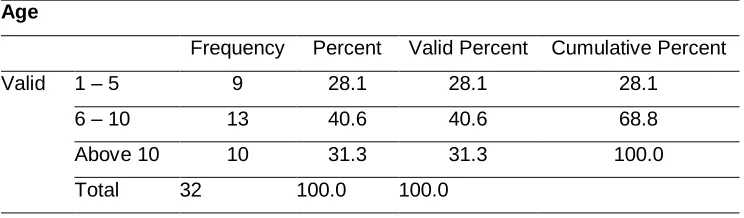
The results of this study showed that approximately 69 percent of the MFIs in Kenya have not
been in existence for more than ten years. Only 31 percent of MFIs in Kenya have been in existence for more than 10 years. The proliferation of MFIs in the last ten years can be possibly
explained the enactment of the Microfinance Act (2006) which was done roughly ten years back.
Table 4 MFIs Age Distribution
Age
Frequency Percent Valid Percent Cumulative Percent
Valid 1 – 5 9 28.1 28.1 28.1
6 – 10 13 40.6 40.6 68.8
Above 10 10 31.3 31.3 100.0
Licensed under Creative Common Page 462
MFI branch network
Most MFIs in Kenya are fairly small in size with 63 percent of them having less than 10 branches country wide. Only 22 percent of the MFIs have more than 10 branches countrywide.
This implies that a satisfactory MFI outreach in the country is yet to be attained. However, the tremendous proliferation on new MFIs in the last 10 years is a good indication. The summary of
MFI branch coverage is outlined in table below:
Table 5 MFI branch network
Number of Branches
Frequency Percent Valid Percent
Cumulative Percent Valid Less than 10 20 62.5 62.5 62.5
10 – 20 5 15.6 15.6 78.1
More than 20 7 21.9 21.9 100.0
Total 32 100.0 100.0
MFI Lending Modalities
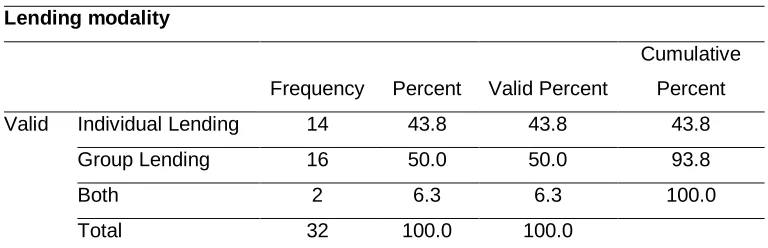
In this study a question was posed to the respondent as to whether the MFI lends to individual
borrowers, group of borrowers (group lending) or adopts both approaches. Approximately 56 percent of the MFIs use group lending modality, only 44 percent of the MFIs use individual
lending approach exclusively. Most MFIs adopt the group lending approach because it minimizes default risk due to peer pressure among the group members (Table 6).
Table 6 MFI lending Modality
Lending modality
Frequency Percent Valid Percent
Cumulative Percent Valid Individual Lending 14 43.8 43.8 43.8
Group Lending 16 50.0 50.0 93.8
Both 2 6.3 6.3 100.0
Total 32 100.0 100.0
Use of Credit Reference Bureau by MFIs
The researcher sought to find out the extent to which MFIs have adopted the use of credit reference bureaus in their lending framework. The results showed that 81 percent of MFIs in
Licensed under Creative Common Page 463 worthiness. This shows the centrality of credit history in evaluating a loan applicant among MFIs
in Kenya. Table 7 below shows the results.
Table 7 MFI use of credit reference bureaus
MFI uses credit reference bureaus in lending policy
Frequency Percent Valid Percent
Cumulative Percent
Valid No 6 18.8 18.8 18.8
Yes 26 81.3 81.3 100.0
Total 32 100.0 100.0
Descriptive Analysis
In this section, the study presents summary information about the opinion of respondents on different constructs in the form of descriptive statistics. Generally, there were varied opinions on
the role of each independent variable in influencing the dependent variable.
Influence of credit history on the borrowing cost
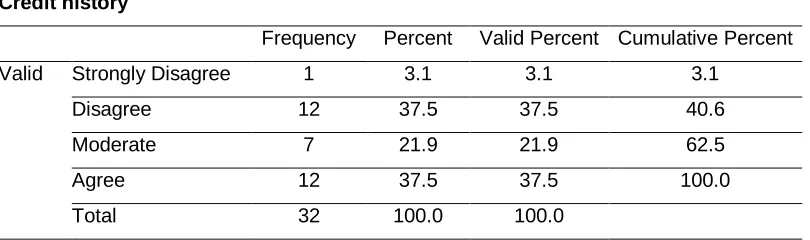
Table 8a gives a summary of respondents‟ opinions on the effect of credit history on the
borrowing cost. The results show a divided opinion, while 37.5 percent of the respondents agreed that a good credit history translates into relatively lower interest rates being charged, an equivalent number of respondents held the contrary opinion (disagreed). The results also
indicated that 21.9 percent of the respondents opined that credit history moderately influences the cost of borrowed. When the researcher lumps together those that agreed with those who
moderately agreed the cumulative percentage of this category is 59.4 percent. This implies that credit history is an important determinant of the interest levied on borrower – that is, a better
credit history is likely to translate into lower interest rates.
Table 8a Effect of credit history on borrowing cost
Credit history
Frequency Percent Valid Percent Cumulative Percent Valid Strongly Disagree 1 3.1 3.1 3.1
Disagree 12 37.5 37.5 40.6
Moderate 7 21.9 21.9 62.5
Agree 12 37.5 37.5 100.0
Licensed under Creative Common Page 464 The mean value of 2.9375 ≈ 3.000, as captured in table 8b below shows that the general
opinion on average was that credit history has an effect on borrowing cost to a moderate extent. Note that the vale 3 corresponds to the opinion “Moderate”. However, the standard deviation
value of 0.94826 (not close to zero) is an indication that there was a diversity of opinion on whether or not credit history affects borrowing cost and to what extent. Note that a standard deviation value of zero would imply there was 100% consensus on the respondents‟ opinion.
Table 8b Mean and standard deviation
N Mean Std. Deviation
Statistic Statistic Statistic
Credit history 32 2.9375 .94826
Valid N (listwise) 32
Influence of soft information on borrowing cost
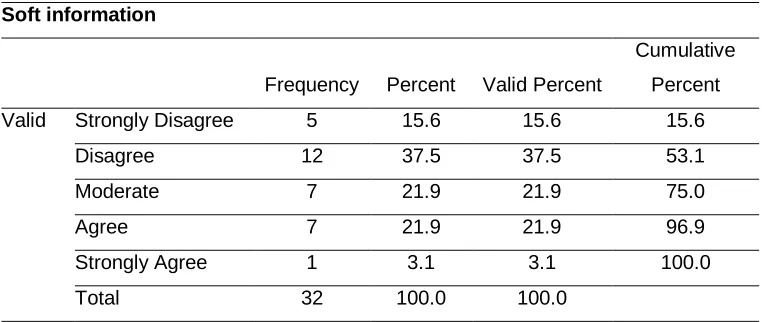
This study sought respondents‟ opinion on whether soft information has influence on the cost of
borrowing. In this respect there was also no consensus. Generally, 46.9 percent (21.9 + 21.9 + 3.1) of the respondents agreed that borrower soft information in possession of the MFI has an influence on the cost of lending. Possession of positive soft information has an effect of reduced
borrowing cost and vice versa. On the other hand, 53.1 percent (15.6 + 37.5) of respondents disagreed that soft information has an effect on the borrowing cost. This implies that there is
polarized opinion on this issue.
Table 9a Effect of soft information on borrowing cost
Soft information
Frequency Percent Valid Percent
Cumulative Percent Valid Strongly Disagree 5 15.6 15.6 15.6
Disagree 12 37.5 37.5 53.1
Moderate 7 21.9 21.9 75.0
Agree 7 21.9 21.9 96.9
Strongly Agree 1 3.1 3.1 100.0
Total 32 100.0 100.0
The researcher obtained further information by computing the mean and standard deviation of
Licensed under Creative Common Page 465 has an effect on the borrowing cost. However, a standard deviation score of 1.10306 implies
that there was a polarized opinion on this issues, that is, the respondents held extreme opinions on both ends. These measures of central tendency and dispersion are shown in table below.
Table 9b Mean and standard deviation
Descriptive Statistics
N Mean Std. Deviation
Soft information 32 2.5937 1.10306 Valid N (listwise) 32
Effect of Borrower Proximity on borrowing cost
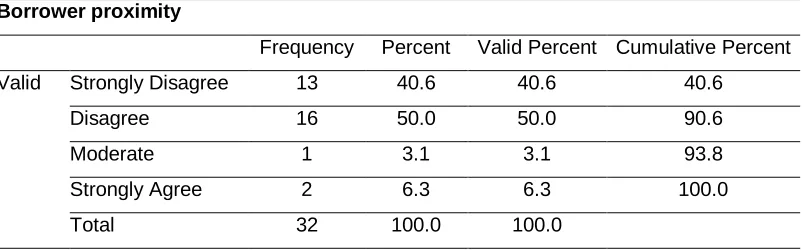
In this study it was hypothesized that borrower proximity has a bearing on the cost of borrowing.
In response to this question, 90.6 percent of the respondents disagreed that borrower proximity affects borrowing cost. On the other hand, 9.4% agreed that borrower proximity affects
borrowing cost. These results are shown in table 10a below.
Table 10a Influence of borrower proximity on borrowing cost
Borrower proximity
Frequency Percent Valid Percent Cumulative Percent Valid Strongly Disagree 13 40.6 40.6 40.6
Disagree 16 50.0 50.0 90.6
Moderate 1 3.1 3.1 93.8
Strongly Agree 2 6.3 6.3 100.0
Total 32 100.0 100.0
On average, the respondents disagreed that borrower proximity affects borrowing cost. This is as evidenced by the mean score of 1.8125 ≈ 2.000. Note that the value 2 corresponds to the opinion “Disagree”. Furthermore, a standard deviation value of 0.99798 (far from zero) shows
that there was a divided opinion on this question.
Table 10b Mean and standard deviation
Descriptive Statistics
N Mean Std. Deviation
Licensed under Creative Common Page 466
Regression Model
An estimation of the relationship between the independent variables and the dependent variable was conducted using a regression model. In this study, borrowing cost was the dependent
variable while the independent variables included credit history, soft information, and borrower proximity.
Regression Coefficients
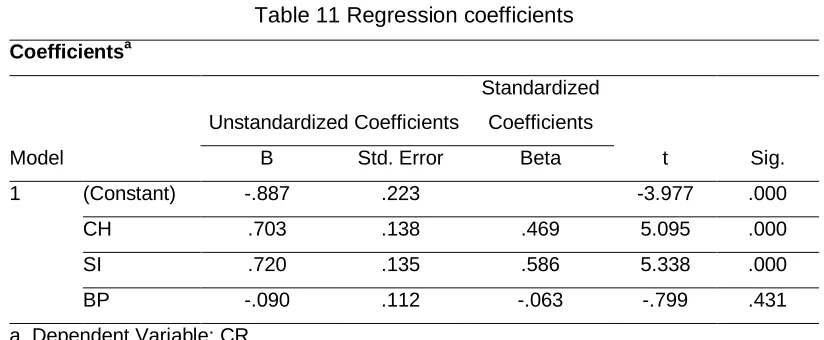
Table 11 Regression coefficients
Coefficientsa
Model
Unstandardized Coefficients
Standardized Coefficients
t Sig. B Std. Error Beta
1 (Constant) -.887 .223 -3.977 .000
CH .703 .138 .469 5.095 .000
SI .720 .135 .586 5.338 .000
BP -.090 .112 -.063 -.799 .431
a. Dependent Variable: CR
The estimated regression equation takes the form: CR= -0.887 + 0.46CH+0.586SI – 0.063BP
The results show that credit history and soft information have a significant influence on the
borrowing cost among MFI borrowers. This is as supported by the P values of 0.000 for the variables regression coefficients. However, borrower proximity has not relationship with the borrowing cost. This is as evidenced by the regression coefficient‟s P value of 0.431 which is way above the benchmark significance value of α = 0.05.
Both credit history and soft information have a favourable influence on the borrowing
cost. That is to imply that any positive information as regards credit history and soft information leads to reduced borrowing cost. The positive regression coefficients of 0.469 and 0.586 for
credit history and soft information respectively attest to this. The reduced borrowing cost could come in the form of lower interest rates, non-requirement of collateral, non-credit rationing and
longer repayment periods.
Model Explanatory Power
Licensed under Creative Common Page 467 Table 12 Model summary
Model Summary
Model R
R Square
Adjusted R Square
Std. Error of the Estimate
Change Statistics R Square
Change F Change df1 df2
Sig. F Change 1 .969a .938 .932 .37136 .938 142.265 3 28 .000
a. Predictors: (Constant), BP, CH, SI
The results show that 93.20% of the changes in the borrowing cost among the MFI borrowers is explained by credit history and soft information. This as evidenced by the R squared value of
0.932 and a significant P value of 0.000.
Significance of the Overall Model
The significance of the overall model was tested using the F-statistic. The results indicate that
all the independent variables are a good joint predictor of the dependent variable. From the following ANOVA table, the F-statistic value obtained was 142.265 which was significant at α =
0.05 as supported by the p-value of 0.000.
Table 13 One Way ANOVA
ANOVAa
Model Sum of Squares df Mean Square F Sig. 1 Regression 58.857 3 19.619 142.265 .000b
Residual 3.861 28 .138
Total 62.719 31
a. Dependent Variable: CR
b. Predictors: (Constant), BP, CH, SI
SUMMARY, CONCLUSIONS AND RECOMMENDATIONS
Summary of the Findings
Money and credit are the lifeblood of an economy. The ability of borrowers to access credit at reasonable terms is critical to facilitate investment and commerce, and thereby sustain
economic growth. Most microfinance clients are information opaque and this partly explains the high risk premium attached to lending hence higher interest rates. Therefore, the poor still find it difficult to access finances from MFIs because of the fairly high cost of loans. MFIs usually take