© 2018 IJSRST | Volume 4 | Issue 2 | Print ISSN: 2395-6011 | Online ISSN: 2395-602X Themed Section: Science and Technology
An Amperometric Sensor for the Determination of Dopamine Using Poly
Zincon Film Modified Electrode
S. Vasanthi, K. Krishna Kumar, S. Sriman Narayanan*
Department of Analytical Chemistry, University of Madras, Guindy Campus, Chennai, Tamil Nadu, India
ABSTRACT
Zincon, a metal ion indicator, has been polymerised on the graphite electrode to get a poly zincon film modified electrode. The formation of the polymer film (PZF)was confirmed by optical microscopis studies. The PZF modified electrode was characterised by the cyclic voltammetry, square wave voltammetry and chronoamperometry. The experimental parameters influencing the electrochemical behaviour of the PZF modified electrode such as pH and scan rates in presence of dopamine were optimised. The modified electrode showed excellent sensitivity and stability towards the electrocatalytic oxidation of dopamine. The determination range for dopamine was found to be 1.16 to 401µM with a correlation coefficient (R2) of 0.997.
The limit of detection for the determination of Dopamine was 0.38 µM. The proposed method was used for the determination of dopamine in pharmaceutical preparations.
Keywords: Poly Zincon Film modified electrode, Dopamine, Amperometric sensor
I.
INTRODUCTION
Dopamine (3, 4-dihydroxyphenyl ethylamine, DA) belongs to the catecholamine family. It plays an important role in the function of the central nervous system, renal, and hormonal systems because it is a neurotransmitter [1,2]. Abnormal concentration levels of DA may result in serious neurological disease such as Schizophrenia, Huntington’s disease and Parkinson’s disease [3]. Due to this considerable importance in biological system, there is a need to establish a reliable, sensitive and selective analytical method for the determination of trace levels of dopamine. Analytical methods such as titrimetry [4], spectrophotometry [5], chemiluminescence [6] and voltammetry have been developed for the determination of dopamine. Electrochemical techniques have proved to be significantly advantageous because of rapid and sensitive response. Due to the electroactive nature of dopamine, it has been determined electrochemically with different modified electrodes such as gold cysteamine
self-assembled monolayers [7], Glassy Carbon Electrode [8], Single-Walled Carbon Nanotube Film Modified on Carbon Fiber Microelectrode [9].
For these reasons, the polymer based electrodes were used for the determination of analytes of some biological compounds.
An attempt has been made to develop a chemically modified electrode for the determination of dopamine using PZF as the redox mediator. The analytical applicability of the PZF modified electrode in presence of dopamine was studied by cyclic voltammetry, square wave voltammetry, hydrodynamic voltammetry and chronoamperometry. The PZF modified electrode possesses high stability and sensitivity towards the oxidation of dopamine. The real samples were analysed for the determination of dopamine by the PZF modified electrode and the results were found to be satisfactory.
II.
EXPERIMENTAL
A. Chemicals and Reagents
Zincon was purchased Aldrich, USA, dopamine was purchased from Himedia, India. Spectroscopic grade graphite rod of 3mm was purchased from Aldrich, Germany. All other reagents were of analytical grade and used as received. Phosphate buffer solution (0.1 M PBS, pH 7) was prepared by mixing solutions of 0.1 M K2HPO4 and 0.1 M KH2PO4. For preparing the
solution the double distilled water was used.
B. Instruments
Cyclic voltammetry, square wave voltammetry and amperometric measurements were made using CHI 660 B electrochemical workstation. The three electrodes system consisting of the modified electrode as working electrode, a saturated calomel electrode (SCE) as reference electrode and a platinum electrode as counter electrode linked in to a data acquisition system was used. All the electrochemical experiments were carried out at room temperature.
C. Preparation of Poly Zincon Film (PZF) modified electrode
Paraffin impregnated graphite electrodes [PIGE] have been prepared from graphite rods as reported [17] and the PIGE has been used as the bare electrode and used for electrode modification. The PIGE surface was polished like mirror finishing followed by electropolymerisation of zincon by cycling the potential of the electrode between 1.0 to 2.2 V for 14 times in 0.1 M PBS of pH 6 containing 0.2 mM of zincon. This has resulted in Polyzincon film (PZF) modified electrode which has been used for electrocatalytic oxidation and amperometric determination of dopamine.
III.
RESULTS AND DISCUSSION
A. Characterisation of Poly Zincon Film Modified Electrode
Optical Microscopic Studies
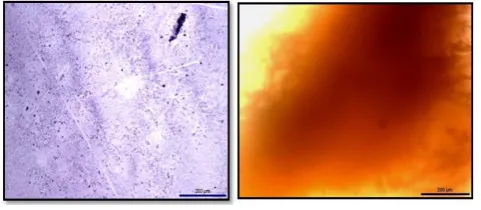
To confirm the electropolymerisation of Poly Zincon on the electrode surface optical microscope images were recorded on the ITO electrode surface. The optical microscopic images of the surfaces of monomer zincon, and polyzincon film on the ITO electrode are shown in Figure 1 (a & b). A purple colour was observed for the monomer which confirmed the presence of zincon monomer (a). The surface of polyzincon film was observed as brown colour which clearly confirmed the formation of PZF as there was a change in colour from purple to brown (b). From the above study, it can be concluded that under the experimental conditions adopted, PZF had formed on the electrode surface.
B. Electrocatalytic oxidation of Dopamine at the PZF modified electrode
Cyclic voltammetric studies
The electrocatalytic activity of the surface modified PZF electrode was studied for the oxidation of DA by cyclic voltammetry. Figure 2 represents the cyclic voltammograms obtained for the oxidation of dopamine with the bare and the modified electrode. The curves a and c show the cyclic voltammograms of bare and modified electrode in the absence of DA and curves b and d show the cyclic voltammograms of bare and modified electrode in the presence of 3.3µM DA in 0.1 M PBS at a scan rate of 50mVs-1.
The bare electrode showed an anodic current of 1.92 µM at 0.4 V where as the PZF modified electrode showed an anodic current of 17.3 µM at 0.15 V. The bare electrode was found to oxidize DA at higher potential whereas the PZF modified electrode exhibited well enhanced redox peak current in presence of DA at a reduced potential of 0.15 V. This observation indicated the electrocatalytic activity of the surface modified PZF electrode towards the oxidation of DA.
Figure 2. Cyclic voltammograms of bare and PZF modified electrode in the absence (a, c) and presence (b, d) 3.3 µM of DA; Electrolyte: 0.1 M PBS; scan rate: 50mVs-1.
Effect of pH
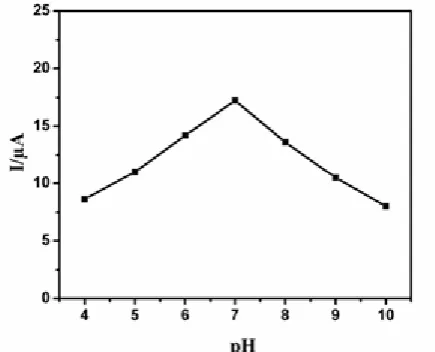
The effect of pH on the electrocatalytic oxidation of DA was examined in the pH range of 4 to 10 in 0.1 M PBS. The cyclic voltammograms of the modified electrode in presence 3.3µM of DA were recorded and the plot of anodic current vs pH is shown in the Figure 3. A maximum peak current was observed at pH 7.0 and in the lower and higher pH range the current was found to be lesser when compared to pH 7.0. Hence, pH 7.0 was chosen as an optimum solution pH for further experiments.
Figure 3. Effect of pH for the peak current of PZF modified electrode in the presence of 3.3 µM of DA in 0.1 M PBS; scan rate: 50mVs-1.
Effect of scan rate variations
The electrochemical behaviour of the surface modified PZF electrode at different scan rates from 10 to 100 mVs-1 in 0.1 M PBS (pH 7) in the potential
Figure 4. Cyclic voltammogram of PZFmodified electrode in presence of 3.3 µM of DA at different scan rates 10 – 100 mVs-1 in 0.1 M PBS.. Inset: Plot of
peak current vs. square root of scan rates
Calibration plot for the determination of DA
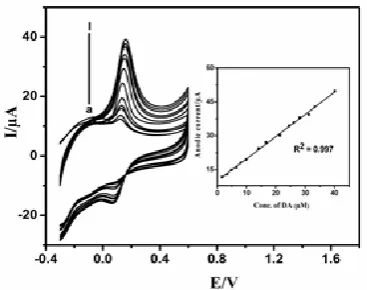
The cyclic voltammograms of different amounts of DA and a plot of anodic current against the concentration of DA in 0.1 M PBS at a scan rate of 50 mVs-1 are shown in Figure 5. As the concentration of
DA increased the anodic current also increased and exhibited a good linearity which indicated that the effective oxidation of DA by PZF modified electrode. The determination range for the oxidation DA was found to be 1.66 to 401µM with a correlation coefficient of 0.997. From the linear regression equation for the plot of anodic current vs concentration of DA, the sensitivity was found to be 0.98 µA /µM and a limit of detection of 0.55 µM was also accomplished.
Figure 5. Cyclic votammograms for the determination of DA with PZF modified electrode. Electrolyte: 0.1 M
PBS; scan rate: 50mVs-1. Inset: Corresponding
calibration plot of current vs. concentration of DA;
SWV studies
The electrocatalytic activity of the surface modified PZF electrode was also carried out by SWV technique towards the oxidation of DA. The square wave voltammograms of the modified electrode for the successive addition of 3.3µM DA in 0.1 M PBS (pH 7) is shown in the Figure 6. It is noticed from the figure, that the anodic peak current increased with increase in concentration of DA revealing the electrocatalytic oxidation of DA by PZF modified electrode.
Figure 6. SWV response of PZF modified electrode for the successive addition of DA (a to l). Electrolyte: 0.1 M PBS.
Hydrodynamic Voltametric studies
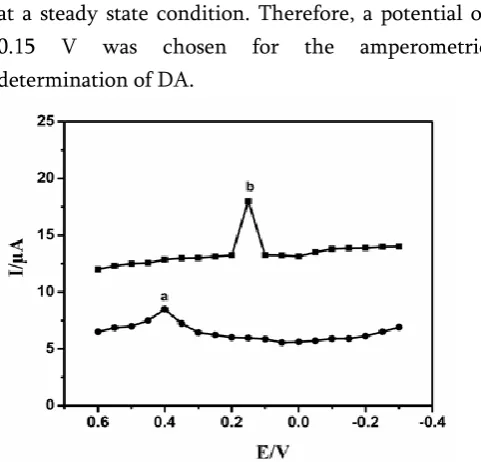
at a steady state condition. Therefore, a potential of 0.15 V was chosen for the amperometric determination of DA.
Figure 7. Hydrodynamic voltammograms of (a) bare and (b) PZF modified electrode in the presence of 3.3 µM of DA; Electrolyte: 0.1 M PBS, under stirring condition.
Chronoamperometric studies In order to examine the application of the surface
modified PZF electrode as an amperometric sensor in flow systems for the electrocatalytic oxidation of DA, experiments were carried out by chronoamperometry and the results are depicted in Figure 8. The figure shows the amperograms of the surface modified PZF electrode and a potential of 0.15 V for the successive addition of DA under stirring condition. The figure clearly shows that the anodic current increased by increasing the DA concentrations in solution. The amperometry under stirred condition showed much higher current than the cyclic voltammetry and hence it was used to estimate the lower amounts of DA using surface modified PZF electrode. Figure 9 shows the corresponding calibration plot of anodic current vs concentration of DA. The determination range, correlation coefficient and sensitivity were found to be 33.2 to 476.1 µM, 0.997 and 0.17 µA/µM respectively.
Figure 8. Chronoamperometric response for DA at the PZF modified electrode for each 0.2 ml addition of 0.01 M DA; Electrolyte: 0.1 M PBS, Potential: 0.15 V, under stirring condition.
Figure 9. Calibration plot of currents vs. concentration of DA; Electrolyte: PBS
Stability of the surface modified PZF electrode towards DA
Figure 10. Current response at PZF modified electrode towards 3.3 µM of DOPA over 80 days. electrolyte : PBS (pH 7 ) at a scan rate of 50mVs-1.
Interference
The interference for the determination of DA using surface modified PZF electrode was studied in presence of most common interferents such as UA. When same concentration of UA was added with that
of DA, it did not show any interference in the electrocatalytic determination of DA because the oxidation potential for the determination of DA is 0.15 V and the potential for the oxidation of UA is 0.3 V. The above results showed that the PZF modified electrode is much reliable and sensitive for the determination of DA in the presence of other interferences.
Real sample analysis
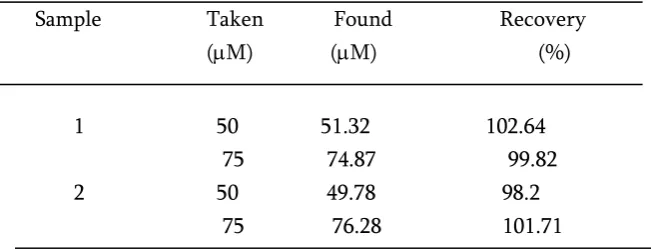
Two different tablets were analysed for the determination of DA by measuring the concentration of DA using PZF modified electrode by cyclic voltammetry. The results are tabulated in Table 1. From the table, it is understood that the results obtained for the proposed method was satisfactory and the recovery was found to be 101.23 and 99.5 %. Therefore, the PZF modified electrode was used for the estimation of DA from commercial samples.
Table 1. Real sample analysis of DA in commercial tablets
Sample Taken Found Recovery (M) (M) (%)
1 50 51.32 102.64 75 74.87 99.82 2 50 49.78 98.2
75 76.28 101.71
IV.
CONCLUSION
The PZF modified electrode was prepared, characterized and utilized for the amperometric determination of dopamine. The PZF modified electrode has been characterized by optical microscope. This electrode has excellent electrocatalytic activity for the determination of dopamine. The linear range was found to be 1.16 to 401 µM with a correlation coefficient of 0.997 and the limit of detection was found to be 0.38 µM. The PZF
modified electrode showed good long term stability and reproducibility.
V.
REFERENCES
[1]. Chunyan Deng, Jinhua Chen, Mengdong Wang, Chunhui Xiao, Zhou Nie, Shouzhuo Yao, Biosensors and Bioelectronics, 24 (2009) 2091. [2]. De-Qian Huang, Cheng Chen, Yi-Ming Wu,
and Zhao-Di Liu, Int. J. Electrochem. Sci., 7 (2012) 5510 .
[3]. Hua-Jun Qiu, Gui-Ping Zhou, Guang-Lei Ji, Yun Zhang, Xi-Rong Huang, Yi Ding, Colloids and Surfaces B: Biointerfaces, 69 (2009) 105.
[4]. D. Amin, Analyst, 111 (1986) 257.
[5]. C.S. Sastry, V.G. Das, K.E. Rao, Analyst, 110 (1985) 398.
[6]. S. Wang, L. Du, L. Wang, H. Zhuang, Anal. Sci., 20 (2004) 317.
[7]. Reza Karimi Shervedani, Mojtaba Bagherzadeh, Seyed Ahmad Mozaffari, Sensors and Actuators B, 115 (2006) 621.
[8]. De-Qian Huang, Cheng Chen, Yi-Ming Wu, Hong Zhang, Liang-Quan Sheng, Hua-Jie Xu, and Zhao-Di Liu, Int. J. Electrochem. Sci., 7 (2012) 5520.
[9]. Haesang Jeong and Seungwon Jeon, Sensors, 8 (2008) 6935.
[10]. Kannika Keawkima, Suchada Chuanuwatanakula, Orawon Chailapakula, Shoji Motomizuc, Food Control, 31 (2013) 14.
[11]. E. Merino and M. Ribagorda, Beilstein J. of Org. Chem., 8 (2012) 1071.
[12]. M. Haro, I. Gascon, R. Aroca, M. C. Lopez and F. M. Royo, J. of Colloid and Int. Sci., 319 (2008) 277.
[13]. E. Kibena, U. Maorg, L. Matisen, P. Sulamagi and K. Tammeveski, J. of Electroanal. Chem., 686 (2012) 46.
[14]. T. Ikeda and O. Tsutsumi, Science, 268 (1995) 1873.
[15]. Y. R. Leroux and P. Hapiot, Electrochem. Commun., 33 (2013) 107.
[16]. J. A. Delaire and K. Nakatani, Chemical Reviews, 100 (2000) 1817.