GLOBAL JOURNAL OF ADVANCED ENGINEERING TECHNOLOGIES AND
SCIENCES
ANALYSIS AND COMPARISON OF CRACK DETECTION IN METAL IMAGES
USING BILATERAL FILTER AND DIFFUSION TECHNIQUE
Dr P.S.S. Akilashri*
* Head, Department of Computer Science, National College, Trichy-1 ABSTRACT
The streak image caused by metal implants degrades the image quality and limits the applications of metal that results in loss of image quality. The proposed method uses bilateral filter and it is compared with diffusion technique and fractional wavelet transformation to extract the texture features. Diffusion method used in this previous work is inefficient for detecting the pitting and laminating defects. By using Gradient Magnitude and structure coherence, the exact level of defect is found. For this purpose, an automatic defect detection and classification technique using enhanced bilateral filter is proposed to ensure the better quality of metal in manufacturing process as well as production rate. In this proposed methodology for crack detection in metal images, bilateral filter method is used to acquire the knowledge about the pattern of defects within a very short period of time and so that the defected metal may not be mixed with the fresh metal.
KEYWORDS: Diffusion, Lamination, Bilateral filter (BLF).
INTRODUCTION
Iron machines and materials square measure utilized in most of the production industries. These iron materials inherit contact with humidness and pollution which will increase the rust of iron. Corrosion takes place once in the mechanical materials, As a result of the attack of the corrosion, these mechanical materials ensure the fatigue that affects the integrity of the argentiferous surfaces. This rust caused by corrosion leads to the wastage of iron materials, reduction in potency and dear maintenance. Different departments use materials that square measure created from iron. In Civil department, for maintaining the great quality of steel bridges, it is necessary to sight rust defects. By detecting rust defects with this acne, bridge managers can make important decisions whether to paint bridges immediately or later [1]. Metallic objects like dental implants, surgical clips, or steel-hip prostheses lead to severe shadow and streak artifacts in CT images that superimpose the structures of interest and deteriorate image quality. The reason is that metallic objects have a very high density in the human body, which creates a barrier to the transmitted x-ray beam during CT examination. It results a lack of data in the projection data that lead to the production of streak in CT images. This photo deficiency caused by metallic object would become more severe under low dose scanning. During the last decade, many approaches have been proposed to reduce these artifacts. These methods can be roughly classified into iterative and interpolation-based methods [2]. If material is heated with infrared radiators, the temperature of the surface will rise suddenly. The speed at which the heat front is subsequently dissipated depends on different thermal properties of the material such as density, heat capacity, thermal conductivity and the bonding quality between top surface layer and the base material.
A defect in the sub-surface creates a barrier for the heat diffusion process and therefore the surface temperature above the defect will decrease more slowly than the temperature in other regions. The region above such a defect will show a hot area much longer than the surrounding containing good quality bonding. This causes a problem in quality assurance.[3]. Component-based representation with LDA is carried out based on a full metal image analysis [5]. The image is partitioned into several metal components to simplify the modeling of image statistics. The components are encoded by LDA to compensate for the effect of illumination and expression variation. LDA is then applied to the collection of the component-based LDA representations yielding a compact description referred to as ‘cascaded LDA’. The decomposition of the face image and its re-combination in the LDA space effectively solves the problem of face retrieval and person identification.[4]. The proposed system analyses automatic crack detection in metal using lamination and pitching process is explained in this paper. The paper is categorized as six sections. The first section is introduction, followed by description of the proposed system. The third section depicts the existing system and next section explains about the results and discussion. The final section states the conclusion.
at this step, the threshold level was slightly overestimated initially, which also caused the cracks thicknesses. A simple erosion with a cross structuring element could be used to correct the thicknesses, but again could cause crack breaking [8]. Hierarchical approach to detecting weld defects is proposed. Comparing with existing techniques, different thresholds are selected to control the scales of defects that make it more flexible to meet various requirements. By using proper parameters, it is easy to locate most of defects from the radiographic image at a desired scale. However in practice, it still is a difficult problem to depict “false” defects from “true” [9]. To ensure low deformation of profile region, corroded surfaces were covered with an epoxy resin before cutting and mounting with phenolic resin for mechanical polishing. A bilateral filter is a non-linear, edge-preserving and noise-reducing smoothing filter for images. The intensity value at each pixel in an image is replaced by a weighted average of intensity values from nearby pixels. This weight can be based on a Gaussian distribution. Crucially, the weights depend not only on Euclidean distance of pixels, but also on the radiometric differences (e.g. range differences, such as color intensity, depth distance, etc.). This preserves sharp edges by systematically looping through each pixel and adjusting weights to the adjacent pixels accordingly. A representative number of 1260-/960-8 bit digital images [10].
Noise filters to remove the noise due to the complexity of welding environment. Comparison of three noise filters (Bilateral filter) was made to find out the optimal noise filtering algorithm. The result showed that the Median filter algorithm is the preferred method, as not only this algorithm performance provided lower MSE (Mean Square Error) and RMSE (Root Mean Square Error) values than those of Gaussian filter and Wiener filter, but also the values of the PSNR (Peak Signal-to-Noise Ratio) and SNR (Signal-to-Noise Ratio) were higher. Therefore, the Median filter can be considered to have a better enhancement effect than the other two filters [11]. In Linear Discriminant Analysis (LDA), the proposed method finds most of the discriminative set of image processing operations to increase training samples. We analyzed the lamination and pitting defects using Diffusion methods [12].
In this proposed methodology, the bilateral filter is used in Crack Detection in Metal process. This filter may be a non-linear technique that may blur a picture whereas respecting robust edges. Its ability to decompose a picture into completely different scales while not inflicting haloes when modification has created it present in process photography applications similar to tone mapping, vogue transfer, relighting, and denoising. This text provides a graphical, intuitive introduction to bilateral filtering, a sensible guide for economical implementation and an outline of its varied applications, likewise as mathematical analysis.
PROPOSED SYSTEM
In the proposed system these images are mainly subjected to two different operations in the proposed analysis system. The first step is to preprocess and the second step is to identity the edges. The image of the metal surface has many features that need to be treated as such and all the information present in the image are analyzed.
In order to detect the crack automatically using Bilateral Filter and diffusion method and also using the texture classification and segmentation are analyzed.
An optimal spatial kernel for the bilateral filter, which is represented by a line spread function with an orientation and scale adjusted adaptively to the metal structure. Moreover, this approach can also be served as a preprocessing tool for improving the accuracy of the filter detection technique.
The proposed system implement the concept as Fractional Wavelet Transform. The proposed transform not only inherits the advantages of multi resolution analysis of the WT-Wavelet Transform, but also has the capability of signal representations in the fractional domain which is similar to the FRWT.
Edge-preserving methods and bilateral filter were proposed to overcome the loss of prominent edges. For example, the anisotropic diffusion filter and the weighted least squares filter attempt to smooth images while preserving edges based on measuring the image gradient. The nonlocal means filter computes filtered result relying on the similarity of intensity and the order of pixel in their neighborhoods. BLF is distinguished for its edge-preserving ability, for which a spatial kernel and a range kernel are combined and the output at each pixel relies both on the spatial distance and intensity differences
Bilateral Filter
Where D and kp denote the image intensities of component within the output image and component within the input image, severally. Represents a collection of components neighboring to pixel. The special kernel and vary kernel, that the weights square measure computed from the geometer distance f and also the measuring distinction between pixels and, severally. The latter is typically measured by image options similar to intensity or texture]. Could be a standardization term computed and each take a worth inverse to the corresponding input and square measure expressed generally as a Gaussian perform. As an example is calculated by
In (3), is a scale parameter determining the weight distribution pattern of the kernel. A large means that the range Gaussian widens and flattens.
BLF outperforms several different image bilateral filtering algorithms thanks to its ability to attain sensible filtering behavior whereas conserving crisp edges. it's obtained by combining the abstraction kernel and also the vary kernel. In sleek regions, BLF performs as a Gaussian low-pass filter by averaging away the little, feeble correlative variations between picture element values caused by noise, due to the abstraction kernel. For a pointy boundary shaped by a dark region and a bright one, BLF replaces the dark pixels by a median of the dark pixels in its neighborhood whereas ignoring bright pixels and the other way around, due to the vary kernel.
However, it's not trivial for BLF to differentiate between skinny metal and noise once applying it to depict pictures. This can be caused by many characteristics of the particular structure of skinny metal compared with a typical image edge that is made by dark and bright regions. First, the pixels of the skinny metal occupy a smaller portion of the pixels in its native window, inflicting the metal depict pixels to be averaged away by the abstraction kernel. Second, image intensities of skinny metal half area unit probably to be getting ready to the background thanks to the restricted resolution of metal image analysis. Third, the abstraction distribution of metal pixels is considerably completely different from freelance, isolated image noise; however BLF lacks functions to completely capture the connected specific properties.
TEXTURE CLASSFICATION
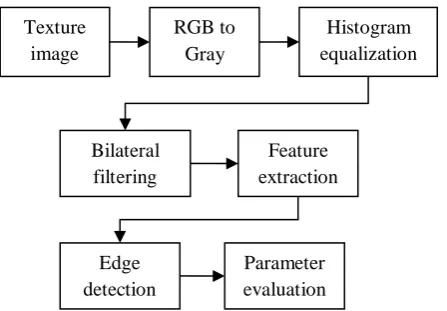
The texture analysis can be divided into various stages which are explained as follows. In the texture analysis, the image acquisition is the first process and preprocesses the image and feature extraction process can be done for the image and finally classify the images.
At the preprocessing stage, images could be segmented into contiguous regions based on texture properties. Texture features could provide cues for classifying patterns or identifying objects.
Figure 1 Stages in texture analysis Texture
image
RGB to Gray
Histogram equalization
Bilateral filtering
Feature extraction
Edge detection
Texture classification involves two phases: the training phase and the recognition phase. Within the learning section, the target is to create a model for the feel content of every texture category gift within the coaching knowledge that usually contains of pictures with known category labels. The feel content of the coaching pictures is captured with the chosen texture analysis technique that yields a group of textural options for every image. These options, which may be scalar numbers or distinct histograms or empirical distributions, characterize given textural properties of the photographs, akin to abstraction structure, contrast, roughness, orientation, etc. within the recognition section the feel content of the unknown sample is initial delineate with a similar texture analysis technique. Then the textural options of the sample square measure compared to those of the coaching pictures with a classification algorithmic program, and therefore the sample is appointed to the class with the simplest match.
In training phase, the classifier will be trained by labeling the input image to a specific texture class. On the other hand, the classifier will test and classify the input image into the correct texture class in testing phase, based on the available trained data. In this project, a set of collected dataset will be divided into two portions for each training and testing phase. Lastly, the output results produced by the classifier will be evaluated.
LAMINATION AND PITTING DEFECTS
A lamination defect is also called a de-lamination defect, lamination flaw, lamination fault, laminar, or simply lamination. As , it happens as a result of a flaw in the planchet, whether an incomplete mixing the metal in the alloy or a foreign substance such as dirt or gas trapped in the alloy, causing a layer of the coin's surface to peel or flake away before, during, or after striking, leaving a smaller or larger depression in the coin.
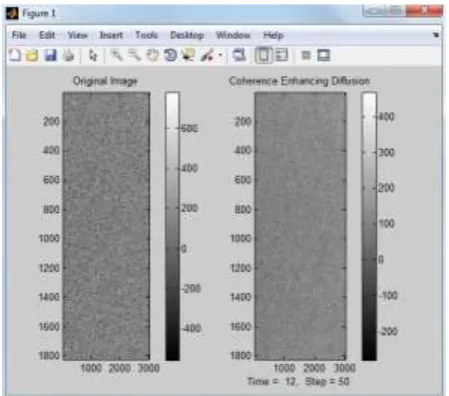
Figure 2 (a) Original Image (b) Enhanced image
In laminated materials, repeated cyclic stresses, impact, and so on can cause layers to separate, forming mica -like structure of separate layers, with significant loss of mechanical toughness. De-lamination also occurs in reinforced concrete structures subject to reinforcement corrosion, in which case the oxidized metal of the reinforcement is greater in volume than the original metal. The oxidized metal therefore requires greater space than the original reinforcing bars, which causes a wedge-like stress on the concrete. This force eventually overcomes the relatively weak tensile strength of concrete, resulting in a separation (or de-lamination) of the concrete above and below the reinforcing bars.
Bonded metal laminations to high accuracy and consistency. The use of a specialized resist provides both insulating properties within the stack as well as bonding capabilities. The etching process provides a burr free finish, ideal to eliminate problems during winding. The full process is available, including post stacking services such as grinding where required.
Metal Laminations:
[1] It can produce and bond stacks of laminations the stack height is completely customizable which incorporates top and bottom resist layers which also acts as an insulated coating and a good bonding agent.
[3] In the lamination standards for all applicable mechanical and physical characteristics meet or exceed the recognized industry standards.
[4] A layer of rust inhibiting paper (V.C.I. or equivalent) shall be packed between lamination layers. [5] In the laminations are made from various grades of electrical steels, silicon steels, nickel-iron alloys, and
cold rolled motor lamination steel. To find out more about the metals available.
Major disadvantages in lamination defects are • Producing poor bonds between layers • Poor surface finish
• Difficulty in producing hollow parts.
PITTING DEFECTS
The inspection of fine pitch surface-mounted devices by comparison of defect-free and defective packages is a promising area of research. The types of defects considered include missing pins, bent pins, broken pins, and bad solder connections on mounted packages. The feature extraction steps include morphological filtering for thresholding, skeletonization. The diffusion image is used as input for detecting the defects.
In texture classification the goal is to assign an unknown sample image to one of a set of known texture classes. Texture classification is one of the four problem domains in the field of texture analysis. The other three are texture segmentation (partitioning of an image into regions which have homogeneous properties with respect to texture; supervised texture segmentation with a priori knowledge of textures to be separated simplifies to texture classification), texture synthesis (the goal is to build a model of image texture, which can then be used for generating the texture) and shape from texture (a 2D image is considered to be a projection of a 3D scene and apparent texture distortions in the 2D image are used to estimate surface orientations in the 3D scene). In the learning phase, the target is to build a model for the texture content of each texture class present in the training data, which generally comprises of images with known class labels. The texture content of the training images is captured with the chosen texture analysis method, which yields a set of textural features for each image. These features, which can be scalar numbers or discrete histograms or empirical distributions, characterize given textural properties of the images, such as spatial structure, contrast, roughness, orientation, etc. In the recognition phase the texture content of the unknown sample is first described with the same texture analysis method. Then the textural features of the sample are compared to those of the training images with a classification algorithm, and the sample is assigned to the category with the best match.
Using the diffusion techniques image enhanced scaling should be measured. In the texture analysis In the Texture classification process involves two phases: the learning phase and the recognition phase. This domain coincides with the one where the enhancement of the diffusion coefficient versus the tilting force is the most rapid. The necessary and sufficient conditions for the non-monotonic behaviour of the diffusion coefficient as a function of temperature are found. The effect of the acceleration of diffusion by bias and temperature is demonstrated to be very sensitive to the value of the asymmetry parameter of the potential. In the learning phase, the target is to build a model for the texture content of each texture class present in the training data, which generally comprises of images with known class labels in the texture classification images using the fractional wavelet transform image enhanced should be effectively,
RESULT AND DISCUSSION
In this paper, detection of lamination and pitting defects using LDA and Filtering and texture process is performed. LDA is then applied to the collection of the component-based LDA representations yielding a compact description referred to as ‘cascaded LDA’. The decomposition of the metal image and its re-combination in the LDA space effectively solves the problem of metal identification.
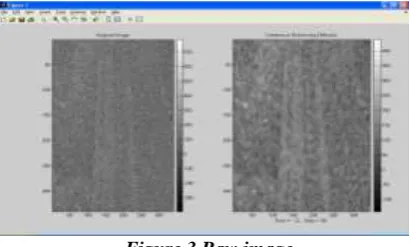
The raw image as shown in Figure 3 is loaded and preprocessing is done. The noise on the borders is quickly eliminated. Diffusion is not inhibited on borders, a rounding effect occurs.
LDA explicitly attempts to model the difference between the classes of data. PCA on the other hand does not take into account any difference in class, and factor analysis builds the feature combinations based on differences rather than similarities.
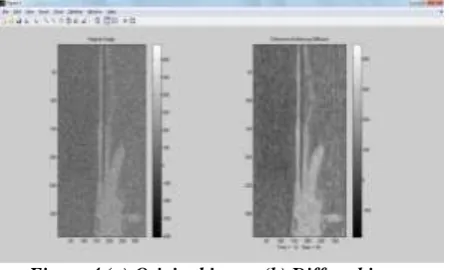
Figure 4 (a) Original image (b) Diffused image
Figure 4(a) indicates an original image and figure 4(b) shows the diffusion. The noise is removed and the defect is identified visually.
Figure (4c) structure orientation of bilateral filter.
The obtained results clearly state that BLF is better than diffusion techniques and other techniques.
Figure 4(d) PSNR measurement
Table 1 Results of pitting S. No Image size Laminati ng Value (dia/mm) Pittin g Value (dia/ mm) Diffusio n techniq ue Bilater al filter
1 256*256 0.06 0.20 0.25 0.35 2 256*256 0.07 0.18 0.22 0.30 3 256*256 0.09 0.15 0.20 0.28 4 256*256 0.10 0.16 0.19 0.26 5 256*256 0.10 0.18 0.23 0.27
The Bilateral and the pitting defects are shown graphically.
Graph 1Comparision of BLF with existing techniques
The above graph reveals that results obtained for the bilateral defect is more efficient than the laminating defect. The noise is removed more efficiently using BLF technique in pitting and laminating defects.
CONCLUSION
The Bilateral Filter is used in various types of images and detecting the accuracy of spot defect which is greater than scratch defects. The speed of detection is increased as well as accuracy is maintained by using proposed approach. BLF is isotropic across the whole image and we find that adjusting the kernel according to the local image structure can significantly improve the performance of image denoising. These properties can be represented by an LSF that spreads as a Gaussian function. Therefore, we propose to determine the spatial kernel of BLF by a particular LSF, which can be obtained by using the Gaussian-like kernel of MF. The proposed BLF performs significantly better in preserving thin metal in metal images while denoising the image. In the proposed method it is predicted that the original BLF is benefited in crack image structure preservation. The result is accurate for pitting defect than laminating by using Fast Bilateral Filter.
ACKNOWLODGMENT
The authors would like to acknowledge A.G.Shreenivasan, DGM/Business Development BARAKATH Engineering Industries P Ltd, Trichy-15.
REFERENCES
[1] V. Märgner, H. El-Abed, P. Meinlschmidt, F. Schlüter “Quality Control of Invisible Defects in the Laminating Process using a New Thermo graphic Online System” IEEE 2007.
[2] Tae-Kyun Kima, Hyunwoo Kima, Wonjun Hwanga, Josef Kittlerb “Component-based LDA Face Description for Image Retrieval and MPEG-7 Standardization” Feb 2005.
[3] Sindhu Ghanta, Tanja Karp and Sangwook Lee, “Wavelet Domain Detection of Rust in Steel Bridge Images”, IEEE 2011.
[4] Mariana P. Bento, Fatima N. S. De Medeiros, Ialis C. De Paula Jr. and Geraldo L.B. Ramalho “Image Processing Techniques applied for Corrosion Damage Analysis” 20th Sep 1995.
[5] Vikram Garg Department of Electrical Engineering IIT Delhi “Algorithms for Image Processing and Image Analysis” 19 th Dec 2008.
[6] Zhonghua Shao Lihong Liang “Automatic Segmentation of Cracks in X-ray Image Based on OTSU and Fuzzy Sets” 2010 3rd International Congress on Image and Signal Processing (CISP2010)
[7] Ioannis Valavanis, Dimitrios Kosmopoulos” Multiclass Defect Detection and Classification In Weld Radiographic Images Using Geometric And Texture Features” 2010 Elsevier Ltd.
[8] E. Padillaa, N. Chawlaa,, L.F. Silvab, V.R. dos Santosb, S. Paciornikb” Image analysis of cracks in the weld metal of a wet welded steel joint by three dimensional (3D) X-ray micro tomography”25 June 2013 [9] Ge Liling, Zhang Yingjie” Hierarchical Segmentation Approach to Detection of Defects on Welding
Radiographic Images” 2009 IEEE.
[10]E.N. Codaro, R.Z. Nakazato, A.L. Horovistiz, L.M.F. Ribeiro, R.B.Ribeiro, L.R.O. Hein “An image analysis study of pit formation on Ti-/6Al-/4V” 28 March 2002