ISSN: 2231-5381 http://www.ijettjournal.org
Page 4598Effect Of Location Of Lateral Force Resisting System On Seismic
Behaviour Of RC Building
Mohammad Parsaei Maram, 1 Dr. K Rama Mohana Rao2
1
Master of Technology in Structural Engineering Department of Civil Engineering, Jawaharlal Nehru Technological University, Hyderabad– 500085, India
2
Professor & Director. BICS, Jawaharlal Nehru Technological University, Hyderabad– 500085, India
ABSTRACT- In this study the influence of location of lateral force resisting systems on the response reduction factor (R), ductility and plastic hinge status at performance point of the RC buildings were studded. The present paper made an attempt to study 4 types of 10 storey RC frame structure with different positions of shear wall on the symmetrical floor plans. Nonlinear pushover analysis has been performed using ETABS software in according with IS1893-2002. The actual values required for determination of response reduction factor (R), ductility and performance of the building are work out on the basis of pushover curve which is a plot of base shear verses roof displacement and pushover curve gives the actual capacity of the structure in the nonlinear rang. The results show that due to transfer the shear wall to the inner core, response reduction factors (R) and ductility reduce, but the number of plastic hinges beyond collapse increase. So it is essential to consider the effect of shear wall shifting for the seismic evaluation of RC buildings.
Keywords - Plastic hinge, performance point, response reduction factor, ductility, nonlinear pushover
I. INTRODUCTION
A. Torsional irregularity
Torsional irregularity mentioned in IS1893-2002 is just
description of definition of torsional irregularity as the
maximum storey drift, computed with design eccentricity, at
one end of the structure transverse to an axis is more than
1.2 times the average of the storey drift at the two ends of
the structure [1]. There is no mention of effect of this
irregularity in building frames. As compression with
FEMA273 for liner analysis of building with rigid
diaphragms when the ratio of maximum storey drift ( )
to the average storey drift ( ) due to total torsional
moment exceeds 1.2, the effect of accidental torsion be
amplified by a factor = [
. ] and 1≤ ≤3, [2].
In this study due to the transfer the lateral force resisting
systems to the inner core of structure, in model-4 torsional
irregularity is appeared because of inner core shear wall.
The accidental torsion, that is an accidental torsional
moment produced by horizontal offset including the given
floor, equal to maximum of 5% of the horizontal dimension
at the given floor level measured perpendicular to the
direction of the applied load [2]. Thus when a structure does
not satisfy[ ] < 1.2, accidental torsion must be increase.
B. Response reduction factor
The response reduction factor or force modification factor
(R) reflects the capacity of structure to dissipate energy
through inelastic behavior. It is combined effect of over
strength, ductility and redundancy represented as
= ∗ ∗
Where:
: Is the over strength that defined as the ratio of the base
shear at yielding to the design lateral strength, =
: This factor is intended to quantify the improved
reliability of seismic framing system that uses multiple lines
of vertical seismic framing in each principle direction of the
building.
A system with little redundancy in the lateral force resisting
system would have a lower redundancy factor than that of a
system with greater redundancy. The more redundant a
structural system, the higher the redundancy factor.
Cannot however, be larger than one. ATC-19 proposed draft
values of the redundancy factor. ATC-19 published
ISSN: 2231-5381 http://www.ijettjournal.org
Page 4599 redundancy on the behavior of a structural system underlateral seismic loads. The committee did not intend the
values to be used in design ATC-19 because the effects of
redundancy had not been studied in depth [3]. Redundancy
factors are tabulated in table 1.
Table 1. Draft redundancy factors, ATC19- 1995
Lines of Vertical Framing Draft Redundancy Factor
2 0.71
3 0.86
4 1.00
: Is the ductility reduction factor. The ductility factor is
period dependent and based on the ductility ratio. The
ductility ratio is the ratio of the yield displacement to the
allowable displacement or maximum considered
displacement. Several teams of researchers, such as Miranda
and Bertero or Nassar and Krawinkler, each developed
methods to determine the period dependent ductility factor
from the ductility ratio and the fundamental period of the
structure. All methods produced similar results, so the
method selected for determining has no significant effect
on the outcome of R. Miranda and Bertero in 1994 present one method for rock, alluvium or soft soil sites [3].
= −1
∅ + 1≥1
∅= 1 + − ( . ) For alluvium soli
Where: µ = ductility ratio, ∆ ∆
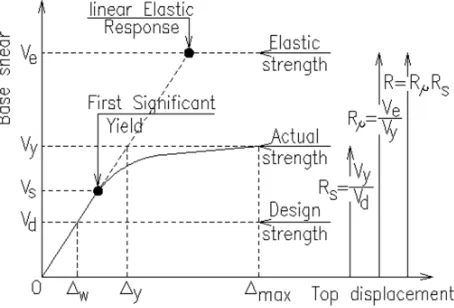
The key components of R factor, over strength and ductility
can be worked out on the basis of pushover curve as shown
in fig1.
Over strength and ductility were obtained from nonlinear
static pushover analysis that has been suggested in
FEMA365 and ATC40. The guidelines ATC and FEMA
mentioned include modeling procedures, acceptance criteria
and analysis procedures for pushover analysis. These documents define
force–deformation criteria for potential locations of lumped inelastic
behavior, designated as plastic hinges used in pushover analysis [4,5].
ETABS implements the plastic hinge properties described in FEMA365
and ATC40 [6].
Figure 1. Relationship between force reduction factor (R),
over strength ( ) and ductility ( )
C. Objective of the study
To obtain the response reduction factor (R), ductility, plastic
hinge status at performance point of the building on
different position of lateral force resisting system located in
seismic zone IV of India, and also identify the most
vulnerable building among the models.
D. Scope of the study
This work is focused on the study of seismic demands of
different position of shear wall in RC buildings using
various analysis techniques such as Equivalent static
analysis method, response spectrum method and pushover
analysis for seismic zone IV India. The analysis result
would be compered for 10 storey buildings in terms of the
response reduction factor (R), ductility, and plastic hinge
status at performance point in nonlinear analysis using
IS1893-2002.
II. DESCRIPTION OF STRUCTURAL MODEL
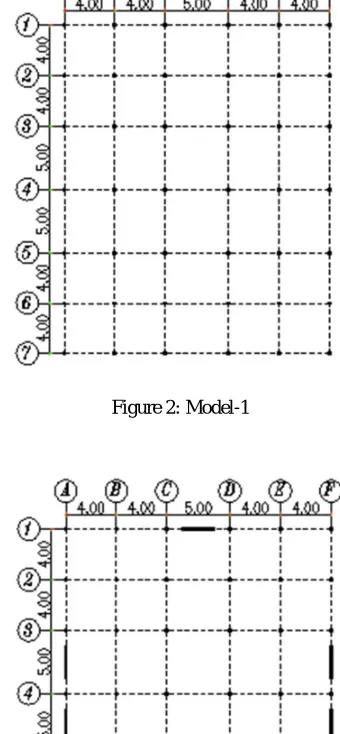
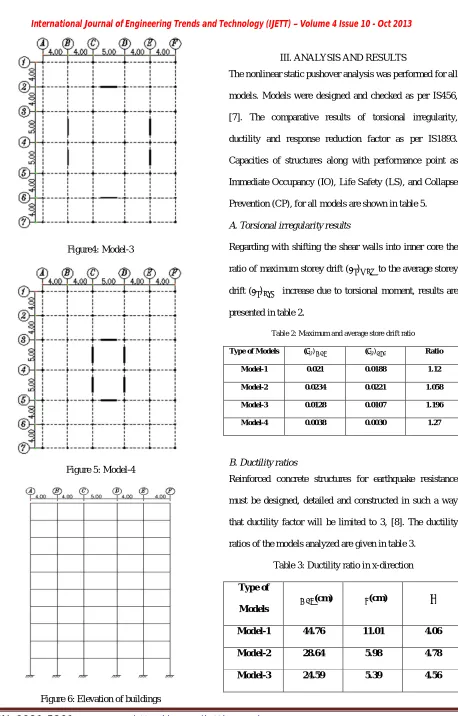
In this study symmetrical floor plan layout of 3D reinforced
concrete residential building with moment resisting RC
frame and dual systems were selected as shown in fig 2 to 6.
The buildings consist of 10 storey floor and a storey height
of 3.0 m each in all the floors, but the plan was unaltered to
avoid any irregularity effects. Buildings are located in
ISSN: 2231-5381 http://www.ijettjournal.org
Page 4600 medium. Response reduction factor for the special momentresisting frame has taken as 5. All the four models are
designed and analyzed as per IS456, 2000 [7]. Further
inputs include unit weight of the concrete is 25 KN/m3,
elastic modulus of concrete is 25*106 KN/m2, compressive
strength of concrete is 25 N/mm2 (M25), yield strength of
steel is 415 N/mm2 (Fe 415),elastic modulus of steel is
2*108 KN/mm2. The loading of building was assumed to be
dead load 5.5 KN/m2, live load 2.0 KN/m2, and weight of
floor finishes is 1 KN/m2. Percentage of imposed load to be
considered in seismic weight calculation 25.The support
condition of columns was assumed to be fixed at ground
level. All columns and beams had different dimensions in
height, dimension of columns vary between 0.40*0.40 m
and 0.65*0.65 m, dimension of beam vary between
0.40*0.30 m and 0.30*0.30 m and thickness of slab is
0.15m, and thickness of shear walls vary between 0.35*0.20
m. finally the example structure used in this study are
following.
1. Model-1: Moment resisting RC frame.
2. Model-2: Dual system, shear walls are arranged in
outer periphery.
3. Model-3: Dual system, shear walls are arranged in
middle of building.
4. Model-3: Dual system, shear walls are arranged as
inner core.
And elevation of buildings is shown in fig 6.
Figure 2: Model-1
ISSN: 2231-5381 http://www.ijettjournal.org
Page 4601 Figure4: Model-3Figure 5: Model-4
Figure 6: Elevation of buildings
III. ANALYSIS AND RESULTS
The nonlinear static pushover analysis was performed for all
models. Models were designed and checked as per IS456,
[7]. The comparative results of torsional irregularity,
ductility and response reduction factor as per IS1893.
Capacities of structures along with performance point as
Immediate Occupancy (IO), Life Safety (LS), and Collapse
Prevention (CP), for all models are shown in table 5.
A. Torsional irregularity results
Regarding with shifting the shear walls into inner core the
ratio of maximum storey drift ( ) to the average storey
drift ( ) increase due to torsional moment, results are
presented in table 2.
Table 2: Maximum and average store drift ratio
Type of Models ( ) ( ) Ratio
Model-1 0.021 0.0188 1.12
Model-2 0.0234 0.0221 1.058
Model-3 0.0128 0.0107 1.196
Model-4 0.0038 0.0030 1.27
B. Ductility ratios
Reinforced concrete structures for earthquake resistance
must be designed, detailed and constructed in such a way
that ductility factor will be limited to 3, [8]. The ductility
ratios of the models analyzed are given in table 3.
Table 3: Ductility ratio in x-direction
Type of
Models
∆ (cm) ∆ (cm)
Model-1 44.76 11.01 4.06
Model-2 28.64 5.98 4.78
ISSN: 2231-5381 http://www.ijettjournal.org
Page 4602Model-4 19.65 4.9 4.01
C. Hinge Status at Performance Point
Pushover curves obtained from nonlinear static pushover
analysis shows capacity of the structure under axial forces
and performance point. The first changes in curves, shows
yield point for structural system. The performance of the
structure is estimated by the state of the structure at
performance point it can be done by studying the status of
the plastic hinges formed at different location of structure.
The point is that studying the state of hinges at performance
point is important. The statuses of plastic hinges at
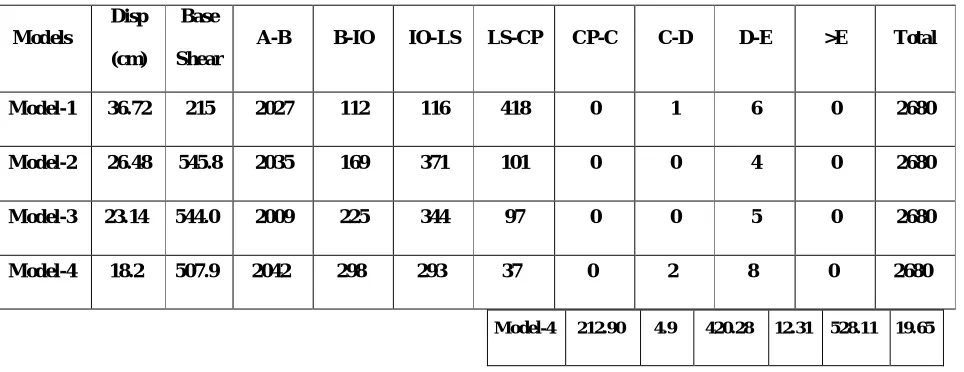
performance point are tabulated in table 4. From the data
presented in table 4, the effect of torsional irregularity on
the status of plastic hinges at performance point can be seen.
In this case as the torsional irregularity increase the number
of hinges beyond collapse (D-E range) also increase.
Table 4: Hinge status at performance point in x- direction for all models
Models
Disp
(cm)
Base
Shear
A-B B-IO IO-LS LS-CP CP-C C-D D-E >E Total
Model-1 36.72 215 2027 112 116 418 0 1 6 0 2680
Model-2 26.48 545.8 2035 169 371 101 0 0 4 0 2680
Model-3 23.14 544.0 2009 225 344 97 0 0 5 0 2680
Model-4 18.2 507.9 2042 298 293 37 0 2 8 0 2680
D. Response reduction factor
Base shear and displacement at performance level obtained
from pushover curve are given in table 5.
Table 5: Base shear (ton) and Displacement (cm) at
Performance level for all models
Type of Models
IO LS CP
Base Shear
Disp Base Shear
Disp Base Shear
Disp
Model-1 169.35 11.01 187.79 13.64 217.74 44.76
Model-2 207.37 5.98 445.16 17.94 566.82 28.64
Model-3 212.90 5.39 423.04 13.89 561.29 24.59
Model-4 212.90 4.9 420.28 12.31 528.11 19.65
From the data presented in table 1, 3 and 5, response
reduction factor (R) is obtained as fallowing.
= ∗ ∗
Results are tabulated in table 4
Table 6: Response reduction factor for all models
Type of
Models
Model-1 1.28 1.00 3.98 5.10
Model-2 2.73 1.00 4.89 13.35
Model-3 2.63 1.00 4.7 12.36
ISSN: 2231-5381 http://www.ijettjournal.org
Page 4603 IV. CONCLUSINONS1. There is no mention for the effect of torsional irregularity
in IS1893-2002, thus result shows that when shear walls
shift to the inner core the ratio of maximum storey drift to
the average storey drift, increase to more than allowable
value 1.2. In this case the value of accidental torsional (5%)
must be increase.
2. Ductility ratio for model with inner core shear wall has
value 4.01, in comparison with outer periphery shear wall
that has 4.78 value, from the above observation it can be
seen that model with inner core shear wall regarding with
shifting shear walls into inner core is going to be less.
Although ductility ratio in model, without shear wall value
in comparison with other models is less it can be said that
building with inner core shear wall and without shear wall
are more pronounce towards brittle failure.
3. It can be seen that when structural ductility increases,
response reduction factor (R), increases.
4. In case of building without shear wall according to its
value of response reduction factor R= 5.10 it can be
observed that the buildings have less value of R as
compared to building with shear wall.
5. It can be observed that due to shifting shear walls into
inner core, the number of hinges in beyond collapse (D-E
range) increase. Overall the performance of structure with
outer periphery shear wall is satisfactory and more elements
in model with inner core shear wall require retrofitting.
REFRENCES
[1]. IS1893. Bureau of indian Standards code, IS1893-2002,
"Criteria for earthquake resistant design of structures", part I:
General Provisionsand Buildings, Fifth revisio, Bureau of
Indian Standards, New delhi, India., 2002.
[2]. FEMA273. NEHRP Guidelines for theSseismic Rehabilitation
of Buildings, Federai Emergency Management Agancy, 1997.
[3]. ATC19. "structural response modification factors", Applied
technology concil, rewood city, california, 1995.
[4]. FEMA365. Evaluation of Earthquake damaged cocrete and
masonry wall building - Basic procedures manual.
Washington, D.C. : Federal Emergency Management Agency.,
1997.
[5]. ATC40. seismic evaluation and Retrofit of Cocrete Buildings,
Applied Technology Council, redwood City, CA., 1996.
[6]. ETABS9.7.0. Nonlinear Version 9.7.0. 2000. Extended 3-D
analysis of the Bbuilding Systems computers and structures
Inc. 2000 Berkeley, california, 2000.
[7]. IS456. Bureau of Indian Standards code, IS456-2000,"Plain
and reinforced concrete-code of Practic",Bureau of Indian
Standards, New Delhi, India., 2000.
[8]. B.G. NARESH KUMAR AND AVINASH GORNALE.
"Seismic Performance Evaluation of Torsionally Asymmetric