SCITECH Volume 5, Issue 5
RESEARCH ORGANISATION
April 27, 2016
Journal of Research in Business, Economics and Management
www.scitecresearch.com
A Model Suggestion and an Application for Nurse Scheduling
Problem
Harun Sulak
1, Mustafa Bayhan
21 Assistant Professor, Suleyman Demirel University, Isparta, Turkey. 2 Assistant Professor, Pamukkale University, Denizli, Turkey.
Abstract
In the health sector, the hospital management’s main and important problem that they come across is the 24 hour shift planning for the service personnel. With a good shift plan, the personnel’s work load is optimized and their work productivity will be provided and when the monthly shift schedule is prepared, the uncertainty and confusion will be overcome. In this study, the blood bank centre nurses scheduling problem is taken into hands in a university hospital where the service is given 7 days, 24 hours, and the daily working hours are between 08.00-16.00 and 16.00-08.00, and the personnel work 40 hours a week. An optimized complex goal programming model is suggested by taking into consideration the centres working hours and the personnel’s leave situation. The main purpose of this suggested model is to determine how to minimi ze the deviations of the nurses’ day and night shifts. It has been seen with the application of the model the optimum shift schedule, compared to the previous hospital managements schedule was obtained, workload is more effectively planned, objective planning of the shifts schedule and a balanced work load have achieved.
Keywords:
Shift Planning; Nurse Scheduling; Integer Goal Programming.1.
Introduction
For nearly half a century, operations researchers have densely worked on shift planning problem areas. Shift plans is based on a 24 hour working plan for police, health, fire brigade personnel, which can be very confusing together with this it can be a very important problem for their motivation. Together with this, when creating the time schedules for match programmes, university lesson and examination programmes aeroplane, train and other public transportations, the suggested model can be used for creating the shift plans. Due to the problem itself and original conditions, there is no generalised individual solution model for these problems. However, flexible models have been obtained for similar problems which include the goal and constraints. In this study, for a monthly period a shift plan has been used for a university hospitals blood bank department with 11 nurses. In the current situation, the schedule that is made by the head nurse manually and subjectively, as a result of this, problems like work malfunctions, continuous 24 hour work and long term leave can be seen. In the suggested model, these problems are rectified and are more effective; each personnel’s monthly day and night working hours are balanced.
2.
Literature
Nurse scheduling problems is a significant problem for the health sector and intensive studies found in the literature for personnel working 24 hours, seven days a week and multiple shifts. Due to the hospitals working structure and limitations are different; studies made in this area have various procedures and methods.
Cheang et al. (2003) who has made a bibliographic study, until that time they have evaluated the nursing schedules, the models used and the solution methods have been extensively studied and a summary has been presented. In this study generally 0-1 integer decision variable have been used and 16 strict and flexible limitations have been mentioned. When goal programming is intensely preferred as an objective function, the scheduling structures problems are usually connected to more complex functions as well as simple objective functions too. The solution methods are usually cycling or non-cycling, the optimization or decision approach for the working period is determined to be the two methods that is used. In optimization methods generally a mathematical model is used, the decision method generally prefers the heuristic methods. Having too many çonstraints and variables used in problems, in late years very little time and satisfying results based on heuristic methods are much more preferred to the mathematical models which takes up more time and doesn’t reach a definite result. For other literature reviews see Ernst et al. (2004) and Brucker et al. (2011).
Bellanti et al. (2004) in a hospital, they have solved the nurse’s time scheduling problem by including the holiday times by using the greedy method. Not to come across with an infeasible region problem where this aim that is not a suitable solution, they have used a local search approach and tabu search method. As long as this model exists, the solution results and timing has made positive results. The developed programming is used for the hospital scheduling purpose.
Azaiez and Sharif (2005) have used the 0-1 goal programming method for the nurse scheduling, and have solved the 6 monthly schedules by using the Lingo packet programme for the 1798 nurses working for a big health organization located in Saudi Arabia. The result obtained, according to the evaluation criteria in the literature, has given very consistent and positive results.
Topaloğlu (2006) has developed a goal programming model for the monthly scheduling problem, for an emergency hospital which has units who have very busy and heavy working conditions. In the model while satisfying strict constraints, flexible constraints have been found and accepted. To determine the importance degrees of the flexible comparatives in the model, the Analytic Hierarchy Process has been used. In the study, the most important results based on actual data used in the application, in regards to the application done via hand has produced more fast and quality printouts.
Tsai and Lee (2010), have developed an effective solution method for the nurse scheduling problem by using the two stepped mathematical optimization model. In the first step, leave and holiday schedule was prepared for the nurses, so the base had been provided and the main limitations are not violated. In the second step, with the Genetic algorithmic the suitable working plan has been determined according to the nurses’ preferences and the hospital management’s needs.
Wong and Chin (2014), have used a two stepped heuristic approach for the handling of the nurse scheduling problem. In the first step, have strict limitations have been provided for the solution, and in the second step have taken into account the nurses requests for the study. They have solved the scheduling problem in the busy and stressful emergency service, by using the two stepped heuristic and local search approach and used Excel for the solution. Using Excel solution, which is easy to understand and apply, is separated their study from the previous studies.
Benazzouz et al. (2015) present a literature review for the last decade on nurse scheduling problems. They classified the different models with respect to objective functions and constraints.
In this study, we have solved the nurse scheduling problem in the blood bank unit which works on a 24 hour basis, with more than once shift, by using the Excel Solver Premium method as a goal programming. In the solution process of this study, which is one of the rarely used Excel Solver studies, is distinctive because it is easy to understand and apply model that can be used by the decision makers who do not have sufficient information about optimization.
3.
Model
The proposed model will be used to create monthly working calendar of 11 personnel who work in Blood Collection Center of University Hospital in Turkey. Main conditions that will be obeyed in order to obtain the model as follows:
a) Blood Collection Center consists of two parts. They are Central Laboratory and other laboratory in another building.
b) Working hour is between 08:00 – 16:00 (8 hours) and 16:00 – 08:00 (16 hours) as two shifts in central laboratory.
c) Working hour is between 08:00-24:00 (16 hours) as one shift in other laboratory.
d) In Central Laboratory at least 2 personnel must work in a daytime and nighttime; but in other laboratory, only 1 personnel should work and that person works 16 hours as shift.
e) Personnel who are on night shift between 16:00 – 08:00 should not work next day and night.
Parameters, decision variables, objective function and constraints are detailed as follows:
Parameters:
personnel index, =1,…,11
day index in monthly planning period, =1,…,31
shift index, =1 day shift (08:00 – 16:00), =2 night shift (16:00 – 08:00), =3 other laboratory shift (08:00 – 24:00)
Decision Variables:
{
{
Objective Function:
Objective function reduces the negative and positive deviations of monthly working hours, day and night shifts as working hours. For calculations to bring the same units in hours, deviations of day and night shifts are multiplied by 8 and 16 for day and night shift deviations respectively.
∑( ( (
Constraints:
i) During one month working period, each personnel should work 176 hours at least. Each of them should work 8 hours in a day and it is necessary to work 176 hours in one month because it has only 22 working days.
∑
∑ ∑
ii) 2 personnel should be on day shift (08:00 – 16:00) in Central Laboratory.
∑
( (
iii) 2 personnel should be on night shift (16:00 – 08:00).
∑
( (
iv) 1 personnel should work (08:00 – 24:00) in other laboratory.
∑
( (
v) Each personnel should be on at most one shift in a day.
∑
vi) A personnel who is on night shift (16:00 – 08:00) cannot be on both day and night shifts next day. ( ( ( (
vii) A personnel who is on shift in other laboratory cannot be on both day and night shifts next day. ( ( ( (
viii) A personnel should be 2 working days on other laboratory shift at least because it is required to distribute the shifts between those three shifts levelly. For this reason, 11 personnel should work 2 days in a monthly period in other laboratory so some of them will work 3 days.
∑
( (
ix) Each personnel should be on 6 shifts in both day and night at least because day and night shifts must be equal. If they are on shifts more or less than 6, it is aimed to be minimum in objective functions of calculated day and night shift deviations.
∑
( (
∑
( (
x) Each personnel should take leave for 2 consecutive days at least three times in a month. ; is 1 if personnel i starts vacation in day j; and if they cannot start vacation this decision variable is 0. If they start vacation, other variables except for in limit balance show that they take 2 consecutive days because this variable will take 0 values. If they cannot start vacation ( = 0), one of the other variables will take 1 value. Namely, they will be on any shift within two days.
( ( ( ( ( xi) The number of taking vacation will be at least three times 2 consecutive days in a monthly period of each
personnel.
∑
(
4.
Model Solution
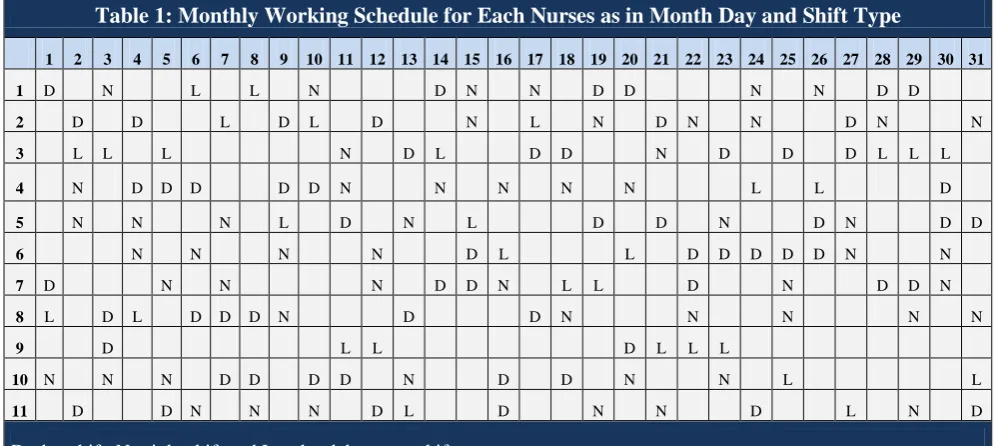
The model was solved with Excel Analytic Solver Platform and working schedule for each nurse can be summarized as in the following Table 1.
Table 1: Monthly Working Schedule for Each Nurses as in Month Day and Shift Type
1 2 3 4 5 6 7 8 9 10 11 12 13 14 15 16 17 18 19 20 21 22 23 24 25 26 27 28 29 30 31
1 D N L L N D N N D D N N D D 2 D D L D L D N L N D N N D N N 3 L L L N D L D D N D D D L L L 4 N D D D D D N N N N N L L D 5 N N N L D N L D D N D N D D 6 N N N N D L L D D D D D N N 7 D N N N D D N L L D N D D N 8 L D L D D D N D D N N N N N 9 D L L D L L L 10 N N N D D D D N D D N N L L 11 D D N N N D L D N N D L N D
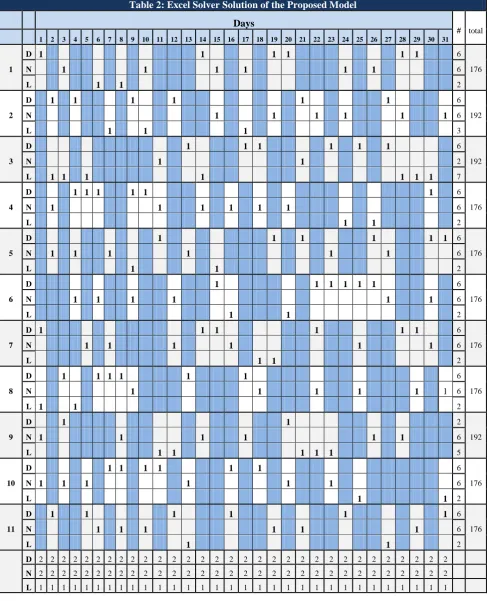
The overall solution of the model is presented below. As seen from the Table 2; only three nurse work more than 176 hours. This is normal because five nurse is required for daily work load 64 hours a day. In one month this requirement is (31 day * 64 hours) totally 1984 hours. On the other hand each nurse should work 176 hours in a month so 11 nurse can work only 1936 hours (11 * 176) in a month. The difference of 48 hours is the overload work hours of three nurses in the model.
Table 2: Excel Solver Solution of the Proposed Model
Days
# total 1 2 3 4 5 6 7 8 9 10 11 12 13 14 15 16 17 18 19 20 21 22 23 24 25 26 27 28 29 30 31
1
D 1 1 1 1 1 1 6 176 N 1 1 1 1 1 1 6 L 1 1 2
2
D 1 1 1 1 1 1 6 192 N 1 1 1 1 1 1 6 L 1 1 1 3
3
D 1 1 1 1 1 1 6 192 N 1 1 2 L 1 1 1 1 1 1 1 7
4
D 1 1 1 1 1 1 6 176 N 1 1 1 1 1 1 6 L 1 1 2
5
D 1 1 1 1 1 1 6 176 N 1 1 1 1 1 1 6 L 1 1 2
6
D 1 1 1 1 1 1 6 176 N 1 1 1 1 1 1 6 L 1 1 2
7
D 1 1 1 1 1 1 6 176 N 1 1 1 1 1 1 6 L 1 1 2
8
D 1 1 1 1 1 1 6 176 N 1 1 1 1 1 1 6 L 1 1 2
9
D 1 1 2 192 N 1 1 1 1 1 1 6 L 1 1 1 1 1 5
10
D 1 1 1 1 1 1 6 176 N 1 1 1 1 1 1 6 L 1 1 2
11
D 1 1 1 1 1 1 6 176 N 1 1 1 1 1 1 6 L 1 1 2
5.
Conclusion
In this study, monthly working calendar of 11 personnel who work in blood collection unit of a public university in Turkey has been discussed and it has been solved by using goal programming techniques and Excel solver Premium program. The problem that needs more help and takes a long time is solved in a short time by taking necessary working conditions into consideration. As a result of study, equilibrium distribution between shifts in monthly working period has been provided and overtime hours in a month have achieved. It is a useful method for unit personnel who do not have information about optimization and schedule. It is separate from other studies because working calendar can be obtained by Excel. This study can be used easily after making small changes in many institutions’ personnel who work in security and fire departments.
References
[1] Ernst, A.T., Jiang, H., Krishnamoorthy, M., & Sier, D. (2004). Staff scheduling and rostering: a review of applications, methods and models. European Journal of Operational Research, 153(1), 3–27.
[2] Azaiez, M.N. & Sharif, S.S. (2005). A 0-1 goal programming model for nurse scheduling. Computers and
Operations Research, 32(3), 491-507.
[3] Bellanti, F., Carello, G., Della Croce, F., & Tadei, R. (2004). “A greedy-based neighborhood search approach to a nurse rostering problem,” European Journal of Operational Research, 153(1), 28–40.
[4] Tsai, C.C., & Lee, C.J. (2010). Optimization of Nurse Scheduling Problem with a Two-Stage Mathematical Programming Model. Asia Pacific Management Review, 15(4), 503-516.
[5] Cheang, B., Li, H., Lim, A., &R odrigues, B. (2003). Nurse rostering problems-A bibliographic survey.
European Journal of Operational Research, 151(3), 447-460.
[6] Brucker, P., Qu, R., & Burke, E. (2011). Personnel scheduling: models and complexity. European Journal of
Operational Research, 210(3), 467–473.
[7] Thornton, J.R., & Sattar, A. (1997). Nurse Rostering and Integer Programming Revisited. International
Conference on Computational Intelligence and Multimedia Applications, ICCIMA '97, Gold Coast, Australia,
February 10-12, 1997, 49-58.
[8] Topaloglu, S. (2006). A multi-objective programming model for scheduling emergency medicine residents.
Computers & Industrial Engineering, 51(3), 375–388.
[9] Benazzouz, T., Echchatbi , A., & Bellabdaoui, A. (2015). A Literature Review on the Nurses’ Planning Problems, International Journal of Mathematics and Computational Science, 1(5), 268-274.
[10] Wong, T.C., Xu, M., & Chin, K.S. (2014). A two-stage heuristic approach for nurse scheduling problem: a case