Computing the Refined Compression Field Theory
A. M. Herna´ndez-Dı´az
1),*, and M. D. Garcı´a-Roma´n
2)(Received December 3, 2015, Accepted March 31, 2016, Published online May 19, 2016)
Abstract: In recent years, some modifications were introduced in the stress–strain relationship of the steel in order to develop a more efficient shear model for reinforced concrete members. The last contribution in this sense corresponding to the Refined Compression Field Theory (RCFT, 2009); this theory proposed a steel constitutive model that has account the tension stiffening area prescribed by technical codes, what simplifies all the design process. However, under certain design conditions supported by such codes, the RCFT model does not provide a real (non-complex) solution for the steel yield strain when the prescribed tension stiffening area is considered; then the load-strain response cannot be computed. In this technical note, the tension stiffening area is fixed in order to guarantee the application of the embedded steel constitutive model for all the standard design range.
Keywords:reinforced concrete, compression field theories, steel constitutive model, tension stiffening area, solvability.
1. Introduction
The design and analysis of reinforced concrete members subjected to shear may be performed taking into consider-ation different strategies reported in the literature, among several others (ASCE-ACE Committee 445 on Shear and Torsion1998; Herna´ndez-Dı´az and Gil-Martı´n2012; Jeong and Kim2014; Mofidi and Chaallal2014). One of the most widely known is the so-called Modified Compression Field Theory (MCFT) (Vecchio and Collins1986). In the MCFT, the stress–strain relationship for the steel reinforcement is assumed to be elastic-perfectly plastic, being the Young’s modulus constant up to the yield strength (fy) and then zero
upon yielding at the crack location. To allow new increments of shear force, MCFT introduces the notion of local shear stress, and as a consequence, requires the check of equilib-rium conditions for local shear stresses at the crack location in order to ensure that the steel stress does not exceed the steel yield strength.
A few years ago, Gil-Martı´n et al. (2009) proposed a new steel constitutive model leading to the Refined Compression Field Theory (RCFT). In the line of a few other shear the-ories, such as the Rotating Angle-Softened Truss Model (RA-STM, Belarbi and Hsu 1994), the RCFT proposes a stress–strain relationship for the reinforcing bars stiffened by
concrete (‘‘embedded bar model’’); the novelty is that the embedded bar stress–strain relationship is obtained imposing equilibrium on the tension stiffening effect; so new formu-lation for the steel model would no longer be needed (compared with RA-STM) and the crack check can be avoided (compared with MCFT). According to Gil-Martı´n et al. (2009), from equilibrium of forces between a cracked section and a generis section (see Fig.1a), the RCFT pre-dicts the average stress (along the bar between cracks) of an embedded bar as a function of the average strain (i.e., measured on certain length including several cracks):
rs;av¼
fyAAcs1þp3fffiffiffiffiffiffiffiffiffiffict:6Mes if esemax
Eses if es\emax
(
with
emax ¼
fy
Es
fct
1þ ffiffiffiffiffiffiffiffiffiffiffiffiffiffi3:6Memax
p
EsAs
Ac
M ¼ PAc
/p
ð1Þ
wherers,avis the average tensile stress in steel (for longitudinal
or transverse reinforcement),Asis the cross section of steel bar
(longitudinal or transverse),esis the average tensile strain in steel
and concrete,fctis the tensile strength of concrete,Esis the elastic
modulus of reinforcement,emaxis the apparent yield strain (or
average tensile strain when first yielding occurs at the crack location, Fig.1) andAcis the area of concrete bonded to the bar.
Technical codes (e.g., EHE2008) usually defineAcas a value
equal to the rectangular area (tributary to and surrounding the bar) over a distance not exceeding 7.5Ø from the center of the bar (Fig.1b), and Ø is the diameter of the bar. Hereafter, we refer to Ac as the prescribed tension stiffening area. In Eq. (1) the
embedded bar stress–strain relationship is established for the concrete tension stiffening model proposed by Bentz (2005). 1)
Department of Civil Engineering, Universidad Cato´lica de Murcia (UCAM), Campus de Los Jero´nimos, 30107 Murcia, Spain.
*Corresponding Author; E-mail: [email protected] 2)Department of Civil Engineering, University of La
Laguna, Campus de Anchieta, 38271 Santa Cruz de Tenerife, Spain.
CopyrightÓThe Author(s) 2016. This article is published with open access at Springerlink.com
International Journal of Concrete Structures and Materials Vol.10, No.2, pp.143–147, June 2016
Numerical results obtained from RCFT for different tested specimens (Gil-Martı´n et al.2009; Palermo et al.2013) show a better fitting of the experimental results, in particular near the peak point in the shear response curve, where the MCFT significantly deviates from the experimental evidences. Nevertheless, it can be proved that when the prescribed tension stiffening area (Ac) is adopted, for certain specimens
(specifically those with high values of the ratiofct/q, beingq
the reinforcement ratio) it is not possible to obtain a positive real solution for the apparent yield strain (emax) defined in
Eq. (1). If all terms in the expression of the apparent yield strain are moved to the right hand side, the following functionGis obtained:
emax ¼
fy
Es
fct
1þ ffiffiffiffiffiffiffiffiffiffiffiffiffiffi3:6Memax
p
EsAs
A0c!G½fct;emax
¼eyemax A0
cfct
1þ ffiffiffiffiffiffiffiffiffiffiffiffiffi3:6Memax
p
EsAs
ð2Þ
whereeyis the strain corresponding tofy(i.e.,ey=fy/Es). A
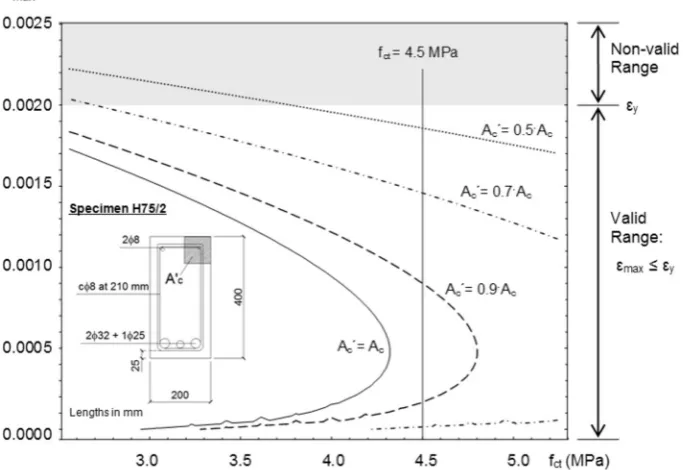
new variable,A0c, has been introduced in Eq. (2) in order to discuss the solvability of this equation in terms of the ratio A0c=Ac. To illustrate the effect of the tension stiffening area in the solvability of the RCFT model, the top longitudinal rein-forcement of a beam (specimen H75/2) tested in shear by Cladera in2002has been considered. The top longitudinal bar diameter is 8 mm, the side cover is 25 mm, the prescribed tension stiffening area (according to EHE) is 9025 mm2, the tensile strength of concrete (fct) is 4.5 MPa and the yield stress
of steel (fy) is 530 MPa. The functionG[fct,emax] has been
represented in Fig.2for different values ofA0c, resulting in a set of curves. For this specimen, the apparent yield strain (emax)
corresponds to the intersection points of these curves with the abscissafct=4.50 MPa.
The interval adopted for the strengthfctin Fig.2coincides
with the range established for this parameter by EC-2 (2002).
It can be seen that, for high values ofA0c(likeA0c¼0:7Acand
A0c¼0:9Ac), the curveG[fct,emax]=0 presents a knee that
breaks the bijection betweenfctandemax(problem of
unique-ness), or even, no solutions exists foremax(problem of
exis-tence), as it occurs by taking A0c¼Ac in this specimen. In relation to the problem of uniqueness, by continuity and taking into account thatemax=eywhenA0c¼0 (cf. Gil-Martı´n et al.
2009), the actual value ofemaxis that of the solution closest to
the yield strainey, that is, the greatest one of the two positive
real solutions of Eq. (2). However, the absence of solution in the steel constitutive model proposed by RCFT indicates that the equilibrium of internal forces along the cracked member (see Fig.1) is not verified, and therefore, the stress–strain relationship for the steel must be corrected.
2. Fixing the Tension Stiffening Area
Hereafter, assumefctis a parameter, and abusing the
nota-tion, denote also byG[emax,A0c] the above mentioned bivariate
functionG[fct,emax]. In Fig.3a the functionG[emax,A0c] has been represented for three values ofA0c; this figure shows that the equation G [emax, A0c]=0 ceases to have positive real
solutions when the value of A0cis greater than the one that makes the graphic of Gtangent to the positive part of the abscise axis. This turns out to happen when both functions G[emax,A0c] andG0[emax,A0c] vanish simultaneously, where:
G0½emax;A0c ¼
ffiffiffiffiffiffiffiffiffiffiffi 3:6M p
A0cfct
2AsEs 1þ ffiffiffiffiffiffiffiffiffiffiffiffiffiffiffiffiffiffiffi3:6Memax
p
2 ffiffiffiffiffiffiffiffi
emax
p
1;emax[0 ð3Þ
is the derivative of G[emax, A0c]. Solving the system of equations {G[emax, A0c]=0, G0 [emax, A0c]=0} in the unknowns emax and A0c, the positive real solution for the apparent yield strain is
Fig. 1 aSteel embedded bar in tension (adapted from Gil-Martı´n et al.2009);bAreaAcof concrete bonded to the bar (according
emax ¼
2þ10:8Mey2pffiffiffiffiffiffiffiffiffiffiffiffiffiffiffiffiffiffiffiffiffiffiffiffiffi1þ10:8Mey
32:4M ;
and it is solvable only when
A0c¼Asfy fct
2 3þ
ffiffiffiffiffiffiffiffiffiffiffiffiffiffiffiffiffiffiffiffiffiffiffiffiffiffiffiffiffiffiffi ð1þ10:8MeyÞ3
q
1 48:6Mey
0 @
1 A
This value of A0c is the greatest one for which G [emax,
A0c]=0 has, at least, a positive real solution. Let us denotek
the factor:
k¼ Asfy Acfct
2 3þ
ffiffiffiffiffiffiffiffiffiffiffiffiffiffiffiffiffiffiffiffiffiffiffiffiffiffiffiffiffiffiffi ð1þ10:8MeyÞ3
q
1 48:6Mey
0 @
1
A: ð4Þ
In a general sense, the factorkrepresents the greatest portion of the tension stiffening area which may be taken in order to
preserve the internal equilibrium of forces, in such a way that as concrete participation increases, the steel stress diminishes. According to this consideration, the effect of tension stiffening area over the embedded steel behavior model is illustrated in Fig.3b for the case of specimen H75/2.
Several studies (Gil-Martı´n et al. 2009; Palermo et al. 2013; Herna´ndez-Dı´az2012; Palermo et al.2014) show the convenience of correcting the prescribed tension stiffening area in order to adjustment the shear response of reinforced concrete members, particularly for high shear strains, where the technical codes underestimate the concrete tension stiffening (Gil-Martı´n et al. 2009; Herna´ndez-Dı´az 2012). This strategy only can be performed for those values ofA0c such that 0A0
c=Ack. In order to display the usefulness of the coefficient k, a widely validated shear test (Abersman and Conte 1973), apud (Collins and Mitchell 1991;
Fig. 2 Specimen H 75/2 (Cladera Bohigas 2002): solvability graphical analysis for apparent yield strain (emax) in the top
longitudinal reinforcement.
Fig. 3 Parameters of RC section:fy=530 MPa,fct=4.50 MPa,As=50.27 mm2(1 Ø 8),Ac=9025 mm2:aFunctionG[emax] for
different values ofA0c; the equationG[emax]=0 has no positive real solutions whenA0c=Acis greater than the limit valuek.
Herna´ndez Montes and Gil-Martı´n2014), has been consid-ered; to this aim, the load-strain curve of the tested specimen has been predicted using the RCFT under two assumptions: (1) neglecting the contribution of the concrete tension stiff-ening area surrounding the reinforcement bars (i.e.,A0
c&0), and (2) considering the limit value of the tension stiffening area established by the coefficientk. These two curves have been illustrated in Fig.4 together the experimental shear response obtained in (Abersman and Conte 1973). As shown, the experimental results lie about halfway the shear curve corresponding to the assumption (1) and the limit curve corresponding to the coefficientk; in particular, for a low-intermediate range of the shear strain, the limit tension stiffening area proposed in this work coincides approxi-mately with the experimental response. In this sense, the factor kestablishes a feasible (solvable) search domain for the experimental adjustment of RCFT model using meta-heuristic methods (cf. Herna´ndez-Dı´az 2012), what improves the computational effectiveness of this process.
In the preceding results, the tension-stiffening curve pro-posed by Bentz has been assumed; however, the formulation of coefficient k may be adapted to other tension stiffening models proposed in the literature (cf. Vecchio and Collins 1986; Palermo et al. 2013; Stramandinoli et al 2008; Her-na´ndez-Montes et al.2013; Wu and Gilbert2008) Recently, Herna´ndez-Montes et al. (2013) proposed a tension stiffen-ing curve, based on EC-2 formulation, which takes into account both the reinforcement ratio and the mechanic characteristics of the involved materials. Such expression is only valid until the reinforcement reaches the yield strain (ey)
at any crack location. Once more, the apparent yield strain (emax) may be obtained from internal equilibrium; in this
case, the above-defined function G adopts the following expression (see Eq. (13) at Carbonell-Ma´rquez et al.2014):
G½emax;qeff ¼eyemax
ffiffiffiffiffiffiffiffiffiffiffiffiffiffiffiffiffiffiffiffiffiffiffiffiffiffiffiffiffiffiffiffiffiffiffiffiffiffiffiffiffiffiffiffiffiffiffiffiffiffiffiffiffiffiffiffi qeff
2 Esemax
2
þf2
ct 1þnqeff
q
qeff
2 Esemax Esqeff
ð5Þ
wheren =Es/Ecandqeffis the effective reinforcement ratio
(qeff ¼As=A0c). Equation (5) represents a monotonically
decreasing function over the whole strain domain; therefore, in this case the value of A0c must be only constrained in order to avoid values ofemaxlower than the
average strain ect corresponding to the concrete tensile
strength (fct), then the expression of coefficientkis given by:
k¼qeff 2
ffiffiffiffiffiffiffiffiffiffiffiffiffiffiffiffiffiffiffiffiffiffiffiffiffiffiffiffiffiffiffiffiffiffiffiffiffiffiffiffi f2
ctn24fy fctnfy
q
fct
n 0
@
1
A ð6Þ
3. Conclusions
A practical relationship is obtained between the reinforce-ment area (As), the tensile concrete strength (fct) and the yield
stress (fy) for a given value of the tension stiffening area (Ac).
These four parameters are not independent, and three of them constrain the fourth one in order to preserve the internal equilibrium of a cracked member. Therefore, such relation must be satisfied in order to make operative the embedded steel constitutive model for every reinforced concrete sec-tion. Finally, this result is extensive to every structural system involving cracked embedded reinforcing bars.
Open Access
This article is distributed under the terms of the Creative Commons Attribution 4.0 International License (http://
creativecommons.org/licenses/by/4.0/), which permits
un-restricted use, distribution, and reproduction in any medium, provided you give appropriate credit to the original author(s) and the source, provide a link to the Creative Commons license, and indicate if changes were made.
References
Abersman, B., Conte, D. F (1973) The design and testing to failure of a prestressed concrete beam loaded in flexure and shear, BASc thesis, Department of Civil Engineering, University of Toronto, Canada.
Fig. 4 Prestressed concrete beam CF1 (Abersman and Conte1973): feasible search domain for the experimental adjustment of
ASCE-ACE Committee 445 on Shear and Torsion. (1998). Recent approaches to shear design of structural concrete. Journal of Structural Engineering, 124(12), 1375–1416. Belarbi, A., & Hsu, T. T. C. (1994). Constitutive laws of
con-crete in tension and reinforcing bars stiffened by concon-crete. ACI Structural Journal, 91(4), 465–474.
Bentz, E. C. (2005). Explaining the riddle of tension stiffening models for shear panel experiments. ASCE Journal of Structural Engineering, 131(9), 1422–1425.
Carbonell-Ma´rquez, Juan F., Gil-Martı´n, Luisa M., Ferna´ndez-Ruı´z, M. Alejandro, & Herna´ndez-Montes, E. (2014). Effective area in tension stiffening of reinforced concrete piles subjected to flexure according to Eurocode 2. Engi-neering Structures, 76, 62–74.
Cladera Bohigas, A. (2002)Shear Design of Reinforced High -Strength Concrete Beams, Ph.D. Dissertation, Technical University of Catalonia, Barcelona, Spain.
Collins, M. P., & Mitchell, D. (1991). Prestressed concrete structures. Upper Saddle River, NJ: Prentice Hall. EC-2 (2002),Eurocode. Design of concrete structures—part 1,
Brussels, Belgium.
EHE. (2008). Instruccio´n de Hormigo´n Estructural. Spain: Ministerio de Fomento, Gobierno de Espan˜a.
Gil-Martı´n, L. M., Herna´ndez-Montes, E., Aschheim, M., & Pantazopoulou, S. (2009). Refinements to compression field theory, with application to wall-type structures, ACI Special publication, 265, 123–142.
Herna´ndez Montes, E., & Gil-Martı´n, L. M. (2014).Hormigo´n armado y pretensado. Concreto reforzado y preesforzado. Madrid, Spain: Colegio de Ingenieros de Caminos, Canales y Puertos.
Herna´ndez-Dı´az, A. M. (2012) Revisio´n de las Teorı´as de Campo de Compresiones en Hormigo´n Estructural, Ph.D. Dissertation, University of Granada, Granada, Spain. Herna´ndez-Dı´az, A. M., & Gil-Martı´n, L. M. (2012). Analysis
of the equal principal angles assumption in the shear design
of reinforced concrete members. Engineering Structures, 42, 95–105.
Herna´ndez-Montes, E., Cesetti, A., & Gil-Martı´n, L. M. (2013). Discussion of ‘‘An efficient tension-stiffening model for nonlinear analysis of reinforced concrete members’’, by Renata S.B. Stramandinoli, Henriette L. La Rovere. Engi-neering Structures, 48, 763–764.
Jeong, J.-P., & Kim, W. (2014). Shear resistant mechanism into base components: Beam action and arch action in shear-critical RC members. International Journal of Concrete Structures and Materials, 8(1), 1–14.
Mofidi, A., & Chaallal, O. (2014). Tests and design provisions for reinforced-concrete beams strengthened in shear using FRP sheets and strips. International Journal of Concrete Structures and Materials, 8(2), 117–128.
Palermo, M., Gil-Martı´n, L. M., Herna´ndez-Montes, E., & Aschheim, M. (2014). Refined compression field theory for plastered straw bale walls. Construction and Building Materials, 58, 101–110.
Palermo, M., Gil-Martı´n, L. M., Trombetti, T., & Herna´ndez-Montes, E. (2013). In-plane shear behaviour of thin low reinforced concrete panels for earthquake reconstruction. Materials and Structures, 46(5), 841–856.
Stramandinoli, Renata S. B., Rovere, La, & Henriette, L. (2008). An efficient tension-stiffening model for nonlinear analysis of reinforced concrete members. Engineering Structures, 30(7), 2069–2080.
Vecchio, F. J., & Collins, M. P. (1986). The modified com-pression field theory for reinforced concrete elements subjected to shear.ACI Journal, 83(2), 219–231.