O R I G I N A L A R T I C L E
Open Access
Flapwise bending vibration analysis of
functionally graded rotating double-tapered beams
N. V. Ramesh Maganti
1*and Mohan Rao Nalluri
2Abstract
Background:During the past decade, many researchers have focused on the vibration characteristics of stationary and rotating functionally graded beams employing various methods of analysis. Hitherto, the studies have been mainly confined to uniform beams. Hence, the present study is aimed at studying the free vibration characteristics of functionally graded double-tapered rotating cantilever beam with symmetric cross section.
Material and Method:This paper presents a method which considers the deformation variables to determine flapwise bending vibrations of rotating functionally graded doubletapered beam attached to a rigid hub. The tapered beam is characterized by continuously variable Young’s modulus along the thickness direction according to a power law. The equations of motions are derived using hybrid deformation variables employing Lagrange’s approach. Rayleigh-Ritz method is used to evaluate the frequencies of the beam.
Results:The effect of several parameters such as material composition gradient, taper ratios, hub radius ratio and rotational speed on flapwise bending natural frequencies of tapered beams are investigated.
Conclusions:Variation in taper ratios affects the frequency parameters of the beam. The frequency parameters are observed to increase with an increase in hub radius. The power law index has negligible influence on the trend of flapwise bending natural frequencies with an increase in angular speed for different taper ratios.
Keywords:Functionally graded beam; Rotating beam; Rayleigh-Ritz method; Flapwise vibration; Double-tapered beam
Background
Generally, to increase the strength as well as stability of the structure and to reduce the weight, tapered beams have practical importance at the design stage of structures, such as the helicopter blades, rotating machinery, wind turbine blades, etc. The design as well as analysis and esti-mation of dynamic characteristics of these structures is very difficult. Centrifugal inertia force due to rotation is one of the critical factors in evaluating the dynamic char-acteristics of the rotating structures. Many researchers have investigated the dynamic characteristics of the homo-geneous rotating beams in the past. Tsai et al. (2011) in-vestigated the free vibrations for inclined Euler beam rotating at constant angular speed using the co-rotational finite element method combined with floating frame method. In this work, the equations of motion were de-rived in terms of an inertial global coordinate system using
d’Alembert principle and principle of virtual work. A method based on the power series solution was proposed by Huang et al. (2010) for a slender beam rotating at high angular velocity, in which the beam was divided into equal segments for estimating flapwise vibration and coupled lagwise and axial vibration. New shape functions that include the rotating speed, element position, and centrifu-gal stiffening effect were considered to derive new finite element to evaluate free vibrations of beams rotating at high speeds by Gunda et al. (2009). Usingp-version finite element method, the vibration characteristics of a rotating beam were obtained by Cheng et al. (2011). Fracture me-chanics and Lagrange equation were used to obtain crack element stiffness matrix and p-version finite element model respectively in the analysis. The vibrations and reli-ability of rotating beams were studied considering the random properties under random excitations by Hosseini and Khadem (2007). Finite element method and space state analysis were applied to obtain the equations of motion. Free vibrations of tapered rotating beam in elastic * Correspondence:[email protected]
1
Department of Mechanical Engineering, Nalla Malla Reddy Engineering College, Hyderabad, Telangana 500088, India
Full list of author information is available at the end of the article
and post elastic areas were evaluated using variational princi-ples to derive the equations of motions in the works of Das et al. (2009). Assuming the centrifugal force as constant, the differential equation of motion of rotating beam was reduced as stiff string and natural frequencies of uniform and tapered beams were evaluated by Ganesh and Ganguli (2013) using Rayleigh-Ritz method. A new finite element was developed by Babu Gunda and Ganguli (2008) satisfying the governing equation of Euler-Bernoulli rotating beams to study the static and dynamic behavior of rotating beam. Lin et al. (2006) evaluated bending-bending vibrations of rotating damped beam with pre-twist and an elastically restrained root and their effects on the complex frequencies of rotating beams were observed. Banerjee and Jackson (2013) studied on free vibration characteristics of a rotating tapered Rayleigh beam considering centrifugal stiffening, outboard force, arbitrary hub radius, and rotary inertia.
Smooth and continuous variation in material properties in one or more directions in case of structures like beams plates and shells, which are made from functionally graded materials (FGMs), exhibits several advantages over homogeneous and laminated composite materials. During the past one decade, many researchers have turned their interest to study the vibration and dynamic characteristics of FGM structures. Sankar (2001) developed a solution for a functionally graded beam subjected to transverse loads, whose Young’s modulus was assumed to vary in thickness direction, and found that the stress concentration depends on the distribution of constituent material of the beam. Based on two-dimensional theory of elasticity, Ying et al. (2008) proposed an exact solution for free vibrations of functionally graded beams resting on elastic foundation wherein material properties were assumed to vary in thickness direction as per exponential law. Higher order shear deformation theory was implemented by Kadoli et al. (2008) to study the behavior of the FG beam with variation of material composition based on power law under uniformly distributed load with different end condi-tions. Differential equation and its solution for deflection of FGM beams resting on elastic foundation using second-order theory were obtained by Murin et al. (2013) and used in free vibration analysis of the beams. Consider-ing the fourth-order differential equation of the second-order beam theory, modal analysis was carried out for beams by Aminbaghai et al. (2012). Using the first-order shear deformation theory, dynamic stiffness matrix was derived by Ziane et al. (2013) to evaluate the free vibra-tions of functionally graded box beam.
The above studies chiefly focused on the evaluation of dy-namic characteristics of homogeneous stationary and rotat-ing uniforms and FGM beams that are stationary. For the design and analysis of tapered rotating structures like wind turbine blades, helicopter blades, rotating machinery, etc., vi-bration characteristics are vital parameters. The knowledge
on these characteristics play a very important role in de-sign stage for studying the dynamic behavior and to avoid structural resonance. The flapwise and chordwise dynamic behavior of the beam depends on the nature of the transverse loads, geometry of the component, and the boundary conditions. Hitherto, the studies have been mainly confined to uniform beams. Hence, the present study is aimed at studying the free vibration characteris-tics of double-tapered rotating cantilever beam with symmetric cross section. The beam material considered is FGM and the variables considered are taper ratio, composition variation of material as per power law index, hub radius ratio, and rotational speed. The results so obtained are compared with those reported in the earlier works based on different approaches.
Material and Method Functionally graded beam
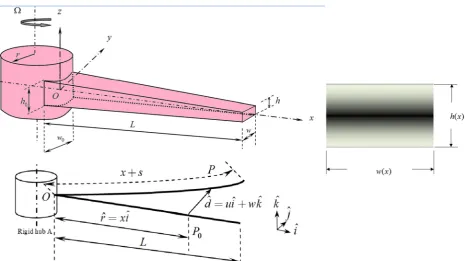
Consider a doubly symmetric cross-section functionally graded beam with length, L, width,w0, and height,h0, at
the root of the beam and width,w, and height,h, at the tip of the beam as shown in Fig. 1. The graded material prop-erties vary symmetrically along thickness direction from the core towards the surface according to a power law:
Pð Þz ¼Pð Þm þ Pð Þc−Pð Þm
2z
h
n ð1Þ
where P(z)represents an effective material property (i.e.,
density, P(z), or Young’s modulus,E(z)) andP(m)and P(c)
are metallic and ceramic properties, respectively.
The volume fraction exponent or power law index,n, is a variable whose value is greater than or equal to zero and the variation in properties of the beam depends on its mag-nitude. Structure is constructed with functionally graded material with ceramic rich at top and bottom surfaces (atz
=h/2 and−h/2) with protecting metallic core (atz= 0).
Equations of motion
For the beam considered in this study, the equations of motion are obtained with the following assumptions:
1. There is a smooth and continuous variation in properties along thickness direction.
2. The neutral and centroidal axes in the cross section of the rotating beam coincide so that effects due to eccentricity and torsion can be negligible.
3. Cross section of the beam varies uniformly along its length with the uniform taper.
4. Shear and rotary inertia effects of the beam are neglected due to slender shape of the beam.
constant angular speed and no external force acts on the beam. The beam rotates at an angular speed ofΩ(t) about thez-axis. In the present work, a hybrid set of Cartesian variablewand a non-Cartesian variablesis approximated by spatial functions and corresponding coordinates are employed to derive the equations of motion. The position of a generic point on the neutral axis of the double-tapered beam before deformation located atP0changes to Pafter deformation and its elastic deformation is denoted asd^that has two components in two-dimensional space.
Approximation of deformation variables
Using the Rayleigh-Ritz assumed mode method, the de-formation variables are approximated as
s xð Þ ¼;t X μ1
j¼1
ϕ1jð Þx q1jð Þt ð2Þ
and
w xð Þ ¼;t X μ3
j¼1
ϕ3jð Þx q3jð Þt ð3Þ
In the above equations, ϕ1j and ϕ3j are the assumed modal functions (test functions) fors and w, respectively. Any compact set of functions which satisfies the essential boundary conditions of the cantilever beam can be used as the test functions. Theqijs are the generalized coordinates andμ1andμ3are the number of assumed modes used for
s and w, respectively. The total number of modes, μ, is equal to the sum of individual modes, i.e.,μ=μ1+μ3.
The geometric relation between the arc length stretch
sand Cartesian variablesuandwpresented by Yoo and Shin (1998) as
s¼uþ1 2
Zx
0
w0 ð Þ2
dσ ð4Þ
where a symbol with a prime (′) represents the partial derivative of the symbol with respect to the integral do-main variable.
Strain energy of the system
The total elastic strain energy of the beam considering the assumptions given in “Functionally graded beam” section can be written as
Es¼
1 2E zð ÞA xð Þ
Z
L
ds dx
2
dxþ1 2E zð ÞIyð Þx
Z
L
d2w
dx2
2
dxði ¼ 1; 2;μÞ
ð5Þ
where Iy(x)is the second moment of area of the tapered
beam.
For the beam tapers in two planes, the general parame-ters of the beam are given by
h xð Þ ¼ho 1−τhx
L
ð6Þ
w xð Þ ¼wo 1−τwx
L
A xð Þ ¼A0 1−τwx
L
1−τhx
L
ð8Þ
Iyð Þ ¼x I0y 1−τwx
L
1−τhx
L 3
ð9Þ
where τw and τh are the width taper ratio and height taper ratio respectively and are defined as
τw¼ 1−w
w0
ð10Þ
τh¼ 1−h
h0
ð11Þ
where A0and I0yare area of cross section and area mo-ment of inertia of the beam at the root of the tapered beam respectively and are defined as
A0¼w0h0 ð12Þ
I0y¼b0w
3 0
12 ð13Þ
Kinetic energy of the system
The velocity of a generic pointPcan be obtained as
v
→P¼
v
→OþAd→p dt þω
→A
p
→ ð
14Þ
where →v O is the velocity of point Othat is a reference point identifying a point fixed in the rigid frame A; →ωo
vector→P in the reference frameAand the terms P→,→v o, andω→Acan be expressed as follows
p
→¼
xþu
ð Þ^iþv^j ð15Þ
v
→O¼
rΩ^j; ð16Þ
ω
→A¼Ω^
k ð17Þ
v
→p¼ u−_ Ω v
ð Þ^iþ½v_þΩðrþxþuÞ^j ð18Þ
where^ι,ĵ, andk^are orthogonal unit vectors fixed inA,ris the distance from the axis of rotation to pointO(i.e., radius of the rigid frame), andΩis the angular speed of the rigid frame. Using Eq.14, the kinetic energy of the rotating beam is derived as
Ek ¼
1 2
ZL
0
ρð Þz A xð Þ→v p:→v pdx ð19Þ
In which, A(x) is the area of cross section of the
ta-pered beam,P(z)is the mass density, andLis the length
of the beam.
Equation of motion
Substituting Eqs. 2 and 3 into Eqs. 5 and 19 and taking partial derivatives ofEkand Eswith respect toqijand qij, neglecting the higher order non-linear terms, the equation of motion for the tapered beam is formulated using the
Table 1Comparison of the non-dimensional lowest three
flapwise bending natural frequencies of a homogenous stationary beam with different taper ratios(δ= 0)
τh τb 0.2 0.4 0.6 0.8
0.0
(a) Fundamental frequency
0.0 3.15601 3.76285 4.09697 4.58531 5.39758
3.51602a 3.76286a 4.09698a 4.58531a 5.39759a 0.2 3.60827 3.85511 4.18932 4.67815 5.49265
3.60828a 3.85512a 4.18932a 4.67816a 5.49266a 0.4 3.73707 3.98419 4.31877 4.80842 5.62551
3.73708a 3.98419a 4.31878a 4.80842a 5.62552a 0.6 3.93427 4.18234 4.51799 5.00903 5.82882
3.93428a 4.18235a 4.51799a 5.00903a 5.82882a 0.8 4.29250 4.54369 4.88244 5.37615 6.19641
4.29249a 4.54368a 4.88244a 5.37614a 6.19639a (b) Second natural frequency
0.0 22.0344 22.5018 23.1186 24.0210 25.6558
22.0345a 22.5018a 23.1186a 24.0211a 25.6558a 0.2 20.6210 21.0567 21.6327 22.4774 24.0153
20.6210a 21.0567a 21.6327a 22.4774a 24.0153a 0.4 19.1138 19.5166 20.0500 20.8343 22.2710
19.1138a 19.5166a 38.4920a,b 20.8343a 22.2710a 0.6 17.4879 17.8557 18.3441 19.0649 20.3953
17.4879a 17.8557a 18.3441a 19.0649a 20.3952a 0.8 15.7473 16.0731 16.5132 17.1668 18.3871
15.7427a 16.0725a 16.5123a 17.1657a 18.3855a (c) Third natural frequency
0.0 61.6972 62.1525 62.7763 63.7515 65.7470
61.6972a 62.1525a 62.7763a 63.7515a 65.7470a 0.2 56.1923 56.6304 57.2258 58.1467 60.0096
56.1923a 56.6303a 57.2257a 58.1466a 60.0094a 0.4 50.3537 50.7715 51.3348 52.1965 53.9177
50.3537a 50.7714a 51.3346a 52.1963a 53.9173a 0.6 44.0252 44.4180 44.9437 45.7391 47.3066
44.0248a 44.4175a 44.9432a 45.7384a 47.3051a 0.8 36.8955 37.2558 37.7358 38.4555 39.8568
36.8846a 37.2439a 37.7223a 38.4392a 39.8336a
a
Results of Ozgumus and Kaya (2006) b
The trends in the second frequency reported by Ozgumus and Kaya (2006) should
exhibit decreasing trend with an increase in taper ratio. However, atτb=τh= 0.4,
Lagrange’s method. The Lagrange’s equation of motion for free vibration of distributed parameter system can be writ-ten as
d dt
∂Ek
∂qi_
−∂Ek
∂qiþ ∂Es
∂qi ¼0 i ¼ 1;2;3 μ ð20Þ
The linearized equations of motion can be obtained as follows
Xμ1
j¼1
"
ρð Þz
ZL
0
A0 1−τwx L
1−τhx L
ϕ1iϕ1jdx
0 @
1 A
€
q1j−2Ω ρð Þz
ZL
0
A0 1−τwx L
1−τhx L
ϕ1iϕ2jdx
0 @
1 Aq_ij
−Ω2 ρ z
ð Þ ZL
0
A0 1−τwx L
1−τhx L
ϕ1iϕ1jdx
0 @
1 Aq1j
þ Eð Þz
ZL
0
I0z 1−τbx L
3
1−τhx L
ϕ01iϕ
0
1jdx
0 @
1 Aq1j
¼Ω2ρ
z
ð Þ ZL
0
A0 1−τwx L
1−τhx L
xϕ1idx
þΩ2ρ
z ð Þ
ZL
0
A0 1−τwx L
1−τhx L
ϕ1idx
ð21Þ
Xμ3
j¼1
"
ρð Þz
ZL
0
A0 1−τwx L
1−τhx L
ϕ3iϕ3jdx
0 @
1 A€q
3j
þ Eð ÞzI0z
ZL
0
1−τbx L
1−τhx L
3
ϕ003iϕ003jdx
0 @
1 Aq3j
þΩ2
(
r ρð Þz
ZL
0
A0 1−τwx L
1−τhx L
L−x
ð Þϕ03iϕ
0 3jdx 0 @ 1 Aq 3j
þ ρð Þz
ZL
0
A0 1−τwx L
1−τhx L
1
2 L
2−x2
ϕ0 3iϕ 0 3jdx 0 @ 1 Aq3j
)#
¼0
ð22Þ
where a symbol with double prime (″) represents the second derivative of the symbol with respect to the inte-gral domain variable.
Dimensionless transformation
For the analysis, Eqs. 21 and 22 may be obtained in di-mensionless form by introducing following dimension-less variables in to the equations:
τ¼ t
T ð23Þ
ξ¼x
L ð24Þ
θj¼
qj
L ð25Þ
Table 2Variation of the first three non-dimensional natural frequencies, with respect to the rotational speed parameter,γ, and the
hub radius parameter,δ(τb= 0,τh= 0.5)
δ γ First frequency Second frequency Third frequency Present
approach
Ref. (Ozgumus and Kaya
2006)
Present approach
Ref. (Ozgumus and Kaya
2006)
Present approach
Ref. (Ozgumus and Kaya
2006)
0.0 1 4.017 3.986 18.501 18.474 47.448 47.417
2 4.547 4.436 19.045 18.936 47.995 47.871
3 5.308 5.092 19.917 19.683 48.891 48.619
4 6.211 5.878 21.077 20.685 50.117 49.645
2.0 1 4.482 4.386 18.974 18.879 47.939 47.830
2 6.033 5.742 20.819 20.473 49.902 49.486
3 7.955 7.452 23.562 22.879 52.995 52.120
4 10.027 9.310 26.918 25.866 57.013 55.581
0.5 1 4.138 4.090 18.621 18.576 47.571 47.521
2 4.961 4.797 19.504 19.332 48.480 48.281
3 6.082 5.777 20.892 20.531 49.953 49.520
4 7.359 6.905 22.689 22.099 51.940 51.201
1.0 1 4.256 4.191 18.739 18.677 47.694 47.624
2 5.343 5.132 19.953 19.720 48.959 48.686
3 6.766 6.386 21.821 21.343 50.990 50.403
δ¼ r
L ð26Þ
γ¼TΩ ð27Þ
whereτ,δ, andγrefer to dimensionless time, hub radius ratio, and dimensionless angular speed, respectively.
Analysis of flapwise bending natural frequencies
Equation 22 governs the flapwise bending vibration of the double-tapered rotating beam which is not coupled with Eq. 21. With the assumption that the first stretch-ing natural frequency of an Euler beam far separated from the first natural frequency, Eq. 21 is ignored in present analysis. Equation 22 involves the parametersL,
Ω,x,E, andP, which are the properties of the beam. After introducing the dimensionless variable from Eqs. 23, 24, 25, 26, and 27 in Eq. 22, the equation results
Xμ3
j¼i
" Z1
0
1−τwξ
ð Þð1−τhξÞψ3iψ3jdζ 0
@
1 Aθ€2j
þ Z
1
0
1−τbξ
ð Þð1−τhξÞ3ψ 00 3iψ
00 3jdζ
0 @
1 Aθ3j
þγ2
( Z1
0
δð1−τwξÞð1−τhξÞð1−ξÞψ 0 3iψ
0 3jdζ
! θ3j
þ 1
2
Z1
0
1−τwξ
ð Þð1−τhξÞ 1−ξ2
ψ03iψ 0 3jdζÞ
! θ3j
)#
¼0
ð28Þ
where
T¼ ρA0L
4
Eð Þz I0y
1
2
ð29Þ
Equation 28 can be written as
Xμ3
j¼1
M33ij €θ3jþKBij3θ3jþγ2 KGij3−M33ij
θ3j
h i
¼0 ð30Þ
where
Mabij ¼
Z1
0
1−τwξ
ð Þð1−τhξÞψaiψbjdξ; ð31Þ
KBaij ¼
Z1
0
1−τbξ
ð Þ3
1−τhξ
ð Þψ00aiψ00bjdξ ð32Þ
and
KGaij ¼
Z1
0
δð1−τwξÞð1−τhξÞð1−ζÞψ0aiψ0bjdζ
þ1 2
Z1
0
1−τwξ
ð Þð1−τhξÞ1−ζ2ψ0aiψ0bjdζ
ð33Þ
whereψaiis a function ofξthat has the same functional value ofx.
From Eq. 30, an eigenvalue problem can be derived by assuming thatθsare harmonic functions ofτexpressed as
Fig. 3Effect power law index on lowest three flapwise bending natural frequencies versus width taper ratio
Fig. 2Effect of taper ratio and power law index on flapwise bending natural frequencies
Table 3Properties of metallic (steel) and ceramic (alumina)
materials
Properties of materials Steel Alumina (Al2O3)
Young’s modulus E (GPa) 214.00 390.00
θ¼ejωτΘ ð34Þ
where j is the imaginary number, ω is the ratio of the flapwise bending natural frequency to the reference fre-quency, andΘ is a constant column matrix characteriz-ing the deflection shape for synchronous motion and this yields
ω2
MΘ¼KCΘ ð35Þ
where M is mass matrix and KC is stiffness matrix, whose elements are defined as
Mij¼M33ij; ð36Þ
KCij ¼KBij3þγ2 KGij3−M33ij
ð37Þ
Results and discussion
The procedure presented above for free vibration ana-lysis of a double-tapered beam is demonstrated through numerical examples.
Fig. 5Effect of taper ratio and power law index on flapwise bending natural frequencies versus angular speed (τw>τh)
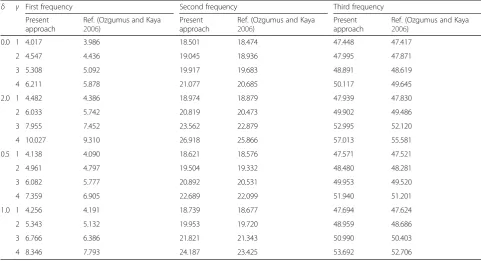
The results from the present modeling method have been obtained considering ten assumed modes com-pared with those reported by Ozgumus and Kaya (2006) using the differential transform method. The influence of taper ratios on the first three fundamental frequencies is presented in Tables 1 and 2 and the results are compared.
From the data, it has been observed that there is nearly one-to-one correspondence between the results obtained from the current approach and those reported based on the differential transform method.
In view of this observation, it is opined that the current approach is in order and has been adopted for further ana-lysis in this study.
Further analysis has been carried out on double-tapered functionally graded beam made of steel as metallic con-stituent and alumina as ceramic concon-stituent whose mech-anical properties are given in Table 3. The dimensional parameters length = 1000 mm, breadth = 20 mm, and height = 10 mm are considered for the analysis.
The frequencies are evaluated with ten assumed modes to obtain the converged bending natural frequencies. As
the frequencies obtained with number of modes greater than ten did not show any significant improvement in the results, the number of assumed modes is restricted to ten only.
The effect of power law index and taper ratios on flap-wise bending natural frequencies of a stationary func-tionally graded double-tapered beam is presented in Fig. 2. It is observed that the three frequencies decrease with an increase in power law index, n, and when the beam composition approached a more metallic state, the rate of decrease in these frequencies is predominant up to a certain n value, thereafter the frequencies are rela-tively un-effected by increase innvalue at all taper ratios. The variation in flapwise bending natural frequencies with the increase in taper ratios is decreasing at all power law indices in all modes of vibration, as the change in taper ra-tio alters the stiffness of the beam.
The effect of taper and power law index on frequencies of a single-tapered beam is studied. The variation of flap-wise bending natural frequencies of the functionally graded rotating stationary beam with respect to width and height taper ratios has been presented in Figs. 3 and 4.
For all the values of power law index, all frequencies are observed to increase with the increase in height taper ratio and the first flapwise frequency is observed to increase while a decreasing trend has been observed in case of higher frequencies with an increase in width taper ratio. It is also observed that, at higher values of power law index, the variation of flapwise bending nat-ural frequencies with a variation in width and height taper ratios tends to reduce.
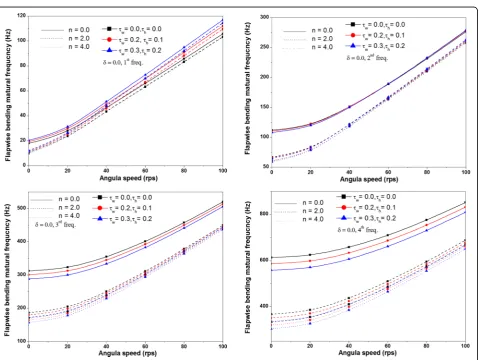
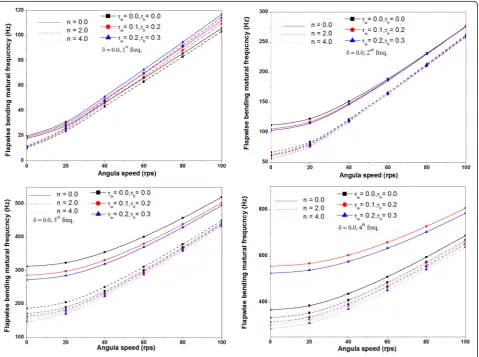
The influence of angular speed on flapwise bending natural frequency for different taper ratios and power law indices is presented in Figs. 5 and 6. It has been ob-served that the first frequency has a lower magnitude for uniform beam compared to that for tapered beam and a reverse trend has been observed in respect of higher order frequencies for all the taper ratios of the beam. It is further observed that the variation in frequencies is predominant when τw<τh as compared to the case of
τw>τh though the area of beam cross section is the same in both cases.
It has been observed that for different values of taper ratios and power law indices, the fundamental frequen-cies are diverging with the increase in angular speed and all higher order frequencies are observed to be conver-ging. However, at a given speed, the frequencies decrease with an increase in power law index.
It is also observed that the influence of taper ratio on fundamental flapwise bending natural frequency is creasing with the increase in angular speed and the in-fluence is less on higher modes of vibration. The power law index has negligible influence on the trend of flap-wise bending natural frequencies with the increase in an-gular speed for different taper ratios which is evident from similarity of variation pattern for solid (n= 0) and that for dashed (n= 2.0) and dotted (n= 4.0) lines for all modes of vibration. These trends should be expected that the tapered beams under consideration would be-have differently, as the stiffness at the root and load variation along the length of the beam depend on the taper ratio.
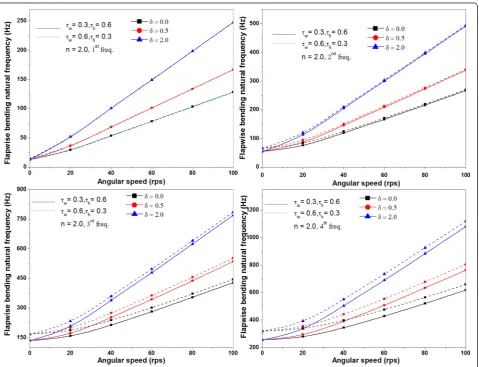
The effect of hub radius ratio and beam taper ratio on flapwise bending natural frequencies of the rotating ta-pered beam is presented in Fig. 7. In general, the flap-wise bending natural frequencies increase with the increase in angular speed. From the figure, it is observed that the difference in frequencies for the two geometries of the beam is more at lower speeds and is decreasing as the speed increases. It may be also noted that the rate of increase in frequencies increase with an increase in hub radius ratio and the increase in ratio of τb/τh. The hub radius ratio could not influence the rate of increase of flapwise bending natural frequency with the increase of angular speed. This is evident from uniformity in the gap between the solid line and dashed lines. These trends should be expected from the increase in angular speed, and hub radius leads to stiffening effect of rota-tion and increase in taper ratio results to softening effect resulting from the decrease of the cross-sectional area.
Conclusions
The free flapwise bending vibrations of a rotating ta-pered beam are investigated in this work. The equations of motions are derived using hybrid deformation variables employing Lagrange’s approach. Rayleigh-Ritz method is used to evaluate the frequencies of the beam. Linear taper-ing in breadth and depth directions is considered for the analysis. Variation in taper ratios affects the frequency parameters of the beam. The frequency parameters are observed to increase with the increase in hub radius parameter. The power law index has negligible influence on the trend of flapwise bending natural frequencies with the increase in angular speed for different taper ratios.
Competing interests
The authors declare that they have no competing interests.
Authors’contributions
NVRM carried out the analytical solution and MRN conceived the study and participated in concept checking and MS preparation. Both the authors read and approved the final MS.
Author details 1
Department of Mechanical Engineering, Nalla Malla Reddy Engineering College, Hyderabad, Telangana 500088, India.2Department of Mechanical Engineering, JNTUK College of Engineering Vizianagaram, Vizianagaram, Andhra Pradesh 535003, India.
Received: 24 March 2015 Accepted: 29 June 2015
References
Aminbaghai, M, Murín, J, & Kutiš, V. (2012). Modal analysis of the FGM-beams with continuous transversal symmetric and longitudinal variation of
material properties with effect of large axial force.Eng Struct, 34, 314–329. Babu Gunda, J, & Ganguli, R. (2008). New rational interpolation functions for finite
element analysis of rotating beams.Int J Mech Sci, 50(3), 578–588. Banerjee, JR, & Jackson, DR. (2013). Free vibration of a rotating tapered Rayleigh
beam: a dynamic stiffness method of solution.Comput Struct, 124, 11–20. Cheng, Y, Yu, Z, Wu, X, & Yuan, Y. (2011). Vibration analysis of a cracked rotating
tapered beam using thep-version finite element method.Finite Elem Anal Des, 47(7), 825–834.
Das, D, Sahoo, P, & Saha, K. (2009). Out-of-plane free vibration analysis of rotating tapered beams in post-elastic regime.Mater Des, 30(8), 2875–2894. Ganesh, R, & Ganguli, R. (2013). Stiff string approximations in Rayleigh-Ritz
method for rotating beams.Appl Math Comput, 219(17), 9282–9295. Gunda, JB, Gupta, RK, & Ganguli, R. (2009). Hybrid stiff-string–polynomial basis
functions for vibration analysis of high speed rotating beams.Comput Struct, 87(3–4), 254–265.
Hosseini, SAA, & Khadem, SE. (2007). Vibration and reliability of a rotating beam with random properties under random excitation.Int J Mech Sci, 49(12), 1377–1388.
Huang, CL, Lin, WY, & Hsiao, KM. (2010). Free vibration analysis of rotating Euler beams at high angular velocity.Comput Struct, 88(17–18), 991–1001. Kadoli, R, Akhtar, K, & Ganesan, N. (2008). Static analysis of functionally graded
beams using higher order shear deformation theory.Appl Math Model, 32(12), 2509–2525.
Lin, S-M, Lee, J-F, Lee, S-Y, & Wang, W-R. (2006). Prediction of vibration of rotating damped beams with arbitrary pretwist.Int J Mech Sci, 48(12), 1494–1504.
Murin, J, Aminbaghai, M, Hrabovský, J, Kutiš, V, & Kugler, S. (2013). Modal analysis of the FGM beams with effect of the shear correction function.Compos Part B, 45(1), 1575–1582.
Ozgumus, O, & Kaya, M. (2006). Flapwise bending vibration analysis of double tapered rotating Euler–Bernoulli beam by using the differential transform method.Meccanica, 41(6), 661–670.
Sankar, BV. (2001). An elasticity solution for functionally graded beams.
Compos Sci Technol, 61(5), 689–696.
Tsai, MH, Lin, WY, Zhou, YC, & Hsiao, KM. (2011). Investigation on steady state deformation and free vibration of a rotating inclined Euler beam.Int J Mech Sci, 53(12), 1050–1068.
Ying, J, Lü, CF, & Chen, WQ. (2008). Two-dimensional elasticity solutions for functionally graded beams resting on elastic foundations.Compos Struct, 84(3), 209–219.
Yoo, HH, & Shin, SH. (1998). Vibration analysis of rotating cantilever beams.
J Sound Vib, 212(5), 807–828.
Ziane, N, Meftah, SA, Belhadj, HA, Tounsi, A, & Bedia, EAA. (2013). Free vibration analysis of thin and thick-walled FGM box beams.Int J Mech Sci, 66, 273–282.
Submit your manuscript to a
journal and benefi t from:
7 Convenient online submission
7 Rigorous peer review
7 Immediate publication on acceptance
7 Open access: articles freely available online
7 High visibility within the fi eld
7 Retaining the copyright to your article