Article
Plasma Based Water Purifier:Design And Testing Of
Prototype with Different samples of water
Suraj M1 , Dr.ANURADHA T2‡
1 Department of Electrical and Electronics Engineering
Anna University (AIHT); [email protected]
2 Department of Electrical and Electronics Engineering
Anna University (AIHT); [email protected]
* Correspondence: [email protected]; Tel.: +918667880409 ‡ These authors contributed as a project coordinator.
Abstract:The objective of the prototype is to eliminate the polluting contamination of water sources, due to the leak of industrial waste without any kind of treatment, mainly generated by the industries and home sector. In this project, a prototype of water purification by plasma technology has been designed. The prototype will convert contaminated water into the plasma stream and eliminate the pathogens from the water by exposing it to ultraviolet radiation and plasma sterilisation. The polluted water will be accelerated at high speed using a water pump in order to convert it into a liquid-gas mixture for ease plasma generation. This process will be achieved when the electric supply from a source of alternating current (AC) is applied to the water by means of high voltage electrodes. After which, the mixture slows down to return into liquid form and the clean water is obtained. The whole process takes place without significantly raising the temperature also knows as non-thermal plasma. The device also has an automatic flow and pressure control system. Finally, a short feasibility study has been conducted on the water samples collected and report obtained from Chennai Metropolitan Water Supply and Sewage boards are reported. It has been concluded that this new plasma-based water treatment system will be more efficient and cheaper than the current wastewater treatment techniques and can be used in the future as the replacement of current secondary and tertiary treatments of industrial wastewater.
Keywords:Plasma generation, non-thermal Plasma, pulsating DC power, Ozone, cost-improvement
1. Introduction
Nowadays, demand on the environment quality has rapidly increased. It is considered sharply watched and an important subject is water environment, since its harmlessness for the human race and nature in general. The wastewater releasing from chemical industries and households most often contain harmful compounds. These compounds can be dangerous or even toxic for the Earths environment, and they can even cause several problems to the human race. Therefore it is very important to purely observe these compounds in water, and also to remove them from this environment. The best way is to prevent the contamination in water by saying not to use harmful compounds in the households and industry. But this not possible at all so, it is important to know how water can be treated to become harmless[1]. For the water treatment, different methods of water treatment have been used for centuries and developed. These treatment methods are divided into four different methods: physical, chemical and biological.
Biological methods are the wider one for water treatment techniques. The main advantage is low operative cost and most widely used by municipals and industries. The main disadvantage is not a very efficient process for removal of harmful pollutant. Moreover, the process of biological degradation of pollutants is significantly slower than other processes[6]. Physical methods are based on a pure
1
mechanical separation in which waste products from water by a particular supporting system like charcoal and filter paper. The advantage of this process is there is no chemical involved. On the other hand, physical methods are not sufficient for the removal of most of the hazardous compounds, especially on the organic basic compound. In conflict to the physical method, chemical oxidation processes are more often used for the treatment of water which is contaminated by organic compounds. The most common oxidants are chlorine dioxide, chlorine, ozone, and potassium permanganate. But this reagent forms the hazardous by-products[4]. So this problem is solved by the ozonisation process which is efficient but more costly in comparison.
Plasma in the liquid can be generated by the different electrode configuration in the coaxial reactor design, with the A/C voltage is applied for the discharge ignition to take place. This discharge in the liquid will initiate the various chemical and physical reaction which is used for the purification of water. The electric discharge will initiate some of the physical processes like a strong electric field, UV radiation and formation of shockwaves. On the other side, chemically reaction such as radicals, high energetic electrons, ions and molecules with high oxidation potential is the most desirable chemical process[1]. Based on the above process This could be used for the treatment of the wastewater from the factory without the use of any additional chemical. Through this process, not only the organic pollutant but also the inorganic pollutant can be treated. Another use of plasma is in the plasma sterilisation (killing microorganism) and surface treatment( Hospital waste).
2. Plasma in Liquid
An application of high electric energy into the system leads the intensive movement of the particle which collides with each other and forms the change ions. Finally, plasma is generated due to this highly charged particle. In general, the plasma which is generated in the gas or liquid phase leads to the generation of the non-thermal plasma, which has been used for the plasma-based water purifier[3].
Plasma generation dependent on the environment in which the plasma is ignited. Plasma in the liquid depends on the three main factor:
• Higher is the density of the medium induces the high collision frequency and low charge particle mobility.
• High polarity and dielectric strength of water molecules which lead to the creation of dipole momentum in the applied electric field and inhomogeneous areas in the vicinity of an electrode surface.
• Discharge creation in the liquid phase is a presence of ions and their different mobility in a solution.
3. Prototype Design
3.1. Process Involved
A reactor model was designed. The main advantage of the prototype, since it produces the non-thermal plasma which will not increase the temperature of the water, which intestinally neglect the use of any cooling system. The device featured a pump and a nozzle which accelerates the pollutant water to high speed to convert it into a liquid-gas mixture in order to transform it into plasma. The electrical discharge is applied to the water by mode of two sharp copper electrodes from a pulsating DC power supply. Later the mixture is decelerated and returns it into the liquid state to obtain clean water, without a temperature rise[3].
Figure 1.Full Schematics Diagram Of Water Purifier
3.2. Main Design Parameter
• Reactor: Coaxial geometry with the copper electrode, 22 cm in length and diameter of 9 cm, Hollowed pyrex tube.
• Power Supply: output A/C, 34 Kv,10 kHz Input D/C, 24v (Laptop charger)
• Nozzle: 20 l/min @70psi
• Pump: 1 hp, single-phase
• Tank: 50 liters, fiberglass material
3.3. High voltage sources
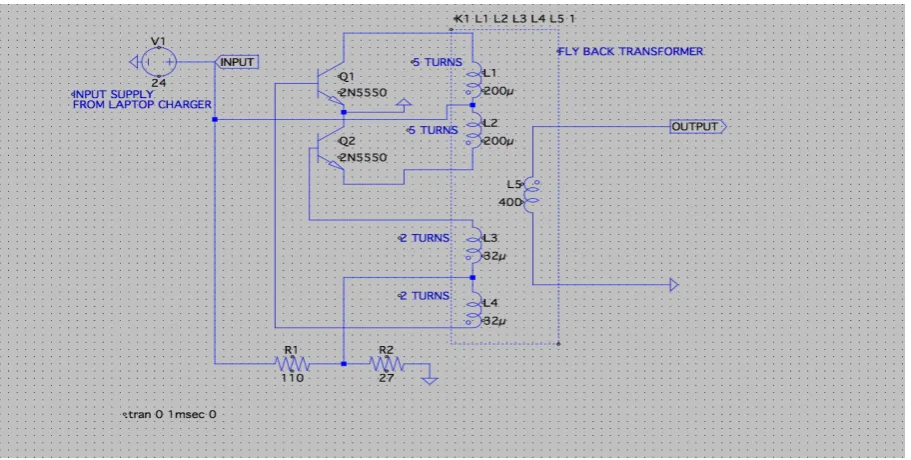
The voltage source used for the discharge generation is the Non-pulsating DC voltage with high frequency about 25KHZ. The simplified scheme of the DC HV source is shown in Figure. By a simple setup, it is possible to generate 30KV from a flyback transformer.
Figure 2.Simplified scheme of DC HV source connected to the discharge reactor
The HF high voltage source was also specially constructed to supply the plasma devices by high-frequency power. It consists of DC sources of 24 Volt for the simplicity laptop charger is enough, Which is coupled with the flyback transformer driver circuit and at the end of the flyback transformer, 30 kV is obtained. The efficiency of the source is approximately 80 Percent.
Figure 3.Typical Input And Output Voltage Simulation in LTspice
3.4. Experimental Reactor Device
perfect to create the liquid-gas mixture. Majorly give an aggressive advantage over other reactors based on parallel plate’s configuration.
Figure 4.Photograph of the simple discharge reactor, which is used mainly for plasma diagnostics
4. Water Sample solutions
After the design of the prototype, work is to check the various water solution interaction with water. For this purpose, tap water is used to support a required conductivity. In some experiments, organic and dye are dissolved. The solution is pumped into the reactor. Subsequently, an appropriate high voltage source is connected to the plasma reactor.
Generally, the experimental solutions consist of following item combinations: a) water + organic dye
b) water + humic acids.
4.1. Organic Dye (Beetroot Dye Extract)
In order to study the decomposition of the dye in water by the plasma, an organic dye selected is BeetrootExtract. The advantages of the dye are that decomposition rate is proportional to the decoration and this effect is visible to the eyes. Here the only problem comes up with the formation of by-products during the dye interaction with plasma.
Figure 5.Dye Extracted from Beetroot
4.2. Humic Acid
dissolved in deionised water for the testing. The concentration of humic acids in this solution is 1.9 mg/L.
5. Observation
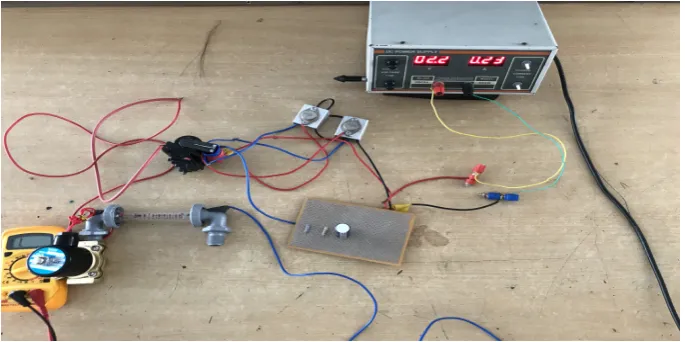
Ignition of plasma in water solutions requires a configuration of the plasma reactor as well as proper experimental conditions. Both the device parameters and water properties are important in the process of the discharge creation. This part of work deals mainly with the DC non-pulsed voltage. The important processes such are bubble formation and electrolysis is detected as well. According to the breakdown theories in water, the discharge ignition can start in bubbles of evaporated liquid or by the direct ionisation of water molecules. Due to a high potential gradient between the outer and inner bubble surface, the ionisation of water vapour occurs and thus the discharge is ignited.
Figure 6.Plasma streamers
Figure 7.Overall Rough Experimental Setup
The following process can be seen in the plasma in water: 1. Plasma Streamers
2. UV Radiation 3. Ozone
6. Result
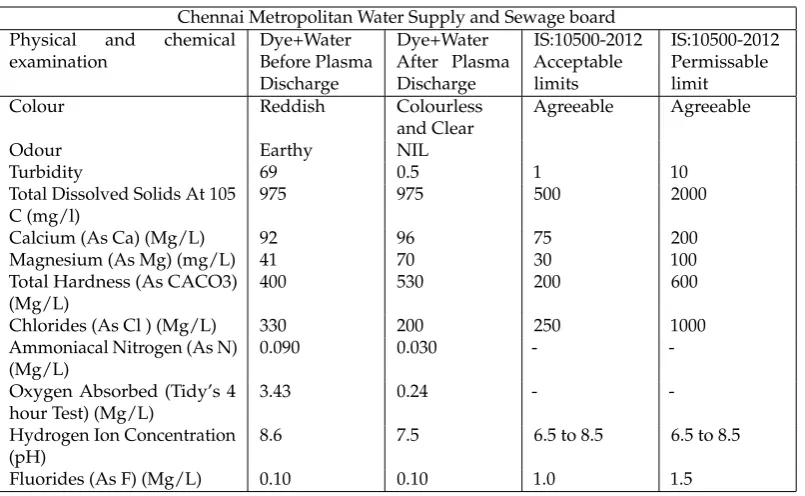
A short feasibility study has been conducted on the water samples collected and report obtained from Chennai Metropolitan Water Supply and Sewage board are reported. It has been concluded that this new plasma-based water treatment system will be more efficient and cheaper than the current wastewater treatment techniques.All the experiment common solution was found, as the pH is maintained with in the limit.After plasma treatment water has become more suitable for drinking.
Table 1.Experiment Results of Normal Water Before And Plasma Treatment.
Chennai Metropolitan Water Supply and Sewage board Physical and chemical
examination Tap Water Before Plasma Discharge Tap Water After Plasma Discharge IS:10500-2012 Acceptable limits IS:10500-2012 Permissable limit Colour Colourless And Clear Colourless And Clear Agreeable Agreeable
Odour NIL NIL
Turbidity 0.1 0.1 1 10
Total Dissolved Solids At 105 C (mg/l)
1140 475 500 2000
Calcium (As Ca) (Mg/L) 124 32 75 200
Magnesium (As Mg) (mg/L) 58 17 30 100
Total Hardness (As CACO3) (Mg/L)
550 148 200 600
Chlorides (As Cl ) (Mg/L) 260 144 250 1000
Ammoniacal Nitrogen (As N) (Mg/L)
0.040 0.040 -
-Oxygen Absorbed (Tidy’s 4 hour Test) (Mg/L)
0.75 0.45 -
-Hydrogen Ion Concentration (pH)
7.2 6.5 6.5 to 8.5 6.5 to 8.5
Fluorides (As F) (Mg/L) 0.10 0.10 1.0 1.5
Table 2.Experiment Results of Water+Dye Before And Plasma Treatment.
Chennai Metropolitan Water Supply and Sewage board Physical and chemical
examination Dye+Water Before Plasma Discharge Dye+Water After Plasma Discharge IS:10500-2012 Acceptable limits IS:10500-2012 Permissable limit
Colour Reddish Colourless
and Clear
Agreeable Agreeable
Odour Earthy NIL
Turbidity 69 0.5 1 10
Total Dissolved Solids At 105 C (mg/l)
975 975 500 2000
Calcium (As Ca) (Mg/L) 92 96 75 200
Magnesium (As Mg) (mg/L) 41 70 30 100
Total Hardness (As CACO3) (Mg/L)
400 530 200 600
Chlorides (As Cl ) (Mg/L) 330 200 250 1000
Ammoniacal Nitrogen (As N) (Mg/L)
0.090 0.030 -
-Oxygen Absorbed (Tidy’s 4 hour Test) (Mg/L)
3.43 0.24 -
-Hydrogen Ion Concentration (pH)
8.6 7.5 6.5 to 8.5 6.5 to 8.5
Table 3.Experiment Results of Water+Humic acid Before And Plasma Treatment..
Chennai Metropolitan Water Supply and Sewage board Physical and chemical
examination Humic acid + Water Before Plasma Discharge Humic acid + Water After Plasma Discharge IS:10500-2012 Acceptable limits IS:10500-2012 Permissable limit
Colour Yellowish Colourless
and Clear
Agreeable Agreeable
Odour Earthy NIL
Turbidity 35 0.4 1 10
Total Dissolved Solids At 105 C (mg/l)
890 1220 500 2000
Calcium (As Ca) (Mg/L) 72 220 75 200
Magnesium (As Mg) (mg/L) 53 56 30 100
Total Hardness (As CACO3) (Mg/L)
400 780 200 600
Chlorides (As Cl ) (Mg/L) 320 430 250 1000
Ammoniacal Nitrogen (As N) (Mg/L)
0.048 0.030 -
-Oxygen Absorbed (Tidy’s 4 hour Test) (Mg/L)
2.92 0.30 -
-Hydrogen Ion Concentration (pH)
8.6 7.5 6.5 to 8.5 6.5 to 8.5
Fluorides (As F) (Mg/L) 0.10 0.10 1.0 1.5
7. Conclusion
As mentioned, the human must treat the wastewater in order to ensure the protection of the environment. It is possible that, due to the high cost and maintenance of traditional treatment plants, people find it difficult to properly treat the contaminated waters. Although experimental data will only be definitive the device is built and tested, it is intended that with the proposed device, cost, maintenance and space could decrease significantly. Which could lead industries especially from developing countries to reconsider discharge untreated sewage. Finally, the ideal state is to offer a whole new cost-improvement, effective, efficient and innovative concept on wastewater plants, for example, by using plasma which could segregate and retain certain organic/inorganic components from the water, and then, eliminate biodegradable organic matter (like microorganisms, bacteria, virus, etc.) by means of the proposed reactor.
References
1. Beverly Richard, P. (2012),‘Water Treatment Process Monitoring and Evaluation’, American Water Works Association. Denver, USA. ISBN: 978- 1583218587
2. Chiuderi, C., Velli, M. (2015),‘Basics of Plasma Astrophysics’, Springer- Verlag, Italy. ISBN 978-88-470-5279-6. 3. Chu,P.K., Lu, XinPei. (2013),‘Low Temperature Plasma Technology: Methods and Applications’, CRC Press, Taylor
and Francis Group, Florida. ISBN 978-1-4665-0990-0.
4. Deng, Y., Zhao, R. (2015), ‘Advanced Oxidation Processes (AOPs) in Wastewater Treatment’, Springer - Current Pollution Reports, Vol. 1, No. 3, pp 167- 176. DOI:10.1007/s40726-015-0015-z., .
5. Freeman, M. H. (1997), ‘Standard Handbook of Hazardous Waste Treatment and Disposal’, 2nd edition, McGraw-Hill Book Company, New York. ISBN: 0-07-022044-1.