R E S E A R C H
Open Access
Design and analysis of an effective graphics
collaborative editing system
Chunxue Wu
1, Langfeng Li
1, Changwei Peng
1, Yan Wu
2, Naixue Xiong
3*and Changhoon Lee
4Abstract
With the rapid development of computer-supported cooperative work (CSCW) technology, graphical collaborative editing plays an increasingly important role in CSCW. The most important technique in graphics co-editing is the consistency of graphics co-editing, which mainly includes causality consistency, consistency of results, and consistency of intention. Most of the previous research was abstract and ineffective, lacking theoretical depth and scalability. However, because the algorithm proposed in this paper can solve the contradictions in the consistency of graphical collaborative editing, the research in this paper has particularity, and the results will be proven by the experiment described in the paper. In order to solve the consistency conflict problem of graphic collaborative editing, the common graphics collaborative editing algorithm (CGCE algorithm) is proposed. It is proposed not only to perfect and expand the definition of graphics collaborative editing but also to merge with HTML5 Canvas, WebSocket, jQuery, Node.js and other network programming languages and technologies. The graphic collaborative editing based on the design and implementation of this paper can effectively solve the consistency conflict problem of many users during the collaborative editing of graphics, which ensures that the graphics of each graphical collaborative editing interface is consistent and the collaborative work can achieve the desired effect.
Keywords:CSCW, Graphics co-editing, Consistency, CGCE algorithm
1 Introduction
Object-based graphical editing systems are a particular class of collaborative editing systems where shared ob-jects subject to concurrent accesses are graphic obob-jects such as lines, rectangles, circles, and text boxes [1]. Graphic collaborative editing brings great convenience; for example, many artists in different regions can work together to edit and complete a picture. Graphic collab-orative editing can also have a positive impact on educa-tion. For example, an art teacher can monitor students’ work online and modify the work at any time. These were unimaginable before. With the increase of collab-orative users, the structure of the network is more and more complicated, and collaborative editing is deeply in-fluenced by network congestion. Traditional routing mechanisms and load-balancing approaches cannot
make efficient use of the network, owing to lack of net-work status information and flexible ways to perform dy-namic controlling operations [2]. Disadvantages caused by network congestion include increased packet loss rate, end-to-end delay, and reduced system throughput. If finances permit, improving physical hardware facilities is also a good choice to shorten the delay. The newest technologies, including an optical amplifier, dispersion compensation, and forward error correction [3], may al-leviate congestion problems. High data rates, low cost, and collision reduction with the full-duplex approach and the elimination of chaining limits inherent in hub-bed Ethernet networks have made the switched Ethernet a dominant network technology [4].
Because full-duplex communication has so many ad-vantages, the graphic editing system is generally used in full-duplex communication, and at the same time, it is
* Correspondence:[email protected]
3College of Intelligence and Computing, Tianjin University, Tianjin 300350,
China
Full list of author information is available at the end of the article
also extremely important to solve the distribution of dif-ferent regions of the collaborative user site synchronization between the computers. Realistic net-work applications often require multiple computers with a high clock consistency-clock synchronization. The Network Time Protocol (NTP) is widely used to synchronize computer clocks on the Internet [5]. But traditional time synchronization technology such as NTP has been unable to meet this precision require-ment, and the cost of a GPS system is prohibitively ex-pensive. However, IEEE 1588 protocol development and maturity provide a low-cost, high-precision network clock synchronization program. Software time stamping may deliver acceptable results for a certain range of ap-plications [6]. Furthermore, the shown architecture will be able to support the upcoming PTP version 2 in hard-ware as well as in softhard-ware [7]. Taking into account the economic and practical needs related to these factors, the IEEE 1588 protocol is adopted to solve problems with synchronization among the collaborative sites, and this paper is based on the B/S architecture. B/S architec-ture is adopted because of the following strengths of the B/S architecture software:
1. Simple maintenance and upgrades: For facilitation of the frequent improvements and upgrades of the software system, B/S
architecture is more advantageous than C/S architecture. With a slightly larger unit, system administrators of C/S architecture have to manage thousands of computers, but with B/S architecture, system administrators only need to manage the server online.
2. Independence of the system: Based on the B/S structure, software can be simply installed on a Linux server, Windows server, Unix server, and so forth. Therefore, the choice of operating system is diversified. No matter what kind of system the user chooses, the computer will not be affected.
3. Running heavy load of data: Administrators only need to manage the server online through the Internet browser on the server, and the key is that logic settings are generally relatively simple on the browser so that managers only need to do hardware maintenance on the browser.
In this paper, we describe how computer graphics co-editing is communicated between all sites using WebSocket technology. WebSocket is a specification developed as part of the HTML5 initiative, and it only establishes a TCP socket connection after the first request for connection, which can save server resources and network bandwidth and achieve
real-time communication [8]. The WebSocket proto-col supports full-duplex communication between the client and the remote host. By using an existing ser-ver, we can focus on learning about the easy-to-use API that enables creation of WebSocket applications [9]. New networking approaches have recently been introduced that are based on repurposed techniques for delivering web pages (Comet) or integration of real-time communication directly into the browser (HTML5 WebSockets) [10–12].
This technology is simplifying the work of program-mers, harmonizing access to diverse devices and ap-plications, and giving users amazing new capabilities [13]. HTML5 and the Canvas element have real po-tential in many useful applications, but the rest of this paper just focuses on Cartagen, a vector-based, client-side framework for rendering maps in native HTML5, and its potential application [14, 15]. In addition to the use of HTML5 Canvas technology, jQuery- and Node.js-related technology are also used. jQuery is a JavaScript library that is fast, small, and feature-rich. jQuery strikes a completely different bal-ance between cost and flexibility of its configuration interface [16]. Node.js is one of the more interesting developments that has recently gained popularity in the server-side JavaScript space, and it is a framework for developing high-performance concurrent programs that do not rely on the mainstream multithreading approach but use asynchronous I/O with an event-driven programming model [17]. With the HTML5 Canvas technology, jQuery, Node.js, WebSocket, and other technical support for the graphics collaborative editing system with software to achieve protection, the next step is to achieve the consistency of graphic editing computer-supported cooperative work (CSCW) algorithm research [18, 19]. Within the CSCW field, collaborative editing systems have been developed to support a group of people sharing editing documents from different sites. Object-based graphic editing systems are a special type of graphic editing system [20]. Consistency of key technolo-gies needed to achieve these are described next.
1.1 Computer synchronization
system between different sites [21–23]. Therefore, the synchronization of computers between sites ensures graphics co-editing consistency.
1.2 Consistency algorithm
A good algorithm can play a key role in the coher-ence of graphics collaborative editing. For example, the algorithm used to achieve the required software and hardware resources generally refers to the algo-rithm’s time complexity and spatial complexity being as small as possible, and the efficiency of the algorithm being very high, which can be expressed as the time required to reach the end of the operation [24–28]. There is no best algorithm in the world, and only only the improved algorithms in this paper can be continually effective to the updated applica-tions. Any algorithm has its own limitations, and the limitations of the algorithm over time will become more and more obvious, so this paper studies a rela-tively efficient algorithm for consistency. This paper mainly describes a common algorithm for graphics collaborative editing (CGCE) [29–31].
1.3 Programming language selection
If a good system has a good algorithm, then to imple-ment the algorithm, a programming language is needed. This paper mainly uses HTLM5’s Canvas core technol-ogy, WebSocket, jQuery, and Node.js-related technology as the method, with the graphics collaborative editing al-gorithm as the core, according to the reality of the situ-ation, the use of C# language in front of the background, and the preparation of graphics collaborative editing sys-tem, so as to complete the subject graphics editor consistency research [32].
2 Method
2.1 Some problems of graphics collaborative editing
Graphic editing refers to the computer’s ability to edit some of the graphics, the package on the point, line, sur-face additions and deletions, as well as their movement, copy, rotation, and other operations. Common graphic editing software are Adobe’s AI and Photoshop, Corel’s CorelDRAW, Autodesk’s AutoCAD, Discreet’s 3D Studio Max, and so on. With scientific progress, many people are required to collaborate sometimes to complete tasks, and graphics collaborative editing can provide people with great convenience. Collaborative editors can be dis-tributed in different areas, or they can be structurally di-verse and complex WANs [33], just requiring sitting in an office to collaborate and complete projects. There-fore, the prospect of applying collaborative editing tech-nology is very exciting. Although the graphic editing software is so abundant and graphic editing technology
is very mature, graphics collaborative editing software is rare. Graphics collaborative editing systems have many practical problems:
1. Robustness: Many graphics collaborative editing techniques are hindered by technical problems of poor robustness. Different theories of graphics collaborative editing research regarding the increased problems faced in the real environment include the different network structure, network congestion, network routing, and so forth [34,35] The robustness of the environment fluctuates poorly, resulting in inconsistent results.
2. High responsiveness: In the Internet environment, the response to the local user’s actions must be quick, even as collaborating users reside on different machines connected via the Internet with a long and nondeterministic communication latency [19]. The graphics collaborative editing operation response speed depends on a lot of conditions: a. Hardware performance of the computers in the
site: There are significant differences in performance between different prices, different models, and different systems. The price is high, the model is new, and the system is upgraded. The computer generally has a good processor and fast response.
b. Spatial complexity and time complexity of the algorithm: When a few graphics operations are performed on the graphics co-editor, the com-puter will run the corresponding graphical co-editing algorithm code after each step [36,37]. The greater the time complexity and spatial complexity of the algorithm, the more time it takes for the computer to run the code, and the slower the response of the graphical collabora-tive editor.
c. The transmission delay of data: Computer data in the physical layer are transmitted in binary form, which raises the following problems:
i. Bit error rate: Data in the channel will be the cause of data distortion, which results in bit error rate. The data length of the data transmission needs to be consistent with Shannon’s theorem:
C¼B logð1þNSÞ 2
Then the transmission process code length can be as long as possible, and the bit error rate can be reduced to a relatively low level.
increasing very rapidly at the same time, the computer network-related hardware facilities have also been greatly improved, but network congestion is still inevitable. When the computer network is congested, the spread of communication between the different computers through the Internet will become very slow, and the response between the cooperative operations will also slow. This may lead to the following results:
When the network is in normal recovery,
collaborative application confusion or even collapse can occur. Because the collaboration among users, if they do not know the network has been congested, is still constantly in cooperation, when the network returns to normal, the collaborative operation may be invalid.
When the network is recovered, collaborative editing consistency will have become damaged. After the network is restored, the response between the cooperative users is normal, and the cooperative information of the network congestion may be transmitted to the different cooperative computers or lost. The result may be inconsistent owing to the lag of the response, resulting in inconsistent computer collaboration among the collaborative users [38].
2.High concurrency: Multiple users are allowed to con-currently edit any part of the shared document at any time by facilitating natural information flow among col-laborating users [19]. High concurrency is the basis for computer collaboration requirements. The higher the concurrency, the better the synergistic effect [39]. How-ever, the higher the concurrency will have a problem that affects the performance of the entire graphics co-editing [40, 41], launching consistency issues. The traditional consistency maintenance methods, such as lock and serialization methods, are not suitable for real-time editing. In this paper, we will study the consistency of graphics co-editing.
2.2 Related concepts involved in coherence of graphics co-editing
Definition 1Minimal Editing Unit“⊕”. Minimal Editing Unit means that the easiest graphics can be edited at once. The smallest editing unit is a point. If the oper-ation is to draw a point, it can be expressed as⊕point.
Definition 2 The Operational Specification Represen-tation: the Intent Consistency Model. The graphical rep-resentation of graphical co-editing in the Model of Intention Consistency is more complex than other con-formance models, and each operation needs to add the
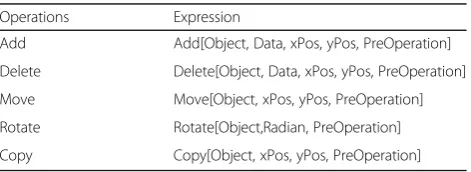
intent of the co-editor. The operation of graphic editing, includes increase, delete, turn, move, copy, and so on. The operations in these operational intent conformances are shown in Table1.
Definition 3Simple Graphics“Δ”. Point, line, equilat-eral triangle, regular quadrilatequilat-eral, regular polygon (more than four edges), and circle are called simple shapes in graphic collaborative editing. In addition to simple graphics, all others are called complex graphs. A simple graphic can itself be minimal editing units, or it can be made up of many minimal editing units. If the operation is to draw an equilateral triangle, it can be expressed as
ΔEquilateral triangle.
Definition 4 The Center of Simple Graphics. A simple graphics center is center of gravity in this paper according to Definition 3, and it can be more convenient for graphic editing. Complex graphics for these operations can be divided into a number of simple graphics, and then the center of these simple graphics can be found.
Definition 5 Delayed Deadline “ ρ”. Delay time is an operation from one site to another site specified by the maximum delay. In order to prevent the occurrence of a loss of operation due to network congestion or failure, we set a delay cutoff time in the graphic editing system. If there is a delay in the operation of the graphic editing system, the operation has not reached the destination site at the deadline, and the destination site issues a re-transmission request. Regarding delay time, depending on the computer network environment, you can set a different delay cutoff time. This scheme requires a sta-tion to send an operasta-tion to another stasta-tion, but an op-eration also needs to be sent to receive confirmation information if the other destination site in the delay deadline to receive the operation, the source site to send a received operation confirmation of information.
Definition 6 Causal Ordering Relation “→”. Given two operations O1and O2, generated at sites i and j, O1
is causally ordered before O2, expressed as O1→O2, if
and only if: (1)i = j and the generation of O1 happened
before the generation ofO2; or (2) i≠j and the execution
of O1at site j happened before the generation of O2; or
(3) there exists an operationOx, suchO1→OxandOx→ O2[22].
Table 1Expression of Operations
Operations Expression
Add Add[Object, Data, xPos, yPos, PreOperation]
Delete Delete[Object, Data, xPos, yPos, PreOperation]
Move Move[Object, xPos, yPos, PreOperation]
Rotate Rotate[Object,Radian, PreOperation]
Definition 7 Dependent and Independent Relations “‖”. Given any two O1 and O2, (1) O1 is dependent on O2if and only ifO1→O2;(2)O1andO2are independent
(or concurrent), expressed as O1‖O2, if and only if
nei-therO1→O2, norO2→O1[22].
Definition 8Conflict Relation“⊗”. Operations O1and O2 conflict with each other, expressed asO1⊗O2, if and
only if (1) Om‖On; (2) Target(O1) =Target(O2); (3)Att.
Key(O1) =Att. Key(O2); and (4) Att. Value(O1)≠Att.
Value(O2) [22].
Definition 9Compatibility Relation “⊙”. Two oper-ations O1 and O2 are compatible, expressed as O1⊙
O2, if and only if they do not conflict with each
other [22].
Definition 10 Compatible Group Set (CGS). Given a group of operations GO, the conflict relationships among these operations can be expressed as a CGS [22].
Definition 11 Different Graphics Coverage (DGC). When the users are editing the different objects because the different objects are compatible with each other. If two or more different objects appear in the same coord-inate position, the later object will overlay the object with the editing time earlier.
Definition 12 Concurrent Group Operations (CGO). In graphic editing, if a site in a few short periods of time continues to operate, then we can treat the operations of this site as concurrent group operations. In this paper, concurrent group operations are whole and not indivisible.
Definition 13 Absolute Differences in Coordinates. Assume that the coordinate of the operation intention is (x1,y1) and the actual coordinate position is (x2,y2), ∂¼ ffiffiffiffiffiffiffiffiffiffiffiffiffiffiffiffiffiffiffiffiffiffiffiffiffiffiffiffiffiffiffiffiffiffiffiffiffiffiffiffiðx1−x2Þ2þ ðy1−y2Þ
2
q
, and if the value of ∂ is greater than a certain number, the operation will be revoked.
Definition 14 Graphical collaborative editing uncer-tainty. Graphical collaborative editing uncertainty refers to the final results of graphics co-editing being uncertain.
Property 1. Given a group of operations GO targeting the same object, there is a unique MCGS for this GO [22].
3 Results and discussion
The graphical editor consistency model mainly includes three categories as follows: (1) Causal Consistency Model, (2) Results Consistency Model, and (3) Intention Consistency Model.
3.1 Causal Consistency Model
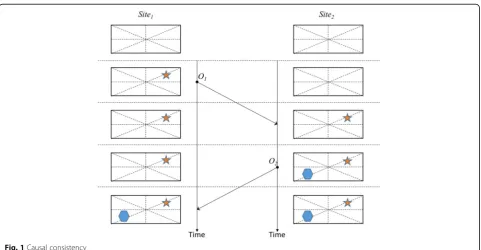
Causal consistency, given any two operations O1 and
O2, if O1→O2, O1 happened before O1 at all the
sites. Graphics co-editing causal consistency is shown in Fig. 1. Assume that only the site Site1 and Site2 are
graphically edited, and the collaborative user at Site1
launches an operation O1, which draws the graphic of
the pentagonal star on Canvas. The operation O1
con-tains the basic information of the five-pointed star
graphic object: the ID of the graphic, shape, color, and the position coordinates of the graphic on canvas. After the O1 operation is performed at the site, a
five-pointed star appears at the top right of the site’s canvas. At the same time, the O1 is sent from Site1
to Site2, and Site2 checks whether there are any other
operations that have not been performed in the cache. If no other operations are waiting in the cache, O1 is
to be put in the queue of waiting for execution. If not, the other operations to be executed are checked, and then Site2 directly implements the operation O1.
The canvas would appear at Site2 the same as atSite1.
In a certain period of time, the Site2 produced O2,
when O2 satisfies the execution condition at Site2,
and then the pentagonal star will appear in the lower right corner on the canvas. O2 was passed from Site2
to Site1 through the Internet. If the execution
condi-tion at Site1 is satisfied, O2is to be executed at Site1.
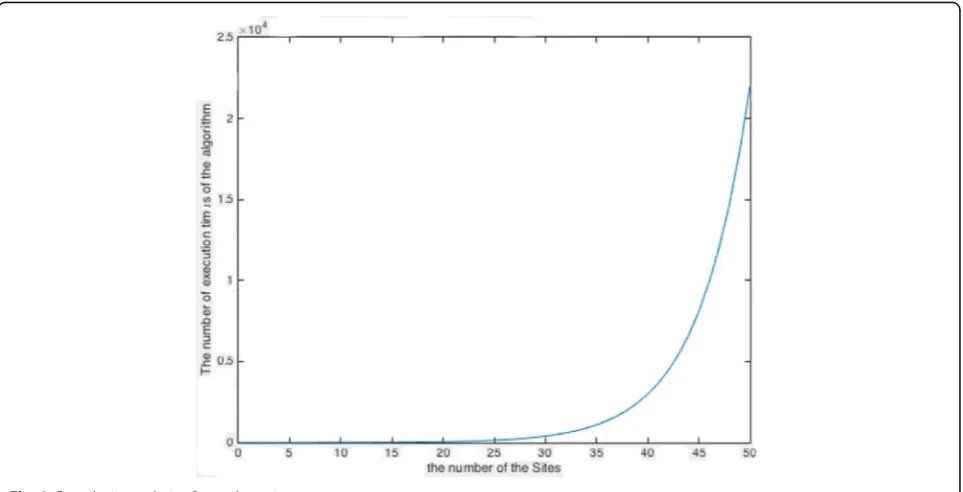
There is an important problem in that Site1,
Site2,⋯,Siten, according to our experiment summary,
because the number of sites approaches nearly 40, which will increasingly become quite complex, as shown in Fig. 2.
3.2 Results Consistency Model
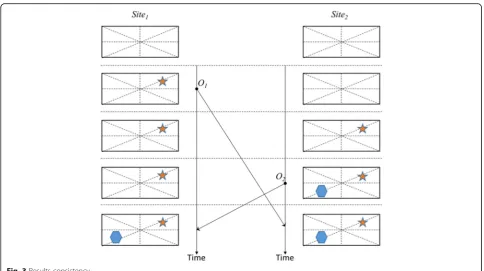
Results consistency is present when all sites share a copy of the document when a collaborative session is in silent state [21, 42, 43]. There is a great difference between the Results Consistency Model and the Causal Consistency Model. Results consistency
between operations does not necessarily require a certain relationship, and the consistency of the re-sults only needs cooperation between sites after the completion of all operations. Ultimately, the results between the stations are the same. The Results Consistency Model is shown in Fig. 3.
The Site1 creates O1 and then executes the operation
ofO1. There is a five-pointed star in the upper right
cor-ner on canvas at Site1. At the same time,O1was passed
from Site1to Site2 through the Internet, and the
trans-mission needs a certain delay. If the operation O1 has
not yet reached the Site2, the Site2have creates an
oper-ationO2, that is, five-pointed star is in the lower left
cor-ner of the canvas at Site2. After it executes O2at Site2,
immediately O2 was passed from Site2 to the Site1
through the Internet. When the operationO1andO2
re-spectively arrive at Site1 and Site2. What’s more, if
both satisfy the execution condition, O1 and O2 would
be executed at Site1 and Site2. A five-pointed star
ap-pears in the lower left corner of the Canvas atSite1, and
a five-pointed star appears in the upper right corner on Canvas at Site2. We will find that the final result is the
same at Site1 and Site2, although the operation O1and
operation O2are created in order, but the execution
re-sults of O1and O2 are independent of their execution
order. According to Property 1, it is not difficult to
know. The relationship between O1 and O2 in Fig. 3 is
O1⊙O2. In the graphics collaborative editing, assume
that MCGS1, MCGS2, ⋯, MCGSn(nϵN∗), GO = {MCGS1,MCGS2,⋯,MCGSn}, and MCGS1¼ fOp1;
Op2;⋯;Opng, MCGS2¼ fOk1;Ok2;⋯;Okng;⋯;MCGSn
¼ fOr1;Or2;⋯;Orng.
The operation in the MCGS are compatible with each other, is that the operation in the MCGS no matter what kind of implementation order, the last site can maintain consistency. This conclusion is given in detail in the paper, Consistency Maintenance In Real-time Collaborative Image Editing Systems [22, 54, 55], it has been given a detailed proof, this article is not cumbersome.
There is an important problem that theSite1, Site2,⋯,
Siten, according to our experiment summary: the
num-ber of sites approaches 25 and will become increasingly complex quickly, as shown in Fig.4.
3.3 Intention Consistency Model
Intention Consistency Model is the operation of each site, the operation of the establishment of a certain operational effect among the orders, through the implementation of the scheduling algorithm, through the implementation of scheduling algo-rithms and conversion functions. As long as the im-plementation of each step needs to ensure that the
implementation does not violate the established op-eration sequence, and then it is ensured that when all the operations are performed at each site, the in-ternal data structure of each site has the same oper-ational effect order from the operation object; that is, the consistency of the operational intention is maintained [21, 44].
Thus, among the Causal Consistency Model, Results Consistency Model, and Intention Consistency Model, the most complex is the Intention Consistency Model. The efficiency of the Intention Consistency Model can reflect the efficiency of the algorithm of graphic collaborative editing system [45, 46]. In graphic col-laborative editing, while satisfying causal consistency or consistency of results, it may not be able to achieve the real intention of the graphical collabora-tive editing system.
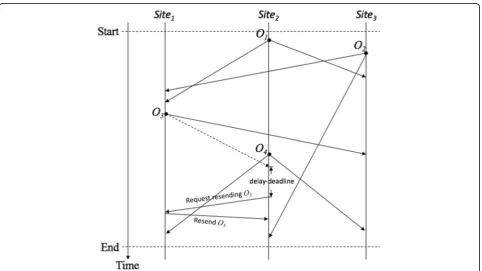
Suppose there are three sites Site1, Site2, and Site3, and
then there are four operations, namely O1,O2,O3 and
O4. O1‖O2, (O1‖O2)→O3, O1→O4, O2‖O4, O3‖O4, and
the operation O3is lost during processing from Site1to
Site2, as shown in Fig.5.
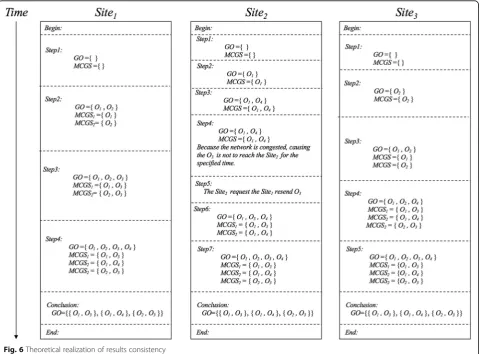
ensure that the final result of graphics co-editing is right, but it cannot guarantee that the final result can be ex-pected for collaborative editing users [47, 48]. For ex-ample, there is a concurrency model in Fig. 5, and the Causal Consistency Model cannot be used; thus, two models can be used: one is the Result Consistency Model, and the other is the Intention Consistency Model. Use the Results Consistency Model to handle the situation, as shown in Fig. 6. A group of operations (GO) represents the set of operations creates by all sites. MCGS (Max Compatible Groups Set) represents a set of the largest compatible sets of operations that operate in GO. At the beginning of the graphics co-editing,GO= {} andMCGS = {}, indicating that the operation in GO and MCGS is empty. The process of results consistency is as follows: (1) When O1and O2 arrive at Site1, variables are updated,
GO = {O1,O2}. Because ofO1‖O2,MCGS1= {O1},MCGS2
= {O2}. When the Site1 creates O3, GO= {O1, O2, O3},
(O1‖O2)→O3, MCGS1= {O1, O3}, MCGS2= {O2, O3}.
WhenO4arrive at Site1, variables updated,GO= {O1, O2,
O3, O4}. Because of O1→O4, O2‖O4, O3‖O4, so MCGS1
= {O1, O3},MCGS2= {O2, O3},MCGS3= {O1, O4}. Finally,
GO= {{O1, O3}, {O2, O3}, {O1, O4}}. (2) When the Site2
creates O1, variables updated, GO= {O1}, MCGS= {O1},
whenSite2creates O1creates O2, variables updated, GO
= {O1,O4}, because ofO1→O4,MCGS= {O1, O4}. Due to
network congestion [49–53], because of the cutoff time delay, Site2 has not receivedO3, which has passed Site1,
and Site2requires Site1resend. Site1receives a resending
request from Site1, and then resends O3. After Site2 has
receivedO3, the variables are updated,GO= {O1, O3,O4}.
Because of O1⊙O3, O1‖O4, O3‖O4, MCGS1= {O1, O3},
MCGS2= {O4}. WhenO2arrives atSite2, the variables are
updated, GO= {O1, O2, O3, O4},O2⊙O3, O2‖O1, O2‖O4,
and MCGS1= {O1, O3},MCGS2= {O2, O3}, MCGS3= {O1,
O4}. GO= {{O1, O3}, {O2, O3}, {O1, O4}}. (3) When Site3
creates O2, variables are updated, GO= {O2}, MCGS
= {O2}. WhenO1arrive atSite3, variables are updated:GO
= {O1,O2},O1‖O2, soMCGS1= {O1},MCGS2= {O2}. When
O3 arrives at Site3, variables are updated: GO= {O1, O2,
O3},O3⊙O2,O3⊙.
O1, MCGS1= {O1, O3}, MCGS2= {O2, O3}. When O4
arrives at Site3, variables are updated: GO= {O1, O2,O3,
O4}, O4⊙O1, O4‖O2, O4‖O3, MCGS1 = {O1,
O3},MCGS2 = {O2, O3},MCGS3= {O1, O4}, GO= {{O1,
O3}, {O2, O3}, {O1, O4}}. To sum up, we can know the
basic principle of the Results Consistency Model, and the advantages and disadvantages of the Results Consistency Model are obvious. Advantages of the Results Consistency Model are as follows. In a set of operations, the operations in MCGS do not take into account the order of execution between them, which is more efficient for graphics co-editing. However, the shortcomings of the Results Consistency Model are also very prominent, according to the graphical col-laborative editing uncertainly (Definition 14). The re-sult of the Rere-sults Consistency Model is uncertain, as shown in Fig. 5, although three sites get the consistency of results finally. The collaborative users only expect that the result of collaborative co-editing is unique so that we have to further improve the co-herence of graphics collaborative editing. We need a better consistency model than the Results Consistency Model, so the Intention Consistency Model will be a good choice, and next the common graphics collab-orative editing algorithm (CGCE algorithm) for the Intention Consistency Model will be described in detail.
4 CGCE algorithm
4.1 Flowchart schematic diagram of intention consistency
A flowchart schematic diagram of the Intention Consistency Model is shown in Fig.7.
4.2 Details of the CGCE algorithm
The core technology of editing consistency in the above collaborative graphics is about researching the intention consistency model and its algorithm for the complex. Because intention consistency is the most important consistency in collaborative graphic editing. The graph-ics collaborative editing consistency key technology CGCE algorithm is shown in Algorithm 1–8.
5 Realization of the key technology of consistency
5.1 Graphical collaborative editing software
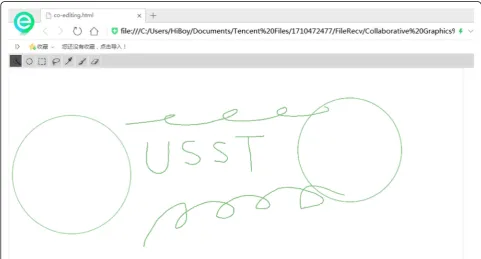
Our study refers to the realization of the algorithm the common graphics collaborative editing algorithm (CGCE algorithm). This is done to perfect and expand not only the definition of graphics collaborative editing but also HTML5 Canvas, WebSocket, jQuery and Node.js and other network programming language and technology in order to realize the system of the key technology of graph-ics co-editing. The interface of graphic collaborative edit-ing software is as shown in Fig.8. As shown in Fig.9, the main functions of the code are graphic drawing, including the drawing of arbitrary points, lines, and surfaces, and the drawing of some basic figures as shown in Fig.10.
5.2 Experimental results
The network conditions of graphics collaborative editing and drawing are mainly composed of three modes:
1. 1.The local mode: This mode is used to open multiple pages on a computer. Multiple pages can be co-edited to the graphics, and each page in the open four local pages is like a drawing board and can be drawn on each page. The content they dis-play on the pages is exactly the same.
2. The LAN mode: In the same LAN, two users can open graphics and edit software at the same time and also can produce the same effect, as shown in Fig.11. 3. The WAN mode: The wide area network mode is
more complex. For example, the high concurrency and packet loss cases in this paper are nearly all in WAN.
The consistency of graphics collaborative editing sys-tem on MacBook Pro is shown in Fig. 12. The consistency of graphics collaborative editing system on the Windows system is shown in Fig.13.
Fig. 8Interface of graphic collaborative editing software
5.3 Graphical collaborative editing software port monitoring
The server monitoring information of monitoring graphics collaborative editing is shown in Fig. 14. The server monitoring information of graphical collabora-tive editing can be used by each user to edit each op-eration of the graphics together and generate the corresponding log files.
There are no issues of high concurrency and packet loss in graphics collaborative editing software running
on local and LAN networks, but there may be high concurrency or packet loss problems in WAN net-works. If the routing path of two cooperative editors is long, the time delay is great. It is difficult to match the real-time situation; what’s more, it is easy to lead to concurrent problems. However, the algorithm in the paper, which is called CGCE algorithm, is excel-lent and ensures that the graphics collaborative edit-ing will be good. The cooperative multiuser operation of WAN networks is shown in Fig. 15.
Fig. 10Drawing graphics
5.4 Analysis of time complexity and space complexity of the algorithm
The analysis of time complexity and space complexity of the algorithm.
(1)Time complexity: The time complexity of the best one isO1. For example, the operations of inserting, deleting, rotating, and copying in the best case of
graphical collaborative editing can be completed at one time. However, the worst is that all operations of multiusers exist concurrently, then the time complexity isO(nm), sufficient data from
experiments shows the average time complexity of the algorithm isO(nlogn).
(2)Space complexity: In order to maintain the normal operation of the algorithm, the experiments in this
Fig. 12Graphics co-editing system on Macintosh
paper at least open up three cache queues in the memory. If each queue has n unit space, the algorithm has a space complexity of O(3n). For the queue, then the algorithm’s spatial complexity is O(nm). Assuming that there is a queue of length m, and then the required space complexity is O(nm).
5.5 Time delay, packet loss, and bit error rate of software data transmission
Fig. 15Cooperative operation of multi-user in WAN
used to perform packet loss test. You can test the packet loss situation of the intranet or extranet, thus providing an important reference for solving a series of packet loss and BER issues. Test the level of the network environ-ment and how much is lost. The network drop test tool (ATKKPING) interface is shown in Fig.16.
From the network test tool interface as shown in Fig.16, we can know that, when the“Ping interval”is selected, the Ping interval is only used as a timeout, and Ping is per-formed fastest. If the data size value is set greater than the MTU value, the data packet must be partitioned. The MTU depends on the physical layer. Therefore, special at-tention should be paid to the size of the MTU, especially when pinging to the Internet. First, the relevant algorithm of this paper is not added in the graphical collaborative editing software of Fig.17, and then the relevant parame-ters of the network testing software are configured. The “target host”is 192.168.1.163, the“ping interval”is 1 milli-second,“ping log”is selected,“Ping Times”is 4, and then click the“Start”button, as shown in Fig.17.
From Fig.18, we can know that the packet loss rate is 25% for the graphical collaboration software without CGCA algorithm in this paper. The minimum
transmission delay is 2 milliseconds about data, the maximum value is 14 milliseconds, and the average value is 8 milliseconds. The packet loss rate is relatively much larger than post-CGCA Algorithm. Configure the same parameters in the network test tool and click the “Start” button. As shown in Fig.16, the number of sent packets is 1659, 18 of which are timeouts; thus, the packet loss rate is 1.08%. The minimum transmission delay is 1 millisecond, the maximum delay is 214 milli-seconds, and the average delay is 6.14 milliseconds. Through analysis of the data, it can be clearly known that the maximum delay of transmission is 214 milli-seconds. If it exceeds 214 milliseconds, the packet will be lost. Above all, after the CGCE algorithm is added in the graphics co-editing software, the packet loss rate is reduced to 1.08%, which is nearly 24% lower than the comparison, and the average delay of data transmission has also been reduced.
6 Conclusions
Graphical collaborative editing plays an increasingly important role in CSCW. The most important tech-nique in graphics co-editing is the consistency of
graphics co-editing, which mainly includes causality consistency, consistency of results, and consistency of intention. In order to solve the consistency conflict problem of graph collaborative editing, the CGCE al-gorithm is proposed in this paper, and a large num-ber of experiments show that this algorithm plays an irreplaceable role in performance optimization. The CGCE algorithm in this paper can solve the contra-dictions in the consistency of graphical collaborative editing, the research in this paper has particularity and results, and it will proved by the experiment. However, due to the relationship of time, the algo-rithm of the paper is more or less inadequate, whic is the key import that some scholars can point to as the shortcoming in the paper, especially the optimization and improvement of CGCE algorithm. A mathemat-ical definition of some graphic cooperative editors can be easily followed. The scholars are going deeper and deeper. This paper has a strict mathematical def-inition of some basic operations of graphic collabora-tive editing, which can facilitate the follow-up scholars to carry out more in-depth and complex aca-demic research.
Acknowledgements
The authors appreciate all anonymous reviewers for their insightful comments and constructive suggestions to polish this paper in high quality. This research was supported by the National Key Research and Development Program of China (No. 2018YFC0810204), National Natural Science
Foundation of China (No. 61872242, 61502220), Shanghai Science and Technology Innovation Action Plan Project (17511107203, 16111107502) and Shanghai key lab of modern optical system.
Availability of data and materials We can provide the data.
About the authors
Chunxue Wu (1964- ) received the Ph.D. degree in Control Theory and Control Engineering from China University of mining and technology, Beijing, China, in 2006. He is a Professor with the Computer Science and Engineering and software engineering Division, School of Optical-Electrical and Computer Engineering, University of Shanghai for Science and Technology, China. His research interests include, wireless sensor networks, distributed and embedded systems, wireless and mobile systems, networked control systems.
Langfeng Li is a student of University of Shanghai for Science and
Technology, and E-mail [email protected].
Changwei Peng (1994- ) received the B.E. degree from Hubei Polytechnic University. HuangShi, Hubei, China, in 2013, He is currently pursuing the master degree in computer technology with the University of Shanghai for science and technology, China. His research interests include Mechanical learning and Data analysis.
Email:[email protected]
degree in Southern Illinois University Carbondale, with concentrations in environmental chemistry and ecotoxicology. His research involves elucidations of environmental fate of contaminants using chemical and computational techniques, as well as predictions of their associated effects on wildlife and public health. Data Processing and Analysis in Environmental Related Fields.
E-mail [email protected] ORCID is 0000-0001-7876-261X
Naixue Xiong is currently an Associate Professor (3rd year) at School of Computer Science and Technology, Tianjin University, Tianjin, China, 300350. He received his both PhD degrees in Wuhan University (about software engineering), and Japan Advanced Institute of Science and Technology (about dependable networks), respectively. Before he attends Colorado Technical University, he worked in Wentworth Technology Institution, Georgia State University for many years. His research interests include Cloud Computing, Security and Dependability, Parallel and Distributed Computing, Networks, and Optimization Theory. Dr./Prof. Xiong published over 100 international journal papers and over 100 international conference papers. Some of his works were published in IEEE JSAC, IEEE or ACM transactions, ACM Sigcomm workshop, IEEE INFOCOM, ICDCS, and IPDPS. He has been a General Chair, Program Chair, Publicity Chair, PC member and OC member of over 100 international conferences, and as a reviewer of about 100 international journals, including IEEE JSAC, IEEE SMC (Park: A/B/C), IEEE Transactions on Communications, IEEE Transactions on Mobile Computing, IEEE Trans. on Parallel and Distributed Systems. He is serving as an Editor-in-Chief, Associate editor or Editor member for over 10 international journals (including Associate Editor for IEEE Tran. on Systems, Man & Cybernetics: Systems, and Edi-tor-in-Chief for Journal of Parallel & Cloud Computing (PCC)), and a guest editor for over 10 international journals, including Sensor Journal, WINET and MONET.
Prof. Changhoon Lee, Department of Computer Science and Engineering, Seoul National University of Science and Technology (SeoulTech), Republic
of Kornbea. Email:[email protected]
Authors’contributions
CW conceived and designed the study. LL, CP, YW, NX and CL participated in experiments and data processing and edited the manuscript. All authors read and approved the final manuscript.
Competing interests
The authors declare that they have no competing interests.
Publisher’s Note
Springer Nature remains neutral with regard to jurisdictional claims in published maps and institutional affiliations.
Author details 1
School of Optical-Electrical and Computer Engineering, University of Shanghai for Science and Technology, Shanghai 200093, China.2School of
Public and Environmental Affairs, Indiana University, Bloomington, IN 47405, USA.3College of Intelligence and Computing, Tianjin University, Tianjin
300350, China.4Department of Computer Science and Engineering, Seoul National University of Science and Technology (SeoulTech), Seoul, Republic of Korea.
Received: 26 September 2018 Accepted: 13 December 2018
References
1. C.L. Ignat, M.C. Norrie, inCSCW’04: Proceedings of the 2004 ACM Conference on Computer Supported Cooperative Work. Grouping in collaborative graphical editors (Association for Computing Machinery, New York, 2004), pp. 447–456
2. Z. Wu et al., Alleviating network congestion for HPC clusters with fat-tree interconnection leveraging software-defined networking. In: 3rd International Conference on Systems and Informatics (ICSAI), Shanghai, China, 19–21 Nov 2016 (2017)
3. L.H. Dang et al., inInternational Electronic Elements. New technology of high-speed and ultra long haul fiber-optic communication system (2008) 4. J. Hillebrand et al., inInternational Symposium on Industrial Embedded
Systems. Coexistence of time-triggered and event-triggered traffic in switched full-duplex ethernet networks (2007)
5. X. Liu, S. Zhao, A. Liu, N. N. Xiong, A. V. Vasilakos,Knowledge-aware proactive nodes selection approach for energy management in Internet of Things, Future generation computer systems,.https://doi.org/10.1016/j.future.2017.07.022. Accessed 5 Aug 2017.
6. P.H. Weibel, D. Béchaz,IEEE 1588 implementation and performance of time stamping techniques(2004)
7. P. Loschmidt et al.,IEEE 1588 hardware for fault tolerance and high precision (2005), pp. 323–332
8. F.Y. Jiang, H.C. Duan, inInternational Symposium on Information Technology in Medicine and Education. Application research of WebSocket technology on Web tree component (2012)
9. V. Wang et al.,The WebSocket API(2013), pp. 13–32
10. R. He, N. Xiong, L.T. Yang, J.H. Park, Usingmulti-modal semantic association rules to fuse keywords and visual features automatically for web image retrieval. Information Fusion.12(3), 223–230 (2011)
11. H. Liu et al., Consistency maintenance in collaborative CAD systems. Chin. J. Electron.22(1), 15–20 (2013)
12. C. Sun et al., A generic operation transformation scheme for consistency maintenance in real-time cooperative editing systems. Leadersh. Org. Dev. J. 35(35), 425–434 (1997)
13. Z. Wan, N.N. Xiong, N. Ghani, A. Vasilakos, L. Zhou,Adaptive unequal protection for wireless video transmission over IEEE 802.11 e networks, Multimedia Tools and Applications.72(1), 541–571 (2014)
14. M.N. Boulos et al., Web GIS in practice VIII: HTML5 and the canvas element for interactive online mapping. Int. J. Health Geogr.9, 1 (2010)
15. S.A. Asghar et al., An open source modelica graphic editor integrated with electronic notebooks and interactive simulation (2011)
16. K.D. Volder, inInternational Symposium on Practical Aspects of Declarative Languages. JQuery: A generic code browser with a declarative configuration language (2006)
17. S. Tilkov, S. Vinoski, Node.js: using JavaScript to build high-performance network programs. IEEE Internet Comput.14(6), 80–83 (2010)
18. T. Bellmann, inModelica Conference. Interactive simulations and advanced visualization with modelica (2009)
19. G.P. Liu et al., Design and stability criteria of networked predictive control systems with random network delay in the feedback channel. IEEE Trans. Syst. Man Cybern. Part C Appl. Rev.37(2), 173–184 (2007)
20. S. Xia et al., Collaborative object grouping in graphics editing systems (2005) 21. L. Chen et al., A negotiation methodology for multidisciplinary collaborative
product design. Adv. Eng. Inform.28(4), 469–478 (2014)
22. X. Xu et al., inIEEE International Conference on Systems, Man and Cybernetics. Consistency maintenance in real-time collaborative image editing systems (2003) 23. M. Ressel, D. Nitsche-Ruhland, inACM Conference on Computer Supported
Cooperative Work. An integrating, transformation-oriented approach to concurrency control and undo in group editors (1996)
24. S Xi and C. Wu, Super resolution reconstruction algorithm of video image based on deep self encoding learning. Multimed Tools Appl., 2018: 1–18 (2018) 25. C. Liu, A. Zhou, C. Wu, Image segmentation framework based on multiple
feature spaces. IET Image Process.9, 271–279 (2015)
26. H. Chen, C. Wu, W. Huang, Design and application of system with dual-control of water and electricity based on wireless sensor network and video recognition technology. Int. J. Distrib. Sens. Netw.14(9), 1550147718795951 (2018) 27. X. Xue, C. Wu, Z. Sun, Y. Wu,Vegetation greening for winter oblique
photography using cycle-consistence adversarial networks. Symmetry(2018), pp. 1–14.https://doi.org/10.3390/syml0070294
28. C. Wu, J. Du, Y. Liu, An energy balancing routing algorithm for mobile sensor networks. Sens. Lett.11, 1783–1791 (2013)
29. H. Li, X. Mao, C. Chun, F. Yang, Design and analysis of a general data evaluation system based on social networks. EURASIP J. Wirel. Commun. Netw.2018, 109 (2018)
30. L. Gao, F. Yu, Consistency maintenance of group/ungroup operations in object-based collaborative graphical editing systems. Int. J. Signal Process. Image Process. Pattern Recogn.8(9), 59–68 (2015)
31. S. Greenberg et al., inHawaii International Conference on System Sciences. Issues and experiences designing and implementing two group drawing tools (1992) 32. H Gu et al., AnchorMF: towards effective event context identification. pp.
629–638 (2013)
33. C.L. Ignat, M.C. Norrie, inACM Conference on Computer Supported Cooperative Work. Grouping in collaborative graphical editors (2004) 34. B. Jiang et al., Semantic consistency maintenance in collaborative graphics
35. C. Liang, Dynamic coordination principle and method of multidisciplinary collaborative product design based on semantics reasoning. Trans. Chin. Soc. Agric. Machinery42(5), 208–213 (2011)
36. C. Ramstein, inConference of the Centre for Advanced Studies on Collaborative Research, October 24–28, 1993, Toronto, Ontario, Canada, 2 Volumes. COOPDRAW: a multiagent architecture for a shared graphical editor (1993)
37. J.X. Wang et al., Design and implementation of an agent-based collaborative product design system. Comput. Ind.60(7), 520–535 (2009)
38. H. Si, W. Sun, J. Zhang, J. Wan, N.N. Xiong, L. Zhou, Y. Ren, An
Effective Identification Technology for Online News Comment Spammers in Internet Media, IEEE Access, Digital Object Identifier:
https://doi.org/10.1109/ACCESS.2019.2900474, On page(s): 1–3, Print ISSN: 2169-3536, Online ISSN: 2169–3536
39. W. Wei, Consistency maintenance of multidisciplinary collaborative product design. China Mech. Eng.21, 12 (2010)
40. P. Wu, F. Xiao, C. Sha, H. Huang, R. Wang, N. Xiong, Node scheduling strategies for achieving full-view area coverage in camera sensor networks. Sensors17(6), 1303 ((2017).https://doi.org/10.3390/s17061303
41. Y. Wang, K. Chen, J. Yu, N.X. Xiong, H. Leung, H. Zhou, L. Zhu, Dynamic propagation characteristics estimation and tracking based on an EM-EKF algorithm in time-variant MIMO channel. Inform. Sci.408, 70–83 (2017) 42. J. Gui, L. Hui, N.X. Xiong, A game-based localized multi-objective topology
control scheme in heterogeneous wireless networks. IEEE Access5(1), 2396– 2416 (2017)
43. H. Zhang, R.W. Liu, D. Wu, Y. Liu, N.N. Xiong, Non-convex total generalized variation with spatially adaptive regularization parameters for edge-preserving image restoration. J. Internet Technol.17(7), 1391–1403 (2016) 44. Z. Xia, X. Wang, X. Sun, Q. Liu, N. Xiong, Steganalysis of LSB matching using
differences between nonadjacent pixels. Multimed. Tools Appl.75(4), 1947– 1962 (2016)
45. Z. Xia, N.N. Xiong, A.V. Vasilakos, X. Sun, EPCBIR: an efficient and privacy-preserving content-based image retrieval scheme in cloud computing. Inform. Sci.387, 195–204 (2017).https://doi.org/10.1016/j.ins.2016.12.030
46. Z. Lu, Y.-R. Lin, X. Huang, N. Xiong, Z. Fang, Video topic discovering, tracking and summarization from social media streams. Multimed. Tools Appl.76(8), 10855–10879 (2017)
47. L. Shu, Y. Fang, Z. Fang, Y. Yang, F. Fei, N. Xiong, A novel objective quality assessment for super-resolution images. Int. J. Signal Process. Image Process. Pattern Recogn.9(5), 297–308 (2016)
48. W. Fang, Y. Li, H. Zhang, N. Xiong, J. Lai, A.V. Vasilakos, On the throughput-energy tradeoff for data transmission between cloud and mobile devices. Inf. Sci.283, 79–93 (2014)
49. N. Xiong, A.V. Vasilakos, L.T. Yang, L. Song, Y. Pan, R. Kannan, Y. Li, Comparative analysis of quality of service and memory usage for adaptive failure detectors in healthcare systems. IEEE J. Sel. Areas Commun.27(4), 495–509 (2009)
50. Y. Fang, Z. Fang, F. Yuan, Y. Yang, S. Yang, N.N. Xiong, Optimized multi-operator image retargeting based on perceptual similarity measure. IEEE Trans. Syst. Man Cybern. Syst.99, 1–11 (2016)
51. X. Lu, S. Chen, N. Xiong, ViMediaNet: an emulation system for interactive multimedia based telepresence services. J. Supercomput.73, 3562–3578 (2017)
52. C. Zhang, D. Wu, R.W. Liu, N. Xiong, Non-local regularized variational model for image deblurring under mixed gaussian-impulse noise. J. Internet Technol.16(7), 1301–1320 (2015)
53. Y. Yang, S. Tong, S. Huang, P. Lin, Dual-tree complex wavelet transform and image block residual-based multi-focus image fusion in visual sensor networks. Sensors14(12), 22408–22430 (2014)
54. N. Xiong, R.W. Liu, M. Liang, W. D., Z. Liu, W. H., Effective alternating direction optimization methods for sparsity-constrained blind image deblurring. Sensors17(1), 174 (2017).https://doi.org/10.3390/s17010174