Taping protocol for two presentations of
pregnancy-related back pain: a case series
Crystal Draper, DC
1Ayla Azad, DC
1Donald Littlewood, DC
1Chloe Morgan, DC
1Lindsay Barker, DC
1Carol Ann Weis, DC, MSc
11 Canadian Memorial Chiropractic College
Corresponding author: Crystal Draper
Canadian Memorial Chiropractic College, 6100 Leslie Street, Toronto, ON M2H 3J1 Tel: 416-482-2340
E-mail: [email protected] © JCCA 2019
The authors have no disclaimers, competing interests, or sources of support or funding to report in the preparation of this manuscript. The involved patients provided consent for case publication.
Background: Back pain is common during pregnancy
and can have an adverse impact on the quality of life for some, yet treatment options for this population are limited. We document a chiropractic treatment that involves using kinesiology tape (tape) to help alleviate pregnancy-related back pain in two patients.
Case Presentation and Management: Two pregnant
women reported to two different chiropractic offices with varying presentations of pregnancy-related back pain. A trial of chiropractic care was rendered in both chiropractic offices, which included the application of tape.
Outcome and Discussion: In both case presentations, the addition of tape in the lumbosacral and/or
abdominal regions, decreased pain intensity from 9-10/10 to 4/10 or less on the Numeric Rating Scale (NRS). Including a taping protocol to a plan of
management in women with pregnancy-related LBP or
Contexte : Les maux de dos sont fréquents pendant
la grossesse et peuvent avoir un impact négatif sur la qualité de vie de certaines femmes, mais les options de traitement pour cette population sont limitées. Nous documentons un traitement chiropratique qui implique l’utilisation de ruban de kinésiologie (ruban) pour aider à soulager les douleurs dorsales liées à la grossesse chez deux patientes.
Présentation et gestion de cas : Deux femmes enceintes se sont présentées à deux cabinets de chiropractie différents présentant des maux de dos différents liés à la grossesse. Un essai de soins chiropratiques comprenant l’application de ruban a été effectué dans les deux cabinets de chiropractie.
PGP may be a safe and effective option to alleviate pain in this population.
(JCCA. 2019;63(2):111-118)
k e y w o r d s: pregnancy, back pain, chiropractic, kinesiology tape, case series
charge chez les femmes présentant une lombalgie ou des douleurs pelviennes liées à la grossesse peut constituer une option sûre et efficace pour soulager la douleur chez cette population.
(JACC. 2019;63(2):111-118)
m o t s c l é s : grossesse, maux de dos, chiropratique, ruban de kinésiologie, série de cas.
Introduction
The literature has reported that up to 90% of pregnant women experience some sort of back pain.1-5 This large
prevalence can be accounted for by the fact that back pain experienced during pregnancy is not just one entity. It can be further separated into (1) pregnancy-related low back pain (LBP), from the bottom of the ribs to the inferior glu-teal folds6, characterized as dull and resembling back pain
that occurs in the non-pregnant state7; (2) pelvic girdle
pain (PGP), from the top of the iliac crests to the bottom of the gluteal folds and/or pain in the symphysis pubis, often described as stabbing, shooting, dull, burning or an occasional “catching” sensation in the leg while walking7.
The pain can occur in either one or both sacroiliac joints (SIJs), in conjunction with/or separate symphysis pubis pain, the pain may radiate into the thigh7; or (3) a
combin-ation of both pains (combined pain)8-10. Clinical features
of pregnancy-related LBP and PGP can start as early as the first trimester, but more often, it starts around the 18th
week of pregnancy, with a peak intensity between the 24th
and 36th week. It often resolves within a few weeks to a
few months following delivery.7
Previous literature has suggested the importance of dis-tinguishing between pregnancy-related LBP and/or PGP for proper management and prognosis of the two condi-tions.7, 11-13 Useful methods of differentiation include the
site of pain, its character and severity, provoking factors, resultant disability, and pain provocation tests.7, 12 A
preg-nant woman experiencing LBP will likely present with pain during forward lumbar flexion, pain and/or tender-ness with palpation of the lumbar erector spinae muscles, and restriction in the lumbar spine. A woman presenting with PGP will likely experience pain with pain provoca-tion tests such as posterior pelvic pain provocaprovoca-tion (P4),
FABER (flexion, abduction, and external rotation), and palpation of the dorsal sacral ligament. Specifically, to diagnose symphysis pubis pain, direct palpation of the symphysis pubis, modified Trendelenburg’s test and ac-tive straight leg raise will be painful.7, 11, 12
Pregnant women seek out pain relief methods such as pain medication, exercise, education, pelvic support belts, and chiropractic treatments, however, there is lim-ited evidence with regards to their efficacy.14 In an effort
to relieve pain from musculoskeletal injuries, an emer-ging form of treatment among manual therapists, such as chiropractors, is the use of kinesiology tape, or “tape” as we refer to it in these cases. Taping has been suggested as a treatment for those with musculoskeletal injuries as it has a number of proposed benefits. These benefits include: supporting the affected area, relaxing the muscles and re-ducing pain sensation10,15,16; is designed to replicate the
physical properties and characteristics of human skin15,17;
and it has been suggested in the literature that it helps in the normalization of muscular function, increase lymph-atic and vascular flow, reduce pain through neurologic-al suppression, and possibly contribute to corrections of joint misalignments15,16,18. Although the full action of tape
has yet to be elucidated16, the effectiveness reported in
various clinical conditions has shown both positive16, 18-21,
and negative results22-24 in the non-pregnant population.
There are currently a few studies regarding taping and pregnancy-related back pain which have demonstrated an improvement in pain and disability in these women.10,25, 26
In the pregnant population, Kuciel et al.25 and
Kalinow-ski et al.26 applied tape to participants experiencing
the pregnancy studies show favourable results, the meth-odology of both studies exhibit weaknesses. One of the strengths of the Kuciel et al. study is that they performed a physical examination on participants to determine if their subjects were experiencing PGP25; however, they did
not utilize a control group for comparison. Additionally, the study employed a general taping protocol, extending tape from below the posterior superior iliac spine into the scapular region, with an additional horizontal strip over the sacroiliac region.25 Whereas, Kalinowski et al. used
a more specific taping protocol, no physical examination was conducted to determine the type of back pain the pregnant women were experiencing.26 The purpose of this
case series is two-fold: (1) to identify the type of preg-nancy-related back pain and (2) to demonstrate that an in-dividualized taping protocol applied in women presenting with different pregnancy-related back pains may help to reduce pain levels over the course of their pregnancy. Case Presentation #1
A 37-year-old female, six-weeks pregnant, presented to her chiropractor with complaints of PGP, localized to the left SIJ, and pregnancy-related nausea. One treatment of manual therapy was performed at this time, including soft tissue therapy (STT) and spinal manipulation (SMT) to the left SIJ. At 16 weeks gestation, the patient reported that she began experiencing round ligament pain and dis-comfort with associated symphysis pubis dysfunction. However, the patient did not return to the chiropractor until 20 weeks gestation because she was considered high-risk and was undergoing genetic testing.
20-27 Weeks Gestation
At 20 weeks gestation, the patient returned to the chiro-practor with exacerbated left SIJ and right round ligament pain. At this time, she reported that she was not sleeping well, was unable to perform her activities of daily living (ADLs) (i.e. walking for more than five minutes), and her pain was 9/10 on the Numeric Rating Scale (NRS). The chiropractor reassessed the patient. Physical examination revealed lumbar range of motion was limited in all direc-tions, with bilateral rotation and right Kemp’s test recreat-ing the round ligament pain, and flexion and extension causing the left SIJ pain. Bilateral straight leg raise, left FABER, left SIJ compression, left P4, left Yeoman’s and left Ely’s (modified for pregnancy) tests all aggravated the
left SIJ pain. Right FABER and right Yeoman’s test elicited the right round ligament pain. Palpation revealed tender-ness bilaterally in the lumbar erector spinae, quadratus lumborum, and piriformis (worse on left), left dorsal sac-ral ligament and right round ligament. Additionally, joint palpation of L3-5 and the left SIJ were painful. The patient was diagnosed with combined pain. Plan of management included STT to the aforementioned musculature, SMT to the involved lumbar segments using Diversified technique and the left SIJ using a table drop piece, taping of the ab-domen, birth preparation exercises and advice to hold/sup-port abdomen during transitions. Immediately following the treatment of STT and SMT, the patient reported her pain to be unchanged on the NRS (9/10).
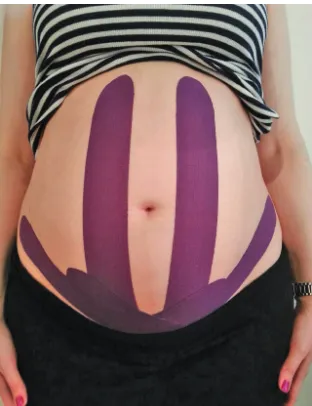
Taping protocol: At this point the chiropractor applied
tape to the abdomen using four strips: two along rectus abdominus and two along external abdominal oblique. The first two strips were started at the superior aspect of the symphysis pubis with no-tape tension for one-inch. Tape-off tension was applied as the tape coursed over the rectus abdominus muscle up to the xiphoid process, with no-tape tension for the last one-inch. The remaining two strips were started on the medial aspect of the sym-physis pubis (overlapping rectus abdominus tape medial-ly) coursing along external obliques and anterior superior iliac spine (ASIS) with tape-off tension; no-tape tension was applied to the starting and ending one-inch of tape, acting as anchors (Figure 1). Home care included Kegel
Figure 1.
exercises and abdominal bracing. The patient was also re-ceiving care from a naturopath, registered massage ther-apist and a midwife.
One week later, at 21 weeks, the patient returned to her chiropractor feeling much better; she rated her pain at a 4/10 on the NRS. The patient reported that her combined pain and round ligament pain improved, as well as her sleep. She was able to walk for 10-15-minute intervals with minimal to no pain. The chiropractor performed the same manual therapy intervention as her previous ap-pointment and re-applied tape.
At 23 weeks, the patient reported overall improvement in symptoms, but continued to experience mild combined pain and round ligament pain, as well as interrupted sleep. The chiropractor treated her with the same manual treat-ments and taping as outlined above. Three days later, the patient returned to the chiropractor stating that she was able to go for a long walk the day before, and that she was experiencing significant relief. However, the patient reported that without the tape, pain returned to 9/10. The tape was re-applied in the same manner outlined above; however, four additional strips were applied for further
support. Two strips were used to reinforce the rectus ab-dominus strips and two creating an “X” over the sym-physis pubis (Figure 2). The patient’s regular manual therapy was provided at this visit. For convenience, and to ensure continued relief for the patient, the chiropractor taught the patient’s husband the taping protocol for home application.
28 Weeks Gestation to Delivery
At 28 weeks, the patient reported the tape continued to provide relief with the round ligament pain as well as combined pain. Unfortunately, the patient started to ex-perience symphysis pubis pain and difficulty walking. At all chiropractic appointments from 28 weeks until delivery, manual therapy was performed, exercises were progressed, and the tape was applied by her husband at home. At 37 weeks, the chiropractor added isometric con-traction of the hip adductors to adjust and relieve pain in the symphysis pubis and applied additional tape over the symphysis pubis (Figure 3). At 38 weeks, the patient experienced Braxton Hicks contractions almost immedi-ately following the treatment. At this point, the chiroprac-(a) (b)
Figure 2.
(a) Front and (b) side view of patient’s reinforced abdominal taping (rectus abdominus reinforced, external abdominal oblique, symphysis pubis ‘X’).
Figure 3.
tor discontinued SMT because the patient expressed con-cern. For the remainder of the visits, and with the patient’s consent, the chiropractor performed instrument assisted adjustments and STT. Treatment continued until just af-ter 40 weeks. At this time, the patient had a successful labour and delivery and continued to seek chiropractic care postpartum. There were no adverse events reported with any of the treatment provided including the manipu-lation, STT or the taping intervention. Signed consent for release of patient information and photographs was ob-tained from the patient.
Case Presentation #2
A 32-year old patient presented to the clinic at 35 weeks gestation with back pain of approximately two-month duration. When asked to point to the area of pain, the pa-tient indicated that her pain was bilaterally at the SIJs. She also reported pain along her anterior thigh and posterior hamstring, not extending distal to the knee. She reported the pain intensity was a 10/10 on an NRS. She denied any numbness or tingling into the lower limb and no change in bowel or bladder control. Although her pregnancy was healthy and uneventful, she was having difficulty with ADLs including, turning over in bed and fast cadence gait as she reported experiencing a “zapping feeling down her leg”. The patient was active during her pregnancy, own-ing a Pilates studio where she continued to teach until 37 weeks gestation.
Physical examination revealed that lumbar range of motion was full and pain-free. A P4 test elicited the chief complaint, with the right-side more painful than left. Palpation of the SIJs and dorsal sacral ligaments were painful bilaterally, as was palpation of the right piriform-is. Diastasis rectus testing was negative, as was greater trochanteric compression. A lower extremity neurologic examination, including deep tendon reflexes, sensory (light touch) and motor testing and plantar reflex, were all within normal limits. A diagnosis of pregnancy-related PGP was rendered for this patient. Plan of management included STT of the piriformis, dorsal sacral ligaments, gluteus minimus and medius, taping of the SIJs, and birth preparation exercises.
Taping protocol: Tape application consisted of three strips, creating an H-pattern. The first two strips were par-allel to each other and started on the lumbar erector spinae running longitudinally until past the SIJs. Tape was
ap-plied for one-inch with no-tape tension. Tape-off tension was applied as the tape was applied along the muscle belly of the lumbar erector spinae to below the SIJs, with no-tape tension for the last one-inch. The third strip was applied over the SIJs, starting at the sacral tubercle. Tape-off tension was applied medial to lateral with no-tape ten-sion at the one-inch ends (Figure 4).
Following the first treatment, the patient emailed the chiropractor reporting her pain was non-existent (0/10), she was very pleased with her treatment response. Until she gave birth at 39.5 weeks to a healthy baby, the pa-tient received three more treatments once a week, with the same protocol and same relief. Although the patient has attempted returning for postpartum chiropractic care, she has been unsuccessful with a newborn. There were no ad-verse events reported with the any of the chiropractic care including the STT and taping intervention. Signed con-sent for release of patient information and photographs was obtained from the patient.
Discussion
It is well known that pregnancy is often associated with the onset or exacerbation of LBP, PGP or a combination of both of these pains.6 Despite this, there is limited evidence
to the etiology, pathophysiology and treatment strategies for this population.6,27 As such, healthcare providers often
dismiss complaints by the expectant mother because these are considered normal ailments of pregnancy and often resolve once the baby has arrived.27 Therefore, the
im-Figure 4.
portance of differentiating pregnancy-related LBP and PGP for proper diagnosis and management is crucial.7, 11-13 Both chiropractors in the current case series conducted
a thorough history to obtain details of the chief complaint and the ADLs impacted by the patient’s back pain. Further-more, a physical examination using two or more pain pro-vocation tests, was performed in both cases to identify the type of back pain each patient was experiencing. Once a proper diagnosis was identified, taping protocols specific to the patient’s symptomatology was rendered.
It has been postulated that the positive results asso-ciated with taping may be a result of direct and indirect means.25 Directly, the tape affects the skin and
associ-ated receptors (Ruffinis, pain and deep sensory recep-tors) and indirectly, through supporting lumbosacral structures (such as thoracolumbar fascia). These mech-anisms may help reduce tension in overloaded muscles, thereby increasing stability, reducing paraspinal stress, and stimulating connective tissues, resulting in pain re-lief.10,25 Following the application of tape, patients in the
current study reported a decrease in pain and qualitative improvement in function and disability. Furthermore, they had less fear of movement with ADLs, which has been noted in previous literature.19 In the current case
series, both patients complained that certain movements were extremely difficult, including changing positions during sleep and an inability to walk quickly and/or long-er than five minutes. One patient felt relief immediately, and the other felt relief within one week following the application of tape. Pain scales were originally 9-10/10 and reduced to 4/10 or less. Previous studies have dem-onstrated that the application of tape increases patients’ sense of confidence and safety. It has been suggested that the tape provides a more secure and stable feeling, as well as a proprioceptive reminder to maintain optimal posture.28 This increased confidence and stability may
allow the patient to actively perform exercises, contrib-uting to the efficacy of their treatment.5
Previous pregnancy taping studies have found similar results to the current case series. Kaplan et al. examined the effectiveness of a five-day intervention that included paracetamol and tape versus paracetamol alone on pain and disability.10 They determined the addition of tape had
more superior effect on the outcomes than paracetamol alone. However, they did not employ a sham group in their study; therefore, a placebo effect cannot be ruled
out.10 Sabbour and Omar randomly assigned pregnant
women who were experiencing LBP to receive pelvic tilt exercises or pelvic tilt exercises plus the application of tape (two applications, approximately one week apart).5
They demonstrated a significant decrease in pain and functional disability scores in the group who received ex-ercise and tape.5 Kuciel and colleagues also found a
re-duction in pain and improved disability scores on day five and day ten following a five-day taping protocol.25 In a
crossover study, Kalinowski et al. applied tape to women experiencing low back pain and determined that there was a decrease in pain intensity and disability when women had the taping protocol applied, as opposed to the pla-cebo taping protocol.26 It should be noted that although
these can be considered positive results, Kuciel et al.25
and Kalinowski et al.26 did not use any type of control
group to compare outcomes.
One difference between the current case series and what is reported in the literature, is that our study fol-lowed patients on a long-term basis with multiple tape applications versus a one-time application with shorter follow-up periods.25, 26 In the present case series, both
pa-tients noted their pain returned immediately following the removal of tape and decreased with their next application. In addition, our case series identified different types of pregnancy-related back pain prior to applying an indi-vidualized taping protocol based on their symptomology. Kuciel et al. 25 utilized the European Guidelines for
Treat-ment and Diagnosis11 to identify PGP in their subjects,
and then employed a generalized taping protocol - tape applied from the bottom of the scapula to the bottom of the sacroiliac joints. Similar to the present case ser-ies, Kalinowski et al.26 and Sabbour and Omar5 applied a
series are limited, positive outcomes on the quality of life of the affected pregnant patient were achieved.
Tape is another treatment modality available to chiro-practors that can be used as a relief mechanism for preg-nant patients. It is a simple technique that can be applied to the patient and can be taught to their partner to apply as a form of pain relief. It is noninvasive, inexpensive, and is well tolerated by the patient, with very few adverse effects.10,25 This case series demonstrates the effects of
in-dividualized taping protocols on pregnancy-related back pains. As tape is easy to apply and relatively inexpensive, we believe it may be an effective option for pain manage-ment during pregnancy.
Limitations and future studies
This case series has several limitations. First, one of the patients had a difficult pregnancy with multiple complica-tions. Due to the complicated nature of her pregnancy, she was seeking care from many different healthcare provid-ers and therefore, her pain relief cannot be solely attribut-ed to taping and chiropractic care. Second, both patients presented with different symptomatology and therefore, received slightly varying therapies from their respective chiropractor, including soft tissue therapy and manual adjustments. Consequently, the benefits seen in this case may not be exclusively related to taping. Furthermore, the methodology differed with respect to taping pregnant pa-tients; both chiropractors used different types of tape and neither chiropractor had any formal training with respect to taping pregnant patients. Despite these limitations, there were still positive clinical results. Third, only qualitative measures were obtained in these case reports, including NRS and perceived quality of life. Future studies would benefit from the inclusion of validated outcome measures to assess disability (i.e. Oswestry Disability Index, Ro-land Morris Disability Questionnaire) or health-related quality of life (i.e. SF-36). Finally, we did not use a sham taping application; therefore, the placebo effect of the tap-ing treatment cannot be discounted.
Our case report highlights the important need for future research. Future studies should focus on the application of an individualized taping protocol that is appropriate for the varying types of pregnancy-related back pain.
Summary
There is limited research on the effectiveness of taping on
LBP and PGP during pregnancy and as far as we know, this is the first case series to follow two pregnant women diagnosed and treated with different pain patterns and tap-ing protocols from presentation in clinic until delivery. Upon each application of tape, the patients experienced significant and immediate pain relief as well as increased quality of life. More research is required to differentiate the types of back pain pregnant patients experience (LBP, PGP, combined pain), and furthermore, if varying types of taping protocols are indicated.
References
1. Ansari NN, Hasson S, Naghdi S, Keyhani S, Jalaie S. Low back pain during pregnancy in Iranian women. Physiother Theory Pract. 2010;26(1):40-48.
2. Malmqvist S, Kjaermann I, Andersen K, Økland I, Brønnick K, Larsen JP. Prevalence of low back and pelvic pain during pregnancy in a Norwegian population. J Manipulative Physiol Ther. 2012;35(4):272-278. 3. Stapleton DB, MacLennan AH, Kristiansson P. The
prevalence of recalled low back pain during and after pregnancy: a South Australian population survey. Aust N Z J Obstet Gynaecol. 2002;42(5):482-485.
4. Ramachandra P, Maiya A, Kumar P, Kamath A. Prevalence of musculoskeletal dysfunctions among Indian pregnant women. J Pregnancy. 2015;15:437105.
5. Sabbour A, Omar H. The effect of Kinesiotaping therapy augmented with pelvic tilting exercises on low back pain in primigravidas during the third trimester. Bull Fac Phys Ther Cairo Univ. 2011;16(1):53-61.
6. Weis C, Barrett J, Tavares P, Draper C, Ngo K, Leung J, et al. Prevalence of low back pain, pelvic girdle pain, and combination pain in a pregnant Ontario population. J Obstet Gynaecol Can. 2018;40(8):1038-1043.
7. Vermani E, Mittal R, Weeks A. Pelvic girdle pain and low back pain in pregnancy: a review. Pain Pract. 2010;10(1):60-71.
8. Kovacs FM, Garcia E, Royuela A, González L, Abraira V. Prevalence and factors associated with low back pain and pelvic girdle pain during pregnancy: a multicenter study conducted in the Spanish National Health Service. Spine. 2012;37(17):1516-1533.
9. Wu W, Meijer O, Uegki K, van Dieen J, Wuisman P, Ostgaard H. Pregnancy-related pelvic girdle pain (PPP), I: terminology, clinical presentation, and prevalence. Eur Spine J. 2004;13(7):575-589.
10. Kaplan S, Alpayci M, Karaman E, Cetin O, Ozkan Y, Ilter S, et al. Short-term effects of kinesio taping in women with pregnancy-related low back pain: a randomized controlled clinical trial. Med Sci Monit. 2016; 22:1297-1301.
B, Stuge B. European guidelines for the diagnosis and treatment of pelvic girdle pain. Eur Spine J. 2008;17(6):794-819.
12. Albert H, Godskesen M, Westergaard J. Evaluation of clinical tests used in classification procedures in pregnancy-related pelvic joint pain. Eur Spine J. 2000;9(2):161-166.
13. Albert H, Godskesen M, Westergaard J. Incidence of four syndromes of pregnancy-related pelvic joint pain. Spine. 2002;27(24):2831-2834.
14. Liddle Sarah D, Pennick V. Interventions for preventing and treating low-back and pelvic pain during pregnancy. Cochrane Database Syst Rev. 2015; (9). Available from: https://www.cochranelibrary.com/cdsr/
doi/10.1002/14651858.CD001139.pub4/full
15. Kachanathu S, Alenazi A, Seif H, Hafez A, Alroumim M. Comparison between Kinesio Taping and a traditional physical therapy program in treatment of nonspecific low back pain. J Phys Ther Sci. 2014;26(8):1185-1188. 16. Paolini M, Bernetti A, Fratocchi G, Mangone M,
Parrinello M, Del Pilar Cooper M. Kinesio Taping applied to lumbar muscles influences clinical electromyographic characteristics in low back pain patients. Eur J Phys Rehabil Med. 2011;47(2):237-244.
17. Alvarez-Alvarez S, Garcia-Muro San Jose F,
Rodrigez-Fernandez A, Gueita-Rodriguez J, Waller B. Effects of kinesiotape in low back muscle fatigue: randomized, controlled, double-blinded clinical trial on healthy subjects. J Back Musculoskelet Rehabil. 2014;27(2):203-212.
18. Castro-Sanchez A, Lara-Palomo I, Mataran-Penerrocah G, Fernandez-Sanches M, Sanchez-Labraca N,
Arroyo-Morales M. Kinesio Taping reduces disability and pain slightly in chronic non-specific low back pain: a randomized trial. J Physiother. 2012;58(2):89-95.
19. Gonzalez-Iglesias J, Fernandez-de-las-Penas C, Cleland J, Hulijbregts P, del Rosario Guiterrez-Vega M. Short-term effects of cervical kinesio taping on pain and cervical range of motion in patients with acute whiplash injury:
a randomized clinical trial. J Orthop Sports Phys Ther. 2009;39(7):515-521.
20. Koroglu F, Colak T, MG P. The effect of Kinesio® taping on pain, functionality, mobility and endurance in the treatment of chronic low back pain: a randomized controlled study. J Back Musculoskelet Rehabil. 2017;30(5):1087-1093.
21. Keles B, Yalcinkaya E, Gunduz B, Bardak A, Erhan B. Kinesio Taping in patients with lumbar disc herniation: a randomised, controlled, double-blind study. J Back Musculoskelet Rehabil. 2017;30(3):543-550.
22. Luz Junior MAD, Almeida MO, Santos RS, Civile VT, Costa LOP. Effectiveness of Kinesio Taping® in patients with chronic non-specific low back pain: a systematic review with meta-analysis. Spine. 2019;44(1):68-78. 23. Araujo A, do Carmo Silvia Parreira P, Junior L, da Silva T,
da Luz Junior M, da Cunha Menezes Costa L, et al. Medium term effects of kinesio taping in patients with chronic non-specific low back pain: a randomized controlled trial. Physiotherapy. 2018;104(1):149-151. 24. Nelson N. Kinesio taping for chronic low back pain:
a systematic review. J Bodyw Mov Ther. 2016;20(3):672-681.
25. Kuciel N, Sutkowska E, Ceienska A, Markowska D, Wrzosek Z. Impact of Kinesio Taping application on pregnant women suffering from pregnancy-related pelvic girdle pain – preliminary study. Ginekol Pol. 2017;88(11): 620-625.
26. Kalinowski P, Krawulska A. Kinesio taping vs. placebo in reducing pregnancy-related low back pain: a cross-over study. Med Sci Monit. 2017;23:6114-6120.
27. Borg-Stein J, Dugan SA, Gruber J. Musculoskeletal aspects of pregnancy. Am J Phys Med Rehabil. 2005;84(3):180-192.