O R I G I N A L A R T I C L E
Open Access
Adjacent digit fingerprint white line count
differences: a pointer to sexual dimorphism
for forensic application
Magaji Garba Taura
1,2, Lawan Hassan Adamu
2*, Abdullahi Yusuf Asuku
2, Kabiru Bilkisu Umar
3and
Musa Abubakar
2Abstract
Background:Sex determination is one of the leading criterion in identification and verification of an individual. However, the potential roles of differences in adjacent fingerprint white line count (FWLC) in sex inference are not well elucidated in the literature especially among Hausa population. The study was conducted to determine sexual dimorphism and predict sex using adjacent digit FWLC difference (adj. DFWLCD) among Hausa population of Kano state, Nigeria.
Methods:The study population involved 300 participants. FWLC was determined from a plain fingerprint captured using live scanner. The formula for adj. DFWLCD of thumb and fifth digit is dR15 for right hand. The same applied for possible combination in cephalocaudal direction. Mann-Whitney andttests were used for comparison of variables between sexes. Binary logistic regression analyses were employed for determination of sex.
Results:We observed a significantly larger adj. DFWLCD in males compared with females in most of the digit combination. A significant sexual dimorphism was observed in most of the adj. DFWLCD involving ring digit in both right (dR14, dR24, and dR34) and left (dL14, dL24, and dL34). The best discrimination was observed in adjacent FWLC difference of second and fourth digits in both right and left digits (dR24 and dL24). This was further
supported by stepwise logistic regression analyses.
Conclusion:The adj. DFWLCD exhibits sexual dimorphism. The best prediction potentials were found to be dR24 and dL24 for right and left hands respectively.
Keywords:Forensic sciences, Fingerprint white line, Sex determination, Hausa population
Introduction
Fingerprint is one of the widely used biometrics for the purpose of human identification. Its uniqueness, consistency, and inexpensiveness give room for its appli-cation in the distinction between individuals at different stages of human life (Zugibe and Costello, 1986; Yager and Amin, 2004; Gutierrez et al., 2007; Kahana et al.,
2001; Franca,2011; Vanrell,2012). The fingerprint ridge configuration formed by epidermal ridges during 12th– 19th gestational weeks remains fixed and permanent throughout the life of an individual (Mulvihill and
Smith, 1969; Babler,1979). The epidermal ridges are ex-plained at different levels; these include pattern config-uration, minutiae, ridge characteristic such as ridge flow, shape, contour, etc. (Hong et al., 1998; Jain et al.,2007). The epidermal ridges are often associated with surface wrinkling on gross examination of fingertip called finger-print white lines.
Fingerprint white lines (FWL) correspond to areas of depression on fingerprints that appear white on the fin-gerprint images and skin deformation on fingertip that may be linked to loss of the elements of skin tissues (Cummins and Midlo,1943; Ashbaugh,1999; D’Adamo,
2010; Maceo,2011). Previous studies suggested that with aging, there is decrease in the strata of the epithelium and an inter digitations between epidermis and dermis
© The Author(s). 2019Open AccessThis article is distributed under the terms of the Creative Commons Attribution 4.0 International License (http://creativecommons.org/licenses/by/4.0/), which permits unrestricted use, distribution, and reproduction in any medium, provided you give appropriate credit to the original author(s) and the source, provide a link to the Creative Commons license, and indicate if changes were made.
* Correspondence:[email protected]
2Department of Anatomy, Faculty of Basic Medical Sciences, College of
of the skin (Makrantonaki and Zouboulis,2007; Waaijer et al., 2012; Farage, 2013) and reduction of elastin syn-thesis (Farage,2013). This leads to decrease in the elasti-city and support of the tissue, increase in the brittleness, and impairment of nuclear and mitochondrial DNA re-pair mechanisms. Hence, the chance for appearance of lesions and spots was exemplified by FWL (Makranto-naki and Zouboulis,2007). This mechanism is supported by a documented increase in FWL in elderly (Vieira Silva et al.,2016) and increase in frequency of FWL with age or when there is alteration in subcutaneous body fat (Cummins and Midlo,1943; Ashbaugh,1999).
It was hypothesized that the size of a fetal fingertip (compared with its neighbor on the same hand) might be influenced by factors that stimulate or inhibit growth along the developmental axis extending from the brain to the lower limbs (Kahn et al., 2001). It is well docu-mented that the growth along developmental axis is sexually dimorphic, with upper to lower body segments proportional difference been higher in males than in fe-males (Bailey and Katch, 1981). However, the potential roles of differences in adjacent FWLC in sex inference are not well elucidated in the literature especially among Hausa population. Only few studies reported the poten-tial role of FWL in sex determination in the other popu-lations (Badawi et al., 2006; Taduran et al., 2016) including the Hausa population (Adamu et al., 2019). Since sex determination is one of the leading criteria in identification and verification of an individual among all the key parameters of identification (Ubelaker, 1996), and determination of sex of human remains has been proven to help forensic experts during analyses of dis-membered and fragmentary remains and also in criminal investigation by narrowing the pool of potential suspect matches (Kanchan et al., 2008; Dey and Kapoor, 2015). It is, therefore, plausible to look at the utility of FWL in sex determination. The present study was set to achieve the following objectives: (i) to determine the sexual di-morphism in adj. DFWLCD, (ii) to predict sex from the adj. DFWLCD, and (iii) to determine the best adj. DFWLCD that discriminate the sex, among Hausa popu-lation of Kano state, Nigeria.
Materials and methods
Study location, design, and participants
The study was carried out at Bayero University Kano (a Federal university) and Maitama Sule University, Kano (a state University). This was a cross sectional study con-ducted among students of the two selected tertiary insti-tutions in Kano metropolis, Nigeria. We randomly selected sample of 150 males and 150 females to partici-pate in the study based on the study selection criteria. The participants were within the age range of 18–33 years (mean age of 21.94 ± 2.31 and 20.13 ± 2.33 years
for male and female respectively). We excluded any par-ticipant with physical deformity in the tip of their digit and belonged to other ethnic group. We adopted self-declaration of the ethnicity methods, and only those that belong to Hausa ethnic group up to the level of grand parentage were considered. We obtained an informed consent from the participants before commencement of the study. The study allowed decline of consent by par-ticipants at any stage of the data collection (although none of the participants declined his/her consent). We used simple proforma for collection of bio-data (sex, age, and ethnicity) of the participants. The study was conducted following the ethical guidelines of Helsinki Declaration. The protocols involved in the study were approved by the Department of Anatomy, Faculty of Basic Medical Sciences, College of Health Science, Bayero University Kano.
Fingerprints capturing and white line counts
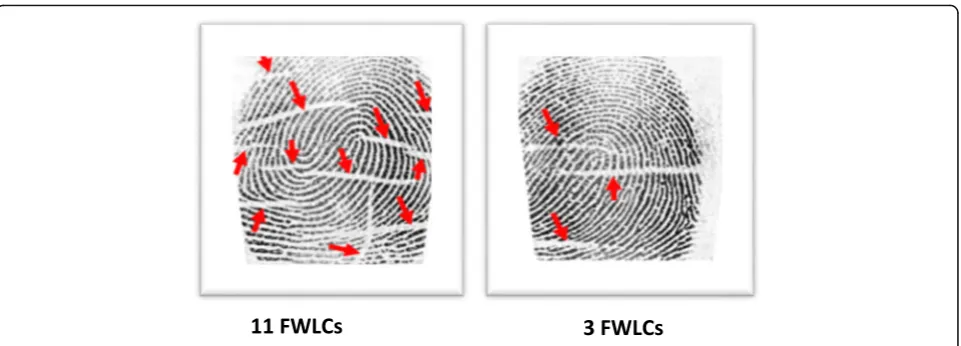
A live scanner (Digita Persona, China) was used to cap-ture the fingerprint of all the ten digits according to methods described by Adamu et al. (2018). We defined the white line as the skin folds in the friction fingerprint epidermal ridges that appear as white lines in the finger-print images (Fig.1). The FWLC for each digit was con-sidered as the number of the observed white lines per unit plain fingerprints (Taduran et al., 2016; Adamu et al., 2019). The reliability and intra observer error in the FWLC were reported elsewhere (Adamu et al.,
2019).
Determination of adjacent digit FWLC differences
It was suggested that each tip of digit is related neuro-logically to a spinal-cord segment in a range that in-cludes the sixth (C6) through the eighth cervical (C8) levels. The first digit (thumb) is linked to the cephalad (upper) side of C6, and the fifth digit is linked to the caudal (lower) side of C8 (Heimer, 1994). We deter-mined the adj. DFWLCD as per Kahn et al. (2001) methods of determination of adjacent fingerprint ridge count difference. The adj. DFWLCD was therefore de-termined as the differences in FWLC from the caudal FWLC value subtracted from the cephalad FWLC value (e.g., dR12 is right first digit (thumb) FWLC minus right second digit (index) FWLC, that is the difference in FWLC between thumb and index finger).
Statistical analyses
analyses were used to generate a model for sex predic-tion using adj. DFWLCD. Stepwise multiple (forward conditional) binary logistic regression analysis was also conducted to determine the adj. DFWLCD that predict sex. The analyses were carried out using SPSS version 20 (IBM Corporation, for Windows) and 5% (P< 0.05) level of error was considered for any statistical inference.
Results
Table 1 shows the descriptive statistics of the FWLC of the right and left hands digits. The mean FWLC was higher in the females in all the ten digits. Absence of FWLC was observed in both sexes in all the digits as the minimum counts. However, the maximum FWLC was in favor of females, with higher count across the ten digits.
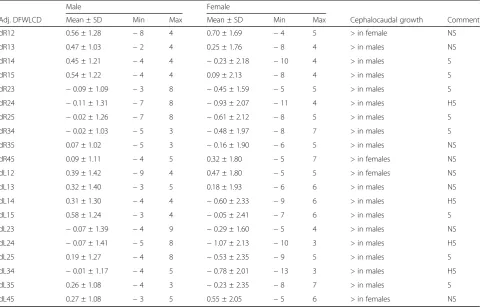
From Table2, the FWLC on the right digits was found to be higher on the first digit compared with other adja-cent digits (second, third, fourth, and fifth) in both sexes except for dR14 in females where fourth digit had higher FWLC compared with the first digit, as indicated by
negative mean value (− 0.23 ± 2.18). The second and third digits were observed to have lower FWLC com-pared with other adjacent digits in both males and fe-males, except for dR35 in males where third digit had higher FWLC compared with the fifth digit, as indicated by positive mean value (0.07 ± 1.02). The mean dR45 was positive in both sexes in the right hand. Similar trend was observed in the left hand except in dL25 in males where the FWLC of the second digit was higher than that of fifth digit, as indicated by positive mean value (0.19 ± 1.27) and dL15 in females where the FWLC of the second digit was lower than the that of fifth digit, as indicated by negative mean value (−0.05 ± 2.41). There were significantly larger adj. DFWLCD in males compared with females in most of the digit com-bination. However, few digits indicated higher adjacent digit FWLC difference adj. DFWLCD in females, but none was significant.
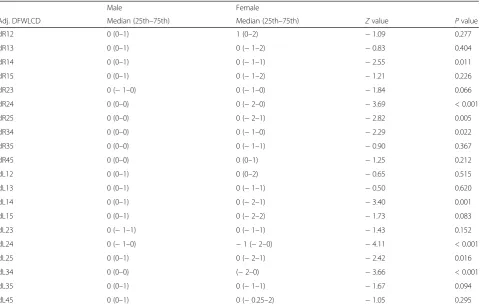
Table 3 shows sexual dimorphism in FWLC adjacent digit asymmetry of the right and left digits. A significant
Fig. 1Techniques for fingerprints white line counts
Table 1Descriptive statistics of the FWLC of the right and left hands digits
Male Female
Digits Designation Min Max Mean ± SD Min Max Mean ± SD
Right thumb R1 0 6 1.03 ± 1.13 0 8 2.13 ± 1.66
Right index R2 0 8 0.47 ± 0.92 0 11 1.43 ± 1.78
Right middle R3 0 5 0.56 ± 0.94 0 9 1.87 ± 2.06
Right ring R4 0 10 0.58 ± 1.22 0 17 2.35 ± 2.81
Right little R5 0 10 0.49 ± 1.20 0 11 2.03 ± 2.40
Left thumb L1 0 5 1.24 ± 1.29 0 12 2.71 ± 1.90
Left index L2 0 9 0.85 ± 1.29 0 11 2.24 ± 2.03
Left middle L3 0 7 0.92 ± 1.38 0 15 2.53 ± 2.54
Left ring L4 0 7 0.93 ± 1.47 0 17 3.31 ± 2.99
Left little L5 0 5 0.66 ± 1.15 0 12 2.77 ± 2.89
sexual dimorphism was observed in all the adjacent FWLC differences involving ring digit in both right (dR14, dR24, and dR34) and left (dL14, dL24, and dL34) digits except for dR45. Similarly, dR25 and dL25 exhib-ited significant sexual dimorphism. The magnitude of the sexual dimorphism was more pronounced in dR24 (Z=−3.69,P< 0.001) and dL24 (Z=−4.11,P< 0.001), more in the left that in the right.
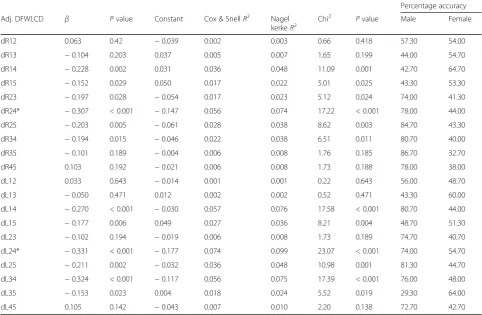
A significant sex prediction potential of adj. DFWLCD was observed in dR14, dR15, dR23, dR24, dR25, and dR34. Similar trend was observed in the left digits except for dL23 and addition of dL35. The best discrimination was observed in adj. DFWLCD of second and fourth digits in both right and left digits (dR24 and dL24). This was further supported by stepwise (forward conditional) multiple binary logistic regression analyses. The variance of sex explained by adjacent digit FWLC difference was higher in dL24 (7.4 to 9.9%) compared dR24 (5.6 to 7.4%) as shown in Table4.
Discussion
Identification of human remains is an essential element of any medico-legal investigation, and it has been a de-manding task for forensic experts and physical
anthropologists across the globe (Kanchan et al., 2008). This has led to continuous need to explore different body parts and techniques to determine key identity pa-rameters often collectively described as “the Big Four”; race, sex, age, and stature (Scheuer, 2002; Ahmed and Omer, 2015). Therefore, the goal of the present study was to investigate and provide insight in to the role of adj. DFWLCD as a probable additional forensic tool that might compliment the sex component of“the Big Four.”
The difference in adj. DFWLCD was significantly more pronounced in males compared with females as an indi-cation of larger cephalocaudal growth inhibition in males. This is supported by a previous study, where large fingerprint ridge-count difference between fingers on the same hand (a decline in the cephalocaudal direction) was used to reflect conditions associated with relative in-hibition of caudal growth (Kahn et al., 2001). The con-cept of a more pronounced caudal growth inhibition in males may be explained by the fact that sexual dimorph-ism in the circumference of the upper limb (averaged 17.9%) was higher compared to that in the lower limb (4.6%), and this exhibited fairly consistent proximal to distal dimorphism in most of the measured body param-eters (Bailey and Katch,1981). It was also suggested that Table 2Descriptive statistics adj. DFWLCD and sexual dimorphism in cephalic to caudal growth inhibition in the right and left sides of the hand
Male Female
Adj. DFWLCD Mean ± SD Min Max Mean ± SD Min Max Cephalocaudal growth Comment
dR12 0.56 ± 1.28 −8 4 0.70 ± 1.69 −4 5 > in female NS
dR13 0.47 ± 1.03 −2 4 0.25 ± 1.76 −8 4 > in males NS
dR14 0.45 ± 1.21 −4 4 −0.23 ± 2.18 −10 4 > in males S
dR15 0.54 ± 1.22 −4 4 0.09 ± 2.13 −8 4 > in males S
dR23 −0.09 ± 1.09 −3 8 −0.45 ± 1.59 −5 5 > in males S
dR24 −0.11 ± 1.31 −7 8 −0.93 ± 2.07 −11 4 > in males HS
dR25 −0.02 ± 1.26 −7 8 −0.61 ± 2.12 −8 5 > in males S
dR34 −0.02 ± 1.03 −5 3 −0.48 ± 1.97 −8 7 > in males S
dR35 0.07 ± 1.02 −5 3 −0.16 ± 1.90 −6 5 > in males NS
dR45 0.09 ± 1.11 −4 5 0.32 ± 1.80 −5 7 > in females NS
dL12 0.39 ± 1.42 −9 4 0.47 ± 1.80 −5 5 > in females NS
dL13 0.32 ± 1.40 −3 5 0.18 ± 1.93 −6 6 > in males NS
dL14 0.31 ± 1.30 −4 4 −0.60 ± 2.33 −9 6 > in males HS
dL15 0.58 ± 1.24 −3 4 −0.05 ± 2.41 −7 6 > in males S
dL23 −0.07 ± 1.39 −4 9 −0.29 ± 1.60 −5 4 > in males NS
dL24 −0.07 ± 1.41 −5 8 −1.07 ± 2.13 −10 3 > in males HS
dL25 0.19 ± 1.27 −4 8 −0.53 ± 2.35 −9 5 > in males S
dL34 −0.01 ± 1.17 −4 5 −0.78 ± 2.01 −13 3 > in males HS
dL35 0.26 ± 1.08 −4 3 −0.23 ± 2.35 −8 7 > in males S
dL45 0.27 ± 1.08 −3 5 0.55 ± 2.05 −5 6 > in females NS
growth trends in the limbs are essentially linear through late adolescence but completed earlier in females (Hier-naux, 1968). The adult leg would therefore be less di-morphic than the adult arm (Bailey and Katch, 1981). Also, according to Kahn et al. (2001), developing em-bryos with higher adjacent digit ridge count difference might accumulate relatively less tissue in the lower body. This might express reduced lower-extremity muscle mass and tissue distribution compared with the upper body. From the foregoing explanations, it is clear that any measurable parameter that serves as an indicator of caudal inhibition, including adj. DFWLCD, will be of interest to forensic experts especially with regard to sex determination.
The significant sexual dimorphism observed in the adj. DFWLCD in the present study; reaffirms the potential of the FWLC in sex prediction as reported in previous studies (Badawi et al.,2006; Taduran et al.,2016; Adamu et al.,2019). The existence of sexual dimorphism in the adj. DFWLCD may be superior to the absolute FWLC in sex prediction especially among the elderly population, since, it was demonstrated that the FWL increases from adult to elderly life cycle. This is linked to the loss of re-silience of the skin, which is the property of returning of the skin to its original shape after being subjected to
elastic deformation (Vieira Silva et al.,2016). Frequency of FWL was also reported to increase with age or when there is alteration in subcutaneous body fat (Cummins and Midlo, 1943; Ashbaugh,1999). In addition to FWL changes, the epidermal ridge thickness and inter papil-lary space were also reported to increase with age as a continuum of increase in body size (Cummins et al.,
1994; David, 1981; Babler, 1991; Gutierrez-Redomero et al.,2011; Soanboon et al.,2016; Sánchez-Andrés et al.,
2018). But, the adjacent finger ridge count difference (dR45) was suggested to be consistent with aging (Kahn et al., 2001). We therefore extended the same observation, of consistency of finger ridge count differ-ence with aging, to adj. DFWLCD. This may be ex-plained by the fact that, similar to second-to-fourth digit ratio of the hand (2D:4D), the indices do not change with aging and growth in body parts (Manning et al., 2004; Aboul-Hagag et al., 2011). Hence, it was concluded that sexing by indices is more reliable than absolute measurement since the relative growth of body parts are proportional to each other (Gutnik et al., 2015). This may lead to the assumption that adj. DFWLCD might not be altered by age or change in body condition similar to adjacent finger ridge count difference and digit ratios.
Table 3Sexual dimorphism in FWLC adjacent digit asymmetry of the right and left digits
Male Female
Adj. DFWLCD Median (25th–75th) Median (25th–75th) Zvalue Pvalue
dR12 0 (0–1) 1 (0–2) −1.09 0.277
dR13 0 (0–1) 0 (−1–2) −0.83 0.404
dR14 0 (0–1) 0 (−1–1) −2.55 0.011
dR15 0 (0–1) 0 (−1–2) −1.21 0.226
dR23 0 (−1–0) 0 (−1–0) −1.84 0.066
dR24 0 (0–0) 0 (−2–0) −3.69 < 0.001
dR25 0 (0–0) 0 (−2–1) −2.82 0.005
dR34 0 (0–0) 0 (−1–0) −2.29 0.022
dR35 0 (0–0) 0 (−1–1) −0.90 0.367
dR45 0 (0–0) 0 (0–1) −1.25 0.212
dL12 0 (0–1) 0 (0–2) −0.65 0.515
dL13 0 (0–1) 0 (−1–1) −0.50 0.620
dL14 0 (0–1) 0 (−2–1) −3.40 0.001
dL15 0 (0–1) 0 (−2–2) −1.73 0.083
dL23 0 (−1–1) 0 (−1–1) −1.43 0.152
dL24 0 (−1–0) −1 (−2–0) −4.11 < 0.001
dL25 0 (0–1) 0 (−2–1) −2.42 0.016
dL34 0 (0–0) (−2–0) −3.66 < 0.001
dL35 0 (0–1) 0 (−1–1) −1.67 0.094
dL45 0 (0–1) 0 (−0.25–2) −1.05 0.295
The present quantification method (adj. DFWLCD) of FWLC may not only be superior to absolute quantifica-tion of FWLC but also to bilateral asymmetry in FWLC. It was documented that the occurrence of bilateral asymmetry depends on the extent exposure to stress and strain on the dominant side (Gutnik et al., 2015) This implies that the greater the use of the preferred side, the more the hypertrophy and development of the muscles on that side of the limb with consequential increase in asymmetry (Plochocki, 2004; Blackburn, 2011; Krishan,
2011; Krzykala and Leszczynski, 2015). Although, the in-fluence of testosterone is more pronounced on the right hand even among the left handed individuals (Hampson and Sankar, 2012), and not more than 10% of every population are left handed, (Hardyck and Petrinovich,
1977) and 5% among African ages 18 to 33 years (De Agostini et al.,1997). For adj. DFWLCD, the differential influences of hand preference are minimal or absent considering the fact that both digits belong to the same body side.
Interestingly, in both right and left hands, the adj. DFWLCD in second and fourth digits (dR24 and dL24) was the best predictor of sex. This is similar to what was
reported for digit ratio, where the 2D:4D exhibited the highest magnitude of sex discrimination especially in the right hand (Kyriakidis and Papaioannidou,2008; Agniho-tri et al., 2015). The 2D:4D is negatively correlated with prenatal testosterone and positively correlated with es-trogen (Manning et al.,1998). This relationship between the digit ratio and sex hormones may be extended to other features associated with the digits (second and fourth digits) in a direct or an inverse manner. For the first time, we hypothesized that the dR24 and dL24 of FWLC correlated positively to prenatal testosterone and negatively correlated to estrogen. This may also be ex-tended to other associated features like fingerprint ridge count which has been demonstrated to be an index of caudal growth inhibition (Kahn et al., 2001). Indeed, we also suggested inverse relationship between the adjacent digits associated feature differences and digit ratios, with higher value indicating “masculine feature” and lower value as “feminine feature” and also, more expression of adj. DFWLCD in the left (dL24) than the right (dL24). This is somewhat a paradox when compared with digit ratio, where high and low 2D:4D has been suggested to be a “feminine and masculine features” respectively Table 4Sex prediction using FWLC adjacent difference of the right and left digits among Hausa population
Percentage accuracy
Adj. DFWLCD β Pvalue Constant Cox & SnellR2 Nagel
kerkeR2 Chi 2
Pvalue Male Female
dR12 0.063 0.42 −0.039 0.002 0.003 0.66 0.418 57.30 54.00
dR13 −0.104 0.203 0.037 0.005 0.007 1.65 0.199 44.00 54.70
dR14 −0.228 0.002 0.031 0.036 0.048 11.09 0.001 42.70 64.70
dR15 −0.152 0.029 0.050 0.017 0.022 5.01 0.025 43.30 53.30
dR23 −0.197 0.028 −0.054 0.017 0.023 5.12 0.024 74.00 41.30
dR24* −0.307 < 0.001 −0.147 0.056 0.074 17.22 < 0.001 78.00 44.00
dR25 −0.203 0.005 −0.061 0.028 0.038 8.62 0.003 84.70 43.30
dR34 −0.194 0.015 −0.046 0.022 0.038 6.51 0.011 80.70 40.00
dR35 −0.101 0.189 −0.004 0.006 0.008 1.76 0.185 86.70 32.70
dR45 0.103 0.192 −0.021 0.006 0.008 1.73 0.188 78.00 38.00
dL12 0.033 0.643 −0.014 0.001 0.001 0.22 0.643 56.00 48.70
dL13 −0.050 0.471 0.012 0.002 0.002 0.52 0.471 43.30 60.00
dL14 −0.270 < 0.001 −0.030 0.057 0.076 17.58 < 0.001 80.70 44.00
dL15 −0.177 0.006 0.049 0.027 0.036 8.21 0.004 48.70 51.30
dL23 −0.102 0.194 −0.019 0.006 0.008 1.73 0.189 74.70 40.70
dL24* −0.331 < 0.001 −0.177 0.074 0.099 23.07 < 0.001 74.00 54.70
dL25 −0.211 0.002 −0.032 0.036 0.048 10.98 0.001 81.30 44.70
dL34 −0.324 < 0.001 −0.117 0.056 0.075 17.39 < 0.001 76.00 48.00
dL35 −0.153 0.023 0.004 0.018 0.024 5.52 0.019 29.30 64.00
dL45 0.105 0.142 −0.043 0.007 0.010 2.20 0.138 72.70 42.70
(Manning et al.,1998). And also 2D:4D is more sexually dimorphic on the right compared with the left in human hands (Manning et al.,1998; Manning,2002), the feet of mice (Brown et al.,2002a;Brown et al.,2002), and zebra fishes (Burley and Foster,2004). Though, further studies are needed to evaluate the direct relationship of adjacent digit associated feature differences with prenatal testos-terone and estrogen.
In the present study, we highlighted the significance of adj. DFWLCD with special interest on FWLC as an index for sex discrimination. The pattern of sexual di-morphism exhibited is similar to well established sexu-ally dimorphic digit ratio. This particular finding is a pointer to the need to investigate whether sexual di-morphism in adj. DFWLCD as observed in the present study is a universal phenomenon equally present in pop-ulations of different races and ethnicity. Considering the sex prediction potential exhibited by adj. DFWLCD, this study would be useful in any forensic case work since it offers adj. DFWLCD as a new biological characteristic that could compliment other known sex discriminating tools in forensic science. The study may also by exten-sion serve as a source of reference data for forensic an-thropologists in the study population. This can be applied in the analyses of cases in situations like mass disasters, acts of violence, bombing, and traffic accidents, which may be associated with dismembered human re-mains and peripheral parts of the body. It can be applied in assault cases where the victim’s body is dismembered to conceal identity. Proper identification of dismem-bered, mutilated, and fragmentary remains using adj. DFWLCD may be imperative.
Conclusion
We concluded that adj. DFWLCD exhibited a sexual di-morphism phenomenon that can be used in sex predic-tion. The best prediction potential was found to be dR24 and dL24 for right and left hands respectively among Hausa population of Kano state, Nigeria. The adj. DFWLCD is an important index for evaluation of caudal growth inhibition along the body axis, a well-established sexually dimorphic phenomenon in human population.
Abbreviations
1–5:First to fifth digits e.g. dR12: difference between right first and second digit; 2D:4D: Second-to-fourth digit ratio of the hand; Adj. DFWLCD: Adjacent digit fingerprint white line count difference; C6: Sixth cervical; C8: Eighth cervical; d: Difference; FWL: Fingerprint white line; FWLC: Fingerprint white line count; HS: Highly significant; L: Left; Max: Maximum; Min: Minimum; NS: Not significant; R: Right; S: Significant; SD: Standard deviation
Acknowledgements
We thank all those that participated in the study. The contribution of Sanusi Aminu in the technical aspect of the software development is hereby acknowledged. The assistance provided by Usman Bn Abdallah, Tajudden Lawan Sa’id, and Sadiya Nasir Bala is highly appreciated.
Authors’contributions
MGT and LHA carried out the concepts, design, definition of intellectual content, editing, and review. AYA,KBU, and MA provided the definition of
intellectual content and edited and reviewed the manuscript. LHA helped in the data acquisition and analyses and manuscript preparation. All the authors read and approved the final manuscript.
Funding
Nil.
Availability of data and materials
Data sets generated from is available at the Department of Anatomy, Faculty of Basic Medical Sciences, College of Health Sciences, Bayero University or on request to the following email addresses;[email protected]/mgtaura. [email protected].
Consent for publication
Not applicable.
Competing interests
The authors declare that they have no competing interests.
Author details 1
College of Medicine, University of Bisha, Bisha, Saudi Arabia.2Department of Anatomy, Faculty of Basic Medical Sciences, College of Health Sciences, Bayero University, Kano PMB 3011, Nigeria.3Department of Human Anatomy, Faculty of Basic Medical Sciences, College of Medicine and Health Sciences, Federal University Dutse, Dutse PMB 7156, Nigeria.
Received: 2 August 2019 Accepted: 24 October 2019
References
Aboul-Hagag KE, Mohamed SA, Hilal MA, Mohamed EA (2011) Determination of sex from hand dimensions and index/ring finger length ratio in Upper Egyptians. Egypt J Forensic Sci 1(2):80–86
Adamu LH, Asuku AY, Muhd UA, Sa’id TL, Nasir SB, Taura MG (2019) Fingerprint white lines counts: an upcoming tool for sex determination. Arab J Forensic Sci Forensic 1(9):1165–1173
Adamu LH, Ojo SA, Danborno B, Adebisi SS, Taura MG (2018) Sex prediction using ridge density and thickness among the Hausa ethnic group of Kano state, Nigeria. Aust J Forensic Sci 50(5):455–471
Agnihotri AK, Jowaheer AA, Soodeen-Lalloo AK (2015) Sexual dimorphism in finger length ratios and sex determination-a study in Indo-Mauritian population. J Forensic Leg Med 35:45e50
Ahmed AA, Omer N (2015) Estimation of sex from the anthropometric ear measurements of a Sudanese population. Leg Med 17(5):313–319 Ashbaugh DR (1999) Quantitative-qualitative friction ridge analysis: an
introduction to basic and advanced ridgeology. CRCPress LLC, Boca Raton, FL
Babler WJ (1979) Quantitative differences in morphogenesis of human epidermal ridges. Birth Defects Origl Artic Ser 15:199–208
Babler WJ. Embryological development of epidermal ridges and their configuration. In: Plato CC, Garuto RM, Shaumann BA. Eds. Dermatoglyphics: science in transition. 2nd Ed. New York: Wiley liss; 1991; 27: 95-112. Badawi A, Mahfouz M, Tadross R, Jantz R (2006) Fingerprint based gender
classification. In: The International Conference on Image Processing, Computer Vision, and Pattern Recognition. CSREA Press, Las Vegas, NV Bailey SM, Katch VL (1981) The effects of body size on sexual dimorphism in
fatness, volume and muscularity. Hum Biol 53(3):337–349
Blackburn A (2011) Bilateral asymmetry of the humerus during growth and development. Am J Phys Anthropol 145(4):639–646
Brown WM, Finn CJ, Breedlove SM (2002a) Sexual dimorphism in digit-length ratios of laboratory mice. Anat Rec 267:231–234
Brown WM, Hines M, Fane BA, Breedlove SM (2002) Masculinized finger length patterns in human males and females with congenitaladrenal hyperplasia. Horm. Behav 42:380–386
Burley NT, Foster VS (2004) Digit ratio varies with sex, egg order and strength of mate preference in zebra finches. Proc. R. Soc. B 271:239–244
Cummins H, Waits WJ, McQuitty JT (1994) The breadths of epidermal ridges on the finger tips and palms: a study of variations. Am J Anat 68:127–150 D’Adamo PJ (2010) Dermatoglyphic in: Fundamentals of generative medicine, vol
1. Drum Hill Books, Wilton CT, USA
David TJ (1981) Distribution, age and sex variation of the mean epidermal ridge breadth. Hum Hered 31:279–282
De Agostini M, Khamis AH, Ahui AM, Dellatolas G (1997) Environmental influences in hand preference: an African point of view. Brain Cogn 1997 35(2):151–167
Dey S, Kapoor AK (2015) Hand length and hand breadth: a study of correlation statistics among human population. Int J Sci Res 4(4):148–150
Farage MA, Miller KW, Elsner P, Maibach HI (2013) Characteristics of the aging skin. Adv Wound Care (New Rochelle) 2:5–10
Franca GV. Medicina Legal, ninth ed., Guanabara Koogan, Rio de Janeiro, 2011. Gutierrez E, Galera V, Martınez JM, Alonso C (2007) Biological variability of the
minutiae in the fingerprints of a sample of the Spanish population. Forensic SciInt 172:98–105
Gutierrez-Redomero E, Alonso MC, Dipierri JE (2011) Sex differences in fingerprint ridge density in the Mataco-Mataguayo population. HOMO–J Comp Hum Biol 62:487–499
Gutnik B, Skurvydas A, Zuoza A, Zuoziene I, Mickeviciene D, Alekrinskis A et al (2015) Evaluation of bilateral asymmetry between upper Limb masses in right-handed young adults of both sexes. Percept Mot Skills 120(3):804–815 Hampson E, Sankar JS (2012) Hand preference in humans is associated with
testosterone levels and androgen receptor gene polymorphism. Neuropsychologia 50(8):2018–2025
Hardyck C, Petrinovich LF (1977) Left-handedness. Psychol Bull84(3):385–404 Heimer L. The human brain and spinal cord: functional neuroanatomy and
dissection guide. 2nd ed. New York, NY: Springer-Verlag, 1994. Hiernaux J (1968) Variability of sexual dimorphism of stature in sub-Saharan
Africa and Europe. In: Anthropology und Humangenetik, Fisher. Springer-Verlag, Stuttgart
Hong Y, Wan A, Jain AK (1998) Fingerprint image enhancement: algorithms and performance evaluation. IEEE Trans Pattern Anal Mach Intell 20:777–789 Jain A, Chen Y, Demirkus M (2007) Pores and pidges: fingerprint matching using
level 3 features. Pattern Anal Mach Intell 29:15–27
Kahana T, Grande A, Tancredi DM, Penalver J, Hiss J (2001) Fingerprinting the deceased: traditional and new techniques. J Forensic Sci 46:908–912 Kahn HS, Ravindranath R, Valdez R, KMV N (2001) Fingerprint ridge-count
difference between adjacent fingertips (dR45) predicts upper-body tissue distribution: evidence for early gestational programming. Am J Epidemiol 153(4):338–344
Kanchan T, Kumar GP, Menezes RG (2008) Index and ring finger ratio: a new sex determinant in the South-Indian population. Forensic SciInt 181(1):53–e1 Krishan K (2011) Marked limb bilateral asymmetry in an agricultural endogamous
population of North India. Am J Hum Biol 23(5):674–685
Krzykala M, Leszczynski P (2015) Asymmetry in body composition in female hockey players. HOMO–J Comp Hum Biol 2015 66(4):379–386 Kyriakidis I, Papaioannidou P (2008) Epidemiologic study of the sexually
dimorphic second to fourth digit ratio (2d:4d) and other finger ratios in Greek population. Coll Antropol 32(4):1093–1098
Maceo AV (2011) Anatomy and physiology of adult friction ridge skin. In: Holder EH, Robinson LO, Laub JH (eds) The fingerprint sourcebook. U.S. Department of Justice, Office of Justice Programs, National Institute of Justice, Washington DC, p 16 Available fromhttp://www.nij.gov/pubs-sum/225320. htm
Makrantonaki E, Zouboulis CC (2007) German National Genome Research Network 2, The skin as a mirror of the aging process in the human organism–state of the art and results of the aging research in the German National Genome Research Network 2 (NGFN-2). ExpGerontol 42:879–886 Manning JT (2002) Digit ratio: a pointer to fertility, behavior, and health. Rutgers
Univ. Press, New Brunswick, NJ
Manning JT, Scutt D, Wilson J, Lewis-Jones DI (1998) The ratio of 2ndto 4th digit
length: a predictor of sperm numbers and concentrations of testosterone, luteinising hormone and oestrogen. Hum Reprod 13:3000–3004 Manning JT, Stewart A, Bundred PE, Trivers RL (2004) Sex and ethnic differences
in 2nd to 4th digit ratio of children. Early Hum Dev 80:161–168
Mulvihill JJ, Smith DW (1969) The genesis of dermatoglyphics. J Pediatr 75:579– 589
Plochocki JH (2004) Bilateral variation in limb articular surface dimensions. Am J Hum Biol 16(3):328–333
Sánchez-Andrés A, Barea JA, Rivaldería N, Alonso-Rodríguez C, Gutiérrez-Redomero E (2018) Impact of aging on fingerprint ridge density:
anthropometry and forensic implications in sex inference. Sci Justice 58:323– 334
Scheuer JL (2002) Application of osteology to forensic medicine. ClinAnat 15: 297–312
Soanboon P, Nanakorn S, Kutanan W (2016) Determination of sex difference from fingerprint ridge density in northeastern Thai teenagers. Egyptian J Forensic Sci 6:185–193
Taduran RJO, Tadeo AKV, Nadine EAC, Townsend GC (2016) Sex determination from fingerprint ridge density and white line counts in Filipinos. HOMO - J Comp Hum Biol 67:163–171
Ubelaker DH (1996) Skeleton testifies: anthropology in forensic science, AAPA Luncheon Address: April 12, 1996. Yearbook Phys Anthropol 39:229–244 Vanrell JP, Odontologia Legal e AntropologiaForense, second ed.,
Guanabakoogan, Rio de Janeiro, 2012.
Vieira Silva LR, Mizokami LL, Vieira PR, SoukaKuckelhaus SA (2016) Longitudinal and retrospective study has demonstrated morphometric variations in the fingerprints of elderly individuals. Forensic SciInt 259:41–46
Waaijer ME, Gunn DA, Catt SD, van Ginkel M, de Craen AJ, Hudson NM, van Heemst D, Slagboom PE, Westendorp RG, Maier AB (2012) Morphometric skin characteristics dependent on chronological and biological age: the Leiden Longevity Study. Age 34:1543–1552
Yager N, Amin A (2004) Fingerprint verification based on minutiae features: a review. Pattern Anal Appl 7:94–113
Zugibe FT, Costello JT (1986) A new method for softening mummified fingers. J. ForensicSci 31:726–731
Publisher’s Note