Makoto Ohkoshi
FTIR-PAS study of light-induced changes in the surface of acetylated
or polyethylene glycol-impregnated wood
Received: September 26, 2001 / Accepted: November 19, 2001 Abstract The objective of this study was to characterize the surface changes in acetylated and polyethylene glycol (PEG)-impregnated wood caused during light irradiation by Fourier transformed infrared photoacoustic spectros- copy analysis to determine their effects on the reduction of light deterioration. Light irradiation made the color of the chemically modified wood lighter or more vivid, whereas it deepened the color of the untreated wood. The color differ- ence during light irradiation was less in the chemically modified wood than the untreated wood. The color differ- ence of PEG-impregnated wood increased with increasing irradiation time. The light irradiation generated much car- bonyl and significantly degraded lignin in the untreated wood. The generation of carbonyl and lignin degradation diminished in the acetylated wood in comparison with the untreated wood, indicating that acetylation restrained the photochemical degradation of wood. Deacetylation did not occur during light irradiation of the acetylated wood. The P E G impregnation decreased the generation of carbonyl and degradation of lignin during light irradiation. However, the irradiation occurred a little photochemical degradation of PEG, generating the carbonyl. Therefore, longer light irradiation should increase the degradation of PEG, thus reducing the effect of treatment. The correlation between the color difference and lignin degradation was high, indi- cating that the color changes during light irradiation significantly depended on lignin degradation. The chemical modification reduced the degradation of lignin and conse- quently decreased the color difference. Some of the com- pounds containing the carbonyl generated during light irradiation were water-soluble.
M. Ohkoshi ( 9 )
Forestry and Forest Products Research Institute, PO Box 16, Tsukuba Norin Kenkyu Danchi-Nai, Ibaraki 305-8687, Japan Tel. +81-298-73-3211; Fax +81-298-74-3720
e-mail: [email protected]
This paper was presented at the 50th Annual Meeting of the Japan Wood Research Society, Kyoto, April 2000
Key words Acetylation 9 P E G impregnation. Light irradia- tion 9 Color changes 9 FTIR-PAS spectra
Introduction
Many studies have focused on reducing light-induced deterioration of wood surfaces by chemical modification. Acetylation has been investigated most often among these modifications because of the relatively easy procedure and low cost. The acetyl substitution of phenolic hydroxyl groups in lignin should restrain the generation of phenoxy radicals, which cause light-induced deterioration. Feist et al. 1 showed that acetylation protected wood from photo- chemical degradation of lignin and hemicellulose during accelerated weathering. Plackett et al. 2 showed that acety- lated wood was more color-stable than untreated wood in an accelerated weathering test with water spraying, and Owen et al. 3 noted that acetylation of wood under mild conditions served to protect the surface from the weather- ing effects of light and water. Leary 4 showed that acetyla- tion retarded the yellowing of wood during light irradiation. Dawson and Torr 5 reported that acetylation photostabilized the surface to a significant degree under light irradiation for 1000h, and the changes in color due to light irradiation decreased as the acetyl content of wood increased.
In contrast, Kalnins s showed that acetylated wood was not more resistant to photodegradation. Torr et al. 9 showed that acetylated wood was not photostable to ultraviolet light.
On the other hand, Minemura and U m e h a r a 1~ reported that a coating of polyethylene glycol (PEG) on whitish wood decreased the color changes after light irradiation, but the coating on some other woods, contrarily, increased the changes. P E G can associate with phenolic compounds at the position of etheric oxygen in polyethylene oxide chains or produce peroxide compounds during light irradia- tion. Thus, the light energy absorbed by wood should migrate to P E G and produce peroxide compounds in P E G to decompose the chromophore in wood.
It is not completely understood if chemical modification reduces the light-induced deterioration of wood, as men- tioned above. Many studies have been carried out on the characterization of weathering of wood by means of Fourier-transformed infrared (FT-IR) transmission spectroscopy and diffuse reflectance spectroscopy (DRIFT). TM Pandey and Theagarajan t2 showed that F T - I R photoacoustic spectroscopy (PAS) spectra of wood were similar to the spectra obtained by the transmission and D R I F T techniques. PAS can nondestructively measure the changes in solid wood surface caused by light irradiation. The present study characterizes in detail the light-induced changes of the wood surface by FTIR-PAS measurements to examine the effects of chemical modification on the reduction of light deterioration.
Experimental
Wood samples
Four softwood species were used: heartwood of sugi
(Cryp-
torneria japonica
D. Don, density 0.37g/cm 3, abbreviation SG); hinoki(Chamaecyparis obtusa
Endl., 0.43 g/cm 3, HK), karamatsu(Larix leptoIepis
Gordon, 0.50g/cm 3, KM); and akamatsu(Pinus densiftora
Sieb. et Zucc., 0.52g/cm 3, AM). The dimensions of the wood specimens were 14cm (L) • 6.5cm (R) • 0.8cm (T) for the color difference measure- ments and 0.6cm (L) • 0.6cm (R) • 0.2cm (T) for the PAS measurements.Acetylation and impregnation with P E G
The wood specimens were extracted with an alcohol/ benzene (1:2) mixture before acetylation. The dried speci- mens were reacted with acetic anhydride in the liquid phase without a catalyst for 24h at 120~ At the end of the reaction the specimens were fully washed with water and then oven-dried before weighing.
The wood specimens were extracted with hot water be- fore impregnation with PEG. The dried specimens were put under vacuum and then impregnated with 30% aqueous solution of P E G 4000 (average molecular weight 3000- 3700). The specimens were weighed after drying. Filter
papers (Advantec) were also impregnated with P E G to examine the changes in P E G caused by light irradiation.
Light irradiation
The untreated, acetylated, and PEG-impregnated wood specimens were irradiated with light using a Suga xenon fade meter F A L - 2 5 A X C - H C (2.5 kW) at a distance of 25 cm from the light source and a black-panel temperature of 63~ The irradiation times were 100 and 1000h for PAS analysis and color measurement, respectively. The average amount of light irradiated on the specimen surface was 1.11MJ/m2/h at wavelengths of 300-700nm. This indicates that the irradiation for 170h by this apparatus is equivalent to the average amount of sunlight irradiated on the horizon- tal plane in Tokyo for 1 month, which was estimated from the value measured for 21 years from 1966 to 1986.13
Measurement of color difference
The colors (brightness L*, chromaticity a*, b*, and chroma C*) of the surface of light-irradiated wood specimens were measured by a Minolta CM-508i spectrophotometric colo- rimeter. The measured position was a circular area of dia- meter 8 m m at the center of the surface. The color difference A E*b was estimated from the equation [(A L*) 2 + (zla*) 2 + (zlb*)2] ~'2.
FTIR-PAS measurement
The FTIR-PAS spectra of the light-irradiated wood speci- mens were measured by a Nicolet Magna 860-PAS300. The intensities of absorbance due to C - - O - - C stretching in polysaccharides at 1161cm -1, to C = O stretching at 1732cm -1, and to benzene ring stretching in lignin at 1508cm -1, were measured from the spectra. In addition, the intensities of absorbance due to C H 3 bending and C - - O stretching in acetyl groups at 1369cm * and 1230cm -~, respectively, were measured in the acetylated wood. In the PEG-impregnated wood, the intensities of absorbance due to/J-linkage in polysaccharides at 899cm -~ and to CH2 rock- ing in P E G t4 at 845cm -~ were also measured. It is known that polysaccharides are little degraded by light irradiation. Therefore, the ratio of the intensities at 1732, 1508, t369, 1230, and 845cm 1 to those at 1161 or 899cm -~ was calcu- lated from the measured values. We then estimated the ratios (Rc_o, RLg,,,
/AcetylCH3, RAcetylC__
O, RPEG)
after irradia- tion to those before irradiation. The ratio of the decrease in lignin (RLignln) by light irradiation was estimated from 1 - RLg n. These ratios indicate changes in the amounts of car- bonyl, lignin, acetyl, and P E G caused by light irradiation.Removal of water-soluble compounds after light irradiation
"Vl
20
10
0
-10
pale i
1
1
\
dull
/
-20
dark
-20
/
-10
0
SG
/
HK ~ A M
SG
KM
A M e
light
/
vivid
,,q
9 H K
AM
deep
0
20
A C* lOOO
20
15
10
5
0
100 hr 1 0 0 h r 1 0 0 hr 1000 hr 1000 hr
U
i
L ,
i
i I
I
L,
iii:iil
ii); I
100 hr lO00hr lO00hr
SG
H K
K M
A M
Fig. 2. Color differences of untreated (U), acetylated (A), and PEG- impregnated (P) wood after light irradiation for 100 and 1000 h. Other abbreviations are the same as described in the text
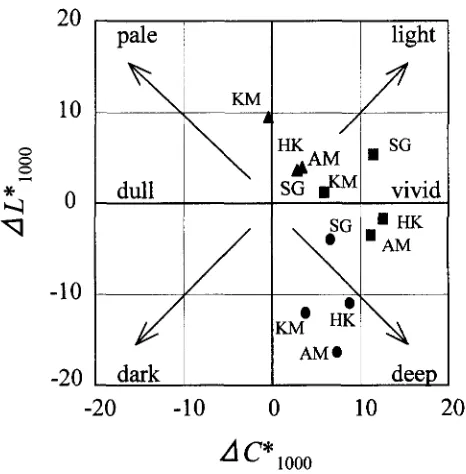
Fig. 1. Color changes of untreated, acetylated, and polyethylene glycol (PEG)-impregnated wood after light irradiation for 1000 h. A L*1000 and
AC*1000 , changes in brightness and chroma after light irradiation for 1000h;
circles,
untreated;triangles,
acetylated;squares,
PEG- impregnated. Other abbreviations are the same as described in the textseveral days to remove water-soluble compounds produced by irradiation. After drying, the PAS spectra were mea- sured. Some of the water-soluble extractives in wood should be also eluted away during the water treatment of untreated wood. Therefore, the specimens extracted previously with hot water were used for this experiment instead of un- treated specimens.
Results and discussion
Acetylation and impregnation with P E G
The weight percent gains (WPG) of wood specimens due to acetylation were 22.5% in SG, 24.6% in HK, 15.1% in KM, and 20.2% in AM. The polymer loading (PL) due to P E G impregnation was 57.5% in SG, 54.6% in HK, 27.8% in KM, and 13.4% in AM. The low PL of the KM specimen may be attributed to its low penetrability, On the other hand, the reason for low PL in the A M specimen may be that pine resins obstruct penetration of P E G into wood because the resins had not been previously removed from the specimens.
Changes in color difference during light irradiation
Figure 1 shows the relation between the changes of bright- ness
(AL*)
and chroma(AC*)
of wood specimens light- irradiated for 1000h. The direction of color changes due to light irradiation can be recognized in Fig. 1. The color of the untreated specimens deepened after light irradiation,whereas the color of the acetylated specimens became lighter, and one of the PEG-impregnated specimens be- came more vivid. These findings show that the direction of color change due to light irradiation differed between the untreated and treated specimens and between the two treatments.
The color differences
AE~'b
of the specimens after light irradiation for 100 and 1000h are shown in Fig. 2. TheAE*b
of acetylated specimens was much smaller than that of the untreated specimens in all wood species tested. The increase in irradiation time from 100 to 1000h scarcely changed the
AE*b
of acetylated specimens except the KM specimen. TheAE*b
of acetylated KM specimen was still smaller than that of the untreated specimen after irra- diation for 1000 h. These results indicate that the acetylation of wood suppressed the color change caused by light irradiation.The A Eab in the acetylated KM wood specimen increased with the increase in irradiation time, as shown in Fig. 2. Dawson and Torr ~ showed that the changes in color during light irradiation were reduced with increased acetyl content of wood. Based on this finding, the observed increase in
AE*b
is thought to be because of low W P G due to acetyla- tion attained in the KM wood specimen. On the other hand, Hon 6 showed that acetylated wood exhibited a color stabili- zation effect for the initial 28 days of light irradiation, but its effect steadily diminished thereafter. He concluded that the decreased effect was due to the deacetylation caused by prolonged light irradiation. However, this decrease may be because of the low W P G of his specimens and not because of the deacetylation, as mentioned later.changed in a manner similar to that of the untreated wood. This is considered to reflect the many factors present during natural exposure (e.g., water, dirt, fungal spores) in addition to light.
The A E*b of PEG-impregnated wood specimens after light irradiation for 100h was smaller than that of the un- treated specimens even in KM and AM, with low PLs. Hon and Ifju t5 reported that the penetration depth of ultraviolet light into wood was about 75#m, and Kataoka and Kiguchi a6 showed that the depth of the photo-induced degradation layer was about 100,um after light irradiation for 100h. It is supposed from these findings that P E G in the surface to a depth of 75-100#m effectively diminishes the color changes during light irradiation. The low PL of the KM and AM specimens can be explained by low penetrability into the wood. The P E G content on the surface should not have been much different from those of the other species (SG and H K ) because P E G aqueous solution with the same concentration impregnated the wood. This P E G content may have been enough to suppress the color changes. Therefore, it is thought that the color changes of KM and A M specimens were small despite the low PL.
Increasesing the irradiation time from 100h to 1000h increased the / I E * b of PEG-impregnated specimens of all species, in contrast to acetylation. Especially, the AE*o of the PEG-impregnated SG specimen after 1000h of irradia- tion was larger than that of the untreated specimens. These results indicate that the effect of P E G on the suppression of color change decreased with the increase in irradiation time. This may be due to the degradation of P E G by light.
Effect of acetylation on photochemical degradation of wood surface
The FTIR-PAS spectra of light-irradiated H K specimens and nonirradiated specimens are shown in Fig. 3. Pandey and Theagarajan 12 and Kuo et al. 17 applied PAS technology to wood analysis and concluded that the FTIR-PAS spectra of wood were similar to the spectra obtained by transmis- sion and diffuse reflectance techniques. The depth sensed by PAS varies depending on the condition of the wood samples (density, coefficient of thermal conductivity, spe- cific heat) and PAS measurement (moving mirror velocity, wave numbers). The depth was approximately 10-30ktm for wave numbers of 4000-400cm -1 in this study. This indi- cates that PAS technology is suitable for analyzing light- irradiated wood surfaces because the sensed depth is smaller than the penetration depth (75/~m) of ultraviolet (UV) light or the depth of the photodegradation layer (100/~m).
In the untreated specimen the absorbance due to C = O stretching at 1732cm -1 increased significantly, and that due to benzene ring stretching in lignin at 1508 cm 1 decreased significantly with increasing irradiation time. These results indicate that the generation of carbonyl and the degrada- tion of lignin progressed as light irradiation continued.
In the acetylated specimen, the absorbance at 1732cm was high because of the overlapping with the carbonyl in
1161cm -~ .
Untreated
~ A
1732cm-1 1508cm "l ,~
T
~.
~ .
1500
1000
Acetylation
1230cm -1
1732cm "1 ,, 1161cm -1
T 1369cm-1 ~
A ,,08cm' ;
\
1500
1000
PEG impregnation
. j - ~ \
845cm-1
l 1508cm -1 .. t ~899cm-1
1732cm- u ~ 1 1 4 7 c m _ l ~ . ~ u
1500
1000
Wavenumber (cm "1)
Fig. 3. Fourier transformed infrared-photoacoustic spectroscopy (FTIR-PAS) spectra of untreated, acetylated, and PEG-impregnated hinoki wood before and after light irradiation. Dotted line, nonir- radiated; broken and thick lines, irradiated for 50 and 100h, respec- tively; thin line, PEG4000
er
<
e,
Z- Ip
<
1.2
0.8
0.4
0
1.2
0.8
0.4
-- i i 9
I ~ I I [
0
20
40
60
80 100
A I m 9 i
120
r ~ i r I
0
20
40
60
80
100
120
1.2
0.8
0.4
h . . l l L
- r , i s I m I I
i i i
0
20
40
60
80
100
120
Irradiation t i m e (hr)
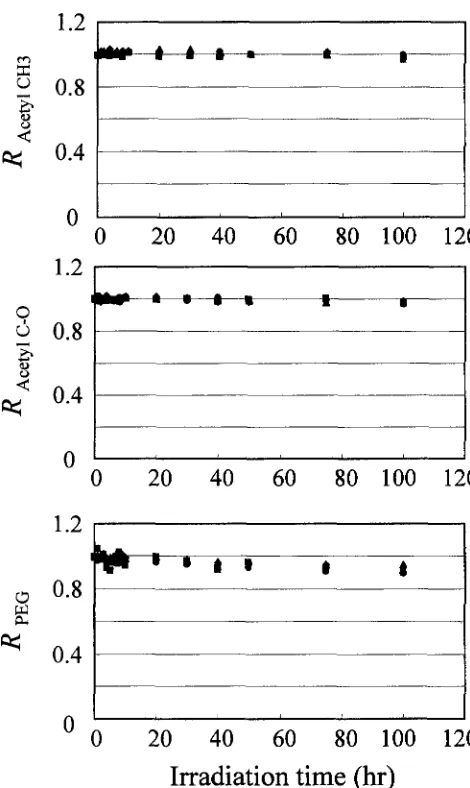
Fig. 4. Changes in the ratios of acetyl
(RAc~tylCH3 and RA~tylC_O)
and PEG (RpE~) in acetylated and PEG-impregnated wood with light irra- diation times. Rhombi, sugi; circles, hinoki; triangles, karamatsu;squares, akamatsu
31
~ , 2
9
II
er
1
SG
HK
KM
AM
Fig. 5. Ratios (Rc=o~00) of carbonyl generation in untreated, acety- lated, and PEG-impregnated wood after light irradiation for 100h. Abbreviations are the same as described in the text and in Fig. 2
.9
0.3
0.2
0.1
U
SG
HK
KM
AM
Fig. 6. Ratios (RLg,in~00) of lignin degradation in untreated, acetylated, and PEG-impregnated wood after light irradiation for 100h. Abbrevia- tions are the same as described in the text and in Fig. 2.
irradiation times because the color change did not increase with increasing irradiation time, as m e n t i o n e d above. Therefore, it is concluded that the small change in absorp- tion at 1732cm -~ after light irradiation was mostly due to the photochemical degradation of w o o d components. These results indicate that acetylation restrained the photochemi- cal degradation of wood.
The ratios (Rc_ol00) of carbonyl generation after irradia- tion for 100h are shown in Fig. 5. In the untreated speci- mens, the Rc=ol00 of SG was the largest, being 2.5. This indicates that the a m o u n t of carbonyl after irradiation was 2.5 times as large as that before irradiation. The ratios for the other species ranged f r o m 1.7 to 1.9. O n the other hand, the ratios of all the acetylated specimens were about 1.05, ranging from 1.0 to 1.1. This indicates that less carbonyl was generated in the acetylated w o o d specimens than in the untreated ones during light irradiation.
Figure 6 shows the ratios of the decrease in lignin (RLigninl00) after light irradiation for 100 h. The
RLigninl00
of theK M specimen was smaller than that of other species. This small degradation of lignin m a y be characteristic of K M
wood. T h e RLign~n~00 in the acetylated specimens of the other wood species was much smaller than in untreated ones, which indicates that the acetylation restrained lignin degra- dation caused by light. This m a y be related to the small degree of carbonyl generation.
Effect of P E G impregnation on photochemical degradation of w o o d surface
PEG-impregnated , J ~
845cm1
9 899cm -1
filter paper
["
~.
*
17~1 cm-I : '!~, :~
1500
1000
Wavenumber (cm -I)
Fig. 7. FTIR-PAS spectra of the filter paper and PEG-impregnated filter paper before and after light irradiation for 100h. Dotted and thin lines', nonirradiated; thick and broken lines, irradiated for 100h
-q
20
15
10
0
K M O
K M A S G A 9 A M
9 S G
SGm
H K H K - - A
I A ~ ' - []
K M A M
AM
O o H K
0.0
0.1
0.2
0.3
R
Lignin 1001508cm 1 decreased in the PEG-impregnated specimens with the increase in light-irradiation times. These results indicate that the generation of carbonyl and the de- gradation of lignin progressed with the duration of light irradiation.
The absorption due to out-of-phase rocking of CH 2 in P E G at 845 cm ~ decreased also during the light irradiation. The changes of RpE~ with light-irradiation time are shown in Fig. 4. The ReEG decreased a little with the increase in irra- diation time. The mean of Rpz~ in four species was 0.91 after 100h of irradiation. This decrease is supposedly due to the degradation of P E G during light irradiation. Longer light irradiation should degrade more PEG, thereby reducing the effect of P E G treatment. This is thought to be the reason for the increase in A E2; brought about by the increase in irradiation time from 100 to 1000h, as shown in Fig. 2.
The P E G degraded by light may have produced the car- bonyl. Figure 7 shows the PAS spectra of the PEG-impreg- nated filter paper before and after light irradiation for 100h versus the spectra of filter paper alone. The spectrum of filter paper without P E G did not change after light irradia- tion. On the other hand, the absorption of CH2 in P E G at 845cm < was decreased after irradiation in the P E G - impregnated filter paper, similar to the PEG-impregnated wood. The absorption of carbonyl at 1721cm -1 was ob- served after light irradiation in the PEG-impregnated filter paper. Turi ~8 reported that heated P E G was at first broken down into lower-molecular-weight compounds and then produced acetaldehyde. The same reaction is thought to occur during light irradiation; that is, P E G was degraded by light, and the carbonyl was generated as a by-product. The same reaction should occur also in the PEG-impregnated wood. Therefore, the carbonyl produced by degradation of P E G should have been included in the increase of carbonyl with irradiation, as shown in Fig. 3.
The ratios of carbonyl generation in the PEG-impreg- nated specimens after light irradiation for 100h (Rc-o~00) are shown in Fig. 5. These Rr ratios were smaller than those of untreated specimens. The ratios due only to the
Fig. 8. Relation between the color difference (AE~oioo) and the ratio of lignin degradation
(RLignml00)
of untreated, acetylated, and PEG- impregnated wood after light irradiation for 100h. Symbols are the same as in Fig. 1; abbreviations are the same as described in the textdegradation of wood components should be smaller than the observed ratios for the reason mentioned above. Based on these facts, it is clear that P E G impregnation decreased the generation of carbonyl during light irradiation.
The absorbance of lignin at 1508cm -1 did not overlap that due to P E G in PEG-impregnated specimens, as shown in Fig. 3. Therefore, the absorbance is related only to lignin in wood. Figure 6 shows the ratios of the decrease in lignin after light irradiation for 100h
(RLigninl00). In
the PEG- impregnated specimens, RLigns,~00 was smaller than that of the untreated one except for KM, which exhibited little degradation of lignin even in the untreated specimen. This indicates that P E G impregnation restrained lignin degrada- tion during light irradiation, but the effect should be re- duced by the increase in P E G degradation with increased irradiation time. This would explain the increased color changes with increasing irradiation time.Hot-water extraction
1 1 6 1 c ~
U
\
1732cmq 1508cm'1 . ,~..-.,1" \
\ ^
,
Acetylation
1500
1230cm
-~
1000
1732cm'~w 1 369 cm q T 1161cm -I^
, A , r / \
II
1'~
/ W \
I1500
1000
PEG impregnation
:../~
l
~ / '~ 899cm-11732em- 1508cm -1 .. _ ~ ' . , , t \ 845cm-1
1500
1000
Wavenumber (cm "1)
Fig. 9. FTIR-PAS spectra of hot-water-extracted, acetylated, and PEG-impregnated hinoki wood after light irradiation for 100h and subsequent water treatment. Dotted lines, light-irradiated for 100h;
solid lines, water-treated after light irradiation for 100h
KM specimens due to light irradiation. Except for the KM specimens, the estimated correlation coefficient was 0.90. This high value indicates that the color changes during light irradiation significantly depend on lignin degradation in softwoods, except KM. Thus, the chemical modification reduced lignin degradation due to light irradiation and consequently decreased the color difference.
Changes in carbonyl contents by water treatment after light irradiation
The PAS spectra of water-treated H K specimens are shown in Fig. 9. The absorbance of lignin at 1508cm 1 was not d e c r e a s e d by the water treatment in the hot water- extracted, acetylated, and PEG-impregnated specimens. This indicates that the lignin remaining after light irradia- tion was insoluble in water.
9 II
2
0 SG HK KMAM SG HKKMAM SGHK KM AM
Hot-water
Acetylation PEG
extraction
impregnation
Fig. 10. Ratios (Rc_ol00) of carbonyl generation in hot-water- extracted, acetylated, and PEG-impregnated wood after light irradia- tion for 100h and subsequent water treatment. I, light irradiation for 100 h; W, water treatment after irradiation for 100 h. Abbreviations are the same as described in the text
On the other hand, the absorbance of carbonyl at 1732cm -1 was largely decreased in the hot water-extracted specimens by the water treatment, as shown in Fig. 9. The Rc=ol00 values before and after water treatment are shown in Fig. 10. In the hot water-extracted specimens, the propor- tion of Rc=ol00 after water treatment relative to that before treatment was 0.76, on average, for four wood species (range 0.67-0.89). This indicates that light irradiation partly produced the water-soluble compounds containing the car- bonyl. 2~ These compounds should have been produced from lignin and extractives degraded by light. Such results sug- gest that the following situation occurs in the weathermeter test or during outdoor weathering of wood: The water- soluble compounds produced during light irradiation are flushed away by sprayed water or rainwater. The fresh wood surface thus revealed is photochemically degraded by light. The repetition of this process weathers wood,
In the acetylated specimens, the absorption at 1732cm -1 was little decreased by water treatment, as shown in Fig. 9. The R c o100 ratio after water treatment compared to that before treatment was 1.00, on average, for four wood spe- cies (range 0.98-1.01). The absorption due to acetyl car- bonyl overlapping with carbonyl at 1732cm -~ should not have been decreased by water treatment, because the ab- sorption of acetyl groups at 1369 and 1230cm -1 did not change. There was little carbonyl generated in acetylated wood during light irradiation, as shown in Fig. 5. This is thought to be the reason for the small change in Rc~o~00 due to the water treatment. These results suggest that acetyla- tion has an effect on weatherability in the weathermeter test and during outdoor weathering.
carbonyl was generated not only by degradation of the wood components but also by degradation of P E G during light irradiation, as mentioned above. The P E G in wood should have been flushed away during water treatment be- cause P E G is water-soluble. This is clear from the disap- pearance of the absorption of P E G at 845cm < after water treatment, as shown in Fig. 9. Therefore, the decrease of carbonyl observed after water treatment should include the flushing away of both degraded products containing car- bow1. These findings suggest that sprayed water or rainwa- ter flushes away P E G during the weathermeter test or outdoor weathering, thereby decreasing the effect of P E G impregnation on weatherability. The PEG-impregnated wood surface should be coated with paint to protect against the flushing away of PEG.
Acknowledgment This study was supported financially by the Special Coordination Funds for Promoting Science and Technology from the Ministry of Education, Culture, Sports, Science and Technology.
References
1. Feist WC, Rowell RM, Ellis WD (1991) Moisture sorption and accelerated weathering of acetylated and methacrylated aspen. Wood Fiber Sci 23:128-136
2. Plackett DV, Dunningham EA, Singh AP (1992) Weathering of chemically modified wood: accelerated weathering of acetylated radiata pine. Holz Roh Werkstoff 50:135-140
3. Owen JA, Owen NL, Feist WC (1993) Scanning electron micro- scope and infrared studies of weathering in southern pine. J Mol Struct 300:105-114
4. Leary GJ (1968) The yellowing of wood by light. Part II. TAPPI 51:257-260
5. Dawson B, Tort K (1992) Spectroscopic and colour studies on acetylated radiata pine exposed to UV and visible light. Bulletin of
the Pacific Rim Bio-based Composites Symposium, Chemical Modification of Lignocellulosics' in Lotolua, pp 41-51
6. Hon DN-S (1995) Stabilization of wood color: is acetylation block- ing effective? Wood Fiber Sci 27:360-367
7. Dunningham EA, Plackett DV, Singh AP (1992) Weathering of chemically modified wood: natural weathering of acetylated ra- diata pine: preliminary results. Holz Roh Werkstoff 50:429-432 8. Kalnins MA (1984) Photochemical degradation of acetylated,
methylated, phenylhydrazine-modified, and ACC-treated wood. J Appl Polym Sci 29:105-115
9. Torr KM, Dawson BSW, Ede RM, Singh J (1996) Surface changes on acetylation and exposure to ultraviolet radiation of Pinus radiata using X-ray photo-electron spectroscopy. Holzforschung 50:449-456
10. Minemura N, Umehara K (1979) Color improvement of wood. I. Photoinduced discoloration and its control (in Japanese). Rep Hokkaido For Prod Res Inst 68:92-145
11. Anderson EL, Pawlak Z, Owen NL, Feist WC (1991) Infrared studies of wood weathering. I. Softwoods. Appl Spectrosc 45:641- 647
12. Pandey KK, Theagarajan KS (1997) Analysis of wood surfaces and ground wood by diffuse reflectance (DRIFT) and photoacoustic (PAS) Fourier transform infrared spectroscopic techniques. Holz Rob Werkstoff 55:383-390
13. Suga T (1988) Taikoukou to shikisai (in Japanese). Suga Shikenki, Tokyo, pp 17-34
14. Matsui Y, Kubota T, Tadokoro H, Yoshihara T (1965) Raman spectra of polyethers. J Polym Sci A 3:2275-2288
15. Hon DN-S, Ifju G (1978) Measuring penetration of light into wood by detection of photo-induced free radicals. Wood Sci 11:118-127 16. Kataoka Y, Kiguchi M (2001) Depth profiling of photo-induced
degradation in wood by FT-IR microspectroscopy. J Wood Sci 47:325-327
17. Kuo M-L, McClelland JF, Luo S, Chien P-L, Walker RD, Hse C-Y (1988) Application of infrared photoacoustic spectroscopy for wood samples. Wood Fiber Sci 20:132-145
18. Turi CJ (1959) Ricerche analitische sui tensioattivi.--Nota I.--I Poliosietilenglicoli. Rend Ist Super Sanita 22:174-188
19. Feist WC, Hon DN-S (1984) Chemistry of weathering and protec- tion. In: Rowell RM (ed) The chemistry of solid wood. American Chemical Society, Washington DC, pp 401-451