The Governance of Labour Migration in the Long-Term Care Sector
Ester Salis
CMS2(4):519–545 DOI:10.5117/CMS2014.4.SALI
Abstract
European societies are currently facing serious challenges in responding to a large and growing demand of long-term care services. To a varying, but overall substantial, extent this increasing demand is satisfied through migra-tion, with migrant women workers representing everywhere a considerable
share of the workforce available in the care sector. In this paper two key questions arising from these observations will be addressed: What has been the specific role of migration in addressing labour shortages in the care sector across Europe? And, secondly, what are the drivers of the different
immigra-tion policy approaches adopted? Drawing on EU-LFS data I will describe the main entry channels of migrant care workers, also distinguished by skill and occupational level, to highlight the specific immigrant labour supply policy mix adopted by national governments. Recent theories of managed
migra-tion policies will be critically assessed to ultimately discuss their ability to explain the immigrant labour supply policy mix in the care sector.
Keywords:care, migrant workers, immigration policies, managed migration, care regimes, Italy, Europe
1
Introduction
1hav-ing (and will increashav-ingly have) important consequences in terms of grow-ing demand of personal and household care services to support dependent people and their families. Indeed, demographic ageing is among the causes of the crisis of traditional informal care systems, revolving around the central role of family members, and primarily women among them: declin-ing size of households and families, transformation in family structures and living arrangements, increasing female participation in labour markets have jointly resulted in a reduction of available caregivers within families. At the same time, European welfare states are undergoing an enduring process of restructuring and withdrawal, gradually downsizing the direct provision of care services. As a consequence of this complex mix of societal processes, new markets for care services have emerged and developed. The development of professional care and personal services has even been lately identified by the European Commission as one of the sectors with the highest job creation potential:‘The size and fast growth of these sectors (twice the employment growth overall) suggests they will remain a key driver in providing new jobs in the years to come’(European Commission, 2012, p. 6).2A large part of the emerging care needs concerns, in particular, people in their old-age (over-65), namely the demographic group showing the most rapid and remarkable growth. Therefore the long-term care (LTC) sector (encompassing both health as well as personal and social care activ-ities) is the one displaying the greater expansion (Colombo et al., 2011).
During the last decades, migrant labour has substantially contributed to the expansion of employment in this sector, although to a different extent and in various forms across European countries. This trend has persisted throughout the current economic crisis: in a general context of rising un-employment, especially for migrant workers, employment of foreign-born workers in domestic or residential care services has increased respectively by 20% and 44.5% between 2008 and 2012 in the European OECD countries (OECD, 2013).
This contribution aims at filling this gap by looking at the articulation of Immigrant Labour Supply policies in the care sector across Europe, and more specifically in the LAB-MIG-GOV research project’s target countries. What has been the specific role of migration in addressing labour shortages in the LTC sector across Europe? Which specific policy mixes for Immi-grant Labour Supply have been adopted in response to an expanding de-mand for LTC services? And which factors may explain the different policy approaches adopted? These are the key questions that this contribution will attempt to answer.
I will first review the existing literature that has focused on explaining the emerging demand for migrant care labour in Europe to highlight its inadequate consideration of immigration policymaking. Therefore, starting from a critical assessment of recent immigration policy theories, I will propose an analytical framework centred upon the concept of Immigrant Labour Supply policy mix and I will explain why and how it can better explain the differentiated contribution of migrant labour to the LTC work-force across Europe; secondly, I will draw on original estimates produced in the context of the LAB-MIG-GOV project3to describe the recent con-tributions of migrant workers in the care labour markets across Europe, giving special attention to the distribution of migrant labour across the skill spectrum in LTC labour markets; I will then describe the main entry categories of migrant care workers (MCWs) in the main target countries, as a proxy indicator for immigrant labour supply policies across Europe; fi-nally, I will advance some hypothesis on the main drivers of the different policy choices adopted.
2
The internationalization of European care regimes: an
analytical framework
The key contribution of migrant workers to the labour markets for care in Europe has not gone unnoticed to scholars and researchers. The scientific interest for the increasing internationalization of care labour has soared in the latest decades, prompted by feminist research on the racialised and gendered divisions of care in contemporary western societies. Global care chains linking the poor global south and the affluent ageing north in an international division of reproductive labour (Parreñas, 2000) have been analyzed in depth by a wealth of feminist studies (Yeates, 2012).
migration regimes to explain the emerging care deficit in European welfare states and the increasing contribution of migrant labour in tackling care needs. Authors in this body of research have thus highlighted the specifi-cities of national contexts in framing and shaping the different forms of migrant care labour: indeed, as Williams, (2012: 370-1) stressed, it is impor-tant to look at‘specific forms of migrant care labour that any individual care regime generates’. European care regimes greatly vary in the organisa-tion, provision and financing of care4. At a first level, European care re-gimes differ in the relative weight and respective roles of State, family, market and no-profit actors in providing care to people in need. Other major interconnected dimensions on which variations emerge are: settings of care, namely whether care is mainly provided at home or in some kind of residential settings (Colombo et al., 2011), and funding, where care may be publicly funded (through in-kind services or some form of monetary support), resort on private resources of families or, as in actual arrange-ments, rely on a mix of public and private resources (Da Roit et al., 2007). Furthermore, important differences are found on the regulation and provi-sion of care for different types of recipients, namely childcare or long-term care for elderly or disabled: in particular, whereas childcare has been in-cluded in the framework of the new‘social investment’strategy underpin-ning welfare reforms in most European countries, elderly care has re-mained largely excluded from this framework.
here that a new space for the employment of migrant workers in the care sector has been opening in many European countries.
In fact, the interaction between care and employment regimes largely explains the existing segmentation within and outside care labour markets and the magnitude of care labour shortages in each national context. Simonazzi (2009) describes‘national employment models’in the care sec-tor by complementing characteristics of the care regimes with specific labour market regulations concerning pay, working and employment con-ditions or skills, training and credentials in the care sector: these aspects largely determine the attractiveness of this kind of work for native workers, who tend to shun those jobs with poorer employment and working condi-tions, lower wages, and bad social recognition. And long-term care is a typical example of a marginal labour market sector where low pay5, poor working conditions, little opportunity for career development, and high vacancy and turnover rates prevail (Fujisawa and Colombo, 2009).In gen-eral terms, a greater role of state-provided care services, either in institu-tional or domiciliary settings, usually entails better employment and work-ing conditions (in terms of wages, employment protection, workwork-ing hours, etc.), a greater labour supply by native (women) workers and a limited role of migrant labour. Conversely, the widespread use of cash transfers, with no or low conditionality upon their use, lower employment protection or poor regulation of care work, creates strong incentives towards the often irregular employment of care workers and makes care work unattractive for native workers: this is where the role of migrant care labour is greater.
homes in particular) in the UK and in private households in Italy, where it is shaped both by irregular status and by the terms and conditions under which regular immigration status can be obtained. Similarly, in another comparative study on UK, Italy and the Netherlands, Van Hooren (2012) has identified three different models of migrant care labour, originating from specific features of the national care regimes that shape the labour demand in the sector: Italy, where a‘migrant-in-the-family’model of care has emerged (Bettio, Simonazzi et al., 2006) as a consequence (among other factors) of the prevalence of unconditional cash allowances; UK, with a ‘migrant-in-the-market’ model, explained by the larger use of means-tested cash allowances and outsourcing of public domiciliary care services by local authorities to private service providers, and the Nether-lands where none of the two has been observed and the employment of migrant workers in the care sector remains negligible. Van Hooren (2012), also looks at the role of immigration policies in setting up these three different models and she concludes that ‘labour migration policies for care workers only had a limited impact on the employment of migrant workers’since‘many migrants employed in the social care sector rely on residence permits unrelated to employment or [...] are already living in the country as irregular migrants’(p. 143).
static and independent factor that care and employment regimes adapt to. The emergence of labour and skill shortages in the care sector, stemming from actual care and employment policies and their dynamic evolution, is indeed a powerful factor to explain relative openness or closure of national labour immigration policies. Nonetheless, it is not the sole factor to ac-count for and immigration policies are typically the outcome of complex mediations between competing interests and concerns. Recent evolutions towards the revival of labour migration in the pre-crisis decade have been reflected in significant changes in immigration policies that have favoured economic migration inflows over allegedly unproductive family or huma-nitarian categories (Pastore, 2010). Aiming at explaining this revival, recent theoretical approaches have explained the shift from a‘zero-immigration’ to a‘managed migration’policy approach by looking at specific features of national ‘varieties of capitalism’, or models of political economy (Menz, 2008; Menz and Caviedes, 2010). According to this literature, the neo-liber-al competition state would aim at maximising its‘competitiveness’by en-suring abusiness-friendlyclimate (Lavenex, 2006): managed migration fits into this new framework by framing migrants as potentially valuable human resources (Menz and Caviedes, 2010). Labour migration policies have consequently revived as a key tool to source labour and skills deemed useful for the national economy, through the key lobbying and mediation efforts of labour market interest associations (i.e. employers’and workers’ organizations). As Menz (2008) argues, the more employers organizations are internally united and structured the more effective and successful their policy demands for open immigration policies will be. Therefore, in general terms, coordinated market economies (CMEs) and, to some extent, mixed market economies (MMEs) tend to accept only skilled and highly skilled labour migrants and to close their doors to low-skilled migration, while liberal market economies (LMEs) need labour migrants at both ends of the skills spectrum. Among our target countries, Germany and UK represent paradigmatic cases of, respectively, CME and LME whereas France is typi-cally classified among mixed market economies, combining elements of both ideal-types.
purposes) as part of a competitiveness strategy do not allow to understand how and why States admit a substantial share of their migrant workforce through alternative channels. Consistently with the analytical framework used in the LAB-MIG-GOV research project, I will instead adopt here a broader focus on the complex and dynamic policy mix in what may be defined as a migrant labour supply (MLS) policy field (Pastore, 2014 and 2010). I will therefore look at bothofficial labour migration policies addres-sing MCWs and at what we have defined as their‘functional equivalents’, i.e. policies regulating other relevant entry channels. With the latter I es-sentially refer to national policies managing the admission and labour market access of EU newly accession countries’nationals and other profiles as diverse as family migrants, different types of humanitarian migrants, international students, so-called co-ethnics (e.g.Aussiedlerin Germany or descendents of emigrants in Italy). Some attention will be also given to what we have called‘functional alternatives to labour migration policies’, defined as all policies and measures (mainly situated in the labour market, education or training policy fields) which are explicitly meant to reduce the dependency on migrant labour and increase the presence of resident workers in given employment sectors. My argument here is that this broad-er analytical framework is particularly suitable to account for the manage-ment of care migration due to the specific characteristics of this labour market sector. One the one hand, as previously highlighted, the demand for care labour is highly dispersed and fragmented across a wide range of actors and private households hold a primary role here. This makes the translation of care labour demand into effective lobbying efforts for more open labour migration policies towards care workers a particularly challen-ging task. Hence, we can expect that alternative admission channels are more relevant for MCWs than for other more‘valuable’categories. On the other hand the traditional depiction of care work as unskilled or low skilled work prevent its inclusion into the framework of managed migra-tion as a competitiveness strategy aimed at sourcing skills and talents useful for the national economy (Kofman, 2013).
deemed beneficial for their economies. Rather, they included loosen ele-ments of skill selectivity in their official labour migration policies, de facto admitting huge inflows of low skilled labour. Mass immigration for work-ing purposes has been driven mainly by demographic rather than econom-ic competitiveness factors: in other words, migrant workers have been admitted to substitute for a native workforce that was shrinking in abso-lute terms rather than to contribute to enhancing the productivity of a fast-growing economy. Immigration has been part more of a survival rather than a growth-oriented strategy and, I argue, care migration has signifi-cantly contributed to this.
3
The growing contribution of migrant care labour in
European care regimes: empirical evidence
The main focus of this paper is on the overall long-term care migrant workforce, primarily differentiated by skill level rather than sub-segment of the care labour market (i.e. whether in institutional, residential or dom-iciliary activities). Since the main goal of this article is to analyse the Im-migrant Labour Supply Policy mix adopted in selected EU countries and thereby critically assess recent immigration policy theories, I believe that a fine-grained distinction between different categories of care workers across sub-sectors is not particularly relevant here. The analysis will draw on data provided by EU-LFS and in particular by information contained in the 2008 ad-hoc module (AHM) on labour market situation of migrants on reason for migration, used as a proxy indicator for entry channels. Thanks to information provided in the 2008 AHM of the EU-LFS it is thus possible to provide data on the main recruitment pools of MCWs relative to main entry routes in the various EU countries6 (Cangiano, 2014b). As for the geographical scope of the comparative analysis, this will be limited to the five largest European countries, namely Germany, France, Italy, the United Kingdom and Spain, plus Sweden. These were in fact the target countries of the LAB-MIG-GOV research project from which this article originates (see Pastore, 2014).
constraints: first, significant differences in labour market structures, skills or classification of occupations within LTC sector in different European countries make a sound comparison difficult to achieve (Fujisawa and Colombo 2009; Simonazzi 2009); secondly, a straightforward identification of MCWs is made difficult by existing shortcomings in the definitions of who is a migrant in each individual country (Cangiano, 2012); finally, care work is often carried out in irregular forms (and by irregular migrants), especially when performed in private homes, which makes it difficult if not impossible to fully detect it in official statistics (Schwenken and Hei-meshoff, 2011; Ambrosini, 2013a; Triandafyllidou, 2013). Despite acknowl-edging all these methodological challenges, Geerts (2011) proposes to iden-tify LTC workers using data from the EU-LFS by singling out four occupa-tional groups on the basis of the ISCO-88 groupings at 3 digits level: nursing and midwifery professionals (ISCO-88 category 223), nursing and midwif-ery associate professionals (ISCO-88 category 323), personal care and re-lated workers (ISCO-88 category 513) and domestic and rere-lated helpers (ISCO-88 category 913) (see also Cangiano, 2014a for further discussion of methodological constraints). However, it must be noticed that these four categories are likely to overestimate LTC workers since they encompass a larger spectrum of occupations also related to child-care, health-care or home-care work. At the same time, EU-LFS is likely to underestimate the immigrant workforce due to well-known methodological limits such as the exclusion of irregular migrants from the sample or the different definitions of immigrants adopted in different EU countries (Cangiano, 2012).
In this contribution I adopt the same approach proposed by Geerts (2011) for the identification and analysis of the care workforce, while I draw on the method proposed by Cangiano (2012) to identify migrant workers in the 2008 EU-LFS sample7: in the context of this paper, then, migrant workers are individuals born outside their countries of residence, with both parents born abroad, and who have entered the host country when they were 15 or older.
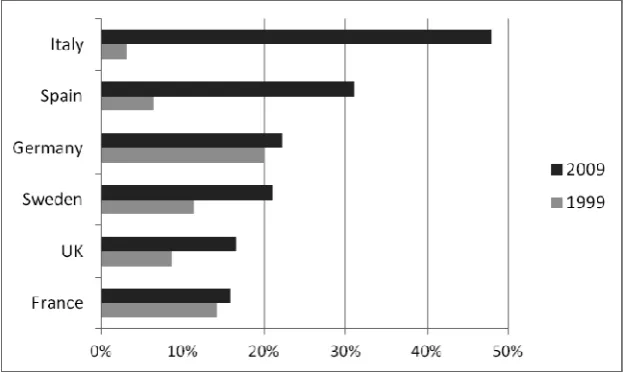
following decade has been dramatic, to reach 48% in 2009; a similar, though slightly weaker, increase is observed in Spain (from 6% to 31%). Conversely, France and Germany have not witnessed significant changes, with the share of the migrant care workforce over total increasing only by 2 percentage points in both cases (respectively from 14 to 16% and from 20 to 22%). The UK and Sweden represent intermediate cases where the weight of the migrant care workforce has nearly doubled though remaining at lower levels than in Italy and Spain (respectively from 9 to 17% and from 11 to 21%).
Figure 1 Migrant share (%) of the care workforce in LAB-MIG-GOV countries, all occupational categories included, 1999 and 2009
Source: Courtesy of Alessio Cangiano; calculations based on the EU Labour Force Survey
host country before 1998 (old migrants) or in the 1998-2008 decade (recent migrants).
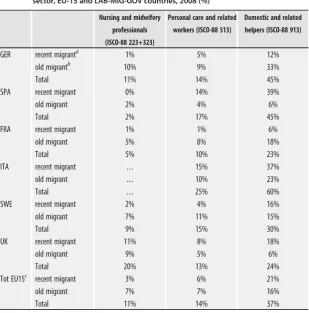
Table 1 Relative share of migrant workers across broad occupational groups in the care sector, EU-15 and LAB-MIG-GOV countries, 2008 (%)
Nursing and midwifery
professionals (ISCO-88 223+323)
Personal care and related
workers (ISCO-88 513)
Domestic and related
helpers (ISCO-88 913)
GER recent migranta 1% 5% 12%
old migrantb 10% 9% 33%
Total 11% 14% 45%
SPA recent migrant 0% 14% 39%
old migrant 2% 4% 6%
Total 2% 17% 45%
FRA recent migrant 1% 1% 6%
old migrant 5% 8% 18%
Total 5% 10% 23%
ITA recent migrant ... 15% 37%
old migrant ... 10% 23%
Total ... 25% 60%
SWE recent migrant 2% 4% 16%
old migrant 7% 11% 15%
Total 9% 15% 30%
UK recent migrant 11% 8% 18%
old migrant 9% 5% 6%
Total 20% 13% 24%
Tot EU15c recent migrant 3% 6% 21%
old migrant 7% 7% 16%
Total 11% 14% 37%
Source: Courtesy of Alessio Cangiano; calculations based on the EU Labour Force Survey
a‘
Recent migrants’are those arrived in the period between 1998 and 2008.
b‘
Old migrant’are those arrived before 1998.
c
Excluding Finland.
the total workforce in the subgroup. In Italy and Spain most of migrant domestic workers have arrived after 1998 while the opposite is observed in Germany. Albeit UK and Sweden display a weaker role of migrant workers as domestic helpers, it has to be noticed that migrants’share in the sub-group has grown considerably in the 1998-2008 decade: 18% and 16% of migrant domestic workers in the UK and Sweden respectively have entered the countries after 1998. The share of personal care and related workers significantly exceeds the EU-15 average in Italy and Spain (respectively 25 and 17% against 14%) while in the remaining four countries the weight of migrant workers in this category is roughly in line with the EU-15 average. Finally, the UK is the only country where the share of migrant nurses and associate nursing professionals exceeds 20% of the total workforce in the sub-group, most of which arrived after 1998, whereas in Germany and Sweden the relative share remains in line with the EU-15 average and in France, Italy and Spain migrant nurses only represent a small to negligible part of the total.
4
Migrant care workers and migration policies: main
entry channels
Whether migrant workers have entered the host countries for reasons of employment, either with or without a job offer in hands, family reunifica-tion, as a freely circulating EU citizen or as an asylum-seeker is likely to have a strong impact on their capacities to get a job, to change employer or sector of employment or to move upward in the occupational ladder (Cangiano, 2012; Büchel and Frick, 2005). Indeed the State, through its policies on immigration and in other domains, plays a major role in the recruitment of migrant workers, by categorizing migrant workers on the basis of their skills sets or national origin. Furthermore, by constraining migrant mobility through different means, State regulations contribute to create and maintain labour market stratification and segmentation along ethnic lines (Anderson 2010; McGovern, 2012).
extent, in UK, namely the three large EU countries that have showed a greater openness to labour migration in the pre-crisis decade (Pastore and Salis, 2013). On the contrary, given their generalized closure to eco-nomic migration until very recently, France, Germany and Sweden have sourced MCWs from alternative entry routes (i.e. functional equivalents), especially family reunification, intra-EU mobility and humanitarian migra-tion. Also, ancestry-based immigration has had a greater role in Germany.
Figure 2 Composition of the migrant care workforce by entry category.(a)EU-15 and LAB-MIG-GOV countries (2008)
Note: (a) The category EU includes nationals of EU-15 countries and post-enlargement EU-10 migrants
(nationals of EU accession countries who moved to the selected destination countries in or after 2004).
Migrants from Central and Eastern Europe who moved before 2004 are included in one of the other
entry categories for non-EU nationals.
Source: Courtesy of Alessio Cangiano; calculations based on the EU Labour Force Survey
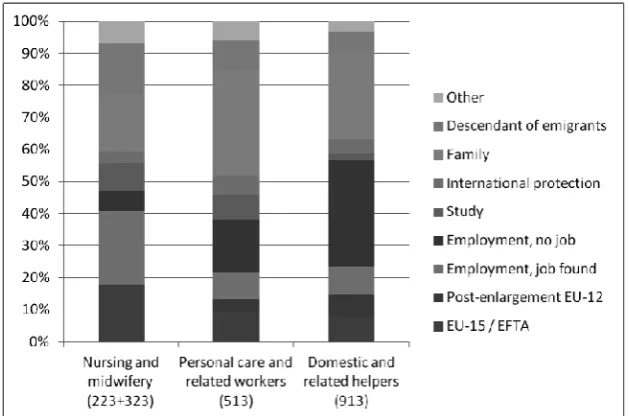
workers entered for study reasons and of intra-EU-15 citizens, is greater than for the other two sub-groups implying that most of them have prob-ably gained training and credentials for the exercise of their profession while already in the EU.
Figure 3 Distribution of care migrant workers at the EU-15 level, by occupational category and entry route, 2008 (%)
Source: Courtesy of Alessio Cangiano; calculations based on the EU Labour Force Survey
Entry routes for employment reasons have been much more relevant for
unskilled MCWs in the‘domestic and related helpers’sub-group. However,
the vast majority of them have entered the host country without a job
offer, therefore presumably through irregular avenues8. Compared to the
other two occupational sub-groups, post-enlargement intra-EU mobility has been more significant for migrant domestic workers. Within the
inter-mediate positions of‘personal and related care workers’the mix of entry
5
The immigrant labour supply policy mix in the care
sector: what drives it?
There-fore, as Condon et al., (2013, p. 16) effectively put it, social care policies in France have in no way relied upon immigration policies. Other major destination countries lie somewhere in between these two extremes, with only small avenues open to MCWs, usually at the higher skill levels, and a relative openness to care labour migration from new EU member states after 2004: in the UK pre-2008 work permit system, senior care workers (with qualifications at level 3 of the National Qualification Framework) were eligible for admission and in the period between 2001 and 2006 over 22,000 new work permits were issued to migrants meeting the established criteria9. At the same time, a fairly high number of low skilled jobs in the social care sector was filled by citizens from the A8 countries between 2004 and 2009. In Germany a pilot program of‘controlled migration’for home helpers was introduced in 2002 but only 3,000 workers were sourced through it, whereas the overall number of migrant elderly care workers was estimated to be between 150,000 and 200,000 (Lutz and Palengal-Möllenbeck 2010). Most of these foreign care workers were nationals of the newly accessed Eastern European Member States entering with tourist visas or exploiting the loopholes of EU mobility regulations by working as self-employed or employment agency care workers (Shire, 2014).
What does explain the diversity of the policy approaches adopted? The varieties of care and employment regimes and their effects in terms of size and characteristics of emerging shortages are certainly a powerful, although partial, explaining factor. Thus the still relevant role of publicly provided care services or, alternatively, a still strong regulation of care work, as observed in Nordic or Western Europe’s care regimes translates into a still limited demand for migrant care labour. Here labour migration policies have therefore remained overall closed to care workers, by sour-cing the few necessary ones through less visible and politically controver-sial entry channels. At the opposite end, strongly familialistic care regimes as those characterizing Mediterranean EU countries, with their reliance on unconditional cash-for-care schemes and poor regulation of professional care work are characterized by huge unmet labour needs in the care sector: immigration policies here have addressed this new labour demand by opening their front (and back) doors to care migrant workers.
workers, preferably recruited among freely circulating new EU citizens from Eastern countries or other‘functional equivalents’of labour migrants. Conversely, CMEs, such as Germany, and MMEs, such as France, have remained overall close to low skilled MCWs while opening some narrow avenues for qualified care workers. Both countries have addressed their care deficits either through ‘functional equivalents’ to labour migrants such as commuter migration or posted workers from neighbouring Eastern countries, as in Germany (Morokvasic, 2004; Shire, 2014), or by developing strategies ultimately engendering‘functional alternatives’to labour migra-tion, as in France (Devitt, 2014). In the latter case, personal and household care services have been the object of various waves of reform since the early 1990s, explicitly framed as a strategy to enhance the high employ-ment creation potential of this sector, thereby investing in the regulariza-tion and professionalizaregulariza-tion of care work. This has resulted in a reduced dependence on migrant care labour compared to other national care re-gimes (Condon et al., 2013).
labour agencies or households). This makes particularly hard to effectively translate a labour demand into a policy demand for more open labour migration policies. The relative exception represented by relative openness to highly skilled care workers (i.e. professional nurses or nursing associate professionals) in some countries actually seems to confirm the rule: indeed professional nurses are more often employed by public or private hospitals or residential homes, that is large employers that could find themselves in better positions for political lobbying.
regulariza-tion costs, often borne by the workers themselves, were lower there. Some partial evidence to support this hypothesis can be drawn from data on the applications presented during the 2009 regularization campaign, a large number of which concerned nationalities of countries such as Morocco (around 36,000 applications), China (around 21,600 applications) or Sene-gal (around 13,600 applications) that are only marginally represented among officially registered or surveyed domestic workers. Furthermore, in many cases applicant employers were immigrants themselves: around 8,000 Moroccans, 5,000 Senegalese or 3,000 Chinese (Pasquinelli and Rus-mini, 2010). Similar clues emerge from official data relative to the 2012 regularization campaign: among the almost 116,000 applications concern-ing domestic workers (two-thirds of the total), almost 70% concerned male workers, especially from Bangladesh (14,279), Pakistan (10,369) or Morocco (10,285) while migrant men only represented around 10% of officially regis-tered domestic workers in 2011. Therefore, the openness towards MCWs has, at least partially, allowed the Italian authorities to open the doors to all other labour migrants while presenting them asgoodandusefulfor the Italian society.
The Italian case, with its use of labour migration policies addressing MCWs as part of a legitimization and survival strategy rather than a com-petitiveness strategy, is therefore strongly questioning the extent of the validity of theoretical accounts based on an overarching managed migra-tion paradigm.
6
Conclusion
although less vocally (Devitt, 2014), also in more recent years, the latter have been increasingly framed as a tool for enhancing the competitiveness of national economies, in line with the goal of a knowledge economy promoted by the Lisbon strategy. In this framework, soft and embodied skills such as those that are key for the quality of care work have been downplayed and neglected, determining the general closure of official la-bour migration channels to care migrant workers. However, the trends towards the professionalization of care work, including a growing recogni-tion of formal and non-formal competences, could contribute to change the consideration of care work as low-skilled. Combined with persistent labour shortages related to demographic processes this could also impact on the design of labour migration policies by redefining the notion of skills and its use in labour market analysis underpinning immigration policy-making.
Secondly, the consequences of the different immigrant labour supply policy mixes adopted in each national context on socio-economic integra-tion paths and outcomes of MCWs should be addressed in future research. Indeed, entry routes and admission procedures, with the diversified set of constraints attached to each immigration status, seem to be relevant fac-tors in influencing subsequent integration trajectories of migrant workers (not only in the care sector): for instance, as recent research has shown, entry through irregular immigration avenues, often used by MCWs not only in Southern European countries, force many of them to accept em-ployment in the most labour-intensive segments in the care labour market (e.g. live-in care work) whereas the shift towards regular status typically imply an improvement in labour conditions (e.g. in domestic services on an hourly basis) (Castagnone, Salis et al., 2013; Gallotti and Mertens, 2013). Besides, immigration regulations in combination with broader care, educa-tion and labour market policies, concerning for instance recognieduca-tion of credentials and qualifications, access to training or support to career devel-opment, are likely to have a significant impact on the possibilities offered to MCWs to upgrade their skills, change employment sector and, ulti-mately, achieve a reasonable level of integration in host societies.
region could help to highlight existing variations in a supposedly homo-geneous immigration model, especially as far as care labour migration management is concerned. Furthermore, recent evolutions related to the differentiated effects of the economic crisis and of different paces in the immigrants’settlement processes across southern European countries will need further investigation.
Notes
1. This article stems from original research produced in the framework of the LAB-MIG-GOV research project (2011-2014) funded by the Europe and Global Challenges funding initiative promoted by three European foundations: the Italian Compagnia di San Paolo, the German Volkswagen Stiftung and the Swedish Riksbankens Jubileumsfond. More detailed information on the project may be found at www.labmiggov.eu 2. In two separate accompanying documents to the referred EC Communication,
chal-lenges for job-creation in professional healthcare and personal and household services are addressed. With respect to the expansion of the healthcare workforce, the European Commission suggests to: (i) improve forecasting mechanisms, (ii) anticipate new skills needs in the health professions related to changes in care delivery models, (iii) develop good practices on effective recruitment and retention of health professionals and (iv) address issues of ethical recruitment of third country nationals health professionals. In relation to personal and household services the main policy challenges identified are (i) to improve work-life balance mechanisms, hence women’s employment, (ii) to exploit the potential of job-creation in this sector with a low cost for public finance (iii) to improve the quality of services and the quality of work.
3. I am grateful to Alessio Cangiano, member of the LAB-MIG-GOV research team, for providing me with these original estimates on the migrant care workforce.
4. Various typologies of European care regimes have been proposed that largely echo the families of welfare states identified in the path-breaking work of Esping-Andersen (1990); See for instance Bettio and Plantenga, 2004; Antonnen and Sipilä, 1996; Lister et al., 2007; Kraus et al., 2010.
5. In most EU countries the wage of care workers with basic formal skills is found to be 50-70% of the average comparable salary. The main exception is Denmark where the care workers’wage is aligned to the average salary. Skilled care workers are generally better paid but a pay gap relatively to workers with comparable skills is however found in most Western and Southern European countries (Bettio and Verashchagina 2010: Tab. A5 pp. 162-4)
/ EFTA(i.e. migrants born in another EU-15 or EFTA country, including both foreign nationals and those who have acquired citizenship of the country of destination);
Post-Enlargement EU-12(i.e. individuals born in the EU-12 who moved to the country of
destination between 2004 and 2008);Employment, job foundbefore migrating (includ-ing intra-company transfers);Employment, no jobfound before migrating; Study; Asy-lum(international protection);Family(including both marriage and family reunifica-tion);Other.
7. Identification of migrant workers here is based on the methodology proposed by Can-giano (2012). Here country of birth was preferred to nationality as the operational criterion to identify migrants combined with information on the year of (last) entry, country of birth of parents and, for naturalized citizens, the year when citizenship was acquired. As a consequence, the target population here is only first-generation immi-grants, namely foreign-born individuals who migrated to the country of destination when they were 15 or older.
8. Given the predominant use of demand-driven admission policies granting access only to individuals explicitly requested by a specific employers, our assumption is that those entered for employment purposes butwithout a job offerhave entered irregularly and have subsequently been regularized, either through mass regularization campaigns or individual regularization procedure.
9. However, eligibility criteria for senior care workers’admission were restricted after 2008 (Cangiano, Shutes et al., 2009).
10. Drawing on a typology proposed by Williams (2006), Eleonore Kofman (2013, p. 584) discusses different types of knowledge to explore their unequal valorization in the global economy and the consequences in terms of immigration regulations. She then distinguishes betweenembrainedknowledge, i.e. that dependent on conceptual skills and cognitive abilities, encoded knowledge, i.e. that embedded in signs or symbols to be found in books, manuals, codes of practice etc.,embodiedknowledge, i.e. that result-ing from experience gained from physical presence, practical thinkresult-ing, material objects, sensory information and learning-by-doing, and, finally,enculturedknowledge, i.e.‘soft skills’based on shared understandings, responses, ways of behaving and communicat-ing.
References
Ambrosini, M. (2013a).Irregular Migration and Invisible Welfare, Palgrave Macmillan.
Ambrosini, M. (2013b). Immigration in Italy: between economic acceptance and political rejec-tion.Journal of International Migration and Integration14(1): 175-194.
Ambrosini, M. & Cominelli, C. (2005).Un’assistenza senza confini: Welfare‘leggero’, famiglie in affanno, aiutanti domiciliari immigrate.Milan, Osservatorio Regionale per l’integrazione e la multietnicità della Lombardia, Fondazione ISMU. [Care without borders:“ligth”welfare, fa-milies under strain, migrant caregivers.].
Anderson, B. (2007). A very private business: exploring the demand for migrant domestic work-ers.European Journal of Women’s Studies14(3): 247-264.
Anderson, B. (2010). Migration, immigration controls and the fashioning of precarious workers.
Anderson B. (2012). Who needs them? Care work, migration and public policy.Cuadernos de Relaciones Laborales.30(1), p. 45-61.
Anttonen, A. & Sipilä, J. (1996). European social care services: Is it possible to identify models ?
Journal of European Social Policy6(2): 87-100.
Arango, J. & Finotelli C. (2009). Past and future challenges of a Southern European migration regime: the Spanish case.IDEA Working Papersn° 8, May 2009. URL: http://www.idea6fp.u-w.edu.pl/pliki/WP8_Spain.pdf
Bettio, F. & Plantenga, J. (2004). Comparing care regimes in Europe.Feminist Economics10(1): 85-113.
Bettio, F., Simonazzi, A., Villa P. (2006). Change in care regimes and female migration: the‘care drain’in the Mediterranean.Journal of European Social Policy16(3): 271-285.
Bettio, F. & Verashchagina, A. (2010). Long-Term Care for the elderly. Provisions and providers in 33 European countries. Rome, EU Expert Group on Gender and Employment (EGGE)– Fondazione G. Brodolini, Rome.
Brennan, D., Cass, B. et al. (2012). The marketisation of care: rationales and consequences in Nordic and liberal care regimes.Journal of European Social Policy22(4): 377-391.
Buchel, F. & Frick, J. R. (2005). Immigrants’economic performance across Europe–does immi-gration policy matter?Population Research and Policy Review24(2): 175-212.
Cangiano, A. (2012). Immigration policy and migrant labour market outcomes in the European Union: New evidence from the EU Labour Force Survey.FIERI Working Papers. Turin, FIERI, URL: www.labmiggov.eu
Cangiano A. (2014a). Elder care and migrant labor in Europe: a demographic outlook.Population And Development Review40(1): 131-154.
Cangiano A. (2014b). Migration policies and migrant employment outcomes: conceptual analysis and comparative evidence for Europe,Comparative Migration Studies,2(4): 417-444. Cangiano, A., I. Shutes, et al. (2009).Migrant care workers in ageing societies. Oxford, Centre on
Migration, Policy and Society, University of Oxford.
Cangiano, A. & Walsh, K. (2013). Recruitment processes and immigration regulations: the dis-jointed pathways to employing migrant carers in ageing societies.Work, Employment & Society.first published on November 13, 2013 doi:10.1177/0950017013491453
Castagnone, E., Salis, E. et al. (2013). Promoting integration for migrant domestic workers in Italy.
International Migration Paper n°115. Geneva, International Labour Office.
Colombo, F., Llena-Nozal, A. et al. (2011).Help Wanted? Providing and Paying for Long-Term Care. Paris, OECD Publishing.
Condon, S., Lada, E. et al. (2013). Promouvoir l’intégration des travailleuses et travailleurs domes-tiques migrants en France.Cahiers des migrations internationales No. 117. Géneve, OIT– Office International du Travail.
Da Roit, B., Le Bihan, B. et al. (2007). Long-term care policies in Italy, Austria and France: Variations in cash-for-care schemes.Social Policy & Administration41(6): 653-671.
Da Roit, B & Sabbatinelli, S. (2013). Nothing on the move or just going private? Understanding the freeze on child- and eldercare policies and the development of care markets in Italy,Social Politics, 20 (3): 430-453.
Devitt, C. (2012). Labour migration governance in contemporary Europe. The case of France,
FIERI Working Papers, Turin: FIERI. URL www.labmiggov.eu
Devitt, C. (2014). Government responses to foreign worker demand during economic crises: the cases of Britain and France 2008-2013,Comparative Migration Studies, 2(4): 445-468 Einaudi, L. (2007).Le politiche dell’immigrazione in Italia dall’Unità a oggi.Bari, Laterza. [
Esping-Andersen, G. (1990).The Three Worlds of Welfare Capitalism. Princeton, Princeton Uni-versity Press.
European Commission (2012). Communication from the Commission to the European Parlia-ment, the Council, the European Economic and Social Committee and the Committee of the Regions. Towards a job rich recovery, COM(2012) 173final.
Fujisawa, R. & Colombo, F. (2009).The Long-Term Care Workforce: Overview and Strategies to Adapt Supply to a Growing Demand. Paris, OECD Publishing.
Gallotti, M. & Mertens J. (2013). Promoting integration for migrant domestic workers in Europe: A synthesis of Belgium, France, Italy and Spain.International Migration Paper n°118. Geneva, International Labour Office.
Geerts, J. (2011). The Long-Term Care workforce: description and perspectives.ENEPRI Research Report No. 93. URL: http://www.ancien-longtermcare.eu/sites/default/files/ENEPRIR-R93_ANCIENWP3_0.pdf
Kilkey, M., Lutz, H. et al. (2010). Introduction: domestic and care work at the intersection of welfare, gender and migration regimes: some European experiences.Social Policy and Society
9 (03): 379-384.
Kofman, E. (2013). Gendered labour migrations in Europe and emblematic migratory figures.
Journal of Ethnic and Migration Studies39(4): 579-600.
Kraus, M., Riedel, M. et al. (2010). A typology of long-term care systems in Europe,ENEPRI Research Report NO. 91, URL: http://www.ceps.be/book/typology-long-term-care-systems-europe
Lavenex, S. (2006). The Competition State and the multilateral liberalization of skilled migration, in A. Favell, ed.,The human face of global mobility, international highly skilled migration in Europe, North America and the Asia-Pacific.New Brunswick, NJ: Transaction Publishers, 29-54.
Le Grand J. (1991). Quasi-Markets and Social Policy.The Economic Journal, 101(408): 1256-1267. Lister, R., Williams, F. et al. (2007).Gendering citizenship in Western Europe: new challenges for
citizenship research in a cross-national context. Policy press, Bristol.
Lutz, H. & Palenga-Möllenbeck, E. (2010). Care work migration in Germany: semi-compliance and complicity.Social Policy and Society9(03): 419-430.
McGovern, P. (2012) Inequalities in the (de-)commodification of labour: immigration, the nation state, and labour market stratification.Sociology Compass6(6): 485-498.
Menz, G. (2008).The political economy of managed migration. Non-state actors, Europeanization and the politics of designing migration policies. Oxford, Oxford University Press.
Menz, G. & A. Caviedes (2010).Labour Migration in Europe, Palgrave Macmillan.
Ministero del Lavoro e delle Politiche Sociali (2012).Secondo rapporto annuale sul mercato del lavoro degli immigrati.Roma, Direzione Generale Immigrazione. [Ministry of Labour and Social Policies (2012).Second annual report on labour market integration of immigrants, Rome.]
Moriarty, J. (2010). Competing with myths: migrant labour in social care, In: Ruhs, M. & Ander-son, B. (eds.)Who Needs Migrant Workers? Labour shortages, immigration, and public policy. Oxford, Oxford University Press.
Morokvasic, M. (2004). Settled in mobility: engendering post-wall migration in Europe.Feminist Review77 (1): 7-25.
Naldini, M. & Saraceno, C. (2008). Social and family policies in Italy: not totally frozen but far from structural reforms.Social Policy & Administration42(7): 733-748.
OECD (2013).International Migration Outlook 2013, OECD Publishing.
immigrant labor in the domestic services industry in Europe.Cahiers de l’UrmisURL: http:// urmis.revues.org/810
Parreñas, R.S. (2000). Migrant Filipina domestic workers and the international division of repro-ductive labor.Gender & Society14(4): 560-580.
Pasquinelli, S. & Rusmini, G. (2010). La regolarizzazione delle badanti. In: Network Non Auto-sufficienza:L’assistenza agli anziani non-autosufficienti in Italia. 2° Rapporto,Sant’Arcangelo di Romagna, Maggioli Editore. [The regularization of migrant caregivers. In: Network Non Autosufficienza:Care to dependent elderly in Italy. 2° Report.]
Pastore, F. (2010). Managing migration through the crisis. Evolving patterns in European policies on labour migration and mobility.FIERI Working Papers. Turin, FIERI. URL: www.labmiggov.eu Pastore F. (2014). The Governance of Migrant Labour Supply in Europe, Before and During the
Crisis. (Introduction)Comparative Migration Studies, 2(4): 385-416.
Pastore, F., Salis, E. & Villosio, C. (2012).L’Italia e l’immigrazione low cost: fine di un ciclo?, Paper presented at the V ESPANET-Italia Conference, Rome, 20-22 September 2012, available online at www.espanet-italia.net
Pastore, F. & Salis, E. (2013). Managing labour migration in times of crisis. Comparative overview.
Research Paper. Brussels, European Policy Centre. URL: http://www.eu-asia.eu/publications/ migration-integration/
Salis, E. (2012). Labour migration governance in contemporary Europe. The case of Italy. Turin, FIERI Working Papers. URL http://www.labmiggov.eu/country-reports/
Salis, E. (2013). The internationalization of care regimes. A concept paper.FIERI Working papers. Turin, FIERI. URL: http://www.labmiggov.eu/working-papers/
Shutes, I. & Chiatti, C. (2012). Migrant labour and the marketisation of care for older people: The employment of migrant care workers by families and service providers.Journal of European Social Policy22(4): 392-405.
Sciortino, G. (2004). Immigration in a Mediterranean welfare state: the Italian experience in comparative perspective.Journal of Comparative Policy Analysis: Research and Practice6(2): 111-129.
Shire, K. (2014). Family supports and insecure work: the politics of household service employ-ment in conservative gender regimes, Paper presented at the XVIII ISA World Congress of Sociology“Facing an unequal world: challenges for global sociology”, Yokohama, 13-19 July 2014.
Simonazzi, A. (2009). Care regimes and national employment models.Cambridge Journal of Economics33(2): 211-232.
Schwenken, H. & Heimeshoff, L.M. (eds) (2011). Domestic workers count: global data on an often invisible sector, Kassel University Press, Kassel.
Triandafyllidou, A. (2013).Irregular Migrant Domestic Workers in Europe: Who Cares?, Ashgate Publishing, Limited.
Ungerson, C. (2003). Commodified care work in European labour markets.European Societies5 (4): 377-396.
Van Hooren, F.J. (2012). Varieties of migrant care work: Comparing patterns of migrant labour in social care.Journal of European Social Policy22(2): 133-147.
Williams, A. (2006). Lost in translation? International migration, learning and knowledge. Pro-gress in human geography, 30(5): 588-607.
Williams, F. (2010). Convergences and divergences in the employment of migrant care workers in European welfare regimes. ISA world congress of sociology. Gothenburg, Sweden.
Williams, F. & Brennan, D. (2012). Care, markets and migration in a globalising world: Introduc-tion to the Special Issue.Journal of European Social Policy22(4): 355-362.
Yeates, N. (2012). Global care chains: a state-of-the-art review and future directions in care transnationalization research.Global Networks12(2): 135-154.
About the Author
Ester Salis is junior research fellow at FIERI (Forum Internazionale ed