
Exploring the opportunities of social media to build knowledge in learner-centered Indigenous learning spaces.
15
0
0
Full text
(2) Exploring the opportunities of social media to build knowledge in learner-centered indigenous learning spaces Henk Huijser and Jurg Bronnimann Batchelor Institute, Australia. This chapter explores the opportunities online learning environments offer to address issues related to Indigenous pedagogy and Indigenous approaches to teaching and learning, with a specific focus on social and mobile media. Social media tools have created many opportunities for social approaches to teaching and learning, and specifically to developing Indigenous learning communities, and overall much more explicitly learner-centered approaches. In this chapter we argue that social media are well suited to address the learning needs of Indigenous students in Australia, and at the same time we use Batchelor Institute of Indigenous Tertiary Education, and its ‘both-ways’ philosophy, as a case study to explore some of the opportunities and potential barriers that social media present within learner-centered pedagogy.. 1.. Introduction. Globally, the impact of new technologies on higher education is profound and accelerating. However, this is not just a one way street or something that is externally imposed, but rather something that higher education institutions themselves are deeply engaged in as well. Indeed, many changes and new applications are in fact driven by higher education institutions themselves (Johnson et al. 2013; Cope and Kalantzis 2009). This accelerated development of online learning environments and tools on the one hand creates major opportunities, while on the other hand it creates new potential barriers that need to be taken into account. For example, for those who are well connected, the information stream is almost endless, and higher education opportunities abound, many of which are even free to access. This includes for example the currently exploding MOOCs universe (Massive Open Online Courses), increasing availability of open access course. © 2014. John Benjamins Publishing Company All rights reserved.
(3) 98. Henk Huijser and Jurg Bronnimann. materials (Johnson et al. 2013), and initiatives such as The University of the People and Melbourne Free University. This in turn leads some to argue that higher education has never been more accessible or affordable (Usher 2009). However, to be able to exploit the opportunities afforded in online, and increasingly mobile, environments requires access to both the technology itself, and to the skills needed to get the most out of what is available and to adapt the information to your own particular needs, and the needs of your community. As Deakin Crick notes, “knowledge and its manifestations are no longer ‘out there’, to be acquired from the centre, mastered and applied” (2007, 135). She goes on to argue that “the key skills needed are the speedy and confident handling of technically and culturally changing and overflowing data and its reformulation to meet new and specific demands of the networked society” (2007, 136). Again, this draws attention to the importance of access to both the network and the skills to utilise this network to your advantage, and this is crucial from an Indigenous perspective, although not necessarily for the most obvious reasons. In a discussion about potential barriers for Indigenous communities in the Northern Territory of Australia, Nadarajah (2012) makes a useful distinction between two categories of challenges: one, access to reliable infrastructure; and two, knowledge about how to use that infrastructure. “The need for knowledge is agreed but how that knowledge is best taught and best learned is the challenge” (Loban, quoted in Nadarajah 2012, 6). While the first challenge will steadily improve, especially as the National Broadband Network is being rolled out across Australia, in this chapter we specifically focus on the opportunities that online learning technologies, and social media in particular, provide to slot into, and perhaps even drive, learner-centred pedagogies that are relevant to Indigenous learners. The broad framework for such a pedagogy already exists at Batchelor Institute of Indigenous Tertiary Education, based on what has been termed a ‘both-ways’ philosophy (Ober and Bat 2007a, 2007b; Bat, Kilgariff and Doe forthcoming). The importance of relationships is central to that framework, which is largely imagined in face-to-face contexts. Online learning technologies, and social media in particular, provide opportunities to build such relationships in an online environment, thereby providing a way to address low access and participation rates (Bradley et al. 2008; Behrendt et al. 2012). 2. ‘Both-ways’ philosophy at Batchelor Institute Batchelor Institute of Indigenous Tertiary Education has played a vital role in higher education for Aboriginal and Torres Strait Islander people in providing them a unique place of knowledge and skills where they can undertake a journey © 2014. John Benjamins Publishing Company All rights reserved.
(4) Exploring the opportunities of social media. of learning for empowerment and advancement, while strengthening identity (Batchelor Institute 2007, 2). To this end Batchelor Institute has developed what they have termed a ‘both-ways’ philosophy as an integral part of student learning journeys. The ‘both-ways’ philosophy is characterised by three key principles and forms the foundation of all learning and teaching at Batchelor Institute: – – –. A shared learning journey Student/community centred Strengthens Indigenous identity. In its simplest representation, the ‘both-ways’ is a philosophy of education that “brings together Indigenous Australian traditions of knowledge and Western academic disciplinary positions and cultural contexts, and embraces values of respect, tolerance and diversity” (Batchelor Institute Strategic Plan 2012–2014, 6). The ‘both-ways’ philosophy is founded on the metaphor of Ganma used by Marika (1999), and based on Yolngu culture of North East Arnhem Land in Australia’s Northern Territory. The Ganma process occurs in a space where fresh water (Yolngu knowledge) and salt water (non-Aboriginal knowledge) come together in a briny lagoon. This lagoon is “a nutrient-rich environment in which some plant and animal life lives that is not found elsewhere. So too with both-ways – there is no need to compromise either epistemological position, but rather a new space can come into being that supports the creation of new understandings and knowledge” (Bat et al. forthcoming). Batchelor Institute acknowledges that this is the metaphor that has formed the basis of the development of the both-ways philosophy (Ober and Bat 2007a). Indigenous Australians who come from strong traditional backgrounds have different concepts of time, ways of questioning, and protocols, but also come from highly diverse cultures (Winch and Hayward 1999). A true ‘both ways’ approach ensures that these differing ways of making sense of the world, the western way, and culturally variant Indigenous ways must all be accepted as valid, equal alternatives. Moreover, the true spirit and productive potential of a ‘both ways’ approach is thus ultimately to allow for the potential to arrive at what Bhabha (1994) has called a ‘third space’, where new knowledge and understanding is created that is neither one nor the other. This is a hybrid space, which is reflected in the briny Ganma lagoon. Although this sounds good in theory, transferring this philosophy into a coherent and consistent learning and teaching approach is not a straightforward process. For a start, there are many different ways of interpreting concepts like ‘shared learning journey’ and ‘student/community centred’, and different teachers have different ideas about what that looks like in a classroom or any other place of learning. For this reason, Batchelor Institute has embarked on the development of a learning and teaching framework that is grounded in ‘both-ways’ philosophy, © 2014. John Benjamins Publishing Company All rights reserved. 99.
(5) 100 Henk Huijser and Jurg Bronnimann. but it is envisaged that, once agreed upon, it will offer teachers a series of practical steps that will ensure that ‘both-ways’ is the underlying philosophy. Again, this is by no means a straightforward process, and the expectation is that in many ways it will mean fundamental changes in teachers’ approaches to learning and teaching at Batchelor Institute in order to incorporate what Nakata (2007) calls a discernible “Indigenous voice” in the production of knowledge. Therefore, to be successful, a whole-of-institution approach to its implementation is needed, which will consist of professional development, but more importantly will include a strategy for learning places and spaces that fits with such a framework, including online learning spaces. 3. A learning framework grounded in ‘both-ways’ philosophy Following the principles of the ‘both-ways’ philosophy, for learning to be relevant and successful for Indigenous students it needs to happen within a specific context of a community of learners or practitioners (Lave and Wenger 2003). With the student at the centre of the learning experience these learning communities will encourage and will allow the construction of new knowledge built on the learners’ prior knowledge, ideas and concepts (Ganma metaphor) and leading them to a deeper understanding. In practice, this means that time needs to be allowed for upfront to develop relationships and to create a context which is culturally safe and therefore conducive to knowledge sharing (Ober and Bat 2007b). For example, after an initial welcome to country, an activity can be scheduled whereby students draw on metaphors that have meaning for them to share some of the prior knowledge they bring into the learning space. Deeper awareness will be demonstrated in that the learners will take on new responsibilities as they acquire new skills (Bransford, Vrown, and Cocking 2003). In the context of this paper this could include the confident and competent use of social media. However, to allow what could be coined as ‘contextual learning’ to occur, there needs to be a common understanding and agreement that Indigenous ways of knowing and learning differ significantly from Western knowledge. Western knowledge is divided into domains or disciplines (Cochran et al. 2008) whereas Aboriginal ways of knowing and being are holistic, non-linear, visual kinaesthetic, social and contextualised (Yunkaporta 2007). Despite the often dichotomous portrayal of the two pedagogies – spontaneous versus structured, repetitive versus inquiring, and so on (Hughes 1987), this is not to say that they are incompatible, but rather that the focus should be on their commonalities, or as Battiste (2002) suggests, “focusing on similarities between the two systems of knowledge rather than on their differences may be a more useful place to start.” © 2014. John Benjamins Publishing Company All rights reserved.
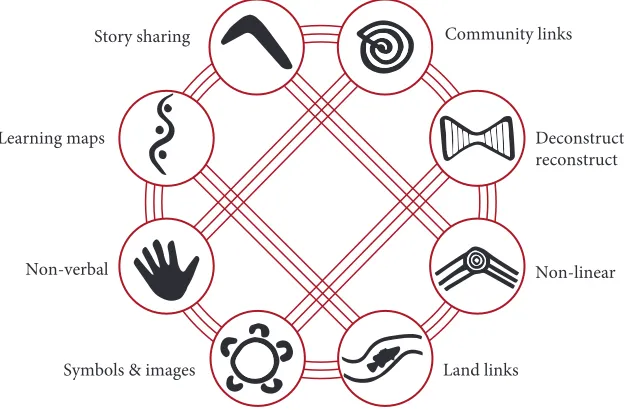
(6) Exploring the opportunities of social media. Drawing inspiration from the ‘both-ways’ philosophy and trying to find a solution on how to better engage with Aboriginal learning processes, while at the same time involving educators in a dialogue of the commonalities between Indigenous and non-Indigenous pedagogies, Yunkaporta (2009) developed the ‘eight-way framework of Aboriginal Pedagogy’, which is visually represented in Figure 1.. Story sharing. Community links. Learning maps. Deconstruct reconstruct. Non-verbal. Symbols & images. Non-linear. Land links. Figure 1. 8-ways Aboriginal Pedagogy Framework (Yunkaporta 2009). What follows is a brief description of the eight interconnected concepts that underlie this framework: Story sharing: The key principle in the framework, according to Yunkaporta, is the sharing of stories. It is through ‘yarning’ that Indigenous people transmit knowledge, learn about the world and keep their strong connection to Country. As the word ‘to yarn’ implies, it is not a monologic activity but a shared dialogue between teacher and learner. Furthermore, ‘yarning’ is not time-bound, and cannot be captured in pre-determined time. In other words, ‘yarning’ is fluid and develops according to a set of circumstances that cannot be captured in terms of pre-determined outcomes; rather, the amount of knowledge that is shared at any one time is context-bound and indeterminate from the outset. Deconstruct-reconstruct: The initial learning process focuses on the whole rather than the parts. Concepts are modelled first by a more knowledgeable individual – an elder of the community – before the learner tries it independently. In that sense, it is much closer to a Confucian style of learning than to western, individualised and compartmentalised ways of learning. © 2014. John Benjamins Publishing Company All rights reserved. 101.
(7) 102 Henk Huijser and Jurg Bronnimann. Non-linear: As highlighted previously, Indigenous pedagogy is not sequential but new knowledge is built by making connections with and building on existing knowledge. There is a lot of repetition and re-iteration of perceptions and ideas which ultimately lead to deeper understanding. Again, this has major implications for the way time is organised around learning, as learning can take place any time and any place…or not. Regardless however, learning takes place over time, and when pre-determined outcomes will be achieved cannot be clearly pinpointed from the outset. This aligns very nicely with social media, as social media allow for non-linear and fluid communication and therefore potentially learning. Cope and Kalantzis (2009) call this ‘ubiquitous learning’, and ‘new learning’ (Kalantizis and Cope 2008), and it means that learning does not only increasingly happen anywhere, anytime, but also that it is characterised by continuous feedback by peers, rather than formal and linear, with the feedback coming only from the teacher as the privileged source of knowledge. Land-links: Aboriginal pedagogies are intimately linked to the living landscape, to Country. For Indigenous people the learning is about making connection to the land. All knowledge is ultimately linked to Country. Social media, and mobile media in particular, create opportunities to maintain this connection to Country from wherever you are. Indeed, in a New Zealand context, Facebook has been called ‘the new marae’ (Maori meeting house). Community links: The Indigenous way of learning is very much group orientated and is closely connected to real life contexts. Learning is also about helping the community. This is intimately linked to the importance of caring for Country as outlined above, reinforcing the holistic nature of the 8 ways framework. Non-verbal: In the Indigenous context learning happens far more by doing and by the use of body language and silence. This is not to say there is a limited language capacity, but rather Indigenous learners test knowledge through experience, reflection and practical application. An example of a practical application is a painting, which in Indigenous contexts is not always simply an individual work of art in the western sense, but more often a medium through which to convey knowledge about country (Martin 2007). Mobile technologies provide opportunities here as well, as they allow for the visual capture of actions that can then be shared via social media like YouTube, potentially without spoken or written language if deemed appropriate. This in turn potentially removes the western emphasis on the written word, opening up the possibility of learning in non-verbal visual digital learning spaces. Learning maps: Learning happens mainly through the use of visual aids, such as drawing diagrams and images. The images serve as a reference point for the learner. Social media are inherently multimedia and lend themselves perfectly to the electronic sharing of learning maps. Symbols and images: Symbols and metaphors are used to understand concepts and content. “Knowledge is coded in symbols, signs, images and metaphors and is therefore a tool for learning and memorising complex knowledge” (Yunkaporta and © 2014. John Benjamins Publishing Company All rights reserved.
(8) Exploring the opportunities of social media. Kirby 2011). In Indigenous contexts, there are often strict protocols around what knowledge can be shared, and whom it can be shared with. However, many social media platforms (e.g. Vimeo, YouTube and even Facebook) allow for choice in their settings in terms of whom content gets shared with.. Applying the 8 ways learning framework in Indigenous contexts has many advantages as it allows for more contextualised learning, it is reflective and self-directed and probably most importantly it is meaningful and relevant to Indigenous students, and hence highly motivating. Recognising and respecting different ways of knowing and the importance of building community relationships are essential ingredients in a community of learning. It will create the trust that is necessary especially where diverse ways of knowing (western and Indigenous) engage in cognitive interactions. The development of the 8 ways Aboriginal pedagogy framework has paved the way to move beyond the binary oppositions (Yunkaporta 2009) of western and Indigenous knowledges and thus create new opportunities in teaching and learning, one of which we argue in this paper is the use of social media in Indigenous contexts. Yunkaporta’s 8 ways framework is a holistic framework which draws its strength from the sum of its parts, much like Indigenous knowledges themselves. Social media present opportunities to develop learning spaces in which such holistic approaches to learning can thrive. 4. Social media, relationships and learner-centredness Digitial technologies in general, and social media in particular, have huge potential to overcome the ‘tyranny of distance’, and with specific reference to Indigenous contexts in Australia, the ‘tyranny of remoteness’. Even though remote communities are increasingly becoming ‘connected’, “currently online learning is not available for most remote living Indigenous people in the Northern Territory (NT)” (Vodic et al. 2012, 34). This means that for many Indigenous people in remote communities, learning still follows a well-trodden path of (mostly) non-Indigenous trainers and teachers flying in and out to ‘deliver’ self-contained learning modules largely in isolation, without necessarily being linked together, nor necessarily being linked to a local context. In other words, despite all good intentions, this is essentially a ‘tick-box’ kind of approach where the emphasis is on the teacher being able to sign off on the delivery being achieved, or the learning being ‘delivered on time’. Whether it has been ‘received’ is of course an entirely different question. It is thus very much a teacher-centred approach, which is driven by administrative convenience, rather than self-identified or co-constructed Indigenous learning needs. This in turn creates the ongoing risk of what Plater (2013, 157) calls ‘over-functioning’: “many non-Aboriginal and Torres Strait Islander educators have, in their approach to providing teaching and learning © 2014. John Benjamins Publishing Company All rights reserved. 103.
(9) 104 Henk Huijser and Jurg Bronnimann. support for Aboriginal and Torres Strait Islander students, tended towards overfunctioning, or rescuing and co-dependency”. In other words, this teacher-centred approach generally, and almost inevitably, forces Indigenous learners into ‘deficit’ mode, from which they need to be ‘rescued’. While this is very far removed from the learning and teaching framework – centred around ‘both ways’ principles – that Batchelor Institute is trying to implement, it is still the reality in many remote Indigenous learning contexts. The rhetoric follows the ideal scenario in which the importance of community engagement and the centrality of relationship building is repeatedly emphasised. Indeed, in the case of Batchelor Institute’s learning and teaching framework, ‘relationships’ has literally been positioned at the heart of ‘everything we do’. There are good reasons for this, as the importance of relationships is frequently cited in the research literature as the crucial prerequisite for successful learning in Indigenous contexts (Perso 2012). However, developing relationships takes time, and it is precisely this time factor that often jars with the ‘audit driven’ efficiency of ‘flying in-flying out’ delivery. To really make an impact and force a shift towards more learner-centred approaches, and by extension more community-driven and relevant approaches, would require structural changes to the way learning and teaching is organised in Indigenous contexts (or for Indigenous contexts), or perhaps a series of new technologies that can help to forge a paradigm shift in this respect. We would argue that social media, in combination with mobile technologies, indeed have the potential to upset the status quo and create a situation where relationship building can take centre stage on an ongoing basis. Ultimately, this would then lead to much more learner-centred approaches with the power to match the rhetoric, and it would apply to all levels of tertiary education, including postgraduate education. In the latter case for example, Trudgett (2011) has argued for the need to involve Indigenous community elders in the supervision process, but this is not always easy to achieve. However, social and mobile media have the potential to make this much more common, and thereby significantly improve the learning experience for Indigenous postgraduate students (Stanton 2013). As Heron points out (cited in Nadarajah 2012, 6), “for the first time we have the opportunity to do away with the ‘remote’. Indigenous communities no longer have to be isolated – they can be connected. Limitations of time and space no longer need to apply”. In other words, while teachers may still ‘fly in and fly out’, there are now increasing opportunities to maintain and develop relationships on an ongoing basis over time. Interestingly, if teachers learn how to leverage existing social media use, it would in many ways be learner-centred already, because Indigenous people in general, and particularly young Indigenous people appear to have taken to social media use, and technology in general, in a big way (Stanton 2013). So when Vidic et al. (2012, 37, our emphasis) recommend that “technical © 2014. John Benjamins Publishing Company All rights reserved.
(10) Exploring the opportunities of social media. and educational support must be made available within communities (particularly around the time of training delivery) to support people in their efforts to access online education”, they do have a point, but at the same time they miss the key point, which is that new technologies (and social media in particular) have the potential to blur the boundaries between formal learning and the ongoing social context in which such learning should be situated. Thus, the adage ‘particularly around the time of training delivery’ becomes almost irrelevant as the support should be there on an ongoing basis, and not just as it relates to online education per se but rather as it relates to education in a social context. Existing social media use should be the driving force in this process, rather than social media use designed by educators; only then will it be relevant and authentic, and thus have the power to develop ongoing engagement with learning that matters at a community level. As a caution, this is not about ‘kow-towing to students’ whims’ or about ‘pleasing’ students, but rather about situating learning in appropriate and relevant contexts, and most importantly, at an appropriate level for those students. This is the part that would make it highly learner-centred. 5. Exploring the potential of social media – the what and the how In their report about social media use in higher education, Moran, Seaman and Tinti-Kane (2011, 4) identify the key element and key potential of social media: “for the first time, the world faces a medium [sic] that is by its very nature noncentralized, meaning that in both form and content, it is user created, user controlled, flexible, democratic, and both very transparent and very not so.” It is not difficult to see the potential links here to learner-centred approaches and to Indigenous approaches to learning. Moran et al. (2011, 4) go on to argue that social media’s most distinctive aspect lies in its “potential to transform from a way of pushing content outward to a way of inviting conversation, of exchanging information, and of invoking unparalleled individual, industry, societal, and even global change”. The slight hyperbole notwithstanding, they do make an important point about the fact that social media are inherently social and you could therefore argue that they are thus by their very nature learner-centred, rather than teachercentred. The ‘democratic’ element is further elaborated on by Selwyn (2011, 1), who notes that “social media use is often described in terms of collaboration, conviviality and creativity. Social media applications are seen to be open rather than closed, bottom-up rather than top-down.” He also makes a specific link to learning, or what he calls a ‘new culture of learning’, “i.e. learning that is based around principles of collective exploration, play and innovation rather than individualised instruction” (2011, 3). All of this points towards major potential for more relevant © 2014. John Benjamins Publishing Company All rights reserved. 105.
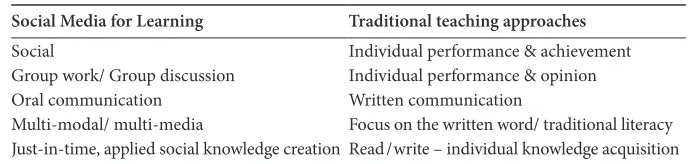
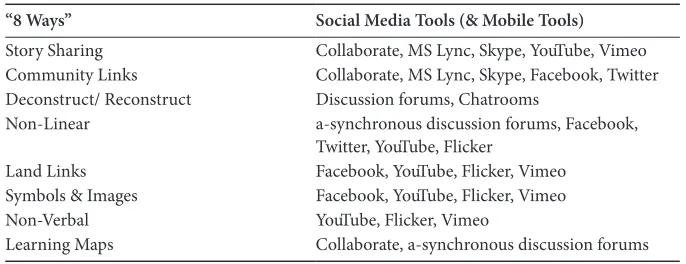
(11) 106 Henk Huijser and Jurg Bronnimann. and learner-centred pedagogical approaches in Indigenous contexts, but questions remain at this stage around how to capitalise on that potential. Table 1 provides some initial first steps in developing ways to draw on existing social media use for Indigenous learning contexts. Table 1. Characteristics of Social Media vs Traditional Teaching Approaches Social Media for Learning. Traditional teaching approaches. Social Group work/ Group discussion Oral communication Multi-modal/ multi-media Just-in-time, applied social knowledge creation. Individual performance & achievement Individual performance & opinion Written communication Focus on the written word/ traditional literacy Read / write – individual knowledge acquisition. Specifically important for Indigenous contexts is the collectivist approach to learning and knowledge, rather than the individualist approach that is fundamental to western, and teacher-centred, approaches to learning. As a word of caution, we are very much talking about broad characteristics and we therefore always need to be vigilant in preventing this from turning into a set of rigid, essentialist ‘rules’ (Trudgett 2011). Culture is fluid and forever changing, and in the case of Indigenous cultures in Australia, there is a huge diversity that has to be taken into account. However, this is part of the point we are making here: that social media allow us to start the learning process from where Indigenous students are at, and allow us to draw on existing knowledge, rather than simply imposing a knowledge set on them, because we (as in western educators) have decided that is what they should know. In the case of language in particular, leveraging social media use potentially allows us to shift the emphasis away from written communication in English, which creates huge barriers to learning in many Indigenous contexts where English literacy levels are low. As noted above, social media are also inherently multimedia, and this creates opportunities to learn in context and learn by using media that students are comfortable with, and that are culturally appropriate. This is not to say that traditional literacy in English is not important, but rather that the timing can be more flexible, and that learning can take place before literacy in English has been achieved, if indeed the latter is deemed to be a relevant and desirable outcome in the particular context in which the learning is to take place. As we have discussed and outlined the relevance of Yunkaporta’s (2009) ‘8 Ways’ framework above, Table 2 identifies potential social media tools that may be aligned with some of these eight ways. These are potential tools, and the eight ways listed in the left hand column are by no means restricted to, or limited by, the tools listed in the right hand column. However, those tools are currently the most widely known and used, and may currnelty be the most appropriate. © 2014. John Benjamins Publishing Company All rights reserved.
(12) Exploring the opportunities of social media 107. Table 2. Aligning ‘8 Ways’ with Social Media Tools “8 Ways”. Social Media Tools (& Mobile Tools). Story Sharing Community Links Deconstruct/ Reconstruct Non-Linear. Collaborate, MS Lync, Skype, YouTube, Vimeo Collaborate, MS Lync, Skype, Facebook, Twitter Discussion forums, Chatrooms a-synchronous discussion forums, Facebook, Twitter, YouTube, Flicker Facebook, YouTube, Flicker, Vimeo Facebook, YouTube, Flicker, Vimeo YouTube, Flicker, Vimeo Collaborate, a-synchronous discussion forums. Land Links Symbols & Images Non-Verbal Learning Maps. As becomes clear in Table 2, there is an increasing array of social media tools that can potentially be leveraged for learning in Indigenous contexts, and indeed for learner-centred approaches to learning that respect and value Indigenous knowledges and Indigenous ways of learning. In terms of their use, we are only beginning to scratch the surface, even if social media use in higher education is apparently increasing rapidly (Moran et al. 2011). For example, in explaining their use of Facebook, Jenkins et al. (2012, 66) hope to achieve two main goals: firstly to improve the effectiveness of communications to their cohort of students, and secondly to energise communications among the student cohort. These are still relatively modest goals, and ones that are echoed by some ‘early adopters’ at Batchelor Institute. The additional advantage in Batchelor Institute’s case is that Facebook provides a continuous communication tool. In other words, while students change their phones and sim cards on a regular basis, there Facebook account is often the only stable space for teachers to get in touch with them. Although this is a promising start, and it is learner-centred in the sense that we meet students ‘where they are at’, there are many new ways and social media tools that are waiting to be explored to achieve more effective learning outcomes in Indigenous contexts. 6. Conclusion If this all sounds highly idealistic, then that is quite deliberately so. In a context where the statistics about educational outcomes for Indigenous students continue to be depressing (Bradley et al. 2008; Trudgett 2011), the potential of social media and other new technologies warrants a certain level of optimism, especially as there appears to be a high uptake of such technologies in Indigenous communities. However, there are some cautions to take into account. As Selwyn (2011, 5) notes, “it is unhelpfully idealistic to imagine social media as providing a level playing © 2014. John Benjamins Publishing Company All rights reserved.
(13) 108 Henk Huijser and Jurg Bronnimann. field for all”, and he identifies ongoing ‘digital inequalities’ that are “especially pronounced in terms of socio-economic status, social class, race, gender, geography, age and educational background”. While these are all relevant in Indigenous contexts, they are factors that have been integral to Indigenous disadvantage for a very long time. The idealism in this paper stems from a strong sense that social media have the potential to put the power of tools for learning in the hands of the learner, rather than learning being defined by non-Indigenous teachers and imposed from the top down. The latter teacher-centred approach has done Indigenous learners very few favours, and we have argued here that social and mobile media have the potential to shift the balance towards much more learner-centred and culturally relevant approaches to learning and teaching in Indigenous contexts.. References Bat, Melodie, Claire Kilgariff, and Tina Doe. 2013 (forthcoming). “Indigenous Tertiary Education – We’re all Learning: Both-ways Pedagogy in the Northern Territory of Australia”. Higher Education Research & Development. Batchelor Institute of Indigenous Tertiary Education. 2012. Strategic Plan 2012–2014. http:// www.batchelor.edu.au/biite/wp-content/uploads/2012/08/Strategic-Plan_V4.7-web.pdf. Batchelor Institute of Indigenous Tertiary Education. 2007. Strategic Plan: The Decade That Counts 2007–2016 – Creating the Future Together. Batchelor: Batchelor Institute. Battiste, Marie. 2002. Indigenous Knowledge and Pedagogy in First Nations Education: A Literature Review with Recommendations. Ottawa: National Working Group on Education and the Minister of Indian Affairs, Indian and Northern Affairs Canada. Behrendt, Larissa, Steve Larkin, Robert Griew, and Patricia Kelly. 2012. Review of Higher Education Access and Outcomes for Aboriginal and Torres Strait Islander People: Final Report. Canberra: Australian Government. Bhabha, Homi K. 1994. The Location of Culture. London and New York: Routledge. Bradley, Denise, Peter Noonan, Helen Nugent, and Bill Scales. 2008. Review of Australian Higher Education. http://www.deewr.gov.au/HigherEducation/Review/Pages/ReviewofAustralian HigherEducationReport.aspx. Bransford, John D., Ann L. Brown, and Rodney R. Cocking (eds). 2003. How People Learn: Brain, Mind, Experience, and School (Expanded Edition). Washington D.C.: National Academy Press. Cochran, Patricia A. L., Catherine A. Marshall, Carmen Garcia-Downing, Elizabeth Kendall, Doris Cook, Laurie McCubbin, and Reva Mariah S. Gover. 2008. “Indigenous Ways of Knowing: Implications for Participatory Research and Community”. American Journal of Public Health 98 (1): 22–27. DOI: 10.2105/AJPH.2006.093641 Cope, Bill, and Mary Kalantzis. 2009. Ubiquitous Learning. Chicago: University of Illinois Press. Deakin Crick, Ruth. 2007. “Learning How to Learn: The Dynamic Assessment of Learning Power”. The Curriculum Journal 18 (2): 135–153. DOI: 10.1080/09585170701445947 Hughes, Paul. 1987. “Aboriginal Culture and Learning Styles – A Challenge for Academics in Higher Education Institutions”. In The Second Frank Archibald Memorial Lecture. Armidale: New South Wales.. © 2014. John Benjamins Publishing Company All rights reserved.
(14) Exploring the opportunities of social media 109. Jenkins, Greg, Kenneth Lyons, Ruth S. Bridgstock, and Lauren Carr. 2012. “Like Our Page – Using Facebook to Support First Year Students in their Transition to Higher Education: A Practice Report”. The International Journal of the First Year in Higher Education 3 (2): 65–72. DOI: 10.5204/intjfyhe.v3i2.131 Johnson, Larry, Samantha Adams, Malcolm Cummins, Victoria Estrada, Alex Freeman, and Holly Ludgate. 2013. NMC Horizon Report: 2013 Higher Education Edition. Austin, Texas: The New Media Consortium. Kalantzis, Mary, and Bill Cope. 2008. New Learning: Elements of a Science of Education. Cambridge: Cambridge University Press. DOI: 10.1017/CBO9780511811951 Lave, Jean, and Etienne Wenger. 2003. Situated Learning: Legitimate Peripheral Participation. Cambridge: Cambridge University Press. Marika, Raymattja. 1999. “Milthun Latju Wanga Romgu Yolgnu: Valuing Knowledge in the Education System”. Ngoonjook: A Journal of Australian Indigenous Issues 16: 23–39. Martin, Karen. 2007. “The Intersection of Aboriginal Knowledges, Aboriginal Literacies and New Learning Pedagogies for Aboriginal students”. In Multiliteracies and Diversity in Education: New Pedagogies for Expanding Landscapes, ed. by Annah Healy, 58–61. Melbourne: Oxford University Press. Moran, Mike, Jeff Seaman, and Hester Tinti-Kane. 2011. Teaching, Learning, and Sharing: How Today’s Higher Education Faculty Use Social Media. Boston, MA: Pearson Learning Solutions. Nadarajah, Hujjat. 2012. “A Passion for Connection: Heron Loban”. Our Place 43: 5–6. Nakata, Martin. 2007. Disciplining the Savages: Savaging the Discipline. Canberra: Aboriginal Studies Press. Ober, Robyn, and Melodie Bat. 2007a. “Paper 1: Both-Ways: The Philosophy”. Ngoonjook: A Journal of Australian Indigenous Issues 31: 64–86. Ober, Robyn, and Melodie Bat. 2007b. “Paper 2: Both-Ways: Philosophy to Practice”. Ngoonjook: A Journal of Australian Indigenous Issues 32: 56–79. Perso, Thelma. 2012. Cultural Responsiveness and School Education, with Particular Focus on Australia’s First Peoples: A Review and Synthesis of the Literature. Darwin: Menzies School of Health. Plater, Suzanne. 2012. “‘For the Life of Me, I Can’t See Why Those Students Were Let Go on So Long’: Educating the Educators, Aboriginal and Torres Strait Islander-Style”. The Australian Journal of Indigenous Education 41 (2): 156–161. DOI: 10.1017/jie.2012.24 Selwyn, Neil. 2011. “Social Media in Higher Education”. The Europa World of Learning. http:// www.worldoflearning.com. Stanton, Sue. 2013. “Elders Panel”. Indigenous Knowledges in a Changing World: Charles Darwin Symposium 2013, Charles Darwin University, Darwin, 21–22 April. Trudgett, Michelle. 2011. “Western Places, Academic Spaces and Indigenous Faces: Supervising Indigenous Australian Postgraduate Students”. Teaching in Higher Education 16 (4): 389–399. DOI: 10.1080/13562517.2011.560376 Usher, Alex. 2009. “Ten Years Back and Ten Years Forward: Developments and Trends in Higher Education in the Europe Region”. UNESCO Forum on Higher Education in the Europe Region: Access, Value, Quality and Competitiveness. Bucharest. Vodic, Alex, Kate Senior, Brett Dwyer, and Penny Szybiak. 2012. A Remote Chance? Widening Participation of Remote Indigenous Students in the Northern Territory via ICT-Enabled Learning. Darwin: Charles Darwin University. Winch, Joan, and Ken Hayward. 1999. “‘Doing it Our Way’: Can Cultural Traditions Survive in Universities?” New Doctor Summer: 25–27.. © 2014. John Benjamins Publishing Company All rights reserved.
(15) 110 Henk Huijser and Jurg Bronnimann. Yunkaporta, Tyson. 2009. Aboriginal Pedagogy at the Cultural Interface. Professional Doctorate, Thesis. Townsville: James Cook University. Yunkaporta, Tyson, and Melissa Kirby. 2011. “Yarning Up Indigenous Pedagogies: A Dialogue about Eight Aboriginal Ways of Learning”. In Two Way Teaching and Learning: Toward Culturally Reflective and Relevant Education, ed. by Hannah Rachel Bell, Gina Milgate, and Nola Purdie, 205–214. Camberwell Victoria: ACER Press.. Authors’ addresses Henk Huijser, PhD Senior Lecturer, Online and Learning Technologies Research, Teaching & Learning Division Batchelor Institute of Indigenous Tertiary Education Corner Nurndina Street & Kirra Crescent, Batchelor, NT 0845 Phone: +61 8 89397140 [email protected] http://henkhuijser.webs.com Jurg Bronnimann, PhD Manager Learning and Engagement Research, Teaching & Learning Division Batchelor Institute of Indigenous Tertiary Education Corner Nurndina Street & Kirra Crescent, Batchelor, NT 0845 Phone: +61 8 89397328 [email protected]. © 2014. John Benjamins Publishing Company All rights reserved.
(16)
Figure
Related documents
For this purpose, an experimental modal analysis (EMA) was conducted on the actual structure, Fig. 1, and the results were then used to create a valid finite-element model.
NCAA , the United States Supreme Court held that a federal law that prevents States from legalizing sports gambling “violates the anticommandeering rule.” 3
Abstract. Rapid urbanization is among the most important causes of ecological degradation across dierent spatial scales ranging from global to regional and local. As protection
Controlling the size of nanoparticles was achieved by changing the rate of gold reduction via variation of initial gold ions concentration, molar ratio of gold ions to HPMo,
human intimacy on one of those days when life feels as if it’s hiding behind the door or collecting in dark clumps in the corners of the eyes.. For the last two months, since my
penicillin, skin testing for immediate hyper-.. sensitivity to the agent should
In this study water quality index determined on the basis of various physical and chemical parameters like pH, Electrical Conductivity, Total Dissolved Solids, Nitrate,
