
1
Information Processing, Computation, and Cognition
Gualtiero Piccinini
Department of Philosophy, Center for Neurodynamics, and Department of Psychology University of Missouri – St. Louis
St. Louis, MO, USA
Email: [email protected] Andrea Scarantino
Department of Philosophy and Neuroscience Institute Georgia State University
Atlanta, GA, USA
Email: [email protected]
This is a preprint of an article whose final and definitive form will be published in Journal of Biological Physics; Journal of Biological Physics is available online at:
http://www.springerlink.com/content/102921/
Abstract:
Computation and information processing are among the most fundamental notions in cognitive science. They are also among the most imprecisely discussed. Many cognitive scientists take it for granted that cognition involves computation, information processing, or both – although others disagree vehemently. Yet different cognitive scientists use ‘computation’ and
‘information processing’ to mean different things, sometimes without realizing that they do. In addition, computation and information processing are surrounded by several myths; first and foremost, that they are the same thing. In this paper, we address this unsatisfactory state of affairs by presenting a general and theory-neutral account of computation and information processing. We also apply our framework by analyzing the relations between computation and information processing on one hand and classicism and connectionism/computational
neuroscience on the other. We defend the relevance to cognitive science of both computation, at least in a generic sense, and information processing, in three important senses of the term. Our account advances several foundational debates in cognitive science by untangling some of their conceptual knots in a theory-neutral way. By leveling the playing field, we pave the way for the future resolution of the debates’ empirical aspects.
2
1. Information Processing, Computation, and the Foundations of Cognitive
Science
Computation and information processing are among the most fundamental notions in cognitive science. Many cognitive scientists take it for granted that cognition involves computation, information processing, or both. Many others, however, reject theories of cognition based on either computation or information processing [1-7]. This debate has continued for over half a century without resolution.
An equally long-standing debate pitches classical theories of cognitive architecture [8-13] against connectionist and neurocomputational theories [14-21]. Classical theories draw a strong analogy between cognitive systems and digital computers. The term ‘connectionism’ is primarily used for neural network models of cognitive phenomena constrained solely by behavioral (as opposed to neurophysiological) data. By contrast, the term ‘computational neuroscience’ is primarily used for neural network models constrained by neurophysiological and possibly also behavioral data. We are interested not so much in the distinction between connectionism and computational neuroscience as in what they have in common: the
explanation of cognition in terms of neural networks and their apparent contrast with classical theories. Thus, for present purposes connectionism and computational neuroscience may be considered together.
For brevity’s sake, we will refer to these debates on the role information processing, computation, and neural networks should play in a theory of cognition as the foundational debates.
In recent years, some cognitive scientists have attempted to get around the
foundational debates by advocating a pluralism of perspectives [22-23]. According to this kind of pluralism, it is a matter of perspective whether the brain computes, processes information, is a classical system, or is a connectionist system. Different perspectives serve different purposes and different purposes are legitimate. Hence, all sides of the foundational debates can be retained if appropriately qualified.
Although pluralists are correct to point out that different descriptions of the same phenomenon can in principle complement one another, this kind of perspectival pluralism is flawed in one important respect. There is an extent to which different parties in the
foundational debates offer alternative explanations of the same phenomena—they can’t all be right. Nevertheless, these pluralists are responding to something true and important: the foundational debates are not merely empirical; they cannot be resolved solely by collecting more data because they hinge on how we construe the relevant concepts. The way to make progress is therefore not to accept all views at once, but to provide a clear and adequate conceptual framework that remains neutral between different theories. Once such a framework is in place, competing explanations can be translated into a shared language and evaluated on empirical grounds.
Lack of conceptual housecleaning has led to the emergence of a number of myths that stand in the way of theoretical progress. Not everyone subscribes to all of the following assumptions, but each is widespread and influential:
3 (2) Semantic information is necessarily true. (3) Computation requires representation.
(4) The Church-Turing thesis entails that cognition is computation. (5) Everything is computational.
(6) Connectionist and classical theories of cognitive architecture are mutually exclusive. We will argue that these assumptions are mistaken and distort our understanding of
computation, information processing, and cognitive architecture.
Traditional accounts of what it takes for a physical system to perform a computation or process information [19, 24-26] are inadequate because they are based on at least some of (1)-(6). In lieu of these traditional accounts, we will present a general account of computation and information processing that systematizes, refines, and extends our previous work [27-37].
We will then apply our framework by analyzing the relations between computation and information processing on one hand and classicism and connectionism/computational
neuroscience on the other. We will defend the relevance to cognitive science of both
computation, at least in a generic sense we will articulate, and information processing, in three important senses of the term. We will also argue that the choice among theories of cognitive architecture is not between classicism and connectionism/computational neuroscience, but rather between varieties of neural computation, which may be classical or non-classical.
Our account advances the foundational debates by untangling some of their conceptual
knots in a theory-neutral way. By leveling the playing field, we pave the way for the future resolution of the debates’ empirical aspects.
2. Getting Rid of Some Myths
The notions of computation and information processing are often used interchangeably. Here is a representative example: “I … describe the principles of operation of the human mind, considered as an information-processing, or computational, system” *38, p. 10, emphasis added]. This statement presupposes assumption (1) above. Why are the two notions used interchangeably so often, without a second thought?
We suspect the historical reason for this conflation goes back to the cybernetic
movement’s effort to blend Shannon’s information theory [39] with Turing’s [40] computability theory (as well as control theory). Cyberneticians did not clearly distinguish either between Shannon information and semantic information or between semantic and non-semantic computation (more on these distinctions below). But at least initially, they were fairly clear that information and computation played distinct roles within their theories. Their idea was that organisms and automata contain control mechanisms: information is transmitted within the system and between system and environment, and control is exerted by means of digital computation [41, 42].
4
the independent roles computation and information processing can fulfill in a theory of cognition.
The notion of digital computation was imported from computability theory into neuroscience and psychology primarily for two reasons: first, it seemed to provide the right mathematics for modeling neural activity [43]; second, it inherited mathematical tools (algorithms, computer program, formal languages, logical formalisms, and their derivatives, including many types of neural networks) that appeared to capture some aspects of cognition. These reasons are not sufficient to actually establish that cognition is digital computation. Whether cognition is digital computation is a difficult question, which lies outside the scope of this essay.
The theory that cognition is computation became so popular that it progressively led to a stretching of the operative notion of computation. In many quarters, especially
neuroscientific ones, the term ‘computation’ is used, more or less, for whatever internal processes explain cognition. Unlike ‘digital computation,’ which stands for a mathematical apparatus in search of applications, ‘neural computation’ is a label in search of a theory. Of course, the theory is quite well developed by now, as witnessed by the explosion of work in computational and theoretical neuroscience over the last decades [20, 44-45]. The point is that such a theory need not rely on a previously existing and independently defined notion of
computation, such as ‘digital computation’ or even ‘analog computation’ in its most straightforward sense.
By contrast, the various notions of information (processing) have distinct roles to play. By and large, they serve to make sense of how organisms keep track of their environments and produce behaviors accordingly. Shannon’s notion of information can serve to address
quantitative problems of efficiency of communication in the presence of noise, including communication between the external (distal) environment and the nervous system. Other notions of information—specifically, semantic information—can serve to give specific semantic content to particular states or events. This may include cognitive or neural events that reliably correlate with events occurring in the organism’s distal environment as well as mental
representations, words, and the thoughts and sentences they constitute.
Whether cognitive or neural events fulfill all or any of the job descriptions of computation and information processing is in part an empirical question and in part a conceptual one. It’s a conceptual question insofar as we can mean different things by ‘information’ and ‘computation’, and insofar as there are conceptual relations between the various notions. It’s an empirical question insofar as, once we fix the meanings of
‘computation’ and ‘information’, the extent to which computation and the processing of information are both instantiated in the brain depends on the empirical facts of the matter.
Ok, but do these distinctions really matter? Why should a cognitive theorist care about the differences between computation and information processing? The main theoretical advantage of keeping them separate is to appreciate the independent contributions they can make to a theory of cognition. Conversely, the main cost of conflating computation and
information processing is that the resulting mongrel concept may be too messy and vague to do all the jobs that are required of it. As a result, it becomes difficult to reach consensus on
5
Debates on computation, information processing, and cognition are further muddied by assumptions (2)-(6).
Assumption (2) is that semantic information is necessarily true; there is no such thing as false information. This “veridicality thesis” is defended by most theorists of semantic
information [46-49]. But as we shall point out in Section 4, (2) is inconsistent with one
important use of the term ‘information’ in cognitive science *37+. Therefore, we will reject (2) in favor of the view that semantic information may be either true or false.
Assumption (3) is that there is no computation without representation. Most accounts of computation rely on this assumption [19, 24-26, 38]. As one of us has argued extensively elsewhere [27, 28, 50], however, assumption (3) obscures the core notion of computation used in computer science and computability theory—the same notion that inspired the
computational theory of cognition—as well as some important distinctions between notions of computation. The core notion of computation does not require representation, although it is compatible with it. In other words, computational states in the core sense may or may not be representations. Understanding computation in its own terms, independently of
representation, will allow us to sharpen the debates over the computational theory of cognition as well as cognitive architecture.
Assumption (4) is that cognition is computation because of the Church-Turing thesis [51, 52]. The Church-Turing thesis says that any function that is computable in an intuitive sense is recursive or, equivalently, computable by some Turing machine [40, 53, 54].1 Since Turing machines and other equivalent formalisms are the foundation of the mathematical theory of computation, many authors either assume or attempt to argue that all computations are covered by the results established by Turing and other computability theorists. But recent scholarship has shown this view to be fallacious [29, 55]. The Church-Turing thesis does not
establish whether a function is computable. It only says that if a function is computable in a certain intuitive sense, then it is computable by some Turing machine. Furthermore, the intuitive sense in question has to do with what can be computed by following an algorithm (a list of explicit instructions) defined over sequences of digital entities. Thus, the Church-Turing thesis applies directly only to algorithmic digital computation. The relationship between algorithmic digital computation and digital computation simpliciter, let alone other kinds of computation, is quite complex, and the Church-Turing thesis does not settle it.
Assumption (5) is pancomputationalism: everything is computational. There are two ways to defend (5). Some authors argue that everything is computational because describing something as computational is just one way of interpreting it, and everything can be
interpreted that way [19, 23]. We reject this interpretational pancomputationalism because it conflates computational modeling with computational explanation. The computational theory of cognition is not limited to the claim that cognition can be described (modeled)
computationally, as the weather can; it adds that cognitive phenomena have a computational explanation [28, 31, 34]. Other authors defend (5) by arguing that the universe as a whole is at
1
The Church-Turing thesis properly so called—i.e., the thesis supported by Church, Turing, and Kleene’s
6
bottom computational [56, 57]. The latter is a working hypothesis or article of faith for those interested in seeing how familiar physical laws might emerge from a “computational” or “informational” substrate. It is not a widely accepted notion, and there is no direct evidence for it.
The physical form of pancomputationalism is not directly relevant to theories of
cognition, because theories of cognition attempt to find out what distinguishes cognition from other processes—not what it shares with everything else. Insofar as the theory of cognition uses computation to distinguish cognition from other processes, it needs a notion of
computation that excludes at least some other processes as non-computational [cf. 28, 31, 34]. Someone may object as follows. Even if pancomputationalism—the thesis that
everything is computational—is true, it doesn’t follow that the claim that cognition involves computation is vacuous. A theory of cognition still has to say which specific computations cognition involves. The job of neuroscience and psychology is precisely to discover the specific computations that distinguish cognition from other processes [cf. 26].
We agree that, if cognition involves computation, then the job of neuroscience and psychology is to discover which specific computations cognition involves. But the if is important. The job of psychology and neuroscience is to find out how cognition works,
regardless of whether it involves computation. The claim that brains compute was introduced in neuroscience and psychology as an empirical hypothesis, to explain cognition by analogy with digital computers. Much of the empirical import of the computational theory of cognition is already eliminated by stretching the notion of computation from digital to generic (see below). Stretching the notion of computation even further, so as to embrace pancomputationalism, erases all empirical import from the claim that brains compute.
Here is another way to describe the problem. The view that cognition involves
computation has been fiercely contested. Many psychologists and neuroscientists reject it. If we adopt an all-encompassing notion of computation, we have no way to make sense of this debate. It is utterly implausible that critics of computationalism have simply failed to notice that everything is computational. More likely, they object to what they perceive to be
questionable empirical commitments of computationalism. For this reason, computation as it figures in pancomputationalism is a poor foundation for a theory of cognition. From now on, we will leave pancomputationalism behind.
Finally, assumption (6) is that connectionist and classical theories of cognitive
architecture are mutually exclusive.2 By this assumption, we do not mean to rule out hybrid theories that combine symbolic and connectionist modules [cf. 59]. What we mean is that according to assumption (6), for any given module, you must have either a classical or a connectionist theory.
2
Classical theories are often referred to as ‘symbolic’. Roughly speaking, in the present context a symbol is something that satisfies two conditions: (i) it is a representation and (ii) it falls under a discrete (or digital)
7
The debate between classicism and connectionism/computational neuroscience is sometimes conflated with the debate between computationalism and anti-computationalism.3 But these are largely separate debates. Computationalists argue that cognition is computation; anti-computationalists deny it. Classicists argue that cognition operates over language-like structures; connectionists suggest that cognition is implemented by neural networks. So all classicists are computationalists, but computationalists need not be classicists, and
connectionists/computational neuroscientists need not be anti-computationalists. In both debates, the opposing camps often confusedly mix terminological disputes with substantive disagreements over the nature of cognition. This is why we will begin our next section by introducing a taxonomy of notions of computation.
As we will show in Section 3.4, depending on what one means by ‘computation’,
computationalism can range from being true but quite weak to being an explanatorily powerful, though fallible, thesis about cognition. Similarly, we will show the opposition between
classicists and connectionists/computational neuroscientists to be either spurious or
substantive depending on what is meant by ‘connectionism’. We will argue that everyone is (or ought to be) a connectionist in the most general and widespread sense of the term, whether they realize it or not.
3. Computation
Different notions of computation vary along two important dimensions. The first is how encompassing the notion is, that is, how many processes it includes as computational. The second dimension has to do with whether being the vehicle of a computation requires possessing meaning, or semantic properties. We will look at the first dimension first.
3.1 Digital computation
We use ‘digital computation’ for the notion implicitly defined by the classical mathematical theory of computation, and ‘digital computationalism’ for the thesis that cognition is digital computation. Rigorous mathematical work on computation began with Alan Turing and other logicians in the 1930s [40, 53, 60, 61], and it is now a well-established branch of mathematics [62].
A few years after Turing and others formalized the notion of digital computation, Warren McCulloch and Walter Pitts [43] used digital computation to characterize the activities of the brain. McCulloch and Pitts were impressed that the main vehicles of neural processes appear to be trains of all-or-none spikes, which are discontinuous events [44]. This led them to conclude, rightly or wrongly, that neural processes are digital computations. They then used their theory that brains are digital computers to explain cognition.4
McCulloch and Pitts’s theory is the first theory of cognition to employ Turing’s notion of digital computation. Since McCulloch and Pitts’s theory had a major influence on subsequent
3
Sometimes, the view that cognition is dynamical is presented as an alternative to the view that cognition is computational [e.g., 4]. This is simply a false contrast. Computation is dynamical too; the relevant question is whether cognitive dynamics are computational.
4
8
computational theories, we stress that digital computation is the principal notion that inspired modern computational theories of cognition [63]. This makes the clarification of digital
computation especially salient.
Digital computation may be defined both abstractly and concretely. Roughly speaking, abstract digital computation is the manipulation of strings of discrete elements, that is, strings of letters from a finite alphabet. Here we are interested primarily in concrete computation, or physical computation. Letters from a finite alphabet may be physically implemented by what we call ‘digits’. To a first approximation, concrete digital computation is the processing of sequences of digits according to general rules defined over the digits [27]. Let us briefly consider the main ingredients of digital computation.
The atomic vehicles of concrete digital computation are digits, where a digit is simply a macroscopic state (of a component of the system) whose type can be reliably and
unambiguously distinguished by the system from other macroscopic types. To each (macroscopic) digit type, there correspond a large number of possible microscopic states. Digital systems are engineered so as to treat all those microscopic states in the same way—the one way that corresponds to their (macroscopic) digit type. For instance, a system may treat 4 volts plus or minus some noise in the same way (as a ‘0’), whereas it may treat 8 volts plus or minus some noise in a different way (as a ‘1’). To ensure reliable manipulation of digits based on their type, a physical system must manipulate at most a finite number of digit types. For instance, ordinary computers contain only two types of digit, usually referred to as ‘0’ and ‘1’.5 Digits need not mean or represent anything, but they can; numerals represent numbers, while other digits (e.g., ‘|’, ‘\’) do not represent anything in particular.
Digits can be concatenated (i.e., ordered) to form sequences or strings. Strings of digits are the vehicles of digital computations. A digital computation consists in the processing of strings of digits according to rules. A rule in the present sense is simply a map from input strings of digits, plus possibly internal states, to output strings of digits. Examples of rules that may figure in a digital computation include addition, multiplication, identity, and sorting.6
When we define concrete computations and the vehicles—such as digits—that they manipulate, we need not consider all of their specific physical properties. We may consider only the properties that are relevant to the computation, according to the rules that define the computation. A physical system can be described at different levels of abstraction. Since concrete computations and their vehicles can be defined independently of the physical media that implement them, we shall call them ‘medium-independent’. That is, computational descriptions of concrete physical systems are sufficiently abstract as to be medium-independent.
In other words, a vehicle is medium-independent just in case the rules (i.e., the input-output maps) that define a computation are sensitive only to differences between portions of the vehicles along specific dimensions of variation—they are insensitive to any other physical
5 The term ‘digit’ is used in two ways. It may be used for the discrete variables that can take different values; for instance, binary cells are often called bits, which can take either 0 or 1 as values. Alternatively, the term ‘digit’ may be used for the values themselves. In this second sense, it is the 0’s and 1’s that are the bits. We use ‘digit’ in the second sense.
6
9
properties of the vehicles. Put yet another way, the rules are functions of state variables associated with certain degrees of freedom that can be implemented differently in different physical media. Thus, a given computation can be implemented in multiple physical media (e.g., mechanical, electro-mechanical, electronic, magnetic, etc.), provided that the media possess a sufficient number of dimensions of variation (or degrees of freedom) that can be appropriately accessed and manipulated.
In the case of digits, their defining characteristic is that they are unambiguously distinguishable by the processing mechanism under normal operating conditions. Strings of digits are ordered sets of digits; i.e., digits such that the system can distinguish different members of the set depending on where they lie along the string. The rules defining digital computations are, in turn, defined in terms of strings of digits and internal states of the system, which are simply states that the system can distinguish from one another. No further physical properties of a physical medium are relevant to whether they implement digital computations. Thus, digital computations can be implemented by any physical medium with the right degrees of freedom.
To summarize, a physical system is a digital computing system just in case it is a system that manipulates input strings of digits, depending on the digits’ type and their location on the string, in accordance with a rule defined over the strings (and possibly the internal states of the system).
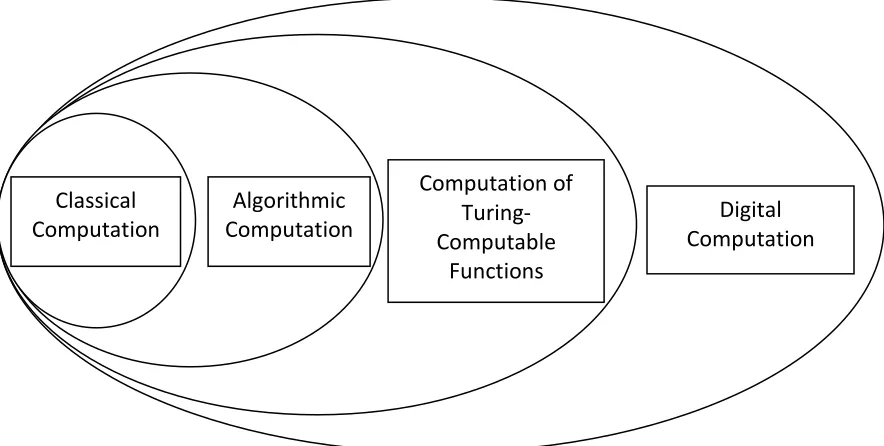
The notion of digital computation here defined is quite general. It should not be confused with three other commonly invoked but more restrictive notions of computation: classical computation (in the sense of Fodor and Pylyshyn [10]),7 computation that follows an algorithm, and computation of Turing-computable functions (see Figure 1 below).
Let us begin with the most restrictive notion of the three: classical computation. A classical computation is a digital computation that has two additional features. First, it manipulates a special kind of digital vehicle: sentence-like strings of digits. Second, it is algorithmic, meaning that it follows an algorithm—i.e., an effective, step-by-step procedure that manipulate strings of digits and produce a result within finitely many steps. Thus, a
classical computation is a digital, algorithmic computation whose algorithms are sensitive to the combinatorial syntax of the symbols [10].8
A classical computation is algorithmic, but the notion of algorithmic computation—i.e., digital computation that follows an algorithm—is more inclusive, because it does not require that the vehicles being manipulated be sentence-like.
Any algorithmic computation, in turn, is Turing-computable (i.e., it can be performed by a Turing machine). This is a version of the Church-Turing thesis, for which there is compelling
7 The term ‘classical computation’ is sometimes used as an approximate synonym of ‘digital computation’. Here we are focusing on the more restricted sense of the term that has been used in debates on cognitive architecture at least since [10].
8 Fodor and Pylyshyn [10] restrict their notion of classical computation to processes defined over representations, because they operate under assumption (3)—that computation requires representation. In other words, the sentence-like symbolic structures manipulated by Fodor and Pylyshyn’s classical computations must have semantic content. Thus, Fodor and Pylyshyn’s classical computations are a kind of “semantic computation”. Since
10
evidence [54]. But the computation of Turing-computable functions need not be carried out by following an algorithm. For instance, many neural networks compute Turing-computable functions (their inputs and outputs are strings of digits, and the input-output map is Turing-computable), but such networks need not have a level of functional organization at which they follow the steps of an algorithm for computing their functions; no functional level at which their internal states and state transitions are discrete.9
Finally, the computation of a Turing-computable function is a digital computation, because Turing-computable functions are by definition functions of a denumerable domain—a domain whose elements may be counted—and the arguments and values of such functions are, or may be represented by, strings of digits. But it is equally possible to define functions of strings of digits that are not Turing-computable, and to mathematically define processes that compute such functions. Some authors have speculated that some functions that are not Turing-computable may be computable by some physical systems [55, 64]. According to our usage, any such computations still count as digital computations. Of course, it may well be that only the Turing-computable functions are computable by physical systems; whether this is the case is an empirical question that does not affect our discussion. Furthermore, the
computation of Turing-uncomputable functions is unlikely to be relevant to the study of cognition. Be that as it may—we will continue to talk about digital computation in general.
Many other distinctions may be drawn within digital computation, such as hardwired vs. programmable, special purpose vs. general purpose, and serial vs. parallel computation [cf. 30]. Such additional distinctions, which are orthogonal to those of Figure 1, may be used to further classify theories of cognition that appeal to digital computation. Nevertheless, digital
computation is the most restrictive notion of computation that we will consider here. It includes processes that follow ordinary algorithms, such as the computations performed by standard digital computers, as well as many types of neural network computations. Since digital computation is the notion that inspired the computational theory of cognition, it is the most relevant notion for present purposes.
9
11
Figure 1. Types of digital computation and their relations of class inclusion.
3.2 Generic Computation
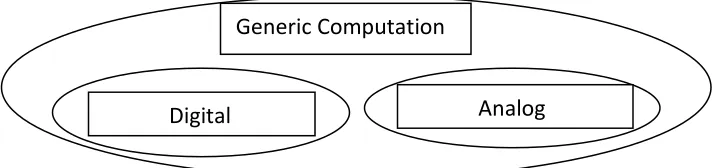
Even though the notion of digital computation is broad, we need an even broader notion of computation. In order to capture all relevant uses of ‘computation’ in cognitive science, we now introduce the notion of ‘generic computation’. The banner of ‘generic computation’ will subsume digital computation as defined in the previous section, analog computation, and neural computation.
We use ‘generic computation’ to designate the processing of vehicles according to rules that are sensitive to certain vehicle properties, and specifically, to differences between
different portions of the vehicles. This definition generalizes the definition of digital
computation by allowing for a broader range of vehicles (e.g., continuous variables as well as discrete digits). We use ‘generic computationalism’ to designate the thesis that cognition is computation in the generic sense.
Since the definition of generic computation makes no reference to specific media, generic computation is medium-independent—it applies to all media. That is, the differences between portions of vehicles that define a generic computation do not depend on specific physical properties of the medium but only on the presence of relevant degrees of freedom.
Shortly after McCulloch and Pitts argued that brains perform digital computations, others countered that neural processes may be more similar to analog computations [65, 66]. The alleged evidence for the analog computational theory includes neurotransmitters and hormones, which are released by neurons in degrees rather than in all-or-none fashion.
Analog computation is often contrasted with digital computation, but analog
computation is a vague and slippery concept. The clearest notion of analog computation is that of Pour-El [67]. Roughly, abstract analog computers are systems that manipulate continuous variables to solve certain systems of differential equations. Continuous variables are variables that can vary continuously over time and take any real values within certain intervals.
Classical Computation
Algorithmic Computation
Computation of Turing-Computable
Functions
12
Analog computers can be physically implemented, and physically implemented continuous variables are different kinds of vehicles than strings of digits. While a digital computing system can always unambiguously distinguish digits and their types from one another, a concrete analog computing system cannot do the same with the exact values of (physically implemented) continuous variables. This is because the values of continuous variables can only be measured within a margin of error. Primarily due to this, analog computations (in the present, strict sense) are a different kind of process than digital computations.10
The claim that the brain is an analog computer is ambiguous between two
interpretations. On the literal interpretation, ‘analog computer’ is given Pour-El’s precise meaning [67]. The theory that the brain is literally an analog computer in this literal sense was never very popular. The primary reason is that although spike trains are a continuous function of time, they are also sequences of all-or-none signals [44].
On a looser interpretation, ‘analog computer’ refers to a broader class of computing systems. For instance, Churchland and Sejnowski use the term ‘analog’ so that containing continuous variables is sufficient for a system to count as analog: “The input to a neuron is analog (continuous values between 0 and 1)” *19, p. 51+. Under such a usage, even a slide rule counts as an analog computer. Sometimes, the notion of analog computation is simply left undefined, with the result that ‘analog computer’ refers to some otherwise unspecified computing system.
The looser interpretation of ‘analog computer’—of which Churchland and Sejnowski’s usage is one example—is not uncommon, but we find it misleading because its boundaries are unclear and yet it is prone to being confused with analog computation in the more precise sense of Pour-El’s *67+. Let us now turn to the notion of ‘neural computation’.
In recent decades, the analogy between brains and computers has taken hold in neuroscience. Many neuroscientists have started using the term ‘computation’ for the processing of neuronal spike trains, that is, sequences of spikes produced by neurons in real time. The processing of neuronal spike trains by neural systems is often called ‘neural
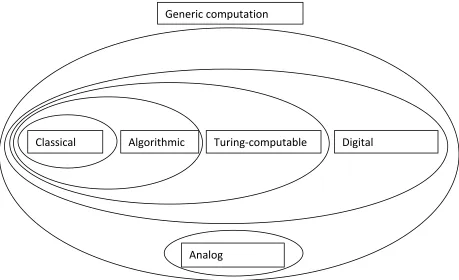
computation’. Whether neural computation is best regarded as a form of digital computation, analog computation, or something else is a difficult question, which we cannot settle here. Instead, we will subsume digital computation, analog computation, and neural computation under the banner of ‘generic computation’ (Figure 2).
While digits are unambiguously distinguishable vehicles, other vehicles are not so. For instance, concrete analog computers cannot unambiguously distinguish between any two portions of the continuous variables they manipulate. Since the variables can take any real values but there is a lower bound to the sensitivity of any system, it is always possible that the difference between two portions of a continuous variable is small enough to go undetected by the system. From this it follows that the vehicles of analog computation are not strings of digits. Nevertheless, analog computations are only sensitive to the differences between
portions of the variables being manipulated, to the degree that they can be distinguished by the system. Any further physical properties of the media implementing the variables are irrelevant
10
13
to the computation. Like digital computers, therefore, analog computers operate on medium-independent vehicles.
Finally, current evidence suggests that the vehicles of neural processes are neuronal spikes and that the functionally relevant aspects of neural processes are medium-independent aspects of the spikes—primarily, spike rates. That is, the functionally relevant aspects of spikes may be implemented either by neural tissue or by some other physical medium, such as a silicon-based circuit. Thus, spike trains appear to be another case of medium-independent vehicle, in which case they qualify as proper vehicles for generic computations. Assuming that brains process spike trains and that spikes are medium-independent vehicles, it follows by definition that brains perform computations in the generic sense.
In conclusion, generic computation includes digital computation, analog computation, neural computation (which may or may not correspond closely to digital or analog
computation), and more.
Figure 2. Types of generic computation and their relations of class inclusion. Neural computation is not represented because where it belongs is controversial.
3.3 Semantic vs. Non-Semantic Computation
So far, we have taxonomized different notions of computation according to how broad they are, namely, how many processes they include as computational. Now we will consider a second dimension along which notions of computation differ. Consider digital computation. The digits are often taken to be representations, because it is assumed that computation requires representation [68]. A similarly semantic view may be taken with respect to generic computation.
One of us has argued at length that computation per se, in the sense implicitly defined by the practices of computability theory and computer science, does not require
representation, and that any semantic notion of computation presupposes a non-semantic notion of computation [32, 50]. Meaningful words such as ‘avocado’ are both strings of digits
and representations, and computations may be defined over them. Nonsense sequences such as ‘#r %h@’, which represent nothing, are strings of digits too, and computations may be defined over them just as well.
Although computation does not require representation, it certainly allows it. In fact, generally, computations are carried out over representations. For instance, usually the states manipulated by ordinary computers are representations.
14
To maintain generality, we will consider both semantic and non-semantic notions of computation. In a nutshell, semantic notions of computation define computations as operating over representations. By contrast, non-semantic notions of computation define computations without requiring that the vehicles being manipulated be representations.
Let us take stock. We have introduced a taxonomy of varieties of computation (Figure 3). Within each category, we may distinguish a semantic notion of computation, which presupposes that the computational vehicles are representations, and a non-semantic one, which doesn’t.11
Figure 3. Types of computation and their relations of class inclusion. Once again, neural computation is not represented because where it belongs is controversial.
3.4 Computationalism, Classicism, and Connectionism Reinterpreted
The distinctions introduced so far shed new light on the longstanding debates on computationalism, classicism, and connectionism/computational neuroscience.
Computationalism, we have said, is the view that cognition is computation. We can now
11
One terminological caveat. Later on, we will also speak of semantic notions of information. In the case of non-natural semantic information, by ‘semantic’ we will mean the same as what we mean here, i.e., representational. A representation is something that can mis-represent, i.e., may be unsatisfied or false. In the case of natural information, by ‘semantic’ we will mean something weaker, which is not representational because it cannot mis-represent (see below).
Generic computation
Digital Turing-computable
Algorithmic Classical
15
appreciate that this may mean at least two different things: (i) cognition is digital computation, and (ii) cognition is computation in the generic sense. Let us consider them in reverse order.
If ‘computation’ means generic computation, i.e., the processing of medium-independent vehicles according to rules, then computationalism becomes the claim that cognition is the manipulation of medium-independent vehicles according to rules. This is not a trivial claim. Disputing ‘generic computationalism’ requires arguing that cognitive capacities depend in an essential way on some specific physical property of cognitive systems other than those required to distinguish computational vehicles from one another. For instance, one may argue that the processing of spike rates by neural systems is essentially dependent on the use of voltages instead of other physical properties to generate action potentials. Without those specific physical properties, one may propose, it would be impossible to exhibit certain cognitive capacities.
Something along these lines is sometimes maintained for phenomenal consciousness, due to the qualitative feel of conscious states [e.g., 69]. Nevertheless, many cognitive scientists maintain that consciousness is reducible to computation and information processing [cf. 70]. Since we lack the space to discuss consciousness, we will assume (along with mainstream cognitive scientists) that if and insofar as consciousness is not reducible to computation in the generic sense and information processing, cognition may be studied independently of
consciousness. If this is right, then, given that cognitive processes appear to be implemented by spike trains and that spike trains appear to be medium-independent, we may conclude that cognition is computation in the generic sense.
If ‘computation’ means digital computation, i.e., the processing of strings of digits according to rules, then computationalism says that cognition is the manipulation of digits. As we saw above, this is what McCulloch and Pitts [43] argued. Importantly, it’s also what both classical computational theories and many connectionist theories of cognition maintain. Finally, this view is what most critics of computationalism object to [1, 3]. Although digital computationalism encompasses a broad family of theories, it is a powerful thesis with considerable explanatory scope. Its exact explanatory scope depends on the precise kind of digital computing systems that cognitive systems are postulated to be. If cognitive systems are digital computing systems, they may be able to compute a smaller or larger range of functions depending on their precise mechanistic properties.12
Let us now turn to another debate sometimes conflated with the one just described, namely the debate between classicists and connectionists. By the 1970s, McCulloch and Pitts were mostly forgotten. The dominant paradigm in cognitive science was classical (or symbolic) AI, aimed at writing computer programs that simulate intelligent behavior without much concern for how brains work [9]. It was commonly assumed that digital computationalism is committed to classicism, that is, the idea that cognition is the manipulation of linguistic, or sentence-like, structures. On this view, cognition consists of performing computations on sentences with a logico-syntactic structure akin to that of natural languages, but written in the language of thought [71, 72].
16
It was also assumed that, given digital computationalism, explaining cognition is an autonomous activity from explaining the brain, in the sense that figuring out how the brain works tells us little or nothing about how cognition works: neural descriptions and
computational descriptions are at “different levels” *72, 73].
During the 1980s, connectionism re-emerged as an influential approach to psychology. Most connectionists deny that cognition is based on a language of thought and affirm that a theory of cognition should be at least “inspired” by the way the brain works *17+.
The resulting debate between classicists and connectionists [e.g., 10, 18] has been somewhat confusing. Part of what’s confusing about it is that different authors employ different notions of computation, which vary in both their degree of precision and their
inclusiveness (see [30] for more details). But even after we factor out differences in notions of computation, further confusions lie in the wings.
Digital computationalism and neural network theories are often described as being at odds with one another. This is because it is assumed that digital computationalism is
committed to classical computation (the idea that the vehicles of digital computation are language-like structures) and to autonomy from neuroscience, two theses flatly denied by many prominent connectionists and computational neuroscientists. But many connectionists also model and explain cognition using neural networks that perform computations defined over strings of digits, so perhaps they should be counted among the digital computationalists [15-17, 19, 74-77]. To make matters worse, other connectionists and computational
neuroscientists reject digital computationalism—they maintain that their neural networks, while explaining behavior, do not perform digital computations [1-3, 5, 7, 78].
In addition, the very origin of digital computationalism calls into question the
commitment to autonomy from neuroscience: McCulloch and Pitts initially introduced digital computationalism based on neurophysiological evidence. Furthermore, some form of
computationalism or other is now a working assumption of many neuroscientists, and nothing in the notion of digital computation commits us to conceiving of its vehicles as language-like.
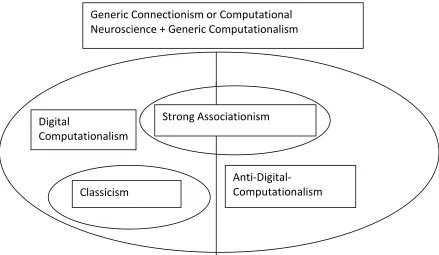
To clarify this debate, we need two separate distinctions. One is the distinction
between digital computationalism (“cognition is digital computation”) and its denial (“cognition is something other than digital computation”). The other is the distinction between classicism (“cognition is digital computation over linguistic structures”) and
connectionist/neurocomputational approaches (“cognition is computation—digital or not—by means of neural networks”).
We then have two versions of digital computationalism—the classical one (“cognition is digital computation over linguistic structures”) and the connectionist/neurocomputational one (“cognition is digital computation by neural networks”)—standing opposite to the denial of digital computationalism (“cognition is a kind of neural network processing that is not digital computation”). This may be enough to accommodate most views in the current debate. But it still doesn’t do justice to the relationship between classicism and
connectionist/neurocomputational approaches.
A further wrinkle in this debate derives from the ambiguity of the term ‘connectionism’. In its original sense, connectionism says that behavior is explained by the changing
17
associationism, according to which behavior is explained by the association between stimuli and responses. Associationist connectionism adds to behaviorist associationism a biological mechanism to explain the associations: the mechanism of changing connections between neurons.
But contemporary connectionism and computational neuroscience are less restrictive than associationist connectionism. In its most general form, contemporary connectionism and computational neuroscience simply say that cognition is explained (at some level) by neural network activity. But this is a truism—or at least it should be. The brain is the organ of
cognition, the cells that perform cognitive functions are (mostly) neurons, and neurons perform their cognitive labor by organizing themselves into networks. Modern connectionism in this sense is little more than a platitude.
The relationship between connectionist and neurocomputational approaches on one hand and associationism on the other is more complex than many suppose. We should distinguish between strong and weak associationism. Strong associationism maintains that association is the only legitimate explanatory construct in a theory of cognition [cf. 81, p. 27]. Weak associationism maintains that association is a legitimate explanatory construct along with others such as the innate structure of neural systems.13
To be sure, some connectionists profess strong associationism [e.g., 14, p. 387]. But that is beside the point, because connectionism per se is consistent with weak associationism or even the complete rejection of associationism. Some connectionist models do not rely on association at all—a prominent example being the work of McCulloch and Pitts [43]. And weak associationism is consistent with many theories of cognition including classicism. A vivid illustration is Alan Turing’s early proposal to train associative neural networks to acquire the architectural structure of universal computing machines *82, 83+. In Turing’s proposal,
association may explain how a network acquires the capacity for universal computation (or an approximation thereof), while the capacity for universal computation may explain any number of other cognitive phenomena.
Although many of today’s connectionists and computational neuroscientists emphasize the explanatory role of association, many of them also combine association with other
explanatory constructs, as per weak associationism [cf. 77, p. 479; 84, pp. 243-5; 85, pp. xii, 30]. What remains to be determined is which neural networks, organized in what way, actually explain cognition and which role association and other explanatory constructs should play in a theory of cognition.
To sum up, everyone is (or should be) a connectionist or computational neuroscientist in the general sense of embracing neural computation, without thereby being committed to either strong or weak associationism. Some people are classicists, believing that in order to explain cognition, neural networks must amount to manipulators of linguistic structures. Some people are non-classicist (but still digital computationalist) connectionists, believing that cognition is explained by non-classical neural network digital computation. Finally, some people are anti-digital-computationalist connectionists, believing that cognition is explained by neural network processes, but these do not amount to digital computation (e.g., because they
13
18
process the wrong kind of vehicles). To find out which view is correct, in the long run the only effective way is to study nervous systems at all levels of organization and find out how they produce behavior (Figure 4).
Figure 4. Some prominent forms of generic computationalism and their relations.
4. Information
We now turn our attention to the notion of information. Computation and information
processing are commonly assimilated in the sciences of mind. As we have seen, computation is a mongrel concept that comprises importantly different notions. The same is true of
information. Once the distinctions between notions of information are introduced, we will be in a position to consider whether the standard assimilation of information processing and computation is warranted and useful for a theory of cognition.
Information plays a central role in many disciplines. In the sciences of mind, information is invoked to explain cognition and behaviour [e.g., 86, 87]. In communication engineering, information is central to the design of efficient communication systems such as television, radio, telephone networks, and the internet [e.g., 39, 88, 89]. A number of biologists have suggested explaining genetic inheritance in terms of the information carried by DNA sequences [e.g., 90; see also 91-92]. Animal communication theorists routinely characterize non-linguistic communication in terms of shared information [93]. Some philosophers maintain that
information can provide a naturalistic grounding for the intentionality of mental states, namely their being about states of affairs [46, 47]. Finally, information plays important roles in several other disciplines, such as computer science, physics, and statistics.
Generic Connectionism or Computational Neuroscience + Generic Computationalism
Classicism Digital
Computationalism
19
To account for the different roles information plays in all these fields, more than one notion of information is required. In this paper, we distinguish between three main notions of information: Shannon’s non-semantic notion plus two notions of semantic information.
4.1 Shannon information
We use ‘Shannon information’ to designate the notion of information initially formalized by Shannon [39].14 We distinguish between information theory, which provides the formal definition of information, and communication theory, which applies the formal notion of information to engineering problems of communication. We begin by introducing two measures of information from Shannon’s information theory. Later we will discuss how to apply them to the physical world.
Let X and Y be two discrete random variables taking values in AX={a1,…,an} and
AY={b1,…,br} with probabilities p(a1),..,p(an) and p(b1),..,p(br). We assume that p(ai)>0 for all
i=1,..,n, p(bj)>0 for all j=1,..,r,
n
i1p (ai)=1 and r
j1p(bj)=1.
Shannon’s key measures of information are the following: H(X)=- p
i 1 n
(ai)log2p(ai)15
I(X;Y)= r n j i , 1 , 1 i j i 2 j i ) p(a ) b | p(a )log b , p(a
H(X) is called ‘entropy’, because it’s the same as the formula for measuring
thermodynamic entropy; here, it measures the average information produced by the selection of values in AX={a1,…,an}. We can think of H(X) as a weighted sum of n expressions of the form
I(ai)=-log2p(ai). I(ai) is sometimes called the ‘self-information’ produced when X takes the value
ai. Shannon obtained the formula for entropy by setting a number of mathematical desiderata
that any satisfactory measure of uncertainty should satisfy, and showing that the desiderata could only be satisfied by the formula given above.16
14 Shannon was building on important work by Boltzmann, Szilard, Hartley, and others [89]. 15 The logarithm to the base b of a variable x—expressed as log
b x—is defined as the power to which b must be raised to get x. In other words, logb x=y if and only if by=x. We stipulate that the expression 0 logb 0 in any of the addenda of H(X) is equal to 0. Shannon [39, p. 379] pointed out that in choosing a logarithmic function he was following Hartley [94] and added that logarithmic functions have nice mathematical properties, are more useful practically because a number of engineering parameters “vary linearly with the logarithm of the number of possibilities”, and are “nearer to our intuitive feeling as to the proper measure” of information.
16
The three mathematical desiderata are the following: (i) The entropy H should be continuous in the probabilities pi, (ii) The entropy H should be a monotonic increasing function of n when pi=1/n, and (iii) If n=b1+..+bk with bi
positive integer, then H(1/n,…,1/n)=H(b1/n,…,bk/n)+ k
i 1
bi/n H(1/bi,…,1/bi). Shannon further supported his
20
Shannon information may be measured with different units. The most common unit is the ‘bit’.17 A bit is the information generated by a variable, such as X, taking a value ai that has
a 50% probability of occurring. Any outcome ai with less than 50% probability will generate
more than 1 bit; any outcome ai with more than 50% probability will generate less than 1 bit.
The choice of unit corresponds to the base of the logarithm in the definition of entropy. Thus, the information generated by X taking value ai is equal to 1 bit when I(ai)=- log2 pi=1; that is,
when pi =0.5.18
Entropy has a number of important properties. First, it equals zero when X takes some value ai with probability 1. This tells us that information as entropy presupposes uncertainty: if
there is no uncertainty as to which value a variable X takes, the selection of that value generates no Shannon information.
Second, the closer the probabilities p1,..,pn are to having the same value, the higher the
entropy. The more uncertainty there is as to which value will be selected, the more the selection of a specific value generates information.
Third, the entropy is highest and equal to log2 n when X takes every value with the same
probability. This occurs when the “freedom of choice” of the selection process represented by X taking values in {a1,…,an} is maximal.
I(X;Y) is called ‘mutual information’; it is the difference between the entropy characterizing X, on average, before and after Y takes values in AY. Shannon proved that X
carries mutual information about Y whenever X and Y are statistically dependent, i.e., whenever it is not the case that p(ai,bj)=p(ai)p(bj) for all i and j. This is to say that the transfer of mutual
information between two sets of uncertain outcomes AX={a1,…,an} and AY={b1,…,br} amounts to
the statistical dependency between the occurrence of outcomes in AX and AY. Information is
‘mutual’ because statistical dependencies are symmetrical.
Shannon’s measures of information have many applications. The best-known application is Shannon’s own: communication theory. Shannon was looking for an optimal solution to what he called the ‘fundamental problem of communication’ *38, p. 379], that is, the reproduction of messages from an information source to a destination. In Shannon’s sense, any device that produces messages in a stochastic manner can count as an information source or destination.
Shannon distinguished three phases in the communication of messages: (a) the
encoding of the messages produced by an information source into channel inputs, (b) the
transmission of signals across a channel with random disturbances generated by a noise source, (c) the decoding of channel outputs back into the original messages at the destination.
The process is summarized by the following picture of a communication system:
17 Shannon credited John Tukey, a computer scientist at Bell Telephone Laboratories, with introducing the term in a 1947 working paper.
18
21
Figure 5: Shannon’s depiction of a communication system [39]
Having distinguished the operations of coding, transmission and decoding, Shannon developed mathematical techniques to study how to perform them efficiently. Shannon’s primary tool was the concept of information, as measured by entropy and mutual information.
A common misunderstanding of Shannon information is that it is a semantic notion. This misunderstanding is promoted by the fact that Shannon liberally referred to messages as carriers of Shannon information. But Shannon’s notion of message is not the usual one. In the standard sense, a message has semantic content or meaning—there is something it stands for. By contrast, Shannon’s messages need not have semantic content at all—they need not stand for anything.19
We will continue to discuss Shannon’s theory using the term ‘message’, but the reader should keep in mind that the usual commitments associated with the notion of message do not apply. The identity of a communication-theoretic message is fully described by two features: it is a physical structure distinguishable from a set of alternative physical structures, and it
belongs to an exhaustive set of mutually exclusive physical structures selectable with well-defined probabilities.
Under these premises, to communicate a message produced at a source amounts to generating a second message at a destination that replicates the original message so as to satisfy a number of desiderata (accuracy, speed, cost, etc.). The sense in which the semantic aspects are irrelevant is precisely that messages carry information merely qua selectable, physically distinguishable structures associated with given probabilities. A seemingly
paradoxical corollary of this notion of communication is that a nonsense message such as ‘#r %h@’ could in principle generate more Shannon information than a meaningful message such as ‘avocado’.
To understand why, consider an experiment described by a random variable X taking values a1 and a2 with probabilities p(a1)=0.9999 and p(a2)=0.0001 respectively. Before the
experiment takes place, outcome a1 is almost certain to occur, and outcome a2 almost certain
not to occur. The occurrence of both outcomes generates information, in the sense that it resolves the uncertainty characterizing the situation before the experiment takes place.
Shannon’s insight was that the occurrence of a2 generates more information than the
occurrence of a1, because it is less expectable, or more surprising, in light of the prior
probability distribution. This is reflected by the measure of self-information we introduced
22
earlier: I(ai)=-log2p(ai). Given this measure, the higher p(ai) is, the lower I(ai)=-log2p(ai) is, and
the lower p(ai) is, the higher I(ai)=-log2p(ai) is. Therefore, if ‘#r %h@’ is a more surprising
message than ‘avocado’, it will carry more Shannon information, despite its meaninglessness. Armed with his measures of non-semantic information, Shannon proved a number of seminal theorems that had a profound impact on the field of communication engineering. The “fundamental theorem for a noisy channel” established that it was theoretically possible to make the error rate in the transmission of information across a randomly disturbed channel as low as desired up until the point in which the source information rate in bits per unit of time becomes larger than the channel capacity, which is defined as the mutual information maximized over all input source probability distributions.20 Notably, this is true regardless of the physical nature of the channel (e.g., true for electrical channels, wireless channels, water channels, etc.).
Communication theory has found many applications, most prominently in
communication engineering, computer science, neuroscience, and psychology. For instance, Shannon information is commonly used by neuroscientists to measure the quantity of information carried by neural signals about a stimulus and estimate the efficiency of coding (what forms of neural responses are optimal for carrying information about stimuli) [44, Chap. 4; 95]. Now, we move on from Shannon information, which is non-semantic, to semantic information.
4.2 Semantic Information
Suppose that a certain process leads to the selection of signals. Think, for instance, of how you produce words when speaking. There are two dimensions of this process that are relevant for the purposes of information transmission. One is the uncertainty that characterizes the
speaker’s word selection process as a whole—the probability that each word be selected. This is the non-semantic dimension that would interest a communication engineer and is captured by Shannon’s theory. A second dimension of the word selection process concerns what the selection of each word ‘means’ (in the context of a sentence). This would be the dimension of interest, for example, to a linguist trying to decipher a tribal language.
Broadly understood, semantic notions of information pertain to what a specific signal broadcast by an information source means. To address the semantics of a signal, it is neither necessary nor sufficient to know which other signals might have been selected instead and with what probabilities. Whereas the selection of, say, any of twenty-five equiprobable but distinct words will generate the same non-semantic information, the selection of each individual word will generate different semantic information depending on what that particular word means.
Semantic and non-semantic notions of information are both connected with the reduction of uncertainty. In the case of non-semantic information, the uncertainty has to do
20 Shannon defined the channel capacity C as follows: ) (a P
MaxI(X;Y)= ) (a P
Max [H(X)-H(X|Y)]. The conditional entropy is
calculated as follows: H(X|Y)= p(ai,bj)log2
1 p(ai|bj) i 1,j 1
n,r
23
with which among many possible signals is selected. In the case of semantic information, the uncertainty has to do with which among many possible states of affairs is the case.
One of the foundational problems for the sciences of mind is that no uncontroversial theory of semantic information—comparable in rigor and scope to Shannon’s theory—has emerged. This explains the temptation felt in many quarters to appropriate Shannon’s theory of non-semantic information and squeeze into it a semantic story. The temptation is in effect to understand information transmission in terms of reduction of uncertainty, use Shannon’s measures to quantify the information transmitted, and draw conclusions about the meanings of the transmitted signals.
This will not do. As we have stressed, Shannon information does not capture, nor is it intended to capture, the semantic content, or meaning, of signals. From the fact that Shannon information has been transmitted no conclusions follow concerning what semantic information, if any, has been transmitted.
To tackle the meaning relation, we begin with Grice’s distinction between two kinds of meaning that are sometimes conflated, namely, natural and non-natural meaning [96]. Natural meaning is exemplified by a sentence such as ‘those spots mean measles’, which is true—Grice claimed—just in case the patient has measles. Non-natural meaning is exemplified by a
sentence such as ‘those three rings on the bell (of the bus) mean that the bus is full’ [96, p. 85], which is true even if the bus is not full.
We extend the distinction between Grice’s two types of meaning to a distinction between two types of semantic information: natural information and non-natural
information.21 Spots carry natural information about measles by virtue of a reliable physical correlation between measles and spots. By contrast, the three rings on the bell of the bus carry non-natural information about the bus being full by virtue of a convention.22 We will now consider each notion of semantic information in more detail.
4.2.1 Natural (Semantic) Information
When smoke carries information about fire, the basis for this informational link is the physical relation between fire and smoke. By the same token, when spots carry information about measles, the basis for this informational link is the physical relation between measles and spots. Both are examples of natural semantic information.
The most basic task of an account of natural semantic information is to specify the relation that has to obtain between a source (e.g., fire) and a signal (e.g., smoke) for the signal to carry natural information about the source. Following Dretske [46], we discuss natural information in terms of correlations between event types. On the view we propose, an event token a of type A carries natural information about an event token b of type B just in case A reliably correlates with B. (Unlike [46], in addition to natural information we posit non-natural information; see below.)
21 By calling this kind of information non-natural, we are not taking a stance on whether it can be naturalized, that is, reduced to some more fundamental natural process. We are simply using Grice’s terminology to distinguish between two importantly different notions of semantic information. We will briefly discuss the naturalization of non-natural information in Section 4.3.
22
24
Reliable correlations are the sorts of correlations information users can count on to hold in some range of future and counterfactual circumstances. For instance, smoke-type events reliably correlate with fire-type events, spot-type events reliably correlate with measles-type events, and ringing doorbell-type events reliably correlate with visitors at the door-type events. It is by virtue of these correlations that one can dependably infer a fire-token from a smoke-token, a measles-token from a spots-smoke-token, and a visitors-token from a ringing doorbell-token.
Yet correlations are rarely perfect. Smoke is occasionally produced by smoke machines, spots are occasionally produced by mumps, and doorbell rings are occasionally produced by naughty kids who immediately run away. Dretske [46] and most subsequent theorists of natural information have disregarded imperfect correlations, either because they believe that they carry no natural information [49] or because they believe that they do not carry the sort of natural information necessary for knowledge [46]. Dretske [46] focused only on cases in which signals and the events they are about are related by nomically underwritten perfect
correlations.
We consider this situation unfortunate because, although not knowledge-causing, the transmission of natural information by means of imperfect yet reliable correlations is what underlies the central role natural information plays in the descriptive and explanatory efforts of cognitive scientists. In other words, most of the natural information signals carry in real world environments is probabilistic: signals carry natural information to the effect that o is probably G, rather than natural information to the effect that, with nomic certainty, o is G.23
Unlike the traditional (all-or-nothing) notion of natural information, this probabilistic notion of natural information is applicable to the sorts of signals studied by cognitive scientists. Organisms survive and reproduce by tuning themselves to reliable but imperfect correlations between internal variables and environmental stimuli, as well as between environmental
stimuli and threats and opportunities. In comes the sound of a predator, out comes running. In comes the redness of a ripe apple, out comes approaching.
But organisms do make mistakes, after all. Some mistakes are due to the reception of probabilistic information about events that fail to obtain.24 For instance, sometimes non-predators are mistaken for non-predators because they sound like non-predators; or non-predators are mistaken for non-predators because they look like non-predators.
Consider a paradigmatic example from ethology. Vervet monkeys’ alarm calls appear to be qualitatively different for three classes of predators: leopards, eagles, and snakes [97, 98]. As a result, vervets respond to eagle calls by hiding behind bushes, to leopard calls by climbing trees, and to snake calls by standing tall.
A theory of natural information with explanatory power should be able to make sense of the connection between the reception of different calls and different behaviors. To make sense of this connection, we need a notion of natural information according to which types of alarm
23
For a more precise and detailed theory of probabilistic information, see [36, 37]. The probabilistic notion of information we employ includes all-or-nothing natural information—roughly, the natural information that o is G with certainty—as a special, limiting case. For a critique of approaches focusing solely on all-or-nothing natural information, see [99].
![Figure 5: Shannon’s depiction of a communication system [39]](https://thumb-us.123doks.com/thumbv2/123dok_us/8617867.1407575/21.612.107.489.75.163/figure-shannon-s-depiction-communication.webp)
