Flying Object Detection and Classification
Techniques: A Survey
Suresh Arunachalam T, Shahana R, Vijayasri R, Kavitha T B.Tech(CSE) Final Year, Assistant Professor, CSE
Periyar Maniammai Institute of Science & Technology, Thanjavur, INDIA
Abstract
Unmanned Aerial Vehicles (UAVs) are extensively used everywhere in commercial applications such as delivering goods and medicines, taking photographs, and to monitor crowded areas. Sometimes these drones are used for capturing our private information without our knowledge. To avoid misuse of UAVs, we need to detect them in advance before entering into the protected areas. Detecting the UAV is a complex task because it is supplemented by birds, aircrafts, moving clouds, and swaying trees. To prevent this, we will detect the drones by video camera. In this paper, we compare the existing computer vision methods such as background subtraction, frame differencing, optical flow and edge detection for object detection. In our work, we will use Convolutional Neural Network for both object detection and classification to enhance its performance.
Keywords - Unmanned Aerial Vehicles, Computer Vision, Background Subtraction, Frame Differencing, Optical Flow, Edge detection, Convolutional Neural Networks.
I. INTRODUCTION
Flying object detection is done by extracting the moving objects from a video sequence. There are various methods have been proposed such as, the background subtraction, the frame differencing, optical flow method, and edge detection.
Background subtraction is a method which is widely used for detecting foreground objects from the background in video sequence. It is calculated by subracting the current frame from the reference frame, called “background image”. Its performance always depends on the quality of background modeling. The advantage of this method is fast and accurate detection and easy to implement. It is not applicable for moving camera because each and every frame will have a different background.
Frame Differencing is used to extract the moving object which is based on calculating the difference between current frame and previous frame in video sequence. The advantages of the frame difference
unable to find the internal pixels of enormous size, with uniformly distributed intensity values.
Optical flow method is a common method for objects detection. The optical flow method detects the objects based on the relative velocity of objects in the scene. Although this method adapts to moving objects detection, the complicated calculation makes it not applicabe for real-time detection.
Edge detection method converts the original images into edge images by examinning the changes of intensity values in the image. The edges are extracted from the video based on the features like edge, curve, straight lines and this is able to detect the objects.
II. RELATED WORKS
In paper[1], they discussed UAV detection framework is based on video images and they capture either by static camera or moving camera. Detection by static camera involves background subtraction. Moving camera based detection done by Region Proposal Neural Network. UAV is detected based on confident value of UAV detection. By using RPN, the number of false positive will be reduced which leads to be an early warning detection system. In there future work, they will use temporal information to increase the accuracy.
Paper[2], focuses on detecting moving objects in image sequences produced by stationary camera.An edge tracker is a method which is used to extract edge traces on the drone. It is robust and fast method for detecting moving objects. Moving objects are detected by computing the difference between the edge-trace flows in consecutive frames. Pairs of consecutive images are processed and perceptual edge segments are found piece by piece.
the real images. By this approach we can get high precision and recall value at the same time. In future, they will use time domain to improve the performance.
CNN method which are capable of solving the optical flow estimation problem are discussed in [5]. Since existing sets are not sufficiently large to train a CNN, they generated a large synthetic Flying Chairs dataset. The networks trained on this paper is unrealistic data set. When comparing with Deep flow and Epic flow CNN performed well on this data set. In future work, they will try for realistic training data set.
Background subtraction method is handled in [6]. Objects are detected by PTZ camera. By using the data of two consecutive images previous and upcoming rotation new background will be created for the detection of moving objects. This method achieved the object detection for single moving object. In future they will choose a multiple moving object detection.
In[7] authors discussed region shrinking algorithm. The region with high density of motion pixels is approached by region shrinking algorithm to detect the moving objects. An image power transformation is adopted to enhance objects at different position. The
method needs no prior knowledge of the number of moving object and it is robust to noise.
Detecting moving objects is achieved by the background subraction algorithm[8]. The current frame is subtracted from the reference frame. They analyzed different background subtraction algorithms like Data Validation, Foreground Detection, Background Modelling and Preprocessing.
[9] focused on CNN method to detect moving object. Zeiler and Fergus (ZF), Visual Geometry Group (VGG16) are CNN architecture. In training data set VGG 16 perform well when comparing with faster R-CNN. The Data set contains both drone and bird images. The results can be improved if the birds are also annotated. By considering bird as a separate class will reduce false positives. Then the trained model will be able to identify birds and drones.
Paper[10] focused on two techniques. Back ground subtraction algorithm to get background model and frame differencing algorithm to update it. Then extracts the moving objects from the fusion of images extracted from these two methods. The moving object used in the video are bees they are very small in size and always fly in high speed. To get more moving information the circle segmentation dynamic threshold is used.
III. COMPARISON OF VARIOUS METHODS
Reference Methodology Description Limitations
[1] Background Subtraction + Region Proposal Network
Background Subtraction is used to identify moving objects. It is done by finding the difference between the current frame and background key model.
Region Proposal Network consists of set of candidate regions that consists of object are produced for every individual frames.
Background Subtraction is only applicable for short sequence length. It is only suitable for static camera.
[2] Edge Detection
Edge detection reduces the data and filters the useless information present in an image. It is implemented by GCS and CPP algorithm. GCS consists of curve points.
[3] YOLO Detection System
YOLO can process an images at the speed of 45 frames per second and Fast YOLO can process an image astonishing 155 frames per second.
YOLO unable to find small objects that appear in group like flocks of birds.
It learn to predict bounding box from the data, it is not suitable to identify objects in unusual configuration.
[4] Deep Networks
YOLOv2 attemp to design regression for object detection. Fully convolutional architecture are trained to extract the high level features in an image. It aims to find bounding boxes of an object in the video sequence directly, replacing the dealing with regions in the video sequence.
It require larger dataset that can include many scenario for high accuracy.
[5] Convolutional Neural Networks
They introduce correlation layer that works by multiplicative patch comparison in between feature maps.
It is only applicable for GPU.
[6] Background Subtraction
PTZ (Pan, Tilt, Zoom) camera is used to detect the moving object because it provide broad vision and more information. Mean filter algorithm is used to build the initial background model.
It is not applicable for moving cameras due to initialization of background model.
[7] Region Shrinking Algorithm
They introduced power transformation method before region shrinking to solve limitation of situation that there is a single object in an image.
___
[8] Background Subtraction
The main role of background modelling is to track the changes in background scene and extract the foreground information.
It is unable to process the moving camera videos due to the background key frames.
[9] Faster RCNN
In this method Caffe deep learning library is used to detect the objects. These are publically available for most of the models and it requires less amount of data set for deep learning system to train from basic. They have used ZF and VGG16 architecture to train their system.
They have used only drone dataset so there is a possible for false positive.
Background subtraction + frame
For getting background model its uses surendra background algorithm and uses frame differencing
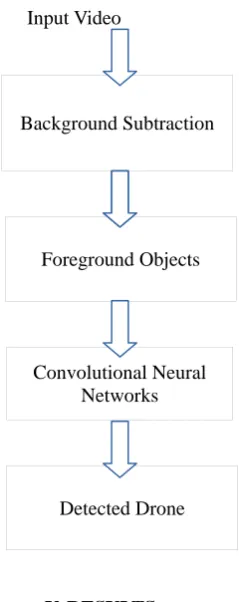
IV. BLOCK DIAGRAM
Input Video
Background Subtraction
Foreground Objects
Convolutional Neural Networks
Detected Drone
V. RESULTS
Comparison of Background Subtraction, Frame Differencing, Optical Flow and Edge Detection
Fig. 1 Original Video Sequence
Fig. 2 Background Subtraction
Fig. 3 Frame Differencing
Fig. 5 Edge Detection
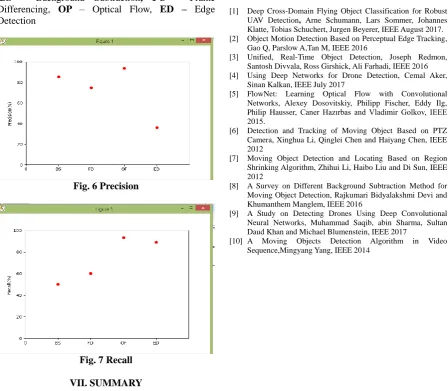
VI. PERFORMANCE MEASURES
BS – Background Subtraction, FC – Frame Differencing, OP – Optical Flow, ED – Edge Detection
Fig. 6 Precision
Fig. 7 Recall
VII. SUMMARY
for static camera due to initialization of background model. Frame Differencing, Optical Flow and Edge Detection are applicable to both static and moving cameras. YOLO based detection can process an images at the speed of 45 frames per second and Fast YOLO can process an image at the speed of 155 frames per second, but Fast YOLO will not give an accurate result compared to YOLO detection method.
VII. CONCLUSION
The existing object detection methods such as Background Subtraction, Frame Differencing, Optical Flow, and Edge Detection algorithms are suitable for detecting objects flying at a particular distance, either in a clear or in a slightly blurred background. From the results, the background subtraction method is suitable for videos taken by static camera and gives better results than the other methods.
REFERENCES
[1] Deep Cross-Domain Flying Object Classification for Robust
UAV Detection, Arne Schumann, Lars Sommer, Johannes
Klatte, Tobias Schuchert, Jurgen Beyerer, IEEE August 2017.
[2] Object Motion Detection Based on Perceptual Edge Tracking,
Gao Q, Parslow A,Tan M, IEEE 2016
[3] Unified, Real-Time Object Detection, Joseph Redmon,
Santosh Divvala, Ross Girshick, Ali Farhadi, IEEE 2016
[4] Using Deep Networks for Drone Detection, Cemal Aker,
Sinan Kalkan, IEEE July 2017
[5] FlowNet: Learning Optical Flow with Convolutional
Networks, Alexey Dosovitskiy, Philipp Fischer, Eddy Ilg, Philip Hausser, Caner Hazırbas and Vladimir Golkov, IEEE 2015.
[6] Detection and Tracking of Moving Object Based on PTZ
Camera, Xinghua Li, Qinglei Chen and Haiyang Chen, IEEE 2012
[7] Moving Object Detection and Locating Based on Region
Shrinking Algorithm, Zhihui Li, Haibo Liu and Di Sun, IEEE 2012
[8] A Survey on Different Background Subtraction Method for
Moving Object Detection, Rajkumari Bidyalakshmi Devi and Khumanthem Manglem, IEEE 2016
[9] A Study on Detecting Drones Using Deep Convolutional
Neural Networks, Muhammad Saqib, abin Sharma, Sultan Daud Khan and Michael Blumenstein, IEEE 2017
[10] A Moving Objects Detection Algorithm in Video