INTERNATIONAL JOURNAL OF PHARMACEUTICAL, CHEMICAL AND BIOLOGICAL SCIENCES
Available online at
www.ijpcbs.com
DEVELOPMENT AND VALIDATION OF A RP-HPLC METHOD FOR
IDENTIFICATION AND ESTIMATION OF GALLIC ACID AND
PROTOCATECHUIC ACID IN TRIGASORNMAS RECIPE
S. Settharaksa
1*, P. Pathompak
1, W. Saingam
1, F. Madaka
1,
K. Chakree
2and L. Charoenchai
11
Sino-Thai Traditional Medicine Research Center,
(
Cooperation between Rangsit University and
Harbin Institute of Technology and Heilongjiang University of Chinese Medicine
)
, Faculty of
Pharmacy, Rangsit University Pathumthani, Thailand - 12000.
2
Nutraceutical and Functional Food Research and Development Center, Prince of Songkla
University, Hat-Yai, Songkhla, Thailand - 90112.
INTRODUCTION
Tradition medicines are in high demand in the developed as well as developing countries for primary healthcare because of their safety and efficacies. About 80% of the world’s population depends wholly or partially on traditional medicine for its primary health care needs1. Thai tradition medicines are still used for primary health care in Thailand because it shown therapeutic effect and fewer side effects2. In Thailand, there are than 3,000 tradition healers and many herbal recipes are in current use but these herbal recipes have never been investigated. The quality control of herbal medicine that is, the profile of the constituents in the final product has
implications in efficacy and safety. Due to the complex nature and variability of the chemical constituents of the plant base drugs, it is difficult to establish quality control parameters and modern analytical technique like HPLC and HPTLC are expected to help in circumventing this problem3. Trigasornmas recipe is one of the Thai tradition herbal recipes. It was used and recorded in National drug list 2013. This formula is used for fatigue and periodic adjustment in patients recovering from illness such as fever and diarrhea. The word Trigasornmas recipe means a mixture of three plant and thus the preparation is a compose mixture of medical herb, Coral plant (Jatropha multifida L.), lotus stamen (Nelumbo nucifera
Research Article
ABSTRACT
A simple, precise, accurate RP-HPLC method was developed for the quantitative estimation of gallic acid and protocatechuic acid in Trigasornmas recipe. The separation was accomplished with a column RP-C18 (250 mm x 4.6 mm x 5 micron) using a gradient of acetonitrile and 0.1% acetic acid in water as the mobile phase, with a flow rate was set to 0.9 mL /min and injection volume of 20 µL, analysis was screened with UV detector at 280 nm. The retention time for standard gallic acid was found at 9.28±0.05 minute and for the protocatechuic acid was found at 17.67±0.03 minute. Calibration curve was linear over the concentration range 1.56-100 µg/mL. Correlation coefficient (r2) was 1.0000. The proposed method was validated for linearity, accuracy, selectivity, precision, LOD and LOQ. The proposed RP-HPLC method was found to be simple, precise, accurate and can be used for the quality control of the raw material as well as its formulation.
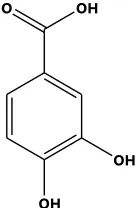
Gaerth) and Bael fruit (Aegle marmelos(L.) Corr) in equal proportions. It contains enormous amount of phenolic acid such as gallic acid (Figure 1)
which was a strong antioxidant and protocatechuic acid (Figure 2) which gallic acid derivatives have also been found in many phytomedicines with a number of biological and pharmacological activities like inducing apoptosis of cancer cells4, inhibiting squalene epoxidase and interfering the signal pathways involving Ca2+ (II) and oxygen free radicals5. In addition, protocatechuic acid is widely distributed naturally occurring phenolic acid which is a well-known antioxidant compound. More than 500 plants contain protocatechuic acid as active constituents imparting various pharmacological activity and these effects are due to their antioxidant activities, along with other possible mechanisms, such as anti-inflammatory properties and interaction with several enzymes6. It is required to maintain their quality and purity for safety and efficacy. Therefore, the present study was aimed to validate a HPLC method to exploit for the standardization of Trigasornmas recipe using polyphenols as markers an attempt to compare and evaluate between the main component in the laboratory Trigasornmas recipe and the commercial product by using analytical HPLC technique. OH OH OH O HO
Fig. 1: Chemical structure of gallic acid
OH
OH OH O
Fig. 2: Chemical structure Protocatechuic acid
MATERIALS AND METHODS Materials
Trigasornmas recipe and its individual components were purchased from Traditional pharmacies in Bangkok, Thailand. Standard gallic acid and protocatechuic acid were purchased from Sigma-Aldrich (USA). HPLC grade methanol, hydrochloric acid, acetonitrile were obtained from Merck (Darmstadt, Germany).
Instrument
Analysis were performed on HPLC – UV of Agilent 1260 series system (Agilent Technology, USA)
with diode array detector (DAD) and EZChrom operation software. Separation was carried out using a RP-HPLC method employing a C18, Zorbax SB column (250 mm x 4.6 mm x 5 micron)
protected by a guard containing the same packing. The column was maintained at 25o C throughout the analysis and detection was monitored at 280 nm.
Standard preparation
The content of the gallic acid and protocatechuic acid were investigated using calibration curve established with six dilution of each standard, at concentration range from 1.56-100 μg/mL. Gallic acid and protocatechuic acid (10 mg each) were weighed accurately and transferred to separate 10 ml volumetric flasks. Both standards were dissolved in 10 ml water to prepare standard stock solution of 1,000 μg/mL. Each concentration was measured in triplicate. Peak identification was achieved by comparison of both the retention time (RT) and UV absorption spectrum for standard.
Sample preparation
The Trigasornmas recipe consists of Coral plant (Jatropha multifida L.), lotus stamen (Nelumbo nucifera Gaertn), and Bael fruit (Aegle marmelos
(L.) Corr). Each ingredient (30 g) were mixed ground and homogenized with methanol and stirred for 12 h in dark room. The mixture was filtered and supernatant was collected to dry in vacuo to give residues of methanol. The extraction is kept in sterile bottle and stored at room temperature for HPLC analysis.
Method validation
gallic acid and protocatechuic acid by the propose method in the concentration range 1.56-100 μg/mL. Precision assessed by measurement of intraday and inter day. In the intraday study the concentration of both were calculated three times on the same day at intervals of 1 h. The accuracy of the proposed method was determined by a recovery study, which was carried out by adding standard markers in the Trigasornmas recipe extract. The samples were spiked with three different amounts of standard compounds prior to extraction. The spiked samples were extracted in triplicate and analyzed under the previously established optimal condition. The obtained average contents of the target compounds were used as the actual values in order to calculate the spike recoveries. Selectivity and specificity of the method were assessed by injecting solutions containing both the standard; after chromatography two sharp peaks were obtained for both standards. The mean amounts and SD value of each constitute were calculated. The LOD and LOQ of marker compounds were calculated at signal-to-noise of approximate 3: 1 and 10: 1 respectively.
RESULTS
Optimization of the HPLC condition
The chromatographic condition was optimized after running different mobile phase through C18 reverse phase column with a wavelength of 280 nm. It is an acceptable response and enables the detection of compounds used in this study. The column was used at 25o C. Elution was carried out at a flow rate of 0.9 ml/min with acetic acid in water (0.1%) as solvent A and acetonitrile as solvent B using gradient elution in 0-15 min with 100-95% A, 15-25 min with 95-95% A. Each run was followed by a 2 hours with 80% water and 20% acetonitrile, vary with 1 hour for 50% water and 50% acetonitrile, finally keep column with 100% acetonitrile about 20 min. HPLC chromatogram of standard gallic acid and protocatechuic acid as shown in Figure 3 and Figure 4.
Quantification of marker present in Trigasornmas recipe
The calibration curve was drawn for concentration and area under curve of gallic acid
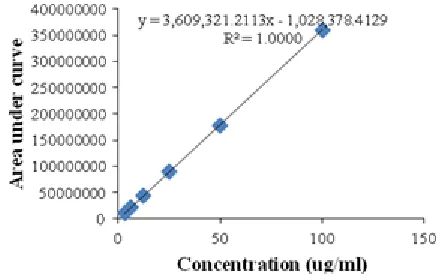
(Figure 5) and that of protocatechuic acid (Figure 6). The results were also quantified with respected to the standard in Table 1.
Method validation for HPLC fingerprinting A linearity relationship was observed from calibration curve of gallic acid and protocatechuic acid standard over concentration range of 1.56-100 µg/mL. Regression analysis showed that the method had a correlation coefficient (r2) of 1.0000 and a linear equation y = 7,615,713.57x+2,968,419.88 for gallic acid and y = 3,609,321.21x+1,028,378.41for protocatechuic acid, where y was the peak area and x was the standard concentration in µg/mL. The signal-to-noise ratio of 3:1 and 10:1 was used to establish LOD and LOQ, respectively. The LOD and LOQ of gallic acid were 0.075 µg/mL and 0.019 µg/mL and protocatechuic acid was 0.25 µg/mL and 0.0625 µg/mL, respectively. The intra-day and inter-day precision of the proposed method was determined. The % RSD for intra-day and inter-day precision for gallic acid were 0.8856% and 0.7630%, respectively and protocatechuic acid were 1.961% and 0.760%, respectively which showed in Table 2.
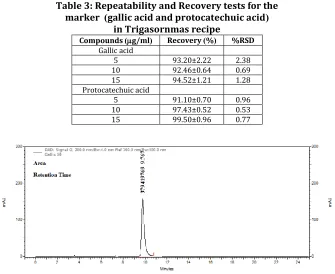
Accuracy of the method was studied using the method of standard addition. Standard gallic acid and protocatechuic acid solution were added to the extract of the Trigasornmas recipe and the percent recovery was determined at three different concentrate level 5, 10, 15 µg/mL. Gallic acid and protocatechuic acid content was determined as percent recovery and % RSD. The results are shown in Table 3.
CONCLUSION
The application of a simple, rapid and accurate HPLC method for the quantitation of gallic acid and protocatechuic acid in Trigasornmas recipe was developed. The results indicate that Trigasornmas recipe contains gallic acid and protocatecuic acid that may be responsible for its therapeutic activity. The developed RP-HPLC method will be useful for the standardization of Trigasornmas recipe using gallic acid and protocatecuic acid. The method was found to be simple, precise, accurate, specific and sensitive and can be used for routine quality control of herbal raw materials and for the quantification of these compounds in plant material.
ACKNOWLEDGEMENTS
chemicals and instruments. Foundation project
was supported by the Research Institute of Rangsit University, PathumThani, Thailand (Grant No. 67/56).
Table 1: Quantification of gallic acid and protocatechuic acid in Trigasornmas recipe and its gradient by HPLC
Samples Amount
Gallic acid
(g/ml)
Protocatechuic acid
(g/ml)
Market sample 1 2.08±0.13 3.60±0.16 Market sample 2 5.57±1.16 11.47±0.02 Laboratory 1.07±0.10 2.25±0.10
Aegle marmelos L. 1.95±0.05 1.68±0.02
Jatropha multifida L. - 3.37±0.05
Nelumbo nucifera Gaertn. 5.25±0.16 1.54±0.03
Table 2: Method validation summary
Parameters Gallic acid Protocatechuic acid
Linearity range (µg mL-1) 1.56-100 1.56-100 Slope (m)a)
Retention time 7,615,713.57 9.28±0.05 3,609,321.21 17.67±0.03 Intercept (c)a) 2,968,419.88 1,028,378.41
Correlation coefficient (R) 1.0000 1.0000 LOD (µg mL-1) 0.075 0.25 LOQ (µg mL-1) 0.019 0.0625 Intra-day precision (%RSD) 0.8856 1.961 Inter-day precision (%RSD) 0.7630 0.760
a)of the equation y=mx+c, where y is peak area, m is the slope, x is the concentration and c is the intercept
Table 3: Repeatability and Recovery tests for the marker (gallic acid and protocatechuic acid)
in Trigasornmas recipe
Compounds (g/ml) Recovery (%) %RSD Gallic acid
5 93.20±2.22 2.38 10 92.46±0.64 0.69 15 94.52±1.21 1.28 Protocatechuic acid
5 91.10±0.70 0.96 10 97.43±0.52 0.53 15 99.50±0.96 0.77
Fig. 4: HPLC chromatogram for standard protocathechuic acid
Fig. 5: HPLC chromatogram for standard gallic acid
REFERENCES
1. Gangadhar M, Shraddha K and Ganesh M. Antimicrobial screening of garlic (Allium sativum) extracts and their effect on glucoamylase activity in vitro. J Appy Pharm Sci. 2012;2(1):106-8.
2. Islam F, Sameem M and Ansari S. Influence of nanotechnology on herbal drug: A review. J Adv Pharm Technol Res. 2012;3(3):142-6.
3. Madhavi P, Vishal PR and Rakesh PK. Development and validation of imploved RP-method for identification and estimation of ellagic acid and gallic acid in
Triphala chuna. Int J Chemtech Res. 2010;2(3):1486-93.
4. Serrano A, Papacios C, Roy G, Cespon C, Villar ML, Nocito M and Gonzalez-Porque
P. Derivatives of gallic acid induce apoptosis in tumoral cell lines and inhibit lymphocyte proliferation. Arch Biochem Biophys. 1998;350:49-54.
5. Inoue M, Sakaguchi N, Isuzugawa K, Tani H and Ogihara Y. Role of reactive oxygen species in gallic acid-induced apoptosis. Biol Pharm Bull. 2000;23:1153-57. 6. Kakkar S. and Bais S. A review on
protocatechuic acid and its pharmacological potential. Hindawi Publishing Corporation. 2014:1-10. 7. International Conference on