Vo1. 5, No. 1, 2017, 1-10 DOI: 10.11634/232907811705843
Print ISSN 2329-0781 - Online ISSN 2329-079X│© 2017 The Author(s) Published by World Scholars │http://www.worldscholars.org
Feedback for Effective Learning: Stumbling Blocks/ Learning Barriers
in Communication between Learning and Teaching
Mukti Ashu Pragya Sharma, PhD
1and Deepti Sharma, PhD
21Khawarizmi International College, General Education Department, Abu Dhabi, UAE 2BML Munjal University, English Department, India
Feedback is an integral part of communication. It renders an opportunity to evaluate the success of communication. In case of classroom learning, feedback plays an important role as it makes the learning process smooth. It is effec-tive for students and teachers in analyzing the performance and designing the teaching methodology. The feedback given by teachers to the students about their work and performance is equally important to the feedback given by students about their understanding regarding the topic taught by the teachers. The importance of feedback is widely known and it covers students’ motivation, their willingness to prove themselves and their confidence in the learning process. It is also required to identify and evaluate the barriers in communication between the teachers and the students. To accomplish this purpose a well-structured survey was conducted based on Likert Scale, covering sixty five students. Major findings of the survey are: 1- Students showed lack of interest in open interaction in the class 2- Non-native English speaking students felt language as a barrier 3-Students felt difficulties in understanding the content 4-Students faced problems to understand the instructions given by the teacher. The stumbling blocks that affect the feed-back process should be effectively removed to provide solution to help both students and teachers to communicate well. Two way feedback is important in continuous improvement in teaching and learning. Teacher and students’ feedback to each other not only enhances the learning of students but it also improves the teaching methodology based on the feedback provided. Mixed Research Methodology was followed to write the paper.
Key Words: Feedback, communication, learning barriers, motivation, learning enhancement, two way communica-tion, teaching methodology
Introduction
Communication is the most effective channel to con-nect to different people. It is a two way process in which both the sender and the receiver play a vital role to proceed an effective communication. We can ob-serve this happening in our day to day communication. Ordinarily, there are two persons or two point interac-tion wherein the messages flow back and forth. Com-munication occurs between the teachers and students in the educational environment (Büsra & Delice, 2016).It is the whole process of idea transfer between the sender and receiver that affects and results in the receiver’s understanding of the meaning of the mes-sage delivered. The purpose of any communication is to send the message to the receiver in the most con-crete manner to establish perfect understanding of the idea or thought between two people who communi-cate. According to Omrcen, (2008) communication is the first point of the knowledge acquisition and a leads to passing ideas, message, information etc. Clarity is an essential pre requisite of any communication. The sender should be attentive and vigilant to observe
whether his/ her message has been delivered to the lis-tener without any confusion or misunderstanding. Communication is more than just speaking and listen-ing it is complete only when the intended meanlisten-ing is properly received and makes the sender believe that he has been understood fully.
If we go back in ancient times we see that com-munication was the study of rhetoric. The purpose of communication was to convince people to persuade them through oratory and public speaking. As Cross-white ,2013 quoted an ancient Greek rhetorician Isoc-rates who wrote in his famous Antidosis, ‘Because there has been implanted in us the power to persuade each other and to make clear to each other whatever we desire, not only have we escaped the life of wild beasts, but we have come together and founded cities
Corresponding author: Dr. Mukti Ashu Pragya Sharma, Assis-tant Professor, Khawarizmi International College, Abu Dhabi, UAE, Email- [email protected]
and made laws and invented arts; and, generally speak-ing, there is no institution devised by man which the power of speech has not helped us to establish.’
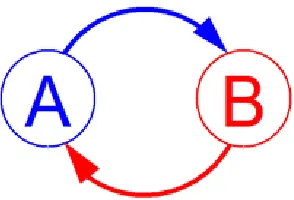
The two major and basic questions are being con-stantly investigated by the educators-how learning is effective for the students? And how well are the teach-ers providing effective education? (Angelo and Cross,1993). Feedback plays a phenomenal role to check whether there is a perfect coordination between the sender and the receiver. Feedback takes places be-tween two people and affects both of them to improve their skills (Figure 1).
Figure 1: Feedback between sender and receiver
Alike communication feedback is also a two way pro-cess of communication. Feedback is mandatory in many fields such as management, engineering, sci-ence, teaching etc. Feedback is a response of the learner which indicates his level of understanding of a particular topic or subject. It can further be understood as his reaction to the style of teaching when it points out certain areas where the learner feels a disconnect between him and the teacher. So in both ways whether it is a response or a reaction it helps both the teacher and the learner immensely. There has to be a constant endeavor by the teacher for perfect deliverance of the topic and by the student to understand it without any confusion. A timely and well planned feedback assists in achieving this state of understanding. It encourages to establish a perfect rapport between a teacher and student. The results of feedback are immensely helpful to enhance teaching techniques and create a conducive classroom environment. In order to achieve maximum benefits of the feedback it is imperative to consider all the learning outcomes in mind before circulating the feedback among the learners.
Literature Review
There have been significant studies done on the sub-ject of feedback for the students and teachers. Accord-ing to Hattie and Timperley,(2007) Feedback has one
of the strongest influences upon learning. This influ-ence may be positive or negative depends the way feedback has been formatted and given. Butler and Winne (1995) analysed how feedback is an integral and major aspect to start self- regulated learning and how feedback enhances functioning in learning. The author begins by making a model of self-regulation and this model is further used to access the utility of feedback. Martínez-Argüelles, Plana-Erta, Hintz-mann-Colominas, Badia-Miró and Batalla-Busquets (2013) analysed the semantic dimension of feedback from the students’ point of view in a virtual learning environment (VLE), a survey was conducted which proved that 90% of the students give huge importance to the feedback given by their instructors.
Teacher’s written feedback holds major contribu-tion among the students. Hammad(2015) in his study examined the impact of written corrective feedback of the teachers on the work of Palestinian EFL university female students in essay writing. The samples were vided between the two groups; one group received di-rect feedback the other group received no-feedback. As a result the group which received the direct feed-back enhanced its performance. Ion, Barrera-Coromi-nas and Tomàs-Folch (2016) through the study tried to analyze the types of feedback provided by the students in peer-assessment in group project and examines the students’ opinion on peer-assessment to improve the learning process as whole. Feedback is known as a very important component in making learning suc-cessful for the students. Hedgcock and Rouwenhorst (2014) explored the usefulness of giving immediate feedback with student response system on student works.
Feedback be it oral or written or both plays a ma-jor role in learning. Rafiei and Salehi (2016) examined the way feedback is given to the students by their teachers and their written feedback practices are matching with their beliefs or not. After collecting and analyzing the data it showed that most of the teachers believed that teachers should give their feedback on the language in terms of grammar, vocabulary, the structure and the content of the student’s essay. Also they found majority of the students believed that indi-rect feedback should also be given by the teachers. Muth’im and Latief (2014) suggested feedback as a process in teaching writing and which is helpful for the students to written better. Feedback can be direct and indirect and given in form of questions, comments and suggestions etc.
feedback for the second language university students who strived to learn writing academic and business English. The research conducted by the author was on the Middle Eastern University who provided with the feedback slip. These feedback slips were attached with remarks and errors. This was an attempt to ease the pressure of both students and the teachers. The feed-back slip was a kind of tool for the students to posi-tively understand their weak areas and work upon them to improve learning.
Feedback enhances learning, Rowe (2011) ex-plored the students’ views on feedback and their opin-ion on the importance of feedback in learning. This pa-per focuses on the value of feedback which is given individually to the students by the teacher and shows teacher’s personal involvement. Also the paper touches the requirement of students’ positive or nega-tive point of view. Laryea(2013) explored the area of important improvements in the field of feedback in higher education sector. The author tried to investigate the way feedback is provided by the teachers to the students verbal or written and how students perceive the given feedback and apply it in their learning. Feedback seems to be more effective if it is given by both teachers and students. Bateman and Roberts (1995) suggested that the feedback is a continuous process, the instructors should use simple surveys to obtain feedback from the students in order to know the learning level or understanding of the students. On the other hand feedback given by the students will also in-dicate the flaw of teachers. This is a very helpful chan-nel of communication between the teacher and the stu-dents. Kaaliauskiene and Anusiene (2012) examined through the paper how the feedback makes an impact on the learners’ attitude towards correction of their
mistakes. Feedback is considered as a tool used in lan-guage teaching to improve the performance of the stu-dents by suggestions, observation etc. Lipnevich and Smith (2009) suggested through his work about the students’ point of view on feedback that how it has an effect on students’ performance, efficiency , motiva-tion and on overall personality.
Brocato and Potocki (1996) showed the students’ satisfaction starts when they give proper fast feedback after the end of each class session. Getting feedback not only helps in understanding the content but also helps in identifying the areas which are not clear to the students. According to Watson (2003) students’ feed-back can lead to many improvements in the institutes of higher education.
Feedback for Learning Enhancement/Feedback: A Two Way Communication
Feedback is the most important and inevitable part of learning. Student-centered research plays a very im-portant role for the teachers to understand the students’ perception about good teaching and the difficulty stu-dents face while learning (Rowe, 2011). Feedback may be seen as final element in the learning process. The information received by the students after finish-ing the content of learnfinish-ing is known as feedback (Laryea,2013). Feedback to individuals and the group as a whole supports continuous individual and group learning. In the field of education evaluation of teach-ing and the units is one of the most important aspects. This provides the base effective teaching and the on-going development of teaching which is undoubtedly beneficial for the students’ understanding of the con-cept (Faisal, 2011).
Figure 2: Process of Feedback
In Pounder’s (2009) opinion students from the univer-sities of Middle Eastern and Asian countries are non-native speakers , the level of English differs as per the universities’ standard and the teachers come across ex-treme different variety of students. Keeping in mind all the above factors it is vital for the teachers to ex-plore a way to be more effective in teaching and as-sessing them in a way to provide the feedback of their work.
Rowe(2011) after conducting a survey on feedback concluded the role of feedback for the students in va-riety like feedback as guide, a tool for learning, source for encouragement, interaction academically etc. Feedback serves a great role to bring good result for both the students and the teachers.
Laryea, (2013) views through the interview of the students that the students have a good understanding
Sender
Message Receiver
about the feedback and for them feedback is an essen-tial part of their experience in academic learning. Ac-cording to the students feedback is a form of infor-mation provided by the teachers on their assessed work so that the outcome of the work be it strengths or weaknesses should be highlighted so that students can take corrective measures to improve their faults and work on them.
The area of feedback is constantly needed im-portant changes in higher education sector according to the National Student Survey in the UK (Laryea, 2013). For the students, feedback is a very important part of the learning. Through the feedback learning be-comes more convenient and approachable. Feedback is helpful in bring satisfactory result, it gives insight to the fault the students make during learning, it helps the students as a tool and also bridges the gap between the students and teacher in the form of academic interac-tion (Rowe,2011). Feedback not only encourages the active participation but it also gives students a clear understanding of the topic which otherwise may be complicated for them to understand. According to the result of the survey Rowe (2011) suggests feedback not only encourages the students in their learning but also lowers down the anxiety and stress of the students in their academic learning.
Feedback is extremely purposeful in various ways. It completes the entire process of communica-tion. It is a stepping stone towards a fruitful and result oriented communication especially in the field of edu-cation where an instructor sends and shares a lot of in-formation with his learners and learners demonstrate that information in the form of response. Hence feed-back is one of the most effective ways to assess the success and completeness of learning and communica-tion.
An instructor knows the positives and negatives of his learners to a large extent. He / she can prepare feedback on the basis of his/her day to day observation to get maximum results. If the feedback is taken sup-portively by the students then it makes the journey of learning an enjoyable experience. The receiver gets to know that his suggestions have been acknowledged by the sender and the sender can work upon those sugges-tions to improvise his teaching methodologies.
It is imperative that feedback turns out to be a con-tributor to achieve the ultimate outcome of teaching i.e. perfect understanding. It should help in experien-tial learning in which the students learn by doing and trying things themselves. Feedback must help students and instructor to introspect and evaluate their skills and competence and hone them further. Watson (2003) suggests that feedback by the students can con-tribute improvement in the educational system and in-stitutions. The role of feedback is crucial for both teachers and the students. Feedback is one of the most
reliable and helpful ways to know the strength and weak points in learning and teaching process. A good feedback should be provided by the teachers and that feedback should be used by the students to improve their learning and also should follow up with the teacher if required (Laryea, 2013). The learning cycle takes place in few stages and feedback is extremely important to complete these stages successfully. It en-ables and motivates the students to explore their po-tential and productively use their credentials to get the desired outcome.
The role of feedback is crucial for both teachers and the students. A good feedback should be provided by the teachers and that feedback should be used by the students to improve their learning and also should follow up with the teacher if required (Laryea, 2013). The feedback which is both ways- by teachers and stu-dents can effectively help in learning and teaching. A timely, accurate, detailed and positively given feed-back can boost the morale and willingness of the stu-dents to perform better in future and motivate stustu-dents in achieving success. On the other hand the feedback given by the students on the teachers’ teaching style can also motivate the teachers to do better as they can modify the teaching style and include effective teach-ing strategies or methodologies if required. Education can attain its purpose more clearly if it is given and received with openness and both students and teachers welcome dialogue and modification.
Feedback by both ways- teachers and students un-doubtedly opens the channel of improvement in learn-ing and teachlearn-ing. The two way feedback opens a pas-sage between the teachers and the students, if the stu-dents highlight the given area which is not understood by them, the teachers will identify the point and clarify with the detailed written feedback (Bateman, 1995). The feedback given by the students about their learn-ing can motivate the teachers to do necessary altera-tion in their teaching styles and to make learning more approachable for the students.
and analyse their weak areas so that they put their gen-uine efforts to improve them.
The aim of the feedback is to accomplish a suc-cessful journey of learning. If the feedback is interac-tive and friendly it will guarantee desired results. Pos-itive feedbacks invite no offence or troubles both by the sender or the receiver but negative feedbacks should be taken with the utmost care. The way of con-veying the message should be extremely polite and humble only then the confrontations can be avoided. One should always remember that feedback is one of the aspects of making communication complete hence
it should not have a judgmental tone. The other im-portant aspect is time. Feedback should be timely given .The sooner the better. In order to achieve max-imum results of feedback it is wise to take feedback after finishing the topic as it not only helps the students to recall and write what they have learned but also helps the instructor to identify the learning barriers then and there. Since the topic is fresh it becomes eas-ier to clarify all the doubts. In order to have a perfect coordination feedback should be made an ongoing process to achieve long term goals. The importance of feedback can be understood through table 1.
Table 1: Before Feedback After Feedback
Before feedback
1- One way Communication 2- Learner is unaware of his skills 3- Learner is unaware of his weaknesses 4- Misunderstandings and doubts
remain unresolved
After feedback
1- Two way Communication
2- Helps learner to realize his true skills
3- Reinforces and guides the learner to identify his weakness and raise his levelof understanding 4- Misunderstandings and doubts get resolved.
Since this paper aims to focus the importance of feed-back to identify the learning barriers it is helpful to briefly mention the different ways of conducting cor-rective feedback especially in education. Corcor-rective feedback begins right from the childhood when a mother tries to correct her child’s behavior verbally or sometimes through signs and body language. When a child enters his school period the purpose of corrective feedback gets changed rather it becomes broader. It’s primary aim is to keep a check on a student’s academic progress. There are different ways to conduct correc-tive feedbacks. During the course of correcting notes a teacher not only points out the errors but she also provides suggestions to rectify them.
At higher level corrective feedbacks can be done through continuous or periodic assessments and eval-uations. The teachers can prepare rubrics to see the un-derstanding of the students in a particular subject. The rubric varies from subject to subject. Intelligent cor-rections can do wonders in the class but a teacher should avoid being critical while explaining her cor-rections to the students. If the students negate to accept their errors then the purpose of the strenuous correc-tion will be defeated. The instructor should maintain an adequate balance between positive and negative feedback or comments. It is always wise to start with positive comments which boost the students’ confi-dence then come to negative comments in the most controlled and humble language. Negative comments should not be highlighted as weaknesses but as an ad-vice that these things require improvement for better results.
Communication flows in a circle it starts from the sender reaches to the receiver and comes back to the sender in a form of response and so is the learning. Recipients are not passive members who absorb any information transmitted to them. They may or may not accept the points presented by the speaker. The ideal way to make this flow more conducive and fruitful is to give and receive feedbacks. Feedback sustains com-munication process and paves a way to a complete and effective communication.
For effective learning it is imperative to identify the learning hurdles and barriers which block the way of understanding in the classroom. An instructor should be vigilant to recognize these hurdles. As discussed above that feedback is of immense help to identify these learning barriers. Feedback is a response which students give to their instructor so that the instructor can identify the learning blocks and makes sure that he upgrades his methodologies to resolve the doubts and breaks the barriers in future. On the other hand when an instructor gives his feedback to the students it helps the students to recognise their weak areas so that they put more efforts to work upon them.
An effective and successful education system is one which includes a variety of students coming from different backgrounds and cultures and provides them ease of learning. If the students are not comfortable and encounter frequent problems during their academic journey they will gradually lose interest in academics. It will be reflected in their assessments and grades later. If learning blocks or barriers are not identified timely they will deter the understanding and growth of the students. Learning becomes much easier and enjoyable once the barriers are identified. The instructor can meticulously focus to resolve or break those barriers for effective learning.
Research Method
The main objective of writing this paper is to identify the learning blocks or barriers with the help of feedback. To attain this purpose a well-structured and planned survey was conducted covering sixty five students of one of the colleges of UAE. The survey was formatted for the students to take their feedback on the course content and their opinion on the facilitator’s way of teaching. In the
survey the aim was to reach out to those problem areas which the students generally feel but probably hesitate to discuss. This survey had variety of questions to gauge the possible learning barriers which prevail and hamper learning such as: covering class room environment, language being used as a medium of teaching, attitudes of the learners, their social and cultural backgrounds, difficulty level of instructions being given, personality differences etc. The students were asked to complete the questionnaire in thirty minutes. The second part of the survey aimed to give a clear feedback of the teacher about her teaching methods. Likert Scale was followed to conduct the survey. Mixed research methodology was followed to write this paper. Through the survey findings the teacher can actually get to know how students feel about her teaching style. The details of the survey questions have been attached in Appendix below after the references.
Results
According to the findings of the surveys 60-70% students showed lack of interest in open interaction in the class. This happens due to lack of motivation and some sort of attitude differences. 53% students felt language as a barrier especially in the case of non-native English speakers. This affects their oral as well as written assessments. 47% students feel that the content of the subject needs to be more flexible as they encounter some difficulties in understanding the content. 40% students faced problems to understand the instructions given by the teacher during the lecture or assessment. Other than the barriers discussed above there are some more barriers which might affect the learning process in the class
.
Figure 3: Barriers in Learning Process 60%
53% 47%
40%
Barriers in learning process
Lack of motivation
Language
Content
The barriers can be found in the classroom itself, within the learner, within the education system specif-ically in giving instructions, curriculum designing or assessment systems, within the social, economic and political context. There can be various barriers which influence an individual’s learning. It is not necessary that an instructor can identify all the barriers at a time. These blocks are visible time to time especially when an instructor realizes that there is lack of participation in the class or after evaluating the exam sheets.
Discussion: Stumbling Blocks/ Learning Barriers
Following are some barriers which have been figured out after a sound analysis of the survey. This part of the paper deals with the detailed discussion of the learning barriers.
Attitudes
An individual’s capability to learn and receive knowledge largely depends upon his attitude. His will-ingness to embrace knowledge or his unwillwill-ingness to understand brings an enormous change in his life. Our attitude is highly influenced by our social, economical, political and cultural background.
As discussed above that learning should be an en-joyable experience for that developing a correct atti-tude toward learning is extremely important. It has been observed that some students have a strong urge to learn and unveil new things. They are inquisitive by nature. They are confident and interactive. They are experiential learners who learn through experiences. They are the contributors in a classroom. They not only learn but also add new things in an academic ses-sion. It was observed through the survey that the active learners participate a lot and encourage participation constantly. They are excellent performers, optimistic, cheerful and full of fresh ideas.
On the contrary those who lack confidence fail to cope up with the active performers. Confidence shapes our personality. There can be various reasons which lead to lack of confidence. Some people are timid and shy by nature, they are introvert and take a lot of time to become vocal in front of others. There could be some personal reasons for example some mishappen-ing or tragedy which had left a deep impact on some-body’s mind and as a result there was a steep decline in his/her confidence. Sometimes the students feel less confident in a particular subject due to their pre con-ceived notions or probably they had recon-ceived a nega-tive feedback about a particular subject.
If one acquires a lot of knowledge but does not know how to express himself he always fails to achieve his desired goal. One of the major barriers
which was figured out is lack of participation by the students. During class discussions some students feel hesitated to utter a word. They prefer to stay inside their cocoon. One of the obvious reasons is that they are not confident. They prefer to sit at the back bench so that they remain unnoticed and can easily avoid class discussions.
Their lack of confidence never encourages them to discuss their doubts and as a result their doubts re-main unsolved most of the times. Later this affects their assessments and grades. Constant monitoring and warm communication of the instructor helps to track such learners so that maximum focus should be given to break this barrier.
Lack of Motivation
A confident performer is self-motivated. His yearning of excellence keeps on motivating him toward his goal. Lack of motivation leads to unwillingness and later the learners disassociate themselves from the ject which they feel cumbersome. By and by the sub-ject becomes inaccessible to them. All this happens be-cause the learners are not motivated enough to learn the subject.
After the analysis of survey it was observed that a few students did not make any suggestions regarding teaching style or methodologies. They did not show willingness to answer those questions which were dis-cussed at length during the session. It can be concluded through their response that they lack motivation. They are physically present in the class but find themselves unable to connect mentally. Lack of interest in studies can also be one of the reasons.
Those who lack motivation are not very inquisi-tive and remain passive in the class. Their perfor-mance is not very encouraging. Their class participa-tion is not spontaneous . During the analysis of the sur-vey it was observed that these learners face problems in recalling the facts , they hesitate in asking questions. Lack of motivation directly affects learning it hampers understanding and deteriorates focus in the class. Un-less the student is motivated to learn he will not put efforts to stay connected with the lecture being deliv-ered. His lack of motivation will impact his assess-ments and grades later.
Social and Cultural Barriers
responding is different, their way of problem solving is different. Their way of interacting is different from each other. These differences are understandable but the ultimate goal of the class is same for everyone i.e. to achieve knowledge for effective learning. It was ob-served through the survey that some students prefer to remain silent during the class participation but they perform well during their assessments. One of the rea-sons could be that they were never encouraged for an open interaction and as a result they hesitate in becom-ing vocal. They know what they learn but they are not willing to come out of their cocoons. Environment shapes our social as well communication skills. Those who come from such background where communica-tion was never encouraged they struggle to communi-cate throughout their life. Lack of expressions further deteriorates one’s confidence and disassociates him from the rest of the society. The culture in which a child grows leaves an everlasting impression upon his behaviour as well as his potential to receive and retain knowledge. A culture which promotes education will have confident and successful people who will uplift the society. On the contrary a culture which represses freedom of expression and demotivates education will make timid and non-confident people.
Curriculum
One of the barriers could be curriculum. Generally a course is designed keeping the standard and learning objectives of that particular subject in mind. There are various things which are considered important while designing any curriculum like topics to be covered, teaching methodologies or resources to teach , assess-ments , assignassess-ments, presentations etc. It is expected that learning outcomes will be achieved at the end of the course. Usually the curriculum is designed keeping the level of the students in mind . It is neither too dif-ficult nor too easy for the learners. During the lecture an instructor can easily identify those learners who get stuck while attending the class. Those learners proba-bly face certain difficulties in understanding during the deliverance of the topic. When a learner feels disasso-ciated or the subject becomes inaccessible for him he starts showing disinterest. As a result his class re-sponse becomes passive and later it affects his assess-ments and grades. During the survey this barrier was found out that some students show lack of interest in their academic work because they don’t find their course interesting. In order to avoid this situation it is imperative to check that the curriculum is not very rigid and allows certain flexibility. Flexibility here means flexibility in assessments and presentations. Some students have an unexplained fear of facing ex-ams. Exams cannot be avoided but they can be con-ducted in such a way that the students give them with
a relaxed and composed mind. It is during the lecture they should be properly counseled for their exams. Sometimes there are certain topics or some parts of any course for which the students have an unexplained apprehension. They start avoiding those topics as a re-sult they don’t show any remarkable improvement and it blocks their understanding. For a smooth flow of in-teraction it is extremely important for the instructor to have in depth study of the curriculum. He should re-vise or upgrade his teaching methodologies so that the curriculum becomes accessible for the students.
Language
Language is the most powerful medium of any com-munication. A well-equipped and clear language has the power to deliver planned and prepared thoughts. Language is a bridge to reach and connect with other people. English is the most commonly used language across the globe. In the field of education English is widely used for teaching as well as learning.
English is not used as the first language in many countries though it is learnt as a second language. Also because of the global demand of the language non- na-tive English speakers also learn English during their academic years.
Non native English speakers face many problems due to lack of confidence in English language. Lan-guage barrier leads to linguistic problems. It affects learners’ oral as well as written skills. They find them-selves falling behind and take a lot of time to compre-hend and understand a course where English is used as the only language of teaching. Non native English speakers may also feel cultural and lingual discrimina-tions in the presence of those peers who use English as their first language. Educators often notice this barrier but they lack somewhere to develop a support system to overcome this problem completely. Communication is the backbone of effective learning and language is the tool through which a communication takes place. If the tool is ineffective then it will certainly affect the learning objectives and outcomes. Sometimes the learners understand the content but they feel them-selves inefficient to express what they have under-stood. They neither express orally nor write with effi-cacy. This happens due to lack of knowledge of the language which later deteriorates their confidence .It is also noticed that accent also plays a significant role in communication. Accent varies from one country to another country. Native English speakers have a dis-tinct accent which is sometimes difficult to understand for non native speakers. Hence it sometimes appears as a barrier in the class.
Effective learning is an outcome of excellent commu-nication. Instructions are often given to the students. The instructors give instructions during their lecture, while conducting assignments, at the time of presenta-tions and at the time of assessments. Instrucpresenta-tions should be simple, short, brief and clear which can be easily understood and followed by the learners. It has been figured out from the survey that lack of under-standing of instructions is also a common barrier which blocks the learners’ understanding and perfor-mance. It has been noted that sometimes the instruc-tions are phrases with too much of complexity. They are either too long or too short to understand. Instruc-tions are oral and written both depends on the purpose of an assessment.
As discussed above those who are non-native English speakers they have lack of confidence in com-municating in a foreign language. The oral instructions may be difficult for them to understand. Though the instructions are repeated by the instructor still if the same instructions are written on a white board it would certainly help the students. Written instructions are also complex at times. The vocabulary used in the in-structions is not easy or simple especially for non-na-tive English learners. As a result the students fail to understand the expectation of the instructors and give insufficient responses. They are unable to comprehend what has been asked and hence give wrong and incom-plete responses.
Personality Differences/ Peer Pressure
Personality differences and peer pressure are also ob-served as learning barriers. Each individual has a unique personality. There are certain traits which dom-inate our personality but one thing is common among all that is, a wish of being accepted in a group. Some-times the students feel a disconnect among them and their instructor due to personality differences, which affects their communication. If they feel that their in-structor is a little rigid or strict they try to maintain a distance. Body language plays an important role in forming impressions. If the students make a certain opinion about their instructor then it takes a lot of time to change.
Peer pressure is a common barrier which is usu-ally found in teenagers but this barrier can be easily overcome through constant efforts. There is a desire to prove supremacy in a group . Each and every learner strives to secure his position in his group. Sometimes in this process the learners feel stressed and burdened which hampers their learning. The fear of rejection se-verely affects their learning.
If the learning barriers continue to exist then they will surely affect the learner as well as the instructor. The learners will lose interest and will to learn further.
The instructor should monitor the learning barriers perpetually and continuously work to minimize them as much as possible. If these barriers remain un-addressed there will be a continuous decline in perfor-mance and all the hard work and efforts of the instruc-tor will be in vain. The learning barriers are the root causes of inefficient learning hence they should be identified and corrected as soon as possible. Once the barriers are identified suitable strategies can be made to resolve them.
Conclusion
Feedback paves a clear way to set a two way commu-nication and bridges the unwanted gaps which might exist between a sender and receiver. The role of feed-back is paramount in education. Continuous and timely feedbacks help both teachers and students. Feedback develops an insight in both instructor as well as learner. Feedback is an integral part of learning pro-cess. It should be incorporated in daily lesson plans so as to obtain maximum results. Feedback is pivotal in learning enhancement and guides students to reana-lyze their strengths and weaknesses. A constructive feedback is of utmost significance for both instructor and learner. The paper has emphasized upon the role of feedback especially to identify the learning barriers which otherwise remain unnoticed in the absence of regular feedback. With a planned and extensive sur-vey, possible learning barriers were identified and dis-cussed at length during the discussion of the paper. Feedback motivates self-learning among the students once the barriers are recognized. It removes all possi-ble hurdles which hampers effective learning. Feed-back encourages students to improve their perfor-mance in future as they get clarity of their weaknesses. On the other side if the teacher gets a clarity of learn-ing barriers he/ she channelizes his/her endeavors to remove those barriers and gets an easy accessibility to reach his /her students.
To conclude with it can be stated that feedback completes the process of communication and learning. Feedback is instrumental in identifying the learning blocks and offers realistic and practical ways for the student and teacher both to improve their performance to achieve effective learning.
References
Angelo, T. A., & Cross, K. P. (1993). Classroom assessment techniques: A handbookfor college teachers. 2nd ed. San Francisco: Jossey-Bass.
Brocato, R., & Potocki, K. (1996). We care about students... one student at a time. The Journal for Quality and Par-ticipation, 19(1), 74-80.
Büsra Sür, & Delice, A. (2016). The examination of teacher student communication process in the classroom: Mathematical communication process model. Paper
presented at the ,
26 doi:http://dx.doi.org/10.1051/shsconf/20162601059 Butler, D. L., & Winne, P. H. (1995). Feedback and
self-regulated learning: A theoretical synthesis. Review of educational research, 65(3), 245-281.
Crosswhite, J.(2013). Deep Rhetoric: Philosophy, Reason, Violence, Justice, Wisdom.University of Chicago Press.
Faisal, A. H. M. (2011). Student's Feedback based Blended Teaching Approach for Effective Learning. Interna-tional Journal of Innovation, Management and Tech-nology, 2(1), 9.
Hammad. E. 2015. The Effect of Teacher Direct Written Corrective Feedback on Al-Aqsa University Fe-male Students' Performance in English Essay. An - Najah Univ. J. Res. (Humanities). Vol. 29(6)
Hattie, J., & Timperley, H. (2007). The power of feed-back. Review of educational research, 77(1), 81-112. Hedgcock, W. H., & Rouwenhorst, R. M. (2014). Clicking
their way to success: using student response systems as a tool for feedback. Journal for Advancement of Mar-keting Education, 22(2), 16..
Ion, G., Barrera-Corominas, A., & Tomàs-Folch, M. (2016). Written peer-feedback to enhance students’ current and future learning. International Journal of Educational Technology in Higher Education, 13(1), 15.
Kavaliauskiene, G., & Anusiene, L. (2012). Case study: Learner attitudes towards the correction of mis-takes. Socialines Technologijos, 2(1).
Laryea, S. (2013). Feedback provision and use in teaching and learning: a case study. Education+ Training, 55(7), 665-680.
Lipnevich, A. A., & Smith, J. K. (2009). “I really need feed-back to learn:” students’ perspectives on the effective-ness of the differential feedback messages. Educational Assessment, Evaluation and Accountability, 21(4), 347 Martínez-Argüelles, M. J., Plana-Erta, D.,
Hintzmann-Co-lominas, C., Badia-Miró, M., & Batalla-Busquets, J. M. (2013). Usefulness of feedback in e-learning from the students’ perspective. In European Conference on
e-Learning (ECEL) (pp. 283-292).
Muth’im, A., & Latief, M. A. (2014). The Effectiveness of Indirect Error Correction Feedback on the Quality of Students’ Writing. Arab World English Journal, 5(2). Omrcen, D. (2008). The importance of communication in
management: The case of sports tourism. Paper pre-sented at the 1863-1873. Retrieved from https://search.proquest.com/docview/217738829?ac-countid=146540
Pounder, E. (2009). A framework for effective feedback for non-native learners of English writing: A practical case study. Education, Business and Society: Contemporary Middle Eastern Issues, 2(3), 174-180.
Rafiei, M., & Salehi, N. (2016). Iranian English Teachers' Perception over Applying Different Feedbacks in Writ-ing. Theory and Practice in Language Studies, 6(2), 283..
Rowe, A. (2011). The personal dimension in teaching: why students value feedback. International Journal of Edu-cational Management, 25(4), 343-360.