
Response time and muscle activation patterns of the
upper limbs during different strikes in kendo
Kengo Yotani
1ABCDE, Hiroyuki Tamaki
2ABCDE, Hikari Kirimoto
2ABC, Atsumu Yuki
3AD,
Koji Kitada
4A, Shigeki Maesaka
1B, Futoshi Ogita
1A1
National Institute of Fitness and Sports in Kanoya, Kanoya, Japan
2Niigata University of Health and Welfare, Niigata, Japan
3National Center for Geriatrics and Gerontology, Aichi, Japan
4Ishikawa National College of Technology, Ishikawa, Japan
Source of support:
This study was supported in part by a Grant-in-Aid for Young Scientists (B) from the Japan Society for the
Promotion of Science and the Niigata University of Health and Welfare, by the Sasakawa Research Foundation of the Japan
Science Society, and by a research grant from the National Institute of Fitness and Sports in Kanoya, Japan
Received:
5 November 2012;
Accepted:
30 April 2013;
Published online:
6 May 2013
ICID:
883904
Abstract
Background
Kendo is an example of a decision-making sport and involves rapidly alternating defensive and offensivemove-ments of a shinai (bamboo sword). The aim of this study was response time and muscle activation patterns during two types of kendo strikes.
Material & Methods:
: Kendo athletes (n=7), other athletes (n=7), and sedentary participants (n=7) performed 10 “Men” strikes(tar-get height, 1.65 m) and 10 “Kote” strikes (tar(tar-get height, 1.15 m). Muscle activity of the bilateral biceps brachii, bilateral triceps brachii, and right flexor carpi ulnaris muscles was recorded using electromyography (EMG).
Results:
The kendo and other athletes had similar response times and shorter response times than the sedentarypartici-pants. The kendo athletes exhibited different timing of muscle activation onset between the two tasks, whereas the other athletes and sedentary participants exhibited no differences in timing. The EMG magnitude differed be-tween kendo athletes and non-kendo subjects (other athletes and sedentary participants).
Conclusions:
In decision-making sports, differences in neuromuscular control, but not in response times, are associated withath-letic experience.
Key words: electromyogram • visual response • elbow motion • athletic experience • men and Kote strikes
Author’s address: Kengo Yotani, National Institute of Fitness and Sports in Kanoya, 1 Shiromizu, Kanoya, Kagoshima 891-2393, Japan; e-mail: [email protected]
B
ackgroundA key ability important in decision-making sports is defined as rapid reactions and actions aimed at exter-nal stimuli. Kendo (Japanese fencing) is an example of a decision-making sport. During a match, the kendo athlete controls a shinai(bamboo sword) and performs rapidly alternating defensive and offensive movements (e.g., Men or Kote). Unlike in fencing, kendo requires
the athlete to hold the shinai in both hands; the palm of the left hand cradles the end of the tsuka (grip area) and the right hand grasps the upper area of the tsuka. To move the shinai rapidly, the kendo athlete takes ad-vantage of coupling force using the elbow motion as the fulcrum of the right hand, which pushes the shinai toward the target, while the left hand pulls the shinai toward the body. As such, well-trained kendo athletes are likely to have not only rapid reactions but also neuromuscular
& Study Aim:
Decision-making sports
– Sports in which players handle physiological and cognitive tasks simultaneously.
Kendo – A Japanese martial art involving sword strikes between opponents.
Shinai – It is a weapon used for practice and competition in kendo representing a Japanese sword.
Men, Kote – Strike position of the head (Men) or the right wrist (Kote) of a player. Authors’ Contribution: A Study Design B Data Collection C Statistical Analysis D Manuscript Preparation E Funds Collection
2013
|
VOLUME 9|
ISSUE 2|
101© ARCHIVES OF BUDO
|
SCIENCE OF MARTIAL ARTScontrol of the upper limbs that differentiates them from non-kendo athletes [1,2].
On the other hand, differences in athletic experiences occur in more than just objective skills. Electromyograph (EMG) recordings are used patterns of activity in vari-ous muscles. Muscle activation patterns (the amplitude or timing of muscle activity assessed by EMG) typical-ly differ between experienced athletes and non-experi-enced athletes [3–5]. The central nervous system is af-fected by long-term motor training [6]. Experienced athletes show different patterns from non-experienced athletes because there is a close relation between mus-cle activity and central motor output [7]. Moreover, ex-perienced athletes show altered muscle activation pat-terns depending on the use of different techniques [8]. Hatta et al. [9] reported that movement-related corti-cal potentials assessed by electroencephalographs dif-fered between kendo athletes and non-kendo athletes. In kendo, which requires control of the right and left upper limbs, it appears that well-trained kendo athletes have different muscle activation patterns depending on the strike being used (e.g., Men or Kote). Conversely, non-kendo subjects may not show different muscle ac-tivation patterns with different strikes, as their neuro-muscular control is less efficient than that of the kendo athlete. However, muscle activation patterns during dif-ferent strikes by subjects with difdif-ferent athletic experi-ence are unclear. In addition, although response time in a simple-finger extension task was similar for decision-making athletes regardless of whether they were ken-do athletes [10], it is not known if response times in a shinai strike performance task are also similar among decision-making athletes.
We focused on the elbow motion of the upper limbs during kendo strikes. The aim of this study was to in-vestigate response time and muscle activation patterns during Men and Kote tasks based on a strike in the sag-ittal direction and compare results between kendo ath-letes, other athath-letes, and sedentary participants. We hypothesised that upper-limb muscle activation pat-terns between Men and Kote tasks would differ among kendo athletes and non-kendo subjects (other athletes and sedentary participants) even if the response time was similar between kendo athletes and other athletes.
M
aterialandM
ethodsSubjects
We studied seven male athletes who actively participat-ed in kendo (kendo group; mean age ±SD, 22.1±0.4 years; height, 171.6±4.9 cm; body weight, 68.9±6.7 kg), seven male athletes who actively participated in
sports other than kendo (non-kendo group; mean age, 22.1±1.1 years; height, 169.1±8.8 cm; body weight, 64.7±7.0 kg), and seven male sedentary participants (sedentary group; mean age, 23.1±1.3 years; height, 173.1±4.8 cm; body weight, 74.9±5.9 kg). All subjects were right-handed according to the Edinburgh scale [11]. The kendo group consisted of experienced athletes who competed at a national level and had trained more than six times per week for at least the last 10 years. The non-kendo group consisted of subjects who had performed regular strength or power training exercises for at least the last 10 years, and were experienced in baseball, vol-leyball, tennis, or gymnastics. The sedentary group con-sisted of subjects who did not regularly participate in any physical or sports activities.
All subjects were healthy and asymptomatic, and provid-ed written informprovid-ed consent prior to enrolment, which was conducted according to the Declaration of Helsinki [12]. The Ethics Committee of the National Institute of Fitness and Sports in Kanoya, Japan approved this study.
Strike tasks
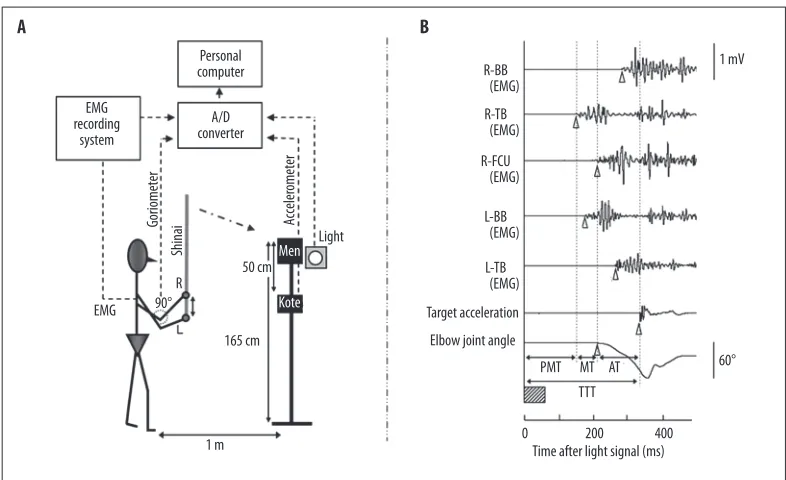
Subjects held a shinai (1.20 m long, 0.510 kg) in both hands, with the right hand placed higher than the left. They stood 1.0 m from a target that was placed at a height of either 1.65 m (Men strike task) or 1.15 m (Kote strike task). Before each trial, subjects were asked to attain right elbow joint flexion of 90° (at 0°, the el-bow is considered to be completely extended), and then a warning signal was presented. After a random delay of between 2 and 6 seconds, a visual signal was present-ed by a rpresent-ed light-emitting diode set close to the target, at the eye level of the participant, and subjects were re-quired to strike (i.e. Men or Kote) the target as quick-ly as possible in response to this visual cue (Figure 1A). Subjects performed between three and six practice tri-als of each task followed by 10 recorded tritri-als.
Data acquisition
The angle of the right elbow was measured using a go-niometer (Model-MLTS 700; Delsys, USA). The elbow angle was also monitored online and feedback was giv-en to the participant to help them achieve 90° flexion prior to task initiation. The striking point was detect-ed using an accelerometer (TA-513G; Nihon Kohden, Japan) built into the target. Muscle activities related to the shinai swing and holding with striking were quan-tified using EMG, recorded from the right (R) and left (L) biceps brachii (BB), triceps brachii (TB) muscles, and the right flexor carpi ulnaris (R-FCU) muscle us-ing surface electrodes [13,14]. After preparation of the skin (shaving, lightly abrading, and cleansing with 70%
Movement-related cortical potentials – Indicators to assess cortical activity level associated with exercise.
ethanol), a single differential surface electrode configura-tion (1 cm intersensor distance, Model DE-2.1; Delsys, USA) was attached to the skin over the belly of each muscle using adhesive interfaces. The electrodes were orientated parallel to the presumed orientation of the muscle fibres [15]. A reference electrode was placed on the left epicondylus medialis humeri. The same inves-tigator placed the electrodes in the same relative posi-tion on all participants. The EMG signal was band pass filtered (20–500 Hz), amplified (×1000), and digitized at 2 kHz using a 16-bit analogue-to-digital converter (PowerLab; AD Instruments, Japan). All data were re-corded and stored on a personal computer for off-line analysis using Chart 6 software (AD Instruments, Japan).
Statistical analysis
The onset of muscle activity was identified from EMG signals using the methods described by Yotani et al. [16] The EMG signals were processed using full-wave rectifi-cation with a time constant of 5 ms, and baseline activ-ity was determined from the 50-msec period prior to vi-sual cue onset. The threshold was set at three SD above the mean of baseline activity. Muscle activity onset was defined as the first point at which the EMG exceeded
this threshold for at least 12.5 ms (25 consecutive sam-ples). If the muscle was determined to be active, we re-turned to the threshold (+3 SD) again and adopted a point of less than 1.5 SD to indicate the onset of re-sponse of EMG activity. After identification of all mus-cle activity onset points for each task, we quantitated response times and muscle activation times as follows:
Response times: Total task time (TTT) was defined as the time from the visual cue onset until the time of the strike. This was further split into pre-motor time (PMT, from visual cue onset to first muscle activity [17]), mo-tor time (MT, from first muscle activity to initiation of elbow joint movement), and action time (AT, from the initiation of elbow joint movement to time of strike [18]) (Figure 1B).
Muscle activation patterns: Differences in muscle activ-ity onset between the R-TB, L-BB, and R-BB before im-pact were calculated for the timing of muscle recruitment for the forward swing and braking of the shinai during each task. In addition, the magnitude of muscle activi-ty (R-TB, L-TB and R-BB, L-BB) was also quantified as the average root mean square EMG magnitude (mean-RMS) from muscle activity onset until time of strike.
Figure 1. Schematic of experimental set-up (A) and example data (B). (A) “Men” represents the strike target in the Men task, and “Kote” represents the strike target in the Kote task. The participant is shown in the “ready” position adopted before presentation of the visual cue. (B) Example data showing electromyography recordings from the right biceps brachii (R-BB), right triceps brachii (R-TB), and right flexor carpi ulnaris (R-FCU) and the left biceps brachii (L-BB) and left triceps brachii (L-TB) goniometer recording from the right elbow joint, and acceleration recording from the target for a single trial. Hatched box (light) indicates visual cue. Triangles indicate onset of each signal. Pre-motor time (PMT) was calculated as the time from visual cue onset to first muscle activity, motor time (MT) was calculated as the time from first muscle activity to initiation of elbow joint movement, and action time (AT) was calculated as time from initiation of elbow joint movement to time of strike. Total task time (TTT) was calculated as PMT + MT +AT.
Personal computer
A/D converter
R-BB (EMG)
1 mV
R-TB (EMG)
R-FCU (EMG)
L-BB (EMG)
L-TB (EMG) Target acceleration Elbow joint angle EMG
recording system
EMG 90°
60° PMT MT
TTT
0 200
Time after light signal (ms)400 AT
1 m 165 cm
R 50 cm
Light Men
Kote
Acceler
ometer
Shinai
Goriometer
A
B
For each subject, we calculated the mean of the 10 trials performed for each strike task, and used this to calcu-late the mean (±SD) of each strike task for each group. Data were compared across groups using one-way analy-sis of variance with three levels (kendo, non-kendo, and sedentary), followed by Tukey’s post hoc tests where appropriate. Within each group, data were compared across strike tasks (Men and Kote) using Wilcoxon’s signed rank sum test by a non-parametric analysis, and the effect size (h2) was also reported. Differences were
considered statistically significant at P<0.05.
r
esultsResponse times
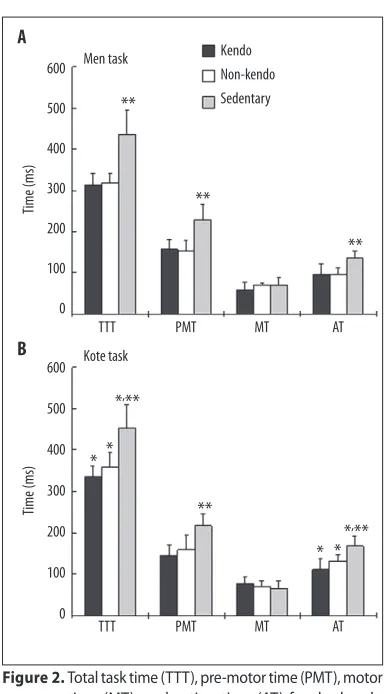
For all groups, TTT and AT were shorter during the Men strike task than during the Kote strike task (kendo P<0.05, h2=0.91–0.95; non-kendo P<0.05,
h2=0.96–0.97; sedentary P<0.05, h2=0.85–0.95). In
both the Men and the Kote strike tasks, athlete groups
(kendo and non-kendo) had shorter TTT, PMT, and AT than the sedentary group (P<0.05, Men: h2=0.84–0.91,
Kote: h2=0.83–0.91), but no significant
differenc-es were observed between the kendo and non-kendo groups in the Men and Kote tasks (P=0.13–0.96, Men:
h2=0.14–0.32, Kote: h2=0.47–0.64) (Figure 2A, B)
Muscle activation patterns: timing of muscle activity onset
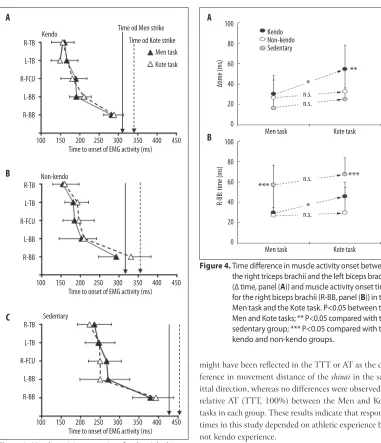
The kendo group exhibited different patterns tendency of muscle activity onset in the two strike tasks (Figure 3A), whereas the non-kendo and sedentary groups exhibited similar patterns tendency of muscle activation for these two tasks (Figure 3B, C). Figures 3 and 4 shows the tim-ing of muscle recruitment for the forward swtim-ing (a) and braking (b) of the shinai in the impact phase during Men and Kote tasks. In the kendo group, the D time was signif-icantly longer in the Kote task (54.6 ms) than in the Men task (30.3 ms; P<0.05, h2=0.87; Figure 3A) and R-BB
muscle activity onset was significantly later (45.9 ms
vs. 29.8 ms; P<0.05, h2=0.91; Figure 4B). However, in
the non-kendo and sedentary groups, these timings were similar in both tasks (P=0.24–0.36, h2=0.60–0.68 for D
time and P=0.26–0.59, h2=0.47–0.67 for R-BB onset).
Muscle activation patterns: magnitude of muscle activity
Figure 5 shows mean-RMS for muscles acting to produce the forward swing (R-TB and L-BB) and braking (R-BB and L-TB) for the shinai in the impact phase during the Men and Kote tasks. L-BB in the non-kendo and sed-entary groups showed significantly larger mean-RMS in the Men task than in the Kote task (723.1–614.5 µV
vs. 232.8–189.5 µV; P<0.05, h2=0.92–0.93; Figure 5A),
whereas the mean-RMS was unchanged irrespective of the tasks in the kendo group (P=0.93, h2=0.17).
d
iscussionThis study has two major findings. First, athletic groups (kendo and non-kendo) showed shorter response times than the sedentary group, with no significant differenc-es between the kendo and non-kendo groups. Second, in terms of muscle activation patterns, the kendo group showed altered timing of the activity onset of muscles between different striking tasks, whereas the non-kendo and sedentary groups exhibited similar patterns between the different strike tasks. On the other hand, the magni-tude of mean-RMS showed a trend opposite to the timing between the kendo and non-kendo or sedentary groups.
The limb motion to visual response typically occurs by a series of processing signals from the central nervous
Figure 2. Total task time (TTT), pre-motor time (PMT), motor time (MT), and action time (AT) for the kendo group, non-kendo group, and sedentary group performing the Men task (A) and the Kote task (B). * P<0.05 between the Men and Kote strikes; ** <0.05 between the sedentary group and both the kendo and non-kendo groups.
600
500
400
300
200
100
0
Kendo Non-kendo Sedentary
TTT PMT MT AT
Men task
**
**
**
*
* *
*
*,**
*,**
**
Time (ms)
600
500
400
300
200
100
0
TTT PMT MT AT
Kote task
Time (ms)
A
B
system to contraction of skeletal muscles through the motor nerves. Response times reflect the time required for these processing signals (nervous or muscular sys-tem) and are more phasic in simple than in choice reac-tion tasks [19,20]. Daily physical training in sports that require rapid decision making shortens response times [10,21]. The training effect is especially evident for the PMT in which the time proportion during the reaction task is quite high [16]. Our results showed that the ath-lete groups had a shortened PMT compared with the sedentary group regardless of kendo experience (Figure 2). In addition, the Men and Kote tasks of this study
might have been reflected in the TTT or AT as the dif-ference in movement distance of the shinai in the sag-ittal direction, whereas no differences were observed in relative AT (TTT, 100%) between the Men and Kote tasks in each group. These results indicate that response times in this study depended on athletic experience but not kendo experience.
Our second finding demonstrated that muscle activation patterns showed a contrasting tendency between ken-do-experienced and kendo-inexperienced groups. The kendo group altered the timing of muscle activity onset between the Men and Kote tasks, whereas the non-ken-do and sedentary groups altered the magnitude of the mean-RMS between each task. We speculate that differ-ences in patterns between each group indicate whether athletes have kendo experience or not [22]. Regulation of antagonistic and agonist muscle activity is important for quick extension movement of elbow joints [23], and the antagonistic muscle activity during elbow ex-tension undergoes an independent neuromuscular con-trol from the agonist muscle activity [24]. Several au-thors have reported that physical exercise programs must be developed in the central nervous system before car-rying out quick movements [25–27], and that alter-ing the timalter-ing or magnitude of muscle activity is one
Figure 3. Muscle activity onset time for the right biceps brachii (R-BB), right triceps brachii (R-TB) and right flexor carpi ulnaris (R-FCU) and the left biceps brachii (L-BB) and left tricep brachii (L-TB) muscles in the Men task (black triangles) and the Kote task (white triangles) tasks in the kendo group (A), non-kendo group (B), and sedentary group (C).
R-TB
L-TB
R-FCU
L-BB
R-BB
Kendo Time od Men strike
Time od Kote strike Men task Kote task
100 200 250
Time to onset of EMG activity (ms)300 350 400 450 150
R-TB
L-TB
R-FCU
L-BB
R-BB Non-kendo
100 200 250
Time to onset of EMG activity (ms)300 350 400 450 150
R-TB
L-TB
R-FCU
L-BB
R-BB Sedentary
100 200 250
Time to onset of EMG activity (ms)300 350 400 450 150
A
B
C
Figure 4. Time difference in muscle activity onset between the right triceps brachii and the left biceps brachii (∆ time, panel (A)) and muscle activity onset time for the right biceps brachii (R-BB, panel (B)) in the Men task and the Kote task. P<0.05 between the Men and Kote tasks; ** P<0.05 compared with the sedentary group; *** P<0.05 compared with the kendo and non-kendo groups.
Kendo Non-kendo Sedentary
Men task
*
**
***
***
Kote task n.s.
n.s.
∆time (ms)
100
80
60
40
20
0
Men task
*
Kote task n.s.
n.s.
R-BB: time (ms)
100
80
60
40
20
0
A
B
neuromuscular control strategy for adjusting to varied movements [28,29]. Given these reports, it seems rea-sonable that the kendo group in this study altered the timing of muscle activity onset between Men and Kote tasks at different striking points (i.e., height). The ken-do group might have altered the timing of R-BB muscle activity onset for braking, as well as the altered the D
time for the forward swing between each task (Figure 4). However, the magnitude of alteration of muscle activi-ty between each task was observed in the kendo-inexpe-rienced groups but not in the kendo-expekendo-inexpe-rienced group (Figure 5). Previous studies have shown that the magni-tude of muscle activity is involved in acceleration con-trol during ballistic movements [30,31]. In the kendo-inexperienced groups, in which timing of muscle activity onset was unaltered, alteration of the magnitude might have been a coping technique to perform the strike at the appropriate phase for each task.
A principal limitation of this study is that results fo-cused on elbow motion of the upper limbs during the strike to determine the style for the downward move of the shinai. A strike with an up-and-down movement
of the shinai for non-kendo experienced subjects is usu-ally difficult and involves factors other than elbow mo-tion (e.g., shoulder momo-tion). The present measurement generalized the kendo experience level in all subjects. In addition, even though the present study included a small number of subjects, data collected in this study enhance the knowledge of differences arising with the level of physical fitness and choice of athletic activity.
c
onclusionsEMG was used to assess response time and muscle ac-tivation patterns during Men and Kote tasks in a ken-do group, a non-kenken-do group, and a sedentary group. We found that the response time for kendo group in two different simple-strike reaction tasks is not found within the non-kendo athletes, whereas the muscle ac-tivation patterns of the upper limbs for different tasks (i.e., Men and Kote) seemed to differ between the ken-do group and kenken-do-inexperienced groups (non-kenken-do or sedentary). In decision-making sports, differences in neuromuscular control, but not in response times, are associated with athletic experience.
Figure 5. Electromyograph (EMG) magnitude (mean root mean square [RMS]) of muscles producing shinai acceleration ((A): shinai acceleration) (right triceps brachii [R-TB] and left biceps-brachii [L-BB], and muscles producing shinai braking ((B): shinai braking) (right biceps brachii (R-BB) and left triceps brachii (L-TB) in the kendo group (top), the non-kendo group (middle), and the sedentary group (bottom) during the Men and the Kote tasks. * P<0.05 between the Men and Kote tasks.
1200 1000 800 600 400 200 0
Kendo
R-TB L-BB
1200 1000 800 600 400 200 0
Kendo
Men task Kote task
Mean-RMS (µ
V)
Mean-RMS (µ
V)
R-BB L-TB
1200 1000 800 600 400 200 0
Non-kendo
R-TB L-BB
*
*
1200 1000 800 600 400 200 0
Non-kendo
R-BB L-TB
1200 1000 800 600 400 200 0
Sedentary
R-TB L-BB
1200 1000 800 600 400 200 0
Sedentary
R-BB L-TB
A
B
h
ighlightsIn a simple reaction task using a kendo strike, the ath-letes showed a shortened response time compared with sedentary participants regardless of kendo experience. In contrast, a difference was seen between kendo ath-letes and non-kendo subjects in muscle activation pat-terns during strikes.
a
cknowledgeMentsThe authors appreciate the collaboration of all sub-jects. This study was supported in part by a Grant-in-Aid for Young Scientists (B) from the Japan Society for the Promotion of Science and the Niigata University of Health and Welfare, by the Sasakawa Research Foundation of the Japan Science Society, and by a re-search grant from the National Institute of Fitness and Sports in Kanoya, Japan.
Cite this article as: Yotani K, Tamaki H, Kirimoto H et al.: Response time and muscle activation patterns of the upper limbs during different strikes in kendo. Arch Budo, 2013; 2: 101–107.
1. Ono M, Otani Y, Takahashi Y et al: Study on the neuro-muscular coordinations of the kendo cham-pions (Part 1). J Phys Fitness Sports Med, 1968; 17: 1–13 [in Japanese]
2. Ono M, Yanagimoto A, Yamashita F et al: Study on the neuro-muscular coordination of the kendo champions (Part 2). J Phys Fitness Sports Med, 1969; 18: 72–82 [in Japanese]
3. Clarys JP, Cabri J: Electromyography and the study of sports movements: a review. J Sports Sci, 1993; 11: 379–448
4. Shaffer B, Jobe FW, Pink M et al: Baseball batting. An electromyographic study. Clin Orthop Relat Res, 1993; 292: 285–93
5. Girard O, Micallef JP, Millet GP: Lower-limb activ-ity during the power serve in tennis: effects of per-formance level. Med Sci Sports Exerc, 2005; 37: 1021–29
6. Del Percio C, Rossini PM, Marzano N et al: Is there a “neural efficiency ” in athletes? A high-resolution EEG study. Neuroimage, 2008; 42: 1544–53 7. Nishihira Y, Araki H, Ishihara A: Comparison among
various movement tasks of cerebral motor poten-tial preceding voluntary movement. Electromyogr Clin Neurophysiol, 1989; 29: 179–84
8. Ryu RK, McCormick J, Jobe FW et al: An electro-myographic analysis of shoulder function in ten-nis players. Am J Sports Med, 1988; 16: 481–85 9. Hatta A, Nishihira Y, Higashiura T et al:
Long-term motor practice induces practice-dependent modulation of movement-related cortical poten-tials (MRCP) preceding a self-paced non-dominant handgrip movement in kendo players. Neurosci Lett, 2009; 14: 105–8
10. Lee JB, Matsumoto T, Othman T et al: Coactivation of the flexor muscles as a synergist with the exten-sors during ballistic finger extension movement in trained kendo and karate athletes. Int J Sports Med, 1999; 20: 7–11
11. Oldfield RC: The assessment and analysis of hand-edness: the Edinburgh inventory. Neuropsychologia, 1971; 9: 97–113
12. WMA: WMA (World Medical Association) Declaration of Helsinki – Ethical Principles for Medical Research Involving Human Subjects – Sixth Revision. Helsinki, 2008
13. Matsuo K, Narusawa M, Muranaga S et al: The laterality of myoelectrical activity during “suburi” movement in kendoists. J Phys Educ, 1998; 43: 176–84 [in Japanese]
14. Yotani K, Imaizumi H, Kirimoto H et al: Reaction and action time analysis for kendo strikes in re-sponse to light signals using an electromyography. J Physiol Anthropol, 2007; 12: 139–46 [in Japanese] 15. Wilson C, Smith D, Burden A et al: Participant-generated imagery scripts produce greater EMG ac-tivity and imagery ability. Eur J Sport Sci, 2010; 10: 417–25
16. Yotani K, Tamaki H, Yuki A et al: Response train-ing shortens visuo-motor related time in athletes. Int J Sports Med, 2011; 32: 586–90
17. Shiozawa S, Komiyama T: Measurement of reaction time. J Phys Ther, 2005; 22: 57–65 [in Japanese] 18. Inui K: Photo stimulation-response time of the
human knee extension. J Phys Ther Sci, 1993; 5: 11–17
19. Burle B, Vidal F, Tandonnet C et al: Physiological evidence for response inhibition in choice reaction time tasks. Brain Cogn, 2004; 56: 153–64 20. Carbonnell L, Hasbroucq T, Grapperon J et al:
Response selection and motor areas: a behavioural and electrophysiological study. Clin Neurophysiol, 2004; 115: 2164–74
21. Yona M, Muro M, Shimoshikiryou K et al: Effects on EMG-reaction time (EMG-RT) by isometric training of heavy intensity. J Phys Fitness Sports Med, 1990; 39: 307–14 [in Japanese]
22. Sakurai S, Ohtsuki T: Muscle activity and accura-cy of performance of the smash stroke in badmin-ton with reference to skill and practice. J Sports Sci, 2000; 18: 901–14
23. Takatoku N, Fujiwara M: Muscle activity pat-terns during quick change in elbow extensions. J Phys Educ Hlth Sport Sci, 2009; 54: 293–306 [in Japanese]
24. Kudo K, Ohtsuki T: Functional modification of ag-onist-antagonist electromyographic activity for rap-id movement inhibition. Exp Brain Res, 1998; 122: 23–30
25. Cooke JD, Brown S, Forget R et al: Initial agonist burst duration changes with movement amplitude in a deafferented patient. Exp Brain Res, 1985; 60: 184–87
26. Sanes JN, Mauritz KH, Dalakas MC et al: Motor control in humans with large-fiber sensory neurop-athy. Hum Neurobiol, 1985; 4: 101–14
27. Mills KR, Kimiskidis V: Motor cortex excitabili-ty during ballistic forearm and finger movements. Muscle Nerve, 1996; 19: 468–73
28. Corcos DM, Gottlieb GL, Agarwal GC: Organizing principles for single-joint movements. II. A speed-sensitive strategy. J Neurophysiol, 1989; 62: 358–68
29. Gottlieb GL, Corcos DM, Agarwal GC: Organizing principles for single-joint movements. I. A speed-in-sensitive strategy. J Neurophysiol, 1989; 62: 342–57 30. Hallett M, Marsden CD: Ballistic flexion move-ments of the human thumb. J Physiol, 1979; 294: 33–50
31. Brown SH, Cooke JD: Amplitude- and instruction-dependent modulation of movement-related elec-tromyogram activity in humans. J Physiol, 1981; 316: 97–107
![Figure 5. Electromyograph (EMG) magnitude (mean root mean square [RMS]) of muscles producing shinai acceleration ((A): shinai acceleration) (right triceps brachii [R-TB] and left biceps-brachii [L-BB], and muscles producing shinai braking ((B): shinai bra](https://thumb-us.123doks.com/thumbv2/123dok_us/8594462.1722067/6.567.134.524.68.380/figure-electromyograph-magnitude-producing-acceleration-acceleration-producing-braking.webp)
