Linear Growth and Child Development
in Low- and Middle-Income Countries:
A Meta-Analysis
Christopher R. Sudfeld, ScDa, Dana Charles McCoy, PhDb, Goodarz Danaei, MD, ScDa,c, Günther Fink, PhDa, Majid Ezzati, PhDd, Kathryn G. Andrews, MPHa, Wafaie W. Fawzi, MBBS, DrPHa,c,e
abstract
BACKGROUND AND OBJECTIVE:The initial years of life are critical for physical growth and broadercognitive, motor, and socioemotional development, but the magnitude of the link between these processes remains unclear. Our objective was to produce quantitative estimates of the cross-sectional and prospective association of height-for-agezscore (HAZ) with child development.
METHODS:Observational studies conducted in low- and middle-income countries (LMICs)
presenting data on the relationship of linear growth with any measure of child development among children,12 years of age were identified from a systematic search of PubMed, Embase, and PsycINFO. Two reviewers then extracted these data by using a standardized form.
RESULTS:A total of 68 published studies conducted in 29 LMICs were included in thefinal database.
The pooled adjusted standardized mean difference in cross-sectional cognitive ability per unit increase in HAZ for children#2 years old was +0.24 (95% confidence interval [CI], 0.14–0.33;I2 = 53%) and +0.09 for children.2 years old (95% CI, 0.05–0.12;I2= 78%). Prospectively, each unit increase in HAZ for children#2 years old was associated with a +0.22-SD increase in cognition at 5 to 11 years after multivariate adjustment (95% CI, 0.17–0.27;I2
= 0%). HAZ was also significantly associated with earlier walking age and better motor scores (P,.05).
CONCLUSIONS:Observational evidence suggests a robust positive association between linear growth during thefirst 2 years of life with cognitive and motor development. Effective interventions that reduce linear growth restriction may improve developmental outcomes; however, integration with environmental, educational, and stimulation interventions may produce larger positive effects.
Departments ofaGlobal Health and Population,cEpidemiology, andeNutrition, Harvard School of Public Health, Boston, Massachusetts;bCenter on the Developing Child, Schools of Education
and Public Health, Harvard University, Cambridge, Massachusetts; anddDepartments of Epidemiology and Biostatistics, MRC-PHE Centre for Environment and Health, Imperial College London,
London, United Kingdom
Drs Sudfeld and Charles McCoy contributed to all aspects of the study including conceptualization of the review protocol, data abstraction, meta-analysis, and drafting of the manuscript; Drs Danaei, Fink, Ezzati, and Fawzi and Ms Andrews contributed to conceptualization of the review protocol, inclusion and exclusion of studies infinal database, meta-analysis, and critical review of the manuscript; and all authors approved thefinal manuscript and agree to be accountable for all aspects of the work.
www.pediatrics.org/cgi/doi/10.1542/peds.2014-3111 DOI:10.1542/peds.2014-3111
Accepted for publication Feb 4, 2015
Address correspondence to Christopher R. Sudfeld, ScD, Department of Global Health and Population, Harvard School of Public Health, 1639 Tremont St, Boston, MA 02120. E-mail: [email protected]
PEDIATRICS (ISSN Numbers: Print, 0031-4005; Online, 1098-4275).
Copyright © 2015 by the American Academy of Pediatrics
FINANCIAL DISCLOSURE:The authors have indicated they have nofinancial relationships relevant to this article to disclose. FUNDING:Funded by the Saving Brains Program, Grand Challenges Canada grant 0073-03.
In 2011 an estimated 314 million children,5 years of age in low- and middle-income countries (LMICs) experienced mild to severe stunting.1
Restricted linear growth is primarily a result of inadequate nutrition and infectious disease and has long been recognized as a principal cause of morbidity and mortality throughout childhood.2,3It is also well
established that the initial years of life are critical for cognitive, motor, and socioemotional development, but the degree to which physical growth, child development, and their
determinants are directly linked remains difficult to untangle.4,5
Studies investigating the relationship between physical growth and child development date back more than a century.6,7Reviews of this literature
to date have presented only qualitativefindings that focus primarily on cognitive outcomes and have generally found that restricted linear growth is associated with reduced cognitive capacity.5,8–11
Given that growth restriction is used as a proxy for children’s broader developmental status in LMICs, quantitative summary estimates are needed to determine the magnitude of the direct links between physical growth and broader child
development.5These estimates are
also needed to design intervention studies with optimal statistical power to determine the effect of risk factors and interventions classically
associated with restricted linear growth on child development outcomes.
In this systematic review and meta-analysis we present all published studies to date conducted in LMICs including data on the relationship of linear growth with child cognitive, motor, and socioemotional
development domains. We produce crude and multivariate adjusted pooled estimates for cross-sectional and prospective studies to inform the ability to use linear growth as an indicator of children not reaching
their developmental potential and to estimate the possible direct link of exposures leading to restricted linear growth and child development.
METHODS
We conducted a systematic literature review of observational studies conducted in LMICs presenting data on the relationship of child linear growth (crude height or height-for-agezscore [HAZ]) with any measurement of cognitive, motor, or socioemotional functioning. We include any measure of children’s intelligence (IQ), executive function, reasoning, language, or academic (eg, early math or reading skills) as representations of cognition. Motor development was represented by measure of bothfine and gross motor capacities, including age of
attainment of particular skills (eg, walking). Socioemotional
development included measures of behavior problems, attachment, emotionality, social competence, and temperament. Studies were excluded from the review if they were conducted among nongeneralizable populations (eg, children with conditions such as HIV,
hypopituitarism, Turner syndrome, or neurologic problems; studies
restricted to low birth weight or preterm infants; or children living in extreme social situations such as institutions or areas of armed conflict), they were conducted in a high-income country, they were based on nonhuman study
populations, they included samples
,50 subjects, the mean age of the study population was.12 years, or the study outcome was designed to represent nonnormative
development, including significant mental or physical disability. We included only studies of children,12 years of age to examine the
relationship of HAZ with child development during the early to middle childhood (ie, preadolescent and prepubertal) period.
Search Strategy
We conducted a comprehensive systematic literature search of PubMed (from 1966 to December 20, 2014), Embase (from 1974 to December 20, 2014), and PsycINFO (from 1872 to December 20, 2014). The PubMed search consisted of (“child”or“infant”) AND (“cognitive” or“cognition”or“psychomotor” or“sensorimotor”or“motor”or “intelligence”or“IQ”or“language”or “executive function”or“attention” or“memory”or“learning”or “information processing”or“literacy” or“reading”or“math”or“school readiness”or“pre-academic”or “academic”or“mental health”or “behavior problem”or“emotional” or“emotion”or“socioemotional”or “temperament”or“self-regulation”or “attachment”or“self-esteem”or “self-esteem” or“self-efficacy”or“social competence”or“peer relationship”or “prosocial behavior”or“internalizing” or“externalizing”or“hyperactivity” or“impulsivity”or“aggression”) AND (“height”or“stunt*”or“ height-for-age” or“HAZ”), and these search terms were customized for Embase and PsycINFO databases. There were no language or publication
restrictions.
Study Selection
Two reviewers (C.R.S. and D.C.M.) independently screened titles and abstracts and then reviewed full texts of selected studies to assess eligibility. Reference lists of included studies and previous reviews were scanned to identify any potentially relevant publications not found through the electronic search. Any discrepancy between the reviewers was resolved through discussion.
Data Abstraction
Two reviewers (C.R.S. and D.C.M.) independently extracted data by using a standardized data extraction form. The data collected from each study included information on study design, location, number of
distribution, time of height assessment, child development measurement tool, time of child development assessment, confounders, and measures of association. We also collected SD of the child development outcome if standardized mean differences (SMDs) or standardized mean scores were not presented. Discrepancies between the reviewers were resolved through discussion, by contacting the authors, or by consultation with a third reviewer (W.W.F. or G.D.).
Statistical Analysis
The objective of the meta-analysis was to produce a series of quantitative estimates of the relationship between linear growth and development separately for the cognitive, motor, and socioemotional domains stratified by study design and statistical
adjustment. For each child development domain we sought to produce a pooled summary of the crude cross-sectional correlation of HAZ with the domain score, crude SMD in domain score for each unit increase in HAZ in cross-sectional studies, multivariate adjusted SMD in domain score for each unit increase in HAZ in cross-sectional studies, crude SMD in domain score for each unit increase in HAZ and in prospective cohort studies, and multivariate adjusted SMD in domain score for each unit increase in HAZ in prospective cohort studies. As a secondary meta-analysis we also present SMDs for each of these summary estimates by design and statistical adjustment for stunted versus nonstunted children; however, these estimates may underestimate the relationship if the nonstunted control group has suboptimal growth or a mean HAZ,0. We produced pooled estimates using SMDs because of substantial differences in the scoring systems used in the many child development tools included in the review. If an SMD was not presented, standardized meanzscores by group or within sample and the SD
of the child development score was used to calculate an SMD estimate. For the socioemotional domain, we present only a qualitative overview because we were unable to present summary estimates in this domain because of the small number of studies and differences in the aspects of socioemotional development that each tool measured. Similarly, we were also unable to produce summary estimates for studies examining the relationship between change in HAZ or height over time and child
development because of the small number of studies and significant differences in timing of height measurements and the type of statistical analysis used.
To calculate a summary correlation coefficient, we used the DerSimonian and Laird method with random effects models.12Studies that presented
correlations by subgroups of age or gender are included in the summary measure separately, and because of the lack of study independence they will lead to an underestimation of the pooled SE and confidence intervals (CIs). For pooled summary SMD estimates we used generic inverse variance weighting.13We used the
Q-statistic and itsPvalue andI2statistics to examine between-study
heterogeneity.14,15If the Q-statisticP
value was,0.10 andI2was .50%, heterogeneity was considered to be substantial, and random effects models were used. A priori we also decided to explore heterogeneity in estimates by age at HAZ measurement. We examined subgroup estimates stratified for the#2 years and.2 years age groups ($50% of the sample) for all analyses, and thex2 test was used to assess statistical significance of difference in pooled estimates between groups for SMDs. If significant differences by age
subgroup were determined, stratified results are presented. We used funnel plots to assess publication bias, and statistical significance was defined as P,.05. We used SAS (version 9.2; SAS Institute, Inc, Cary, NC), RevMan
(version 5.1; The Cochrane
Collaboration, Copenhagen, Denmark), and MedCalc (version 12.5; MedCalc Software bvba, Ostend, Belgium) for the analyses.
RESULTS
Literature Search
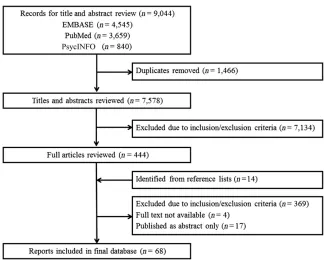
A summary of the literature search andfinal database study selection process is presented in Fig 1. Briefly, we identified a total of 9044 records from Embase, PubMed, and PsycINFO, of which 7578 were unique citations after we removed duplicates. We screened these record titles and abstracts and identified 444 citations for full-text review. We also identified 14 additional studies from reference lists to be included in the full-text review. We were unable to obtain full text for 4 articles, and abstracts only were available for 17 citations (see Supplemental Information for a list of these references). After a detailed review of available full-text articles, we included 68 reports in thefinal database.
Study Characteristics
The 68 reports included in thefinal database consisted of 56 distinct study populations in 29 different LMICs and represented a range of study designs from small cohorts to large cross-sectional multicountry demographic surveys.16–83We
present study characteristics and results in Supplemental Tables 2–7 for cognitive, motor, and
socioemotional domains, respectively. Some studies presented data on multiple developmental domains, resulting in 52 studies reporting cognitive domain associations,* 22 with motor associations,†and 13 with socioemotional associations.‡
*Refs 22–26, 28–30, 32, 34–40, 42–53, 55, 56, 58, 60–62, 64–66, 68, 69, 71, 73–79, 82, and 83. †Refs 17, 21, 25, 27, 29, 31, 33, 46, 48, 50, 54, 57–61,
66, 67, 72, 73, 77, and 81.
‡Refs 19, 20, 25, 26, 29, 50, 51, 63, 67, 70, 73, 80,
Cognitive Domain
A summary of the cognitive domain
findings is presented in Table 1, and individual study descriptors and results are found in Supplemental Tables 2 and 3. A total of 11 studies presented cross-sectional unadjusted correlations of HAZ with cognitive domain score, which produced a pooled correlation of 0.28 (95% CI, 0.19–0.36;I2= 92%)x(Supplemental
Fig 5). When data were stratified by age, there was no difference in correlations for studies assessing cognitive correlations between children#2 years of age (pooled correlation 0.22; 95% CI,
0.12–0.32)42,66,73and children.2
years of age (pooled correlation 0.31; 95% CI, 0.19–0.41).23,25,32,44,49,60,65,74
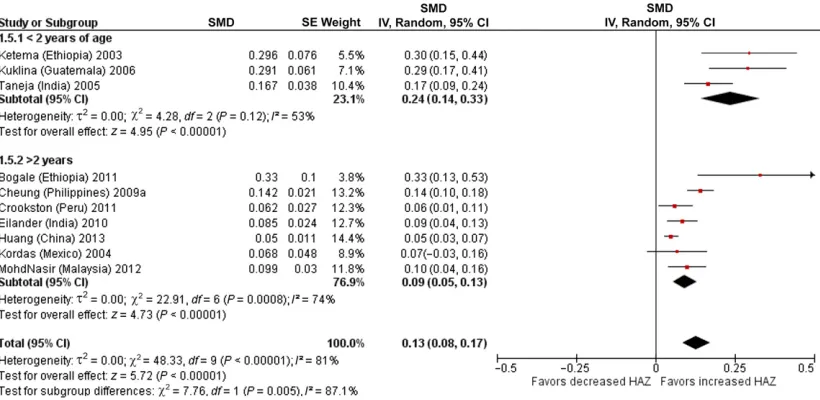
A total of 10 cross-sectional studies presented multivariate adjusted SMDs for the relationship between HAZ and cognition.‖The SMD in cognitive score for each unit increase in HAZ was significantly greater for
studies conducted among children #2 years old as compared with study populations.2 years old (test for subgroup differencesP,.01). For children#2 years old, each unit increase in HAZ was associated with a +0.24-SD increase in cross-sectional cognitive ability (95% CI, 0.14–0.33;I2= 53%), whereas for children.2 years old each unit increase in HAZ was associated with only a +0.09 SMD in the cognitive score (95% CI, 0.05–0.13;I2= 74%)
(Fig 2). A total of 5 prospective cohort studies presented
a multivariate adjusted SMD for each unit increase in HAZ, and a pooled analysis determined that each unit increase in HAZ#2 years was associated with a +0.22 SD increase in cognition at 5 to 11 years of age with no significant heterogeneity (95% CI, 0.17–0.27;I2= 0%) (Fig 3).22,28,43,48,83,84Summary
estimates for stunted versus nonstunted participants are presented in the Supplemental Information by study design and use of statistical adjustment
(Supplemental Figs 6–9). Seven
studies presented multivariate adjusted associations examining change in length/height or HAZ over time with cognitive
scores.22,28,35,37,58,69,82Because of
differences in timing of height assessment and statistical analyses we were not able to pool these estimates; however, most studies suggest that improvements in HAZ over time or recovery from a stunted to a nonstunted HAZ is associated with improved cognition.
Motor Domain
A summary of the motor domain meta-analyses is presented in Table 1, and study descriptors and results are found in Supplemental Tables 4 and 5. Four cross-sectional studies presented the correlation of HAZ with motor score, and the summary pooled correlation was 0.24 (95% CI, 0.11–0.36;I2= 84%)17,25,67,73
(Supplemental Fig 9). The pooled SMD for the 2 studies that presented multivariate adjusted cross-sectional motor scores was +0.39 for each 1-unit increase in HAZ (95% CI, 0.30–0.47;I2= 31%)58,77
(Supplemental Fig 11). In addition, 3 studies among children#2 years old presented the multivariate cross-sectional association of HAZ with odds of walking; when these studies were pooled, each 1-unit increase in HAZ was associated with 2.03 (95% CI, 1.57–2.64;I2= 46%) times the
odds of walking54,57,72(Supplemental
Fig 12). Two prospective cohort studies determined that each unit increase in HAZ among children#3 years old was associated with a 0.29-SD increase (95% CI, 0.15–0.42;I2=
0%) in motor score at 5 to 8 years of age after multivariate adjustment29,48
(Fig 4). The unadjusted cross-sectional SMD for stunted versus nonstunted children is presented in Supplemental Fig 10. One study presented data on change in HAZ over time and motor development and determined that increases in HAZ from birth to 1 year were significantly FIGURE 1
Flow diagram of literature search and study identification process.
xRefs 23, 25, 32, 42, 44, 49, 60, 65, 66, 73, and 74.
associated with reduced time to walking.57
Socioemotional Domain
Study descriptors and results for the included 13 studies are found in Supplemental Tables 6 and 7. It was difficult to synthesize results for the socioemotional domain because of the small number of studies and poor comparability of
socioemotional development outcomes assessed at different ages (eg, fussing, socialization,
exploration, aggression). In multivariate analyses, 3 studies found no significant relationship of HAZ or stunting with different aspects of socioemotional
development,19,51,821 study found
significantly improved social scores with increased HAZ,29and another
study found that increased height was associated with increased aggression.70
DISCUSSION
The results of this study suggest that linear growth is positively associated with cognitive and motor
development among children living in LMICs. We found that each unit increase in HAZ during thefirst 2 years of life was independently associated with a +0.24-SD shift in concurrent cognitive ability and a +0.22-SD shift in cognition at 5 to 11 years of age. This suggests that,
without intervention, early cognitive deficits may persist throughout childhood for children experiencing restricted linear growth during the
first 2 years of life. Nevertheless, this study suggests there is substantial variation in child development that is not linked to linear growth. The associations of HAZ with current and future motor development skills were of similar magnitude to those seen in the cognitive domain. We were unable to produce results for socioemotional development because of the small number of studies and differences in the constructs each study attempted to measure.
The independent association of HAZ with cognitive and motor
FIGURE 2
Multivariate adjusted cross-sectional SMD in cognition per unit increase in HAZ stratified by age at measurement. IV, inverse variance. TABLE 1 Summary of Pooled Meta-Analysis Results by Developmental Domain
No. of Studies Pooled Estimate (95% CI) I2, % Figure Cognitive domain
Unadjusted cross-sectional correlation 11 0.28 (0.19–0.36) 92 Supplemental Fig 5 Adjusted cross-sectional SMD per unit increase in HAZ*
#2 y of age 3 0.24 (0.14–0.33) 53 Fig 2
.2 y of age 7 0.09 (0.05–0.13) 74 Fig 2
Adjusted prospective SMD per unit increase in HAZ 5 0.22 (0.17–0.27) 0 Fig 3 Motor domain
Unadjusted cross-sectional correlation 4 0.24 (0.11–0.36) 84 Supplemental Fig 9 Adjusted cross-sectional SMD per unit increase in HAZ 2 0.38 (0.31–0.46) 31 Supplemental Fig 11 Adjusted cross-sectional odds ratio for walking per unit
increase in HAZ
3 2.00 (1.68–2.37) 46 Supplemental Fig 12
Adjusted prospective SMD per unit increase in HAZ 2 0.29 (0.15–0.42) 0 Fig 4
development after multivariate adjustment in both cross-sectional and prospective studies supports the possibility of a biological mechanism whereby early exposure to
malnutrition and infection leads simultaneously to restricted linear growth and deficits in brain development that may persist throughout childhood.85Decades of
animal and human research have shown that prenatal and early life malnutrition negatively affect neuronal growth, pruning, and connectivity within regions of the brain associated with both motor and attentional functioning.85,86 A few
trials of energy supplementation have also indicated improved cognitive development for undernourished children or those at high risk of malnutrition.87–89
Ourfinding that linear growth in the
first 2 years of life appears to be a stronger independent predictor of both early and later childhood cognition as compared with growth after 2 years of age also corroborates a growing body of neuroscientific research showing that exposure to environmental and biological adversity during early sensitive periods of brain development can be
particularly detrimental to cognitive development.90We found
a significantly muted cross-sectional association of HAZ with cognition for children.2 years old. A partial explanation may be that the biologically relevant time period during which malnutrition acts on child development is during infancy or early toddlerhood, and because of growth catch-up the association is diluted at older ages.91Studies
examining changes in HAZ over time also suggest that early growth catch-up or reversal of stunting status is associated with improved
cognition.22,35,58,69,82
Another possible mechanism is that chronic infection or protein energy malnutrition may delay or prohibit advancement of early motor skills, which then leads to cognitive delays by way of reduced ability of the child to explore and extract learning opportunities from the physical and social environment.54,67This
mechanism is a component of the functional isolation hypothesis, in which infants or children with significant growth restriction may experience reduced ability to engage in their environments and a lack of responsiveness by caregivers.92,93In
addition, mothers of children with growth restriction may have low expectations about developmental milestones as a result of their short stature. In our pooled analysis, each unit increase of HAZ was
independently associated with approximately twice the odds of being able to walk and a +0.29-SD shift in overall motor score. In support, animal models have also suggested that loss of muscle and decreased musclefiber size caused by malnutrition may directly lead to motor delay, and studies have also found that children who are less active and lethargic are given fewer opportunities to advance motor skills.54,94This mechanism illustrates
the significant interconnection of child development domains, particularly during infancy, and future studies should attempt to measure noncognitive domains to assess potential causal cognitive pathways.
It is also important to note the significant attenuation of the association of HAZ with cognitive development in multivariate adjusted versus unadjusted analyses in both cross-sectional and prospective studies. For example, a prospective FIGURE 3
Multivariate adjusted prospective SMD in cognition per unit increase in HAZ. * Estimate obtained from Fischer Walker et al.43IV, inverse variance.
FIGURE 4
cohort study of Filipino infants found stunting at 2 years of age was associated with a20.40-SD deficit in cognition at 8 years in crude analysis, but after adjustment for
socioeconomic, caregiver, and demographic factors thezscore deficit for stunted infants was significantly reduced to20.14.64This
large change indicates the strong potential for residual and
unmeasured confounding to lead to overestimation of the direct effect of linear growth on cognitive and motor abilities in adjusted estimates because of unmeasured and residual confounding; however, multivariate adjusted estimates of the association of HAZ with cognition and motor development are homogeneous despite these analytical differences. This suggests that the contribution of unmeasured confounding above and beyond measures of socioeconomic status and age, which are included in most adjusted analyses, may be small. Nevertheless, this large attenuation also suggests that integrating nutritional, environmental, educational, and stimulation interventions may produce large positive effects on child development. Although limited in number and sample size, interventions that integrate both nutrition and stimulation interventions appear to be particularly promising for promoting multiple domains of child functioning.87In addition, these
experimental studies offer the opportunity to begin to untangle the many pathways that potentially link children’s physical growth and broader cognitive, motor, and socioemotional development.
Although this systematic review and quantitative meta-analysis provides several important advantages over past qualitative work, we were limited by several factors that should be addressed in future studies. Foremost, because of the
observational nature of the included studies we are unable to determine a causal link between underlying
factors that lead to restricted linear growth and child cognitive and motor development. Second, the lack of comparable evidence in the socioemotional domain prevents us from drawing conclusions about the nature of relationships between growth and social and emotional development at different ages during childhood. The significantly smaller number of studies examining socioemotional development as compared with cognitive and motor domains illustrates the need to better understand and measure the
diversity and complexity of social and emotional skills acquired by children over time and globally across cultures. In addition, there was significant heterogeneity in most pooled analyses presented in this study, which may be attributed in large part to the diversity of measurement tools and related constructs included in the analyses. For example, the inclusion of measures of IQ, attention, reasoning, language, and preacademic skills as representations of cognition probably generated some degree of
imprecision in estimates. In the future, more unified measurement tools are needed that take advantage of both broad and construct-specific measurement strategies to allow more analogous comparisons. In addition, we were unable to examine the complete shape or dose response of the relationship of HAZ with child development because of the lack of analyses presenting estimates for HAZ$21 in LMICs. Many studies presented adjusted estimates for stunting (HAZ,22), and a few presented data for mild growth restriction (HAZ$22 and,21), but the magnitude and shape of the relationship remain unclear for HAZ $21, specifically if there are any additional benefits to obtaining HAZs
.0.
Ourfindings suggest that restricted growth and stunting can be used as an incomplete proxy for delayed child development broadly and that the
underlying causes of growth restriction may also have direct effects on cognitive and motor development. Thesefindings can also be viewed as a possible mechanism to the more distal relationship of increased height with schooling attainment determined in a recent pooled analysis of long-term follow-up studies.95A multitude of risk
factors and effective interventions for restricted linear growth that span prepregnancy through early and middle childhood have been identified, but for the majority of these risk factors and interventions the impact on child development remains understudied or unclear.4
Future research is needed to determine the effectiveness of interventions used to prevent and treat linear growth restriction on child development and the
effectiveness of integrated nutrition and psychosocial stimulation interventions.
REFERENCES
1. Stevens GA, Finucane MM, Paciorek CJ, et al; Nutrition Impact Model Study Group (Child Growth). Trends in mild, moderate, and severe stunting and underweight, and progress towards MDG 1 in 141 developing countries:
a systematic analysis of population representative data.Lancet. 2012; 380(9844):824–834
2. Scrimshaw NS, SanGiovanni JP. Synergism of nutrition, infection, and immunity: an overview.Am J Clin Nutr. 1997;66(2):464S––477S
3. Black RE, Allen LH, Bhutta ZA, et al; Maternal and Child Undernutrition Study Group. Maternal and child
undernutrition: global and regional exposures and health consequences. Lancet. 2008;371(9608):243–260
4. Black RE, Victora CG, Walker SP, et al; Maternal and Child Nutrition Study Group. Maternal and child
undernutrition and overweight in low-income and middle-low-income countries. Lancet. 2013;382(9890):427–451
International Child Development Steering Group. Developmental potential in the first 5 years for children in developing countries.Lancet. 2007;369(9555):60–70
6. Porter WT.The Physical Basis of Precocity and Dullness. St Louis, MO: Academy of Science of St Louis; 1893
7. Goddard HH. The height and weight of feeble-minded children in American institutions.J Nerv Ment Dis. 1912;39(4): 217–235
8. Grantham-McGregor S. A review of studies of the effect of severe malnutrition on mental development. J Nutr. 1995;125(8 suppl):2233S–2238S
9. Gorman KS. Malnutrition and cognitive development: evidence from
experimental/quasi-experimental studies among the mild-to-moderately
malnourished.J Nutr. 1995;125(8 suppl): 2239S–2244S
10. Walker SP, Wachs TD, Gardner JM, et al; International Child Development Steering Group. Child development: risk factors for adverse outcomes in developing countries.Lancet. 2007;369(9556): 145–157
11. Walker SP, Wachs TD, Grantham-McGregor S, et al. Inequality in early childhood: risk and protective factors for early child development.Lancet. 2011; 378(9799):1325–1338
12. DerSimonian R, Laird N. Meta-analysis in clinical trials.Control Clin Trials. 1986; 7(3):177–188
13. Higgins JPT, Green S.Cochrane Handbook for Systematic Reviews of Interventions, Version 5.1.0. Oxford, UK: The Cochrane Collaboration; 2011
14. Higgins JP, Thompson SG, Deeks JJ, Altman DG. Measuring inconsistency in meta-analyses.BMJ. 2003;327(7414): 557–560
15. Higgins JP, Thompson SG. Quantifying heterogeneity in a meta-analysis.Stat Med. 2002;21(11):1539–1558
16. Abubakar A, Holding P, Van de Vijver FJR, Newton C, Van Baar A. Children at risk for developmental delay can be recognised by stunting, being underweight, ill health, little maternal schooling or high gravidity.J Child Psychol Psychiatry. 2010;51(6):652–659
17. Abubakar A, Van de Vijver F, Van Baar A, et al. Socioeconomic status,
anthropometric status, and psychomotor development of Kenyan children from resource-limited settings: a path-analytic study.Early Hum Dev. 2008;84(9): 613–621
18. Amarra MS, Bongga DC, Peñano-Ho L, Cruz FB, Solis JS, Barrios EB. Effect of iodine status and other nutritional factors on psychomotor and cognitive performance of Filipino schoolchildren. Food Nutr Bull. 2007;28(1):47–54
19. Aubuchon-Endsley NL, Grant SL, Berhanu G, et al. Hemoglobin, growth, and attention of infants in southern Ethiopia. Child Dev. 2011;82(4):1238–1251
20. Avan B, Richter LM, Ramchandani PG, Norris SA, Stein A. Maternal postnatal depression and children’s growth and behaviour during the early years of life: exploring the interaction between physical and mental health.Arch Dis Child. 2010;95(9):690–695
21. Benefice E, Malina R. Body size, body composition and motor performances of mild-to-moderately undernourished Senegalese children.Ann Hum Biol. 1996; 23(4):307–321
22. Berkman DS, Lescano AG, Gilman RH, Lopez SL, Black MM. Effects of stunting, diarrhoeal disease, and parasitic infection during infancy on cognition in late childhood: a follow-up study.Lancet. 2002;359(9306):564–571
23. Bogale A, Stoecker BJ, Kennedy T, et al. Nutritional status and cognitive performance of mother-child pairs in Sidama, Southern Ethiopia.Matern Child Nutr. 2013;9(2):274–284
24. Bogin B, MacVean RB. The relationship of socioeconomic status and sex to body size, skeletal maturation, and cognitive status of Guatemala City schoolchildren. Child Dev. 1983;54(1):115–128
25. Brito GN, Onis M. Growth status, behavior and neuropsychological performance: a study of Brazilian school age children. Arq Neuropsiquiatr. 2004;62(4):949–954
26. Chang SM, Walker SP, Grantham-McGregor S, Powell CA. Early childhood stunting and later behaviour and school achievement.J Child Psychol Psychiatry. 2002;43(6):775–783
27. Chang SM, Walker SP, Grantham-McGregor S, Powell CA. Early childhood stunting and laterfine motor abilities.
Dev Med Child Neurol. 2010;52(9): 831–836
28. Cheung YB, Ashorn P. Continuation of linear growth failure and its association with cognitive ability are not dependent on initial length-for-age: a longitudinal study from 6 months to 11 years of age. Acta Paediatr. 2010;99(11):1719–1723
29. Cheung YB, Gladstone M, Maleta K, Duan X, Ashorn P. Comparison of four statistical approaches to score child development: a study of Malawian children.Trop Med Int Health. 2008;13(8): 987–993
30. Cheung YB, Lam KF. Three estimates of the association between linear growth failure and cognitive ability.Trop Med Int Health. 2009;14(9):1020–1024
31. Cheung YB, Yip PS, Karlberg JP. Fetal growth, early postnatal growth and motor development in Pakistani infants. Int J Epidemiol. 2001;30(1):66–72
32. Chowdhury SD, Ghosh T. Nutritional and socioeconomic status in cognitive development of Santal children of Purulia district, India.Ann Hum Biol. 2011;38(2):188–193
33. Chowdhury SD, Wrotniak BH, Ghosh T. Nutritional and socioeconomic factors in motor development of Santal children of the Purulia district, India.Early Hum Dev. 2010;86(12):779–784
34. Church AT, Katigbak MS. Home environment, nutritional status and maternal intelligence as determinants of intellectual development in rural Philippine preschool children. Intelligence. 1991;15(1):49–78
35. Crookston BT, Schott W, Cueto S, et al. Postinfancy growth, schooling, and cognitive achievement: Young Lives.Am J Clin Nutr. 2013;98(6):1555–1563
36. Crookston BT, Dearden KA, Alder SC, et al. Impact of early and concurrent stunting on cognition.Matern Child Nutr. 2011; 7(4):397–409
37. Crookston BT, Penny ME, Alder SC, et al. Children who recover from early stunting and children who are not stunted demonstrate similar levels of cognition.J Nutr. 2010;140(11): 1996–2001
39. Eilander A, Muthayya S, van der Knaap H, et al. Undernutrition, fatty acid and micronutrient status in relation to cognitive performance in Indian school children: a cross-sectional study.Br J Nutr. 2010;103(7):1056–1064
40. Faisal Ghazi H, Isa ZM, Aljunid S, Shah SA, Abdalqader MA. Intelligence quotient (IQ) relationship with energy intake and micronutrient composition among primary school children in Baghdad city, Iraq.Pak J Nutr. 2013; 12(2):200–204
41. Fernald LC, Grantham-McGregor SM. Stress response in school-age children who have been growth retarded since early childhood.Am J Clin Nutr. 1998; 68(3):691–698
42. Fernald LC, Neufeld LM, Barton LR, Schnaas L, Rivera J, Gertler PJ. Parallel deficits in linear growth and mental development in low-income Mexican infants in the second year of life.Public Health Nutr. 2006;9(2):178–186
43. Fischer Walker CL, Lamberti L, Adair L, et al. Does childhood diarrhea influence cognition beyond the diarrhea-stunting pathway?PLoS ONE. 2012;7(10):e47908
44. Freeman HE, Klein RE, Kagan J, Yarbrough C. Relations between nutrition and cognition in rural Guatemala.Am J Public Health. 1977;67(3):233–239
45. Liang PH, Hie TT, Jan OH, Giok LT. Evaluation of mental development in relation to early malnutrition.Am J Clin Nutr. 1967;20(12):1290–1294
46. Grantham-McGregor SM, Walker SP, Chang SM, Powell CA. Effects of early childhood supplementation with and without stimulation on later development in stunted Jamaican children.Am J Clin Nutr. 1997;66(2): 247–253
47. Hall A, Khanh LN, Son TH, et al; Partnership for Child Development. An association between chronic
undernutrition and educational test scores in Vietnamese children.Eur J Clin Nutr. 2001;55(9):801–804
48. Hamadani JD, Tofail F, Cole T, Grantham-McGregor S. The relation between age of attainment of motor milestones and future cognitive and motor development in Bangladeshi children.Matern Child Nutr. 2013;9(suppl 1):89–104
49. Hamid JJ, Amal MK, Hasmiza H, Pim CD, Ng LO, Wan MW. Effect of gender and nutritional status on academic achievement and cognitive function among primary school children in a rural district in Malaysia.Malays J Nutr. 2011;17(2):189–200
50. Handal AJ, Lozoff B, Breilh J, Harlow SD. Sociodemographic and nutritional correlates of neurobehavioral
development: a study of young children in a rural region of Ecuador.Rev Panam Salud Publica. 2007;21(5):292–300
51. Huang C, Martorell R, Ren A, Li Z. Cognition and behavioural development in early childhood: the role of birth weight and postnatal growth.Int J Epidemiol. 2013;42(1):160–171
52. Ivanovic DM, Olivares MG, Castro CG, Ivanovic RM. Nutrition and learning in Chilean school age children: Chile’s Metropolitan Region Survey 1986–1987. Nutrition. 1996;12(5):321–328
53. Ivanovic DM, Pérez HT, Olivares MG, Díaz NS, Leyton BD, Ivanovic RM. Scholastic achievement: a multivariate analysis of nutritional, intellectual, socioeconomic, sociocultural, familial, and
demographic variables in Chilean school-age children.Nutrition. 2004; 20(10):878–889
54. Kariger PK, Stoltzfus RJ, Olney D, et al. Iron deficiency and physical growth predict attainment of walking but not crawling in poorly nourished Zanzibari infants.J Nutr. 2005;135(4):814–819
55. Ketema L, Abate G, Jabar M. Correlates of children’s cognitive skills in an agrarian community with mixed crop–livestock production systems, Ghinchi, central Ethiopia.Ethiop Med J. 2003;41(2): 151–161
56. Kordas K, Lopez P, Rosado JL, et al. Blood lead, anemia, and short stature are independently associated with cognitive performance in Mexican school children. J Nutr. 2004;134(2):363–371
57. Kuklina EV, Ramakrishnan U, Stein AD, Barnhart HH, Martorell R. Growth and diet quality are associated with the attainment of walking in rural
Guatemalan infants.J Nutr. 2004;134(12): 3296–3300
58. Kuklina EV, Ramakrishnan U, Stein AD, Barnhart HH, Martorell R. Early childhood growth and development in
rural Guatemala.Early Hum Dev. 2006; 82(7):425–433
59. Kulkarni S, Ramakrishnan U, Dearden KA, et al. Greater length-for-age increases the odds of attaining motor milestones in Vietnamese children aged 5–18 months.Asia Pac J Clin Nutr. 2012;21(2): 241–246
60. Lasky RE, Klein RE, Yarbrough C, Engle PL, Lechtig A, Martorell R. The relationship between physical growth and infant behavioral development in rural Guatemala.Child Dev. 1981;52(1):219–226
61. Lima MC, Eickmann SH, Lima AC, et al. Determinants of mental and motor development at 12 months in a low income population: a cohort study in northeast Brazil.Acta Paediatr. 2004; 93(7):969–975
62. López I, de Andraca I, Perales CG, Heresi E, Castillo M, Colombo M. Breakfast omission and cognitive performance of normal, wasted and stunted
schoolchildren.Eur J Clin Nutr. 1993; 47(8):533–542
63. Gardner JM, Grantham-McGregor SM, Himes J, Chang S. Behaviour and development of stunted and nonstunted Jamaican children.J Child Psychol Psychiatry. 1999;40(5):819–827
64. Mendez MA, Adair LS. Severity and timing of stunting in thefirst two years of life affect performance on cognitive tests in late childhood.J Nutr. 1999;129(8): 1555–1562
65. Mohd Nasir MT, Norimah AK, Hazizi AS, Nurliyana AR, Loh SH, Suraya I. Child feeding practices, food habits,
anthropometric indicators and cognitive performance among preschoolers in Peninsular Malaysia.Appetite. 2012; 58(2):525–530
66. Olney DK, Kariger PK, Stoltzfus RJ, et al. Development of nutritionally at-risk young children is predicted by malaria, anemia, and stunting in Pemba, Zanzibar. J Nutr. 2009;139(4):763–772
67. Olney DK, Pollitt E, Kariger PK, et al. Young Zanzibari children with iron deficiency, iron deficiency anemia, stunting, or malaria have lower motor activity scores and spend less time in locomotion.J Nutr. 2007;137(12): 2756–2762
academic achievement among urban primary school children in Malaysia. Singapore Med J. 2010;51(3):247–252
69. Pongcharoen T, Ramakrishnan U, DiGirolamo AM, et al. Influence of prenatal and postnatal growth on intellectual functioning in school-aged children.Arch Pediatr Adolesc Med. 2012;166(5):411–416
70. Raine A, Reynolds C, Venables PH, Mednick SA, Farrington DP. Fearlessness, stimulation-seeking, and large body size at age 3 years as early predispositions to childhood aggression at age 11 years. Arch Gen Psychiatry. 1998;55(8):745–751
71. Sandjaja S, Poh BK, Rojroonwasinkul N, et al; SEANUTS Study Group. Relationship between anthropometric indicators and cognitive performance in Southeast Asian school-aged children.Br J Nutr. 2013;110(suppl 3):S57–S64
72. Siegel EH, Stoltzfus RJ, Kariger PK, et al. Growth indices, anemia, and diet independently predict motor milestone acquisition of infants in south central Nepal.J Nutr. 2005;135(12):2840–2844
73. Sigman M, Neumann C, Baksh M, Bwibo N, McDonald MA. Relationship between nutrition and development in Kenyan toddlers.J Pediatr. 1989;115(3):357–364
74. Sigman M, Neumann C, Jansen AA, Bwibo N. Cognitive abilities of Kenyan children in relation to nutrition, family
characteristics, and education.Child Dev. 1989;60(6):1463–1474
75. Sokolovic N, Selvam S, Srinivasan K, Thankachan P, Kurpad AV, Thomas T. Catch-up growth does not associate with cognitive development in Indian school-age children.Eur J Clin Nutr. 2014;68(1): 14–18
76. Spears D. Height and cognitive achievement among Indian children. Econ Hum Biol. 2012;10(2):210–219
77. Taneja S, Bhandari N, Bahl R, Bhan MK. Impact of zinc supplementation on mental and psychomotor scores of children aged 12 to 18 months:
a randomized, double-blind trial.J Pediatr. 2005;146(4):506–511
78. Tarleton JL, Haque R, Mondal D, Shu J, Farr BM, Petri WA Jr. Cognitive effects of diarrhea, malnutrition, andEntamoeba histolyticainfection on school age children in Dhaka, Bangladesh.Am J Trop Med Hyg. 2006;74(3):475–481
79. Walker SP, Grantham-McGregor SM, Powell CA, Chang SM. Effects of growth restriction in early childhood on growth, IQ, and cognition at age 11 to 12 years and the benefits of nutritional supplementation and psychosocial stimulation.J Pediatr. 2000;137(1):36–41
80. Whaley SE, Sigman M, Espinosa MP, Neumann CG. Infant predictors of cognitive development in an undernourished Kenyan population.J Dev Behav Pediatr. 1998;19(3):169–177
81. WHO Multicentre Growth Reference Study Group. Relationship between physical growth and motor development in the WHO Child Growth Standards.Acta Paediatr Suppl. 2006;450:96–101
82. Yang S, Tilling K, Martin R, Davies N, Ben-Shlomo Y, Kramer MS. Pre-natal and post-natal growth trajectories and childhood cognitive ability and mental health.Int J Epidemiol. 2011;40(5): 1215–1226
83. Pollitt E, Gorman KS, Engle PL, Martorell R, Rivera J. Early supplementary feeding and cognition: effects over two decades. Monogr Soc Res Child Dev. 1993;58(7): 1–99, discussion 111–118
84. Niehaus MD, Moore SR, Patrick PD, et al. Early childhood diarrhea is associated with diminished cognitive function 4 to 7 years later in children in a northeast Brazilian shantytown.Am J Trop Med Hyg. 2002;66(5):590–593
85. Prado EL, Dewey KG. Nutrition and brain development in early life.Nutr Rev. 2014; 72(4):267–284
86. Fish I, Winick M. Effect of malnutrition on regional growth of the developing rat brain.Exp Neurol. 1969;25(4):534–540
87. Yousafzai AK, Aboud F. Review of implementation processes for integrated nutrition and psychosocial stimulation interventions.Ann N Y Acad Sci. 2014; 1308:33–45
88. Grantham-McGregor S, Baker-Henningham H. Review of the evidence linking protein and energy to mental development.Public Health Nutr. 2005;8 (7a):1191–1201
89. Waber DP, Vuori-Christiansen L, Ortiz N, et al. Nutritional supplementation, maternal education, and cognitive development of infants at risk of malnutrition.Am J Clin Nutr. 1981;34 (suppl 4):807–813
90. Shonkoff JP, Boyce WT, McEwen BS. Neuroscience, molecular biology, and the childhood roots of health disparities: building a new framework for health promotion and disease prevention. JAMA. 2009;301(21):2252–2259
91. Prentice AM, Ward KA, Goldberg GR, et al. Critical windows for nutritional interventions against stunting.Am J Clin Nutr. 2013;97(5):911–918
92. Wachs TD, Georgieff M, Cusick S, McEwen BS. Issues in the timing of integrated early interventions: contributions from nutrition, neuroscience, and
psychological research.Ann N Y Acad Sci. 2014;1308:89–106
93. Strupp BJ, Levitsky DA. Enduring cognitive effects of early malnutrition: a theoretical reappraisal.J Nutr. 1995; 125(8 suppl):2221S–2232S
94. Levitsky DA, Barnes RH. Nutritional and environmental interactions in the behavioral development of the rat: long-term effects.Science. 1972;176(4030): 68–71
DOI: 10.1542/peds.2014-3111 originally published online April 6, 2015;
2015;135;e1266
Pediatrics
Ezzati, Kathryn G. Andrews and Wafaie W. Fawzi
Christopher R. Sudfeld, Dana Charles McCoy, Goodarz Danaei, Günther Fink, Majid
A Meta-Analysis
Linear Growth and Child Development in Low- and Middle-Income Countries:
Services
Updated Information &
http://pediatrics.aappublications.org/content/135/5/e1266 including high resolution figures, can be found at:
References
http://pediatrics.aappublications.org/content/135/5/e1266#BIBL This article cites 93 articles, 21 of which you can access for free at:
Subspecialty Collections
http://www.aappublications.org/cgi/collection/nutrition_sub Nutrition
al_issues_sub
http://www.aappublications.org/cgi/collection/development:behavior Developmental/Behavioral Pediatrics
following collection(s):
This article, along with others on similar topics, appears in the
Permissions & Licensing
http://www.aappublications.org/site/misc/Permissions.xhtml in its entirety can be found online at:
Information about reproducing this article in parts (figures, tables) or
Reprints
DOI: 10.1542/peds.2014-3111 originally published online April 6, 2015;
2015;135;e1266
Pediatrics
Ezzati, Kathryn G. Andrews and Wafaie W. Fawzi
Christopher R. Sudfeld, Dana Charles McCoy, Goodarz Danaei, Günther Fink, Majid
A Meta-Analysis
Linear Growth and Child Development in Low- and Middle-Income Countries:
http://pediatrics.aappublications.org/content/135/5/e1266
located on the World Wide Web at:
The online version of this article, along with updated information and services, is
http://pediatrics.aappublications.org/content/suppl/2015/03/31/peds.2014-3111.DCSupplemental Data Supplement at:
by the American Academy of Pediatrics. All rights reserved. Print ISSN: 1073-0397.