© 2015 IJSRST | Volume 1 | Issue 2 | Print ISSN: 2395-6011 | Online ISSN: 2395-602X Themed Section: Technology
Case Study on Improving Overhaul Performance of CAT 3412
Marine Engine by Six Sigma Program
Chin-Chiuan Lin
*1, Chang-Jiang Lee
2, Liang-Yu Chueh
3 *1Professor of Department of Business Administration, Kun Shan University, Tainan, Taiwan 2
General Manager of Capital Machinery Limited Co., Tainan City, Taiwan 3
Manager of Overhaul Department of Capital Machinery Limited Co., Tainan City, Taiwan
ABSTRACT
Present study developed improving steps of overhaul process of CAT 3412 marine engine which conducted by Six Sigma program. The research procedure includes four stages: analyze the current status, establish improve steps, implement improve step, and confirm improved status after implement improve step. The wastes of overhaul plant was confirmed and the improving steps was established after analyze the current status. After implement the improving steps, the overhaul workforce efficiency was increased about 14% and increased about 4% of profit. The results were confirmed that the overhaul performance of marine engine can be improved by the improving steps which conducted by six sigma program.
Keywords: Overhaul Performance, Marine Engine, Six Sigma Program.
I.
INTRODUCTION
Since 1987, the Taiwan government permit the people go to China to visit their relatives. At 1992, further permit the businessmen to invest China. The Mini-Three-Links also started at 2001 and fully opened (liberalization) the tourists and cargos at 2008. The tourists and cargos needed between China and Taiwan begin speedily increase. However, until now, the air transport has been unable to compete with the passenger freighter due to the cost factors, especially in the freight transport. Therefore, the passenger freight became the majority transport tools of the cross-strait transportation.
Marine engine (Fig.1) is the indispensable equipment on ships (passenger/cargo freight). The overhaul of the marine engine is costly. Hence, the overhaul income is one of the most importance revenue for the case company (about 10 percent of the total revenue). For example, there are about NT$ 200 million of total revenue per year was come from overhaul, and more than half of income was come from marine engine. However, the average overhaul performance was loss about NT$ 5 million compare to the target at 2012.
Therefore, the present study was aim to improve the overhaul performance of the case company.
Figure 1: The illustration of marine engine
II.
SIX SIGMA PROGRAM
master black belt, black belt, and green belt. The champion is usually assigned by the general manager and is the high level manager, therefore, responsible for the success of the Six Sigma implementation. The master black belt is responsible for a specific area of work of Six Sigma, they need to set goals, and then select the black belt for the project and at the same time training and supervision the black belt. Black belt is the implementation of the specific issues and the team leader.
Using Six Sigma program to improve and increase the good ratio of products or services. Further, Six Sigma's success lies in the leadership and commitment of top managers; focus efforts to achieve the target set by the enterprise. Then use the tools to solve problems to complete strategic business outcomes.
Kwak and Anbari (2006) indicated that to understand the benefits, obstacles, and future of the Six Sigma program enabled the organizations to better support of its strategic direction, training, and constantly demand. Effective Six Sigma principles, practices, and constantly improve the organizational culture will succeed. Before that, they must strongly implanted the organizational culture change takes time and commitment.
Six Sigma program basically followed the five logical steps:
(1) MAIC: Measurement, analysis, improve, and control to improve the current status of the organization.
(2) DMAIC: Define, measurement, analysis, improvement, and control to strengthen the definition of the improvement in the existing system.
(3) DMADV: Define, measurement, analysis, design, and validation to break through the status of the innovation and change outside the system.
(4) DEOVI:Define, evaluate, optimize, validate, and incorporate and using the most efficiency ways to achieve the goal of the company.
(5) DFSS:Design for Six Sigma. The purpose is to obtain the accumulated experience of product design, the effective transformation and upgrading.
Figure 2 shows the DMAIC process of Six Sigma.
Figure 2: DMAIC Process of Six Sigma
III. RESEARCH PROCEDURE
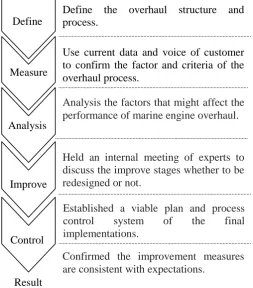
The present was aim to improve the overhaul performance of the case company. The research procedure was shown in Figure 3. The present study firstly investigated the goals of business and customers. Secondly, the present study employed Six Sigma program to improve overhaul performance. Finally, confirm the improving steps and results (efficiency and profit).
Figure 3: Research procedure of the present study Define
Measure
Result Analysis
Improve
Control
Define the overhaul structure and process.
Analysis the factors that might affect the performance of marine engine overhaul.
Held an internal meeting of experts to discuss the improve stages whether to be redesigned or not.
Confirmed the improvement measures
are consistent with expectations.
Established a viable plan and process
control system of the final implementations.
Use current data and voice of customer to confirm the factor and criteria of the overhaul process.
Increased efficiency, profit, and customer satisfaction Customers Goal:
Price
Guarantee Period Delivery
Business Goal: Cost
Quality Time
Table I shows the research stage and contents of improving overhaul process, which includes four stages: analyse the current status, establish improving steps, implement improving step, and confirm the improved status after implement the improving step.
Table I
RESEARCH STAGES AND CONTENTS OF THE IMPROVING STEPS OF OVERHAUL PROCESS
Research stage Research contents Analyze the
current status
Analyze the current status of overhaul performance of CAT 3412 marine engine.
Establish the improving steps
According to the current status analysis and conducted six sigma program to establish the improving steps. Implement the
improving steps
Implement improving steps which established in above stage.
Confirm the improved status
Compared the different of overhaul performance between current and after improved and confirmed the improving steps.
IV. IMPROVEMENT PROCEDURE
A.
Analyze the Current Status
1) CAT 3412 marine engine
Figure 4 and Table II shows the structure details and names of CAT 3412 marine engine.
Figure 4:Structure detail of CAT 3412 marine engine
Table II
STRUCTURE NAMES OF CAT3412MARINE ENGINE
(1) Turbochargers (2) Air filter elements (3) Fuel transfer pump (4) Crankcase breather
(5) Lifting eyes (6) Electronic control
module (7) Cooling system filler
cap
(8) Air intake shutoff
(9) Injection actuation pressure control valve
(10) Engine oil filler
(11) Unit injector hydraulic pump
(12) Flywheel housing
(13) Engine oil level gauge (14) Heat exchanger (15) Fuel priming pump (16) Primary fuel filter (17) Secondary fuel filters (18) Jacket water heater (19) Crankcase oil drain
plugs
(20) Engine oil filters
(21) Crankshaft vibration damper
(22) Auxiliary water pump
2) CAT 3412 marine engine overhaul procedure
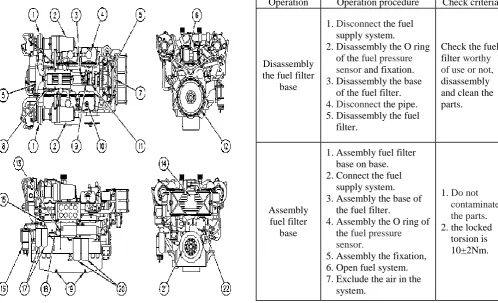
Table III shows the Partial illustration (fuel filter base) of overhaul operation procedure analysis of CAT 3412 marine engine.
Table III
PARTIAL ILLUSTRATION (FUEL FILTER BASE) OF OVERHAUL OPERATION PROCEDURE ANALYSIS OF CAT3412MARINE
ENGINE
Operation Operation procedure Check criteria
Disassembly the fuel filter
base
1. Disconnect the fuel
supply system.
2. Disassembly the O ring of the fuel pressure
sensor and fixation.
3. Disassembly the base of the fuel filter.
4. Disconnect the pipe.
5. Disassembly the fuel filter.
Check the fuel filter worthy of use or not,
disassembly and clean the parts.
Assembly fuel filter
base
1. Assembly fuel filter base on base. 2. Connect the fuel
supply system. 3. Assembly the base of
the fuel filter.
4. Assembly the O ring of
the fuel pressure
sensor.
5. Assembly the fixation, 6. Open fuel system. 7. Exclude the air in the
system.
1. Do not
contaminate
the parts.
3) Eight types of waste
Try to find the eight types of waste (I-U-WE-TO-DO) of the overhaul plant. Table IV shows the items and contents of eight types of waste which developed by case company.
Table IV
ITEMS AND CONTENTS OF THE EIGHT TYPES OF WASTE
Waste items Waste contents
Inventory Excess raw material, work-in-process or finished goods.
Unused creativity/ capability
Lost opportunities due to poor safety and an underutilized workforce.
Waiting
Lost time due to poor product and/or process flow-shortages, bottlenecks, down machines and errors.
Excess motion Waste movement made while working.
Transportation Excess and inefficient movement of work-in-process.
Over processing
Work that adds no value to the customer or business.
Defect
Production or rework of out-of-specification parts. Rework due to information errors or processes not adering standard work.
Over production
Excesssupply beyond the requirements of the next process.
4) Current wastes status of the overhaul plant
There are four major wastes in current status: (1) waiting: due to the weight of components usually geaterthan 40 kgs, therefore, must used hydraulic dray to transportation the location in order to obey the labor legislation. However, there are only 1 hydraulic dray and 1 stacker. The transportation task must wait the hydraulic dray and stacker to carry out. This resulted about 2 technicians and 10 working hours waiting for each excavator. (2) Excess motion: the sizes of the components were not the same, therefore, usually have to use 2 technicians to transport the components. This caused the excess motion waste about 2 technicians and 4 working hours for each marine engine. (3) Transportation: due to the inefficient movement of work-in-process. This resulted about 1 technicians and 2 working hours waste for each excavator. Table V shows the PQVC analysis of the wastes and the objects of the overhaul plant.
Table V
PQVCANALYSIS OF THE OVERHAUL PLANT
Wastes Objects
Unfamiliar with assembly procedures People
Parts list is incorrect Quality
Marked untrue Velocity
Inefficiencies and excessive overtime hours Cost
B. Established the Improving Steps
1) Lead time
Generally, in time-based competition measure, usually focus on the lead time of manufacture, supply chain, information flow, and R&D (Bicheno, 2004). The lead time also includes work-in-process between production batch, waiting time, processing time, and transfer time. Takahiro (1999) also indicated that company must focus on the difference of manufacture system and information transfer in time-based competition measure.
2) Supply chain management
The supply chain management played a vital role in pull system. If the company can establish efficiency supply chain, it can improve their operation performance and competition ability (Tan et al., 1998). Kerin and Sethuraman (1998) indicated that long-term cooperation partnership can result better cooperation performance, reduce transaction costs, and increase customer value.
3) Smooth the production flow
This production flow gives the customer value, and covered the product, information, and services in the production system. The process of normalized production refers to the actual demand for the product according to the period, balanced flow and output in the production line, minimum waiting time of customers, minimize the shortage, and avoid insufficient capacity during the peak period. Equalization the staff working time, so that production workers will not sometimes faster or slower (Womack and Johns, 1994). The concept of production flow includes smooth the production flow and pull production system the common approach of improving production systems.
4) Pull production system
This pull production system and smooth the production flow are the two main principles of just-in-time production system. The kanban is the most important tool and the information transfer tool in the pull production system among the processes (Monden, 1983).
5) Multi-skill workers
6) Statistical process control
Statistical process control (SPC) has become an important tool of practitioners to solve manufacturing process and product standards, improve quality and continuous improvement.
7) Manufacturing operating performance
Lean production program has a significant contribution for the overall manufacturing performance, which is likely to enhance manufacturing capacity, improve product quality and rapid speed to market, and better ability to respond to customers (Womack and Johns, 1994). The plant used lean production program, such as multi-skill workers or small batch production, not only can manufacture in a wide range of products, but also can retain the high quality and productivity (Panizzolo, 1998). Hunter (2003) indicated that the four properties of lean production program: reduced unit costs, one hundred percent of the high quality, the shortest cycle time, and maximum the output flexibility. The advantages of lean production program includes: enhance productivity and product quality, shorten customer lead time, shorten the cycle time, and reduce costs (Shah and Ward, 2003).
C.Implement the Improving Steps
The present developed and proposed several improving steps based on lean production program. Table V shows the PQVC analysis of the overhaul plant. And, Figure 5 shows the partial illustrations and statements of the improving steps of the overhaul plant.
Figure 5(a): Before improved of marine engine after overhaul
Figure 5(b): After improved of marine engine after overhaul
D. Confirm the Improved Status
Table VI shows the improved status of the overhaul plant. After seven months improved, the overhaul performance had significantly improved. The overhaul workforce efficiency was increased about 14% and increased about 4% of profit after implenemt the improving steps with three stages.
Table VI
THE IMPROVED STATUS OF THE OVERHAUL PLANT
Baseline Stage 1 Stage 2 Stage 3
Quality, costs, profit,
satisfaction
Overhaul quality Reduce cost
Service quality Reduce cost
Delivery time
Customer satisfaction
A% A+4% A+8% A+14%
V.
CONCLUSION
The purpose of present study is to develop overhaul improving steps to reduce the total overhaul cost, to and to increase the profit, and increase customer’s satisfaction. After implement the improving steps about seven months, the overhaul workforce efficiency was increased about 14% and increased about 4% of profit. The results were confirmed that the overhaul performance of marine engine can be improved by the improving steps which conducted by Six Sigma program.
VI. REFERENCES
[1] Bicheno, J., 2004. The new lean toolbox: toward fast, flexible flow, 3rd edition, PICISIE Books.
[2] Hunter, S. l., 2003. An introduction to a lean production system, FDM Management, 75(13): 58-60.
[4] Kwak,Y.H. and Anbari, F.T., 2006. Benefits, obstacles, and future of six sigma approach , Technovation, 26(5-6): 708-715. [5] Majchrzak, A. and Wang, Q., 1996. Breaking the functional
mind-set in process organizations, Harvard Business Review, 74(5): 93-99.
[6] McDonald, T.N., 2004. Analysis of worker assignment policies on 102 production line performance utilizing a multi-skilled workforce, Blacksburg, Virginia.
[7] Monden, Y., 1983. Toyota production system, Industrial Engineering Management Press.
[8] Panizzolo, R., 1998. Applying the lessons from lean manufacturers- the relevance of relationships management, International Journal of Production Economics , 55: 223-240. [9] Shah, R. and Ward, P.T, 2003. Lean manufacturing: context,
practice bundles, and performance, Journal of Operations Management, 21: 129-149.
[10] Takahiro, F., 1999. The evolution of a manufacturing system at Toyota, New York: Oxford University Press.
[11] Tan, K., Kannan, V.R., Handfield, R.B. and Ghosh, S., 1999. Supply chain management: an empirical study of its impact on performance, International Journal of Operations and Production Management, 19(10): 1034-1052.
[12] Volpe, C.E., 1996. The impact of cross-training on team functioning: an empirical investigation, Human Factors, 38(1): 87-100.