CLINICAL REPORT
Pediatric Observation Units
abstract
Pediatric observation units (OUs) are hospital areas used to provide medical evaluation and/or management for health-related conditions in children, typically for a well-defined, brief period. Pediatric OUs rep-resent an emerging alternative site of care for selected groups of chil-dren who historically may have received their treatment in an ambulatory setting, emergency department, or hospital-based inpatient unit. This clinical report provides an overview of pediatric OUs, including the definitions and operating characteristics of different types of OUs, quality considerations and coding for observation services, and the effect of OUs on inpatient hospital utilization. Pediatrics 2012;130:172–179
BACKGROUND INFORMATION
Across the United States, hospitals providing care for children are facing the challenges of limited inpatient and emergency department (ED) bed capacity and pressures to decrease health care costs and improve efficiencies, quality, and patient safety. One approach has been the establishment of pediatric observation units (OUs). OUs have become widely used in adult medicine to provide hospital-level patient care on a short-term basis, providing efficient care of adults with chest pain, asthma, congestive heart failure, overdose, and many other diagnoses.1–4Although the numbers of pediatric OUs and of children treated in them are not tracked or reported on a national basis, a growing body of literature and interest in these units accompanying health care reform support the notion that the number of OUs may increase in the near future. In this context, it is important that pediatricians be familiar with the clinical and operating character-istics of OUs.
DEFINITIONS
Efforts to categorize different OU models are hampered by a lack of universally accepted terminology and definitions. Nonetheless, OUs may be described on the basis of location, scope of clinical activity, or intended function. A recent Institute of Medicine report5described OUs as“separate areas that allow for observation of patients to determine whether admission is necessary”; this is a common perspective. OUs may also serve as an alternate site for treatment of selected con-ditions. And in some hospitals, the OU may serve both functions. In a recent study from a children’s hospital with extensive OU experience,
Gregory P. Conners, MD, MPH, MBA, Sanford M. Melzer, MD, MBA, COMMITTEE ON HOSPITAL CARE, and COMMITTEE ON PEDIATRIC EMERGENCY MEDICINE
KEY WORDS
pediatric, observation unit, observation status, emergency department, inpatient
ABBREVIATIONS
CPT—Current Procedural Terminology
ED—emergency department OU—observation unit
This document is copyrighted and is property of the American Academy of Pediatrics and its Board of Directors. All authors havefiled conflict of interest statements with the American Academy of Pediatrics. Any conflicts have been resolved through a process approved by the Board of Directors. The American Academy of Pediatrics has neither solicited nor accepted any commercial involvement in the development of the content of this publication.
The guidance in this report does not indicate an exclusive course of treatment or serve as a standard of medical care. Variations, taking into account individual circumstances, may be appropriate.
www.pediatrics.org/cgi/doi/10.1542/peds.2012-1358
doi:10.1542/peds.2012-1358
All clinical reports from the American Academy of Pediatrics automatically expire 5 years after publication unless reaffirmed, revised, or retired at or before that time.
PEDIATRICS (ISSN Numbers: Print, 0031-4005; Online, 1098-4275).
the OU was described both as “ dedi-cated areas where patients may be treated or observed for a defined time period to determine the need for in-patient admission” and as a “ disposi-tion opdisposi-tion for children who are judged to be too ill for home management.”6 This range of descriptions demonstrates that there may be considerable over-lap between different types and func-tions of OUs, even within a single institution.
The following are definitions related to OUs and observation care from recent literature, acknowledging that termi-nology varies widely. As the pediatric OU management and research liter-ature evolves, it will be important to have standardized terminology for ac-curate comparison and referencing purposes.
Traditional inpatient care: Admis-sion of a patient to a hospital in-patient setting for management or diagnosis of a health-related con-dition, typically for more than 24 hours. Observation unit (OU): A hospital area used to manage and/or diagnose a health-related condition, typically for a well-defined, brief period (typically under 24 or 48 hours). Use of the word “observation” suggests that patients will be frequently reas-sessed to monitor progression of illness or response to therapy. Observation services: Services fur-nished by a hospital on its prem-ises, including the use of a bed, periodic monitoring by nursing and other staff, and other reasonable and necessary services to evaluate a pa-tient’s condition or determine the need for a possible (inpatient) ad-mission to the hospital. Observation status: Observation status is a level of care determi-nation that is often assigned to patients who present to an ED (or a private office or clinic) and re-quire a period of monitoring before a decision is made concerning ad-mission or discharge. Observation status generally results in a deci-sion to continue observation care (Current Procedural Terminology [CPT] codes 99224–99226 for subse-quent observation care [Table 1]), admit the patient (ie, change them to inpatient status with the report-ing of CPT codes 99221–99223 for initial hospital care), or discharge the patient (CPT code 99217 for ob-servation care discharge). A patient need not be in a designated OU to be considered in observation sta-tus, and likewise, placing a patient in an OU does not constitute initia-tion of observainitia-tion-status care. Clinical decision unit: Often usedsynonymously with OU, this is a more descriptive term for an area
designated for assessment of patients for whom more time is needed to make a decision whether to admit for traditional inpatient care.5
Rapid (or extended) treatmentunit, short-stay unit, 23-hour unit: These and similar terms are some-times used synonymously with OU. Their time-specific nature suggests a special emphasis on expeditious patient disposition as a key ele-ment of their operation, although observation stays can be longer than 24 hours.
Hybrid OU: Hybrid OUs provide both the short-term diagnostic and man-agement work performed in the typical OU and hospital-level care for scheduled, brief, elective admis-sions, typically for diagnostic or therapeutic procedures. The most common of these pediatric proce-dures is provision of sedation for a painful diagnostic procedure such as lumbar puncture or bone mar-row aspirate,6admissions for infu-sions, pH probe studies, or recovery from anesthesia.6,7Hybrid units may enhance operating efficiencies in that they use a unit’s resources for different activities at different times, leading to smoother bed and staffing demands.6,8–10The term“hybrid unit,” as described here, is not consistently applied. The au-thor of a 2001 review defined the dual mission of a“hybrid or com-bined unit” differently, calling it
“an OU where both pediatric and adult patients can be treated or observed.”11
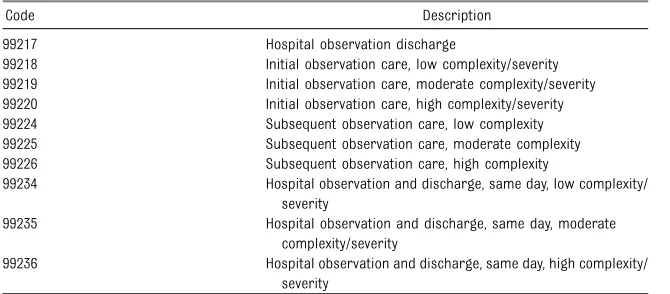
Holding unit, overflow unit, delayed admission unit: Because hospital overcrowding has led to significant numbers of admitted patients be-ing kept in EDs and other areas of hospitals that have not previously provided traditional inpatient care, some hospitals have designated 1 or more specific areas to provideTABLE 1 Observation-Related CPT Codes
Code Description
99217 Hospital observation discharge
99218 Initial observation care, low complexity/severity 99219 Initial observation care, moderate complexity/severity 99220 Initial observation care, high complexity/severity 99224 Subsequent observation care, low complexity 99225 Subsequent observation care, moderate complexity 99226 Subsequent observation care, high complexity
99234 Hospital observation and discharge, same day, low complexity/ severity
99235 Hospital observation and discharge, same day, moderate complexity/severity
99236 Hospital observation and discharge, same day, high complexity/ severity
overlap with the mission of an OU, depending on individual hospi-tal requirements.12 It is important to be aware that, just as is the case with EDs, holding inpatients in OUs that are designed for rapid pa-tient turnover will impinge on their ability to perform their primary missions.
OPERATING CHARACTERISTICS OF PEDIATRIC OUs
Clinical Staffing
Optimal management of an OU requires a team approach, with all involved being focused on the goal of efficient yet safe patient management. Although management of OUs is typically led by physicians, including emergency physicians, hospitalists,13,14or a small-but growing group of dedicated
“observationalists,”nurse practitioners and/or physician assistants often play in-tegral roles as well.15,16Using a hospital-based provider staff allows for the frequent rounding and decision-making usually associated with observation status. However, treatment of children in an OU or coding for such services is not limited to hospital-based physicians. The quality of pediatric OU care can be enhanced with dedicated, experienced nursing staff with specific pediatric experience. To enhance efficiency and decrease OU length of stay and waiting time, a well-organized system to schedule and interpret laboratory, im-aging, and other test results is also important.
The role of residents and other trainees in the operation of OUs lo-cated in academic training centers is variable, and the literature on this topic is scant. A survey of interns during a rotation on a short-stay unit indicated that their educational expe-rience was favorable.17 The authors suggested that the unit’s clustering of
the intern’s educational experience. Exposing residents to patients in the OU also provides them with experi-ence with lower-acuity patients than they would obtain in caring for those on hospital wards alone.
Clinical Care Provided in OUs
Studies describing the diagnoses of children cared for in OUs have revealed that these units may provide effective care for a wide range of common pediatric illnesses and con-ditions.18The most frequent pediatric observation diagnoses include the following: respiratory conditions, such as asthma, bronchiolitis, and croup; gastroenteritis/dehydration and abdomi-nal pain; and prolonged observation of patients with head or other injuries, potential appendicitis, or toxic inges-tions. OUs can also be used by day surgery or ambulatory procedure patients who have a delayed recovery time from sedation or anesthesia or whose postoperative/procedure pain is not well controlled. These conditions lend themselves to specific guidelines of care, and for this reason, diagnostic dilemmas are typically not well suited for the OU. Admission criteria to the OU are typically based on age, degree of illness, diagnosis, and the patient’s then-current location (ED, clinic, primary care, etc). Although specific guidelines governing patient admission to OUs are universally recognized as critical to OU operations, it is also important to maintain flexibility in patient selection. Reconciling the intensity of expected OU care with available unit staffing is also important, because physician and nursing availability may vary with time of day or at time of peak volumes.
Location of Observation Care
Although traditional pediatric inpatient care is predominantly provided on
a variety of settings. This may include a geographic location (or locations) specifically designated as a pediatric OU or a mixed adult-pediatric OU. These units are most commonly found adja-cent to or contiguous with an ED; however, others are distinct units in a hospital setting.6,12,19,20In either case, a patient is physically transferred to an OU, often after an initial period as an ED patient. Alternatively, observation services may be provided to patients who physically remain in an ED or who are on a hospitalfloor or other setting, such as a postanesthesia care unit. Observation services may be provided to patients who do not meet the spe-cific admission criteria of a defined OU, who are at hospitals that have chosen not to dedicate space to a discrete OU,21or who may simply not fit in an already-full OU.
OUs, uniquely positioned at the interface of inpatient and outpatient care, present certain unique compliance, regulatory, and risk-management issues. In some states, OU beds may not count against a hospital’s quota of licensed, inpatient beds and/or be subject to certificate of need determinations. An area of regu-latory uncertainty relates to obligations created under the Emergency Medical Treatment and Labor Act for patients in observation status. In addition, OU care, with its unique billing codes and hos-pital requirements, requires careful at-tention to clinical protocols as well as documentation and management of med-ical records.
MEASURING AND ENSURING QUALITY OF CARE IN OUs
attention to developing policies and procedures addressing administration, staffing, quality assurance, patient safety, equipment, clinical protocols for treatment, and quality measures. Macy et al18 have suggested compo-nents of a performance metrics“ dash-board” for pediatric OUs. Although some of the most commonly cited OU-specific quality measures include return visit rates, length of stay, and
financial performance, consistent and comparative measures of opera-tional and clinical performance have been hampered by a lack of standard definitions.18
As an example, return visit rates will vary depending on the follow-up time period, the type of return visits being tracked, and how closely the initial and subsequent medical conditions are related. Similarly, OU length of stay determination will vary depending on the definition of the starting and ending points of care. In addition, variability in accounting methods to report and al-locate OU revenue and costs creates challenges in describing the economic outcomes of OU care.
The rate of admission for traditional inpatient care after observation ser-vices is also frequently tracked as a quality marker. Although sometimes characterized as“failed observation,”18 progress to traditional hospital ad-mission should be expected of a sub-stantial portion of patients receiving observation services, especially those being observed to determine whether hospital admission will be required. The frequency of inpatient admission among children initially treated in OUs varies widely and may be impacted by medical condition or admission and discharge criteria for individual units. Reported admission rates range from 4% for diagnoses such as croup and seizures to, in some cases, more than 50% for respiratory conditions such as bronchiolitis.6,16,18,20,22,23 An overall
rate of 15% to 25% conversion from observation to full inpatient status is commonly reported.18Rates higher or lower than these suggest a need for reevaluation of admission criteria.
Attempts to identify the clinical fea-tures that differentiate which specific patients will go on to require an in-patient admission from those who will be discharged have had only marginal success. The clinical characteristics of patients more likely to require ad-mission from an OU vary widely by diagnosis and care provided. Studies of children with asthma treated in an OU did notfind meaningful differences in clinical characteristics of patients who were successfully discharged from the OU and those who required hospital admission, except for a per-sistent need for oxygen supplemen-tation.24,25 Hypoxia also predicts hospital admission for children with bronchiolitis.23 Among children with dehydration caused by gastroenteri-tis and treated in an OU, unplanned admission was required in 19%, al-though there were no significant as-sociations between specific historical, physical examination, or laboratory characteristics and the need for ad-mission.26Young age (<30 days) has been shown to be associated with a risk of inpatient admission, along with diagnoses of hematochezia, vi-ral pneumonia, and bronchiolitis.18 Among patients with closed head injuries treated in an OU in a pediatric level 1 trauma center, patients with basilar skull fracture, head laceration, or the need for intravenous fluids were more likely to need inpatient admission after OU management.27 A recent study at a major children’s hospital revealed use of certain resources, including intravenousfluids and medications, cardiorespiratory monitoring, respiratory therapy, sub-specialty consultation, and oxygen, were associated with hospitalization.28
The diagnoses most commonly leading to hospitalization included asthma, adenitis, cellulitis, bronchiolitis, and the presence of esophageal foreign bodies.28
In addition to return visit and hospital admission rates, best practices in OUs generally include tracking other clini-cal quality metrics. Examples include the following: adverse events, patient outcomes, satisfaction (of patients, parents,29staff, and referring or pri-mary care physicians30), and compli-ance with clinical protocols.18
The clinical characteristics of patients who are receiving observation serv-ices support the use of standardized clinical pathways for common diag-noses such as croup31 and dehydra-tion.15 Although the quality effect of these pathways can be difficult to measure, standardized care has been shown to reduce the length of stay for patients in an OU compared with pa-tients with equivalent conditions in an inpatient unit32by reducing unneces-sary variations in care. The nature of OU care also requires clear indications as to when patients are moved out of observation status, either to inpatient hospital admission or discharge, providing additional opportunities to standardize care.
In addition to standard care protocols, safety and family-centered care may be enhanced through effective com-munication in the OU. Medical control responsibilities should be clearly delineated for all patients to ensure smooth transitions from the ED, operating room, or procedure area to inpatient or off-unit testing areas to reduce the risks associated with
“handovers”or transfers of care from 1 site to another. After an episode of OU care, a discharge summary and follow-up plan provided to the family and primary provider is important to support the child’s family and medical home.33
A benefit of OUs is that they may re-duce the rate of admissions to in-patient units. Although there are limited data to support this claim, OUs may have an especially important ef-fect on pediatric inpatient admissions, in part because a significant number of inpatient admissions among chil-dren are of relatively short duration. An analysis of the Nationwide Inpatient Sample database, an all-payer na-tionally representative data set of hospital discharges compiled by the Agency for Healthcare Research and Quality, revealed that since 1999, nearly one-third of children hospital-ized in the United States have stayed fewer than 2 nights.34 Furthermore, the proportion of short-stay patients (0 or 1 night) increased from 25% to 30% between 1993 and 2003. Many of these patients are likely eligible for care in OUs.
Several studies support the notion that observation services can substitute for traditional inpatient admission. In a study of inpatient pediatric admis-sions for asthma in Rochester, NY, more than 70% of admissions could either have been avoided entirely or patients could have been treated in an observation setting.35In another study of emergency asthma care in a pedi-atric ED before and after imple-mentation of an OU, the admission rate for asthma decreased 23%, al-though there was a modest increase in asthma-related return visits to the ED.36 In a retrospective review of admissions for croup to a children’s hospital after introduction of an OU, the rate of hospitalization among
“nondischargeable” children with croup decreased from 9.5% to 4.2%, and median charges and length of stay were also decreased in the OU group.37 A study of an ED-based OU in France revealed that among 509
authors concluded that having an OU reduced patient hospitalizations while generating few inappropriate short-stay hospitalizations. A recent study of a British pediatric OU had similar
findings.12
In published studies comparing ob-servation care to inpatient care for selected diagnoses and cases, OU length of stay has been described as shorter than the inpatient alterna-tive.32,37–40Because the care model in the OU may involve fewer handovers, more protocol-driven care, and more frequent patient assessment when compared with traditional inpatient care, reduction in length of stay in these units may be achieved by re-ducing the time from when the patient is clinically ready for discharge un-til actual departure from the unit. A chart review of 220 patients admitted to an Australian teaching hospital re-vealed that 65% of patients were medically ready for discharge within 12 hours.41 The authors also found that the actual length of stay was closer to 17 hours, and they postu-lated that unnecessary delays caused by administrative aspects of hospital admission and the relatively infre-quent evaluation of patients in inpa-tient settings may lengthen the period of admission. They suggested that many short-stay patients who are admitted to hospitals may be eligible for care in OUs. McConnochie et al42 have shown similar results in a US study of pediatric patients admitted for gastroenteritis. Despite a growing body of evidence supporting the con-cept that observation services can substitute for inpatient admissions, however, there are insufficient data to assess the overall effect of OUs on pediatric inpatient use rates across the United States.18
fl
perience long delays when ED rooms are being used by patients needing ongoing treatment or awaiting an in-patient bed. A computer simulation study at the Children’s Hospital in Vancouver British Columbia43revealed that an OU would reduce wait times in the pediatric ED by creating additional capacity and improving patient flow. Although it is plausible that establish-ing an OU could lead to increased hospitalization, because some patients who would previously have been dis-charged after ED evaluation might in-stead be admitted to the OU, this was not found in a recent, large, pro-spective pediatric study.28
CODING FOR OBSERVATION CARE
Historically, observation care has been clinically defined as care provided in less than 48 hours. However, for the purposes of coding and reporting of clinical services provided to observa-tion patients, many payers, including Medicaid, have defined observation status by using clinical criteria that do not depend on time. Rather, observation status is more typically characterized as a set of clinically appropriate spe-cific services that include ongoing short-term treatment, assessment, and reassessment before deciding whether a patient requires further treatment as a hospital inpatient or discharge from the outpatient hospital, independent of the time required for treatment.
under “evaluation and management” services.44 The observation codes rep-resent an unusual set of CPT codes. They represent physician services that lie between ambulatory and outpatient care and inpatient admission services. These codes may be reported by physicians practicing any specialty, including emergency physicians, hospitalists, and office, clinic, or hospital-based general pediatricians or pediatric medical sub-specialists. The coding rules governing the reporting of professional fee codes for observation services are not the same as the reporting rules that health plans or state Medicaid agencies use to determine observation or inpatient sta-tus, which in turn determines facility payments. In general, the attending physician makes the determination as to whether the care provided is at the level of observation or inpatient. However, hospitals or payers including Medicaid frequently define observation care by using clinical characteristics developed by companies such as InterQual,45 and these characteristics may vary depend-ing on payer and geographic area.
The use of observation codes is based on the level, rather than the location, of care provided and, like all evaluation and management coding, requires careful documentation of the history, examination, and medical decision-making. Observation services may be reported by physicians for patients treated in an ED, OU, or an inpatient or other hospital unit. These codes are divided into those used when the child is both placed on observation status and discharged on the same date of service versus those used when the child is placed on observation status 1 day and sent home on another. When the child’s observation services are begun and completed on the same date of service, the code set 99234– 99236 is used. One or more physicians practicing the same specialty may not bill the same patient for the same
complaint or illness on the same day. Thus, for example, an emergency physician or 2 emergency physicians may not submit professional bills for both emergency care and observation care on the same day. If the child is seen for the same complaint or ill-ness in a number of different sites of service by a single physician (eg,
of-fice, ED, observation, and inpatient admission), only 1 code representing the final disposition of the patient is reported for that date. However, practitioners of different specialties, such as an emergency physician who
first evaluates a patient and another physician practicing pediatrics in an OU, may submit separate professional bills on the first calendar day of ad-mission, even if they are evaluating the same complaint or illness. When the child is placed on observation care on 1 date and discharged from the hospital on another calendar day, the 99218–99220 code set is used for the initial date of service, the code set 99226–99226 is used for subsequent days, and 99217 is used on the dis-charge day.46Children meeting clinical criteria may be transferred to in-patient status with the use of initial and subsequent inpatient care codes as determined by history, physical examination, and medical decision-making. An order reflecting the sta-tus change should be written. Code 99217 should not be used when a pa-tient is transferred from observation to inpatient status.
CONCLUSIONS
With continued financial pressures to reduce costs of care as well as greater emphasis on efficiency and patient-centered care, it is likely that many hospitals providing care for children will offer observation services to children and that pediatricians will be increasingly likely to work in an OU or refer patients for OU care. Many
children previously cared for in a tra-ditional inpatient hospital setting may be safely and efficiently cared for in an OU. However, the operation of pediatric OUs presents distinct challenges, in-cluding a lack of uniform definitions for the types of OU care, the selection of patients for OU services, and the unique requirements to deliver care that may end with either admission or discharge. Pediatricians, managers, and other care providers should be aware of the unique coding and reporting requirements for observation services and ensure that the docu-mentation provided supports the se-lection of specific observation care codes. Quality of care in OUs may be enhanced with defined criteria for ad-mission and discharge, use of stan-dardized clinical protocols, and clearly defined policies and procedures
de-fining responsibility for the patient’s care while in observation status. A growing research base, largely descriptive to date, suggests that OUs enhance the care of children; further research is necessary to better describe the con-tributions of OUs to overall pediatric health.
LEAD AUTHORS
Gregory P. Conners, MD, MPH, MBA Sanford M. Melzer, MD, MBA
COMMITTEE ON HOSPITAL CARE, 2011–2012
Jack M. Percelay, MD, MPH, Chairperson James M. Betts, MD
Maribeth B. Chitkara, MD Jennifer A. Jewell, MD Patricia S. Lye, MD Laura J. Mirkinson, MD
FORMER COMMITTEE MEMBERS
Jerrold M. Eichner, MD, Chairperson Sanford M. Melzer, MD, MBA
LIAISONS
Chris Brown, MS, CCLS–Child Life Council Lynne Lostocco, RN, MSN–National Association of Children’s Hospitals and Related Institutions Richard A. Salerno, MD – Section on Critical Care
Professional and Technical Advisory Commit-tee, The Joint Commission
STAFF
S. Niccole Alexander, MPP
COMMITTEE ON PEDIATRIC
EMERGENCY MEDICINE, 2011–2012
Kathy N. Shaw, MD, MSCE, Chairperson Alice D. Ackerman, MD, MBA
Thomas H. Chun, MD, MPH Gregory P. Conners, MD, MPH, MBA
Brian R. Moore, MD Steven M. Selbst, MD Joseph L. Wright, MD, MPH
LIAISONS
Isabel A. Barata, MD – American College of Emergency Physicians
Kim Bullock, MD–American Academy of Family Physicians
Toni K. Gross, MD, MPH–National Association of EMS Physicians
Elizabeth Edgerton, MD, MPH –Maternal and Child Health Bureau
Resource Center
Cynthia Wright Johnson, MSN, RNC–National Association of State EMS Officials
Lou E. Romig, MD – National Association of Emergency Medical Technicians
Sally K. Snow, RN, BSN – Emergency Nurses Association
David W. Tuggle, MD – American College of Surgeons
STAFF
Sue Tellez
REFERENCES
1. Ross MA, Graff LG. Presenting the obser-vation unit concept to administration and payors. In: Graf LG, ed.Observation Units. Dallas, TX: American College of Emergency Physicians; 1998:6–15
2. Graff L, Radford MJ, Werne C. Probability of appendicitis before and after observation. Ann Emerg Med. 1991;20(5):503–507 3. Lee TH, Juarez G, Cook EF, et al. Ruling out
acute myocardial infarction. A prospective multicenter validation of a 12-hour strategy for patients at low risk.N Engl J Med. 1991; 324(18):1239–1246
4. Graff LG, Dallara J, Ross MA, et al. Impact on the care of the emergency department chest pain patient from the chest pain evaluation registry (CHEPER) study. Am J Cardiol. 1997;80(5):563–568
5. Institute of Medicine, Committee on the Fu-ture of Emergency Care in the United States Health System. Hospital-Based Emergency Care: At the Breaking Point. Washington, DC: The National Academies Press; 2007 6. Zebrack M, Kadish H, Nelson D. The
pedi-atric hybrid observation unit: an analysis of 6477 consecutive patient encounters. Pediatrics. 2005;115(5). Available at: www. pediatrics.org/cgi/content/full/115/5/e535 7. D’Errico C, Voepel-Lewis TD, Siewert M,
Malviya S. Prolonged recovery stay and unplanned admission of the pediatric sur-gical outpatient: an observational study. J Clin Anesth. 1998;10(6):482–487 8. Ross MA, Naylor S, Compton S, Gibb KA,
Wilson AG. Maximizing use of the emer-gency department observation unit: a novel hybrid design.Ann Emerg Med. 2001;37(3): 267–274
9. ‘Hybrid’ obs unit offsets 60% volume growth.ED Manag. 2008;20(12):139–141
10. Bond GR, Wiegand CB. Estimated use of a pediatric emergency department observa-tion unit.Ann Emerg Med. 1997;29(6):739–742 11. Mace SE. Pediatric observation medicine. Emerg Med Clin North Am. 2001;19(1):239– 254
12. Levett I, Berry K, Wacogne I. Review of a paediatric emergency department ob-servation unit. Emerg Med J. 2006;23(8): 612–613
13. Abenhaim HA, Kahn SR, Raffoul J, Becker MR. Program description: a hospitalist-run, medical short-stay unit in a teaching hos-pital.CMAJ. 2000;163(11):1477–1480 14. Ogershok PR, Li X, Palmer HC, Moore RS,
Weisse ME, Ferrari ND. Restructuring an academic pediatric inpatient service using concepts developed by hospitalists. Clin Pediatr (Phila). 2001;40(12):653–660, dis-cussion 661–662
15. Martineau O, Martinot A, Hue V, Chartier A, Dorkenoo A, Guimber D. Effectiveness of a short-stay observation unit in a pediatric emergency department [in French]. Arch Pediatr. 2003;10(5):410–416
16. Silvestri A, McDaniel-Yakscoe N, O’Neill K, et al. Observation medicine: the expanded role of the nurse practitioner in a pediatric emergency department extended care unit. Pediatr Emerg Care. 2005;21(3):199–202 17. Marks MK, Baskin MN, Lovejoy FH, Jr;Hafler
JP. Intern learning and education in a short stay unit. A qualitative study.Arch Pediatr Adolesc Med. 1997;151(2):193–198 18. Macy ML, Kim CS, Sasson C, Lozon MM,
Davis MM. Pediatric observation units in the United States: a systematic review. J Hosp Med. 2010;5(3):172–182
19. Leduc K, Haley-Andrews S, Rannie M. An observation unit in a pediatric emergency
department: one children’s hospital’s expe-rience.J Emerg Nurs. 2002;28(5):407–413 20. Scribano PV, Wiley JF, II, Platt K. Use of an
observation unit by a pediatric emergency department for common pediatric ill-nesses. Pediatr Emerg Care. 2001;17(5): 321–323
21. Crocetti MT, Barone MA, Amin DD, Walker AR. Pediatric observation status beds on an inpatient unit: an integrated care model. Pediatr Emerg Care. 2004;20(1):17–21 22. Browne GJ. A short stay or 23-hour ward in
a general and academic children’s hospital: are they effective? Pediatr Emerg Care. 2000;16(4):223–229
23. Sandweiss DR, Corneli HM, Kadish HA. Bar-riers to discharge from a 24-hour observa-tion unit for children with bronchiolitis. Pediatr Emerg Care. 2010;26(12):892–896 24. Gouin S, Patel H. Utilization analysis of an
observation unit for children with asthma. Pediatr Emerg Care. 1999;15(2):79–83 25. Miescier MJ, Nelson DS, Firth SD, Kadish
HA. Children with asthma admitted to a pediatric observation unit.Pediatr Emerg Care. 2005;21(10):645–649
26. Mallory MD, Kadish H, Zebrack M, Nelson D. Use of a pediatric observation unit for treatment of children with dehydration caused by gastroenteritis. Pediatr Emerg Care. 2006;22(1):1–6
27. Holsti M, Kadish HA, Sill BL, Firth SD, Nelson DS. Pediatric closed head injuries treated in an observation unit.Pediatr Emerg Care. 2005;21(10):639–644
29. Arendts G, MacKenzie J, Lee JK. Discharge planning and patient satisfaction in an emergency short-stay unit. Emerg Med Australas. 2006;18(1):7–14
30. Rentz AC, Kadish HA, Nelson DS. Physician satisfaction with a pediatric observation unit administered by pediatric emergency medicine physicians. Pediatr Emerg Care. 2004;20(7):430–432
31. Chin R, Browne GJ, Lam LT, McCaskill ME, Fasher B, Hort J. Effectiveness of a croup clinical pathway in the management of children with croup presenting to an emergency department. J Paediatr Child Health. 2002;38(4):382–387
32. Calello DP, Alpern ER, McDaniel-Yakscoe M, Garrett BL, Shaw KN, Osterhoudt KC. Obser-vation unit experience for pediatric poison exposures.J Med Toxicol. 2009;5(1):15–19 33. American Academy of Family Physicians,
American Academy of Pediatrics, American College of Physicians, American Osteopathic Association. Joint principles of the patient-centered medical home. Elk Grove Village, IL: American Academy of Pediatrics; 2010. Available at: http://practice.aap.org/content. aspx?aid=2063. Accessed January 10, 2012 34. Macy ML, Stanley RM, Lozon MM, Sasson C,
Gebremariam A, Davis MM. Trends in high-turnover stays among children hospitalized
in the United States, 1993-2003.Pediatrics. 2009;123(3):996–1002
35. McConnochie KM, Russo MJ, McBride JT, Szilagyi PG, Brooks AM, Roghmann KJ. How commonly are children hospitalized for asthma eligible for care in alternative set-tings?Arch Pediatr Adolesc Med. 1999;153 (1):49–55
36. Gouin S, Macarthur C, Parkin PC, Schuh S. Effect of a pediatric observation unit on the rate of hospitalization for asthma. Ann Emerg Med. 1997;29(2):218–222
37. Greenberg RA, Dudley NC, Rittichier KK. A reduction in hospitalization, length of stay, and hospital charges for croup with the institution of a pediatric observation unit. Am J Emerg Med. 2006;24(7):818–821 38. Bajaj L, Roback MG. Postreduction
man-agement of intussusception in a children’s hospital emergency department. Pediat-rics. 2003;112(6 pt 1):1302–1307
39. Wathen JE, MacKenzie T, Bothner JP. Use-fulness of the serum electrolyte panel in the management of pediatric dehydration treated with intravenously administered
fluids.Pediatrics. 2004;114(5):1227–1234 40. Listernick R, Zieserl E, Davis AT. Outpatient
oral rehydration in the United States.Am J Dis Child. 1986;140(3):211–215
41. Numa A, Oberklaid F. Can short hospital admissions be avoided? A review of admissions of less than 24 hours’duration in a paediatric teaching hospital. Med J Aust. 1991;155(6):395–398
42. McConnochie KM, Conners GP, Lu E, Wilson C. How commonly are children hospitalized for dehydration eligible for care in alter-native settings?Arch Pediatr Adolesc Med. 1999;153(12):1233–1241
43. Hung GR, Kissoon N. Impact of an obser-vation unit and an emergency department-admitted patient transfer mandate in decreasing overcrowding in a pediatric emergency department: a discrete event simulation exercise. Pediatr Emerg Care. 2009;25(3):160–163
44. American Medical Association.Physicians’ Current Procedural Terminology (CPT). Chicago, IL: American Medical Association; 2012
45. Mitus AJ. The birth of InterQual: evidence-based decision support criteria that helped change healthcare.Prof Case Manag. 2008; 13(4):228–233
46. American Academy of Pediatrics. Coding for Noncritical Inpatient and Observation Services: The Dilemma. Pediatric Coding Companion. Elk Grove Village, IL: American Academy of Pediatrics; 2006:1–5
DOI: 10.1542/peds.2012-1358 originally published online June 25, 2012;
2012;130;172
Pediatrics
Services
Updated Information &
http://pediatrics.aappublications.org/content/130/1/172
including high resolution figures, can be found at:
References
http://pediatrics.aappublications.org/content/130/1/172#BIBL
This article cites 41 articles, 6 of which you can access for free at:
Subspecialty Collections
sub
http://www.aappublications.org/cgi/collection/emergency_medicine_ Emergency Medicine
ic_emergency_medicine
http://www.aappublications.org/cgi/collection/committee_on_pediatr Committee on Pediatric Emergency Medicine
l_care
http://www.aappublications.org/cgi/collection/committee_on_hospita Committee on Hospital Care
http://www.aappublications.org/cgi/collection/current_policy Current Policy
following collection(s):
This article, along with others on similar topics, appears in the
Permissions & Licensing
http://www.aappublications.org/site/misc/Permissions.xhtml
in its entirety can be found online at:
Information about reproducing this article in parts (figures, tables) or
Reprints
http://www.aappublications.org/site/misc/reprints.xhtml
DOI: 10.1542/peds.2012-1358 originally published online June 25, 2012;
2012;130;172
Pediatrics
COMMITTEE ON PEDIATRIC EMERGENCY MEDICINE
Gregory P. Conners, Sanford M. Melzer, COMMITTEE ON HOSPITAL CARE and
Pediatric Observation Units
http://pediatrics.aappublications.org/content/130/1/172
located on the World Wide Web at:
The online version of this article, along with updated information and services, is
by the American Academy of Pediatrics. All rights reserved. Print ISSN: 1073-0397.