© 2016 IJSRST | Volume 2 | Issue 5 | Print ISSN: 2395-6011 | Online ISSN: 2395-602X Themed Section: Engineering and Technology
Inversion of Space in the Classical Kinematics of Material Point
Zvezdelin Ivanov Peykov
*1, Angel Todorov Apostolov
2*1,2 Department of Physics, University of Architecture, Civil Engineering and Geodesy, Sofia, Bulgaria
ABSTRACT
A definition is given of inversion of space based on its fundamental property to determine the direction between any two different points in it, where a material point moves between. Some examples are examined of inversion of space for different movements. The influence of inversion of space on the main kinematic quantities shown, characterizing the movement of the material point. Many different types of movements examined in case of inversion of space: 1) Reversible movements in which inversion is possible. These are all constant motions and movements in which the tangential acceleration is proportional to the velocity.
2) Irreversible movements in which the inversion is impossible. These are all movements in which the tangential acceleration has a particular source in space.
Coordination of the basic kinematic laws at inversion of space has shown. Some major conclusions in the inversion of space has drawn and their impact on classical physics.
Keywords:
Space, Inversion of Space
I.
INTRODUCTION
In our previous work [1] we examined in details the issue of inversion of time in the classic kinematics of material point. The question arises - if the time is reversible in the classical kinematics, whether the inversion of space can be realised and how it affects the mechanical movements in it?
II.
METHODS AND MATERIAL
A. Definition
Many authors [3-5] consider that the inversion of space consists of a transition from a right to left orientating coordinate system and substitute of the radius-vector r with the opposite one rr. We are not agreed with this definition because it gives only a reflection of space which is not equivalent to its inversion.
What inversion (reversal) of space means? In order to give a definition of this concept, we shall use the fundamental property of space to determine the direction in it - between two points: starting point A and ending
point B. Let a material point passes a distance
AB along the arbitrary trajectory between them. Under inversion of space we shall understand the point to go through the same spatial positions between the two points, but in
reverse order
BA without inversion of time, with velocities with reverse direction and same sizes in every moment of time, but different for a particular point of the trajectory (i.e. preserving the nature of the initial movement and the type of trajectory). Thus moving point determines the opposite direction in space on its trajectory.
B.Realization of space inversion
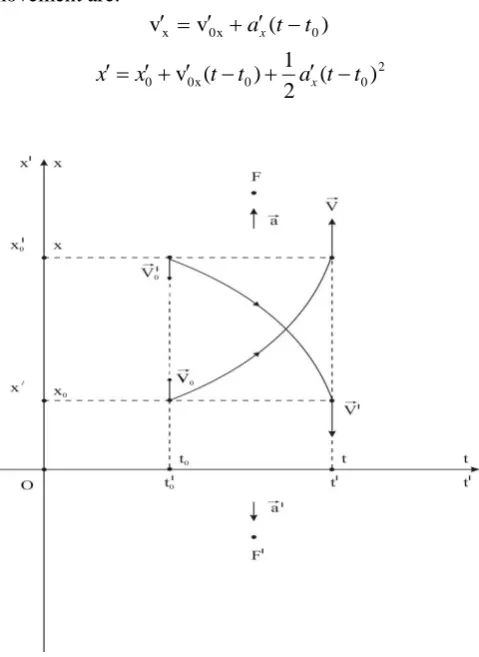
First example: Constant straight-line motion (Fig. 1).
Let consider a material point, which moves constantly in a straight line along the axis Ox, as in the initial moment of time t0 its spatial position has coordinate x0 and initial
velocity v0
. In the final moment of time t it is in a
position x with final velocityv v0
. The projection of the laws of velocity and movement along the axis Ox has a type:
const t
t)v ( ) (
vx 0x 0
) ( v ) ( )
(t x0 t0 0x t t0
x
Figure 1 : Inversion of space at constant straight-line motion
In accordance with the definition in case of inversion of space the point must go back the distance from x to x0 for the same instants of time in the interval (t0 , t), preserving the nature of its movement - constant straight-line motion again, but in the opposite direction along the axis Ox. The relevant laws in case of inversion of space have type:
const t
t ( ) v ( )
vx 0x 0
) ( v ) ( )
(t x0 t0 0x t t0 x
If in the first law we replace the projection of the initial inverted velocity with the negative value of the projection of the initial non-inverted velocity:
) ( v ) (
v0x t0 0x t0 , and in the second law - the initial inverted position with the final non-inverted position:
) ( ) (0 0 t xt
x (while preserving the instants of time: t'0 =
t0 and t` = t and the course of time as well) we shall receive:
const t
t t
t ( ) v ( ) v ( ) v ()
vx 0x 0 0x 0 x
) ( v ) ( ) ( v ) ( )
(t x0 t0 0x t t0 x t 0x t t0 x
If in the second law we replace x(t) with its equal from the non-inverted law, we shall receive:
) ( ) (t x0 t0 x
i.e. the point reaches the initial position, starting from the final position:
) ( ) (0 0 t x t x
The graphics of the inverted law is shown in Figure 1.
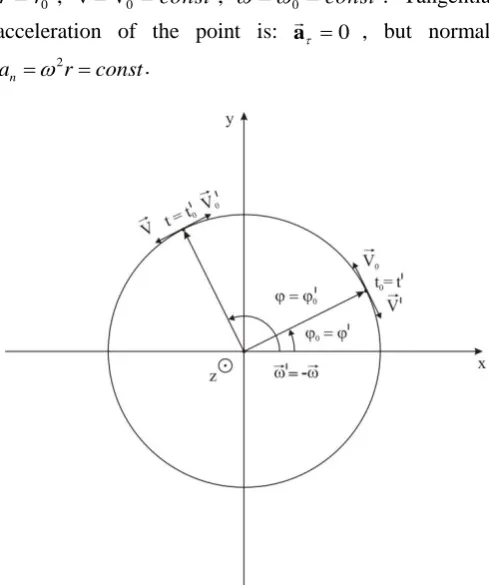
Second example: Constant motion in a circle (Fig. 2).
Let consider a material point, which moves constantly in a circle. At the initial instant of time t0 it is in the position with radius vector r0, position angle
0 andinitial angular and linear velocity: v0 and
0. In thefinal moment t the point moving constantly in a circle in
the right direction has parameters: r,
, v and
, as:0 r
r , vv0 const , 0 const
. Tangential
acceleration of the point is: a 0 , but normal: const
r an
2
.
Figure 2 : Inversion of space at constant motion in a circle
Respectively the laws of velocity and movement are: const
t t) ( ) ( 0 0
) ( ) ( )
(t 0 t0 0 tt0
Relevant laws in inversion of space are: const t
t ( ) 0(0)
) ( ) ( )
(t 0 t0 0 tt0
In them we replace:
0( )
t
0
with
( )
t
,
0(t )0 with0( )t0
const t
t t
t ( ) 0(0) 0(0) ( )
) ( ) ( ) ( ) ( ) ( ) ( ) ( ) ( ) ( 0 0 0 0 0 0 0 0 0 0 0 0 0 0 t t t t t t t t t t t t t
It can be seen that the point moves constantly back from final to initial position with the same size of the velocity.
Inverted normal acceleration is preserved:
n
n r r a
a 0 2 2
) (
Common in both examined examples of inversion of space is that in the inverted laws (which have the same type as the non-inverted – the nature of movement has preserved) we replace the initial inverted velocity with reverse non-inverted velocity and the initial inverted position - with the final non-inverted position. This ensures consistency between the straight and reverse laws.
C. Inversion of space at the kinematic parameters describing the motion
We shall examine how the inversion of space affects the kinematic parameters describing the motion of a material point. Change of direction in space we shall reflect replacing the moments of time t΄ with t as the initial position becomes final and vice versa, and we shall change the directions of the initial velocities:
0
0 v
v for a particular instant of time according to
the mentioned above. The nature of the motion preserves. (See Figures 1 and 2). Here unfortunately the impact on the kinematic variables is less pronounced than in the inversion of time (see [1]) because of the fact that in one and the same instant of time the material point has different spatial positions at the direct and reverse movement.
1. Positions and moments:
t
t - instant of time.
)
(
)
(
t
r
t
r
- radius vector;
- positional angle at motion in a circle;2. Changes in the position and time:
displacement: r r r r r r r
r
0 0 ( 0)
s s
- distance angle of rotation:
0 0 ( 0)
t t t t t
t
2 1 2 1 - time interval
The same applies to differential changes without those for displacement and angle of rotation:
r d r
d
d
d
TT - period
T
T
1
1
- frequency ср срt
t
- averagecircular frequency. But:
dt
d
t
d
d
3. Velocities
dt
d
t
d
d
dt
t
d
v
r
d
r
d
v
But: (t) -) t ( v(t) ) t ( v
(Note: Here the sizes of the velocities and angular velocities at irregular movements are different from their corresponding inverted values at equal points of trajectories.)
v r r
v
- the right-hand screw rule is preserved4. Velocity Changes
v v v v v
v
0 0
But: vvv0 vv0 v
0 ( 0)
(The same is relevant to the differential changes.)
5. Accelerations
a
v
d
v
d
a
dt
t
d
e
e
e
a
a
v v v
dt
d
dt
d
t
d
d
v
)
(
v
v
But: a(t)a(t)
(Here, a unit vector indicating the direction of the
velocity, changes its direction: ev ev
n
n n n a
a
2
(
)2
(Here the radius of curvature of the trajectory and the normal vector to it does not change under inversion of space in order to preserve the type of trajectory.)
a a a a a
a n n
dt
d
t
d
d
r
r aa
Similarly can be considered and the time derivatives of higher order.
6. Laws of motion, velocity and acceleration
According to the first part of the definition of the inversion of space - the material point to pass through the same spatial positions, but in reverse order - follows that the rights and reverse law of motion must be coordinated by initial and end position:
0
( )t ( )t
0
r r and r0 ( )t0 r( )t
According to the second part of the definition – the velocity of the material point to preserve its size in a particular moment of time, but to alter its direction backwards - follows that that the rights and reverse law of motion must be coordinated by initial and final velocity.
(t) -) t (
v(t) ) t ( v
According to the third part of the definition – the nature of the movement (respectively the type of the trajectory) to be preserved follows that:
) ( ) (t a t a
) ( )
(r r a r r an n
7. Equations of motion
We shall examine how the inversion of time affects the fundamental equation of motion in classical mechanics - the second law of Newton [2].
F a a
F mm
(Here mm - body mass, which does not change at the inversion of space)
It is seen that the equation of motion (the second principle of dynamics) in general does not preserve at the inversion of space - i.e. it is not reversible and the
inversion of space is impossible. But there are certain movements in which it becomes reversible (see below) and the inversion of the space becomes possible.
D. Examples of movements inverted in space.
To answer the question which movements are reversible in space, we shall use the theorem of decomposition of random movement:
r(t)r0(t0)v0(tt0)
a dtdt
andtdt
Rest
At rest: a 0, an 0
, v0 0 .
As the rest is the absence of movement (r r0
), we cannot determine whether it is reversible in space, because the starting and ending position of the point match and it is impossible the direction in space to be determined.
Reversible movements:
Let: a 0, an
- random. This case corresponds to all
regular movements:
1. Constant straight-line motion.
In this case an 0. As we saw above, this movement is reversible in space.
2. Constant motion in a circle.
In this case:
a
n
2
const
. As seen above, this motion is reversible in space as well. Here, as an example of reversible motion we can add uniform motion in a helical line.3. Uniform curvilinear movements - general case.
In this case: an nconst
2
v
. Because of preservation
the kind of trajectory at the right and inverted movement for each its point, it follows:
) ( v
v ) (
2 2
r r a n n
r r
an n
In this case, the normal acceleration (normal force
F
F) determines only the radius of the curvature of the trajectory in any point. In case of inversion of the space it (respectively the force) does not change.
We shall prove the following theorem - all regular movements are reversible in space.
for curvilinear axis S [6] with direction coinciding with the direction of movement. The projection of the normal acceleration to this axis at any moment of time is:
0
ns
a . The movement is constant, i.e. a 0
. The
projection of the velocity in the direction of the axis at any moment of time is an algebraic value: vs(t)const.
The law of velocity of movement of the point has the form:
const
t 0s
s( ) v
v
The respective law of the velocity of the inverted
movement is:
const
t
0s
s( ) v
v
This law is consistent with the law of straight
movement:
const t
t
t
s 0s s 0s
s( ) v ( ) v v ( ) v
v
The relevant laws of motion have the following kind:
)
(
v
)
(
)
(
v
)
(
0 0s 0
0 0s 0
t
t
s
t
s
t
t
s
t
s
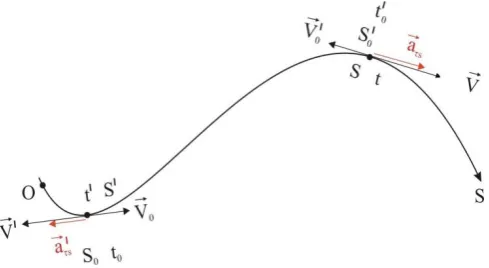
Figure 3 : Inversion of space at random constant movement
They are also consistent between them, if we consider that: s0 s and v0s v0s.
0 0 0s 0 0s 0
0 0s
)
(
v
)
(
v
)
(
v
)
(
)
(
s
t
t
t
t
s
t
t
t
s
t
s
Thus the theorem is proven.
The main conclusion is in force that all uniform movements - straight and reverse - run in one and the same way in the time and space and therefore they cannot serve as an indication of the condition of the space - whether it is inverted or not.
Irreversible movements:
Let now: a 0, an 0
. This case corresponds
to all straight movements.
1. Uniformly variable movements.
In these movements a const. Although in this case
consistence of straight and inverted laws for the velocity and movement can be achieved, they appear irreversible in case of inversion of space. We shall show this with the example of the uniformly accelerated straight line motion (Figure 4). Let the material point moves under constant acceleration along the axis Ox. Respectively the laws of velocity and movement are of the type:
) ( v
vx 0xax tt0
2 0 0
0x
0 ( )
2 1 ) (
v t t a t t
x
x x
If we invert space, the relevant laws for the reverted movement are:
) ( v
vx 0xax tt0
2 0 0
0x
0 ( )
2 1 ) (
v t t a t t
x
x x
Figure 4 : Impossibility of space inversion at uniformly accelerated straight-line motion
It proves that they are coordinated with those for the straight movement. Indeed, at: v0x v0x, x0 x and
x
x a
a , we have:
x 0
0x
x v ( ) v
0 2 0 0
0x ( )
2 1 ) (
v t t a t t x
x
x x
However, the movement is irreversible in space, because the direction of the acceleration changed contrariwise. From the second principle of dynamics this leads to a change of position of the source of the acceleration (force) - from F becomes F΄. However, in an inversion of the space the source of the force does not change! That is why indicated movement is irreversible. Such is the uniformly decelerated straight line motion as well.
2. Variable straight-line movements.
In them: a const
. (This includes the important case
of harmonic oscillation of the material point). For the same reason - contradiction with the second principle of dynamics - they are also irreversible in space.
3. Variable curvilinear movements – general case.
For them: a const , an const
. These include
elliptic, parabolic and hyperbolic movements in a gravitational field.
We shall prove the following theorem: all variable movements in which acceleration (force) has a determinate source in space, are irreversible in case of inversion of space.
Let consider the motion of a material point in arbitrary definite space curve that we shall choose here as a curvilinear coordinate (Figure 5).
Figure 5: Impossibility of space inversion at arbitrary variable movement
Acceleration laws at straight and inverted movement have type:
0
0
ns ns
a
a
as(s,t)as(s,t)const
Accordingly, velocity laws are:
dt a t
dt a t
s s
0s s
0s s
v ) ( v
v ) ( v
If we take into consideration that: v0s v0s, we shall
see that they are consistent with each other:
) ( v v
v ) ( v
s s
0s s
t dt
a dt a
dt a t
s s
s
Accordingly, the laws of motion are:
dtdt a t
t s
t s
dtdt a t
t s
t s
s s
0 0s 0
0 0s 0
) ( v )
(
) ( v )
(
If we consider that: s0 s, we shall see that they also
are consistent with each other:
0 0
0s
0 0s 0
0 0s
)
(
v
)
(
v
)
(
v
)
(
s
dt
dt
a
t
t
dt
dt
a
t
t
s
dt
dt
a
t
t
s
t
s
s s
s
Nevertheless the inverted movement is impossible because we come to conflict with the second law of dynamics:
)
,
(
)
,
(
s
t
m
m
s
t
a
a
F
F
Furthermore, the normal acceleration at straight and inverted variable movement is different for a point of trajectory:
) ( v
v ) (
2 2
r r a n n
r r
an n
which leads to the inability to preserve the nature of the trajectory at space inversion. Because of preserving the position of the source of force in the space at its inversion and changing the type of trajectory these movements are irreversible.
Special case of reversible variable movements.
Let consider the special case of variables straight-line movements where the tangential acceleration is proportional to a particular power of velocity:
v
e v a kn
where k is a proportionality coefficient, and n = 0, 1, 2, 3, ... is an integer. (Such movements have been considered in [1] in case of inversion of time and they were completely irreversible).
The sign (-) corresponds to the accelerations obtained by the action of so-called dissipative forces of friction and resistance to movement of the body in a given environment. Examples of such forces:
TABLE 1
n = 0 - Forces of dry friction at sliding of the body on some surface;
n = 1 - the resistance forces in case of movement of the body with minor velocity into a viscous fluid - so-called resistance as a result of friction;
n = 2 - vortex resistance on the body, moving at high velocity in a fluid;
n = 3 - resistance due to shock wave at movement of the body with a supersonic velocity in a fluid , etc.
All of these forces tend to decrease of the kinetic energy of the moving body, which is dissipated to the environment [1]. The work of these forces is negative.
The sign (+) corresponds to the accelerations, obtained by the action of so-called cumulative forces, which act on the body, when the environment is moving along it. These forces increase the kinetic energy of the body at the expense of energy from the environment and the work they do is positive.
In both cases, the acceleration of the body is parallel to the velocity and the movement is delayed or accelerating.
It turns out that these movements are reversible in case of inversion of space.
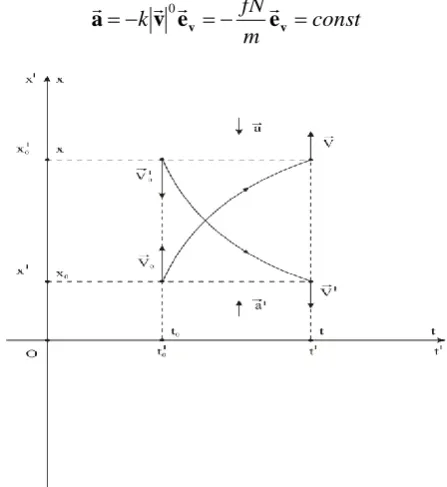
For example, let consider the movement occurring under the action of dissipative forces of dry friction at slipping (Figure 6). Let a body moves in a straight line along the axis Ox (it slides freely) on a support. Its movement will be delayed by the force of friction:
const fN
fN
v
T e
v
F
v
where f is the coefficient of friction at sliding, N - the pressure of the body on the support, and ev is the unit
vector having always the direction of the velocity. From the second principle of the dynamics for the acceleration of the body we shall obtain:
const m
fN
k
v ev ev
a 0
Figure 6 : Special case of inversion of space in motion with forces of dry friction at slipping
where m is the mass of the body. What is important in this case is that the direction of acceleration is always opposite to the direction of the velocity. From the projection of the above law of acceleration along the axis Ох when integrate, we get the law of the velocity.
) ( v
) (
vx 0x ev t t0 m
fN
t
The movement is uniformly decelerated. Through re-integrating in t, we receive the law of movement as well:
2 0 v 0
0x
0 ( )
2 1 ) ( v )
( e t t
m fN t
t x
t
x
Let now to invert space:
) ( ) ( )
( v ev a t
m fN e
m N f t
ax x
) ( v
) (
vx 0 ev t t0
m N f
t x
2 0 v 0
0x
0 ( )
2 1 ) ( v )
( e t t
m N f t
t x
t
x
Straight and inverted laws are consistent with each other:
) ( v ) ( )
( v
) ( v
) ( v
x 0 v 0
v x
0 v 0x
x
t t
t e m fN t t e m fN
t t e m fN t
) ( ) ( 2 1 ) ( v
) ( 2 1 ) ( v
) ( 2 1 ) ( v )
(
0 0 2 0 0
0x
2 0 v 0
0x 0
2 0 0
0x
t x t t e m fN t
t
t t e m fN t
t x
t t e m fN t
t x t x
v
v
and also the resistance force:
F F
It is seen that this motion is reversible in the case of inversion of the space.
Similarly we may consider other examples as well of movement under the influence of dissipative and cumulative forces, which also appear to be reversible. The reason for this is that the source of these forces is each point of the environment in which the body is moving and they always turn their direction, when the direction of the velocity changes contrariwise in case of inversion of the movement. This ensures the correctness of the second law of dynamics. The trajectory always remains a straight line.
III.
RESULTS AND DISCUSSION
We shall summarize the conclusions made up to now. 1. Inversion of space in kinematics means moving
material point to pass in reverse order through the same spatial positions, preserving the nature of the starting movement.
2. Equations in kinematics (law of motion, velocity, acceleration, etc.) are consistent at the inversion of space if tangential accelerations disproportionate to the velocity are absent.
3. There are two types of movements concerning the inversion of space:
a) Reversible movements – that are all constant movements and straight-line movements, in which the acceleration is proportional to the velocity. They show
that the space can be inverted, but not determine its position.
b) Irreversible movements - these are movements in which the tangential acceleration is proportional to the velocity. The reason for them is the irreversibility of the forces acting on the material point and no preservation of the type of trajectory in case of inversion of space. These movements can be used to determine the condition of the space. Rest does not determine the condition of space.
IV.
REFERENCES
[1]. Z. Peykov, T. Spiridonov, A. Apostolov, Inversion of Time in the Classical Kinematics of Material Point, IJSRST, V.2, №4, p.116-125, 2016.
[2]. Надолийски М., З. Пейков, Учебник по физика, УАСГ, София, 2011. (Nadoliiski M., Peykov Z. Physics Textbook. UACG, Sofia, 2011.)
[3]. Zelevinsky V., Discrete Symmetries, Quantum Physics, v.1, p.187, 2011.
[4]. Roberts J.A.G., Quispel G.R.W., Chaos and Time-reversal symmetry. Order and Chaos in Reversible Dynamical Systems, Physics Reports, v.216, № 2,3, p.63-171, 1992.
[5]. Sargsian M., Lecture2: Classical Space-Time Symmetries, Advanced Quantum Mechanics, 6645 (6), 2014.