Secure Group based Routing and Flawless Trust
Formulation in MANET using Unsupervised Machine
Learning Approach for IoT Applications
Maitreyi Ponguwala
1,* and DR.Sreenivasa Rao
21Research Scholar of JNTUH, MGIT Hyderabad, India, [email protected] 2Professor in Dept. Of CSE, JNTUH Hyderabad, India, [email protected]
Abstract
INTRODUCTION: Mobile Adhoc Network (MANET) is integrated with Internet of Things (IoT) in many application cases due to its flexibility and scalability. The dynamic nature of MANET introduces some security threats in IoT environment. In those threats, Blackhole attack and Grayhole attack are severe routing attacks that disrupts routing algorithm to crack transmission in the entire network.
OBJECTIVES: Many security mechanisms are introduced in MANET based on trust computation schemes. However, computation of inaccurate trust value degrades the performance of mitigation schemes. Thus the major objective of this work is to design a novel security mechanism to protect the MANET-IoT from different adversaries.
METHODS: in this paper we propose a novel group based routing algorithm with recommendation filtering supported by security monitors (SMs). Unsupervised machine learning algorithm is adapted for the purpose of recommendation filtering in the network. Initially the entire network is grouped by Secure Certificate based Group Formation (SCGF) algorithm. In each group, Recommendation Filtering by K-means algorithm (RF-K means) algorithm is employed to perform trust computation. For secure and optimal route selection, hybrid optimization algorithm that combines Genetic Algorithm and Fire Fly Algorithm (GA-FFA) is proposed. Data transmission is protected by novel Hash Message Authentication Code with Advanced Encryption Standard (HMAC-AES) algorithm in which hash function is integrated with cryptography function.
RESULTS: The proposed work is validated in network simulator-3 environment and the obtained results show better performance in terms of packet delivery ratio (96.3%), throughput (135kbps), delay (3.26ms), detection rate (99%), and energy consumption (8.5%).
CONCLUSION: The MANET-IoT network is secured by group formation and trust filtering approaches. Further, involvement of cryptography function ensures data security whereas hash function ensures data integrity..
Keywords: MANET, Recommendation Filtering, Blackhole, Grayhole, IoT applications.
Received on 20 March 2019, accepted on 03 August 2019, published on 09 October 2019
Copyright © 2019 Maitreyi Ponguwala et al., licensed to EAI. This is an open access article distributed under the terms of the Creative Commons Attribution licence (http://creativecommons.org/licenses/by/3.0/), which permits unlimited use, distribution and reproduction in any medium so long as the original work is properly cited.
doi: 10.4108/eai.13-7-2018.160834
*Corresponding author. Email: [email protected]
1. Introduction
MANET is an infrastructure-less, dynamic, and distributed network that has self-configurable ability [1]-[3]. MANET comprises group of mobile nodes that establish
technologies increases requirement of IoT nowadays [4], [5]. IoT can be described as a network that comprises millions of heterogeneous devices and enables communication among these smart ‘things’. Empowering opportunistic communication among IoT devices becomes significant since IoT involves with dynamic devices. In order to enable opportunistic communication among IoT devices MANET is integrated with IoT [6], [7]. Immersion of MANET in IoT brings improved connectivity through multi-hop communication and also supports high scalability. With the integration of MANET, IoT applications can be extended in military scenarios, smart city applications, waste management, and disaster management and so on. However, absence of the infrastructure and centralized control increases the presence of security threats in MANET-IoT environment [8], [31]. MANET is vulnerable to security attacks such as jamming attack, Grayhole attack, rushing attack, Blackhole attack, packet dropping attack, and Sybil attack. These attacks degrade the performance of entire network.
Device 5 Blackhole
Device 7
Device 4 Device 1
Device 6
Device 2
Grayhole
Device 3
Successful transmission RREQ
RREP
Packet drop
Packet drop
Figure 1. Blackhole and Grayhole attack in MANET-IoT
Blackhole attack and Grayhole attack are moreover similar routing attacks in MANET-IoT [9], [10]. Both attackers involved in malicious activities such as packet dropping, packet altering, packet redirecting, route alteration, and so on. In figure.1, the behavior of Blackhole attack and Grayhole attack is illustrated. Here the Blackhole attacker receives the data by sending false routing information to source node. It prevents data from reaching destination through dropping received data. This will introduce huge packet loss in the network. Similarly, Grayhole attack is a variant of Blackhole attack that drops only selective packets. In other words, the Grayhole attacker drops selective packets and forwards remaining packets to the destination. In the figure, the Grayhole attacker drops data from Device 1 and forwards the data from Device 2. Majority of
Blackhole and Grayhole attack mitigation schemes utilize trust based methods for attack detection and prevention [32]. In order to mitigate Blackhole attack in MANET a data control packet and extended data routing information table (EDRI) are used in adhoc on-demand distance vector (AODV) protocol [11]. Herein routing path verification process is enabled for attack detection. Mitigation of Blackhole attack in IoT environment is carried out by securing routing protocol over low power lossy network (RPL) protocol [12]. In RPL, destination oriented directed acyclic graph (DODAG) construction is enabled with trust value computation. A flooding factor based framework for trust management (F3TM) is proposed to mitigate Grayhole attack in MANET through trust value computation [13]. For validating network nodes, a grey wolf and swarm optimizer algorithm is introduced. Cryptography schemes are also concentrated to provide security in MANET and IoT [33]. A selective significant data encryption (SSDE) algorithm utilizes Blowfish algorithm [14]. However, the cryptography technique must minimize the overhead and time consumption (i.e.) lightweight cryptography techniques are most suitable for MANET.
1.1 Major Contributions
Many research works are held on IoT and MANET in the perspective of security. But attack detection with data security and integrity is still challenging issue with the increase in number of IoT devices as well as number of adversaries in MANET-IoT environment. To cope with these issues, this paper presents following contributions,
• A novel IoT architecture is designed with the integration of MANET for establishing group based communication. A new entity namely Security Monitor (SM) is deployed in the network to strengthen the security level. Security provisioning is achieved by secure group formation, flawless trust value computation, trusted routing and partial encryption processes.
• Group formation is initialized with group head (GH) selection by SM. SCGF algorithm is proposed to form secure groups in the network. SCGF algorithm not only ensures network security but also supports dynamic mobile network management. Secure grouping process isolates unauthorized nodes in network.
• SM is responsible for flawless trust computation by using RF-K means algorithm. Unsupervised K-means algorithm is adapted for trust computation through recommendation filtering mechanism. By formulating optimal trust computation value, the Grayhole attack detection is performed.
since fitness computation involves with trust value, residual energy, link stability, and hopcount. • Data security and integrity is achieved jointly by
HMAC-AES algorithm. HMAC-AES algorithm performs based on partial encryption and partial hashing process in order to minimize encryption time and overhead without loss in security and integrity.
1.2 Paper organization
The rest of this paper is organized as follows: Section II surveys significant related works held on IoT and MANET for security provision. In section III, the problems existed in previous research works are highlighted. Section IV, details overall process of proposed security mechanism with novel algorithms. Section V, evaluates the proposed work in terms of performance metrics and compares proposed work with previous works. In section VI, we conclude our contributions and highlight the future directions of this work.
2. Related Works
In past few years, enormous numbers of research works are held on MANET and IoT for security provisioning. In this section, we provide detailed literature review on significant previous research work in order to exploit the vital challenging issues in this research area.
2.1. Survey on attack detection methods
In adhoc networks, Blackhole attack detection was performed by fuzzy based trust value computation [15]. Trust value of each node was computed in fuzzy approach based on following metrics: packet delivery ratio, percentage of energy exhaustion, percentage of buffer utilization, and number of connection requests given by a node. If computed trust value was greater than threshold value then that node is considered as normal otherwise that node is considered as Blackhole attacker. However, here node behavior analysis is performed by fuzzy approach (i.e.) threshold computation is an additional process which increases time consumption. Blackhole attack detection was performed based on dynamic threshold cumulative sum (CUSUM) test [16]. Here CUSUM test was utilized in order to detect the changes in normal behavior of AODV’s sequence number. Based on AODV’s sequence number (SQN), a new parameter named as Blackhole intensity was formulated for attack detection. Perhaps this method performs attack detection; this method is not able to secure transmitted data.
Blackhole attack, Grayhole attack and flooding attack were mitigated jointly by multi-level trust computation scheme [17]. Here Elliptic Curve Cryptography was used and the security was categorized into three levels. The first level computes direct trust value and indirect trust value,
then in second level objective and subjective trust was computed and lastly in third level static and dynamic trust was estimated. Summing up of all the three levels of trust, the total trust value was obtained. Although ECC algorithm provides data security, it is not able to ensure data integrity which leads to data alteration. For Grayhole attack detection, denial contradictions with fictitious node mechanism (DCFM) was proposed [18]. The original DCFM algorithm was developed to mitigate node isolation attack in Optimized Link State Routing (OLSR) based routing algorithm. Then the algorithm was improved to extend the attack detection to Grayhole attack. This method was able to handle passive silent attacker, randomly located attacker, initially 1-hop neighbor attacker, shadow attacker, and man in the middle attacker. This method increases complexity while fails to improved detection accuracy. A trusted AODV (TOAV) protocol was presented to mitigate routing attacks in MANET [34]. Herein trust value was represented by opinion. An acknowledgement based method namely 2ACK method was proposed to detect misbehavior in MANET environment [35]. This method was implemented on the top of dynamic source routing (DSR) protocol. In MANET, trust value of node was defined based on mobility, pause time, and remaining battery power [36]. However, consideration of inappropriate trust metrics is inefficient for providing security in MANET. Thus in majority of works, data security is not concentrated which increases vulnerability of data.
2.2. Survey on security mechanisms
To improve security against multiple threats, support vector machine (SVM) based intrusion detection system was proposed for ad-hoc networks [21]. In SVM classifier, average packet drop, average packet reception, and average packet interval were considered for attack detection. However, SVM is a supervised machine learning algorithm which requires huge data size and large time for training. In IoT environment, privacy and security was ensured by incorporating message authentication code (MAC) [22]. For that, a privacy-preserving communication protocol was designed with MAC. However, computing hash function for whole data increases computational complexity as well as memory consumption. In addition, this method is only able to provide data integrity and data security is not provided. In IoT environment, security was ensured by robust ECC based authentication protocol [23]. In this approach, each sensor was registered and authenticated through ECC protocol. Following security services were provided by this method: anonymity, untracebility, forward secrecy, and backward secrecy. Perhaps, this protocol provides authenticity; this method is not able to ensure data security and integrity. In IoT network, communication between nodes and server was secured by heterogeneous ring signcryption scheme [24]. The major objective of this scheme was to defend against ciphertext attacks in the network. This scheme increases time consumption with increase in number of nodes.
Thus all previous research works consider trust value for attack detection in ad-hoc network. However, the trust computation is also vulnerable since malicious node can modify this trust value. Similarly, none of these works is able to achieve data security and data integrity jointly without increase in computational complexity.
3. Problem Definition
In this section, we exploit major problems identified in MANET and IoT for security provisioning. Trusted security AODV (TS-AODV) protocol was designed with IDS to mitigate flooding attack, Blackhole attack, and Grayhole attack [25]. In IDS, a source-trust-rate was provided based on number of route requests generated. Here trust value for source node was computed as follows,
𝑆𝑆𝑆𝑆𝑆𝑆𝑆𝑆𝑆𝑆𝑆𝑆 − 𝑇𝑇𝑆𝑆𝑆𝑆𝑇𝑇𝑇𝑇 = (𝑅𝑅𝑅𝑅𝑅𝑅𝑅𝑅𝐶𝐶𝑆𝑆𝑆𝑆𝐶𝐶𝑇𝑇)−1 (1)
In eqn.(1), trust value for source node was computed based on number of RREQ packets forwarded by that node. However, trust value computation is ineffective since in AODV, each intermediate node broadcast RREQ packet for route selection. Furthermore, route selection based on trust value alone increases number of retransmissions due to frequent link breakages. Fuzzy logic based trust management mechanism were proposed in MANET [26], [27]. In fuzzy based OLSR routing, packet delivery ratio (PDR), and delay were considered for trust computation. However, both PDR and delay metrics are not only affected by malicious activities but also affected by other factors. Thus trust computation based on PDR and delay is not
effectual. Fuzzy based secure architecture (FBSA) was comprised with training and testing phases. Based on fuzzy rules, the network nodes were categorized into malicious, normal, and best node. Here malicious activity is identified by fuzzy rules in which involvement of training phase increases time consumption. In addition, this method is able to identify malicious activities only; not able to detect malicious activities exactly. For mitigating Blackhole attack, a secure-AODV (SAODV) protocol was designed [28]. In SAODV, the first RREP packet received by source node was dropped and the node which sends RREP packet was considered as Blackhole attacker. Nonetheless, it is not ensured that first RREP packet is always malicious. Thus dropping first RREP request is not an intelligent wayto mitigate malicious attack. In addition, SAODV detects only affected path instead of detecting Blackhole attacker.
The problems highlighted in this section are considered in our work and resolved by our novel approaches. The major problems identified in this section are: (i) trust management is not accurate, (ii) route selection is not effectual, and (iii) attack detection is not efficient. Furthermore, data security and integrity is not ensured in all above works.
4. Proposed Secure MANET-IoT
4.1. Network Overview
To improve security and integrity, we design a novel group based routing scheme and flawless trust formulation for MANET-IoT environment. The overall proposed network environment is illustrated in figure.2. Our network environment comprises following entities: 𝐶𝐶 number of MANET-IoT devices/nodes as 𝑁𝑁=𝑁𝑁1,𝑁𝑁2, . . ,𝑁𝑁𝑛𝑛, certificate
authority (CA), 𝑘𝑘 number of security monitors 𝑆𝑆𝑆𝑆= {𝑆𝑆𝑆𝑆1,𝑆𝑆𝑆𝑆2, … ,𝑆𝑆𝑆𝑆𝑘𝑘}, and malicious devices. Security
monitors are responsible for malicious node detection, recommendation filtering and secure group formation. Initially, the devices are grouped by security monitors after certificate verification. For flawless trust value formulation, security monitors utilize RF-K means algorithm. Further, route selection is involved with hybrid optimization algorithm which is effectively designed by combining GA and FFA algorithm with new fitness formulation. Data security and integrity are assured by HMAC-AES algorithm during data transmission. Each significant process is explained in following subsections.
4.2. Secure Group Formation
SM
CA
Flawless trust formulation-
RF-K means algorithm
Optimal Route
Selection-GA-FFA algorithm
Flawless trust distribution
Join request with C
Join Reply after verification
Group formation-
SCGF algorithm
Secure Data Transmission-
HMAC-AES algorithm
Route verification
Join request dropped
Mobile IoT node
Malicious node isolated from group
Route with malicious node Weak links
GH
Source
LS RE FL_TV
SK
Figure 2. Proposed Secure MANET-IoT environment
Involvement of SCGF algorithm improves network management as well as security of the network through certificate verification. Initially, the network is divided into regions based on security monitors. The nodes within the range of each SM belong to corresponding group that is formed by that SM. SCGF algorithm is initiated with optimal GH selection. For optimal GH selection, weighting factor (𝑊𝑊𝑊𝑊) is formulated as follows,
𝑊𝑊𝑊𝑊(𝑁𝑁𝑖𝑖) =𝑅𝑅𝑁𝑁𝑖𝑖−(𝑆𝑆𝑁𝑁𝑖𝑖+𝐴𝐴𝐷𝐷𝑁𝑁𝑖𝑖) (2)
The weighting factor of ‘𝑖𝑖𝑡𝑡ℎ’ node 𝑁𝑁
𝑖𝑖 is computed
based on energy level (𝑅𝑅𝑁𝑁𝑖𝑖), mobility (𝑆𝑆𝑁𝑁𝑖𝑖), and average distance with neighbor nodes (𝐴𝐴𝐷𝐷𝑁𝑁𝑖𝑖). A node with highest
𝑊𝑊𝑊𝑊 in particular region is selected as GH by 𝑆𝑆𝑆𝑆. Then the selected GH is verified through certificate verification. For this purpose, all IoT nodes must be registered with CA in order to obtain certificate (𝐶𝐶) and secret key (𝑆𝑆𝑆𝑆) to form secure group. Each node submits its unique ID (𝐼𝐼𝐷𝐷) and password (𝑃𝑃𝑊𝑊) to CA during registration. Then the CA provides a digital certificate to that corresponding node. The digital certificate consists of ID of the node, signature of CA (𝑆𝑆𝑖𝑖𝑆𝑆𝐶𝐶(𝐶𝐶𝐴𝐴)), and secret key of node, and unique certificate ID (𝐼𝐼𝐷𝐷(𝐶𝐶)). After the completion of
registration, CA distributes the certificates of registered nodes to 𝑆𝑆𝑆𝑆𝑇𝑇 for further verification. The selected GH submits its {𝐼𝐼𝐷𝐷‖𝐶𝐶} to 𝑆𝑆𝑆𝑆 in order to receive group secret (𝐺𝐺𝑆𝑆). When GH submits the {𝐼𝐼𝐷𝐷‖𝐶𝐶}, 𝑆𝑆𝑆𝑆 verifies whether the node is legitimate or not. For verification, 𝑆𝑆𝑆𝑆 checks the 𝑆𝑆𝑖𝑖𝑆𝑆𝐶𝐶(𝐶𝐶𝐴𝐴) in 𝐶𝐶 and encrypt the 𝐺𝐺𝑆𝑆 by using secret key of GH. If the node is legitimate 𝑆𝑆𝑆𝑆 sneds 𝐺𝐺𝑆𝑆 to that node in encrypted form (𝑅𝑅𝐶𝐶{𝐺𝐺𝑆𝑆}) and broadcast the 𝐺𝐺𝐺𝐺
selection message to all other nodes in that region. Thus the node must decrypt the 𝐺𝐺𝑆𝑆 in order to join with group. Upon receiving, 𝐺𝐺𝐺𝐺 selection message, all other nodes sends 𝐽𝐽𝑆𝑆𝑖𝑖𝐶𝐶𝑅𝑅𝑆𝑆𝐽𝐽 to 𝐺𝐺𝐺𝐺. However, for group formation the node must have 𝐺𝐺𝑆𝑆 obtained from 𝑆𝑆𝑆𝑆 (i.e.) the node must be verified by 𝑆𝑆𝑆𝑆. If 𝐺𝐺𝑆𝑆 submitted by node is matched with 𝐺𝐺𝑆𝑆 provided by 𝑆𝑆𝑆𝑆, then 𝐺𝐺𝐺𝐺 sends 𝐽𝐽𝑆𝑆𝑖𝑖𝐶𝐶𝑅𝑅𝑆𝑆𝐽𝐽 to that node. Otherwise, 𝐺𝐺𝐺𝐺 deny the access of that node from group formation. Thus in SCGF algorithm, the legitimate nodes in the region form secure group to establish communication among nodes. Here malicious nodes are isolated form the group through verification.
supports dynamic network management and also supports flawless trust formulation through recommendation filtering.
Registration{ID||PW}
{C}
N1{ID||C}
{ID||C}
JoinReq{GS}
JoinRep for group formation
JoinReq{GS}
GS is matched Yes No N1
CA
SM
Non-legitimate node GH
Secure group
Figure 3. SCGF algorithm based group formation
4.3. Flawless Trust Formulation
In MANET-IoT network, majority of attackers are identified by analyzing trust value. Thus trust value computation plays vital role in security provisioning in MANET-IoT. However, trust value is also subjected to security threats such as trust value distortion attacks. In this type of security threats, the malicious nodes alter the trust value of other nodes during indirect trust computation which introduces unnecessary conflicts in the network. In addition, inaccurate trust computation leads to ineffectual attack detection. In our work, we adapt RF-K means algorithm for flawless trust formulation as well as for Grayhole attack detection. RF-K means algorithm is performed by 𝑆𝑆𝑆𝑆 for trust computation. For each node, 𝑆𝑆𝑆𝑆 computes flawless trust value (𝑊𝑊𝐹𝐹_𝑇𝑇𝑇𝑇) based on trust value provided by other nodes. Thus for each node 𝑊𝑊𝐹𝐹_𝑇𝑇𝑇𝑇, 𝑆𝑆𝑆𝑆 performs RF-K means algorithm. The process of RF-K means algorithm in flawless trust formulation and Grayhole attack detection is described in following steps,
Step 1: In this step, 𝑆𝑆𝑆𝑆 collects 𝑇𝑇𝑇𝑇 from all nodes in the region through GH. In our work, each node computes 𝑇𝑇𝑇𝑇
for its neighboring nodes and transmits it to corresponding GH periodically. Then GH aggregates the
𝑇𝑇𝑇𝑇 and sends 𝑇𝑇𝑇𝑇 to 𝑆𝑆𝑆𝑆. The 𝑇𝑇𝑇𝑇 that is transmitted to 𝑆𝑆𝑆𝑆
is in the form of [𝑁𝑁1→{𝑇𝑇𝑇𝑇𝑇𝑇},𝑁𝑁2→{𝑇𝑇𝑇𝑇𝑇𝑇}, . . ,𝑁𝑁𝑗𝑗→
{𝑇𝑇𝑇𝑇𝑇𝑇}] (i.e.) the node ID (𝑁𝑁1) and its corresponding trust
values are provided by other nodes (𝑇𝑇𝑇𝑇𝑇𝑇). Each node computes 𝑇𝑇𝑇𝑇 of neighboring nodes as follows,
𝑇𝑇𝑇𝑇=𝐵𝐵𝐵𝐵+𝐷𝐷𝑇𝑇𝑇𝑇𝑇𝑇 (3)
For a node 𝑇𝑇𝑇𝑇 is computed in terms of transmission rate (𝑇𝑇𝑅𝑅), buffer size (𝐵𝐵𝑆𝑆), and drop rate (𝐷𝐷𝑅𝑅). Transmission rate of a node (𝑇𝑇𝑅𝑅) is computed as follows,
𝑇𝑇𝑅𝑅=𝑁𝑁𝑁𝑁𝑁𝑁𝑁𝑁𝑁𝑁𝑁𝑁𝑇𝑇𝑜𝑜𝑡𝑡𝑝𝑝𝑇𝑇𝑁𝑁𝑁𝑁𝑁𝑁𝑁𝑁𝑁𝑁𝑁𝑁𝑜𝑜𝑜𝑜𝑝𝑝𝑝𝑝𝑝𝑝𝑘𝑘𝑁𝑁𝑡𝑡𝑝𝑝𝑜𝑜𝑜𝑜𝑝𝑝𝑝𝑝𝑝𝑝𝑘𝑘𝑁𝑁𝑡𝑡𝑝𝑝𝑜𝑜𝑜𝑜𝑁𝑁𝑓𝑓𝑝𝑝𝑁𝑁𝑓𝑓𝑁𝑁𝑓𝑓𝑝𝑝𝑁𝑁𝑛𝑛𝑡𝑡 (4)
Similarly 𝐵𝐵𝑆𝑆 and 𝐷𝐷𝑅𝑅 can be calculated as follows,
𝐵𝐵𝑆𝑆=𝐵𝐵𝑁𝑁𝑜𝑜𝑜𝑜𝑁𝑁𝑁𝑁𝐵𝐵𝑁𝑁𝑜𝑜𝑜𝑜𝑁𝑁𝑁𝑁𝑁𝑁𝑡𝑡𝑖𝑖𝑇𝑇𝑖𝑖𝑈𝑈𝑁𝑁𝑓𝑓𝐵𝐵𝑖𝑖𝑈𝑈𝑁𝑁 (5)
𝐷𝐷𝑅𝑅=𝑇𝑇𝑜𝑜𝑡𝑡𝑝𝑝𝑇𝑇𝑁𝑁𝑁𝑁𝑁𝑁𝑁𝑁𝑁𝑁𝑁𝑁𝑛𝑛𝑁𝑁𝑁𝑁𝑁𝑁𝑁𝑁𝑁𝑁𝑜𝑜𝑜𝑜𝑝𝑝𝑝𝑝𝑝𝑝𝑘𝑘𝑁𝑁𝑡𝑡𝑝𝑝𝑜𝑜𝑜𝑜𝑝𝑝𝑝𝑝𝑝𝑝𝑘𝑘𝑁𝑁𝑡𝑡𝑝𝑝𝑓𝑓𝑁𝑁𝑜𝑜𝑝𝑝𝑝𝑝𝑁𝑁𝑓𝑓𝑝𝑝𝑁𝑁𝑛𝑛𝑡𝑡 (6)
Step 2: In this step, 𝑆𝑆𝑆𝑆 performs RF-K means algorithm for each node based on 𝑇𝑇𝑇𝑇𝑇𝑇 provided by other neighboring nodes. For this purpose, 𝑆𝑆𝑆𝑆 initializes number of clusters 𝑆𝑆value. Thus for each node, 𝑆𝑆 number of clusters are formed for 𝑇𝑇𝑇𝑇𝑇𝑇.
Step 3: Randomly initialize number of centroid as
follows,
𝐶𝐶𝑆𝑆𝐶𝐶𝑇𝑇𝑆𝑆𝑆𝑆𝑖𝑖𝐶𝐶𝑇𝑇= {𝑇𝑇𝑇𝑇𝐶𝐶1,𝑇𝑇𝑇𝑇𝐶𝐶2, … ,𝑇𝑇𝑇𝑇𝐶𝐶𝐶𝐶} (7)
Here the centroids initialized are trust values of a node. Let 𝑁𝑁1 has 𝑇𝑇𝑇𝑇𝑇𝑇 as 𝑇𝑇𝑇𝑇= {𝑇𝑇𝑇𝑇1,𝑇𝑇𝑇𝑇2, . . ,𝑇𝑇𝑇𝑇𝐿𝐿}. Thus from
this set of 𝑇𝑇𝑇𝑇𝑇𝑇, 𝑆𝑆 number of centroids are initialized in random manner.
Step 4: Assign 𝑇𝑇𝑇𝑇𝑇𝑇 to nearest centroid based on trust distance (𝑇𝑇𝐶𝐶𝑖𝑖𝑇𝑇) value. Here the 𝑇𝑇𝐶𝐶𝑖𝑖𝑇𝑇 is computed as the difference between 𝑇𝑇𝑇𝑇 and centroid. For ‘𝑘𝑘𝑡𝑡ℎ’ 𝑇𝑇𝑇𝑇, the
difference with ‘𝑗𝑗𝑡𝑡ℎ’ centroid is computed as,
𝑇𝑇𝐶𝐶𝑖𝑖𝑇𝑇=�𝑇𝑇𝑇𝑇𝐶𝐶𝑗𝑗− 𝑇𝑇𝑇𝑇𝑘𝑘� (8)
𝐼𝐼𝐼𝐼𝑇𝑇𝐶𝐶𝑖𝑖𝑇𝑇(𝑗𝑗,𝑘𝑘) =𝑆𝑆𝑆𝑆𝑆𝑆𝑆𝑆𝑆𝑆, 𝑆𝑆𝑇𝑇𝑇𝑇𝑖𝑖𝑆𝑆𝐶𝐶𝑇𝑇𝑇𝑇𝐶𝐶→ 𝑇𝑇𝑇𝑇𝐶𝐶𝑗𝑗 (9)
Eqn.(9) represents that the 𝑇𝑇𝑇𝑇𝑘𝑘 is assigned to centroid
which minimizes 𝑇𝑇𝐶𝐶𝑖𝑖𝑇𝑇. In this manner, all 𝑇𝑇𝑇𝑇𝑇𝑇 are assigned to closest centroid.
Step 5: In this step, all centroids are updated (i.e.)
recomputed. Then all above steps are performed with new centroid until optimal ‘𝑆𝑆’ clusters are formed. In this step ‘𝑆𝑆’ number of recommendation clusters (𝑅𝑅𝐶𝐶𝑆𝑆𝑇𝑇) are formed as,
𝑅𝑅𝐶𝐶𝑆𝑆𝑇𝑇= {𝑅𝑅𝐶𝐶𝑆𝑆𝑇𝑇1,𝑅𝑅𝐶𝐶𝑆𝑆𝑇𝑇2, … ,𝑅𝑅𝐶𝐶𝑆𝑆𝑇𝑇𝐶𝐶} (10)
which is computed by particular node is too large while by other nodes are low for an attacker. Thus there is high possibility to the attacker to be considered as honest node. In order to avoid this conflict, RF-K means algorithm performs inter-cluster distance computation. Before that, each 𝑇𝑇𝑇𝑇 in each cluster is weighted based on following function,
𝑊𝑊�𝑇𝑇𝑇𝑇𝑗𝑗�=∑ ∆(𝑇𝑇𝑉𝑉𝑗𝑗,𝑇𝑇𝑉𝑉𝑖𝑖)
𝑋𝑋 𝑖𝑖=1
𝑋𝑋 (11)
𝑊𝑊𝑆𝑆𝑖𝑖𝑆𝑆ℎ𝑇𝑇𝑆𝑆𝐶𝐶𝑇𝑇𝑇𝑇𝑗𝑗=𝑇𝑇𝑇𝑇𝑗𝑗×𝑊𝑊(𝑇𝑇𝑇𝑇𝑗𝑗) (12)
Here 𝑋𝑋 represents number of 𝑇𝑇𝑇𝑇𝑇𝑇 in the cluster and
∆(𝑇𝑇𝑇𝑇𝑗𝑗,𝑇𝑇𝑇𝑇𝑖𝑖) represents difference with ‘𝑖𝑖𝑡𝑡ℎ’ 𝑇𝑇𝑇𝑇. In this
manner, each trust value is computed as 𝑤𝑤𝑆𝑆𝑖𝑖𝑆𝑆ℎ𝑇𝑇𝑆𝑆𝐶𝐶𝑇𝑇𝑇𝑇 in this step. After completion of 𝑤𝑤𝑆𝑆𝑖𝑖𝑆𝑆ℎ𝑇𝑇𝑆𝑆𝐶𝐶𝑇𝑇𝑇𝑇 computation, average 𝑤𝑤𝑆𝑆𝑖𝑖𝑆𝑆ℎ𝑇𝑇𝑆𝑆𝐶𝐶𝑇𝑇𝑇𝑇 is computed for each cluster as follows,
𝐴𝐴𝐴𝐴𝑆𝑆𝑇𝑇𝑇𝑇=∑𝑋𝑋𝑗𝑗=1𝑊𝑊𝑁𝑁𝑖𝑖𝑊𝑊ℎ𝑡𝑡𝑁𝑁𝑓𝑓𝑇𝑇𝑉𝑉𝑗𝑗
𝑋𝑋 (13)
This average TV is computed for each cluster in 𝑅𝑅𝐶𝐶𝑆𝑆𝑇𝑇. Then inter-cluster cluster distance is computed as follows,
𝐼𝐼𝐶𝐶𝐶𝐶= |𝑅𝑅𝐶𝐶𝑆𝑆1− 𝑅𝑅𝐶𝐶𝑆𝑆2| (14)
Eqn.(14), represents the inter-cluster distance (𝐼𝐼𝐶𝐶𝐶𝐶) between two clusters 𝑅𝑅𝐶𝐶𝑆𝑆1 and 𝑅𝑅𝐶𝐶𝑆𝑆2. If this distance is
small, then the node is not a Grayhole attacker. Otherwise the node is considered as Grayhole attacker since Grayhole attacker obtains high 𝑇𝑇𝑇𝑇 from particular nodes and obtains low 𝑇𝑇𝑇𝑇 from other nodes.
Step 7: In this step, flawless 𝑇𝑇𝑇𝑇 computation is performed based on majority rule. For each 𝑊𝑊𝐹𝐹_𝑇𝑇𝑇𝑇 is computed as 𝐴𝐴𝐴𝐴𝑆𝑆𝑇𝑇𝑇𝑇 of cluster with large number of 𝑇𝑇𝑇𝑇𝑇𝑇
(i.e.) the 𝑇𝑇𝑇𝑇 which is provided by majority of nodes is assigned as 𝑊𝑊𝐹𝐹_𝑇𝑇𝑇𝑇 as follows,
𝑊𝑊𝐹𝐹_𝑇𝑇𝑇𝑇(𝑗𝑗) =𝐴𝐴𝐴𝐴𝑆𝑆𝑇𝑇𝑇𝑇(𝑗𝑗),𝑖𝑖𝐼𝐼𝑋𝑋=𝑆𝑆𝑆𝑆𝑆𝑆𝑆𝑆𝑆𝑆𝑆𝑆 (15)
Thus in RF-K means algorithm, Grayhole attacker is detected effectually and also 𝑊𝑊𝐹𝐹_𝑇𝑇𝑇𝑇 computation is accomplished. The computed 𝑊𝑊𝐹𝐹_𝑇𝑇𝑇𝑇 for each node is distributed to all other nodes in the group through GH. Then this 𝑇𝑇𝑇𝑇 is further used for optimal route selection.
Pseudocode for RF-K means Input: 𝑆𝑆, collected 𝑇𝑇𝑇𝑇𝑇𝑇 for all nodes
Output: 𝐺𝐺𝑆𝑆𝑆𝑆𝐺𝐺ℎ𝑆𝑆𝑆𝑆𝑆𝑆𝑆𝑆𝑇𝑇𝑇𝑇𝑆𝑆𝑆𝑆𝑘𝑘𝐶𝐶𝑆𝑆𝑇𝑇𝑆𝑆𝑆𝑆𝑇𝑇𝑖𝑖𝑆𝑆𝐶𝐶, 𝑊𝑊𝐹𝐹_𝑇𝑇𝑇𝑇 formulation 1. Begin
2. For 𝑁𝑁𝑖𝑖∈ 𝑆𝑆𝑆𝑆𝑆𝑆𝑆𝑆𝐽𝐽
3. Collect 𝑇𝑇𝑇𝑇= {𝑇𝑇𝑇𝑇1,𝑇𝑇𝑇𝑇2, . . ,𝑇𝑇𝑇𝑇𝐿𝐿}from 𝐺𝐺𝐺𝐺
4. Initialize centroids 5. For each 𝑇𝑇𝑇𝑇𝐽𝐽∈ 𝑇𝑇𝑇𝑇
6. Compute 𝑇𝑇𝐶𝐶𝑖𝑖𝑇𝑇 with centroids
7. Assign 𝑇𝑇𝑇𝑇𝑗𝑗 to centroid which 𝑆𝑆𝑖𝑖𝐶𝐶𝑖𝑖𝑆𝑆𝑖𝑖𝑚𝑚𝑆𝑆𝑇𝑇𝐶𝐶𝑖𝑖𝑇𝑇
8. End for
9. Update centroids
10. Form 𝑅𝑅𝐶𝐶𝑆𝑆𝑇𝑇= {𝑅𝑅𝐶𝐶𝑆𝑆𝑇𝑇1,𝑅𝑅𝐶𝐶𝑆𝑆𝑇𝑇2, … ,𝑅𝑅𝐶𝐶𝑆𝑆𝑇𝑇𝐶𝐶}
11. For each 𝑇𝑇𝑇𝑇 ∈ 𝑅𝑅𝐶𝐶𝑆𝑆
12. Compute 𝑊𝑊(𝑇𝑇𝑇𝑇) using(11) 13. Find 𝑊𝑊𝑆𝑆𝑖𝑖𝑆𝑆ℎ𝑇𝑇𝑆𝑆𝐶𝐶𝑇𝑇𝑇𝑇 using (12) 14. End for
15. For all 𝑅𝑅𝐶𝐶𝑆𝑆𝑇𝑇
16. Compute 𝐴𝐴𝐴𝐴𝑆𝑆𝑇𝑇𝑇𝑇
17. Find 𝐼𝐼𝐶𝐶𝐶𝐶
18. If 𝐼𝐼𝐶𝐶𝐶𝐶==𝐹𝐹𝑆𝑆𝑤𝑤
19. 𝑁𝑁𝑖𝑖𝑖𝑖𝑇𝑇𝑆𝑆𝐺𝐺𝑆𝑆𝑆𝑆𝐺𝐺ℎ𝑆𝑆𝑆𝑆𝑆𝑆𝑆𝑆𝑇𝑇𝑇𝑇𝑆𝑆𝑆𝑆𝑘𝑘𝑆𝑆𝑆𝑆
20. Else
21. 𝑁𝑁𝑖𝑖𝑖𝑖𝑇𝑇ℎ𝑆𝑆𝐶𝐶𝑆𝑆𝑇𝑇𝑇𝑇
22. End if
23. Compute 𝑊𝑊𝐹𝐹_𝑇𝑇𝑇𝑇 using (15) 24. End for
25. End for 26. End
The above pseudocode explains the procedure of proposed RF-K means algorithm. This algorithm can be explained through an example. Consider a node 𝑁𝑁𝑖𝑖 has
three neighbour nodes as 𝑁𝑁𝑖𝑖+1, 𝑁𝑁𝑖𝑖−1, and 𝑁𝑁𝑖𝑖+2. Each node
provides 𝑇𝑇𝑇𝑇𝑇𝑇 for 𝑁𝑁𝑖𝑖 as follows, 𝑁𝑁𝑖𝑖+1→10,𝑁𝑁𝑖𝑖−1→
11,𝑁𝑁𝑖𝑖+2→2 . In this case, two 𝑅𝑅𝐶𝐶𝑆𝑆𝑇𝑇 are formed as
𝑅𝑅𝐶𝐶𝑆𝑆1= {10,11} and 𝑅𝑅𝑆𝑆𝑆𝑆2= {2}. The 𝑊𝑊𝑆𝑆𝑖𝑖𝑆𝑆ℎ𝑇𝑇𝑆𝑆𝐶𝐶𝑇𝑇𝑇𝑇 in
each cluster is computed as 𝑅𝑅𝐶𝐶𝑆𝑆1= {5.25}, and 𝑅𝑅𝐶𝐶𝑆𝑆=
{2}. Thus 𝐼𝐼𝐶𝐶𝐶𝐶= 3.25. Here inter-cluster distance is high, thus the node is considered to be an attacker (i.e.) 𝑁𝑁𝑖𝑖
forwards legitimately from 𝑁𝑁𝑖𝑖+2 and drops packets from
other nodes. In this manner, Grayhole attack detection is carried out by RF-K means algorithm.
4.4. Hybrid optimization algorithm for
secure routing
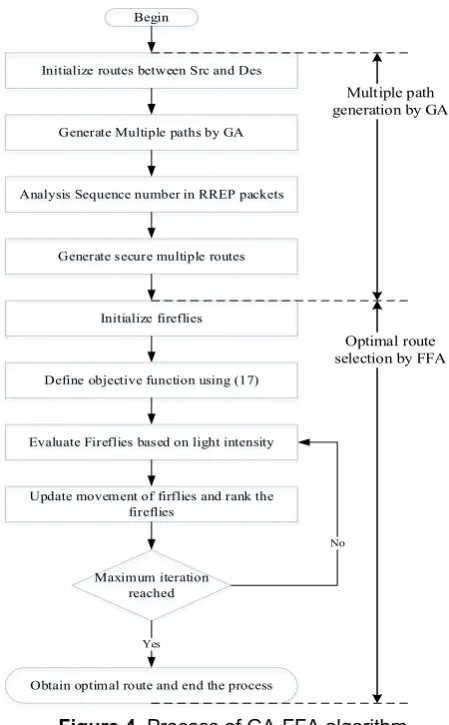
In this section, we propose a hybrid optimization algorithm for secure route selection for data transmission. Involvement of adversaries in the network increases the packet loss in the network. To secure data transmission, it is necessary to select trusted path between source and destination. However, MANET-IoT is highly dynamic which also requires optimal route for data transmission. Thus we propose GA-FFA algorithm for optimal route selection between source and destination. GA is a well-known algorithm that has been employed for optimal route selection in MANET [29]. Although GA provides optimum route for data transmission, it consumes large time for convergence. On the other hand, FFA algorithm shows efficiency in route optimization for MANT [30]. In order to mitigate the issue of GA, a new FFA algorithm is integrated with GA for route selection. In GA-FFA algorithm, multiple available paths between source (𝑆𝑆𝑆𝑆𝑆𝑆) and destination (𝐷𝐷𝑆𝑆𝑇𝑇) are generated by GA and an optimal route is selected by FFA algorithm. In GA algorithm, the available paths are generated by applying 𝑆𝑆𝑆𝑆𝑆𝑆𝑇𝑇𝑇𝑇𝑆𝑆𝐴𝐴𝑆𝑆𝑆𝑆 and
initialized as fireflies in FFA algorithm. In all available paths, route request (RREQ) is sent by 𝑆𝑆𝑆𝑆𝑆𝑆 and route reply (𝑅𝑅𝑅𝑅𝑅𝑅𝑃𝑃) is sent by intermediate nodes. In order to detect Blackhole attacker, the sequence number (𝑆𝑆𝑆𝑆𝐽𝐽𝑁𝑁𝑆𝑆𝑆𝑆) of all RREP packets is analyzed. If 𝑆𝑆𝑆𝑆𝐽𝐽𝑁𝑁𝑆𝑆𝑆𝑆
difference is large, then the node which sent RREP packet s considered as malicious node. Then this route is eliminated from available paths. After elimination of attacker path, finally the following multiple paths are initialized in FFA algorithm,
𝐴𝐴𝑃𝑃= {𝑅𝑅1,𝑅𝑅2, . . ,𝑅𝑅𝑌𝑌} (16)
In GA, 𝑌𝑌 number of routes are generated between 𝑆𝑆𝑆𝑆𝑆𝑆
and 𝐷𝐷𝑆𝑆𝑇𝑇. Then all available paths (𝐴𝐴𝑃𝑃) are initialized in FFA algorithm.
In FFA algorithm following rules are deployed for optimal route selection,
• All fireflies are unisex (i.e.) attracts each other regardless of their gender
• Attractiveness is directly proportional to brightness and distance is inversely proportional to both attractiveness and brightness
• Objective function is used to determine the brightness level.
Based on above rules, the process of FFA for optimal route selection is performed as follows,
1. Formulation of objective function (𝑂𝑂𝑊𝑊) as follows,
𝑂𝑂𝑊𝑊=𝑆𝑆𝑆𝑆𝑀𝑀(𝐹𝐹𝐿𝐿_𝑇𝑇𝑉𝑉𝐻𝐻𝐶𝐶,𝑇𝑇𝑅𝑅,𝐿𝐿𝐵𝐵) (17)
The objective function of our proposed GA-FFA algorithm is to select optimal route that maximizes
𝑊𝑊𝐹𝐹_𝑇𝑇𝑇𝑇, 𝑅𝑅𝑅𝑅, link stability (𝐹𝐹𝑆𝑆), and minimizes hopcount (𝐺𝐺𝐶𝐶).
2. Initialize all available routes
𝐴𝐴𝑃𝑃= {𝑅𝑅1,𝑅𝑅2, . . ,𝑅𝑅𝑌𝑌} fireflies in the population.
3. Computation of light intensity (𝐼𝐼(𝑅𝑅)) is performed based on 𝑂𝑂𝑊𝑊 as follows,
𝐼𝐼 ∝ 𝑂𝑂𝑊𝑊(𝑅𝑅) (18)
4. Attractiveness between two fireflies is formulated as follows,
𝛽𝛽=𝛽𝛽0𝑆𝑆−𝛾𝛾𝑁𝑁2 (19)
The attractiveness is determined based on light absorption coefficient (𝛾𝛾), and attractiveness at 𝑆𝑆= 0 (𝛽𝛽0), and the distance between those fireflies (𝑆𝑆).
5. Movement of firefly towards more attractive firefly (i.e.) optimal solution is determined as,
𝑀𝑀𝑖𝑖=𝑀𝑀𝑖𝑖+𝛽𝛽0𝑆𝑆−𝛾𝛾𝑁𝑁�𝑀𝑀𝑗𝑗− 𝑀𝑀𝑖𝑖�+𝛼𝛼𝛼𝛼 (20)
6. Update light intensity based on movement and rank the fireflies accordance with light intensity. 7. Select optimal route (𝑂𝑂𝑅𝑅) over iteration
8. End the process
By executing all above steps, the GA-FFA algorithm selects optimal route (𝑂𝑂𝑅𝑅) between 𝑆𝑆𝑆𝑆𝑆𝑆 and 𝐷𝐷𝑆𝑆𝑇𝑇. In GA-FFA algorithm 𝑂𝑂𝑊𝑊 is formulated based on significant routing metrics which improves security as well as efficiency of data transmission. Selection of optimal route based on 𝑊𝑊𝐹𝐹_𝑇𝑇𝑇𝑇 minimizes the possibility of adversaries in the particular route. Thus proposed GA-FFA algorithm ensures high level security as well as data transmission efficiency in MANET-IoT network.
Begin
Initialize routes between Src and Des
Generate Multiple paths by GA
Analysis Sequence number in RREP packets
Generate secure multiple routes
Initialize fireflies
Define objective function using (17)
Evaluate Fireflies based on light intensity
Update movement of firflies and rank the fireflies
Maximum iteration reached
Obtain optimal route and end the process
No
Yes
Multiple path generation by GA
Optimal route selection by FFA
Figure 4. Process of GA-FFA algorithm
In figure.4, the entire process involved in GA-FFA algorithm is illustrated. Here GA algorithm generates multiple available paths and the affected paths are eliminated by sequence number analysis. Then the secure routes which are free from Blackhole attack are initialized in FFA algorithm to identify optimal route between 𝑆𝑆𝑆𝑆𝑆𝑆
4.5. Data security and integrity provisioning
Perhaps, our proposed network is secured through secure clustering and routing; data security and integrity are still required for transmitted data to improve security level. To achieve data security and integrity jointly, we proposed a novel method that integrates hash function and cryptography function without increase in overhead and time consumption. For ensuring data security and data integrity, AES algorithm is proposed. In HMAC-AES algorithm, the data (𝐷𝐷) to be transmitted is divided into two equal blocks as {𝐷𝐷1,𝐷𝐷2}. Then the first block ofthe data (𝐷𝐷1) is encrypted by AES algorithm and the
second data block (𝐷𝐷2) is involved with has generation by
HMAC algorithm. AES algorithm involves four major transformations such as SubBytes, ShiftRows, MixColumns, and AddRoundKey. Here encryption of data is performed through key expansion processes and each round key is stored in 4-byte words denoted as 𝑤𝑤[𝑚𝑚] In AES algorithm data encryption is performed as follows,
Pseudocode for AES encryption Input: 𝑆𝑆𝑆𝑆, 𝐷𝐷1
Output: Ciphertext of 𝐷𝐷1 (𝑅𝑅𝐶𝐶{𝐷𝐷1})
1. Begin
2. Assign 𝑆𝑆𝑇𝑇𝑆𝑆𝑇𝑇𝑆𝑆 =ℳ
3. AddRoundKey(𝑆𝑆𝑇𝑇𝑆𝑆𝑇𝑇𝑆𝑆, &𝑤𝑤[0]) 4. For (𝑚𝑚= 1 𝑇𝑇𝑇𝑇𝑆𝑆𝐽𝐽 1 𝑇𝑇𝑆𝑆 9) 5. SubBytes (𝑆𝑆𝑇𝑇𝑆𝑆𝑇𝑇𝑆𝑆) 6. ShiftRows (𝑆𝑆𝑇𝑇𝑆𝑆𝑇𝑇𝑆𝑆) 7. MixColumns (𝑆𝑆𝑇𝑇𝑆𝑆𝑇𝑇𝑆𝑆)
8. AddRoundKey (𝑆𝑆𝑇𝑇𝑆𝑆𝑇𝑇𝑆𝑆, &𝑤𝑤[𝑚𝑚 ∗4]) 9. End for
10. SubBytes (𝑆𝑆𝑇𝑇𝑆𝑆𝑇𝑇𝑆𝑆) 11. ShiftRows (𝑆𝑆𝑇𝑇𝑆𝑆𝑇𝑇𝑆𝑆)
12. AddRoundKey (𝑆𝑆𝑇𝑇𝑆𝑆𝑇𝑇𝑆𝑆, &𝑤𝑤[40]) 13. End obtain 𝑅𝑅𝐶𝐶{𝐷𝐷1}
The above pseudocode explains the process of AES algorithm in data encryption. Here the first part of the data is encrypted and corresponding ciphertext (𝑅𝑅𝐶𝐶{𝐷𝐷1}) is
obtained. Forming data block, message authentication code (MAC) is generated to ensure data integrity using HMAC algorithm. HMAC based MAC generation is performed as follows,
𝐺𝐺𝑆𝑆𝐴𝐴𝐶𝐶(𝑆𝑆𝑆𝑆,𝐷𝐷2} =𝐺𝐺((𝑆𝑆′⊕ 𝑆𝑆𝐽𝐽𝑆𝑆𝐶𝐶)‖𝐺𝐺((𝑆𝑆′⊕
𝑖𝑖𝐽𝐽𝑆𝑆𝐶𝐶)‖𝑆𝑆))
(21)
The overall process of HMAC based MAC generation is performed illustrated in following pseudocode. Thus in HMAC-AES algorithm the first data block is encrypted by AES algorithm and foe second data block MAC is generated by HMAC algorithm. Then the data is transmitted to destination in the form of ({𝑅𝑅𝐶𝐶{𝐷𝐷2},𝑆𝑆𝐴𝐴𝐶𝐶{𝐷𝐷2}) (i.e.) ciphertext of 𝐷𝐷1, MAC of 𝐷𝐷2,
and plaintext of 𝐷𝐷2. In destination, the ciphertext is
decrypted using AES algorithm and the MAC in received data is verified by generating MAC for 𝐷𝐷2.
Pseudocode for HMAC based MAC generation Input: 𝑆𝑆𝑆𝑆, 𝐷𝐷2
Output: MAC generated for 𝐷𝐷2
1. Begin
2. If (𝑆𝑆𝑆𝑆𝐶𝐶𝑆𝑆𝑇𝑇ℎ(𝑆𝑆𝑆𝑆) >𝑏𝑏𝑆𝑆𝑆𝑆𝑆𝑆𝑘𝑘𝑇𝑇𝑖𝑖𝑚𝑚𝑆𝑆)
3. 𝑆𝑆𝑆𝑆𝐺𝐺 ← ℎ𝑆𝑆𝑇𝑇ℎ(𝑆𝑆𝑆𝑆)
4. Else
5. 𝑆𝑆𝑆𝑆𝐺𝐺 ← 𝑃𝑃𝑆𝑆𝐶𝐶(𝑆𝑆𝑆𝑆,𝑏𝑏𝑆𝑆𝑆𝑆𝑆𝑆𝑘𝑘𝑇𝑇𝑖𝑖𝑚𝑚𝑆𝑆) 6. End if
7. 𝑆𝑆_𝑘𝑘𝑆𝑆𝐺𝐺_𝐽𝐽𝑆𝑆𝐶𝐶=𝑆𝑆𝑆𝑆𝐺𝐺𝑋𝑋𝑂𝑂𝑅𝑅 [0 × 5𝑆𝑆 ∗ 𝑏𝑏𝑆𝑆𝑆𝑆𝑆𝑆𝑘𝑘𝑇𝑇𝑖𝑖𝑚𝑚𝑆𝑆] 8. 𝑖𝑖_𝑘𝑘𝑆𝑆𝐺𝐺_𝐽𝐽𝑆𝑆𝐶𝐶=𝑆𝑆𝑆𝑆𝐺𝐺𝑋𝑋𝑂𝑂𝑅𝑅 [0 × 36∗ 𝑏𝑏𝑆𝑆𝑆𝑆𝑆𝑆𝑘𝑘𝑇𝑇𝑖𝑖𝑚𝑚𝑆𝑆] 9. Obtain 𝑆𝑆𝐴𝐴𝐶𝐶=𝐺𝐺(𝑆𝑆_𝑘𝑘𝑆𝑆_𝐽𝐽𝑆𝑆𝐶𝐶‖𝐺𝐺(𝑖𝑖_𝑘𝑘𝑆𝑆𝐺𝐺_𝐽𝐽𝑆𝑆𝐶𝐶‖𝐷𝐷2))
10. End
Thus AES algorithm provides data security whereas HMAC algorithm ensures data integrity. If any attacker obtains the data, the attacker is not able to obtain entire data without secret key. Similarly, the alterations made by attacker can be determined by HMAC algorithm. Thus our proposed work ensures both data security and data integrity for transmitted data.
5. Experimental Results and Simulation
In this section, we evaluate our proposed work with previous research works through necessary simulations. In this section, simulation environment of proposed secure MANET-IoT is briefly described and the comparative analysis is performed to measure the efficiency of our proposed work.5.1. Simulation environment of MANET-IoT
Our proposed secure MANET-IoT that integrates MANET in IoT environment is simulated in network simulator-3.26 (ns-3.26) which is a discrete event simulator that supports various communication standards, and different networks. Our network comprises MANET-IoT devices, CA, SMs, and malicious nodes.Table 1. Simulation parameters
Parameter Value
Simulation area 1000×1000 m
Number of IoT devices 50
Number of CA 1
Number of SMs 5
Number of groups 5
Communication range of IoT
device 100m
Mobility model Random Way Point
Total number of packets 100
Packet size 1000 bytes (Max)
Packet interval 1 s
Initial energy level 100 Joules
Number of retransmissions 7
Data rate 1 Mbps
GA-FFA Initial population 100
Crossover rate 0.7
Mutation rate 0.001
γ, β0 1.0, 0.2
Number of iteration 50
Simulation time 35s
In table.1, all significant simulation parameters considered in secure MANET-IoT implementation is illustrated. These parameters are not limited and all other parameters that support MANET-IoT are also considered in our work.
0 250 500 750 1000
500 750 1000
250
SM1 CA
SM5
SM4
SM2 SM3
N8
N7 N10
N2
N11
N9
N3 N6 N5 N1
N20
N12 N21
N13 N19
N18
N16 N14 N15 N4
N43
N40 N44
N33
N24 N42
N34 N32
N35 N31
N48
N46 N50
N28
N45 N39
N30 N47
N38 N37
N29
N23 N49
N17 N25
N26
N41
N22 N27 N36
Figure 5. Simulation environment of MANET-IoT
In figure.5, the simulation environment of our proposed MANET-IoT is illustrated for smart city applications. Here the devices include mobile devices of humans, smart devices deployed on animals, vehicles and so on to perform specific operations. Our network environment comprises MANET-IoT devices which move around within the network area and malicious nodes which are looking for launching attack on communication between honest nodes. Here 5 nodes are malicious and those nodes are differentiated from honest nodes using red color. Based on SMs communication range, five groups are formed without malicious nodes.
5.2. Obtained results in security provision
Our proposed work achieves data security and integrity by a novel HMAC-AES algorithm. In this sub-section, we provide security analysis of proposed work.
Table 2. Security analysis
Parameter Value
Key size 128 bit
Number of rounds in AES 10
Block size 4
Average encryption time 4 ms
Average decryption time 5 ms
Number of malicious nodes 5 (10% of total nodes)
Attacks considered Blackhole and Grayhole
In table.2, the security results obtained by our proposed work are depicted. In the network, each node is registered with CA and obtains unique certificate from CA. The
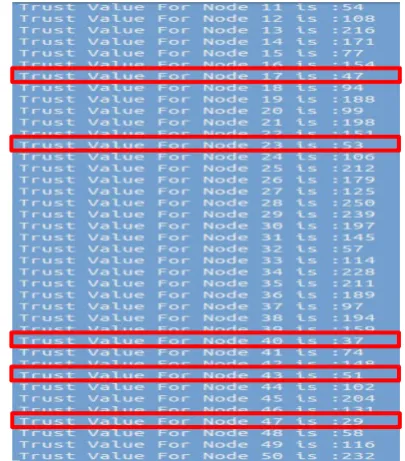
𝑊𝑊𝐹𝐹_𝑇𝑇𝑇𝑇 computed by RF-K means algorithm is depicted in figure.6. Here we can see that the malicious nodes such as
𝑁𝑁17,𝑁𝑁23,𝑁𝑁40,𝑁𝑁43,𝑁𝑁47 are given with lower trust values than other honest nodes. Involvement of flawless trust computation improves the trust value computation in our work.
Figure 6. Simulation environment of MANET-IoT
5.3. Performance Evaluation and
Comparative analysis
In this sub-section, we evaluate our proposed work in MANET-IoT network based on following performance metrics: packet delivery ratio (PDR), throughput, delay, and malicious activity detection. Our proposed work is compared with state-of-the-art works such as SOADV [28], FBSA [27], and conventional AODV. The performance metrics considered in our work are described as follows,
− PDR: PDR is defined as the ratio between number of packets transmitted by source node and the number of packets received by destination node successfully.
− Throughput: throughput is defined as the
average rate of successful data transmission over a communication link in the network at given period of time.
− Delay: In the network, delay is defined as the
average time taken by a data packet to reach the destination from source node.
− Malicious activity detection: This metric is
defined as the ratio between number of malicious nodes identified by security scheme to the total number of malicious nodes in the network.
− Energy Consumption: In the network, energy
consumption is estimated by computing energy consumed due to data transmission, data reception, and idle listening.
Table 3. Comparative Analysis
Parameter AODV SAODV FBSA Proposed
Routing
algorithm AODV S-AODV OLSR GA-FFA
Route selection metrics
Distance Distance PDR &
Delay Flawless trust, residual energy, link stability, hop count Security
metrics None None Trust Flawless Trust
Data
security Not provided Not provided Not provided Data is secured Security
algorithm None None None HMAC-AES
Trust
mechanism None None Based on PDR
and delay
RF-K means
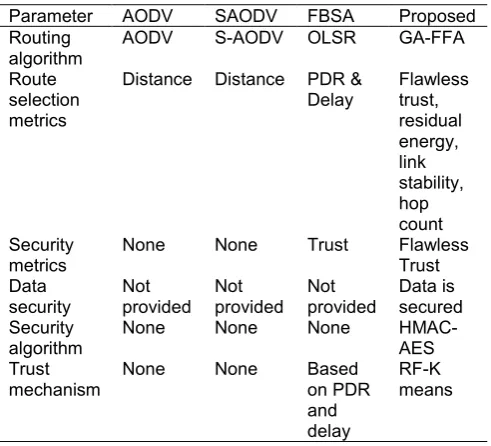
In table.3, comparative analysis between proposed work and state-of-the-art works has depicted. The analysis
confirms that proposed work fulfills all security and routing requirements better than previous works.
Analysis on PDR
PDR is a significant metric that measures successful data transmissions held over the network. In the presence of malicious nodes, the packet loss is increased in the network which minimizes the PDDR.
In figure.7, we compare PDR obtained by proposed work with previous research works. Here we can see that, our proposed work achieves better PDR than previous works. When average speed of nodes is 2m/s, 96% of packets are transmitted to destination successfully in our work. In the same node speed, FBSA method transmits 94% of packets to destination and SAODV method transmits 36% of packets successfully to destination. Here SADOV method and AODV protocol are fail to provide better even upto 50%. In addition, FBSA method also provides PDR 2% lower than proposed work. This analysis shows that involvement of effectual security schemes and optimal routing in proposed work improves PDR of the network. The previous works are not able to achieve better PDR since the involvement of adversaries which limits the network performance.
Figure 7. Comparative analysis on PDR
Analysis on throughput
Network throughput is an significant metric that measures the performance of entire network. In the presence of adversaries this metric is low (i.e.) in a secure environment throughput is large.
In figure.8, throughput metric achieved by our proposed work is compared with previous works. Our proposed work achieves throughput upto 140kbps even in high mobility (i.e.) 10m/s. perhaps, the modes are highly dynamic; selection optimal route by GA-FFA algorithm and group formation by SCGF algorithm improves the performance of the network. In addition, formulation of
𝑊𝑊𝐹𝐹_𝑇𝑇𝑇𝑇 helps in detection of highly secure route which further improve network performance. In FBSA method, the throughput is only 121kbps which is 20kbps lower than our proposed approach. Absence of secure routing
0 20 40 60 80 100
2 4 6 8 10
PDR
(%
)
Node speed (m/s)
and mobility management scheme results in lower throughput performance. But conventional AODV and AODV protocols are not able to handle large number of adversaries and high dynamic mobility. Thus both protocols are not able to improve network throughput.
Figure 8. Comparative analysis on throughput
Analysis on delay
In mobile network environment, delay is significant since it is increased with increase in node mobility. Thus this analysis will show the ability of the work to cope with dynamic environment.
Figure 9. Comparative analysis on delay
In figure.9, proposed work is analyzed in terms of delay metric. The analysis shows that proposed work minimizes delay (i.e.) in our proposed work the data is transmitted to destination from source node within minimum transmission time. The delay is increased with increase in number of attackers. This is because; involvement of attackers disrupts data transmission through packet dropping, data redirection and so on. However, our proposed work improves delay even in the presence of five malicious nodes. The reason behind improved delay in our work is that involvement of 𝑊𝑊𝐹𝐹_𝑇𝑇𝑇𝑇, secure grouping, and secure routing minimizes delay metric in
the network. The previous methods results in large time delay which degrades the performance of the network. This analysis confirms that FBSA, SAODV methods are not able secure network environment. the results obtained for AODV protocol shows that absence of security scheme results in increased adversaries which not suitable for mobile environment. in the presence of five attackers, proposed work provides 4.5ms of delay which is relative lower than previous works.
Table 4. Efficiency of proposed work in data transmission
Method PDR (%) Throughput (kbps) Delay
(ms)
AODV 23 32 14
SAODV 36 40 13
FBSA 93 119 7.6
Proposed 96.3 135 3.26
In table.4, efficiency of our proposed work in data transmission is analyzed in terms of performance metrics. From the analysis we can conclude that proposed work achieves better performance in data transmission. Involvement of secure group formation supports mobility management while involvement of 𝑊𝑊𝐹𝐹_𝑇𝑇𝑇𝑇 formulation relaxes the problem of adversaries in data transmission. In addition, secure routing and secure data transmission protect the data from adversaries which increases number of retransmissions. Thus each significant process involved in our work contributes in efficient data transmission in MANET-IoT environment.
Analysis on malicious activity detection
The prime objective of our work is to minimize the presence of adversaries in the network. To analyze the security strength of our proposed work, we analyze malicious activity detection rate.
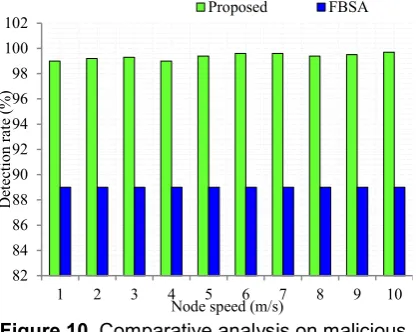
Figure 10. Comparative analysis on malicious activity detection
0 20 40 60 80 100 120 140
2 4 6 8 10
Th
ro
ug
hp
ut
(K
bp
s)
Node speed (m/s)
Proposed FBSA SAODV AODV
0 2 4 6 8 10 12 14 16
1 2 3 4 5
D
el
ay (
m
s)
Number of attackers
Proposed FBSA SAODV AODV
82 84 86 88 90 92 94 96 98 100 102
1 2 3 4 5 6 7 8 9 10
D
et
ec
tio
n r
at
e (
%
)
Node speed (m/s)
In figure.10, detection rate achieved by proposed work and previous FBSA method is compared. The graphical illustration shows that our proposed work is effectual in malicious activity detection. Averagely, our proposed work achieves 10% better detection rate than FBSA method. In our work, 99% of malicious nodes are identified accurately whereas in FBSA method only 89% of malicious nodes are detected correctly. Both methods utilize trust value for malicious activity detection. However, our proposed work improves detection rate with significant trust value computation by flawless trust formulation. In addition, secure route selection also minimizes involvement of adversaries in the network. Thus with the support of 𝑊𝑊𝐹𝐹_𝑇𝑇𝑇𝑇 formulation, our proposed work improves malicious activity detection rate upto 96%.
Table 5. Analysis on malicious node detection
Parameter FBSA Proposed
Number of nodes 50 50
Number of malicious node 5 5
Number of malicious nodes
identified accurately ≅4 ≅5
Detection rate 89% 99%
In table.5, the detection rate achieved by proposed work and FBSA method is analyzed. In our work, 99% of malicious nodes are detected accurately (i.e.) all 5 malicious nodes are identified accurately. But in FBSA method, 4 nodes only detected as malicious nodes. Thus our proposed work is efficient in attack detection rate.
Analysis on energy consumption
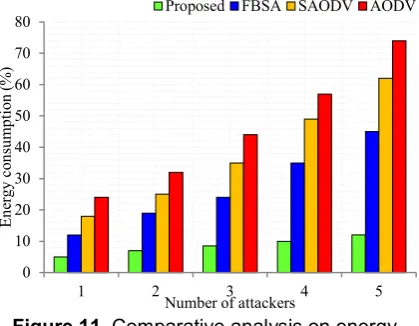
In literature, security provisioning approaches often increases energy consumption. In this subsection, energy consumption is analyzed with respect to malicious activities.
Figure 11. Comparative analysis on energy consumption
In figure.11, energy consumption is analyzed based on number of attacker nodes in the network. In the graph, we can see that proposed work consumes only 12% of energy even with 5 attackers. However, for the same number of attackers FBSA scheme consumes nearly 45% of energy due to absence of effectual security scheme. Likewise, SAODV and AODV consume 62% and 74% of energy respectively. The major reason for this huge energy difference is, previous approaches require large number of retransmissions due to involvement of malicious nodes. But in proposed work, malicious nodes are identified accurately and optimum path is selected for route election. Thus combined security provision and optimal route selection minimizes energy consumption in the network.
Table 6. Analysis on energy consumption
Method Initial energy (J) Average Energy
consumption (%)
AODV 100 46.2
SAODV 100 37.8
FBSA 100 27
Proposed 100 8.5
In table.6, average energy consumption metric is compared with for each work. The analysis shows that proposed work achieves relatively minimum energy consumption (8.5%) which is 17% lower than FBSA method, 29% lower than SAODV, and 37% lower than conventional AODV scheme.
6. Conclusion
In this paper, a novel security scheme is proposed with flawless trust formulation mechanism for MANET-IoT environment. To improve network management, the network is initially grouped by SCGF algorithm in secure manner. In each secure group, flawless trust computation is performed by SM using RF-K means algorithm. Flawless trust computation uses recommendation filtering approach which also helps in Grayhole attack detection. For secure as well as effectual data transmission, GA-FFA based optimal route selection algorithm is presented. Here GA-FFA algorithm utilizes a new fitness value that is formulated by flawless trust value and significant routing metrics. The transmitted data is secured by HMAC-AES algorithm that combines cryptography function and hash function together. HMAC-AES algorithm also assures data integrity which is significant for mobile environment. Experimental results show that proposed work is effectual in PDR, throughput, delay, malicious activity detection, and energy efficiency. From the achieved results, it is clear that proposed work better in network management as well as security. On the whole, our proposed work achieves data security and integrity with improved data transmission in MANET-IoT environment. In future, we 0
10 20 30 40 50 60 70 80
1 2 3 4 5
En
er
gy
c
on
su
m
pt
io
n (
%
)
Number of attackers
have planned to extend this work with energy efficient schemes. Although the results have shown that proposed work achieves better energy efficiency we aim to improve further energy efficiency of the network without loss in security level.
References
[1] Leite, J.R., Ursini, E.L., & Martins, P.S. (2017). Simulation of AdHoc Networks Including Clustering and Mobility. ADHOC-NOW.
[2] Anjum, S.S., Noor, R.M., & Anisi, M.H. (2017). Review on MANET Based Communication for Search and Rescue Operations. Wireless Personal Communications, 94, 31-52. [3] Kandari, S., & Pandey, M.K. (2016). Impact of Residual Life Estimator Battery Model on QoS Issues in MANET. Wireless Personal Communications, 86, 601-614.
[4] Giri, A., Dutta, S., Neogy, S., Dahal, K., & Pervez, Z. (2017). Internet of Things (IoT): A Survey on Architecture, Enabling Technologies, Applications and Challenges. International Conference on Internet of Things and Machine Learning.
[5] Razzaque, M.A., Milojevic-Jevric, M., Palade, A., & Clarke, S. (2016). Middleware for Internet of Things: A Survey. IEEE Internet of Things Journal, 3, 70-95. [6] Jabbar, W.A., Saad, W.K., & Ismail, M. (2018).
MEQSA-OLSRv2: A Multicriteria-Based Hybrid Multipath Protocol for Energy-Efficient and QoS-Aware Data Routing in MANET-WSN Convergence Scenarios of IoT. IEEE Access, 6, 76546-76572.
[7] Bujari, A., Furini, M., Mandreoli, F., Martoglia, R., Montangero, M., & Ronzani, D. (2018). Standards, Security and Business Models: Key Challenges for the IoT Scenario. Mobile Networks and Applications, 23, 147-154. [8] Liu, G., Yan, Z., & Pedrycz, W. (2018). Data collection for attack detection and security measurement in Mobile Ad Hoc Networks: A survey. J. Network and Computer Applications, 105, 105-122.
[9] Gurung, S., & Chauhan, S. (2018). A novel approach for mitigating gray hole attack in MANET. Wireless Networks, 24, 565-579.
[10] Gupta, P., Goel, P., Varshney, P., & Tyagi, N. (2019). Reliability Factor Based AODV Protocol: Prevention of Black Hole Attack in MANET.
[11] Dorri, A. (2017). An EDRI-based approach for detecting and eliminating cooperative black hole nodes in MANET. Wireless Networks, 23, 1767-1778.
[12] Airehrour, D., Gutiérrez, J.A., & Ray, S.K. (2016). Securing RPL routing protocol from blackhole attacks using a trust-based mechanism. 2016 26th International Telecommunication Networks and Applications Conference (ITNAC), 115-120.
[13] Ahmed, M.N., Abdullah, A.H., Chizari, H., & Kaiwartya, O. (2017). F3TM: flooding factor based trust management framework for secure data transmission in MANETs. [14] Kushwaha, A., Sharma, H.R., & Ambhaikar, A. (2016). A
Novel Selective Encryption Method for Securing Text Over Mobile Ad Hoc Network.
[15] Jain, A., Tokekar, V., & Shrivastava, S.K. (2018). Security Enhancement in MANETs Using Fuzzy-Based Trust Computation Against Black Hole Attacks.
[16] Panos, C., Ntantogian, C., Malliaros, S., & Xenakis, C. (2017). Analyzing, quantifying, and detecting the
blackhole attack in infrastructure-less networks. Computer Networks, 113, 94-110.
[17] Singh, O., Singh, J., & Singh, R. (2017). Multi-level trust based intelligence intrusion detection system to detect the malicious nodes using elliptic curve cryptography in MANET. Cluster Computing, 1-13.
[18] Schweitzer, N., Stulman, A., Margalit, R.D., & Shabtai, A. (2017). Contradiction Based Gray-Hole Attack Minimization for Ad-Hoc Networks. IEEE Transactions on Mobile Computing, 16, 2174-2183.
[19] Garg, M.K., Singh, N., & Verma, P. (2018). Fuzzy rule-based approach for design and analysis of a Trust-rule-based Secure Routing Protocol for MANETs. Elsevier, 132, 653-658.
[20] Gomathi, K., Parvathavarthini, B., & Saravanakumar, C. (2017). An Efficient Secure Group Communication in MANET Using Fuzzy Trust Based Clustering and Hierarchical Distributed Group Key Management. Wireless Personal Communications, 94, 2149-2162. [21] Shams, E.A., & Rizaner, A. (2018). A novel support vector
machine based intrusion detection system for mobile ad hoc networks. Wireless Networks, 24, 1821-1829.
[22] Song, T., Li, R., Mei, B., Yu, J., Xing, X., & Cheng, X. (2016). A Privacy Preserving Communication Protocol for IoT Applications in Smart Homes. IEEE Internet of Things Journal, 4, 1844-1852.
[23] Li, X., Niu, J., Bhuiyan, M.Z., Wu, F., Karuppiah, M., & Kumari, S. (2018). A Robust ECC-Based Provable Secure Authentication Protocol With Privacy Preserving for Industrial Internet of Things. IEEE Transactions on Industrial Informatics, 14, 3599-3609.
[24] Li, F., Zheng, Z., & Jin, C. (2016). Secure and efficient data transmission in the Internet of Things. Telecommunication Systems, 62, 111-122.
[25] Kumar, V.V., & Ramamoorthy, S.K. (2018). Secure Adhoc On-Demand Multipath Distance Vector Routing in MANET. International Conference on Computing and Communications Systems, Springer, pp. 49-63.
[26] Tan, S., Li, X., & Dong, Q. (2016). A Trust Management System for Securing Data Plane of Ad-Hoc Networks. IEEE Transactions on Vehicular Technology, 65, 7579-7592.
[27] Bisen, D., & Sharma, S. (2018). Fuzzy Based Detection of Malicious Activity for Security Assessment of MANET. National Academy Science Letters, 41, 23-28.
[28] Jain, A.K., & Tokekar, V. (2015). Mitigating the effects of Black hole attacks on AODV routing protocol in mobile ad hoc networks. 2015 International Conference on Pervasive Computing (ICPC), 1-6.
[29] Yen, Y., Chan, Y., Chao, H., & Park, J.H. (2008). A genetic algorithm for energy-efficient based multicast routing on MANETs.
[30] Persis, D.J., & Robert, T.P. (2016). Reliable Mobile Ad-Hoc Network Routing Using Firefly Algorithm.
[31] Sumra, I.A., Sellappan, P., Abdullah, A.V., & Ali, A. (2018). Security issues and Challenges in MANET-VANET-FANET: A Survey. EAI Endorsed Transactions on Energy Web and Information Technologies, 5 (17). [32] Wang, P., & Zhang, P. (2016). A Review on Trust
Evaluation for Internet of Things. MobiMedia.
[33] Kumar, A., Vishnoi, P., & ShimiS., L. (2019). Smart Grid Security with Cryptographic Chip Integration. EAI Endorsed Trans. Energy Web, 6, e6.
Aerospace Conference Proceedings (IEEE Cat. No.04TH8720), 2, 1286-1295 Vol.2.