GSJ: Volume 6, Issue 4, April
2018, Online: ISSN 2320-9186
www.globalscientificjournal.com
C
OMPARATIVE
A
NALYSIS OF THE
E
CONOMIC
L
OAD
D
ISPATCH
P
ROBLEM OF THE
N
IGERIAN
T
HERMAL
P
OWER
S
TATIONS
1
Y. S. Haruna,
2S. Idris,
3G. A. Bakare and
4A. U. Abu
1, 2, 3
Department of Electrical and Electronics Engineering, A. T. B. U Bauchi-Nigeria.
4
Department of Electrical Engineering Technology, Federal Polytechnic Idah, Kogi State, Nigeria.
Emails: [email protected]
Abstract: The focus of modern power system has shifted towards enhanced performance, increased customer
satisfaction, low cost, reliable and clean power. In this perspective, scarcity of energy resources, increasing power generation cost, environmental concern necessitates optimal economic load dispatch. In reality, power stations neither are at equal distances from load nor have similar fuel cost functions. Hence for providing cheaper power, load has to be distributed among various power stations in a way which results in lowest generation cost. Practical economic load dispatch (ELD) problems have highly non-linear objective functions with security constraints, rigid equality and inequality constraints. In this particle swarm optimization (PSO) was applied to allot the active power among the generating stations satisfying the system constraints and minimizing the cost of power generated. The results will then be sent to the National Control Center and the various power stations via internet. Communications is very essential for the implementation of an end-to-end and two-way open communication grid infrastructure. Internet is a global system of interconnected computer networks that uses the internet protocol suite (TCP/IP) to link devices worldwide and electronic mail (email or e-mail) for exchanging messages between people. This formed the main concern for sending the results in this paper. The viability of the method was analyzed for its accuracy and rate of convergence. The economic load dispatch problem was applied to the Nigerian Power system Network. From the results obtained, the PSO method performed better and faster than CGA, MGA and DE methods in terms of its effectiveness and efficiency.
I. INTRODUCTION
Communications plays a critical role in power systems and will become even more critical when it comes to implementing an end-to-end and two-way open communication grid infrastructure. The Internet is the global system of interconnected computer networks that use the Internet protocol suite (TCP/IP) to link devices worldwide. Modern electric power generation, transmission, and distribution systems require intelligent devices that can communicate quickly and reliably, around the clock and under the harshest conditions. Considering the thermal generation alone, as found in many countries, fuel cost contribute significantly to the total generation cost of electric power to the consumers [1, 2].
The sole aim of the economic load dispatch (ELD) is to distribute the total power demand among the generating units at the same time minimizing the cost of generation while satisfying system constraints. The important factors to be considered for economic operation of the system are efficiency of the generating units, fuel and operating costs, and transmission losses [2, 3]. In Nigeria, the needs of a customer have been the reliability of electricity supply at an acceptable cost. The transmission/dispatch problem in electric power authority is as a result of the following constraints; fragile and inflexible state of the transmission network to wheel increased power levels, absence of state-of-the art dispatch facilities and high technical losses. Since power generation is dynamic, there is the need of sending the results of the ELD to all the power stations so as to meet up with the changes in the demand [4].
A. Problem Formulation
The economic dispatch (ED) is a nonlinear programming problem. In a specific power system with a determined load schedule as shown in Figure1, ELD planning performs the optimal power generation dispatch among the existing generation units.
Figure 1: Interconnected System with Generating Unit in Power System Network
Where, FG1 = Fuel cost of unit 1
Ploss= Total power loss and
Pj = Total power demand.
The solution of ELD problem must satisfy the constraints of the generation units, while it optimizes the generation based on the cost factor of the generation units. Eqn. (1) represents the total fuel cost for a power system.
∑
( )
Where, ng - is the number of generation units and Pj -is the output power of jth generation unit.
The cost function in Eqn. (1) can be approximated to a quadratic function of the power generation; therefore, the total cost function will be changed to Eqn. (2).
∑
Where,
Pj- is generated power by jth is generation unit.
are the fuel cost coefficients of unit j.
Three set of constraints were considered in this study, including equality constraints, inequality constraints and security constraints.
In a power system the amount of generated power has to be enough to feed the load demand plus transmission lines loss Eqn. (3).
∑
Where,
Pd- is the load demand and Ploss- is the transmission lines loss,
ng and Pj have the same definition as Eqn. (1).
∑ ∑
Where, Ploss is total transmission loss in the system;
Pi, Pj are generated power by ith and jth generating units respectively; Bij element of the B-matrix between ith and jth generating units.
2. Inequality constraints
All generation units have some limitations in output power regardless of their type. Generating less power than minimum may cause the rotor to over speed whereas at maximum power, it may cause instability issues for synchronous generators. So Eqn. (5) has to be considered in all steps of solving the ELD problem.
For j=1, 2, …,ng.
Where, and are the constraints of generation for jth generating unit.
3. Security Constraint
It is required that the operator must dispatch the online generating units in such a way that the apparent power flow through the transmission line Si is restricted by its upper limits to ensure secured operation as;
; k= 1, 2, …nl …(6)
It is to be noted that the kth transmission line flow connecting bus i and bus j can be calculated as:
…(7)
where, Iij is the current flow from bus i to bus j.
II. LITERATURE REVIEW
A. Economic Load Dispatch (ELD)
[2] proposed a method for solving ELD problem using conventional and micro-GA. They compared micro-GA with the conventional techniques, where micro-GA proved to be the best in terms of cost and power loss minimization.
[5] presented on GA based ELD with application to coordination of Nigerian thermal power plants. They used conventional GA and micro-GA based economic dispatch of load for generation cost reduction was comparatively investigated on two sample networks (a 6-bus IEEE test and 31-bus Nigerian grid Systems). The results obtained were satisfactory for both approaches but it was shown that the µGA performed better than CGA from the economic and computational time (average of 62% time reduction) viewpoints.
[6] presented a multi-objective constraint handling method with the PSO algorithm for tackling power generation unit loading optimization problem. The proposed approach adopted the concept of dominance from multi-objective optimization, and uses a few selection rules to guide the search direction. They authors recommended improvements to the basic PSO technique to solve the multi-objective optimization problem effectively. From the results obtained, the hybrid PSO technique improves the convergence and performed better when compared with the other PSO techniques.
algorithm method to solve economic load dispatch (ELD) problem considering valve point loading was proposed by [8]. They considered valve loading effect changes ELD as a non-convex optimization problem.
[9] proposed a method of solving dynamic ELD using improved PSO algorithm. In this method, the problem was handled in an interactive way and does not need to know any global preference structure or some type of initial goals of the decision maker for the objectives function.
In this paper, PSO technique was applied to the Nigerian thermal power plant to solve ELD solution to obtain better converging criteria. During the iteration, acceleration constant was varied to improve the searching capability of PSO. Thus, optimal solution of the problem is obtained assuring constraint satisfaction. Thus the results obtain, using particle swarm optimization were converging in nature.
B. Overview Particle Swarm Optimization (PSO)
PSO was developed by Kennedy and Eberhart in 1995 and is based on analogy of Swarm of birds and school of fish [10]. PSO follows the behavior of individuals in swarm to maximize the survival of species and based on Metaphor of social interaction. Every particle in the swarm try to improve its velocity and position based on the distance between its local best value and current position The procedures for PSO is shown below and flowchart in Fig. 2.
Figure 2: Particle Swarm Optimization Algorithm Flow Chart
C. Application Of PSO in ELD
The aim of this paper is to distribute the total power demand among the available thermal generating stations to minimizing the total fuel cost subject to both equality and inequality constraints as earlier stated in Eqns. (1) - (3). Particle Swarm Optimization was used to achieve this desired goal. The iterative steps of PSO implementation are as follows:
Step1: Swarm initialization
Each particle in the swarm is initialized randomly. The velocity and position initialized values follow a uniform random number approach lying between its maximum and minimum values [11]. Velocity and position can be represented as follows:
Vi = Vi1,Vi2 ,…, Vin
The full swarm can be expressed as a matrix;
[
] …(9)
Where, G represent number of generators and PR is the number of particles in the swarm.
Step2: Velocity updating
The velocities of each of the particles in the swarm of a modified PSO can be updated using α-factor and β-factor using the following equation:
Vijnew = W * Vij + α * C1 * rand() * (Pijbest – Pij) + β * C2 * rand() * (Gibest – Pij ) …(10)
Such that α + β =1 providing dominant nature of exploration initially while at later stages, exploitation follows. C1 is a
positive coefficient known as coefficient of the self-cognition component, C2 is also a positive constant term, called as
coefficient of the social component, Vij represents the velocity of each particle in the swarm, rand() and rand() are the
random numbers distributed uniformly in the interval (0,1), and w is the inertia weight and can be expressed by the following expression [12]:
w = w max − (wmax – wmin) * IT/IT max …(11)
where,Wmax initial weight and W min final weight.
Step3: Position updating
Each particle’s positions are updated between successive iterations using the updated velocity term as explained above according to the following equation:
Pijnew =Pij+ Vijnew (i=1,2,…..,PR;j=1,2,…,G) …(12)
Step4: Memory updating
The local best and global best values are modified using the following equation:
Pibest = Pi if F(Pi) < F(Pibest ) …(13)
Gbest = Pi if F(P i) < F(G best) … (14)
Where, F(Pi) is the value of objective function at ith individual’s position and F(G ) is the value of objective function of global best individual’s position.
Step5 Termination criteria examination
The algorithm is repeated until pre-specified terminating rules are satisfied.
Step6 Convergence Criteria
The process stops when the convergence criteria are satisfied; the most commonly used criteria in PSO are;
i. Under comparatively mild assumptions about the objective function, the particles find at least a local optimum ii. For a very large class of objective functions, PSO converges towards the optimum with linear convergence
speed.
III. METHODOLOGY
Step 1 Start PSO
Step 2 Initialize the PSO parameters.
Step 3 Read the data for the Nigerian thermal power stations and the total power demand. Step 4 Generate initial velocities and position for the particles
Step 5 Calculate the fitness of the particles. Step 6: Update each particle with global best Step 7 Check the criteria for stopping
Step 8 Go back to step 4 if condition of step 7 is not met
Step 9 Save and Print the ELD results, the cost of generation and the total network losses with and without ELD.
Step 10 Send the results to the various power stations and national control centre.
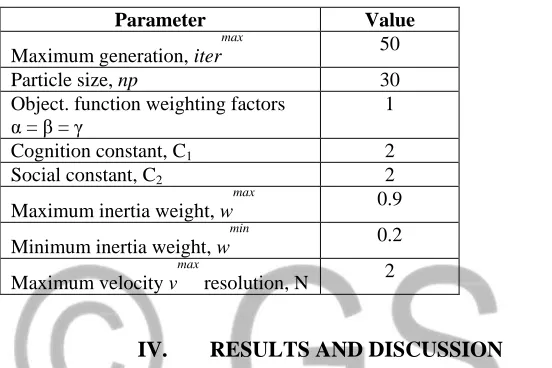
The PSO parameter setting used during the implementation of the ELD problem for the Nigerian thermal stations can be seen in Table 5 below.
Table 5: Optimal Parameters of PSO
Parameter Value
Maximum generation, iter
max
50
Particle size, np 30 Object. function weighting factors
α = β = γ 1
Cognition constant, C1 2
Social constant, C2 2
Maximum inertia weight, w
max
0.9
Minimum inertia weight, w
min
0.2
Maximum velocity v
max
resolution, N 2
IV. RESULTS AND DISCUSSION
The cost functions of the Nigerian thermal generating stations were used in calculating the total fuel cost. The cost functions of the thermal stations, their maximum and minimum power limits are shown in Table 6 below.
Table 6: Characteristics of the Nigeria Thermal Power System Network
Station α β Γ PGmin (MW)
PGmax (MW) Sapele 6929.0 7.84 0.13 137.5 550.0 Delta 525.74 -6.13 1.20 75.0 300.0 Afam 1998.0 56.0 0.092 135.0 540.0 Egbin 12787.0 13.1 0.031 275.0 1100.0
A. Implementation
PSO based ELD was applied to the Nigerian thermal generating stations based on the data obtained from the National Control Centre, Osogbo. The hydro stations were allocated a lump sum of power to be shared among the three hydro stations. The PSO based ELD were implemented using the MATPOWER in the MATLAB environment.
The proposed method was applied to the coordination of the Nigerian thermal power stations. The coordination was divided in two cases; case 1 was without considering the network losses while in case 2, the losses were taken into consideration.
B. Nigeria Power System Network ELD Simulation Result
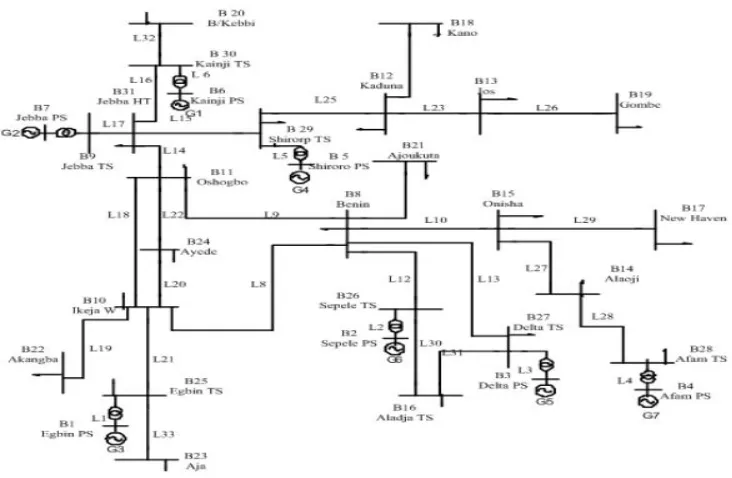
Figure 3: Single Line Diagram of theNigerian 330 kV, 31- Bus Grid System
The results obtained for the ELD of the Nigerian Power system with and without losses in comparison with the results obtained by [2] and [13] can be seen in Tables 7 and 8, with a total power generating capacity of 2823.1MW, the contribution of each thermal power plant to the total power generated and the cost of generation using GA and DE methods in comparison with the proposed PSO technique were shown. From the results, the proposed method produced the least cost of generation and power loss when compared to GA and DE methods.
Table 7: Results for Nigeria Power System Network ELD without Losses
Power Station MGA CGA DE Proposed
PSO Method
Thermal Stat
ion
s
Sapele PG1(MW) 174.81 227.88 263.00 270.26
Delta PG2(MW) 79.59 81.03 81.00 75.00
Afam PG3(MW) 202.99 286.69 168.80 135.00
Egbin PG4(MW) 1075.71 937.50 1020.30 1051.44
Total thermal power Generated ∑PG(MW)
1533.10 1533.10 1533.10 1533.10
Thermal Power Demanded PD(MW)
1533.10 1533.10 1533.10 1533.10
Hydro Stat
ion
s Kainji (MW) 350.00 350.00 350.00 350.00
Shiroro (MW) 490.00 490.00 490.00 490.00
Jebba (MW) 450.00 450.00 450.00 450.00
Total Power
Generated(MW) 2823.10 2823.10 2823.10 2823.10 Total Power Demand
PD(MW) 2823.10 2823.10 2823.10 2823.10
Total Cost (N/hr) 99,818.29 101,302.53 98,380.05 97,471.70
Power Station MGA CGA DE Proposed PSO Method
Thermal Stat
ion
s
Sapele PG1(MW) 345.35 457.79 365.93 272.62
Delta PG2(MW) 68.48 69.51 68.00 75.00
Afam PG3(MW) 320.46 230.82 318.36 135.00
Egbin PG4(MW) 838.39 814.56 818.08 1077.24
Total thermal power Generated ∑PG(MW)
1572.68 1572.68 1570.37 1559.86
Thermal Power Demanded PD(MW)
1532.40 1532.40 1532.40 1532.40
Hydro Stat
ion
s Kainji (MW) 350.00 350.00 350.00 350.00
Shiroro (MW) 490.00 490.00 490.00 490.00
Jebba (MW) 450.00 450.00 450.00 450.00
Total Power
Generated(MW) 2862.68 2862.68 2860.37 2849.86 Total Power Demand
PD(MW)
2823.10 2823.10 2823.10 2823.10
Total Power
Loss (PL) (MW)
39.58 39.58 37.27 26.76
Total Cost (N/hr) 114,521.33 116,946.55 107,430.00 99,643.25
The convergence characteristics obtained at the end of the program execution can be seen in Figure 4 below.
Figure 4: PSO Convergence Characteristics
C. Discussion of Results
The results in Tables 7 and 8 shows that, the proposed PSO algorithm finds a better fitness value for the problem when compared to other methods. The intense of convergence in Figure 4 also proves that the proposed algorithm was able to search the problem space and move efficiently and faster.
fuel cost of N14,878.08 per hour and N17,303.30 per hour respectively. Figure 4 is the convergence characteristic of the PSO where is converged within 750 iterations.
V. CONCLUSION
PSO method was successfully employed to solve the ELD problem for the Nigeria Thermal Power Stations. The PSO algorithm showed superior features including high quality solution, faster and stable convergence characteristics. The comparison of results for the two cases clearly shows that the proposed PSO method is indeed capable of obtaining excellent results in terms of transmission loss reduction and cost of power generation when compared with CGA, MGA and DE algorithms.
References
[1] A. J. Wood and B. F. Woolenberg. (1996). Power Generation Operation and Control. John Wiley and Sons, New York. Second Edition, Chapter 3, pp 29- 88.
[2] Haruna, Y. S. (2004). Comparison of Economic Load Dispatch using Genetic Algorithm and Classical Optimization Method. Unpublished M.Eng. Thesis, Abubakar Tafawa Balewa University, Bauchi.
[3] Haruna, Y. S., Yisah, Y. A., Bakare, G. A., Haruna, M. S. and Oodo, S. O. (2017). Optimal Economic Load Dispatch of the Nigerian Thermal Power Stations Using Particle Swarm Optimization (PSO).The International Journal of Engineering and Science (IJES), Vol. 6(1), PP 17-23. ISSN (e): 2319 – 1813 ISSN (p): 2319 – 1805.
[4] Makoju, J. (2003). Resuscitating the Nigerian Power Sector: The Resuscitating and Privatisation Reforms. COREN Assembly, Abuja.
[5] Ganesh, K. V., G. A. Bakare, U. O. Aliyu, and Y. H. Shu'aibu (2005). Genetic Algorithms Based Economic Dispatch with Application to Coordination of Nigerian Thermal Power Plants. Electrical and Computer Engineering Faculty, Missouri University of Science and Technology.
[6] Lily, D. L., Xiaodong, L. and Xinghuo, Y. (2008).Power Generation Loading Optimization using a Multi-Objective Constraint-Handling Method via PSO Algorithm. The IEEE International Conference on Industrial Informatics (INDIN 2008) DCC, Daejeon, Korea. Pp 1632 – 1637.
[7] Abido, H. T., Bhandari, H., Dalal, Y. & Roy, R. (2010) Economic load dispatch including wind power using plant growth simulation algorithm, 11th International conference on environment and electrical engineering, volume 388(393), pp. 18-25.
[8] Ahmed A. G. & Prasad P.V. (2013).Constriction coefficient particle swarm optimization for economic
load dispatch with valve point loading effects International Conference on Power, Energy and Control, pp.
350 – 354.
[9] Xin .M. & Yong L. (2013) Dynamic Load Economic Dispatch in Electricity Market Using Improved
Particle Swarm Optimization Algorithm International conference on intelligent computation technology and
automation, volume 2(165,168), pp. 11-12.
[10] J. Kennedy and R. Eberhart, (1995). “Particle swarm optimization,” in Proceedings of the IEEE International Conference on Neural Networks, pp. 1942–1948.
[11] Jaini. A., Musirin. I., Aminudin. N., Othman. M.M. & Rahman. T. K A (2013) Particle swarm optimization
(PSO) technique in economic power dispatch problems 4th International power engineering and
optimization Conference, volume 308(312), pp. 23-24.
[12] Affijulla, S., Chauhan, S. (2014) A new intelligence solution for power system economic load dispatch 10th
International Conference on environment and electrical engineering, volume 1(5), pp. 8-11.