A conceptual framework for audio-visual museum media
M. K. L. Nielsen
1,*
1
Dept. of Architecture, Design and Media Technology, Aalborg University, Niels Bohrs Vej 8, 6700 Esbjerg, Denmark.
Abstract
In today's history museums, the past is communicated through many other means than original artefacts. This interdisciplinary and theoretical article suggests a new approach to studying the use of audio-visual media, such as film, video and related media types, in a museum context. The centre of interest is how history and authenticity is mediated at history museums and how museum visitors perceive this use. In this article, focus is moved away from technology and specific types of installations to concentrate on what museums do with technology. Building on disciplines such as media science and museum studies, existing case studies, and real life observations, the suggested framework instead stress particular characteristics of contextual use of audio-visual media in history museums, such as authenticity, virtuality, interativity, social context and spatial attributes of the communication design.
Keywords: design, learning, creative industries, creative technologies, audio-visual media, museums.
Received on 16 November 2016, accepted on 04 March 2017, published on 05 April 2017
Copyright © 2017M. K. L. Nielsen, licensed to EAI. This is an open access article distributed under the terms of the Creative Commons Attribution licence (http://creativecommons.org/licenses/by/3.0/), which permits unlimited use, distribution and reproduction in any medium so long as the original work is properly cited.
doi: 10.4108/eai.5-9-2017.153061
*Corresponding author. Email:[email protected]
Introduction – Museums and dynamic,
audio-visual media
Museums’ role
The International Council of Museums defines museums as ‘… a non-profit, permanent institution in the service of society and its development, open to the public, which acquires, conserves, researches, communicates and exhibits the tangible and intangible heritage of humanity and its environment for the purposes of education, study and enjoyment.’[1]. Such description reflects that museums’ vast collections of material objects are cornerstones in museum work. This has been the case, since the dawn of the Museion over the ‘Wunderkammer’, but nonetheless changing agendas have affected the role of the object and the museums through the years.
Objects in ‘old’ museums was chosen and displayed according to classification based on their morphology, whereas modern museums select material things according to their relationship to people, to their connected stories and the link to history [2]. Paradigmatic
notions as authenticity and history between museum professionals and their visitors. But professional museum communicators do not necessarily share this fear of make-believe. One recent example is the Danish Moesgaard Museum, which rebuilt archaeological exhibitions are communicated mainly through narratives in interactive settings with a vast amount of lights, audio, video and animations in order to let visitors experience past lived lives instead of perceiving exhibited artefacts as purely aesthetic objects of art [8]. What is important to understand is that – without reducing the terms into opposite binaries – most museums and history professional are aware that mediation of history is to some degree a construct. Researchers in the field of mediation and reception of the past are likewise aware that the boundaries between fiction and fantasy, and critical, source-based discussions about the past, are blurred, but both types of products are contributing to historical knowledge and consciousness [9]. Efficiently and appealingly communication of this information to visitors includes modern technology and media. Therefore, the focus of this paper is on the use and evaluation of audio-visual and digital media in the mediation of the past within cultural history museums by presenting a conceptual framework for audio-visual museum mediation. Building on disciplines such as media science and museum studies, existing case studies, and real life observations, the suggested framework stress particular characteristics of contextual use of audio-visual media in history museums. The framework is presented after a short introduction to the relationship between audio-visual media and history, the history museums’ use of audio-visual media, and prior attempts to conceptualise or typologise media technology in a museum context.
Audio-visual media and history
History is communicated in various forms. Different media – especially audio-visual – contribute impressively to our knowledge of history. In this article the term digital audio-visual media is used as an overarching term for dynamic, kinetic media including - but not only restricted to - what we traditionally would be calling film or video and animation. In its simplest description, it is a digital media using both sight and sound. Digital video and film are part of such description, although the terms ‘video’ and ‘film’ are multifaceted. The film medium ‘(…) may be analogue or digital, while new media (video games, the web, etc.) may involve moving images but also other features such as interactive simulations, databases, or hypertext.’ [10]. The primary focus of this article is on the relation between the digital audio-visual media and its role at the history museum, but audio-visual content may be delivered via new media. Furthermore, audio-visual media may be delivered in either linear form constituting a fixed narrative (e.g. traditional film and video), or a non-linear form with user-controlled narrative (e.g. interactive games) [11]. Historians claims that today
people’s historical consciousness – more than books and lectures – emerges from films and TV series [12] [13]. It is also possible to add computer games [14] to this pool of audio-visual contributions to historical consciousness. Steve F. Anderson has presented the term Technologies of History, which represents a view on how media practices “help us think about the world, the past, and our potential to act as historical and political agents” [15].† Museums may even be considered a medium on their own [16], but do also widely implement such technologies in the attempt to construct images of the past in the eyes of their visitors.
Museums and audio-visual media: Attitudes toward museums and the authentic
Why should audio-visual media be used in museums? A simple, though not very fulfilling, answer was given by museologist Josef Beneš (1976), who saw it as a way of keeping up with the progress of technology and the communicative standards of the museums’ public – thereby maintaining their position as cultural establishments [17]. Dierking and Falk aligned the learning potential of media in museums with that of a trained docent or hands-on exhibits. These are all communication strategies with different qualities - each an important tool in a museum’s toolbox of storytelling devices to support the past mediated at the specific
museum [18]. Exhibitors nowadays also show
increasingly awareness of diverse learning styles, and to many visitors, visual and aural stimuli seems to be a most welcome information alternative to exclusively reading labels [11]. Though we may see a move away from ‘trophyism’ (where focus has changed from object to knowledge) [19], museums still strive to present their collections, which traditionally has been the museum’s core. But traditional museum exhibition design has evolved and expanded from resembling book pages on the walls to much more complex and interweaved systems of various media – often aiming at establishing immersive environments.
Can any media, then, be included into the museum? There are certain parameters to consider. Ann Mintz has described four aspects making museum media differ from media applications produced for other use (see Table 1). The first aspect is the context of the museum media application. This is not functioning as a standalone, but is dependent upon and supplements the presented past in the form of artefacts and various other material. But also the content is different in museum media. Mintz emphasize
†
that, above all, museum media has an educative purpose. The third aspect that Mintz find distinguishable in museum media is the user interface on interactive applications. The visitor needs to get a quick understanding of the interface due to the volatile browse-and-glance free-choice nature of the museum visit. The fourth aspect that, according to Mintz, characterises museum media is closely related to the previous one, and concerns patterns of interaction. Given that the museum environment is full of information competing for attention, and time therefore may be a crucial and limited factor, Mintz suggest that museum media application immediately satisfy the visitor instead of presenting complex systems with too many choices [20].
Table 1. Mintz' Four Museum Media Aspects.
Context Content User
interface
Pattern of interaction
It has been questioned whether the various means of representation and mediation overshadows and distract attention from the original objects on display and in extreme utterances expressed fear of a so called Disneyfication and museums evolving into theme parks [21] [22].Analogue to discussions about museums being about objects or knowledge and experiences, free-choice learning researchers Falk and Dierking has tried to close down a long-living discussion about whether the museums are about learning or fun by concluding that entertaining and enjoyable museum experiences not automatically trivialises the experience of the institution or its mission [23].But discussions like these tend to seem simplified. Depending on the design, digital technology can either distract visitors' attention from real objects, or increase their engagement with exhibits [24]. In reality, it is a complex situation, and it may seem difficult to conclude either or in this case, unless one is willing to ultimately determine and define how the museum experience ought to be (which would be contradictory, since most researchers agree about defining the museum visit as something very unique to the single individual). Even though both museum visitors and exhibition designers shows positive attitudes towards such use, fears of media overtaking attention from original museum objects exists, although studies has shown that dynamic audio-visual media can actually have difficulties with attracting and retaining visitors’ attention. Thus, a study on museum visitors’ use of video shows that only about one third of the visitors were attracted by videos, and those who were, usually only watched between one third and less than half the video [25]. The modern approach to mediation of history has had its implications. The move from merely displaying objects, to more complex arenas of experiences and information, has established most museums as what researchers of free-choice learning John Falk and Lynn Dierking describe as ‘extremely sensory environments, rivalled only by amusement parks and shopping malls.’ [23]. Objects on display are now one
kind of communicative tools, alongside means such as texts, images, sounds and interactive installations. The often sensory overwhelming meeting with the many information channels at a museum tends to make visitors discriminate the exhibited material, only focusing on what they find visually compelling and intrinsically interesting [23]. But such discrimination is not an intrinsic quality of audio-visual media. Instead, museum visitors’ selective attitude is a necessity universal to all kinds of information in the museum.
Audio-visual media is used in several ways, from single media installations (such as the cinema room or a TV screen) to ‘total’ installations consisting of multiple media types. It may occur on various platforms, carried by different technologies and in diverse hybrid systems like augmented reality or the likes on a mixed reality continuum, which span from the real environment at one extreme of the continuum to an entirely virtual environment in the other end [26] [27]. Furthermore, digitalisation has opened up possibilities for increased user participation in the communication between museum and visitor, represented by various communication models. In terms of content, museums also use different types of dynamic, audio-visual media. Audio-visual media may be used and presented as historical sources, and consist of material originally produced with another purpose than being put on display in a historical museum. Such use necessitates the existence of the medium in the relevant period. Based on the 1895 Lumiére brothers’ film premiere, this particular kind of use of film and related media is applicable for topics relating to the Twentieth Century (including the very late Nineteenth Century) and onward. Secondly, museums may also include scripted (or edited) audio-visual material, either in the form of documentaries or drama. Newly produced, purpose-made material can serve different purposes ranging from abstract visual additions to immersive ambience to the more mimetic or concrete interpretative expressions of a certain message.
Purpose and scope
The purpose of this theoretical article is to formulate a conceptual framework to demonstrate contextual variations connected to the use of audio-visual media in history museums. Thereby, this article highlights certain aspects related to the use of audio-visual media in a museum context, and contributes to a model for both understanding and evaluating such use. The current article is part of a larger study, where the model presented here functions as the foundation for analysis of existing uses of audio-visual media in museums, as well as a consumption perspective in the form of participating visitors’ experience of this use.
perceive this use. This focus means that topics such as the use of audio-visual media in related institutions such as art museums or science centres are excluded in this text, though the framework to some degree may be applicable to these kinds of institutions as well.
Digital strategist Loic Tallon claims about museums and technology, that ‘However, the fact that museums have time and again turned to technology to meet visitor expectations is due to technologies' ability to deliver new interactions and experiences. If they didn't, there would be no need for technology in museums.’ [28]. Tallon admits that research in the field for a long time has been focused on the hardware, and not necessarily the visitor experience [28]. It is my hope that my studies will be contributing to both. But specific technology is not the subject here. Instead, focus lies on situations of audio-visually aided history mediation in a museum context. The premise is to move focus from technology and specific types of installations to concentrate on what museums do with technology. With another set of evaluative tools based on museum values, museums may keep embracing new technology without moving away from what they represent.
Before the set of characteristics in the conceptual framework is unfolded, let us first look on previous attempts to define or discuss the use of audio-visual media at museums.
Previous definitions
The following section presents and discusses previous contributions to the definition of audio-visual mediation of the past. In 1976, museologist Josef Beneš made a distinction between two museum uses of audio-visual media, which could – according to Beneš – either be shown independently of the museum’s collection, or be incorporated into this, and Beneš’ focus lay on the latter use. Beneš identified audio-visual media such as films, slides (sets of – or single), light patterns and sound recordings. Beneš’ article may be seen as a prompt for further studies in the field, and he also asked for further research revealing the ‘educational effectiveness’ [17] of these types of communication before implementing them in a museum context. But it also consisted of a small quantitative exploration of the audio-visual media use in two museums. This referred to visitors’ usage and appreciation (in percentage and segmented on the two sexes) of a selected variety of the media types. The article expressed reluctance towards stuffing museums with these media and demonstrated a fear of their alluring nature, removing attention from the original objects.
Since Beneš wrote his article in the mid-1970’s, museums’ attention on being able to communicate in contemporary ways has definitely not diminished. This is reflected in a vast amount of literature on the topic of museum and communication technology on various topics such as the museum institution, heritage and media in broader terms [16][29][30][31], the aspects and
consequences of digitalization in a museum context [32][33][34], or interactivity in museums [35]. In the following, focus lie on the previous attempts to conceptualise or typologise museums’ use and integration of media technology.
In acknowledgment of museums as central providers of culture to a mass audience, Carrozzino and Bergamasco discussed image-centred technologies and their level of interactivity regarding their immersive potentials in the form of the variety of Virtual Reality (VR) technology devices. Thereby they place VR technology systems on two continua: One continuum represents the level of interaction and stretches from a non-interactive point over device based, mediated interaction to what is referred to as ‘Natural Interaction’. The second continuum represents the level of immersion provided by these visual, acoustic, haptic and motion based devices, ranging from non-immersive over a low immersion onto the degree of high immersion [36].
Digitalisation made an important impact on the use of dynamic audio-visual media. Digital media is accessible through a great variety of platforms and technologies and may be implemented, embedded and presented in endless ways. One example of a general classification and
comparison of virtual-digital heritage and the
visualization of cultural heritage presents a four dimensional model consisting of continua representing degrees of virtuality, interactivity, visual consistency and precision, and automatism. Though focusing on parameters of the technological classifications, the article, in which the complex model was presented, showed that the four dimensions had different value to people, depending on their role. It demonstrated that ‘content consumers’ (audience) saw visual consistency as a necessity, and precision as an option, whereas automatism and interactivity was deemed unnecessary, while ‘content holders’ (historians and archaeologists) on the contrary valued precision over optional visual consistency and the unnecessary automatism [37]. Not only this role-dependant evaluation of audio-visual media describes its status in museums. In another example, a framework for multimedia in public space present examples of installations used in museums. This framework consists of two axes, one representing the relationship to the exhibition, ranging from an adjunctive resource over mediated experiences, exhibits themselves, to takeaway experiences. The other axis represents the multimedia installations’ nature of interactivity, ranging from passive presentations over guided experiences, interactive browsing to direct creation [38].
Instead of presenting taxonomies or typologies, and not focusing primarily on the technology, learning design researcher Tiina Roppola differentiate eight different types of exhibits on a design continuum, dependent on their primary interpretative media. The image-based exhibit is dominated by static, graphical elements. The
dominated by linguistic, audio and/or graphical elements, which to some degree enables choice or self-direction.
The artefact-based exhibit consists of artefacts in various approaches towards contextualization. A three dimensional representation of objects, processes or events dominates the model/replica based exhibit, while the hands-on exhibit requires a physical participation to engage with the exhibit purpose. Roppola’s last two exhibit types concentrate on immersion. The simulation exhibit is an immersive, sensorial-stylised visitor experience, while immersive experiences in surround environments is labelled reconstruction exhibit [39]. These are ideal types, and in many occasions, one will meet a blend of the different categories.
The position and approach of the current article is different than the above examples. Instead of choosing Beneš’ approach from 1976 [17], exploring if visitors would use audio-visual media in museums, and if they seemed to ‘like’ it, or more technology-oriented definitions from recent authors trying to fit exact technologies into narrow typologies, or addressing the overall character of entire exhibitions, as in the examples presented in this section, I suggest a broader perspective on the notion of audio-visual media. Instead, focus should be on the contextual use of the audio-visual media, and so investigate both how these media are used at museums and what the museum visitors make out of it. The first kind of application - the how - will be described in this article, while the latter is unfolded in my case studies building on the framework. The implication of such an approach means that the model is of a more universal character and may be used in any given situation where audio-visual media is used by museums without the needs of defining a specific technology, which in given situations may delivery very different results in the framework, depending especially on its actual use and context.
The characteristics of audio-visually
mediated museum situations: a conceptual
framework
Exhibitions and museum mediation are complex multimedial and multimodal communication systems. Social semiotician Gunther Kress defines communication as something happening, when an interpretation has happened as a response to a prompt, and by nature communication is multimodal, since the characteristics or shape of the prompt ‘constitute the ground on which the interpretation happens’ [40]. Rather than a theory in itself, multimodality refers to a field of application [41]. One key premise of the multimodal approach is that meaning-makers always use several modes in meaning making processes [42]. A mode can be described as a certain channel of representation or communication that is socially and culturally shaped. Simultaneous use of several modes is the case in exhibitions where objects are displayed with additional information (often
communicated via different media, for instance written text near to an ancient pot, providing the curatorial data in writing). Curators and exhibition designers use various separate communicative modes to support or direct and contribute to visitors’ interpretation. Describing a modern exhibition with its integration of several forms of visualization and presentation, museologist Kerstin Smeds has distinguished between the exhibition as a ‘Hybrid medium’, forming a general ‘expression’ or ‘story’ and the exhibition as a ‘multimodal ensemble’, displaying ‘many diverse discourses forming one integrated
multimodal “text”’ [43]. Various modes of
communication offer different affordances, widening the field of possible information to communicate. Therefore, people simultaneously orchestrate different modes into multimodal ensembles [41].
Audio-visual media inherits several possibilities and constrains. The modal affordances of film (or a similar audio-visual) medium in a museum context are many. Audio-visual media is governed by the logic of time (the audio, and the succession of one still frame after another), though it also inherit the logic of space (the visual part). It has also been suggested to be termed kineikonic to focus on the moving images instead of forms such as film, cinema, TV, etc. Strictly speaking it is a multimodal ensemble itself, since it contain modes like speech, dramatic gesture, music, space, lighting, costume etc. [44]. It offers to communicate condensed knowledge, difficultly delivered through text or still images. Physical development over time (Figure 1) or the familiarization with a historical person, who appears live in front of you, is just two of many possibilities of the mode. Time, on the other hand, may be one of its constraints, as well as the navigation forth and back in the communicated matter. Since the media is driven forward through time, visitors also needs to invest the time it takes to experience it, and if information was lost, visitors needs to use other measures than if this information was situated in a mode governed by spatial logic (for instance a written text). This can be achieved by introducing an interface offering interactivity with the audio-visual media, thus altering affordances. In addition to this, the spatial relation between the media and the visitor also makes an impact on the experience.
Figure 1. Nearly 100 years of a cityscape shown in a few seconds via an animated morph of two still images. Framegrabs from film produced by the author and Lisbeth Aagaard Larsen / Viborg
Museum, Denmark. Used with permission.
museums are increasingly using different media in the staging of the past to attract a broader audience and stimulate meaning making by other means than only verbal based information. Putting original artefacts on a line, augmenting them with a short text on a label is now substituted by - or expanded with – the addition of a great variety of visual and physical information. Often the representation of the past is bound together by some – more or less abstract or evident – narrative. In the following, contours of different audio-visual driven museum mediation are drawn. Focus is on a set of characteristics, which will together form a conceptual framework for audio-visual museum media (Figure 2). The purpose is to demonstrate contextual variations connected to the use of audio-visual media. The characteristics do not focus on the specific means (or technology) transmitting audio-visual assisted information, but rather on what defines this experience. There are at least two benefits from derogating strict descriptions of exact installations. Firstly, technological development may quickly make such a typology obsolete, and, secondly, many kinds of media technology are versatile and may be used for a great range of different purposes in different situations, i.e. the experience of a given media technology may be influenced be the exact context in which it is used. My perspective is thereby not as much a technological view on how it is done (specific installation types), as it is to examine what is happening in the museum situations where audio-visual media is used to convey knowledge about the past. These diverse implementations of audio-visual media are believed to be dominated by certain distinct, but interrelated characteristics.
Figure 2. Conceptual framework for audio-visual museum media.
The characteristics of audio-visual media use in a museum context are described in the following. The intention with the designation of these characteristics is to raise awareness of the factors in play in the dialogue that takes place between the museum and its visitors when history is conveyed by audio-visual media. The characteristics may thus serve as focus points for further analysis with the inclusion of theory from the related fields, or they can be used to define certain audio-visual mediated museum situations by referring to the different parameters on the continua suggested in connection to each characteristic. By using continua instead of strict definitions, it is possible to position and discuss different situations of history museums’ audio-visual media use.
For further analysis, a description of the specific audio-visual media installation’s nature should accompany these characteristics.
Navigation and narrative structure
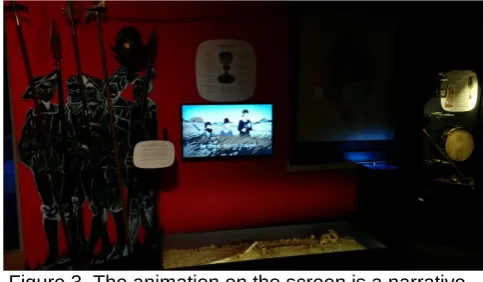
Figure 3. The animation on the screen is a narrative on its own. Around it are artefacts (for example the
skeleton of one of the film’s main characters) connecting and adding depth to the audio-visual story. Viborg Museum, Denmark. Photo: The author.
construct stories themselves from what is presented to them [39]. Tracking a narrative is a helpful means of wayfinding for visitors, but even more abstract or mixed exhibitions without obvious stories may ignite the construction of narratives by the visitors themselves.
Narratives are thus defining parts of museums, as it ‘is a common framework for interpretation’ [46]. Narrative is used to make sense of the world in an ordered way by organising, explaining and presenting certain parts of the world in certain ways. It plays three roles in the museum: The interpretative role, defined by the storytelling of the academic disciplines and traditions lying behind it; a performative role by which it interestingly – and entertainingly - conveys a meaning; and a constructive role, directing visitors’ experience and flow. Museums themselves may even be seen as narratives [46]. Narratives in museums may be present on several levels. Besides seeing entire museums as a narrative, parts of an exhibition may constitute a narrative, and less may also do. Single museum sections or various installations may be in the form of an independent narrative, for instance films or interactive games. Describing this characteristic on a continuum, one end represents a tight, singular narrative structure, whereas the other end consists of a loose and multidirectional structure, the latter also representing interactive narrative models.
Interactivity
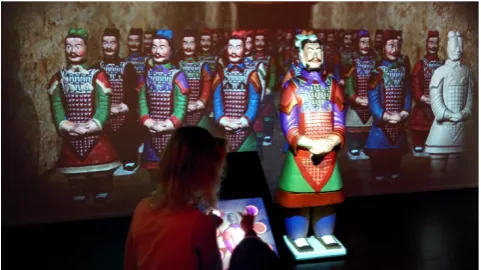
Figure 4. Interactive painting installation. On the touchscreen, parts and colours to manipulate on the physical terracotta warrior (copy) are selected. When
the warrior is painted, this goes into flames, and occurs in the long line of painted warriors on the projection in the background. Moesgaard Museum,
Denmark. Photo: The author.
In broad terms, interactivity is the active relationship between two or more entities (objects or people), on which three major academic perspectives has been laid. Perspective one regards interactivity as a formal property of a media technology, where the user can influence content or form of communication. Secondly, interactivity may also be seen as a communication process, not
focusing on the technology, but the information exchanges taking place between the actors. A user-oriented perspective is presented in the third perspective, and focus lies on the effects of this interactive communication. It is also possible to distinct between so-called open (or productive/ontological) interactivity, where users can actually create content (Figure 4), and closed (or explanatory) interactivity (Figure 5), restricting users only to navigation and selection of content [47]. Until this day, the latter version of interactivity has probably been the most common in the museum world. Is it a sign of fear of handing over the authority and risk losing control, or is it a matter of understanding the notion in the context of the museum? It has been stated, that in broad terms, the nature of a museum is to interact with the surrounding community, as it is also exemplified by for instance the Danish Museum Act, to which the state owned and state approved museums in Denmark comply, and therefore are obliged to collect, register, preserve, research and educate. More specifically, there has been a recent change in the exchange and communication between museums and their visitors and other non-professionals, originating from new possibilities of interaction and new purposes with these, concentrating on the users who may be seen as either citizens in need of education or consumers wanting experiences. Digitalisation and access to technology has made it possible to reshape the various interactive kinds of communication whether it is through a one way delivery of information or through a dialogue and whether it is communicated from one to one, from one to many or from many to many [48].
Figure 5. Information about life in a Danish military camp in Afghanistan is acquired by selecting short videos on a mounted iPad. Tøjhusmuseet, Denmark.
Photo: The author.
passively consumed by passive users, whereas active users may be able to act interactive with more static media such as broadcast media etc. Regarding interactivity in museums, curator Benjamin Asmussen has suggested three ideal elements to describe the possibilities for visitors’ use of an exhibition. The first element consists of gazing, and is most often prompted by traditional display of non-touchable artefacts, texts, sound and film. The next element prompts visitors’ activity. Here we find objects that may be touched or otherwise handled, clothes to try out, buttons that activates lights, films or other simple actions. Interactivity is prompted by the third of Asmussen’s elements, which reacts and changes on the visitor’s input and thereby changes condition by giving a new feedback to the user. In a museum context, such features are often found in games or simulators [50]. Adding to such a distinction, Andrea Witcomb has criticized the mechanistic or technical view on interactivity that is common in the museum world, putting this label onto nearly every hands-on experience. Instead of defining interactivity merely as the outcome of interactives, Witcomb suggests a constructivist approach, where a form of dialogue between museum and visitor is considered a core element in the thinking of the notion interactivity in the visitor oriented museum context [51]. Roppola endorses the focus on the less explicit interactivity, and suggests that one discerns between interactive as a product and interactive as a process, since – in the end – the experience of interactivity is individual [39].
In describing the characteristic interactivity on a continuum of the conceptual framework for audio-visual museum media, one end represents the simplest or most passive level of interactivity (none), while the other end will suggest unlimited and open ended interactivity.
Integration with museum objects
Consider the discussion about the museum object from the introductory section. A large part of the museum identity still lies in collections. This characteristic relates to audio-visual media’s physical integration with historical objects.
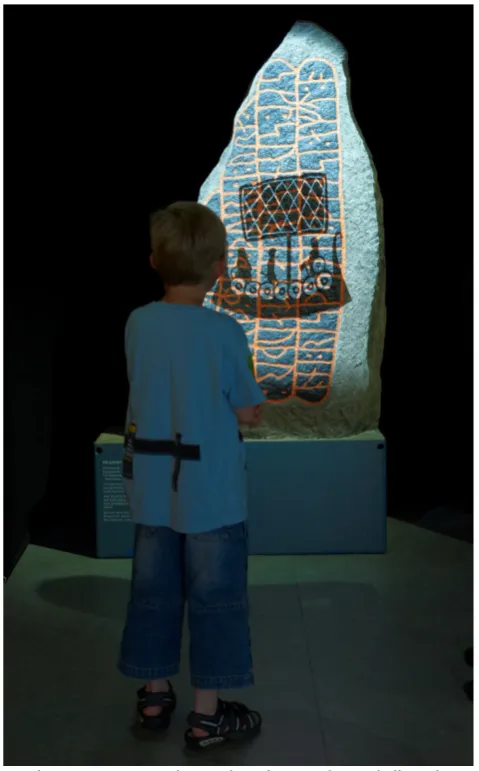
Figure 6. Interactive animation projected directly onto the authentic runic stone.
Photo: Museum Østjylland (East Jutland Museum), Denmark. Used with permission.
the extremes represent respectively a strongly connected, or detached, audio-visual mediation of objects on display.
Figure 7. Audio-visual media spatially detached from object. A screen in a display case presenting a virtual 3D version of an object is being watched by a
man in black, while a lady in red carrying a child is the only one actually looking at the original object in
the foreground of the photo. Suzhou Museum, People's Republic of China. Photo: The author.
Virtuality and authenticity
Museologist Ross Parry has pointed out that after the introduction of the web and social media, museums have – with these types of media - tended to resist a fictive tradition, which has previously been a strong part of their history. The use of artifice, the illusory and make-believe for imitation, illustration and immersion [5] seems to be challenged by the new media’s possibilities for museum visitors to participate as both consumers and producers of knowledge in a dialogue with the museum. Nonetheless, museums have a long tradition for, and are continuously, staging and virtualising the past when it comes to more traditional, controllable, one-way museum mediation. One of the reasons that museum professionals may justify the use of virtuality in their presentation of the past, lies in the complexity of the notion authenticity. Showcasing a virtual version of the past is not a direct opposite to ‘the truth’ or authentic, but indeed a demonstration of a potential [53], and may very well represent what [5] describes as authentic experiences, though these can be based on substantially artificial materials (such as molded and assembled dinosaur skeletons or other reconstructions). Turning to social semiotics and the notion of modality, the concept of truth is interpersonal rather than ideational, and to a greater extent considered a construct of semiosis, where given verbal, visual or other kinds of propositions can be represented as true or not based on values and beliefs of particular social groups (for instance ‘the western societies’) [54]. Instead of attaching terms like ‘original’ or ‘accurate’, focusing on provenance, authenticity also lies in the intention of the
museum and the impact on the visitor. In this context the virtual should not be automatically judged as non-authentic. Even ‘authentic’ objects displayed in a museum are at this stage detached from their original context, and the use and status of these artefacts are now ‘museum objects’. On the other hand, visitors tend to perceive fully equipped, old interiors as authentic, even though many of the objects surrounding them may consist of replacements for lost originals. In some people’s view authenticity may be aligned with the accurate. Avoiding dichotomising museum material into opposite pairs of authentic-nonauthentic - deeming every unoriginal part of the museum mediation as fake – the act and notion of virtualization makes sense in the museum context. Mimesis and the virtual thus belong in the museum, as some of the conceptual tools for representing the past.
Figure 8. The archaeologist presents data on touchscreen. Lindholm Høje, Denmark. Photo: The
author.
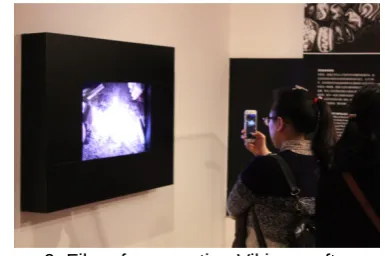
This continuum is not to be confused with the more technical aspects of a mixed reality continuum, where the extremes represent respectively, a real environment and a virtual environment. Instead it is concerned with the virtualizing role of audio-visual media in museums. Thus, one end of the continuum represents the use of audio-visual media to convey strictly factual museum objects or historical data (Figure 8), while the other end signifies a virtual (Figure 9) version of the past.
Figure 9. Film of re-enacting Viking craftsmen on display is being recorded onto a museum visitor’s smartphone. Suzhou Museum, People's Republic of
Spatial interrelation
The traditional, physical museum exhibition can be defined as a certain space. It is a physical space, bounded by walls etc., with exhibited material. It is also a space defined by social conventions [55]. The museum space itself can be experienced as a condition of meaning making that is both facilitating and is intertwined with the interpretation processes [56]. Space and scenography contributes to meaning making and is actively used in the museums. Though writing is still used to explain and contextualise objects, interior design is part of the storytelling and provide messages, information and moods alongside verbal text elements [57]. People may behave in certain ways at the museum, and they may have certain expectations to these spaces. The communicative and representational elements are spatially ordered into areas with information relating to certain narratives about a topic (similar to a chapter or section in a book). Usually, such areas, or zones, are physically defined by walls, display cases and screens, and serves to inform and guide the visitors. Audio-visual media may be implemented under certain guidelines according to the specific situation, but may also expand or create new spaces, for instance by filling out planes with moving images.
Figure 10. A video projection on the inner backdrop of a tent situates the museum visitor among Danish UN forces in Afghanistan. Tøjhusmuseet, Denmark.
Photo: The author.
Museums may be defined as representing the world (of the past) in a material and spatial manner. Besides the physical museum’s building containing collections and exhibitions, museums also have activities outside the museum building – such as touring exhibitions, mobile installations and apps, as well as online spaces such as virtual museums, websites and online collections [26]. Audio-visual museum media occurs in many other places than inside exhibition halls. Therefore, one should consider the spatial aspects of the audio-visual mediation and how it influences the experience of physical space. Is it on- or offsite? If one consider outdoor cultural heritage as kinds of mega objects, this can be a special case of the
characteristic of integration with the museum object. A more pressing question is instead if the audio-visual media is delivered via a fixed (Figure 10) or a mobile (Figure 11) system. A continuum representing spatial aspects of audio-visual museum mediation should reflect this interrelation between the audio-visual media and the surrounding space.
Figure 11. Mobile augmented reality-application bringing ships back to the old harbour. Sydvestjyske
Museer, Denmark. Photo: The author.
The social context
Figure 12. Headphones concentrate the attention to the mobile app. Sydvestjyske Museer, Denmark.
The area of interest in this section lies within the social context. The large part of museum visitors visits museums together with others, and even lone visitors often take part in social interactions at the museum. This sociocultural context is considered in the current framework to evaluate whether a given audio-visual museum mediation is suitable for social interaction [23]. Media technologies like headphones (Figure 12) or small monitors (Figure 13) may present constraints for simultaneous experiences.
Figure 13. Playing a touch screen based game in the exhibition room. Museet Ribes Vikinger, Denmark.
Photo: The author.
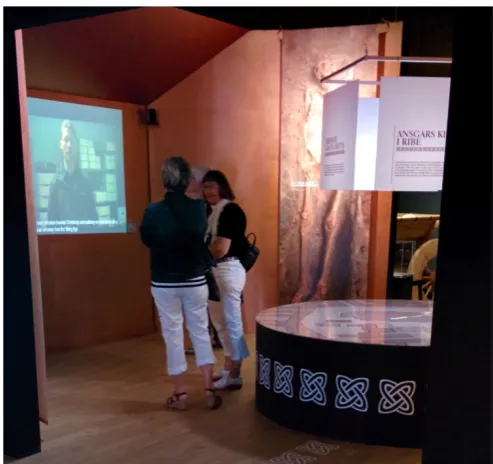
A key question about the social dimensions of audio-visual museum media is if communication with one another is possible during the experience (Figure 14), or maybe even necessary to get the full experience of a given audio-visually aided museum installation? Though museums are regarded as social places, where visitors meet and discuss their experiences, ‘(…) much of the computer technology that has been introduced to museums is for individual rather than individual use’ [58]. One end in this almost binary continuum represents situations prompting an individual experience, while the other end represents audio-visual museum mediation aiming multiple visitors at the same time.
Figure 14. A social audio-visual media experience. Museet Ribes Vikinger, Denmark. Photo: The
author.
Mimesis-abstraction
Figure 15. Mobile, mimetic representation of the past. Sydvestjyske Museer, Denmark. Photo: The
author.
the level of the media content’s abstraction and ranges from abstraction to mimesis.
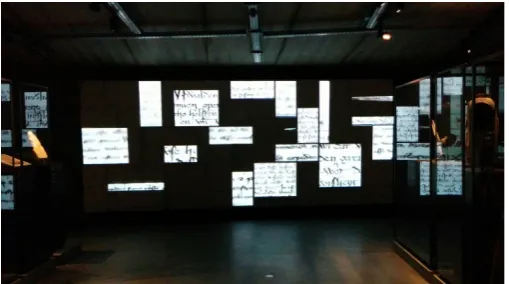
Figure 16. Dynamic audio-visual projection of forms and colours based on fragments of artefacts and old manuscripts. Danmarks Borgcenter, Vordingborg,
Denmark. Photo: The author.
Conclusion
Museums use audio-visual media in many different ways. With a seemingly increasing use of the combination of interactivity and audio-visual media, it is useful to introduce new perspectives on the use of audio-visual media in museums instead of previous technology-and-installation-focused definitions. Observations of visitors engaging with selected audio-visual mediated museum situations support previous studies, showing that free-choice environments of a modern museum makes every tool of communication in a given museum competitors of attraction. In that respect, the above attempt to identify different uses and characteristics may not say much about what situation is preferred, as such distinction is dependent on a broader context. But awareness of the characteristics and their affordances make it easier to choose strategies for museum professionals planning to communicate history with the aid of audio-visual media. I propose that the current framework model can be used on at least two different levels. First of all it can be applied to identify characteristics of a given design of audio-visual media use, and secondly it can also function as guidelines or focal points for investigating visitors’ experience of the given media use.
Since museums’ presentation of the past involves constructive communication of the relevant topics, it is also my hope, that the discussion in this article reduces the either-or attitudes to implementation of media that adds to the virtualisation of the past in a misconceived understanding of authenticity and the nature of history as a profession.
Acknowledgements.
The author wish to thank Professor MSO, Ph.D. Eva Petersson Brooks, Aalborg University, for critical feedback and
conversations. The research project, of which this paper is part, has been co-funded by Aalborg University and external funding raised by Sydvestjyske Museer. I will therefore show my appreciation of Slots- og Kulturstyrelsen, Esbjerg Kommunes Vækstfremmepulje, and SUC-Fonden for finansially supporting the project.
References
[1] ICOM (n.d.), Museum Definition, Available at: http://icom.museum/the-vision/museum-definition/ [Last accessed 4 March 2015].
[2] HOOPER-GREENHILL, E. (2003) Museums and the Shaping of Knowledge (London: Routledge).
[3] KIRSHENBLATT-GIMBLETT, B. (2000) The Museum as Catalyst. Keynote address. Museums 2000: Confirmation or Challenge. (ICOM Sweden, the Swedish Museum Association and the Swedish Travelling Exhibition/Riksutställingar in Vadstena, Sept. 29, 2000). Available at: https://www.nyu.edu/classes/bkg/web/vadstena.pdf [Last accessed 7 July 2015].
[4] STARN, R. (2005) A Historian’s Brief Guide to New Museum Studies. American Historical Review110(1): 68-98.
[5] PARRY, R. (2013) The Trusted Artifice: Reconnecting with the Museum’s Fictive Tradition Online. In: Drotner, K. and Schrøder K. C. (eds.) Museum Communication and
Social Media: The Connected Museum (London:
Routledge), 17-32.
[6] CHHABRA, D. (2008) Positioning Museums on an Authenticity Continuum. Annals of Tourism Research, 35(2): 427–447.
[7] DUEHOLM, J. and SMED, K. M. (2014) Heritage authenticities – a case study of authenticity perceptions at a Danish heritage site. Journal of Heritage Tourism, 9(4): 285-298.
[8] ASINGH, P. (2013) At bevare den gode historie.
Arkæologisk Forum, 29: 26-29.
[9] STUGU, O. S. (2008) Historie i bruk (Oslo: Det Norske Samlaget).
[10] EDER, J. (2014) Film and Digital Media. In: Ryan, M. L., Emerson, L. and Robertson, B. J. The Johns Hopkins
Guide to Digital Media (Baltimore: Johns Hopkins
University Press), 191-197.
[11] HUGHES, P. (2010) Exhibition design (Portfolio) (London: Laurence King).
[12] KJELSTADLI, K. (1999) Fortida er ikke hva den en gang
var: En innføring i historiefaget, 2nd ed. (Oslo:
Universitetsforlaget).
[13] ROSENSTONE, R. A. (1995) Visions of the past: the challenges of film to our idea of history (Cambridge, Massachusetts: Harvard University Press).
[14] FOGU, C. (2009) Digitalizing Historical Consciousness.
History and Theory (47): 103-121.
[15] ANDERSON, S. F. (2011) Technologies of History: Visual Media and the Eccentricity of the Past. (New Hampshire: University Press of New England).
[16] HOOPER-GREENHILL, E. (ed.) (1999) Museum, Media, Message (London: Routledge).
[17] BENES̆, J. (1976) Audio-visual media in museums. Museum International, 28: 121–124.
Virtual and the Real: Media in the Museum (Washington: American Association of Museums), 57-70.
[19] KELLY, L. (2010) The role of narrative in museum exhibitions. (Sydney: Australian Museum). Available at: http://australianmuseum.net.au/blogpost/museullaneous/the -role-of-narrative-in-museum-exhibitions [Last accessed 15 April 2013].
[20] MINTZ, A. (2000) Media and Museums: A Museum Perspective. In: Thomas, S. and Mintz, A. (eds.) The Virtual and the Real: Media in the Museum (Washington: American Association of Museums), 19-34.
[21] FILIPPINI-FANTONI, S. and BOWEN, J. P. (2008) Mobile Multimedia. In: Tallon, L. and Walker, K. (eds.) Digital Technologies and the Museum Experience: Handheld Guides and Other Media (New York: AltaMira Press), 79-96.
[22] SCHUESSLER, J. (1992) Audio-visual technology: interpretive aid or roadside attraction? In: Museum International44: 88–91.
[23] FALK, J. H. and DIERKING, L. D. (2013) The Museum Experience Revisited (Walnut Creek, CA: Left Coast Press).
[24] GAMMON, B. and BURCH, A. (2008) Designing Mobile Digital Experiences. In: Tallon, L. and Walker, K. (eds.)
Digital Technologies and the Museum Experience: Handheld Guides and Other Media (New York: AltaMira Press), 35-60.
[25] SERRELL, B. (2002) Are They Watching? Visitors and Videos in Exhibitions, Curator, 45(1): 50-64.
[26] NIELSEN, M. K. (2014) The Modern Museum: A Space for
Authentic Experiences? In: Berning, N., Schulte, P. and Schwanecke, C. (eds.) Experiencing Space – Spacing Experience: Concepts, Practices, and Materialities (Trier: WVT Wissentschaftlicher Verlag Trier), 129-143.
[27] MILGRAM, P. and KISHINO, F. (1994) A Taxonomy of Mixed reality Visual Displays. In IEICE Transactions on Information Systems, Vol E77-D(12): 1321-1329.
[28] TALLON, L. (2008) Introduction: Mobile, Digital, and Personal. In: Tallon, L. and Walker, K. (eds.) Digital Technologies and the Museum Experience: Handheld Guides and Other Media (New York: AltaMira Press), xiii-xxv.
[29] THOMAS, S. and MINTZ, A. (eds.) (2000) The Virtual and the Real: Media in the Museum (Washington: American Association of Museums).
[30] HENNING, M. (2006) Museums, Media and Cultural Theory (Maidenhead: Open University Press).
[31] HENNING, M. (ed.) (2015) Museum Media (Chichester, West Sussex: Wiley-Blackwell).
[32] TALLON, L. and WALKER, K. (eds.) (2008) Digital Technologies and the Museum Experience: Handheld Guides and Other Media (New York: AltaMira Press). [33] CAMERON, F. and KENDERDINE, S. (eds.) (2010) Theorizing
Digital Cultural Heritage: A Critical discourse
(Cambridge: The MIT Press).
[34] PARRY, R. (ed.) (2010) Museums in a Digital Age
(London: Routledge).
[35] DROTNER, K., LARSEN, B. A., LØSSING, A. S. W. and WEBER, C. P. (eds.) (2011a) Det Interaktive Museum
(Frederiksberg C.: Samfundslitteratur).
[36] CARROZZINO, M. and BERGAMASCO, M. (2010) Beyond virtual museums: Experiencing immersive virtual reality in real museums. Journal of Cultural Heritage, 11(4), 452-458.
[37] FONI, A., PAPAGIANNAKIS, G. E. and MAGNENAT -THALMANN, N. (2010) A taxonomy of visualization
strategies for cultural heritage applications. Journal on Computing and Cultural Heritage (JOCCH), 3(1): 1-21. [38] SEMPER, R. J. (2000) Designing Hybrid Environments:
Integrating Media into Exhibition Space. In: Thomas, S. and Mintz, A. (eds.) The Virtual and the Real: Media in
the Museum (Washington: American Association of
Museums), 119-127.
[39] ROPPOLA, T. (2012) Designing for the Museum Visitor Experience (New York: Routledge).
[40] KRESS, G. (2010) Multimodality: A social semiotic
approach to contemporary communication (Oxon:
Routledge).
[41] BEZEMER, J. and JEWITT, C. (2010) Multimodal Analysis: Key issues. In: Litosseliti, L. (ed.) Research Methods in Linguistics. (London: Continuum), 180-197.
[42] BEZEMER, J., DAMANOPOULOU, S., JEWITT, C., KRESS, G. and MAVERS, D. (2012) Using a Social Semiotic Approach to Multimodality: Researching Learning in Schools, Museums and Hospitals, NCRM Working Paper 01/12, March 2012. Available at http://eprints.ncrm.ac.uk/2258/ [Last accessed 3 March 2014].
[43] SMEDS, K. (2012) On the Meaning of Exhibitions – Exhibition Epistèmes in a Historical Perspective. Designs for Learning5(1-2): 50-73.
[44] BURN, A. (n.d.) Kineikonic. Glossary of Multimodal Terms. National Centre for Research Methods. Available at:
https://multimodalityglossary.wordpress.com/kineikonic/ [Last accessed 4 March 2015].
[45] AUSTIN, T. (2012) Scales of narrativity. In: MacLeod, S.,
Hanks, L. H., and Hal, J. (eds.): Museum Making: Narratives, Architectures, Exhibitions (Oxon: Routledge), 107-118.
[46] PARRY, R. (2008) The future in our hands? Putting the potential of digital handhelds into practice. In: Tallon, L. and Walker, K. (eds.) Digital Technologies and the Museum Experience: Handheld Guides and Other Media
(New York: AltaMira Press), 179-193.
[47] MECHANT, P. and VAN LOOY, J. (2014) Interactivity. In: Ryan, M. R., Emerson, L. and Robertson, B. J. (eds.) The Johns Hopkins Guide to Digital Media (Baltimore: Johns Hopkins University Press), 302-305.
[48] DROTNER, K., LARSEN, B. A., LØSSING, A. S. W. and WEBER C. P. (2011b) Introduktion. Interaktive museer: hvordan og hvorfor? In: Drotner, K., Larsen, B. A., Løssing, A., S. W. and Weber, C. P. (eds.), Det Interaktive Museum (Frederiksberg C.: Samfundslitteratur), 11-24. [49] RETZINGER, K. (2009) Confounding definitions: using a
continuum to understand interactivity. In: Proceedings of the 27th ACM international conference on Design of
communication (SIGDOC '09) ACM (New York, NY,
USA): 245-250.
[50] ASMUSSEN, B. (2012) Beskuelse, aktivitet og interaktivitet – et forsøg på en definition af udstillingselementer. Available at http://historieblog.dk/2012/beskuelse-aktivitet-interaktivitet/ [Last accessed 7 July 2015]. [51] WITCOMB, A. (2006) Interactivity: Thinking Beyond. In:
Macdonald, S. (ed.) A Companion to Museum Studies
(Oxford: Blackwell Publishing), 353-361.
[52] WALKER, K. (2008) Structuring Visitor Participation. In: Tallon, L. and Walker, K. (eds.) Digital Technologies and the Museum Experience: Handheld Guides and Other Media (New York: AltaMira Press), 109-124.
[54] KRESS, G. and VAN LEEUWEN, T. (2006) Reading Images: The Grammar of Visual Design (London: Routledge). [55] CAMERON, F. 2007 Beyond the Cult of the Replicant:
Museums and Historical Digital Objects – Traditional Concerns, New Discourses. In: Cameron, F. and S. Kenderdine (eds.) Theorizing Digital Cultural Heritage: A Critical discourse (Massachusetts: MIT Press), 49-75. [56] SCHORCH, P. (2013) The experience of a museum space,
Museum Management and Curatorship: 1-16.
[57] HABSBURG-LOTHRINGEN, B. (2015) From Object to Environment: The Recent History of Exhibitions in Germany and Austria. In: Henning, M. (ed.) Museum Media (Chichester, West Sussex: Wiley-Blackwell), 237-347.
[58] SHARPLES, M., FITZGERALD, E., MULHOLLAND, P. and JONES, R. (2013) Weaving Location and Narrative for Mobile Guides. In: Drotner, K. and Schrøder, K. C. (eds.)
Museum Communication and Social Media: The Connected Museum (New York: Routledge), 177-196. [59] BORDWELL, D. (1985) Narration in the Fiction Film.
(Madison, Wisconsin: The University of Wisconsin Press). [60] FURNISS, M. (2009) Art in Motion: Animation Aesthetics.