Requirements Engineering for Self-Adaptive
Systems with ARE and KnowLang
Emil Vassev
11Lero–the Irish Software Engineering Research Center, University of Limerick, Limerick, Ireland
Abstract
This article presents an approach to Autonomy Requirements Engineering (ARE) that targets the integration and promotion of autonomy in software-intensive systems by providing a mechanism and methodology for elicitation and expression of autonomy requirements. ARE relies ongoal-oriented requirements engineeringto elicit and define system goals, and uses thegeneric autonomy requirementsmodel to derive and define assistive and, eventually, alternative objectives. The system may pursue these “self-* objectives” in the presence of factors threatening the achievement of the initial system goals. Once identified, the autonomy requirements are specified with KnowLang, a formal language dedicated to knowledge representation and reasoning. To demonstrate both the ARE’s and KnowLang’s ability to handle autonomy requirements for self-adaptive systems, the approach is applied to Science Clouds, a self-adaptive cloud platform.
Receivedon 16 November 2014;acceptedon 09 January 2015, published on 28 January 2015
Keywords: self-adaptive systems, requirements engineering, autonomy, ARE, KnowLang
Copyright © 2014 Emil Vassev, licensed to ICST. This is an open access article distributed under the terms of the Creative Commons Attribution license (http://creativecommons.org/licenses/by/3.0/), which permits unlimited use, distribution and reproduction in any medium so long as the original work is properly cited.
doi:10.4108/sas.1.1.e6
1. Introduction
There are many advantages to self-adaptation. Among the most promising are the fact that self-adaptation enables software-intensive systems to become more versatile, flexible, resilient, dependable, robust, energy-efficient, recoverable, customizable, configurable, and self-optimizing by adapting to changing operational contexts, environments or system characteristics. Although very promising, the paradigm brings a lot of challenges.
Among the many challenges software engineers must overcome are those related to elicitation and expression of autonomy requirements. Nowadays, requirements engineering for autonomous and self-adaptive systems appears to be a wide open research area with no definitive solution yet. The major problem is that the integration and promotion of autonomy in software-intensive systems is an extremely challenging task.
This article draws upon my experience with the Autonomy Requirements Engineering (ARE) [1, 2] approach to present its ability to handle autonomy requirements for self-adaptive systems. The ARE
∗
Corresponding author. Email:[email protected]
approach has been developed by Lero, the Irish Software Engineering Research Center, within the mandate of a joint project with ESA, the European Space Agency. The approach is intended to help engineers tackle the integration and promotion of autonomy in software-intensive systems. ARE combines specialgeneric autonomy requirements(GAR) with goal-oriented requirements engineering (GORE) [3]. Using this approach, software engineers can determine what autonomic features to develop for a particular system as well as what artifacts that process might generate (e.g., goals models, requirements specification, etc.). To model and formalize the elicited requirements, ARE relies on KnowLang [4], a formal language dedicated to knowledge representation and reasoning for self-adaptive systems.
Both ARE and KnowLang have been used in a few projects to capture the autonomy requirements of self-adaptive systems. Some proof-of-concept examples are related to the ESA BepiColombo Mission [5–7] and the ASCENS Project’s [8] case studies on Swarm Robotics [9], eMobility [10], and Science Clouds [11].
2. ARE - Autonomy Requirements Engineering
2.1. Understanding ARE
The first step in developing any new software-intensive system is to determine the system’s functional and non-functional requirements. The former requirements define what the system will actually do, while the latter requirements refer to its qualities, such as performance, along with any constraints under which the system must operate. Despite differences in application domain and functionality, all autonomous systems extend upstream the regular software-intensive systems with special self-managing objectives (self-* objectives). Basically, the self-* objectives provide the system’s ability to automatically discover, diagnose, and cope with various problems. This ability depends on the system’s degree ofautonomicity,quality and quantity of knowledge,awareness and monitoring capabilities, and quality characteristics such asadaptability, dynamicity, robustness, resilience, and mobility. Basically, this is the basis of the ARE approach [1, 2, 5–7]: autonomy requirements are detected as self-objectives backed up by different capabilities and quality characteristics outlined by the GAR model.
The ARE approach starts with the creation of a goals modelthat represents system objectives and their interrelationships. For this, we use GORE where ARE goals are generally modeled with intrinsic features such as type, actor, and target, with links to other goals and constraints in the requirements model. Goals models might be organized in different ways copying with the system specifics and engineers’ understanding about the system goals. Thus, we may have 1) hierarchical structures where goals reside different levels of granularity; 2) concurrent structures where goals are considered as concurrent; etc. At this stage, the goals models are not formal and we use natural language along with UML-like diagrams to record them. The next step in the ARE approach is to work on each one of the system goals along with the elicited environmental constraints to come up with the self-* objectives providing the autonomy requirements for this particular system’s behavior. In this phase, we apply the GAR model to a system goal to derive autonomy requirements in the form of goal’s supportive and alternative self-* objectives along with the necessary capabilities and quality characteristics. In the first part of this phase, we record the GAR model in natural language. In the second part though, we use a formal notation to express this model in a more precise way. Note that, this model carries more details about the autonomy requirements, and can be further used for different analysis activities, including requirements validation and verification.
2.2. System Goals and Goals Models
Goals have long been recognized to be essential components involved in the requirements engineering (RE) process [12]. To elicit system goals, typically, the system under consideration is analyzed in its organizational, operational and technical settings. Problems are pointed out and opportunities are identified. High-level goals are then identified and refined to address such problems and meet the opportunities. Requirements are then elaborated to meet those goals.
Goal identification is not necessarily an easy task [13–15]. Sometimes goals can be explicitly stated by stakeholders or in preliminary material available to requirements engineers. Often though, they are implicit so that goal elicitation has to be undertaken. The preliminary analysis of the current system along with the operational environment is an important source for goal identification. Such analysis usually results in a list of problems and deficiencies that can be formulated precisely. Negating those formulations yields a first list of goals to be achieved by the system-to-be. In my experience, goals can also be identified systematically by searching for intentional keywords in the preliminary documents provided. Once a preliminary set of goals and goal-related constraints is obtained and validated with stakeholders, many other goals can be identified byrefinementand by abstraction, just by asking HOW and WHY questions about the goals/constraints already available [16]. Other goals are identified by resolving conflicts among goals or obstacles to goal achievement. Further, such goals might be eventually defined as self-* objectives.
Goals are generally modeled byintrinsic featuressuch as their type and attributes, and by their links to other goals and to other elements of a requirements model. Goals can be hierarchically organized and prioritized where high-level goals (e.g., main system objectives) might comprise related, low-level, sub-goals that can be organized to provide different alternatives of achieving the high-level goals. In ARE, goals are registered in plain text with characteristics likeactors, targetsandrationale. Moreover, inter-goal relationships are captured bygoals models putting together all goals along with associated constraints. ARE’s goals models are presented in UML-like diagrams. Goals models can assist us in capturing autonomy requirements in several ways [2,5–7]:
2. ARE goals models might be used to provide a means to represent alternative ways where the objectives of the system can be met and analyze and rank these alternatives with respect to quality concerns and other constraints, e.g., environmental constraints:
(a) This allows for exploration and analysis of alternative system behaviors at design time. (b) If the alternatives that are initially delivered
with the system perform well, there is no need for complex interactions on autonomy behavior among autonomy components. (c) Not all the alternatives can be identified
at design time. In an open and dynamic environment, new and better alternatives may present themselves and some of the identified and implemented alternatives may become impractical.
(d) In certain situations, new alternatives will have to be discovered and implemented by the system at runtime. However, the process of discovery, analysis, and implementation of new alternatives at runtime is complex and error-prone. By exploring the space of alternatives at design time, we are minimizing the need for that difficult task.
3. ARE goals models might provide the traceability mechanism from design to requirements. When a change in requirements is detected at runtime, goal models can be used to re-evaluate the system behavior alternatives with respect to the new requirements and to determine if system reconfiguration is needed:
(a) If a change in requirements affects a particular goal in the model, it is possible to see how this goal is decomposed and which parts of the system implementing the functionality needed to achieve that goal are in turn affected.
(b) By analyzing a goals model, it is possible to identify how a failure to achieve some particular goal affects the overall objective of the system.
(c) Highly variable goals models can be used to visualize the currently selected system configuration along with its alternatives and to communicate suggested configuration changes to users in high-level terms.
4. ARE goals models provide a unifying intentional view of the system by relating goals assigned to individual parts of the system (usually expressed
as actors and targets of a goal) to high-level system objectives and quality concerns:
(a) High-level objectives or quality concerns serve as the common knowledge shared among the autonomous system’s parts (or components) to achieve the global system optimization. In this way, the system can avoid the pitfalls of missing the globally optimal configuration due to only relying on local optimizations.
(b) Goals models might be used to identify part of the knowledge requirements, e.g., actors or targets.
Moreover, goals models might be used to manage con-flicts among multiple goals including self-* objectives. Note that by resolving conflicts among goals or obsta-cles to goal achievement, new goals (or self-* objectives) may emerge.
2.3. Self-* Objectives and Autonomy-Assistive
Requirements
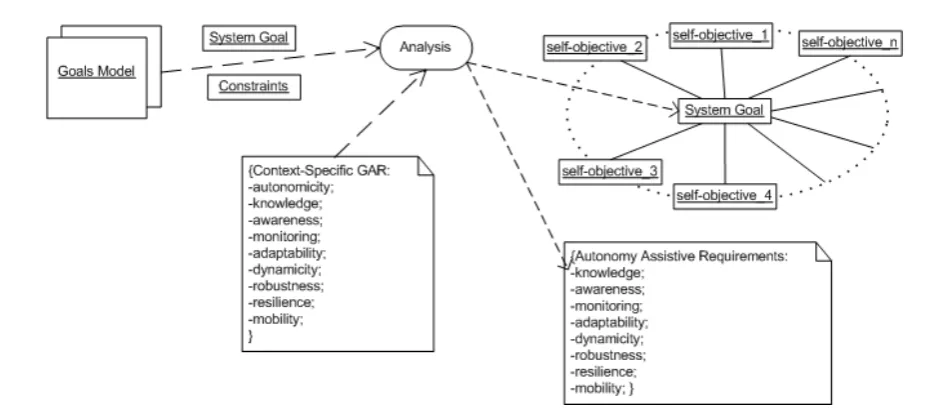
Basically, the GAR (generic autonomy requirements) model follows the principle that despite their diff er-ences in terms of application domain and functionality, all autonomous systems are capable of autonomous behavior driven by one or moreself-management objec-tives [2] that drive the development process of such systems. ARE uses goals models as a basis helping to derive self-* objectives per a system goal by applying a model forgeneric autonomy requirementsto any system goal [2,6]. The self-* objectives represent assistive and eventually alternative goals (or objectives) the system may pursue in the presence of factors threatening the achievement of the initial system goals. The diagram presented in Figure 1 depicts the process of deriving the self-* objectives from a goals model of the system-to-be. Basically, a context-specific GAR model provides some initial self-* objectives, which should be further analyzed and refined in the context of the specific system goal to see their applicability. As shown in Figure1, in addition to the derived self-* objectives, the ARE process also produces autonomy assistive require-ments. These requirements (also defined as adaptation-assistive attributes) are initially defined by the GAR model [1,2,5] and are intended to support the achieve-ments of the self-* objectives. The autonomy assistive requirements outlined by GAR might be defined as following:
• Knowledge- basically data requirements that need to be structured to allow efficient reasoning.
Figure 1. The ARE Process of Deriving Self-* Objectives per System Goal
events and/or sensor signals to derive particular system states.
• Resilience and robustness - a sort of soft-goals. For example, such requirements can be defined as “robustness: system is robust to communica-tion latency” and “resilience: system is resilient to hardware failures, node disappearances, or appearances”. These requirements can be spec-ified as soft goals leading the system towards “reducing and copying with communication latency” and “keeping system’s performance optimal”. A soft goal is satisfied rather than achieved. Note that specifying soft goals is not an easy task. The problem is that there is no clear-cut satisfaction condition for a soft goal. Soft goals are related to the notion of satisfaction. Unlike regular goals, soft goals can seldom be accomplished or satis-fied. For soft goals, eventually, we need to find solutions that are “good enough” where soft goals are satisfied to a sufficient degree. Thus, when specifying robustness and resilience autonomy requirements we need to set the desired degree of satisfaction, e.g., by using probabilities.
• Monitoring, mobility, dynamicity and adaptability - might also be defined as soft-goals, but with relatively high degree of satisfaction. These three types of autonomy requirements represent impor-tantquality requirementsthat the system in ques-tion needs to meet to provide condiques-tions mak-ing autonomicity possible. Thus, their degree of satisfaction should be relatively high. Eventually, adaptability requirements might be treated as hard goals because they determine what parts of the system in question can be adapted (not how).
2.4. Autonomy Needs and Requirements Chunks
To record autonomy requirements, ARE relies on both natural language and formal notation. A natural language description of a self-* objective has the following format [6]:
• Name of Self-* Objective:Rationale of this self-* objective.
– Assisting system goals: List of system goals assisted by this self-* objective.
– Actors:Actors participating in the realization of this self-* objective.
– Targets:Targets of this self-* objective.
Note that this description is abstract and does not say how the self-* objective is going to be achieved. Basically, as recorded the self-* objectives define the “autonomy needs” of the system. How these needs are going to be met is provided by more detailed description of the self-* objectives recorded as ARE Requirements Chunks and/or specified formally.
In general, a more detailed description in a natural language may precede the formal specification of the elicited autonomy requirements. Such description might be written as a scenario describing both the conditions and sequence of actions needed to be performed in order to achieve the self-* objective in question.
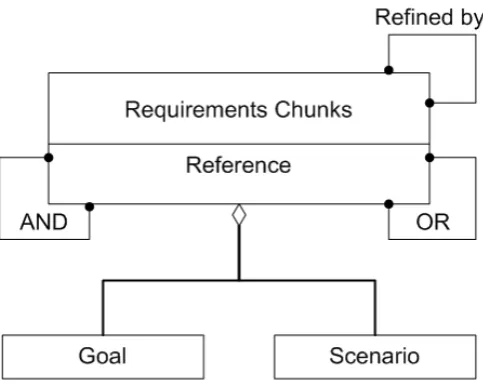
Note that a self-objective could be associated with multiple scenarios. The combination of a self-* objective and a scenario forms anARE Requirements Chunk(see Figure2). A requirements chunk can be recorded in a natural language as following:
ARE Requirements Chunk
• Name of Self-* Objective: Rationale of this self-* objective.
– Assisting system goals: List of system goals assisted by this self-* objective.
– Actors:Actors participating in the realization of this self-* objective.
– Targets:Targets of this self-* objective.
• Scenario: Description of a scenario how this self-* objective can be met by performing the system’s functionality.
Figure 2. Requirements Chunk - Goal & Scenario
Requirements chunks associate each goal with sce-narios where the goal-scenario pairs can be assembled together throughcomposition,alternativeandrefinement relationships(see Figure2). The first two lead to AND and OR structures of requirements chunks, whereas the last leads to the organization of the collection of requirements chunks as a hierarchy of chunks of diff er-ent granularity.AND relationshipsamong requirements chunks link complementary chunks in the sense that everyone requires others to define a completely func-tioning scenario covering a main goal. Requirements chunks linked throughOR relationshipsrepresent alter-native ways of fulfilling the same goal. Requirements chunks linked through a refinement relationship are at different levels of abstraction. Internally, the scenarios might introduce additional variability via conditional requirementsderived from the GAR’s requirements such as monitoring, adaptability, dynamicity, resilience, and robustness.
2.5. Formal Specification
ARE relies on KnowLang [4] for the formal specification of the elicited autonomy requirements. We use KnowLang to record these requirements as knowledge representation in a Knowledge Base (KB) comprising a variety of knowledge structures, e.g., ontologies, facts, rules, and constraints. The self-* objectives are specified with special policies associated with goals, special situations, actions (eventually identified as system capabilities), metrics, etc. Thus, the self-* objectives are represented as policies describing at an abstract level what the system will do when particular situations arise. The situations are meant to represent the conditions needed to be met in order for the system to switch to a self-* objective while pursuing a system goal. Note that the policies rely on actions that are a priori-defined as functions of the system. In case, such functions have not been defined yet, the needed functions should be considered asautonomous functions and their implementation will be justified by the ARE’s selected self-* objectives. ARE does not state neither specify how the system will perform these actions. This is out of the scope of the ARE approach. Basically, any requirements engineering approach states what the software will do not how the software will do it.
3. KnowLang
Figure 3. KnowLang Specification Model
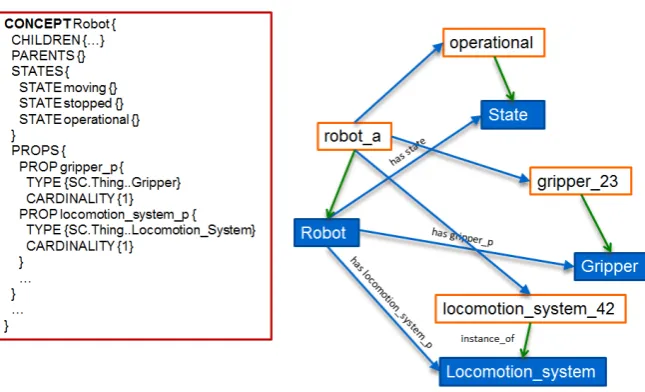
ontologies, facts, rules and constraints where we need to specify the ontologies first in order to provide the “vocabulary" for the other knowledge structures. A KnowLang ontology is specified over concept trees, object trees, relations and predicates. Each concept is specified with special properties and functionalities and is hierarchically linked to other concepts through PARENTSandCHILDRENrelationships. For reasoning purposes every concept specified with KnowLang has an intrinsicSTATEattribute that may be associated with a set of possible state values these concept instances may be in. Concept instances are considered as objects and are structured in object trees — a conceptualization of how objects existing in the world of interest are related to each other. The relationships in an object tree are based on the principle that objects have properties, where the value of a property is another object, which in turn also has properties. Moreover, concepts and objects may be connected via relations. Relations are binary and may have probability-distribution attributes (e.g., over time, over situations, over concepts’ properties, etc.). Probability distribution is provided to support probabilistic reasoning and by specifying relations with probability distributions we actually specify Bayesian networks connecting the concepts and objects of an ontology. Figure 4 shows a KnowLang specification sample demonstrating both the language syntax [20] and its visual counterpart — a concept map based on interrelations with no probability distributions. Modeling knowledge with KnowLang requires a number of phases:
• Initial knowledge gathering – involves domain experts to determine the basic notions, relations
and functions (operations) of the domain of interest.
• Behavior definition – identifies situations and behavior policies as “control data" helping to identify important self-adaptive scenarios. • Knowledge structuring – encapsulates domain
entities, situations and behavior into KnowLang structures such as concepts, objects, relations, facts and rules.
3.1. Modeling Self-adaptive Behavior
KnowLang employs special knowledge structures and a reasoning mechanism for modeling autonomic self-adaptive behavior [19]. Such a behavior can be expressed via KnowLang policies, events, actions, situationsandrelationsbetween policies and situations (see Definitions 1 through 10). Policies (Π) are at the core of autonomic behavior. A policy πhas a goal(g), policy situations(Siπ),policy-situation relations(Rπ), and policy conditions (Nπ) mapped to policy actions (Aπ) where the evaluation ofNπmay eventually (with some degree of probability) imply the evaluation of actions
(denotedNπ [Z]
→Aπ) (see Definition2). A condition is a Boolean expression over an ontology (see Definition4), e.g., the occurrence of a certain event.
Policy situationsSiπ are situations (see Definition7) that may trigger (or imply) a policy π, in compliance with the policy-situations relations Rπ(denoted by
Siπ [Rπ]
→ π), thus implying the evaluation of the policy conditions Nπ(denoted by π→Nπ)(see Definition 2). Therefore, the optional policy-situation relations (Rπ) justify the relationships between a policy and the associated situations (see Definition 10). Note that in order to allow for self-adaptive behavior, relations must be specified to connect policies with situations over an optional probability distribution (Z) where a policy might be related to multiple situations and vice versa. Probability distribution is provided to support probabilistic reasoning and to help the reasoner to choose the most probable situation-policy “pair". Thus, we may specify a few relations connecting a specific situation to different policies to be undertaken when the system is in that particular situation and the probability distribution over these relations (involving the same situation) should help the reasoner decide which policy
to choose (denoted by si[Z]→π – see Definition 10). Hence, the presence of probabilistic beliefs in both mappings and policy relations justifies the probability of policy execution, which may vary with time. A goalg
Figure 4. KnowLang Specification Sample
expressed with a state (s), a history of actions (A←si) (actions executed to get to states), actionsAsi that can be performed from state s and an optional history of eventsE←si that eventually occurred to get to states(see Definition8).
Def. 1. Π:={π1, π2, ...., πn}, n≥0 (Policies) Def. 2. π:=< g, Siπ,[Rπ], Nπ, Aπ, map(Nπ, Aπ,[Z])>
Aπ⊂A, Nπ [Z]
→Aπ (Aπ- Policy Actions)
Siπ⊂Si, Siπ [Rπ]
→ π→Nπ (Siπ- Policy Sitns)
Rπ⊂R (Rπ-Policy-Situation Relations )
Def. 3. Nπ:={n1, n2, ...., nk}, k≥0 (Policy Condtns)
Def. 4. n:=be(O) (Boolean Expression over Ontol-ogy)
Def. 5. g :=h⇒s0i|hs⇒s0i (Goal)
Def. 6. s:=be(O) (State)
Def. 7. Si:={si1, si2, ...., sin}, n≥0 (Situations)
Def. 8. si:=< s, A←si,[E
←
si], Asi> (Situation)
A←si⊂A (A
←
si - Executed Actions)
Asi ⊂A (Asi- Possible Actions)
E←si⊂E (E
←
si - Situation Events)
Def. 9. R:={r1, r2, ...., rn}, n≥0 (Relations)
Def. 10. r:=< π,[rn],[Z], si > (rn- Relation Name)
si∈Si, π∈Π, si[Z]→π
Ideally, KnowLang policies are specified to handle specific situations, which may trigger the application of policies. A policy exhibits a behavior via actions generated in the environment or in the system itself. Specific conditions determine, which specific actions
(among the actions associated with that policy – see Definition 2) shall be executed. These conditions are often generic and may differ from the situations triggering the policy. Thus, the behavior not only depends on the specific situations a policy is specified to handle, but also depends on additional conditions. Such conditions might be organized in a way allowing for synchronization of different situations on the same policy. When a policy is applied, it checks what particular conditions are met and performs the mapped actions (map(Nπ, Aπ,[Z]) – see Definition 2). An optional probability distribution may additionally restrict the action execution. Although specified initially, the probability distribution at both mapping and relation levels is recomputed after the execution of any involved action. The re-computation is based on the consequences of the action execution, which allows for reinforcement learning.
3.2. Converting Sensory Data to KR
methods are used to control the sensor and read data from it. Both the sensory data andsensors should be represented in the KB by using METRIC explicit concepts and instantiate objects of these concepts. By specifying a METRIC concept we introduce a class of sensorsto the KB and by specifying objects, instances of that class, we give the actual KR of a real sensor. KnowLang allows the specification of four different types of metrics [20]:
• RESOURCE – measure resources like capacity;
• QUALITY – measure qualities like performance, response time, etc.;
• ENVIRONMENT – measure environment quali-ties and resources;
• ENSEMBLE – measure complex qualities and resources; might be a function of multiple metrics both of RESOURCE and QUALITY type.
3.3. KnowLang Reasoner
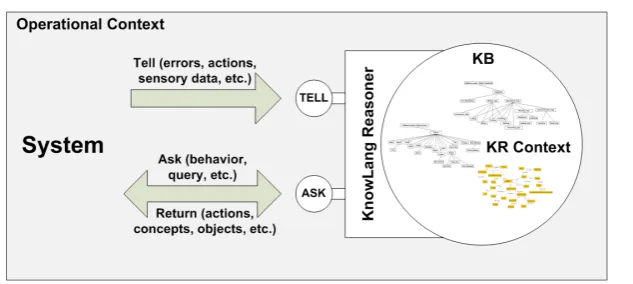
A very challenging task is the R&D of the infer-ence mechanism providing forknowledge reasoning and awareness. In order to support reasoning about self-adaptive behavior and to provide a KR gateway for com-munication with the KB, a special KnowLang Reasoner has been developed. The reasoner communicates with the system and operates in the KR Context, a context formed by the represented knowledge (see Figure5).
The KnowLang Reasoner should be supplied as a component hosted by the system and, thus, it runs in the system’s Operational Context as any other system’s component. However, it operates in the KR Context and on the KR symbols (represented knowledge). The system talks to the reasoner via special ASK and TELL Operators allowing for knowledge queries and knowledge updates (See Figure 5). Upon demand, the KnowLang Reasoner can also build up and return a self-adaptive behavior model - a chain of actions to be realized in the environment or in the system.
4. Capturing Autonomy Requirements for Science
Clouds
To better understand the concepts behind ARE, in this section, is presented an example of using the ARE approach to capture autonomy requirements for an autonomic system described as Science Clouds.
4.1. Science Clouds
Science Clouds is a cloud computing scientific platform for application execution and data storage [21], tackled by the ASCENS Project [8] as a case study. Individual users or universities can join a cloud to provide
(and consume of course) resources to the community. A science cloud is a collection of cloud machines - notebooks, desktops, servers, or virtual machines, running the Science Cloud Platform (SCP). Each machine is usually running one instance of the Science Cloud Platform (Science Cloud Platform instance or SCPi). Each SCPi is considered to be a Service Component (SC) in the ASCENS sense . To form a cloud, multiple SCPis communicate over the Internet by using the IP protocol. Within a cloud, a few SCPis might be grouped into a Service Component Ensemble (SCE), also called a Science Cloud Platform ensemble (SCPe). The relationships between the SCPis are dynamic and the formation of a SCPe depends mainly on the properties of the SCPis. The common characteristic of an ensemble is SCPis working together to run one application in a fail-safe manner and under consideration of the Service Level Agreement (SLA) of that application, which may require a certain number of active SCPis, certain latency between the parts, or have restrictions on processing power or memory. The SCP is a platform as a service (PaaS), which provides a platform for application execution [22]. Thus, SCP provides an execution environment where special applications might be run by using the SCP’s application programming interface (API) and SCP’s library [22]. These applications provide asoftware as a service (SaaS) cloud solution to users. The data storage service is provided in the same manner, i.e., via an application.
Based on the rationale above, we may conclude that the Science Clouds’ main objective is to provide a scientific platform for application execution and data storage [21]. Being a cloud computing approach, the Science Clouds approach extends the original cloud computing goal toprovide services(or resources) to the community of users. Note that cloud computing targets three main types of service (or resource):
1. Infrastructure as a Service (IaaS): a solution providing resources such as virtual machines, network switches and data storage along with tools and APIs for management (e.g., starting VMs).
2. Platform as a Service (PaaS): a solution providing development and execution platforms for cloud applications.
3. Software as a Service (SaaS): a solution providing software applications as a resource.
4.2. GORE for Science Clouds
Figure 5. KnowLang Reasoner
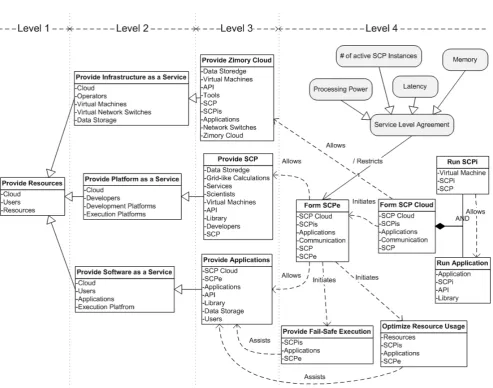
Figure 6 depicts the ARE goals model for Science Clouds where goals are organized hierarchically at four different levels. In addition, from the rationale above we may conclude that an underlying system goal is to optimize application execution by minimizing resource usage along with providing a fail-safe execution environment.
As shown in Figure 6, the goals from the first three levels are main system goals captured at different levels of abstraction. The 3rd level is resided by goals directly associated with Science Clouds and providing a concrete realization of the cloud computing goals outlined at the first two levels. Finally, the goals from the 4th level are supporting and preliminary goals that need to be achieved before proceeding with the goals from the 3rd level. Figure6puts together all the system goals by relating them via particular relationships such as inheritance and dependency. Goals are depicted as boxes listing both goal actors and targets (note that targets might be considered as a distinct class of actors). The ARE Goals Model for Science Clouds provides the traceability mechanism for autonomy requirements. When a change in requirements is detected at runtime, the goals model can be used to re-evaluate the system behavior with respect to the new requirements and to determine if system reconfiguration is needed. Moreover, the presented goals model provides a unifying intentional view of the system by relating goals assigned to actors and involving targets. Some of the actors can be eventually identified as the autonomy components providing a self-adaptive behavior when necessary to keep up with the high-level system objectives (the goals residing Level 3).
The following elements describe the system goals by goal levels as shown in Figure6:
Level 1 Goals:
• Provide Resources: A cloud computing system (cloud) shall provide computational resources to the community of users.
– Actors: cloud (the cloud computing system), users
– Targets:resources
Level 2 Goals:
• Provide Infrastructure as a Service: The cloud shall provide resources such as virtual machines, virtual network switches, and data storage. To manage this infrastructure, the cloud provides tools and APIs for management, e.g., starting and stopping VMs or creating new virtual networks.
– Actors: cloud, operators
– Targets: virtual machines, network switches, data storage
• Provide Platform as a Service: The cloud shall provide development and execution platforms for cloud applications, e.g., it may provide a framework for writing applications (by devel-opers), which can either be supplied with ade-quate resources and distributed automatically, or request additional resources.
– Actors: cloud, developers
– Targets: development platforms, execution platforms
• Software as a Service: The cloud shall provide software applications that can be run by users within the cloud. Some examples of such applica-tions could be e-mail service, word processor, etc. A good real-life example is Google Apps.
– Actors: cloud, execution platform, users – Targets: applications platforms
Level 3 Goals:
Figure 6. Science Clouds Goals Model
The Zimory Cloud shall provide cloud infrastruc-ture based on SCP by running SCPis on virtual machines, as described by the rationale above. In addition, the goal requires that the Zimoty Cloud provide both API and tools needed for infrastructure management.
– Actors: Zimory Cloud, API, tools, SCP, SCPis, operators
– Targets: virtual machines, network switches, data storage, applications
• Provide SCP: This goal is to realize the Provide Platform as a Service cloud computing goal by providing the Zimory Cloud’s SCP. The SCP must ensure both development and execution platforms where cloud applications can be developed and executed. Therefore, the platform must provide both API and libraries used by developers.
– Actors: SCP, developers, scientists
– Targets: API, library, virtual machines, services, grid-like calculations, data storage
• Provide Applications: This goal is to realize the Provide Software as a Service cloud computing goal by providing applications running in the SCP Cloud (or Zimory Cloud). The software applications can be run within a SCPe by users using the SCP’s application programming interface (API) and SCP’s library. Data storage services might be provided via applications as well.
– Actors: SCP Cloud, SCPe, API, library, users
– Targets: applications, data storage
Level 4 Goals:
The Form SCPe goal is supportive to these two goals (see the allows relationship in Figure 6). Moreover, the achievement of this goal may initiate two more assistive goals: Provide Fail-safe Execution and Optimize Resource Usage, which assist the Provide Applications goal (see Figure6). Note that this goal shall take into consideration the Service Level Agreement constraint, which may impose restrictions (or requirements) on the processing power, number of SCPis running within the ensemble, communication latency, memory usage, etc.
– Actors: SCP Cloud, SCPis, application, communication, Service Level Agreement – Targets: SCPe
• Form SCP Cloud: This goal is to form the SCP Cloud (Zymory Cloud) from the running SCPis joining their resources within that cloud. Note that the cloud allows the individual SCPis voluntarily join in or opt out. In addition, any application that runs on a cloud’s SCPi is also added to the cloud as a resource. Thus, the SCP Cloud is formed by both running SCPis and applications (see Figure6).
– Actors: SCP, SCPis, application, communica-tion
– Targets: SCP Cloud
• Run SCPi: This goal is to run a SCPi as an instance of SCP hosted by a virtual machine. Basically, this goal along with the Run Application goal (both connected via AND relationship) might be considered as a sub-goal of the Form SCP Cloud goal.
– Actors: SCP, virtual machine
– Targets: SCPi
• Run Application: This goal is to run an application on a SCPi using SCP’s API and library. This goal must be achieved as part of the Form SCP Cloud goal, i.e., it might be considered as a sub-goal of this goal.
– Actors: SCPi, API, library
– Targets: application
• Provide Fail-safe Execution: This goal is to ensure that running applications will continue working if a hosting SCPi fails. This policy must be provided by a SCPe, eventually formed to provide a fail-safe execution environment. The Provide Fail-safe Execution goal is assistive to the
Run Application goal and it may be considered as a self-* objective providing fault tolerance.
– Actors: applications, SCPis, SCPe
– Targets: fail-safe execution of applications
• Optimize Resource Usage: This goal is to ensure that running applications will use the cloud resources in the most optimal way. This policy must be provided by a SCPe, eventually formed to provide an optimal use of particular cloud resources, e.g., memory, disk space, etc. The Optimize Resource Usage goal is assistive to the Run Application goal and it may be considered as a self-* objective providing self-optimization.
– Actors: applications, SCPis, SCPe, cloud resources
– Targets: optimized resource usage
4.3. GAR for Science Clouds
After completing the goals model for Science Clouds, the next step of the ARE approach is to put the GAR model in the context of cloud computing to derive a domain-specific GAR that can be applied to the goals captured by the goals model for Science Clouds. To derive the domain-specific GAR, we need to elaborate on the Science Clouds features, issues and goals to come up with self-* objectives and the consecutive autonomy-assistive requirements. For example, some remarkable issues that eventually can turn to autonomy features are [21]:
• fail-safe operation: An application should be available even its host SCPi fails (see Provide Fail-safe Execution goal in Section4.2).
• load balancing / throughput: Parallel execution of same applications to distribute the computa-tional/resource overhead (load) when it is high, but not before that.
• energy conservation: Shutting down virtual machines or de-configuring virtual networks if not required (this feature requires IaaS support).
• SCPi fails, disappears, or appears: A failing SCPi attempts to notify other SCPis, which need to take over responsibilities. If a new SCPi appears, it should engage with applications execution.
To address these issues, SCPis must be monitored (including self-monitored) along with the cloud envi-ronment to detect high computational loads (due to applications), high communication latency, high mem-ory usage, other SCPis that join in or opt out, etc. Basically, monitoring shall go on three levels:
• network level: The SCPis forming a SCPe need to know each other and be able to route between themselves.
• application level: The SCPis forming a SCPe need to know what applications run on which SCPis.
• data level: When an application is deployed, the SCPis that can eventually run that appli-cation need to have the appliappli-cation executable (immutable data). Moreover, the SCPis running that application need to monitor the applica-tion data (mutable data) and eventually store it through check points, so the application can be resumed in case of a SCPi failure or the failure of the application itself.
Addressing these issues in the context of the system goals (see Section 4.2) will result into self-adaptive behavior realized by self-* objectives. These self-* objectives along with the autonomy-assistive require-ments form the domain-specific GAR model for Science Clouds as following:
• self-* objectives (autonomicity):
– self-healing: If a SCPi fails or is shut down, the applications executing on it must be made available on another SCPi in the SCPe hosting those SCPis.
– self-configuring_1: Each SCPi is aware about changes in its hosting SCPe - new SCPis can be added to the hosting SCPe or other can voluntarily leave of shut down. A SCPi should adapt itself to take into consideration both the newly available resources and recently disappeared resources provided by other SCPis.
– self-configuring_2: A SCPi is aware about the performance of the hosted applications. If an application is slowing down due to a lack of resources, this application can be distributed among different SCPis (run/resumed in parallel) if the application itself supports distributed execution.
– self-optimizing_1: If a SCPi reaches its capacity (e.g., consistent high CPU load or swapping due to high memory usage), it may transfer some of the computational load to another SCPi from the same SCPe.
– self-optimizing_2: If the communication latency within a SCPe is relatively high, due to overloaded links in the network, the SCPe may engage new SCPis to reduce the communication traffic.
– self-optimizing_3: If the communication latency within a SCPe is relatively high, due to overloaded links in the network, the SCPe may reduce the load transfer within the SCPe itself.
– self-optimizing_4: If SCPis are no longer required, the hosting SCPe may reconfigure to engage the idle SCPis in computational processes.
– self-optimizing_5: If certain SCPis are no longer required, they may shut down along with their hosting virtual machines to save energy.
– self-optimizing_6: If the computational load in certain SCPes is relatively high, due to overloaded application executions, the SCPe may start new SCPis along with the hosting virtual machines (if necessary) to reduce the computational overload.
• knowledge: cloud objectives; SCPes (engaged SCPis, ensemble’s applications, ensemble’s vir-tual machines, service level agreement, states), SCPis (applications, CPU, memory, storage capac-ity, states); applications (needed resources, dis-tributiveness, states); communication links;
• awareness: application awareness (resource con-sumption, execution stage, load distribution, data-transfer); SCPi self-awareness (applications, resources, hosting virtual machine, user); SCPe awareness (participating SCPis, communication links, distributed applications, service level agree-ment); cloud awareness (SCPes, SCPis); commu-nication awareness (communicating SCPis, data-transfer);
• monitoring: SCPi self-monitoring (running appli-cations, CPU load, memory usage, storage capac-ity); SCPe monitoring (ensemble’s SCPis, com-munication latency between SCPis, data transfer within SCPe);
• adaptability: adaptable load balancing; adaptable communication;
• dynamicity: dynamic communication links; dynamic SCPe formation;
• resilience: resilient communication links (com-munication losses must be repairable); network resilience (the routing needs to work in a dynamic environment where SCPis voluntarily join in and opt out of SCPes); application resilience; data resilience;
• mobility: data distribution; application distribu-tion; SCPi mobility (SCPis may run on different virtual machines);
4.4. ARE Requirements Chunks for Science Clouds
The next step is tomergethe GORE model for Science Clouds with the GAR model for science clouds, by applying the GAR model to the system goals captured in the first phase of the ARE process. Considering the fact that the Level 3 goals (see Figure 6 and Section 4.2) present the main system goals, we can apply the GAR model to these goals to derive self-adaptive behavior supporting the common Science Clouds behavior realized by the goals Provide Zimory Cloud,Provide SCP, andProvide Applications. Note that not all the self-* objectives derived by the GAR model in Section4.3are relevant to every one of these three goals. In this section is presented the self-* objectives derived for these three goals. The self-* objectives are presented as autonomy requirements chunks (see Section4.5).
For the Provide Zimory Cloud goal, are derived the following self-* objectives:
• Self-Optimizing_5: If certain SCPis are no longer required, they may shut down along with their hosting virtual machines to save energy.
– Assisting system goals: Provide Zimory Cloud
– Actors: SCPis, virtual machines
– Targets: SCPis shut down
– Scenario: If a SCPi is in idle mode during a certain interval of time, then it can autonomously shut down. If a hosting virtual machine detects that it is not running any SCPis for a certain period of time, it can autonomously shut down.
• Self-Optimizing_6: If the computational load in a SCPe is relatively high, due to overloaded application executions, the SCPe may start new SCPis along with the hosting virtual machines (if necessary) to reduce the computational overload.
– Assisting system goals: Provide Zimory Cloud
– Actors: SCPe, SCPis, virtual machines, appli-cations
– Targets: SCPis started,
– Scenario: If a SCPe detects a high computa-tional load in the entire ensemble of SCPis, i.e., all the engaged SCPis run heavy applica-tion execuapplica-tions, then it may start new SCPis. If there is a lack of virtual machines that can host SCPis, then such machines can be started as well.
For theProvide SCPgoal, are derived the following self-* objectives:
• Self-Configuring_1: Each SCPi is aware about changes in its hosting SCPe - new SCPis can be added to the hosting SCPe or other can voluntarily leave of shut down. A SCPi should adapt itself to take into consideration both the newly available resources and recently disappeared resources provided by other SCPis.
– Assisting system goals: Provide SCP
– Actors: SCPe, SCPis, applications
– Targets: SCPis updated on changes in resource availability
– Scenario: If a SCPi detects absence of a previously active SCPi it stops collaborating with that SCPi, i.e., it stops all the joint oper-ations on applicoper-ations execution and data transferring. Moreover, the active SCPi may need to reconsider the resource availability and eventually reschedule the controllable application executions to cope with the new situation. If a SCPi detects presence of a new SCPi that recently joined the SCPe, it shall reconsider the resource availability and eventually it may ask this new SCPi share part of the computational workload.
• Self-optimizing_1: If a SCPi reaches its capacity (e.g., consistent high CPU load or swapping due to high memory usage), it may transfer some of the computational load to another SCPi from the same SCPe.
– Assisting system goals: Provide SCP
– Actors: SCPe, SCPis, resources, applications
– Targets: application executions shared among SCPis
– Scenario: If a SCPi detects high resource usage (consistent high CPU load or high swapping) it may ask another SCPi to take over some of the application executions.
links in the network, the SCPe may engage new SCPis to reduce the communication traffic.
– Assisting system goals: Provide SCP
– Actors: SCPe, SCPis, communication
– Targets: low communication latency
– Scenario: If a SCPi detects high commu-nication latency while communicating with another SCPi, it may start collaborating with other SCPis to reduce the data transfer with the initial SCPi and consecutively, reduce the communication latency.
• Self-optimizing_3: If the communication latency within a SCPe is relatively high, due to overloaded links in the network, the SCPe may reduce the load transfer within the SCPe itself.
– Assisting system goals: Provide SCP
– Actors: SCPe, SCPis, communication, trans-ferred data
– Targets: low communication latency
– Scenario: If a SCPi detects high commu-nication latency while communicating with another SCPi, it may reduce the amount of transferred data.
• Self-Optimizing_4: If SCPis are no longer required, the hosting SCPe may reconfigure to engage the idle SCPis in computational processes.
– Assisting system goals: Provide SCP
– Actors: SCPe, SCPis, applications
– Targets: SCPis involved in application exe-cutions
– Scenario: If a SCPi stays in idle mode for a specific period of time, it may request from other SCPis to take over some of the ongoing application executions.
For the Provide Application goal, are derived the following self-* objectives:
• Self-Healing: If a SCPi fails or is shut down, the applications executing on it must be made available on another SCPi in the SCPe hosting those SCPis.
– Assisting system goals: Provide Application
– Actors: SCPe, SCPis, applications
– Targets: applications transferred for execu-tion to other SCPis
– Scenario: If a SCPi fails or is shut down while performing application executions, other SCPis shall detect the SCPi failure and shall take over the application executions carried by the failed SCPi.
• Self-Configuring_2: A SCPi is aware about the performance of the hosted applications. If an application is slowing down due to a lack of resources, this application can be distributed among different SCPis (run/resumed in parallel) if the application itself supports distributed execution.
– Assisting system goals: Provide Application – Actors: SCPe, SCPis, application, resources – Targets: application distributed for
execu-tion to other SCPis
– Scenario: If a SCPi detects low performance in application executions due to a lack of resources, the SCPi may request other SCPis to take over some of the hosted application executions, which will eventually release resources in the initial SCPi and improve the performance of its still hosted applications.
In addition to the self-* objectives derived from the context-specific GAR model, more self-* objectives might be derived from the constraints associated with the targeted system goal. Note that the analysis step in Figure 1 (see Section 2.3) uses the context-specific GAR model and elaborates on both system goal and constraints associated with that goal. Often environmental constraints introduce factors that may violate the system goals and self-* objectives will be required to overcome those constraints. Actually, such constraints might represent obstacles to the achievement of a goal. Constructing self-* objectives from goal constraints can be regarded as a form of constraint programming, in which a very abstract logic sentence describing a goal with its actors and targets (it may be written in a natural language as well) is extended to include concepts fromconstraint satisfaction and system capabilities that enable the achievement of the goal. In ARE, the capabilities are actually abstractions of system operations that need to be performed to maintain the goal fulfillment along with constraint satisfaction. In this approach, we need to query the provability of the targeted goal, which contains constraints, and then if the system goal cannot be fulfilled due to constraint satisfaction, a self-* objective is derived as an assistive system goal preserving both the original system’s goal targets and constraint satisfaction.
Figure 7. Science Clouds Goals Model with Self-* Objectives Assisting System Goals from Level 3
Agreement (SLA) constraints (see Section 4.2). SLA may impose constraints on application execution, e.g., certain number of active SCPis, certain latency between the communicating SCPis, or restrictions on processing power or on memory [22]. In this exercise are derived the following self-* objectives copying with the SLA constraints:
• Self-Engaging-SCPis: A SCPe formed for the execution of a certain application may need a certain number of involved SCPis.
– Assisting system goals: Provide SCP
– Actors: SCPe, SCPis, application – Targets: exact number of SCPis
– Scenario: If an application requires an exact number of SCPis to run, then SCPe shall engage the exact number of SCPis needed for the execution of that application.
• Self-Tuning-Latency: A SCPe formed for the execution of a certain application may need a certain latency between the communicating SCPis needed for the execution of that application.
– Actors: SCPe, SCPis, application, communi-cation
– Targets: latency
– Scenario: If an application requires a certain communication latency between the SCPis engaged to run that application, then each one of these SCPis shall maintain its communication latency by either speed up the communication (by applying the self-* objective Self-Optimizing_3) or slow it down (by introducing certain delay before sending the data packages).
• Self-Tuning-CPU-Usage: A SCPi executing a cer-tain application might be restricted by maximum CPU power allowed to this application.
– Assisting system goals: Provide SCP – Actors: SCPi, application
– Targets: CPU power
– Scenario: If an application is consum-ing more CPU power than the maximum allowed, then the hosting SCPi should slow down the application execution to minimize the CPU usage.
• Self-Tuning-Memory-Usage: A SCPi executing a certain application might be restricted by maximum memory allowed to this application.
– Assisting system goals: Provide SCP – Actors: SCPi, application
– Targets: memory
– Scenario: If an application is consuming more memory than the maximum allowed, then the hosting SCPi should enforce lower memory use by this application.
Figure 7 depicts the Science Clouds Goals Model (shown in Figure 6), but enriched with the self-* objectives described above. As shown, these self-self-* objectives (depicted in gray color) inherit the system goals they assist by providing behavior alternatives with respect to these system goals. Note that, due to the “inheritance” relationship, the targets of the assisted system goals are kept in all of those self-* objectives. Note that the Science Clouds system switches to one of the assisting self-* objectives when alternative autonomous behavior is required (e.g., an SCPi fails to perform).
4.5. Formalizing Science Clouds with KnowLang
The next step after deriving the autonomy requirements per system goal is their specification with KnowLang.
Note that the autonomy requirements carry all the necessary information that needs to be represented as knowledge for Science Clouds. Therefore, by specifying the captured self-* objectives, we build the necessary knowledge model for Science Clouds, which is the ultimate goal of this exercise. Specifying with KnowLang goes over a few phases:
1. Initial knowledge requirements gathering -involves domain experts to determine the basic notions, relations and functions (operations) of the domain of interest.
2. Behavior definition - identifies situations and behavior policies as “control data” helping to identify important self-adaptive scenarios.
3. Knowledge structuring - encapsulates domain entities, situations and behavior policies into KnowLang structures like concepts, properties, functionalities, objects, relations, facts and rules.
By applying the ARE approach to capture the autonomy requirements for Science Clouds, we actually perform the first two phases, as described above. This makes the resulting knowledge model very efficient and rele-vant and without any unnecessary knowledge details. KnowLang [4] is exclusively dedicated to knowledge specification where knowledge is specified as a Knowl-edge Base (KB) comprising a variety of knowlKnowl-edge structures, e.g., ontologies, facts, rules, and constraints. Here, in order to specify the autonomy requirements for Science Clouds, the first step is to specify the KB representing the cloud, SCPes, SCPis, applications, etc. To do that, we need to specify ontology structuring the knowledge domains of the cloud. Note that these domains are described via domain-relevant concepts andobjects(concept instances) related throughrelations. To handle explicit concepts like situations, goals, and policies, we grant some of the domain concepts with explicit state expressions (a state expression is a Boolean expression over ontology) [4]. Note that being part of the autonomy requirements, knowledge plays a very important role in the expression of all the autonomy requirements:autonomicity,knowledge,awareness, moni-toring,adaptability,dynamicity,robustness,resilience, and mobilityoutlined by GAR (see Section2.3).
Figure 8. Science Clouds Ontology: Cloud_Thing Concept Tree
the KnowLang’s multi-tier specification model [4]. The following is a sample of the KnowLang specification representing two important concepts: the SCP concept and the Application concept (partial specification only). As specified, the concepts in a concept tree might have propertiesof other concepts, functionalities (actions associated with that concept), states (Boolean expressions validating a specific state), etc. The IMPL specification directive refers to the implementation of the concept in question, i.e., in the following example SCPImplis the software implementation (presuming a C++ class) of the SCP concept.
// Science Cloud Platform CONCEPT SCP {
CHILDREN {}
PARENTS { SCCloud.Thing..Cloud_Platform } STATES {
STATE Running { this.PROPS.platform_API. STATES.Running AND this.PROPS.platform_Library.STATES.Running } STATE Executing { IS_PERFORMING(this.FUNCS.runApp) } STATE Observing { IS_PERFORMING(this.FUNCS.runApp) AND
SCCloud.Thing..Application.PROPS.initiator=this } STATE Down { NOT this.STATES.Running }
STATE Overloaded { this.STATES.OverloadedCPU OR
this.STATES.OverloadedStorage OR this.STATES.OverloadedMemory } STATE OverloadedCPU { SCCloud.Thing..Metric.CPU_Usage.VALUE > 0.95 }
STATE OverloadedMemory { SCCloud.Thing..Metric.Memory_Usage.VALUE > 0.95 } STATE OverloadedStorage { SCCloud.Thing..Metric.Hard_Disk_Usage.VALUE > 0.95 } STATE ApplicationTransferred { LAST_PERFORMED(this, this.FUNCS.transferApp) } STATE InCommunication { this.FUNCS.hasActiveCommunication }
STATE InCommunicationLatency { this.STATES.InCommunication AND this.FUNCS.getCommunicationLatency >0.5 } STATE InLowTrafic { this.FUNCS.getDataTrafic <= 0.5 } STATE Started { LAST_PERFORMED(this, this.FUNCS.start) } STATE Stopped { LAST_PERFORMED(this, this.FUNCS.stop) } }
PROPS {
PROP platform_API { TYPE {SCCloud.Thing..API} CARDINALITY {1} } PROP platform_Library { TYPE {SCCloud.Thing..Library} CARDINALITY {1} } PROP platform_CPU { TYPE {SCCloud.Thing..CPU} CARDINALITY {1} } PROP platform_Memory { TYPE {SCCloud.Thing..Memory} CARDINALITY {1} } PROP platform_Storage { TYPE {SCCloud.Thing..Data_Storage} CARDINALITY {1} } PROP platform_Applications { TYPE {SCCloud.Thing..Application} CARDINALITY {*} } }
FUNCS {
FUNC run { TYPE { SCCloud.Thing..Action.RunSCP } } FUNC down { TYPE { SCCloud.Thing..Action.StopSCP } } FUNC runApp { TYPE { SCCloud.Thing..Action.RunApplication } }
FUNC startApp { TYPE { SCCloud.Thing..Action.StartApplication } } FUNC stopApp { TYPE { SCCloud.Thing..Action.StopApplication } } FUNC transferApp { TYPE { SCCloud.Thing..Action.TransferApplication } } FUNC startNewCommunication { TYPE { SCCloud.Thing..Action.StartCommunication } } FUNC stopNewCommunication { TYPE { SCCloud.Thing..Action.StopCommunication } } FUNC hasActiveCommunication { TYPE { SCCloud.Thing..Action.HasActiveCommunication } } FUNC getCommunicationLatency { TYPE { SCCloud.Thing..Action.GetCommunicationLatency } } FUNC getDataTraffic { TYPE { SCCloud.Thing..Action.GetTraffic } }
}
IMPL { SCCloud.SCPImpl } }
// Science Cloud Application CONCEPT Application {
CHILDREN {}
PARENTS { SCCloud.Thing..Software } STATES {
STATE Running { PERFORMED(this.FUNCS.Started)
AND NOT PERFORMED(this.FUNCS. Stopped) } STATE Started { LAST_PERFORMED(this, this.FUNCS.start) } STATE Stopped { LAST_PERFORMED(this, this.FUNCS.stop) } }
PROPS {
PROP needed_CPU_Power { TYPE {SCCloud.Thing..CPU_Power} CARDINALITY {1} } PROP needed_Memory { TYPE {SCCloud.Thing..Capacity} CARDINALITY {1} } PROP needed_Storage { TYPE {SCCloud.Thing..Storage} CARDINALITY {1} } PROP distributiveness { TYPE {Boolean} CARDINALITY {1} }
PROP requiredSCPis { TYPE {Integer} CARDINALITY {1} }
PROP requiredLatency { TYPE { SCCloud.Thing..Latency } CARDINALITY {1} } PROP initiator { TYPE {SCCloud.Thing..SCP} CARDINALITY {1} } }
FUNCS { ÅĚ } IMPL { SCCloud.ApplicationImpl } }
Boolean function of two other states, particularly, states of concept’s properties, e.g., the SCP is running if both its API and Library are running:
STATE Running { this.PROPS.platform\_API.STATES.Running AND this.PROPS.platform\_Library.STATES.Running }
States are extremely important to the specification of goals (objectives), situations, and policies. For example, states help the KnowLang Reasoner determine at runtime whether the system is in a particular situation or a particular goal (objective) has been achieved. Note that to specify some of the SCP states, we used metrics. Metrics are special KnowLang constructs [4] that may handle themonitoring autonomy requirements (see Section4.3).
STATE OverloadedCPU { SCCloud.Thing..Metric.CPU_Usage.VALUE > 0.95 }
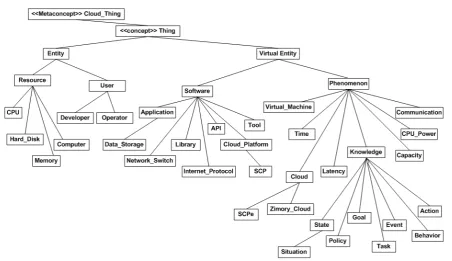
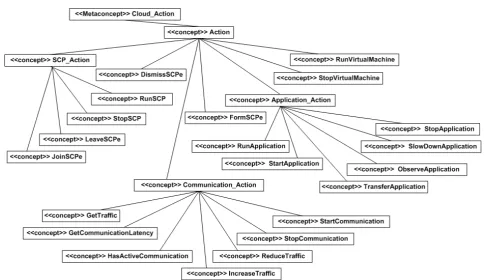
TheCloud_Thingconcept tree (see Figure8) is the main concept tree of the SCCloud Ontology. Note that due to space limitations, Figure 8 does not show all the concept tree branches. Moreover, some of the concepts in this tree are “roots” of other trees. For example, the Action concept, expressing the common concept for all the actions that can be realized by the cloud, is the root of the concept tree shown in Figure 9. As shown, actions are grouped by subsystem (or part) they are associated with. For example, the SCP actions are: RunSCP,StopSCP,LeaveSCPe, andJoinSCPe.
Note that in the KnowLang specification models, in addition to concepts, we also specifyconcept instances, which are considered as objects and are structured in object trees. The latter are a conceptualization of how objects existing in the world of interest (e.g., Science Clouds) are related to each other. The relationships in an object tree are based on the principle that objects have properties, where the value of a property is another object, which in turn also has properties [4]. Therefore, the object trees are the realization of concepts in the ontology domain (e.g., Science Clouds). To better understand the relationship between concepts and objects, we may think of concepts as similar to the OOP classes and objects as instances of these classes. For example, the SCP concept might be regarded as a class and the SCPis as SCP “instances” of that class. In this exercise are specified a few exemplar SCPis as object trees, which are not presented here due to space limitations.
Autonomicity. To specify the self-*objectives (auto-nomicity requirements), we use goals, policies, and situations [4]. These are defined as explicit con-cepts in KnowLang and for the Cloud Ontol-ogy (SCCloud) are specified under the concepts Virtual_entity->Phenomenon->Knowledge(see Figure8). Figure10, depicts a concept tree representing the speci-fied Science Clouds goals. Note that most of these goals were directly interpolated from the goals models (see
Section4.2) and more specifically, from the goals model for self-* objectives assisting the Science Clouds goals from Level 3 (see Section4.4).
KnowLang specifies goals asfunctions of stateswhere any combination of states can be involved. A goal has an arriving state (Boolean function of states) and an optional departing state (another Boolean function of states) [4]. A goal with departing state is more restrictive, i.e., it can be achieved only if the system departs from the specific goal’s departing state.
The following code samples present the specification of two simple goals. Note that their arriving and departing states can be either single SCP states or Boolean functions involving more than one state. Note that the states used to specify these goals are specified as part of theSCPconcept.
//
//==== Cloud Goals ============================================================== //
CONCEPT_GOAL Self-optimizing_1 { SPEC {
DEPART { SCP.STATES.OverloadedCPU }
ARRIVE { SCP.STATES.ApplicationTransferred AND NOT SCP.STATES.OverloadedCPU } }
}
CONCEPT_GOAL Self-optimizing_3 { SPEC {
DEPART { SCP.STATES.InCommunicationLatency }
ARRIVE { SCP.STATES.InLowTrafic AND NOT SCP.STATES.InCommunicationLatency } }
}
According to the KnowLang semantics (see Section 3.1), in order to achieve specified goals (objectives), we need to specify policies triggering actions that will eventualy change the system states, so the desired ones, required by the goals, will become effective [4]. All the policies in KnowLang descend from the explicit Policyconcept. Note that policies allow the specification of autonomic behavior (autonomic behavior can be associated with self-* objectives). As a rule, we need to specify at least one policy per single goal, i.e., a policy that will provide the necessary behavior to achieve that goal. Of course, we may specify multiple policies handling same goal (objective), which is often the case with the self-* objectives and let the system decides which policy to apply taking into consideration the current situation and conditions.
The following is a specification sample showing a simple policy called ReduceCPUOverhead - as the name says, this policy is intended to reduce the CPU overhead of a SCPi. As shown, the policy is specified to handle the goalSelf-Opimizing_1and is triggered by the situationHighCPUUsage. Further, the policy triggers conditionally (theCONDITONS directive requires that a SCPi is executing an application) the execution of a sequence of actions.
CONCEPT_POLICY ReduceCPUOverhead { SPEC {
POLICY_GOAL { SCCloud.Thing..Self-Optimizing_1 } POLICY_SITUATIONS { SCCloud.Thing..HighCPUUsage } POLICY_RELATIONS { SCCloud.Thing..Policy_Situation_1 } POLICY_ACTIONS {SCCloud.Thing..Action.StartCommunication,
SCCloud.Thing..Action.TransferApplication, SCCloud.Thing..Action.StopCommunication }
POLICY_MAPPINGS { MAPPING {
Figure 9. Science Clouds Ontology: Cloud_Action Concept Tree
DO_ACTIONS { SCCloud.Thing..SCP.Action.StartCommunication,
SCCloud.Thing..SCP.Action.TransferApplication, SCCloud.Thing..SCP.Action.StopCommunication }
} } } }
As mentioned above, policies are triggered by situa-tions. Therefore, while specifying policies handling sys-tem objectives, we need to think of important situations that may trigger those policies. These situations shall be eventually outlined by the scenarios of the ARE Requirements Chunks (see Section4.4). A single policy requires to be associated with (related to) at least one situation, but for polices handling self-* objectives, we eventually need more situations. Actually, because the policy-situation relationis bidirectional, it is maybe more accurate to say that a single situation may need more policies, those providing alternative behaviors or execu-tion paths from that situaexecu-tion. The following code rep-resents the specification of theHighCPUUsagesituation, used for the specification of the ReduceCPUOverhead policy.
//
//==== Cloud Situations ========================================================= //
CONCEPT_SITUATION HighCPUUsage { CHILDREN {}
PARENTS { SCCloud.Thing..Situation} SPEC {
SITUATION_STATES { SCCloud.Thing..SCP.STATES.OverloadedCPU} SITUATION_ACTIONS { SCCloud.Thing..Action.TransferApplication,
SCCloud.Thing..Action.SlowDownApplication, SCCloud.Thing..Action. StopApplication }
} }
As shown, the situation is specified with states and possible actions. To consider a situation effective (the
system is currently in that situation), its associated states must be respectively effective (evaluated as true). For example, the situationHighCPUUsageis effective if the SCP stateOverloadedCPUis effective. The possible actions define what actions can be undertaken once the system falls in a particular situation. For example, theHighCPUUsagesituation has three possible actions: TransferApplication,SlowDownApplication, and StopAp-plication. The following code represents another policy intended to handle theHighCPUUsagesituation. In this policy are specified three MAPPING sections, which introduce three possible alternative execution paths.
CONCEPT_POLICY AIReduceCPUOverhead { SPEC {
POLICY_GOAL { SCCloud.Thing..Self-Optimizing_1 } POLICY_SITUATIONS { SCCloud.Thing..HighCPUUsage } POLICY_RELATIONS { SCCloud.Thing..Policy_Situation_2 } POLICY_ACTIONS { SCCloud.Thing..Action.SlowDownApplication,
SCCloud.Thing..Action. StopApplication } POLICY_MAPPINGS {
MAPPING {
CONDITIONS { SCCloud.Thing..SCP.STATES.Executing } DO_ACTIONS { SCCloud.Thing..Action. SlowDownApplication } PROBABILITY {0.5}
} MAPPING {
CONDITIONS { SCCloud.Thing..SCP.STATES.Executing } DO_ACTIONS { SCCloud.Thing..Action. StopApplication } PROBABILITY {0.4}
} MAPPING {
CONDITIONS { SCCloud.Thing..SCP.STATES.Executing } DO_ACTIONS { GENERATE_NEXT_ACTIONS(SCCloud.Thing..SCP) } PROBABILITY {0.1}
} } } }
Figure 10. Science Cloud Ontology: Cloud_Goal Concept Tree
the HighCPUUsage situation to two different policies: ReduceCPUOverheadandAIReduceCPUOverhead.
//
//==== Cloud Relations ======================================================== //
RELATIONS {
RELATION Policy_Situation_1 {
RELATION_PAIR { SCCloud.Thing..HighCPUUsage, SCCloud.Thing..ReduceCPUOverhead } PROBABILITY {0.5}
}
RELATION Policy_Situation_2 {
RELATION_PAIR { SCCloud.Thing..HighCPUUsage, SCCloud.Thing..AIReduceCPUOverhead} PROBABILITY {0.4}
} }
As specified, the probability distribution gives initial designer’s preference about what policy should be applied if the system ends up in the HighCPUUsage situation. Note that at runtime, the KnowLang Reasoner maintains a record of all the action executions and re-computes the probability rates every time when a policy has been applied. Thus, although initially the system will apply the ReduceCPUOverhead policy (it has the higher probability rate of 0.5), if that policy cannot achieve its goal due to action fails (e.g., the communication link with another SCPi is broken and application transfer is not possible), then the probability distribution will be shifted in favor of the AIReduceCPUOverheadpolicy and the system will try to
apply that policy. Note that in this case both policies share the same goal.