45
SOME FEATURES OF INITIAL SCIENCE
TEACHER TRAINING IN LITHUANIA
1
1 This report is carried out within the frames of international project “IQST“ (Improving Quality of Science Teacher Training in European Cooperation), http://www.iqst.upol.cz
Abstract
After gaining the independence, well-grounded, qualitatively new and intensive changes took place in the education system of Lithuania. The issues of science education became even more burning and though more complex. One of the directives requires solving the problems of science education on the grounds of a general culture rather than separately as the questions should be treated as a part of culture. A teacher of sciences must fully master different training technologies and have a thorough preparation for teaching sciences. Ob-viously, science pedagogical education undergoes serious changes. The majority of the recent international studies face an alarming situation in the fi eld of science education. A critical situation has been encountered by the ROSE project (Sjøberg, 2004). It is obvious, that preparation of the qualifi ed science teachers is actual and diffi cult task.
Key words: science education, teacher training, educatedness.
Introduction
Obviously, that natural science education is a crucially important area of a general background (educatedness). The 21st century, an era of modern biology, chemistry, physics and advanced tech-nology, proves that it is extremely diffi cult to operate without a broad background in this fi eld. Moreover, natural science education is an integral phenomenon that requires a systemic approach and assessment. Therefore, most of the issues should be discussed in a broad context of general natural science education (Lamanauskas, 2003a).
The system of teacher training in Lithuania has to lay down conditions for effective prepara-tion of qualifi ed teachers. Next, the system has to be oriented to the models prevailing in the EU teacher training practice and general tendencies of this process. Modern didactics is more devoted to the child rather than to the teacher. However, researchers mark (Kavaliauskienė, 2001, etc.) that it does not depreciate the role of the teacher but on the contrary, requires more thorough professional competence. A social survey of Lithuanian teachers’ carried out by the centre of studies of the Open Society Fund Lithuania in 1999 confi rmed the results of the previous investigations conducted by various authors (Purvaneckienė, 1996; Būdienė, 1997 etc.). Research reveals that the amount of theo-retic subjects is too big and that of practic subjects is too small, teaching practice is short and often is not effective, methodological knowledge is insuffi cient, etc. B.Bitinas stresses a dominant role of theory in the preparation process of teachers (Bitinas, 1996). V.Rajeckas accentuates the relevance of pedagogy in the studies and supports an idea that the whole process of studies should be oriented
Vincentas Lamanauskas
46 to the student’s preparation to work at school (Rajeckas, 1994). Pedagogy literature highlights that a wide gap between theory and practice of pedagogy studies can be noticed in Lithuanian pedagogic higher schools (Pūkelis, 1998). The assessment of the results of the investigations conducted by different authors demonstrates that preparation for work at school is a key problem that can hardly be solved.
Research in the fi eld discloses that natural science teacher training determines the approach of the young generation to natural sciences in general. Thus, natural sciences teacher training has to be effi cient and permanently investigated. Teachers’ natural science competence can be examined in a general cohesive system:
Natural science education standards – teacher‘s natural science competence –
professional teaching skills – results of natural science education
Therefore, in this entire context, the teachers of sciences play a crucial role. Training quality directly infl uences and determines the effi ciency of science education in comprehensive school.
There are three main professions - science teachers, science-teacher educators, and university science or education faculty members. For all of them the main two questions should be how to train science teachers and about how to teach science. Their understanding of the given questions is different enough. For science teachers the methodical recommendations (scenarios) are more useful and interesting, than the results of scientifi c researches. Two inconsistent moments can be mentioned:
• the correlation between research and practice is weak. First, teachers’ competence level in the fi eld of educational research is rather low; second, partnership with the research-ers’ community remains unexpanded; the teacher is, fi rst of all, a subject of pupils’ training for life and their integration into society (socialization) who is responsible for high quality education and better results. Therefore, there are a few bitter reproaches about problematic research of educological natural science education that might be irrelevant in terms of teachers’ work experience. According to Keogh and Naylor (2002), many teachers who are committed to applying research in their classrooms of a constructivist approach fi nd that in practice it is more problematic;
• the correlation between a higher school lecturer and comprehensive school and educa-tional practice in general, is very weak in most of the cases; a mission of the scientist is knowledge about scientifi c educational reality. From this point of view, teaching natural sciences at higher school seems to be rather complicated when educating the teachers of this profi le. Often teaching science subjects at higher school is limited by “dry” academicism, a didactic cover is thin. The “real” naturalists hypothetically renounce the educologists working in the fi eld of natural science education. The latter frequently feel being misunderstood by the “real” pedagogues – didacticists.
Nowadays it is clear that the main trend prevails - training for science teachers is focused on learning, not teaching strategies. On the other hand, the constructivist perspective is becoming a dominant paradigm in the fi eld of the science education. Also it is obvious, that the constructivist approach in the initial science teacher training is not still too common at many European teacher training institutions. Therefore, there is a certain interest in the analysis of a current situation in system of initial science teachers training in the different countries of the Europe.
The object of the research is the system of initial science teachers training of Lithuania (cur-rent state). The main goal of the research is to highlight the principal peculiarities and tendencies of training teachers of sciences in Lithuania at this stage. The tasks of the research are:
• to disclose the existing current situation of training teachers of sciences in Lithu-ania;
47 Volume 2, 2007
Methodology of Research
The conducted research includes assessment of scientifi c literature, a comparative assessment of documents (curricula of studies), analysis of some examples from universities, systemic analysis ect. The main idea is that the curricula of studies instantly refl ect the main aspects of the science teachers` training system. The given research is based on researches which are carried out earlier (Lamanauskas, 2002; Lamanauskas, 2003b; Lamanauskas, Gedrovics, 2006). In opinion of the author, it is important to observe constantly (monitoring) the process that it is better to understand possible tendencies of development, and also to offer recommendations for improvement of the process. This research is carried out in May, 2007 in the frame of international project IQST.
Results of Research
General background
The description of a few key points defi ning a system of teacher training in Lithuania can be found rather purposeful.
• Professional teachers’ qualifi cation and competence is the pivot of the whole teacher training system.
• The candidates’ sample /contingent/ of participation in the pedagogical curricula. Motivation for becoming a teacher and working at school constantly decreases. The pedagogical curricula usually choose the candidates with medium-based abilities. On the other hand, a demand for the teachers of sciences is fairly low.
• Education received by teachers /university or college education/. A new concept of the teacher training system basically answers the question.
• Material and intellectual resources of higher educational institutions. To train the teachers of sciences, not only intellectual but also large material resources are required (properly equipped research facilities, rooms of didactics, botanical gardens and zoos etc.).
• Elitistic and mass education.
• The ways of training mentors of teaching practice. A system of granting licences for teachers.
• Two models of teacher training: parallel /individual subject training + pedagogical training + practical activity/ and consistent /academic studies of a certain subject pro-ceeding with realization of teacher training/. Primary and pre-primary school teacher training is received applying the parallel model whereas gymnasia teacher training uses the second model. The colleges also employ the parallel model.
• A right to work as a teacher /licence/ is granted when studies or successful pedagogical practice-traineeship in basic school (half a year under the parallel model or one year under the consistent model) is over (Lamanauskas, Gedrovics, 2006).
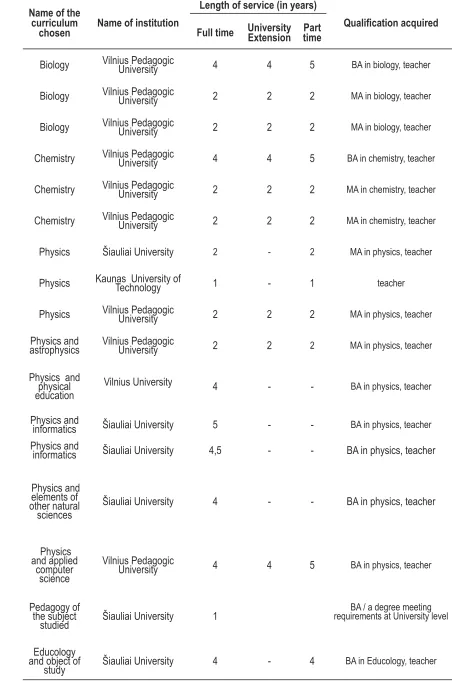
Assessment Guidelines on the Present Situation of Teacher Training
48 Table 1. The major institutions training the teachers of natural sciences.
Name of the curriculum
chosen Name of institution
Length of service (in years)
Qualifi cation acquired
Full time UniversityExtension timePart
Biology Vilnius Pedagogic University 4 4 5 BA in biology, teacher
Biology Vilnius Pedagogic University 2 2 2 MA in biology, teacher
Biology Vilnius Pedagogic University 2 2 2 MA in biology, teacher
Chemistry Vilnius Pedagogic University 4 4 5 BA in chemistry, teacher
Chemistry Vilnius Pedagogic University 2 2 2 MA in chemistry, teacher
Chemistry Vilnius Pedagogic University 2 2 2 MA in chemistry, teacher
Physics Šiauliai University 2 - 2 MA in physics, teacher
Physics Kaunas University of Technology 1 - 1 teacher
Physics Vilnius Pedagogic University 2 2 2 MA in physics, teacher
Physics and
astrophysics Vilnius Pedagogic University 2 2 2 MA in physics, teacher
Physics and physical education
Vilnius University 4 - - BA in physics, teacher
Physics and
informatics Šiauliai University 5 - - BA in physics, teacher Physics and
informatics Šiauliai University 4,5 - - BA in physics, teacher
Physics and elements of other natural
sciences
Šiauliai University 4 - - BA in physics, teacher
Physics and applied
computer science
Vilnius Pedagogic
University 4 4 5 BA in physics, teacher
Pedagogy of the subject
studied Šiauliai University 1
BA / a degree meeting requirements at University level
Educology and object of
49 Volume 2, 2007 Curricula of Studies
The teachers of natural sciences in Lithuania can choose between studying a bachelor’s and a master’s degree (can be either broadly-based or focused) curriculum.
The curricula of studies fall into three categories: 1. Basic studies;
2. MA studies;
3. Specifi ed professional studies.
The curricula of studies can also be subdivided into two sections:
• Theoretical studies;
• Scientifi c research.
A module is the fundamental unit of planning studies. It is a subject studied or a part of it taught along the term. The module of studies can be either compulsory or optional and includes different forms of learning: lectures, laboratory experiments, practice, individual student’s work, scientifi c research and planning.
A measurement unit of the scope of studying is a credit which on average makes 40 hours of effective and independent work in and outside the classroom and equates with one weak of studies. The curricula of studies are designed following the Rules of quality assessment for institutions of research and higher education approved by Order No 1326 of the Ministry of Science and Education of the Republic of Lithuania on October 10, 2000 and the regulations of the curricula of studies and modules of a higher school.
The scope of the bachelor’s degree curriculum is 160 credits. The length of service of full-time studies makes 4 and university extension and part-time studies – 5 years.
The curriculum of studies schedules three groups of the subject studied.
• General education subjects at university level make no less than 15% of the scope of the whole curriculum;
• Subjects discussing the fundamentals of studies make no less than 25% of the scope of the curriculum;
• Subjects dealing with special education take the rest of the scope of the curriculum but not less than 40%.
The scope of the term of full-time is 20 and of the 4th year of studies - 16 credits. Thesis takes 8 credits. The number of the subjects studied in the 1st and 2nd year cannot exceed 7, in the 3rd - 6 and in the 4th - 5 credits per term. From the beginning of term 4, the curriculum may enclose no more than 2 term papers/projects in each of the terms. The curriculum may also include practice. The examination session should accept no more than 5 exams (Type E). The bachelor studies ends in completing thesis and taking fi nal exams.
The number of the modules of the subjects taught, the term papers and projects as well as the scope of the exams of the curricula of university extension and part-time studies agrees with that of the curricula followed by the full-time students except from the length of service, the number of credits and hours studied within the term.
The teachers having a bachelor’s degree have a possibility of gaining a master’s degree. The scope of the curricula of all forms of MA studies makes from 60 to 80 credits. The university extension and part-time studies may also last for 2 years and take 80 credits or 1,5 years and take 60 credits.
The scope of the term curriculum of full-time studies is 20 credits. The term may include no more than 4 theoretical modules, 1 module of research work and no more than 2 term papers/projects. The master’s studies ends in completing thesis.
50 except from the length of service, the number of credits and hours studied within the term.
The curricula of studies of the same fi eld include a part of general subjects. A general part of a fi eld curriculum is coordinated by the University board of studies and approved by the rector.
Planning Individual Studies
Every spring term, along the modules chosen, the students work out individual plans of studies for the forthcoming year. The questions of planning individual studies are discussed with the Dean Offi ce and lecturers. The individual plans of studies can be adjusted within two fi rst weeks of the term started. The fi nal versions of individual plans and changes are approved by the Dean Offi ce.
Types, Stages and Forms of Studies
The University offers two types of studies – continuing and incoherent. Continuing studies are aimed at all-round higher education confi rmed by the obtained university degree and (or) professional qualifi cation. Incoherent studies embrace only separate subjects or their cycles studied and focus on improving or changing one’s professional qualifi cation as well as on developing professional and general education. These studies also encompass supplementary (retraining) studies.
The stages of continuing studies are: 1. Bachelor’s and professional studies;
2. Master’s, and specifi ed professional studies; 3. Postgraduate studies.
Bachelor’s studies are continuing the fi rst degree studies at university level. A student is
awarded a bachelor’s degree after studying is over. Professional qualifi cation may also be obtained. The graduates are allowed to take up postgraduate or specifi ed professional studies.
Complete studies concentrate on receiving master’s degree and (or) professional qualifi cation
when fi rst and second degree studies at university level are combined.
Specifi ed professional studies are continuing the second degree studies for graduates from
university devoted to the students seeking for professional qualifi cation of a particular fi eld. Studying helps with a better preparation for work that requires special practical abilities.
Master’s studies are continuing the second degree studies for those improving individual
professional and scientifi c qualifi cation focused on scientifi c activity. The students are trained to be either scientists-researchers or teachers and directed to be involved in analytical applied activity.
Postgraduate studies are the third stage studies at university level concentrating on
would-be scientists training. The applicant must have a master’s degree or would-be a graduate from complete studies. When postgraduate studies are over and thesis is defended, a student is awarded a degree in Educology.
Examples Given
Pedagogy of the subject can be studied at the Department of Educology at Šiauliai University. The students are provided a possibility of obtaining a bachelor’s degree in Educology. The curriculum mainly covers studying pedagogy and psychology and includes 4 week teaching practice in second-ary school. Studying the curricula of pedagogy awards the graduates professional qualifi cation of
teacher. The latter curriculum of studies is most frequently chosen by those having natural science
education but not teacher qualifi cations.
51 Volume 2, 2007 offered an opportunity of implementing natural science and environment protection education and
ecology curricula at national level, gain a bachelor’s degree in Educology and acquire high profes-sional qualifi cation of secondary school teacher of sciences and geography. The graduates dealing with these curricula will have better career prospects as curriculum implementation is supported by the educational establishments of Northern Lithuania, students’ parents and naturalists and teachers of Educology at Šiauliai University. Having graduated the curriculum of studies Educology (sci-ences and geography), a student is awarded a bachelor’s degree in social sciences (Educology). The goal of the curriculum is to train highly qualifi ed and having professional qualifi cation teachers of Educology, sciences and geography.
The teachers of physics are trained by the Department of Physics at Vilnius University, by the Department of Physics and Technology at Vilnius Pedagogic University and by the Department of Sciences of Šiauliai University.
Bachelor’s and professional studies 180 credits, full-time studies, 4 years
Qualifi cation acquired: a bachelor’s degree in physics and teacher’s professional qualifi cation The main subjects of the curriculum. General educational subjects at university level: introduc-tion into philosophy, culture of the mother tongue, law, foreign language, history of cultures and civilizations etc.
General subjects of studies: classical physics, differential equations, informatics, mathematical physics, mathematical analysis, linear algebra, probability theory, theory of atoms and molecules, astronomy, physics of waves, electrodynamics, experimental physics, history of physics, fundamentals of solid state physics, computer applications, biophysics, statistical physics etc.
Specifi c subjects: research methods of environment pollution, personalities and social pedagogy, education, research methods of biological objects, electronics, energetic and environment, method-ology of teaching physics, historical and comparative pedagogy, computer applications in teaching physics, psychology, spectroscopy, applied nuclear physics, education elements and didactics, hygiene at school etc.
Vilnius Pedagogic University – physics and applied computer science Bachelor’s and professional studies
Full-time studies and university extension, 4 years
Qualifi cation acquired: a bachelor’s degree in physics and teacher’s professional qualifi cation Šiauliai University – physics and informatics
Bachelor’s and professional studies 180 credits, full-time studies, 4,5 years
Qualifi cation acquired: a bachelor’s degree in physics and professional qualifi cation of teacher of physics and informatics.
The would-be teachers of physics and informatics study general education subjects
(fo-cused on fundamentals broadening world outlook and understanding of the principles of sustainable development): fundamentals of philosophy, history of culture, psychology, education management, history of physics, culture of the mother tongue, terminology, foreign language; subjects discussing
the fundamentals of studies (focused to build up a professional image of the physical world and to
develop abilities and skills required for studying subjects of special education and taking up stud-ies at the second stage at university level): higher and discreet mathematics, differential equations, mathematical statistics and probability theory, computer systems, fundamentals of programming, mechanics, thermodynamics, electricity and magnetism, optics, astronomy, biophysics, solid state, nuclear and elementary particles and statistical physics, mathematical methods in physics etc.; special
(professional) subjects (focused on accumulating knowledge and abilities allowing to successfully
deal with the job that corresponds with education acquired): computer physics, laser physics, electron-ics, objective programming, database management, information teaching technologies, Educology, didactics of physics and informatics, hodegetics etc.
52 from 7 to 10 of comprehensive school or may occur in certain forms of gymnasium (240 hours); the next step involves the students from forms 11 and 12 or certain forms of gymnasium (160 hours). In total, the length of service makes 400 hours.
The major qualities.
• In order to ensure the mobility of students, the curricula of physics teacher training of all universities are coherent.
• Qualifi ed and experienced teachers are involved in the process of curriculum develop-ment.
• A substantial number of educational laboratories and equipment used.
• Quickly advanced computer technology and software are applied.
• A fi rm experimental basis of didactics of physics.
• Close collaboration with teachers of physics and physicists of other higher schools nation-wide.
Weaknesses:
• Due to low prestige of teacher’s profession, the latter is chosen by those having no success at school.
• To more precisely defi ne the curricula, there is lack of regulations observing the curricula of teacher training.
• Scant attention devoted by the Government.
The majority of teachers of chemistry and biology are trained by Vilnius Pedagogic University. The structure of the curricula of these studies is similar comparing to those of other sciences.
It is supposed that in the future, the number of primary school teachers will decrease due to demo-graphic problems, whereas the need for teachers of chemistry, biology and physics will rise (Dzemyda, Gudynas, altenis, Tie is, 2001).
Conclusions
In conclusion, we can maintain that:
• After restoring independence, the new teacher training curricula using experience of Western countries and considering national needs were developed.
• The teachers of natural sciences mainly have to meet new social, pedagogic and subjective requirements. They are treated not only as providers imparting knowledge and facts but also as those helping the learner with choosing the required information on an individual basis. The changes in society and the process of teaching show that higher schools must take into account these facts while training would-be teachers.
• The training curricula of teachers of natural sciences are designed on the basis of the regu-lations of the fi eld of studies and standards of teacher training and are aimed at training teachers able to teach a few subjects of natural sciences.
• The curricula focused on preparing teachers able to teach natural sciences integrated into other subjects taught are designed.
• The curricula of natural sciences include education management, an introductory course on Educology, didactics and hodegetics that are involved into the process of competence development; however, it is not enough to gain general competence in pedagogical prac-tice.
53 Volume 2, 2007 studies that proceed receiving a bachelor’s degree are confi rmed by the new curricula of
professional studies scheduling a general coresection of the subjects developing pedagogi-cal competence and didactipedagogi-cal subjects of different fi elds of science that will be applied for the purposes of improving didactical competence of a certain subject.`
• Lack of specifi c methodology, examples of good practice and recommendations for solving the problem of integrated education can be noticed in Lithuania.
• No detailed systemic recommendations and methodical and organizational tools of how to integrate modern Information Communication Technologies (ICT) into the processes of teaching/learning natural sciences are created.
• The teachers of natural sciences are not experienced enough in the fi eld of general compe-tence in modern ICT and suffer from shortage of methodical experience of how to effectively apply ICT in the educational process. The teachers should gain relevant experience in the seminars in methodology, training courses and accepted pedagogical practice at school using the latest Lithuanian versions of natural science training aids based on ICT.
References
Bitinas B. (1996). Apie teorijos ir praktikos santykį rengiant specialistą. Kn.: Studijos aukštojoje mokykloje: konferencijos pranešimų medžiaga, 2 knyga. Kaunas, p. 3-7.
Būdienė V. (1997). Mokytojų rengimo problemos Lietuvoje. Kn.: Lietuvos mokyklai – 600 metų (konferencijos medžiaga). Vilnius, P. 224-235.
Dzemyda G., Gudynas P., Šaltenis V., Tiešis V. (2001). Lietuvos pedagogai ir moksleiviai: analizė ir prognozė. Vilnius.
Kavaliauskienė V. (2001). Pedagogų iš pašaukimo rengimo universitete perspektyva. Acta Paedagogica
Viln-ensiai, T.8, p. 198.
Keogh B., Naylor S. (2002). Research into practice: a view from the classroom. Primary Science Review, 71, p. 19.
Lamanauskas V. (2003a). Natural Science Education in Contemporary School. Siauliai: Siauliai University
Press.
Lamanauskas V. (2003b). Development of Natural Science Education in Lithuanian General School: Have it Changed Since 1990? In.: Importance of Science Education in the Light of Social and Economic Changes in the Central and East European Countries: The Materials of the IV IOSTE Symposium for Central and East European Countries. Kursk: KSU, P. 21-25.
Lamanauskas V., Gedrovics J. (2006). Training Basic School Science Teachers in Lithuania and Latvia: Assessment of the Situation and Tendencies. In.: University of Joensuu, Bulletins of the Faculty of Education: K.Sormunen (ed.) The Bologna Process in Science and Mathematics Higher Education in North-Eastern Europe: Tendencies, Perspectives and Problems, No. 99. Joensuu, p. 40-51.
Pukelis K. (1998). Praktinių pedagoginių studijų problema rengiant mokytojus. Pedagogika, T.36, p. 47. Purvaneckienė G. (1996). Mokyklos reforma ir mokytojo profesija. Acta Paedagogica Vilnensia, T.3, p. 32-48. Rajeckas V. (1994). Aukštųjų mokyklų, rengiančių mokytojus, pedagogizavimo kryptys. Kn.: Švietimo reforma ir mokytojų rengimas: konferencijos tezės. Vilnius, p. 25-26.
Sjøberg S. (2004). Science Education: The voice of the learners Contribution to the conference on Increasing Human Resources for Science and Technology in Europe EU, Brussels April 2. 2004: Available
http://www.ils.uio.no/forskning/rose/documents/presentations/ROSE_Sjoberg_EU_April04.pdf iaulių universitetas. Studijų programos (2007). Prieiga per internetą: http//www.su.lt (2007-05-10).
Vilniaus pedagoginis universitetas. Studijų programos (2007). Prieiga per internetą: http://www.vpu.lt (2007-04-25).
Ламанаускас В. (2002). Теория и практика подготовки учителей естествознания. In.: Teorija un prakse
skolotaju izglitiba (Starptautiskas zinatniskas konferences materiali). Riga, p. 14-22.