$ANCTUARY
OF
D[EM[ET[RAN~
KO<R
E
AT
CO
R
INTH
According to Pausanias (2.4.6-7) at least ten sanctuaries were to be seen on the north slope of Acrocorinth and at its base. But as yet only one of these has been identified and excavated, namely, the Sanctuary of Demeter and Kore, which was the ninth in Pausanias' account. Despite the fact that worship of the two goddesses was widely spread throughout the Mediter- ranean, relatively few of their sanctuaries have been systematically and extensively explored. It was therefore with great interest that the Ameri- can School of Classical Studies at Corinth carried out work there over nine seasons, exposing a site that covered more than 700 square meters and extended in use from the Late Helladic IIIC period to the end of the 4th century A.C.'
When the principal work was carried out in the 1960s through early 1970s, however, the practice of water-sieving soils had not yet begun in Corinth. Recovery of floral and faunal specimens was therefore limited to what could be gathered by hand or by selective dry-sieving. For a sanctu- ary that ultimately proved to have so many dining facilities, this repre- sented a potential loss of important information about the composition of ritual meals. Faunal and floral remains were limited to pig bones, found in two areas of sacrifice, Area D and Pit B,2 scattered bones from both the dining rooms and various fills throughout the site, an occasional olive pit, and a deep deposit of discarded wheat, used as packing behind the central Roman temple T-U:19 on the Upper Terrace in the late 1st century A.C.3
Because few bones had been found in the dining rooms, we concluded
1. The first three volumes of the final publication of the site and its excavations have appeared, namely, Corinth XVIII, i and Corinth XVIII, ii, on the Greek and the Roman pottery, respectively, and Corinth XVIII, iii, on the architecture. Corinth XVIII, iv, Terracotta Figurines of the Classical, Hellenistic, and Roman Periods by Gloria
Merker, is in press. Preliminary excavation reports can be found in Stroud 1965, 1968; Bookidis 1969;
Bookidis and Fisher 1972, 1974. All of the architectural elements related to dining cited here are fully described in Corinth XVIII, iii, together with a detailed summary of the site's history, pp. 423-440. Figure 1 is a simplified plan of the site, intended to present the major buildings of all periods com- bined. We thank David Romano of the University of Pennsylvania for its preparation.
2. For the rock-cut platform in Area D, see Corinth XVIII, iii, pp. 74-78, and pp. 240-245 for Pit B.
3. The deposit of wheat is discussed in Bookidis and Fisher 1974, pp. 283- 284 and Corinth XVIII, iii, pp. 347- 348. All of the faunal remains from the excavations prior to 1994 are being prepared for publication by David Reese, who informs us that more than 1,800 bones and 450 shells were collected from that work.
American School of Classical Studies at Athens is collaborating with JSTOR to digitize, preserve, and extend access to
Hesperia
2 BOOKIDIS, HANSEN, SNYDER, AND GOLDBERG
TABLE 1: STRATIGRAPHIC LIST OF LOTS BY AREA AND ROOM
AREA I, BUILDING N:2I, RooM I:
PHASE I
Lot 1994-79: Removal of floor 4. First to early second quarter 5th century.
Lot 1994-80: Fill beneath floor 4 (Phase 1, floor 1) and over floor 5 (Phase 1, floor 2). At least 500-475. FILLS ASSOCIATED WITH CONSTRUCTION OF PHASE 2
Lot 1994-78: Leveling fill over floor 4. Last quarter 5th century, early (?). Lot 1994-75: Removal of Phase 2 north wall. Third quarter 5th century (?).
Lot 1994-74: Foundation trench of Phase 2 north wall. 5th century.
Lot 1994-73: Removal of Phase 2 north banquette wall. Last quarter 5th century. Lot 1994-72: Fill under Phase 2 north dais. Second-third quarter 5th century. Lot 1994-77: Clay under Phase 2 north dais. Last quarter 5th century. Lot 1994-71: Fill under Phase 2 south dais. Second half 5th century. PHASE 2
Lot 1994-76: Gravel fill over floor 3 in northwest corner. Mid to second half 5th century. Lot 1994-70: Removal of floor 3 (Phase 2, floor 1). Second half 5th century.
Lot 1994-69: Leveling fill over floor 3. At least early 4th century.
Lot 1994-68: Removal of floor 2 (Phase 2, floor 2). 6th to first half 4th century (?).
Lot 1994-67: Removal of floor 1 (Phase 2, floor 3). Late 5th century to second half 4th century.
AREA I, BUILDING N:2I, ROOM 2:
PHASE I
Lot 1994-62: Packing for east couch. Late 7th to ca. 500.
Lot 1994-63: Fill over floor 2 (Phase 1, floor 1). Late second quarter 5th century at earliest.
Lot 1994-64: Removal of east couch clay surface (?) and underlying packing. First half 5th century at earliest. FILLS ASSOCIATED WITH CONSTRUCTION OF PHASE 2
Lot 1994-65: Leveling fill over west side of room, under floor 1 of later Room 1. Second half 5th century. Lot 1994-66: Leveling fill over north side of room. Late 7th to mid or third quarter 5th century. PHASE 2*
NB 637 B 127**: Removal of floor 1. Early 5th century (?).
AREA 2, ROOM 2:
Lot 1994-81: Removal of floor and packing. Early to third quarter 5th century.
Lot 1994-82: Fill covering east couch and floor. Second half 5th to first quarter 4th century.
AREA 2, ROOM 3:
Lot 1994-85: Removal of possible upper floor in door area. Second half 5th century (?).
Lot 1994-83: Dumped fill covering room. End 4th century.
NB 637 B 107: Fill above floor (?). Second quarter 4th century or later. NB 637 B 108: Fill above floor (?).5th century.
NB 637 B 114: Cleaning over floor. Not precisely datable.
NB 637 B 113: Dumped fill over south side. 5th century (?). All dates B.C.
NB 637 B 112: Cut through south wall. End 6th century (?) * Virtually all excavated in 1965. ** Because it was uninformative, the
AREA 2, NONDESCRIPT GENERAL FILLS: context potterywas discarded after its
that meat had probably not been a part of the banquet. Relying on sacred laws and literary traditions elsewhere, we attempted to determine what would have been eaten in its place.4 As we shall show, however, this con- clusion was apparently incorrect.
In 1994 ajoint project was designed to investigate this specific subject through the combined facilities of the Wiener Laboratory of the Ameri- can School of Classical Studies and the Corinth Excavations.' Three weeks were devoted to the excavation of two small areas that typify the dining establishments in the sanctuary. During these excavations a sampling of earth from all significant levels was washed in a water-sieve,6 while virtu- ally all of the remaining earth was dry-sieved. Nancy Bookidis conducted the excavations and was responsible for the analysis of the architectural and ceramic remains; Julie Hansen supervised the water-sieving and sub- sequent study of the plant remains; Lynn Snyder oversaw the dry-sieving, assisted in the water-sieving, and was responsible for the study of the fau- nal remains. At a later date Paul Goldberg took several samples of earth from Area 1 in order to examine their composition.
The results of that work are presented below. Despite the limitations of time, the results were rewarding, and we recovered a satisfactory amount of floral and faunal specimens, some of which were unexpected. As will be clear from the following report, certain questions have arisen from the interpretation of this material, but in our opinion they could be asked about virtually all sanctuaries that were used over a long period of time. In addi- tion, the project has made clear the importance of applying such tech- niques to Classical levels and to dining contexts in particular, for it has enabled us to place greater emphasis on food and less on the architectural setting of dining.
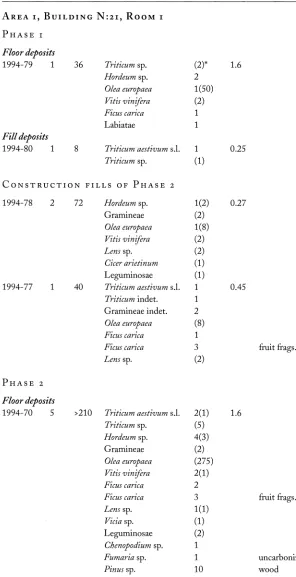
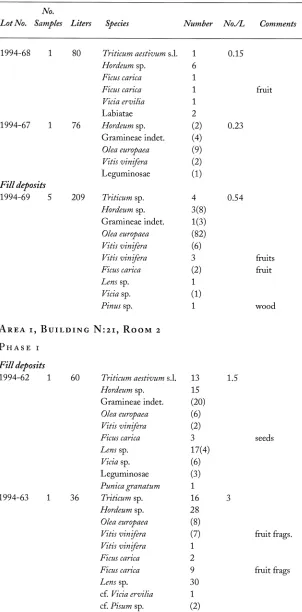
To provide the physical setting for the subject of food, we will begin with a description of the architectural remains in both areas, followed by a brief discussion of the pottery related to dining (Part I). This description will also serve as an excavation report for the season's discoveries. Since both the general form of the Demeter dining room and the Late Classical phase of Building N:21 have been described in detail in Corinth XVIII, iii, we will concentrate on those rooms which are not included in that volume. There then follow reports on the plant and animal remains (Part II) and sedimentary samples (Part III); general conclusions appear in Part IV. Tables 2 through 7 present in synoptic form all of the plant and faunal remains that were found. In addition, Table 1 provides the stratigraphic and chro- nological control for Parts I and II. Accordingly, this information will not be repeated in those sections.
PART I: THE EXCAVATIONS
For those unfamiliar with the sanctuary in the Archaic and Classical peri- ods, a few introductory words will provide a background for the more detailed description that follows (Fig. 1).
Excavated, for the most part, between 1961 and 1973, the sanctuary covers roughly 770 square meters on the north slope of Acrocorinth. Origi-
4. For preliminary discussions of food in the sanctuary, see Bookidis 1990 and 1993. The subject will be treated in a study of the cult to appear in a later fascicle of Corinth XVIII.
5. We would like to express our gratitude to Sarah Vaughan, former Director of the Wiener Laboratory, for initiating this project and for assem- bling the scientific staff, and to Charles K. Williams II, former Director of the Corinth Excavations, for making the project possible and, as always, for his unflagging support and interest. The plans are the combined work of Robin Rhodes, Charles K. Williams II, David Romano, Roxanna Doxan, and James Herbst. Figure 12 was drawn by Karen H. Soteriou. We would also like to thank Mrs. Phani Pachyianni, Ephor of the Argolid and the Corinthia, Zoe Aslamatzidou, and the staff of the Archaeological Service at Corinth for their cooperation and permission to transfer the floral and faunal remains temporarily to the United States for analysis. Conservation of finds was carried out by Stella Bouzaki, and the mending of pottery by Niko
Didaskalou, Anastasios Pappaiouanou, and George Arberores. Work on the site was overseen by Aristomenes Arberores, excavation foreman. Finally, we thank our anonymous reviewers for their useful comments.
An initial report on this work was presented at the annual meeting of the Archaeological Institute of America in 1995, for which see Hansen, Bookidis, and Snyder 1995.
4 BOOKIDIS, HANSEN, SNYDER, AND GOLDBERG nally it must have been larger, for the eastern, western, and possibly north- ern boundaries of the Lower Terrace have not as yet been found. The sanctuary was linked to the city below by a road that passed along its lower, north, side. From the road a broad stairway ascended the Lower Terrace to the south. Rows of small dining complexes lined this stairway and from the late 5th century B.C. onward also extended north of the road. Accord-
ing to our present evidence, the earliest dining rooms date to around the third quarter of the 6th century B.C. They continued to be built and used until Mummius' destruction of Corinth in 146 B.C. Initially designed as
one-room units, the buildings were gradually enlarged to include subsid- iary rooms for cooking, washing, and sitting. As of 1994, we have been able to determine through excavation that at least 36 dining rooms were in operation in 400 B.C., the period that is best attested in the sanctuary.
Above the dining rooms the broad Middle Terrace provided areas for sac- rifice, repositories for votive offerings, and a large square enclosure, which we have called the Oikos and which presumably functioned as a temple in the Archaic and Classical periods. On the steep rocky slope of the Upper
Op Figure 1. Schematic plan of the
sanctuary, with Areas 1 and 2 marked
AREA 2
II.L'
0 2 3
D.8A PECK JR.
~~~~~II. I ' ||I@*.
OIL SAMPLE 1
A
~~~~~~~1
SOIL SAMPLE 2
7
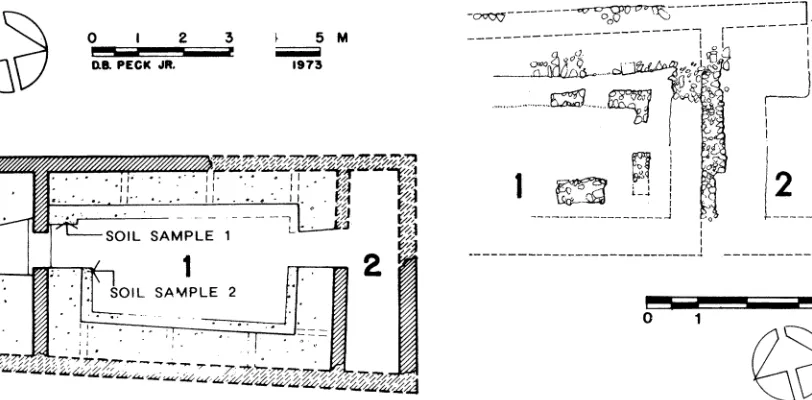
Figure 2 (above, left). Building N:21, plan of Phase 2
Figure 3 (above, right). Building N:21, plan of Phase 1
-
5M- -- - - ---
V
___ 5~, 5 M ____________sg>i
M~~~~~~~~~~~~~~~~~~
1973 ~QI
1C
..j...
r IV
Terrace that continued above the Middle Terrace were two theatral areas
and a small Hellenistic successor to the Oikos below, Building S-T:-16-17.
In 1994 we began in the unexplored, northeast corner of the excava-
tions (Fig. 1: Area 2), nearly 50 meters east of the stairway and ca. 20
meters northeast of the Middle Terrace. Six trenches were laid out over an
expanse 1 1.00 m wide east-west by 15.00 m long north-south, just east of
the Hellenistic dining structures L-M:28 and N:28.7 Within this space
parts of at least five or six Late Archaic to Classical dining rooms were
uncovered, containing floral and faunal specimens in stratigraphic con-
texts extending from the late 6th to the late 4th century B.C. Because none
of these structures was sufficiently preserved to warrant lengthy investiga-
tion, we turned to a Classical dining complex in the middle of the site that
in 1965 and 1969 had been excavated down to a floor of the late 4th cen-
tury B.C. (Fig. 1: N:21). Similar floral and faunal specimens were found
here but in greater abundance and in a far better continuous stratigraphic
sequence that extended from the late 6th to the late 4th century B. C. This
similarity between the finds from the two areas is of importance for our
interpretation of the results.
AREA I: BUILDINGN:zI
Building N:21 is located on the southernmost row of dining buildings just
below the Middle Terrace.' It opens directly off landing 6 of the central
stairway and, in its later form (Phase 2), comprises a larger dining room, 1,
preceded by a deep porch on the west, and a smaller service room, 2, to the
east. Thought to have been built in the late 5th century, abandoned in the
late 4th century B.C., and covered by later walls, the building nevertheless
offered promise of a longer history, since an earlier crosswall was just vis-
ible beneath the existing-4th-century B.C. floor. We therefore excavated
beneath this exposed floor to find a sequence of four earlier floors as well
as
earlie1r Ia
1I
Ir I I I
tm did
7. Corinth XVIII, iii, pp. 179-184, 193-198. In 1971 excavation along the east side of Building L-M:28 exposed part of what is here called Room 2. Regrettably, all records of this work were lost in the fire that destroyed part of the excavation complex in 1972.
6 ~~~BOOKIDIS, HANSEN, SNYDER, AND GOLDBERG
~~~~~~~~~~~~~~~~~~~~Fgur 4. Building N9; :2|1 Pasie 2_
l > w-# a e---J e -tahSOF its g-! IZ! w 2;in foregro!nd from east, Room
~~~~~~~~~~~~~~~~~~~~~Fgre. Building N:21 Phase :'..',
K~~~~~~~~~ Room. 2. foreground,_ w fro east in
~~~~~~~~Aw wit couhe of Phas 2 to l ;ef
. .t
,:e.,*~~~Ilir.*.t_.3S5_/j7
_.!; ... ,s50i s?;-L'.5 .... ,t... e __RStt 2wS 8X '; fl
t_~~~~~~~~~~~~~~~~~~~~~~~~~~~~~~~~~~~. . \..;..-j -... _i-*;
not allow us to complete our exploration of the unit to bedrock. Despite this, we can now extend the building's history back to the end of the 6th century B.C.
EARLIER PHASE (PHASE I)
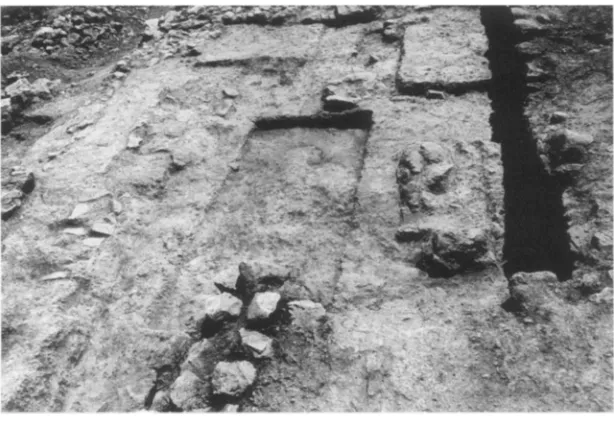
In its earlier, if not earliest, form Building N:21 consists of at least two dining rooms of different sizes, namely, a larger western room, 1, and a smaller eastern room, 2 (Fig. 3). Because of the overlying Classical couches, which were left in place, much of the earlier Room 2 remained hidden (Fig. 5).
For this phase portions of both the north and east exterior walls exist, the north wall at foundation level, the east wall to a height of 0.20-0.40 m above floor level. The south wall of both phases was destroyed when the Trapezoidal Building of the Middle Terrace was constructed over it at the end of the 4th century B.C. but can be restored from the interior disposi- tion of the furnishings in Room 1. Later construction has also covered the earlier west wall, the position of which is unknown. So defined, the build- ing measures at least 8.10 m east-west by roughly 4.95 m north-south.
Although no longer preserved, the entrance to Room 1 stood on the west side, probably just a couch's width, or about 0.80-1.00 m, from the northwest corner of the building. Its position is suggested by the disposi- tion of the couches and tables within the room. Room 1 measures an esti- mated 4.30-4.50 m from north to south by more than 4.00 m from east to west. Within the room, couch-banquettes9 0.70-0.80 m wide presumably once lined all four walls. These now exist only on the north and east sides.'0 The position of the south banquette, as we shall see, can be restored with some certainty.
In front of the north banquette is a broad dais of clay, 0.56 m wide, the top of which lies only a few centimeters below the existing banquette top and 0.05-0.10 m above the upper floor of this phase.1' The dais probably continued around the east and south sides of the room but could not be clearly isolated there. Furthermore, solid packings of fieldstones that once must have supported stone or wooden tabletops were exposed on three sides of the room. Of the two tables on the long north side, the eastern, 2, is L-shaped to bridge the northeast corner.12 A third table serves the south half of the east banquette,13 while a fourth stands in the middle of the south side (Fig. 7).14 Since these tables are placed 0.30 m from the ban- quettes, we can restore both the south banquette just inside the face of the Classical banquette that covers it, and the south wall of the building ca. 0.80 m from the banquette. Nothing was found of the west table, unless a single large stone, projecting from beneath the later west couch, is a part of it. Nevertheless, we estimate that seven people could have reclined within the room, one on the west side, two on each of the other three sides, on couches roughly 1.75 to 2.00 m long.
Within the room we exposed two floors that were heavily "burned." In the past, we used this term to denote the presence of small bits of car- bon or carbonized material in the clay. Through water-sieving these bits can now be identified as remains of food. While these remains were scat-
9. This term has been used to designate the continuous, knee-high platform that is a feature of all Demeter dining rooms; on this platform indi- vidual couches were marked off by means of contoured armrests.
10. Although now preserved to the height of only one course of fieldstones, or ca. 0.15 m, the north banquette seems to follow the usual formula. Apart from a few small stones, no retaining wall exists for the east banquette, but its earth packing separated clearly from the clay floor that abuts it. A solid packing of small fieldstones covers the northern 0.60 m of the east banquette. Neither its function nor its attribution to the earlier phase is clear, for it projected through the later floor that covered this couch. 11. For a description of the dais as a form see Corinth XVIII, iii, pp. 414- 415.
12. Table 1 is 0.62 m long by 0.24 m wide; it falls 1.10 m from the later stone threshold and 0.45 m from table 2. Table 2 is 0.81 m long north-south by 0.53 m east-west and 0.31 m wide.
13. Table 3 lies 0.62 m south of table 2 and measures 0.83 m long by 0.35 m wide.
8 BOOKIDIS, HANSEN, SNYDER, AND GOLDBERG
Figure 7. Building N:21, Phase 1, Room 1, from west, with floor 2 exposed in the center
Sout NoI
A _ _ _ _B
Couch D-94-4 Couch
Ph. 2 Noh.h
Ph.2
~
~ ~
~ ~ ~ ~ ~
~~D9- Ph.2 alB Ph.1 | Wall~~~~~~~~~~~~~~~~Wl }
Ph. 1
0 05 1 2m
__ I 1 Figure 8. Building N:21, Room 1,
south-north stratigraphic cross- sections A, B, looking west.
tered throughout the room, they tended to concentrate in the center, within the framework of the tables. The earlier of the floors (Fig. 8, layer 5) was only partially uncovered in the center of the room on the last day of exca- vation.'5 On it was a round patch of concentrated burning and red earth 0.25 m north of table 4. Measuring about 0.30 m in diameter, this patch may well have functioned as a small hearth or may mark the position of a portable brazier, subsequently removed.'6 In the earth above it were found four fish bones that appear to have been burned. This floor was subse- quently raised about 0.07 m (Fig. 8, layer 4A), and a new clay surface (Fig. 8, layer 4) was laid down over the earth fill.17
Room 2 is 3.13 m wide east-west by roughly 4.50 m long north- south. The northern half of its east wall and east 2.70 m of its north wall are not preserved. In addition, the later east banquette of Room 1 covers most of the earlier floor space within the room. Nevertheless, certain de- tails of its interior can be restored.
The entrance lay on the north side, just a couch's width from the north- east corner.'8 Within the room we have restored six couches.'9 A very small portion of a clay floor (floor 2)20 was exposed along the east banquette, but because of later, overlying remains, no more of it could be examined. Tests in the packing for the east couch revealed no sign of an earlier phase, nor does there seem to have been an earlier floor. Regrettably, time did not permit corresponding tests on the west side of the room.
The test in the east couch provides us with evidence for the begin- nings of Room 2 and perhaps of Building N:21 as a whole around the end of the 6th century B.C. (lot 1994-62).21 A clay surface removed from the top of the east couch is slightly later in date (lot 1994-64), descending into the first half of the 5th century B.C., but this may reflect a period of use as
well as construction. The room presumably continued in this form until its renovation near the end of the 5th century.
In Room 1 the earliest floor, 5, was left untouched; therefore its chrono- logical relation to the earliest floor in Room 2 remains unknown.22 The raising of the floor level took place no earlier than the first quarter of the 5th century B.C., as shown by pottery from the leveling fill (lot 1994-80). Sherds
recovered from the excavation of the overlying clay floor 4 may descend into the early second quarter of the 5th century B.C. (lot 1994-79).
LATER PHASE (PHASE 2)
In the late 5th century B.C. Building N:21 was rebuilt with a new west wall as well as a new north wall on top of its predecessor; the earlier east and, probably, south walls were retained (Fig. 2). The party wall was shifted 1.50 m to the east to create a large west dining room, 1, 6.30 m long east- west by 4.15 m wide north-south, and a small east service room, 2,2.20 m long. In all, the new structure was 8.50 m long from east to west by about 4.90 m wide from north to south. An entrance porch lay on the west side adjacent to landing 6 of the stairway.
Building N:21 in its later phase has already been published.23 We will therefore confine ourselves to a few observations. Within Room 1 the only substantial changes to the preceding arrangement consisted of the length-
15. Elevation +170.850-170.790 m. The floors have been numbered from top to bottom; thus floors 1-3 belong to Phase 2, floors 4 and 5 to Phase 1. In Figure 8 these same numbers are used for the floors, while underlying fills associated with each floor are desig- nated by the addition of the letter A.
16. For a similar feature in another early building, J-L:21, see Corinth
XVIII, iii, pp. 87-88.
17. Elevation +170.923-170.835 m. 18. Although the doorway itself is not preserved, its position can be determined by means of the 0.65 m- wide passage to the door that inter- rupted the north banquette.
19. These consist of a single couch of 1.77 m along the north side, two on the west side each 1.50 m long, one south couch of 2.30 m, and two of 1.70 m each on the east side.
20. Elevations of the floor are +171.273 m (south), +171.081 (center), and +170.60 (door). The considerable difference in level from south to north may be, in part, due to a subsidence of fills under the deeper, northern half of the building. Some sloping, however, may have been intended to facilitate cleaning. In comparison with those of Room 1, the elevations of this floor are substantially higher.
21. Lot numbers refer to the pottery storage system of the Corinth excava- tions, each lot representing a specific stratum. It is these numbers that are used in Table 1 to represent in simplified form the sequence of fills.
22. That there must have been an even earlier phase to Room 1 is suggested by the construction of the fieldstone party wall that now separates Rooms 1 and 2. Largely 0.45 m thick, the southernmost 0.90 m of its exposed portion dwindles to 0.30 m in
thickness. Quite possibly, an earlier door to Room 2 existed here that was later blocked.
IO BOOKIDIS, HANSEN, SNYDER, AND GOLDBERG ening of its plan and addition of a door in the east party wall, 2.00 m from the restored southeast corner of the room. The door divided the east couch- banquette into two small units. Although the dais was retained as a fea- ture, it was translated from clay into fieldstones. No tables are attested for this phase, and we therefore assume that they were portable. In this form Room 1 could accommodate eight or nine couches.
Three successive floors were identified in Room 1, the latest being that exposed in 1965 and 1969. Each was flecked with carbon and pro- duced food remains. The lowest floor, 3 (Fig. 8, layer 3), just covered the earlier dais and table foundations.24 Floor 2 (Fig. 8, layer 2) was raised 0.07-0.12 m above floor 325 while floor 1 (Fig. 8, layer 1) simply overlay floor 2. In Room 2 no interior features were preserved to indicate the room's function except for a single, uniform clay floor. Quite possibly, the absence of any foundations for either a bench or a bath stall may mean that the room functioned as a kitchen. Since most of the floor and overlying fill had been excavated in 1965, this identification could not be corroborated.26
Evidence for the construction of this phase of Building N:21 is pro- vided by a series of fills that covered both rooms. In Room 1 the earlier floor, 4, tables, and dais were covered by a stratum 0.13-0.25 m deep, com- posed of a distinctive, very hard red earth, identified as a sediment by Paul Goldberg (Fig. 8, layer 3A; sample D-94-3). Clearly different from the
terra rosa regularly found above bedrock, this earth had been brought in from another part of the city as construction material, probably for the walls or roof of the earlier building, and was then reused as filling debris early in the last quarter of the 5th century B.C. (lot 1994-78).27 A dumped fill covered the northern half of Room 2. Like most such fills in the sanc- tuary, this contained material that spans a long period, extending from the late 7th to the middle or third quarter of the 5th century B.C. (lot 1994- 66).28 A similar fill overlay the western side of the room (lot 1994-65), while lot 1994-63, representing the earth that covered floor 2, dates no earlier than the late second quarter of the 5th century B.C.29
The catalyst for this remodeling of N:21 was undoubtedly the con- struction of the processional stairway, the laying of which required modi- fications to all preexisting dining halls along its length.30 Here the alter- ations were not limited simply to a contraction of the west side as happened further north, for the building appears to have been completely recon-
structed.3'
Within Room 1 the earliest floor, floor 3, of Phase 2 was laid down at the time of reconstruction late in the 5th century B.C. (lot 1994-70). The first raising of that surface took place in the first half of the 4th century B.C. Pottery from the leveling stratum (Fig. 8, layer 2A) dated almost en- tirely to the 5th century, except for one lamp nozzle and a terracotta doll of the early 4th century B.C. (lot 1994-69). Material from the new clay floor 2 included sherds dating from the 6th to the first half of the 4th century B.C. (lot 1994-68). Although floor 1 lay directly on top of floor 2, some time seems to have elapsed between the two surfacings, for incorporated in it were sherds of the second half of the 4th century B.C. (lot 1994-67).32 Above both this floor and the south couch lay a 0.20 in-thick layer of debris, which was excavated in 1965 and 1969. Pottery from this layer can
24. The elevations of floor 3 are +171.187-170.946 m.
25. Its elevations are +171.254- 171.068 m.
26. A portion removed in 1994 produced a small amount of early pottery. See Table 1: notebook 637, basket 127.
27. In addition to the pottery, a bronze coin of Corinth of the Pegasos/ Trident series was found in this layer, coin 1994-407.
28. In an area measuring roughly 1.00 by 3.00 m by no more than 0.40 m deep we recovered 8.42 kg of pottery, or 2,639 sherds. Eight figurines, both handmade and moldmade types of the 6th through early 5th centuries B.C., 5 pieces of iron, including a pin, and 8 6th-century B.C. lamps were also recovered. Among the sherds were fragments of an Attic black-figured neck-amphora that joined a piece found in 1973 further down the hill. The original piece is published in
Corinth XVIII, i, p. 139, no. 310, pl. 34, there called an oinochoe. The new joins will be published separately by Ann Brownlee.
29. Of interest from this stratum is an uninscribed iron key, MF-1994-50, to be published in a future fascicle of Corinth XVIII.
30. These modifications are discussed in Corinth XVIII, iii, pp. 98, 102, 122-124.
be dated to the third or possibly early fourth quarter of the 4th century B.C.
(lots 4452, 6217, and 6218).33 Because of the presence of fragmentary roof tiles on top of both this debris and the south couch against the Hellenistic wall of the Trapezoidal Building, we concluded that the tiles were not so much the result of a collapsed roof as intentional fill. Pottery from the debris over Room 2 was generally similar to that from Room 1, with the addition of twelve fragments of animal bones (lot 4476).34
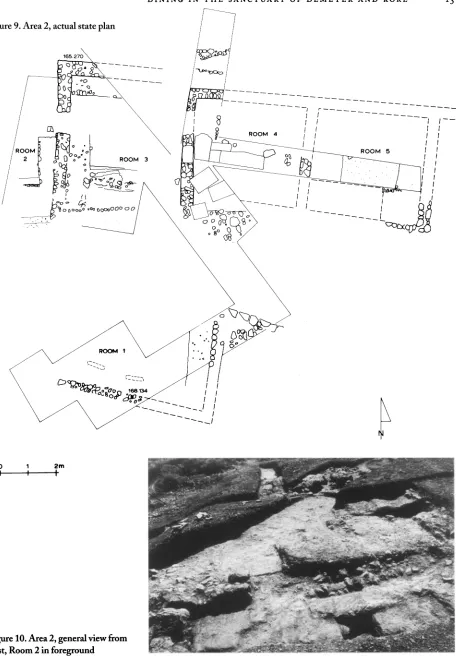
AREA 2, GRID-SQUARES L-N:29-31
In Area 2 we exposed parts of five dining rooms built in or before the 5th century B.C., as well as one corner of a Hellenistic building (Fig. 9). The tests were extremely useful in verifying that the dining rooms do continue to the east. They were less productive, however, of the kind of information needed for our joint project. The surface soils were so stony that dry- sieving was difficult and water-sieving impractical. Since the fieldstone walls of most of these structures stood to a height of no more than one or two courses on the more protected south side of the hillslope, little re- mained within the rooms once these stony soils were removed. The excep- tions were Rooms 2 and 3, where cleaner fills could be sieved. Neverthe- less, before moving to Area 1 we sampled enough to produce floral and faunal remains as well as a sketchy plan.
Room 1, the southernmost of the five rooms, lies about 1.60 m east of Building N:28 in grid-squares N:29-30.35 The extant portions define a room with an internal length of at least 4.50 m from east to west, having a couch-banquette 0.70 m wide along its east wall. The fill that covered these few remains contained worn sherds of the 5th and early 4th centu- ries B.C., together with an early Roman basin, which probably postdates
the period when the room was abandoned.36 It is possible that Room 1 was part of a row of rooms; a wall, which could have formed the north wall of an adjoining room, extended 2.00 m eastward from the northeast cor- ner of Room 1. Its orientation differs somewhat, however, from that of Room 1.
The remaining four rooms all lie on the next row of buildings to the north, beginning with Room 2 on the west and ending with Room 5 on the east.37 Largely destroyed by the construction of Building L-M:28 in the late 4th century B.C., Room 2 is now limited to its easternmost 1.60 m
(Fig. 11). In this narrow segment parts of both south and east walls are preserved, the latter for a length of 4.95 m. In addition, a 0.90 m-wide door in the east wall, 3.00 m from the southeast corner of the room, leads into Room 3. Both here and in Room 3 the south wall is composed of a red gravely pise. In addition, in Room 3 this red earth alternates with layers of clay.
Couch-banquettes line both east and south sides of the room. These measure 0.60 and 1.15 m wide, respectively.38 In addition, a low dais of red earth, 0.22 m wide, lies at the foot of the southern banquette. Despite the narrowness of the east banquette, the presence of the south dais indicates that the room was a dining area.
A test through the single clay floor revealed only gravel packing over- lying bedrock. Pottery from the removal of the floor and packing belongs
33. In addition, there were two intrusive sherds of Roman date. Some of the distinctive pieces from this layer can be found in Bookidis and Fisher 1972, p. 294, nos. 6-8, pl. 57, p. 325, no. 29, as well as in Corinth XVIII, i, p. 156, no. 402, and p. 160, no. 441.
34. Bone lot 65-24, to be published by Reese.
35. Of the room, 3.00 m of its south wall and about 2.70 m of its east wall are all that remain.
36. Notebook 637, basket 93, dry- sieved.
37. Of these four, Rooms 2 and 3 and Rooms 4 and 5 certainly share a party wall. The relation between Rooms 3 and 4 is less clear. As Figure 9 shows, their north walls do not align; moreover, the west wall of Room 4 clearly represents at least two periods of construction: the earlier northern half, which bonds with the exposed north wall, built of fieldstones, and dating to
the 6th or 5th century B.C.; the later southern half, incorporating both fieldstones and breccia blocks, of possibly 4th century B.C. date. Since the earlier portion of Room 4 lies at a deeper level than the north wall of Room 3, it is possible that Room 3 is later in date.
I2 BOOKIDIS, HANSEN, SNYDER, AND GOLDBERG roughly to the third quarter of the 5th century B.C. (lot 1994-81). This gives us some evidence for the period when the room was in use. Although the pottery from the fill that covered the room may date no later than the beginning of the 4th century B.C. (lot 1994-82),39 it is more likely that the room continued in use until the end of the century, as evidenced by the abundant material recovered from adjoining Room 3.
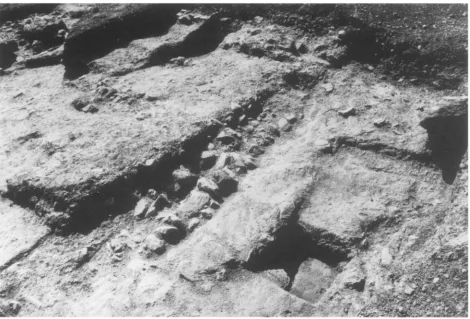
For Room 3, in addition to its entire west wall, roughly half of its south wall and 1.60 m of its north wall are known (Figs. 10, 11). The internal dimensions of the room are 4.65 m from north to south by at least 2.50 m from east to west. Because of the way in which the test trenches were laid out, neither the southeast nor the northeast corner of the room was excavated; moreover, the east side had been quite thoroughly destroyed.
Room 3 was extremely difficult to excavate, for only the north couch- banquette preserved the lowest course of its stone retaining wall. The re- maining couch-banquettes were only identifiable by their earth packings and by facings of 0.20 m-wide strips of red earth.40 A clay floor was iden- tified only in the area of the west door.4' With so much of the room miss- ing, we have not attempted to restore its plan, for there may have been an exterior door on the north side. Presumably, there were no more than seven couches, two each on north, south, and east sides, one 2.40 m long on the west side.
The date of the room's construction at the end of the 6th century B.C. is based on twenty-one sherds recovered from a small cut through the packings of the south wall.42 Removal of the hypothetical floor yielded pottery of the second or possibly early third quarter of the 5th century B.C.
(lot 1994-85).
But most productive of pottery, plant, and faunal remains was the deep fill that covered the southern half of the room (lot 1994-83). This was brought in when the room was finally abandoned and, like other such final fillings, contained material from various parts of the site. Most interesting for our purposes was the high incidence of coarse and cooking wares. As is usual, the chronological range reflected by the finds is great, extending from the 6th to the 4th century, but a coin of Ptolemy I, dated 310-305 B.C.,43 firmly pins down the room's abandonment to the end of the 4th century B.C., presumably when Buildings L-M:28 and L:30-31 were con- structed. We discuss the cooking ware from this dumped fill below.44
Such small portions of Rooms 4 and 5 were uncovered that we will confine ourselves only to a brief mention of them. Room 4 measured an estimated 3.50-3.60 m from north to south by 3.90 m from east to west. Roughly 1.00 m of the retaining wall was found for the west banquette, indicating that no door communicated here with Room 3, and also verify- ing the room's function. Evidence for Room 5 is limited to a small portion of its west party wall and its southeast corner. Time did not permit more intensive excavation here. Part of a couch-banquette 1.15 m wide was ex- posed against that wall. Although the east banquette wall was not pre- served, its packing suggests that, once again, that banquette was narrower.
Finally, the southwest corner of an ashlar-built structure in breccia, L:30-31, overlay the southwest quarter of Room 4, thereby adding one more structure to the Hellenistic period plan of the sanctuary. The build-
39. From this layer comes a small bronze snake, MF-1994-46, to be published in a future fascicle of Corinth
xvIII.
40. The north couch is 0.70 m wide, the west 1.00 m wide, and the south 1.15 m wide.
41. Its elevation is +165.54-165.45 m. 42. Notebook 637, basket 112. 43. Coin 1994-402. With this coin were two more, minted in Corinth in the Pegasos/Trident series, coins 1994-403 and 1994-404. We thank Orestes H. Zervos for identifying these coins. They will be published with the remaining sanctuary coins in a future fascicle of Corinth XVIII.
Figure 9. Area 2, actual state plan
165 270
Apo
0
/
o [r11TXDOQ 02m
'p.
ROOM 3 00 1 2m
I I
I4 BOOKIDIS, HANSEN, SNYDER, AND GOLDBERG
7.0
Wt.
J,
7e.
. .. ... .. .
VA 1w WI 44
.. . .. ...
2,
-or - 0G."
0 AN
o 4-
J- mis
W,
ing lies roughly 6.50 m east of Building L-M:28, until now thought to be the northeasternmost Hellenistic dining room on the Lower Terrace. It is curious that the building's south wall is not, aligned with that of L-M:28 but falls some 5.00 m further north. Presumably, the contours of the hill- side are responsible for this shift in placement, for a similar difference is apparent in the Classical rooms just described. While Rooms 2 to 5 may be roughly aligned with the Classical buildings west of L-M:28, Room 1 falls further north of its corresponding western neighbors.
POTTERY
Within the dining halls described above we have found an abundance of pottery, though quite fragmentary.45 Apart from votive miniatures, which permeate every shovelful of earth in the sanctuary, we find the following shapes which undoubtedly relate to dining. Cups are the most numerous, and of the cups the most popular shape is the kotyle.4 Less frequent but nonetheless popular is the Corinthian one-handled cup. A variety of bowls, small and large, and lekanides characterize every level. Kraters and oinochoai are attested, but far less frequently, and it is interesting that smaller variet- ies of oinochoai, such as might provide a single portion, outnumber the larger types.47 Service vessels for larger numbers of people are more com- mon in coarse or plain fine fabrics.
Both the coarse and cooking wares were extremely fragmentary this season, disappointingly so, and profiled sherds were relatively rare. The
Figure 11. Area 2, Rooms 2, 3 from northwest
45. All pottery from the excavation of the two areas was checked for joins; very few complete profiles were assembled and virtually no complete pots. The fineware pottery is over- whelmingly Corinthian. Indeed, the votive miniatures are entirely
Corinthian. Imports represent no more than 2 percent of the whole and are all of Attic provenience; these chiefly consist of cups, lekythoi, and figured kraters.
46. Among the identifiable sherds from both areas of excavation, kotylai number 6,539, or 40.5 percent of the fine ware.
Figure 12. Bean-parcher (C-1994-
78), profile
shapes, however, are fairly repetitious. Among the coarse wares, most preva- lent are mixing bowls or lekanai, both shallow and deep varieties, mortars, perirrhanteria or louteria, large jars with flaring or trefoil rims,48 and trans- port/storage jars. Among the latter, Corinthian types A and B predomi- nate, but at least two Thasian bodies, a possible Thasian handle, and a pseudo-Coan fragment in a later fill attest to the use of amphoras from elsewhere. That some of these may have been used for wine is suggested by the discovery of grape seeds in the bottom of one Corinthian type A amphora (lot 1994-65).
Since our main concern was food, we hoped to recover a good amount of cooking ware. Unfortunately, cooking pots were quite poorly represented. In most cases, only a handful of small body sherds was found; occasionally, a small rim fragment allowed us to identify the shape. A few large dumped fills were more productive, in particular lot 1994-83, mentioned earlier in conjunction with the abandonment of Area 2, Room 3. Here not only could we identify shapes but we could also take some measurements. The shapes are few. As clearly set forth in Corinth XVIII, i,49 stewpots and casseroles prevail. Among the stewpots, several varieties are attested, pri- marily the unflanged and the flanged. The unflanged stewpot with hori- zontal rim may, in fact, be a Corinthian peculiarity. Having a neck and rim that are narrower than those of a flanged stewpot but wider than those of a pitcher, the shape could have been used for pouring as well as for boiling. Faint traces of burning on the exteriors of some of these pots certainly suggest that they were used in some way with fire.
If we look at the dimensions of those vessels recovered from lot 1994- 83, we find among the more numerous unflanged stewpots the following rim diameters: 0.20 m,50 0.18 m, 0.11 m, 0.095 m, and 0.07-0.08 m. A second example of the smallest size was also found in lot 1994-78, dated roughly a century earlier. As we have observed elsewhere, a variety of small pots were used in the sanctuary dining rooms, as well as a few large ones.5 The capacity of the smallest is very slightly greater than one kotyle, a com- mon unit of measure.52 This raises the question of whether these were used for individual portions within the dining rooms or were simply used for making small quantities of certain kinds of food. Here again it is inter- esting to keep in mind the frequency of small fineware oinochoai over large ones.
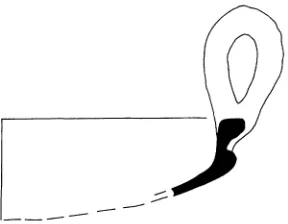
An unusual cooking pot was found in lot 1994-83 (Fig. 12).53 Con- sisting of a shallow, unlidded bowl with a high loop handle set vertically on the rim, the pot was used over a fire, as its burned bottom indicates. In shape it comes closest to the bean-parcher and like that vessel may have been used for parching barley or beans.54
Unfortunately, no fragments of casseroles were large enough to be measured, apart from one in lot 1994-65 with a diameter of 0.14 m.55 But of greater interest than their size is the probable use to which casseroles were put. In his study of cooking wares and the ancient sources, Michel Bats concluded that the casserole, or lopas, was basically used to cook fish.56 In the past, this interpretation did not seem to fit what we knew of the sanctuary's needs, for, apart from a few seashells, no remains of fish had been found in the dining rooms.This is no longer the case, because through
48. For the type, see Corinth VII, ii, p. 152, An 271, pls. 79, 110, top row left, and 111.
49. See Corinth XVIII, i, pp. 68-75. 50. This is similar in shape to Corinth XVIII, i, p. 186, no. 650 (end of the 4th century B.C.).
51. Bookidis 1993, p. 53. 52. Using sand, we measured the capacity of C-71-152, a complete stewpot of identical size and shape found in the Forum excavations. Measured to the base of the outturned rim, the pot could hold 0.300 liters. See Agora X, p. 46, for the capacity of a
kotyle equivalent to 273.6 cc. 53. C-1994-78A-B. A: pres. H. to rim 0.026, rest. H. to rim 0.042, max. rest. H. 0.088, rest. D. rim 0.19 m. Fragments A and B together preserve nearly half the circumference of the rim, a small part of the bottom, and one handle.
54. Cf. Agora XII, pp. 228-229, 275, nos. 1987 and 1990, fig. 17, pl. 96.
55. It is interesting to compare this diameter with those of casseroles from the Athenian Agora, most of which are 0.20 m or more, although a few are only 0.10 m; see Agora XII, pp. 373- 374.
i6 BOOKIDIS, HANSEN, SNYDER, AND GOLDBERG water-sieving fish bones were found in a number of strata in 1994-bones of small fish that could easily have been fried in the shallow pans. These are discussed below in Part II.
ON THE CONTEXTS
Before turning to the reports on the floral and faunal remains, we will conclude this section with a few general statements about the buildings described above, their depositional history, and their relation to the cult activities on the Middle Terrace. It should be understood, however, that these comments are, to a large extent, provisional and will be discussed more thoroughly when all of the material from the sanctuary has been pub- lished. Like all of the sanctuary dining rooms, these just excavated were used for a long period, approximately two hundred years. Over that time, as we have seen, a number of modifications were carried out; some of these were undoubtedly due to the sanctuary's location on a steep hillside where harsh winters demanded frequent maintenance. Walls were rebuilt, couches moved, floors raised. For all of this work the necessary materials were taken as much as possible from near at hand. Thus, pottery brought to the sanc- tuary either as votive offerings or for use in the dining buildings and there- after broken or buried inevitably formed part of the fill.57 A perusal of catalogue entries in Corinth XVIII, i will make clear how far joining frag- ments of a vessel could travel both horizontally and vertically on the hill- side. Although we cannot say with any certainty that a given fragmentary vessel was used where it had been found, we do feel certain that it was used within the limits of the sanctuary. This is because of the overwhelming consistency of shapes found, or not found, in all parts of the site.58
Given their plan, there can be no doubt that the buildings under dis- cussion were used for dining. In addition, a number of them, unfortu- nately not any dug in 1994, also contained kitchens with hearths;59 cook- ing pots of the types just described were ubiquitous-indeed, in one case, still resting on the hearth.60 If the sacrificial animal formed part of the meal, a question that will be addressed below, clearly other kinds of food were made on the premises. In the reports that follow we have distin- guished between faunal and floral remains found in the floors and in the fills, thinking that what was pressed into the floors might represent food eaten on the spot, while what lay in the deeper fills might have been brought in from another part of the site, including other dining rooms. As shall be seen, however, while this distinction is potentially informative for bones, it is less so for floral remains.
This issue of provenience is further complicated by the proximity of Building N:21, in particular, to the Middle Terrace with its places of sac- rifice. As we stated in the beginning, these were two. The earlier of these, Area D, was an elevated terrace cut into the hillslope, on which stood two low rubble platforms tentatively identified as altars, where we assume that sacrifice was carried out because of the high concentration of black ashy soil. In this soil was found a small amount of animal bones, pig where identifiable, as well as several iron knife blades.61 The second, Pit B, was a deep stone-lined pit with fire-scarred walls, which lay at the east end of
57. An analogy may be drawn to the large deposits of discarded statuary and other objects found north of the Erechtheion or south of the Parthenon on the Athenian Acropolis. No one would dispute that these belong to the sanctuary; only their original place of deposition is uncertain. In addition, see Kron 1992, pp. 643-644, comparing the fragmentary material that is customarily found in a sanctuary with the unusual deposits of whole vessels at Bitalemi, Gela.
58. The lekythos, for example, is rare. Only 30 fragments were identified among the finds from the 1994 season. The mushroom jug, which is ubiqui- tous in the lower city, is completely absent from the sanctuary.
59. For a discussion of the kitchen, see Corinth XVIII, iii, pp. 407-410.
60. Corinth XVIII, iii, p. 148 and Corinth XVIII, i, p. 187, no. 654.
the Trapezoidal Building; within it was found, once again, a small number of pig bones together with considerable amounts of ash and discarded pottery.62 In addition, a deep stratum of black ashy earth, containing some animal bones and much pottery, formed the construction fill for the rest of the long Trapezoidal Building.
We know virtually nothing about the sacrifices performed in the sanc- tuary, except that pig was clearly the preferred animal. Whether those sac- rifices were holocaustic or not is unclear; the material remains are slight. Whether other foodstuffs accompanied that sacrifice is also unclear. That this is possible, however, is suggested by the clay models of likna, or win- nowing trays, filled with different kinds of food, that have recently been published by Allaire Brumfield.63 Among the foods depicted are different kinds of cakes, maza, and nuts or pulses-possibly almonds or chickpeas. In addition, small trays with empty cups could have held real grains, seeds, or pulses. Presumably these models replicate actual cakes and foods brought to the sanctuary for offering. Pausanias (9.19.5) tells us that in the Sanctu- ary of Demeter at Mykalessos fresh fruits of the autumn, placed at the feet of the cult statue, stayed fresh for the whole year. But would all such foods simply have been offered in sacrifice, or could some have been shared among the participants? We return to our earlier statement that something was clearly eaten and cooked in the dining rooms, and the discovery of grind- ing stones, reused in later contexts on the site, clearly indicates that some grinding was done in situ.
In considering the meaning of the faunal and floral remains found in the successive layers of the dining rooms, the reader should keep in mind that these seeds and bones were not found in concentrated ashy strata of the sort that covered the terrace of Area D or filled Pit B and the founda- tions of the Trapezoidal Building. In a sense, they were isolated finds within the floors and fills, although, as Paul Goldberg shows below, minute bits of charcoal did occur as well. The samples were deposited in stratified se- quences from the end of the 6th to the end of the 4th century in both Areas 1 and 2, widely spaced across the eastern half of the site. While all of the floral samples were carbonized, not all of the animal bones were burned, a point Lynn Snyder addresses. In the earlier excavations of Building N:21 we found several fragments of iron knives that we then assumed had been used for sacrifice. But now that there is more reason to think that meat was actually eaten in the dining rooms, it is also possible to explain these knives as some of the utensils used in the preparation of the meal.64
PART II: PLANT AND ANIMAL REMAINS
METHODOLOGY
The water-sieve system built for the Demeter Sanctuary project consisted of a 1 x 1 m tank with an inflow pipe at its base and a spreader that forced the water up and out underneath the sieves (Fig. 13). This facilitated the agitation of the sediments in the sieves and pushed light material to the surface, thus increasing the likelihood that it would float. The tank was
62. Corinth XVIII, iii, pp. 243-247. 63. Brumfield 1997, in particular pp. 149-158. See also the addendum to the section on plant remains below, pp. 31-32.
i8 BOOKIDIS, HANSEN, SNYDER, AND GOLDBERG
,. . ;_
...~~~~~~~~~M. P. _* _
MM im
~
~
i4
~ ~ ~ ~ ~ ~ ~ ~
* . '... _ ...
filled through a hose attached to two large holding tanks near the road above the site, which were replenished as needed by a truck from the vil- lage.65 Into the sieve tank fit a metal basket (0.65 x 0.98 m) with large holes (ca. 0.02 m diam.); this held a set of nested heavy fraction (residue) sieves with metal mesh of 1.0 and 3.0 mm (Fig. 14). These sieves caught the heavy fraction of material that did not float. The tank had a wide overflow chute that fed the light fraction (flot) into a sieve with mesh of ca. 0.5 mm which sat in a cylindrical tank (ca. 1.00 m diam. by 0.65 m deep) below the chute. This sieve was lined with a piece of muslin so that the light fraction could be easily removed and hung on a clothesline to dry. The excess water and silt flowed out of this container through a drain at the base into a well.
Approximately 1,700 liters of sediment were water-sieved from 35
excvtio-n units an avragerof about 48 liters per unit.66 Nearly every sample
prdue som carbonize pat reais, s well_ as,
small
bon fragmntsselceaics,an a ocsioalpiceofmta.Smls wretakn ro
Figure 13. Water-sieving tank, operated byJ. Hansen
Figure 14. Heavy fraction sieves
65. Water is at a premium in Corinth in the summertime, being frequently rationed. This has been a serious factor in restricting the use of water-sieving methods in the Corinth Excavations. For this project water was bought from a source down on the plain.
excavated levels in large baskets, measured in a bucket of known volume, and then poured into the nested sieves in the water-sieve. The earth was agitated by the inflow of water under the sieves. In addition, the sediment was carefully lifted by hand from the sieve to release light material. Float- ing remains, consisting primarily of carbon, small bone fragments, shell, and modern rootlets, were carried by the overflow out of the main tank through the chute and were caught in the muslin lining the light fraction sieve. When material ceased to float, the residue sieves were removed from the main tank and set on wooden benches to dry.
LIGHT FRACTION
The corners of the muslin squares, containing the flora, were tied together and taken back to the excavation house, where they were hung on a clothes- line to dry. When dry, this material was transferred to plastic bags, labeled, and ultimately boxed and sent to Boston University for analysis. The re- mains were sorted using a Leica stereozoom microscope at lOx-70x magnification. Most plant material could be identified to the genus level, although some remains were too badly damaged to classify beyond the family. A few seeds could not be identified at this time due to a lack of comparative material. Wood charcoal from the samples was identified by examining a fresh transverse section obtained by breaking the piece in half. This was then mounted on a piece of plasticene on a glass slide and examined at 50x-70x, using fiber optic illumination.
HEAVY FRACTION
When dry, the heavy fraction was bagged in the field and taken to the Corinth Museum, where it was sorted, occasionally with the aid of a low- powered (lOx) microscope. Plant remains from the heavy fraction were ultimately combined with the flot from the same basket. Animal bones were bagged separately for analysis, which was conducted at the Smithsonian Institution. The remaining nonbotanical and nonfaunal ma- terial was combined with the pottery.
PLANT REMAINS
20 BOOKIDIS, HANSEN, SNYDER, AND GOLDBERG the fills may have been from earlier meals elsewhere in the site from which the fill material was taken.
Cereals
Figure 15 below gives the measurements for several species, including Triti- cum aestivum s.l., hexaploid, free-threshing wheat, which is found in many of the deposits. The grains are generally short and fat, suggesting that at least some of them might be club wheat (Triticum aestivum subsp. compactum). There is no rachis material from any of the deposits, however, and without this evidence it is difficult to distinguish with certainty club wheat from bread wheat or hard wheat.
The barley from the sanctuary is a hulled type, although it is not pos- sible to determine from the few well-preserved grains whether it is of the two-row (Hordeum vulgare spp. distichum) or six-row (Hordeum vulgare spp. vulgare) form. There were also a large number of fragmentary grains that could not be assigned to either wheat or barley, although they were most probably one of these two. No small-seeded grasses that might have been weeds in the crops were found among the samples.
Length Breadth Thickness (mm) (mm) (mm)
Triticum aestivum s.l. (avg.) 4.97 3.61 3.11 N=10
Hordeum vulgare (avg.) 5.7 3.1 2.4 N=8
Vitis vinifera 4.7 2.5 1.9
4.9 3.4 2.9
Punica granatum 3.6 2.1
Lens sp. Max. dia. (avg.) 2.7 N=14
Legumes
Lentils make up the majority of legumes identified among the sanctuary samples. These appear to be a fairly small-seeded type (Lens culinaris spp. microsperma), with an average diameter of only 2.7 mm (Fig. 15). While it is possible that they could be wild lentils, this is unlikely in the 5th century B.C. There are few other legumes represented in these deposits, and most of these are only fragmentary and cannot be identified to the species level with cer- tainty. Those that are identifiable include bitter vetch (Vicia ervilia), pea (Pisum sativum), chickpea (Cicer arietinum), and grass pea (Lathyrus sp.).
Fruit
Olives (Olea europaea) are the most abundant species represented in the samples from the Sanctuary of Demeter and Kore. They may be over- represented in relation to the other species because they have a thick, hard shell that preserves well when carbonized and because they are large and more easily seen during excavation and dry-sieving, and so are more likely to be recovered by the workmen. The majority of olive remains are frag- mentary, probably the result of trampling.
There is little that can be said about the single pomegranate (Punica granatum) seed from these deposits. Clearly pomegranates were available
Figure 15. Table of Measurements
TABLE 2: PLANT REMAINS
No.
Lot No. Samples Liters Species Number No./L Comments
AREA I, BUILDING N:21, RooM I
PHASE I
Floor deposits
1994-79 1 36 Triticum sp. (2)* 1.6
Hordeum sp. 2
Olea europaea 1(50)
Vitis vinifera (2)
Ficus carica 1
Labiatae 1
Fill deposits
1994-80 1 8 Triticum aestivum si. 1 0.25
Triticum sp. (1)
CONSTRUCTION 'FILLS OF PHASE 2
1994-78 2 72 Hordeum sp. 1(2) 0.27
Gramineae (2)
Olea europaea 1(8) Vitis vinifera (2)
Lens sp. (2)
Cicer arietinum (1)
Leguminosae (1)
1994-77 1 40 Triticum aestivum si. 1 0.45 Triticum indet. 1
Gramineae indet. 2
Olea europaea (8)
Ficus carica 1
Ficus carica 3 fruit frags.
Lens sp. (2)
PHASE 2
Floor deposits
1994-70 5 >210 Triticum aestivum s.l. 2(1) 1.6
Triticum sp. (5) Hordeum sp. 4(3)
Gramineae (2)
Olea europaea (275)
Vitis vinifera 2(1)
Ficus carica 2
Ficus carica 3 fruit frags.
Lens sp. 1(1)
Vicia sp. (1)
Leguminosae (2)
Chenopodium sp. 1
*Numbers in parentheses denote Fumaria sp. 1 uncarbonized
22 BOOKIDIS, HANSEN, SNYDER, AND GOLDBERG
TABLE 2, CONTINUED
No.
Lot No. Samples Liters Species Number No./L Comments
1994-68 1 80 Triticum aestivum s.l. 1 0.15 Hordeum sp. 6
Ficus carica 1
Ficus carica 1 fruit Vicia ervilia 1
Labiatae 2
1994-67 1 76 Hordeum sp. (2) 0.23
Gramineae indet. (4)
Olea europaea (9) Vitis vinifera (2)
Leguminosae (1) Fill deposits
1994-69 5 209 Triticumsp. 4 0.54 Hordeum sp. 3(8)
Gramineae indet. 1(3)
Olea europaea (82) Vitis vinifera (6)
Vitis vinifera 3 fruits Ficus carica (2) fruit Lens sp. 1
Vicia sp. (1)
Pinus sp. 1 wood
AREA I, BUILDING N:21, ROOM 2 PHASE I
Fill deposits
1994-62 1 60 Triticum aestivum s.l. 13 1.5 Hordeum sp. 15
Gramineae indet. (20)
Olea europaea (6) Vitis vinifera (2)
Ficus carica 3 seeds
Lens sp. 17(4)
Vicia sp. (6)
Leguminosae (3)
Punica granatum 1
1994-63 1 36 Triticum sp. 16 3
Hordeum sp. 28 Olea europaea (8)
Vitis vinifera (7) fruit frags. Vitis vinifera 1
Ficus carica 2
Ficus carica 9 fruit frags Lens sp. 30
cf. Vicia ervilia 1