Asian Journal of Pharmaceutical Research and Development
(An International Peer-Reviewed Journal of Pharmaceutical Research and Development)
www.ajprd.com
ISSN 2320-4850
Review Article
PELLETALIZATION TECHNIQUES: A REVIEW
Vaphare AM*, DR. Banerjee SK, MR. Gadhave MV, DR. Gaikwad DD,
Department of Pharmaceutics, Vishal Institute of Pharmaceutical Education and Research, Ale.
Received: June 2014 Revised and Accepted: July2014
ABSTRACT
In present times, the pelletization technologies are giving much attention as they represent an efficient pathway for manufacture of new drug delivery system .It has good advantage over the conventional dosage form. Pelletization technique help in the formation of spherical beads or pellets having a diameter 0.5 -1.5 mm which can be eventually coated for preparation of modified release dosage form .It leads to an improvement in flow ability, appearance and mixing properties thus avoiding for generation of excessive dust and reduces segregation and remove the undesirable properties and improve the physical and chemical properties of fine powder. The aim of this study is to provide detailed and different techniques of pelletization such as powder layering, suspension /solution layering, extrusion and spheronization, cryopelletization, etc. It also gives a brief idea about the evaluation of pellets and application of pelletization technique.
Keywords: Pelletization, extrusion, spheronization, cryopelletization
INTRODUCTION
Oral modified drug delivery systems can be classified in to two broad groups Single Unit dosage forms &multiple unit dosage forms. Multiple unit dosage forms (MUDFs), such as granules, pellets, or mini tablets. The concept of MUDFs was initially introduced in 1950s. The production of MUDFs is a common strategy to control the release of drug as Shown by the reproducibility of the release profiles when compared to the ones obtained with SUDFs. The development of mini matrices is a promising area in pharmaceutical research concerned with a high control over the release rate of the drug combined with a high flexibility on the adjustment of both the dose and the release of drugs and has attracted some attention in the 1990s. Like other MUDFs, several mini tablets can either be filled in to hard capsules or compacted in to bigger tablets.
*For corrospondance: Vaphare Ashok M.
VJSM’s, Department of Pharmaceutics, Vishal Institute of Pharmaceutical Education & Research, Ale ,Tal. : Junnar, Dist.: Pune (412411) Contact no.: 9987654212
Email id- [email protected]
Then after disintegration, they release these sub-units as multiple dosage forms. There has been increasing interest in the development of MUDF’S incorporated into tablets instead of hard gelatin capsules in order to overcome the higher production costs of capsules. In contrast to Monolithic dosage forms multiple unit dosage forms offer several advantages.
Pellets
Pellet has been used to describe a variety of
systematically produced, geometrically
defined agglomerate obtained from diverse starting materials utilizing different processing conditions. They contain multiples of free-flowing, spherical or semispherical solid units which are smaller in size (0.5 mm to 1.5 mm),
and are intended mostly for oral
administration. [1, 2] The small sterile masses which are obtained from the compression of implants or sterile cylinders are termed as pellets in pharmacy. [3, 4]
Regardless of which manufacturing process is used, pellets have to meet the
• Spherical shape and smooth surface is considered as desired characteristics for uniform film coating.
• The particle size of pellets should be in range of 600-1000µm.
• The quantity of the active ingredient in pellets should be maximum in order to maintain size of pellet.
For the past two decades, pellets made their use promising for are ideal characteristics. [7] Due to free-flowing character of Pellets they are packed easily without any difficulties and hence flexibility in design and development a uniform solid dosage form. (Uniform weight of capsules and tablets) [8, 9].
The spherical shape and a low surface area-to volume ratio of pellets made uniform film
coating.[10] two or more drugs can be
formulated in a single dosage form, chemically compatible or incompatible, at the same sites or different sites in the gastrointestinal tract different release rates of the same drug can be supplied in a single dosage form.[11] Multiple unit dosage forms are showing a number of advantages over the single-unit dosage system like suspensions, capsules or disintegrating tablets.[12] With pellets, the above mentioned goals can be obtained through the application
of coating materials (mainly different
polymers), providing the desired function, or through the formulation of matrix pellets to provide the desired effect.[13]
Therapeutic Advantages of Multiple Units over Single Units
When taken orally, multiple unit dosage forms • Disperse freely in the gastro intestinal tract.
• Maximize drug absorption, reduce peak
plasma fluctuations, minimize local
irritation of the mucosa by certain irritant drugs and minimize potential side effects
without appreciably lowering drug
bioavailability.
• Offer reduced variation in gastric emptying
rate and transit time which is less dependent on the state of nutrition.
• Provides less risk of dose dumping.
• Reduces localized concentration of
irritative drugs.
• Improves safety and efficacy of a drug.
• Reduce inter and intra patient variability.
• More suitable for fabrication of
formulations with acid-sensitive drugs. (e.g. Erythromycin) (Digeenis GA 1994).
Desirable Properties of Pellets Uncoated pellets
• Uniform spherical shape and smooth
surface.
• Optimum size, between 600 and 1000mm.
• Improved flow characteristics.
• High physical strength and integrity.
• Good hardness and low friability.
• High bulk density.
• Ease and superior properties for coating.
• Reproducible packing of beds and columns.
Coated pellets
• Maintain all of the above properties. • Contain as much as possible of the active
ingredient to keep the size of the final dosage form within reasonable limits. • Have desired drug release characteristics.
Advantages of Pellets
• The smooth surface and the uniform size of
the pellets allow uniform coating not only for each pellet but also from batch to batch. Coating of pellets can be done with different drugs to enable a controlled release rate.
• In case of immediate release products,
larger surface area of pellets enables better distribution.
• Chemically incompatible products can be
formed into pellets and delivered in a single dose by encapsulating them.
• The beads or granules of different thickness
of coatings are blended in the desired proportions to give the desired effect. • The thickness of the coat on the pellets
dictates the rate at which the drug or contents are released from the coated particles.
• By selecting the proper formulation,
processing conditions and processing
equipment, it is possible to attain smooth surfaced and uniform pellets.
• Improved appearance of the product and
• They offer high degree of flexibility in the design and development of oral dosage form like suspension, tablet and capsule. • Recently, coated pellets are compressed to
rapidly disintegrating tablets. For this purpose small pellets with the mean diameters below 0.5 mm are most suitable. Such pellets can be produced by direct pelletization methods.
Disadvantages of Pellets
• The manufacturing of multiple unit dosage forms is more complicated and more expensive.
• The filling into gelatin capsules is difficult to accomplish, especially in the case where different subunits are involved.
Factor Affecting Pelletization Technique
Moisture Content
It is one of the critical parameter for pellet growth in pelletization technique .Moisture in the wet mass bring cohesiveness to the powder so that the wet mass can be extracted and spheronize to give spherical shape. High moisture contents lead to agglomeration of pellets during the process of spheronization which is one of the technique of pelletization due to excess of water in the surface of pellets and low moisture content lead to generation of
fines with large variation in size
distribution.[10]
Rheological characteristics
The Rheological condition of the wet mass determines the flow ability in extruder optimum Rheological condition leads to good flow ability in order to extrude the wet mass variation in rheology make improper and non-uniform extrusion.[14]
Solubility of excipients and Drug in granulating fluid
A soluble drug get dissolve in a granulating liquid .Thus increasing the volume of liquid phase lead to over wetting of system of agglomeration of pellet sand increase in wetting liquid increases plasticity but induces sticky mass. [11]
Composition of Granulating Fluid
Besides water, alcohol, water / alcohol mixture, Ethyl Ether, Dilute Acetic Acid, Isopropyl alcohol is also used as a granulating liquid. According to researcher like Millili and Schwartz, a minimum of 5 % of granulation liquid have to be water in order to produce pellets be water in order to produce pellets
containing Avicel pH (101) and
theophylline.[15] Some researchers used water and dilute acetic acid in different powder to liquid ratio and concluded that mass fraction can be increased up to 100% by using dilute acetic acid for granulation step in place of
demineralized water.[16] Aqueous polymer
dispersion containing Eudragit, Hydroxy Propyl Methylcellulose (HPMC), Poly vinyl pyrrilodine (PVP) and Gelatin is used in the moistening liquid.
Physical Properties of Starting Material Formulation variable such as type and content of starting material, type of filler and particle size of constituent have the effect on the pelletization process. Quality of pellets depends not only composition but also on different grades of the same product. [17] The swelling property of material used in pelletization technique decides the release rate of the drug in pellets.
Speed of the Spheronizer
The speed of the spheronizer affects the size, hardness, sphericity and density of pellets, high speed gives high sphericity, lower friability, smooth surface and higher crushing strength.[18]
Extrusion Screen
The quality of the extrudate/ pellets is greatly influenced by the characteristics of the orifice of the screen. An increase in orifice dimension resulted in increased mean pellet size. The increase in orifice depth decreased with the presence of water at the extrudate surface, increasing the extrusion force, and then had a negative effect on granulometric
distribution and on shape.[19]
Stages of Pellet Growth
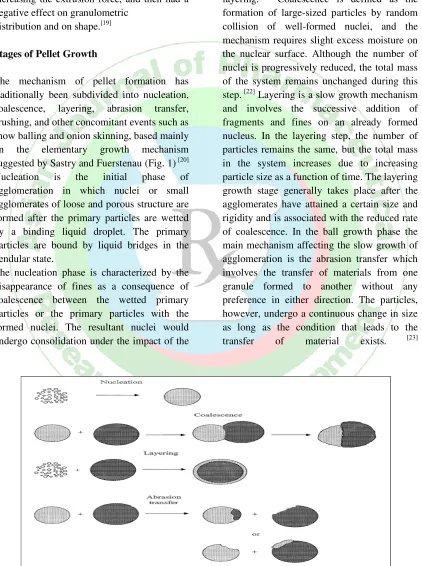
The mechanism of pellet formation has traditionally been subdivided into nucleation,
coalescence, layering, abrasion transfer,
crushing, and other concomitant events such as snow balling and onion skinning, based mainly
on the elementary growth mechanism
suggested by Sastry and Fuerstenau (Fig. 1) [20]
Nucleation is the initial phase of
agglomeration in which nuclei or small agglomerates of loose and porous structure are formed after the primary particles are wetted by a binding liquid droplet. The primary particles are bound by liquid bridges in the pendular state.
The nucleation phase is characterized by the disappearance of fines as a consequence of coalescence between the wetted primary particles or the primary particles with the formed nuclei. The resultant nuclei would undergo consolidation under the impact of the
externally applied mechanical forces and acquire sufficient strength to resist further breakdown by impact forces and will be able to grow into bigger agglomerates. Nucleation is followed by a transition phase for progression in the size of the formed nuclei, and the growth mechanisms affecting the
transition region are coalescence and
layering.[21] Coalescence is defined as the formation of large-sized particles by random collision of well-formed nuclei, and the mechanism requires slight excess moisture on the nuclear surface. Although the number of nuclei is progressively reduced, the total mass of the system remains unchanged during this step. [22] Layering is a slow growth mechanism and involves the successive addition of fragments and fines on an already formed nucleus. In the layering step, the number of particles remains the same, but the total mass in the system increases due to increasing particle size as a function of time. The layering growth stage generally takes place after the agglomerates have attained a certain size and rigidity and is associated with the reduced rate of coalescence. In the ball growth phase the main mechanism affecting the slow growth of agglomeration is the abrasion transfer which involves the transfer of materials from one granule formed to another without any preference in either direction. The particles, however, undergo a continuous change in size as long as the condition that leads to the
transfer of material exists. [23]
Methods of Pellet Preparation
The most commonly used and intensely investigated pelletization processes are powder layering, solution/suspension layering, and extrusion–spheronization. Other pelletization processes that either have limited application include spherical agglomeration or balling, spray congealing/ drying, and emerging technologies such as cryopelletization and melt spheronization.
Powder Layering:
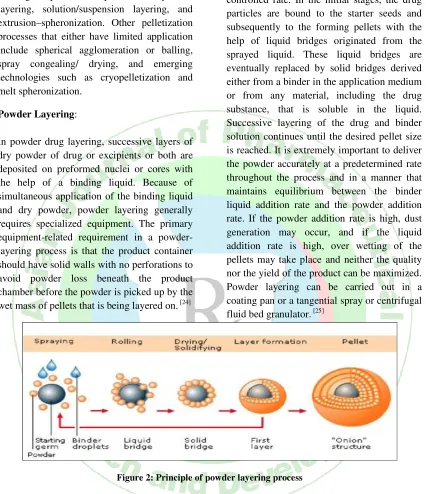
In powder drug layering, successive layers of dry powder of drug or excipients or both are deposited on preformed nuclei or cores with the help of a binding liquid. Because of simultaneous application of the binding liquid and dry powder, powder layering generally requires specialized equipment. The primary equipment-related requirement in a powder-layering process is that the product container should have solid walls with no perforations to avoid powder loss beneath the product chamber before the powder is picked up by the wet mass of pellets that is being layered on. [24]
During powder layering, a binding solution and a finely milled powder are added simultaneously to a bed of starter seeds at a controlled rate. In the initial stages, the drug particles are bound to the starter seeds and subsequently to the forming pellets with the help of liquid bridges originated from the sprayed liquid. These liquid bridges are eventually replaced by solid bridges derived either from a binder in the application medium or from any material, including the drug substance, that is soluble in the liquid. Successive layering of the drug and binder solution continues until the desired pellet size is reached. It is extremely important to deliver the powder accurately at a predetermined rate throughout the process and in a manner that maintains equilibrium between the binder liquid addition rate and the powder addition rate. If the powder addition rate is high, dust generation may occur, and if the liquid addition rate is high, over wetting of the pellets may take place and neither the quality nor the yield of the product can be maximized. Powder layering can be carried out in a coating pan or a tangential spray or centrifugal fluid bed granulator. [25]
Figure 2: Principle of powder layering process
Solution/Suspension Layering:
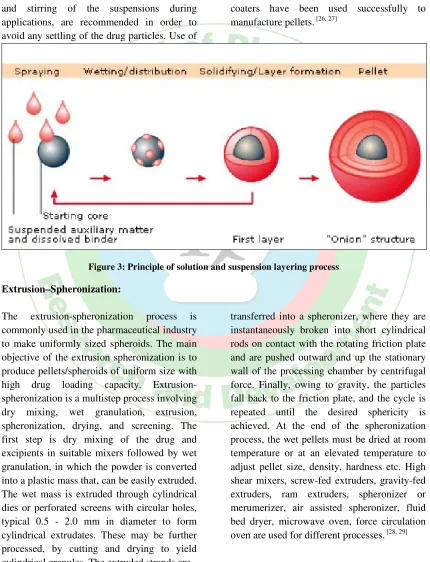
Solution/suspension layering involves the deposition of successive layers of solutions and/or suspensions of drug substances and binders on starter seeds, which may be inert materials or crystals/granules of the same drug.
During processing, all the components of the formulation are first dissolved or suspended in an appropriate quantity of application medium to provide a formulation with the desired
Ideally, no new nuclei are formed, and the
particle population remains the same;
however, the sizes of the pellets increase as a function of time, and as a result, the total mass of the system also increases. For suspension layering, particle size of the drug plays an important role. If the particle size is large, a higher quantity of binder may be necessary to ensure adherence of the drug particles on the pellet surfaces. Use of high viscosity binders and stirring of the suspensions during applications, are recommended in order to avoid any settling of the drug particles. Use of
very large particle may block the spraying gun or may settle in the tubing if the diameter of the tube is too large. For suspension layering process, the particle size of the API should be less than 10 - 50 µm. In principle, the factors that control coating processes apply to solution or suspension layering and, as a result, require basically the same processing equipment. Consequently, conventional coating pans, fluid bed centrifugal granulators, and wurster coaters have been used successfully to manufacture pellets. [26, 27]
Figure 3: Principle of solution and suspension layering process
Extrusion–Spheronization:
The extrusion-spheronization process is
commonly used in the pharmaceutical industry to make uniformly sized spheroids. The main objective of the extrusion spheronization is to produce pellets/spheroids of uniform size with high drug loading capacity. Extrusion-spheronization is a multistep process involving dry mixing, wet granulation, extrusion, spheronization, drying, and screening. The first step is dry mixing of the drug and excipients in suitable mixers followed by wet granulation, in which the powder is converted into a plastic mass that, can be easily extruded. The wet mass is extruded through cylindrical dies or perforated screens with circular holes, typical 0.5 - 2.0 mm in diameter to form cylindrical extrudates. These may be further processed, by cutting and drying to yield cylindrical granules. The extruded strands are
Figure 4: Schematic representation of Different pellets formation stages during spheronization
Hot Melt Extrusion:
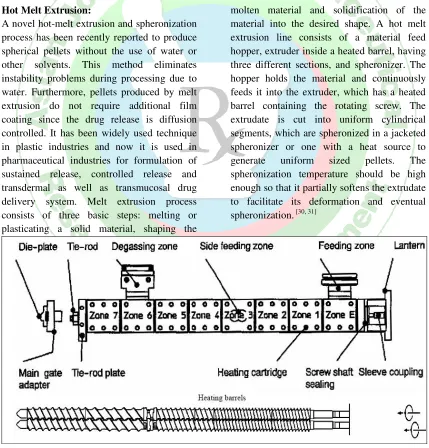
A novel hot-melt extrusion and spheronization process has been recently reported to produce spherical pellets without the use of water or other solvents. This method eliminates instability problems during processing due to water. Furthermore, pellets produced by melt extrusion do not require additional film coating since the drug release is diffusion controlled. It has been widely used technique in plastic industries and now it is used in pharmaceutical industries for formulation of sustained release, controlled release and transdermal as well as transmucosal drug delivery system. Melt extrusion process consists of three basic steps: melting or plasticating a solid material, shaping the
molten material and solidification of the material into the desired shape. A hot melt extrusion line consists of a material feed hopper, extruder inside a heated barrel, having three different sections, and spheronizer. The hopper holds the material and continuously feeds it into the extruder, which has a heated barrel containing the rotating screw. The extrudate is cut into uniform cylindrical segments, which are spheronized in a jacketed spheronizer or one with a heat source to
generate uniform sized pellets. The
spheronization temperature should be high enough so that it partially softens the extrudate to facilitate its deformation and eventual spheronization. [30, 31]
Spherical Agglomeration:
Spherical agglomeration, or balling, is a pelletization process in which powders, on addition of an appropriate quantity of liquid or when subjected to high temperatures, are converted to spherical particles by a continuous rolling or tumbling motion in pans, discs, drums or mixers.[32]
Cryopelletization:
Cryopelletization is a process whereby droplets of a liquid formulation are converted into solid spherical particles or pellets by using liquid nitrogen as the fixing medium. These pellets are then freeze dried or lyophilized to remove water or organic solvents. Solid content and temperature of the liquid formulation determine the amount of liquid nitrogen used in the whole process. This technology was first developed to lyophilize bacterial suspension in the nutrition industry and now a days it is used in the pharmaceutical industry to produce drug loaded pellets for immediate as well as controlled release formulations. [33]
Immediate release formulation typically
consists of drugs, fillers (lactose and mannitol) and binders (gelatin and PVP) while cross-linked polymers of collagen derivatives are used in the sustained release formulation. The equipment consists of a perforated plate below which a reservoir of liquid nitrogen having conveyer belt of varying speed with transport baffle is dipped. The varying speed of the conveyer belt can be adjusted to provide the residence time required for freezing the pellets. The frozen pellets are transported into storage container at-60°C before drying and are finally dried into the freeze dryer. Droplet formation is the most critical step in this technique and is influenced by formulation related variables, such as solid content, viscosity, surface tension, equipment design and process variables.
Spray Drying and Spray Congealing
Spray drying and spray congealing, known as globulation processes, involve atomization of hot melts, solutions, or suspensions to generate spherical particles or pellets. Spray drying is a
process in which, the drug entities in solution or suspension are sprayed, with or without excipients, into a hot air stream to generate dry and highly spherical particles. This process is commonly used for improving the dissolution rates, hence bioavailability of poorly soluble drugs.
Spray congealing is the process in which a drug is allowed to melt, disperse or dissolve in hot melts of gums, waxes or fatty acids, and is sprayed into an air chamber where the temperature is kept below the melting point of the formulation components, to produce spherical congealed pellets under appropriate processing conditions. [34]
Compression:
Compression is one type of compaction technique for preparing pellets. Pellets of definite sizes and shapes are prepared by compacting mixtures or blends of active ingredients and excipients under pressure. The formulation and process variables controlling the quality of pellets prepared are similar to those used in tablet manufacturing. [35]
Freeze Pelletization:
Freeze pelletization technique is a novel technique for producing spherical matrix pellets containing active ingredients. In this technique, a molten solid carrier along with a dispersed active ingredient is introduced as droplets into an inert and immiscible column of liquid. These droplets can move either in upward or downward directions, depending on their density with respect to the liquid in the column and solidify into spherical pellets. The technique involves less process variables and also offers several advantages over other pelletization methods, in terms of quality of pellets and process cost. The pellets produced by this technique are spherical in shape with narrow size distribution. Since the pellets are solid at room temperature, they do not require drying. [36, 37]
CHARACTERIZATION OF PELLETS
Particle size distribution should be as narrow as possible. That will ensure minimum variation in coating thickness; facilitate blending process if blending of different types of pellets is required. Sieve analysis using sieve shaker is the most widely used method for measuring particle size distribution. Microscopy is direct method for determining particle size distribution. Optical microscopy and scanning electron microscope are used to measure the diameter of pellets. Patappee.W. 2004 reported the use of vernier callipers to determine the size of pellets. [38, 39, 40]
Surface area
The characteristics of pellets, those controlling the surface area, are mainly size, shape, porosity and surface roughness. There are three methods of measuring the surface area of pellets. It can be calculated from the particle-size distribution by measuring/using the mean diameter, since the surface area is equal to
πd2. However, this calculation does not
account for the contributions of the surface
area arising from other morphologic
characteristics, such as porosity, surface roughness and shape of the pellets. Therefore, two techniques, i.e. gas adsorption and air permeability, permit direct calculation of surface area [39, 41].
Air permeability methods are widely used
pharmaceutically for specific surface
measurement, especially to control batch to batch variations. The principal resistance to the flow of a fluid - such as air-through a plug of compacted material is the surface area of the material. [38, 39, 40]
The gas adsorption method (commonly known as the BET method) was developed by Brunauer, Emmett and Teller (1937). In this method the volume of nitrogen that is absorbed by the substrate contained in an evacuated glass bulb is measured at different pressures, and the results are plotted as P/V (p0-p) versus p/p0 to generate a linear plot where V is the volume of gas in cm3 adsorbed per gram of substrate at pressure p and p0 is the saturation vapour pressure of liquefied nitrogen at the temperature of the experiment. The slope and intercept of the plot yield the values b and Vm. The specific surface (sw) of
the pellets is then obtained by using the following equation:
Porosity
The porosity of pellets influences the rate of release of drugs from the pellets by affecting the capillary action of the dissolved drug. The porosity of the pellets can be measured qualitatively by scanning electron microscopy
(SEM) and quantitatively by mercury
porosimetry. The porosity of pellets can be determined quantitatively also by using optical microscopy and scanning electron microscopy together with image. [38, 40, 42]
Density
The density of pellets can be affected by changes in the formulation and/or process, which may affects other processes or factors, such as capsule filling, coating, and mixing. The bulk density of the pellets can be measured by an automated tapper. True density indicates the extent of densification or compactness of substances. [38, 39]
Hardness and Friability
Hardness and friability determination of pellets is necessary because the pellets have to withstand during handling, shipping, storage and other processing such as coating. The instrument such as the Kaul pellet hardness tester provide relative harness values and friability of pellets are determined by using Erkewa type tablet friabilator or turbula mixer for a fixed period of time combined with glass beads of certain diameter in order to generate abrasion. Friability can also be determined using fluidized bed with Wurster insert by using stream of air. [39, 41, 43]
Tensile strength
The tensile strength of the pellets is determined by using tensile apparatus with a 5 kg load cell, the pellets are strained until failure occurs. The load is recorded and the
tensile strength is calculated applying the value for the failure load and the radius of the pellets. [39, 40]
Today pelletization technology represents an efficient pathway for manufacture of drug delivery system. This review focused on frequently used pelletization techniques for producing pellets for oral drug delivery. Each technique has its own advantages and disadvantages. Layering processes have been used over the years for manufacturing of pellets. Most of the scientists have focused research on refining and optimizing existing pelletization techniques and also focused on the development of novel approaches and
procedures of manufacturing pellets
employing innovative formulation and
processing equipment. These pelletization
techniques have great impact on the
development of different types novel drug delivery systems. A number of pelletized products are being designed to maximize the in vivo performance of medications already in the market and to meet all regulatory requirements.
CONCLUSION
In the later decades, pelletization has gained an increased interest, especially due to the possibilities to use pellets in the development of modified-release solid oral dosage forms. Currently there are several pelletization methods, the most widely used being extrusion
/ spheronization. Due to the good
technological, pharmacokinetic and
biopharmaceutical characteristics of the pellets and the flexibility of the manufacturing processes involved, pellets are expected to continue to play a major role in design and fabrication of solid dosage forms.
REFERENCES
1. Ansel CH, Poppovich NG, 1995. Pharmaceutical Dosage Forms and Drug Delivery Systems. New Delhi: B.I. Waverly Pvt.Ltd;; 6: 213.
2. Bianchini R, Bruni G, Gazzaniga A, Vecchio C, 1992. Influence of extrusion spheronization processing on the physical properties of dindobufen pellets containing pH adjusters. Drug Dev. Ind. Pharm; 18: 1485-1503.
3. Bodmeir R., 1997.Tabletting of coated pellets. Eur J Pharmaceut and Biopharmaceutics.; 43(1): 1-8.
4. Bornhoft M.,Thomames M.,Kleinibudde P. Preliminary assessmentof carrageenan as excipient for extrusion/spheronization. Eur. J. Pharm. Biopharm., 2005; 59:127-31.
5. Clarke GM, Newton JM, 1995.Comparative gastrointestinal transit of pellet systems of varying density. Int J Pharmaceut.; 114(1): 1-11.
6. Connor RE, Schwartz JB. Spheronization II. Drug release from drug diluentsmixtures. Drug Dev Ind Pharm. 1985; 11: 1837-57.
7. Digenis GA, 1994. The In Vivo behavior of multiparticulate versus single unit dosage formulations. Multipaticulate Oral Drug Delivery. Marcel Dekker: New York; Ghebre-Sellassie. I(ed.):; 333-55...
8. Evdokia S. korakianiti, Dimitrios MK, Paraskevas PD, and Nikolaos HC, 2000.Optimizationof the pellitization process in a Fluid-bed Rotor granulator using experimental design. Apps Pharm Sci Tech; 1(4): 71-5.
9. Extrusion-Spheronization (cited 2008 Dec 29);
Available from:
spheronizer.com/html/spheronization_stages.html. 10. Fielden, K.E., Newton, J.M.,Rowe, R.C. The
influence of moisture content on spheronization of extrudate processed by ram extruder. Int. J. Pharm., 1993; 97: 79-86.
11.Flament, M.P., Dupont, G., Leterme, P., Farah, N., Gayot, A. Development of 400 µm pellets by extrusion-spheronization. Application with Gelucire 50/02 to produce a sprinkle form. Drug Dev. Ind. Pharm., 2004; 30: 43-51.
12. Follonier N, Doelker E, 1992. Biopharmaceutical comparasion of oral multiple-unit and single unit sustained release dosage forms. STP Pharm Sci.; 2: 141-5.
13.Ghebre-Sellassie I, Knoch A. Pelletization techniques Encyclopedia of Pharmaceutical Technology. Informa Healthcare. 3rd ed: 2002.
14.Harrison, P.J., Newton, J.M., Rowe, R.C. The application of capillary rheometry to the extrusion of wet powder masses Int. J. Pharm., 1987; 35: 235-42. 15.Millili, G.P., Schwartz, J.B. The strength of
microcrystalline cellulose pellets: The effect of granulating with water/ethanol mixtures. Drug Dev. Ind. Pharm., 1990; 16:1411-26.
16.Indian Pharmacopiea 2007, volume I.
17.Johansson B, Alderborn G. Degree of pellet deformation during compaction and its relationship to the tensile strength of tablets formed of microcrystalline cellulose pellets. Int J Pharmaceut. 1996; 132(1-2): 207-220.
18.Johansson B, Nicklasson F, Alderborn G. Effect of pellet size on degree of deformation and densification during compression and on compactability of microcrystalline cellulose pellets. Int J Pharmaceut. 1998; 163(1-2): 35-48
19.Rahman.A.M.,Ahuja.A.,Baboota.S.,Bhavna.
Bali.V.,Saigal.N., and Ali.J. Recent Advances in Pelletization Technique for Oral Drug Delivery:A Review. Current Drug Delivery, 2009; 6(1):122-129. 20.Sastry KVS, Fuerstenau DW. Mechanisms of
agglomerate growth in green pelletization. Powder Technol. 1973; 7: 97-105.
21.Schæfer T. Growth mechanisms in melt agglomeration in high shear mixers. Powder Technol. 2001; 117: 68-82.
22.Ennis BJ, Tardos G, Pfeffer R. A microlevel-based characterization of granulation phenomena. Powder Technol. 1991; 65: 257-72.
Delivery System : Pellets and pelletization technique. Drug Invention Today, 2010; 2(5): 233-7.
24.Jan S, Goodhart FW. Dry powder layering. In: Pharmaceutical pelletization technology. Ghebre-Sellassie. Ist Ed. Marcel Dekker, Inc. New York; 1989: 182-3.
25.Jackson IM, Roberts S, Timmins P, Sen H. Comparison of laboratory scale processing in the production of coated pellets. Pharm Technol Int. 1989, 1: 29-32.
26.Jones DM, Solution and suspension layering. In: Pharmaceutical pelletization technology. Ghebre-Sellassie, Ist Ed. Marcel Dekker, Inc.: New York; 1989: 158-9.
27.14. Petersen FJ, Worts O, Schaefer T, Sojka PE. Effervescent atomization of aqueous polymer solutions and dispersions. Pharm Dev Technol. 2001; 6: 201-10.
28.Hicks DC, Freese HL. Extrusion Spheronization Equipment. In: Ghebre I, Sellassie A, editors. Pharmaceutical Pelletization Technology. Ist Ed. Marcel Dekker, Inc.: New York; 1989: 71-100. 29.Shyamala B, Lakshmi PK. Extrusion spheronization –
A review. Int J Pharm Tech Res. 2010; 2(4): 2429-33.
30.Jogad NP. A Review: MUPS by Extrusion spheronization technique. J Pharm Res. 2010; 3(8): 1793-7.
31.Aitken C, Zheng F, McGinity JW. Hot-melt extrusion of acrylic films. Pharm Res. 1996; 13: 804.
32.Kleinebuddle P. Crystallite gel model for microcrystalline cellulose in wet granulation, extrusion and spheronization. Pharm Res. 1997; 14: 804-9.
33.Knoch, A. Cryopelletization. In: Multiparticulate Oral Drug Delivery. Ghebre-Sellassie, Ist Ed. Marcel Dekker, Inc.: New York; 1994: 35-50.
34.Turkan E, Speiser P, Hincal A. Optimization of spray dried and congealed lipid micropellets and characterization of their surface morphology by scanning electron microscopy. Pharm Res. 1991; 8(1): 47-54.
35.Kader A, Jalil R. In vitro release of theophylline from poly (lactic acid) sustained-release pellets prepared by direct compression. Drug Dev Ind Pharm. 1998; 24(6): 527-34.
36.Cheboyina S, Wyandt CM. Wax-based sustained release matrix pellets prepared by a novel freeze pelletization technique. I. Formulation and process variables affecting pellet characteristics. Int J Pharm. 2008; 359: 158-66.
37.Cheboyina S, Wyandt CM. Wax-based sustained release matrix pellets prepared by a novel freeze pelletization technique. II. In vitro drug release studies and release mechanisms. Int J Pharm. 2008; 359: 167-73.
38.Gamlen MJ. Pellet manufacture for controlled release. Manuf Chem 1985; 56: 55-59.
39.Devices GSI. Pharmaceutical Pelletization Technology. Vol. 37. Marcel Dekker Inc.; 1989, pp. 30-100.
40.Reynolds AD. A new technique for the production of spherical particles. Manuf Chem 1970; 6: 39-43. 41.Fielden KE, Newton JM, Rowe RC. The influence of
lactose particle size on spheronization of extrudate processed by a ram extruder. Int J Pharm 1992; 81: 205-12.
42.Vertommen J, Kinget R. The influence of five selected processing and formulation variables on the particle size, particle size distribution, and friability of pellets produced in a rotary processor. Drug Dev Ind Pharm 1997; 23: 39-46.